
NATURE WRITING: A NATIVE PARK
This is not the wilderness. The crisp leaves rattle overhead as squirrels jump from branch to branch. The wind and sun alike are filtered through the dry, prickly foliage causing the reflective leaves to sparkle like the ruffled surface of a lake. Spiderwebs catch the westering light, near invisible threads stretching seemingly to nowhere. It is here that I encounter my subject, the tree who will be my emissary of Nature, a representative on behalf of landscape, ecosystem, Earth: Quercus chrysolepus, the canyon live oak, one of many oak species native to the California climate. I cannot presume to know this tree, but I will attempt to inquire, to observe, to learn, perhaps to better understand the land that generated us both.
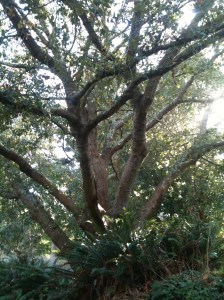 This oak is not in the wilderness. We have both grown up in the city of San Francisco. This particular Quercus lives within the Botanical Gardens of Golden Gate Park, in the California Native Plant section. It lives in an enclosed space surrounded by a human constructed city, a place that is artificial yet natural at the same time. This park is tended and cared for by human hands, not for food, clothing, or shelter, but as a place of beauty. This tree is not growing in the wilderness, but it is still a tree, it is still nature. Perhaps it is better to conduct this inquiry within the bounds of a city park, a place where human and non-human ecosystems coincide, where boundaries are less clear and the symbiotic role of the human in these micro-ecosystems is more apparent than in the places that have been designated pristine wilderness.
The live oak I sit beneath is several feet wide at the base of its trunk with seven thick boughs extending radially outward, branching again and again until they end in thin twigs clothed in the distinctively pointed, dull green leaves that characterize California’s oaks. Many brown leaves litter the wide, mossy paving stones and the small, fern-covered slope beneath its spreading branches. It is a chilly November day, and both the fallen leaves and the temperature bring to mind that autumn is well underway. The rough, cracked bark of the ochre branches are spotted with sea-foam green lichen. Toward the base of the trunk, nailed into the wood, hangs a small, black, metal sign printed with the words: Fagaceae, Quercus chrysolepus, Canyon Live Oak, Western North America.
Spreading out around the oak is a gardened landscape containing many of California’s native plant species. Within the enclosure of this park is likely a better representation of the plant species growing on the West Coast of North America before European settlement than anywhere else in California. It is a reproduction and preservation of the past, guarded and tended to remain in such a state. Paths wind between dense clusters of chaparral—which means “short, woody vegetation” in Spanish—that are comprised of manzanita, buck brush, chamise, nude buckwheat, scrub oak, mountain mahogany, toyon, California coffeeberry, and silk tassel bush. Around and beneath the denser patches of chaparral are herbs and flowers: matilija poppies, red maids, farewell-to-spring, melic grass, gilia, chia, and clover.[1] Although the composition of the plants reflects an ecosystem prior to European contact, the contemporary common names clearly do not.
Timothy Morton writes in his book Ecology Without Nature that “We discover how nature always slips out of reach in the very act of grasping it.”[2] As I sit beneath this live oak tree writing of the play of golden light across the waxy leaves of the chaparral, I am actually distancing myself from nature. The more I describe the landscape, the deeper I go into the writing and the further I depart from where I am situated in this moment.[3] Nature slips away as it is turned into written words, making what is tangible and alive transform into a piece of art, something that is no longer nature. This paradox may be worth keeping in mind as I enquire further into the nature of nature, the nature of the human being, and the boundaries that may or may not exist between us.
I have titled this essay “The Great Mosaic” for several reasons: the name refers to the diverse ecological microclimates of the landmass named California, as well as to the mosaics created by symbiotic human interaction with that landscape; but it also refers to the method of writing I am exploring in this piece. I will attempt to create a mosaic of language, forming puzzle pieces of nature writing, scientific and ecological study, and philosophical and historical inquiry that will fit together with the same diversity, incongruity, and complexity as the landscapes that inspired these words.
A DUALISTIC WORLD VIEW
It is becoming increasingly evident that human beings are rampantly destroying the ecosystems of the Earth. A primary reason for such destruction seems to be part of the Western world view as developed and inherited from the European tradition: a perceived dualism between the human and all other non-human entities, the latter often termed nature. If one is to address this dualism one needs to understand not only how it came to be, but also why it is a problem. Many, although certainly not all, environmentalists work on behalf of nature without actually addressing the underlying foundations of why they do their work, acting from a sense of reverence and love for an intrinsically valuable and good environment that must be saved from the marring touch of human hands. For this kind of environmentalist, the environment is defined as “that form of nature that is vulnerable to human-made devastation and disaster.”[4] The work such environmentalists do should not in any way be disregarded or dismissed. It is important work not to be taken lightly or for granted. What I hope to address is the world view behind their actions. Their work may ultimately be futile unless we can have a clearer understanding of the role of the human being, not as an alien destroyer of the natural world, but as a fundamental part of Earth’s ecosystems, a species that shapes and inhabits its ecological niche like all other species.
WITHOUT WILDERNESS, WITHOUT NATURE
“Scientific findings indicate that virtually every part of the globe, from the boreal forests to the humid tropics, has been inhabited, modified, or managed throughout our human past.”[5] As is clear in this quote from Arturo Gomez-Pompa and Andrea Kaus’s article “Taming the Wilderness Myth,” the idea of wilderness as a pristine, untouched landscape is increasingly being exposed—through the writings of William Cronon, M. Kat Anderson, Anna Lowenhaupt Tsing, James Fairhead, Melissa Leach, and many others—as an idealized myth of the Western psyche. Timothy Morton takes this perspective a step further by calling for not only a human practice of ecology without the idea of wilderness, but without even the concept of nature. The idea of nature will have to “wither away” for an “ecological” human state to be able to exist.[6] He writes that “in all its confusing, ideological intensity, nature ironically impedes a proper relationship with the earth and its life-forms, which would, of course, include ethics and science.”[7]
Cronon writes in his essay “The Trouble With Wilderness” that wilderness does not exist apart from the human, it is rather an entirely human construction.
Far from being the one place on earth that stands apart from humanity, it is quite profoundly a human creation—indeed, the creation of very particular human cultures at very particular moments in human history. It is not a pristine sanctuary where the last remnant of an untouched, endangered, but still transcendent nature can for at least a little while longer be encountered without the contaminating taint of civilization. Instead, it’s a product of that civilization, and could hardly be contaminated by the very stuff of which it is made.[8]
This is not to say that the land itself is shaped exclusively by human hands—indeed, quite the contrary—but rather that the human is a species interacting with the natural environment in ways that shape it like every other species that participates with that land.
CALIFORNIA AND ITS OAKS
The landscapes of California provide a clear example of ecosystems that have been preserved under the guise of untouched wilderness in some of the world’s most famous and majestic national parks. Far from being untouched, however, these ecosystems were formed in relationship to human inhabitants over thousands of years, and some species may even have become dependent on a symbiotic relationship with humans. Therefore, I will be concentrating specifically on the various oak species indigenous to California, to understand the role they play in their ecosystems, their relationships to humans, as well as to ecosystem disturbance, to fire, and to the virulent pathogen that causes sudden oak death which is now devastating oak populations across the state.
California is a richly diverse landscape supporting between 5,800 and 6,300 plant species that grow in a wide variety of ecosystem communities, making it one of the world’s greatest biodiversity hotspots.[9] California’s microclimates range from deserts to salt and freshwater marshes, coastal prairie, valley grasslands, shrublands, riparian and foothill woodlands, and coastal redwood, lower montane, and evergreen forests.[10] The state has been called by some “the great mosaic.”[11] The wealth of species diversity can be seen in the example of the coastal prairie grassland, in which the average of 22.6 plant species per square meter is higher than in any other grassland in the North America.[12]
There are nine major kinds of chaparral ecosystem in California, each defined by the dominant species in its community. The variety I was observing in San Francisco’s Botanical Gardens was the ceanothus chaparral, characterized by its abundance of buck brush (Ceanothus cuneatus).[13] Different oak species grow among this kind of chaparral, predominantly scrub oak (Quercus dumosa), a shorter, more shrub-like oak than the Quercus chrysolepus under which I was sitting.[14] Unlike the scrub oaks, canyon live oaks grow primarily in California’s moist ravines and canyons and can live to be three hundred years old. Foothill woodland ecosystems, which cover some three million acres of California land, are dominated by oak species. In the drier inland regions the endemic blue oak (Quercus douglasii) grows in stands from the Sacramento Valley to Los Angeles County. Often the blue oak grows in mixed stands along with valley oak (Quercus lobata), interior live oak (Quercus wislizenii), coastal live oak (Quercus agrifolia), and gray and foothill pine (Pinus sabiniana); blue oak also grows among chaparral species and even in pure stands solely comprised of Quercus douglasii.[15]
The largest species of California oak are the valley oaks, christened “monarchs of the soil” because of their enormous size. Their shade provides a nourishing microclimate rich with a diversity of understory species.[16] In the northern coastal regions of California the dominant oak species are California black oak and Oregon oak; further south coastal live oaks are the dominant species. Unlike the valley oak, live oaks have little to no undergrowth, giving their stands the look of well-tended parks.[17] Indeed, California has been compared not only to a park but also to a flower garden, or as John Muir named it “the Pacific land of flowers.”[18] While this concept of California as a park or garden may have seemed unusual to arriving Europeans who believed they were entering a pristine wilderness area, it actually was the case that they were entering a garden of sorts, a landscape that had been developing in symbiosis with the hundreds of indigenous tribes living in the area over the previous 12,000 to 13,500 years.[19]
THE WILD GARDEN
No country in the world was as well supplied by Nature, with food for man, as California, when first discovered by the Spaniards. Every one of its early visitors have left records to this effect—they all found its hills, valleys and plains filled with elk, deer, hares, rabbits, quail, and other animals fit for food; its rivers and lakes swarming with salmon, trout, and other fish, their beds and banks covered with mussels, clams, and other edible mollusca; the rocks on its sea shores crowded with seal and otter; and its forests full of trees and plants, bearing acorns, nuts, seeds and berries.[20]
This evocative excerpt from Titus Fey Cronise’s book The Natural Wealth of California, published in 1868, provides a delectable image of a veritable Garden of Eden ripe for the taking. Yet Cronise makes no mention of the thousands of people whose lifestyles were thoroughly integrated into this wealthy landscape, who had coaxed forth such abundance through cultural practices that cultivated the land not as an intensive farm but as an extended wild garden.
California’s high species diversity was matched by its diversity of indigenous peoples. Indeed, Fikret Berkes has written of correlations worldwide between cultural diversity and biodiversity, likely caused by human “disturbance” and rotational use of the land.[21] Some 500 to 600 tribes lived in California, with each tribe spread over multiple villages.[22] Estimates of California’s indigenous human population at the time of European contact ranges from 133,000 to 705,000 people, with the most widely accepted estimate at around 310,000.[23] The tribes that lived in what is now the San Francisco Bay Area, where I was sitting beneath the canyon live oak, were the Ohlone, Coast Miwok, and Pomo, among others.
Juan José Warner, a European traveler in the San Joaquin Valley in the 1830s, noted with some wonder that such large indigenous populations could thrive on land that was apparently not cultivated.[24] Yet what he did not see were the subsistence activities carried out by these different tribes that were a form of cultivation and conservation, a coaxing of abundance from the natural processes of the land. Native Californians gathered, hunted, fished, and quarried stone for tools.[25] The acorns of the canyon live oak were used by the Pomo to relieve coughs and sore throats. The oak stands and prairies provided ingredients for acorn bread, wild grass seed cakes, and a variety of edible bulbs. Indigenous peoples lit fires on the land that could burn through chaparral and other woody vegetation to open up pathways and restart the cycle of regenerative plant growth that provides new vegetable matter and attracts grazing herds.[26] Fire is critical to the California landscape and many plant species have developed both a resistance and dependence on it for their lifecycles to continue. The same acre of land burned about once every ten to fifteen years before European contact, and fire has been crucial in shaping at least three quarters of California’s flora.[27]
CREATIVE DESTRUCTION: FIRE AND DISEASE
Ecosystem resilience is defined as how much disturbance a system can take before it is fundamentally altered and becomes a new kind of ecosystem.[28] The four stages of ecosystem recovery after disturbance begin with the reorganization phase, in which the ecosystem is renewed, seeds open and begin to germinate; followed by the exploitative phase, in which pioneer species compete and colonize the landscape with rapid plant growth; the next is the conservation phase, during which growth slows and larger, perennial species dominate; the fourth phase is ecological disturbance, or the creative destruction phase, which begins the cycle anew. It is the phase of creative destruction that is activated by such activities as routine burning of the land. Such a disturbance releases what Lance Gunderson calls “accumulated ecological capital,” such as nutrients and dormant seeds, that can now germinate and grow into new plants.[29]
Another type of ecosystem disturbance can come in the form of insect or pathogen invasion.[30] Like fire, insects and pathogens can lead to a creative destruction phase but, also like a fire that burns too hot or for too long, such invasions can cause irreparable damage, pushing an ecosystem to the brink of collapse. An example of such an invasive pathogen is Phytophthora ramorum, which has been the cause of sudden oak death for thousands of oaks across California and Oregon. Thus far it is unknown which stands of oak trees will be infected or exactly how the disease is spread, but research has been conducted to locate the most susceptible parts of oak forests. The species of oak that have been most devastated are coastal live oaks (Quercus agrifoli), black oaks (Quercus kelloggi), and tanoaks (Lithocarpus densifloru).[31] It appears that the trees at highest risk for infection are those at the edge of forest clusters, those growing near stands of bay laurels, and also those in close proximity to hiking and biking trails.[32]
The pathogen can colonize several other species of plant without actually killing them, such as the California rhododendron, huckleberry, madrone, California buckeye, big leaf maple, and manzanita.[33] Many of these species grow in the understory of oak stands and only carry the pathogen on their leaves while the main stem of the plants remain uninfected. The disease can pass easily from this understory foliage to their terminal hosts, the oaks, during rain and wind storms.[34] Mortality of oaks is highest at the edge of forest stands where the presence of pathogen-colonized undergrowth is most prevalent.[35]
Lee Klinger, a scientist who has closely studied sudden oak death, has found a correlation between abundance of moss and lichens on oaks and diseased and weakened trees. The mosses and lichens contribute to acidification of the soil, which is detrimental to the health of the trees and often kills their fine root systems.[36] Klinger suggests that the compromised health of the oaks, due to acidification and lichen growth, are making the trees more susceptible to Phytophthora ramorum, aiding the spread of sudden oak death.
Studies conducted on sudden oak death throughout Northern California have indicated that Phytophthora ramorum infecting oaks is far less prevalent in areas that have been recently burned.[37] Interestingly, the presence of lichens and mosses are also greatly reduced in frequently burned forest stands.[38] Although three quarters of California’s vegetation, including oaks, are fire-adapted species, the frequency of fire is dramatically different than during the time before European settlement. The U.S. Forest Service suppresses most forest fires, and as a result large quantities of undergrowth and lichens can build up that once were regularly burned away. It is quite likely that fire suppression has played a major role in the spread of sudden oak death.
Many of the indigenous tribes of California had symbiotic relationships with the oak trees growing near them. They often tended to the trees by burning brush and undergrowth from beneath the oak, thus improving the fertility of the soil and suppressing pests or diseases that might be detrimental. The soil fertility was also enhanced through working seashell and bone fragments into the soil, and mulching with seaweed.[39] Klinger writes,
In my holistic view, the problem of sudden oak death is ultimately related to the profound ecological shift of the oak forests in California brought about by a fundamental change in management practices associated with white settlement of the lands. The oak forests that, for centuries, were tended by native people were suddenly abandoned.[40]
Klinger treats oak trees today with a holistic medicinal approach which aims not to treat sudden oak death, or eradicate Phytophthora ramorum, but to support the trees’ health so they are more resistant to pathogens.[41] He scrubs the moss and lichens from the trees to reduce acidification, then fertilizes the soil surrounding the oaks, essentially mimicking the effects of fire.[42] He is stepping in to fulfill an ecological niche critical to California’s oak-dominant landscapes that was once filled by a species often not considered to be an integral part of nature: the human being.
THE SUBLIME AND THE FRONTIER
Over a relatively brief period of time touching three centuries from the 18th to the 20th, the concept of wilderness shifted from a place of evil and desolation to the sublime cathedral of pristine perfection wrought by the hand of God. Romanticism and the Enlightenment were the two primary catalysts of this profound shift. Before this transformative period, as Cronon writes, “To be a wilderness then was to be ‘deserted,’ ‘savage,’ ‘desolate,’ ‘barren’—in short, a ‘waste,’ the word’s nearest synonym.”[43] Yet by the year 1862 Henry David Thoreau would be declaring “In Wildness is the preservation of the World,”[44] and just seven years later John Muir, upon his arrival in the Sierra Nevada Mountains, said “No description of Heaven that I have ever heard or read of seems half so fine.”[45]
The two sources that led to such a reverence for the concept of pristine, wild nature, according to Cronon, were the ideas of the Sublime, and of the Frontier. The Sublime comes to us through European Romanticism, whereas the Frontier is truly a concept of Americanism.[46] Cronon writes,
Indeed, it is not too much to say that the modern environmental movement is itself a grandchild of Romanticism and post-frontier ideology, which is why it is no accident that so much environmentalist discourse takes its bearings from the wilderness these intellectual movements helped create.[47]
Romantic thought is what birthed the concept of Nature that Morton finds so problematic. “The ‘thing’ we call nature becomes, in the Romantic period and afterward, a way of healing what modern society has damaged.”[48]
In both contrast and complement to Morton, Berkes traces the origins of the concept of nature, as an external environment, to post-Enlightenment thought and the Cartesian dualism of mind and body, spirit and matter, man and nature (I use the term “man” instead of the gender-inclusive “human” here purposefully).[49] Thoreau wrote a beautiful passage in The Maine Woods which captures both this Romantic notion of sublime awe and the Enlightenment dualism of man and nature:
It is difficult to conceive of a region uninhabited by man. We habitually presume his presence and influence everywhere. And yet we have not seen pure Nature, unless we have seen her thus vast and drear and inhuman, though in the midst of cities. Nature was here something savage and awful, though beautiful. I looked with awe at the ground I trod on, to see what the Powers had made there… It was the fresh and natural surface of the planet Earth, as it was made forever and ever,—to be a dwelling of man, we say,—so Nature made it, and man may use it if he can. Man was not to be associated with it. (My italics.) [50]
Nature, for Thoreau, is a place of sublime, terrifying beauty. It is a place where spirit and matter are able to be conjoined, an overcoming of the Cartesian dualism, but it can only be so if nature does not include the human. Nature is, as Morton writes, “a transcendental term in a material mask.”[51] The grand cathedrals of the natural world, for the Romantics and American conservationists, were places where the lone individual might have the chance to encounter the might of God.[52] This is, of course, not an experience unique to Euro-Americans; for example, the indigenous tribes living near the Arctic glaciers understood that the glaciers had a powerful sentience and would respond to human behavior.[53] The sacred in nature is certainly not isolated to the European tradition. However, it seems the idea of an untouched sacred wilderness, with a complete lack of human presence, is less common worldwide.
Morton makes a strong case against revering such a conception of Nature: “Putting something called Nature on a pedestal and admiring it from afar does for the environment what patriarchy does for the figure of Woman.”[54] He is clear though that he is not advocating for no environmentalism—or what he prefers to call “ecology” as this term encompasses so much more—but rather he is suggesting an “ecology to come,” an ecology of the future.[55] Many environmentalists are trying to preserve what they see as pristine wilderness, particularly places of supreme natural beauty or biodiversity.[56] But the problem with privileging such sublime locations of grandeur is that we choose to value some parts of the Earth over other, perhaps more humble, places, or endangered species over more “common” plants and animals.[57] New dualisms are created between wilderness and the garden, the park, or even our human dwellings.
The other source of the American notion of wilderness, besides the Romantic Sublime, is the American Frontier. As Euro-American settlers moved ever westward across the North American continent the idea of the frontier became a way to reconnect with one’s primitive origins, to experience what it meant to be a true American. As settlers reached the West Coast they shared a sense of loss, a lament for the “free land” that had been available to them.[58] But this is the heart of the problem of wilderness, or nature, and of the frontier: there never was free land. This land had been occupied and shaped by and with the thousands of tribes that had been living here for millennia.
AN EMPTIED WILDERNESS
Both the movement of the frontier and the movement to preserve national parks were, and still are, acts of violence against the indigenous people who belonged to this land. As national parks were emptied of their inhabitants it created the illusion for tourists that they were visiting, “raw nature,”[59] land as fresh and pristine as God first created it.[60] Activities that helped shape the land and ecosystems, such as hunting, gathering, and burning, have been made illegal in many, although not all, parks, and are now labeled arson and poaching.[61] The 1964 U.S. Wilderness Act defines wilderness as a place “where man himself is a visitor who does not remain.”[62] Cronon points out that the ideal of a natural landscape unworked by human hands can only be the fantasy of those who have never had to make their living from the land.
Only people whose relation to the land was already alienated could hold up wilderness as a model for human life in nature, for the Romantic ideology of wilderness leaves precisely nowhere for human beings actually to make their living from the land… If we allow ourselves to believe that nature, to be true, must also be wild, then our very presence in nature represents its fall. The place where we are is the place where nature is not.[63]
Wilderness, from such a perspective, is imagined to be an escape from history, from our human past.[64] We can enter the wilderness and leave behind our personal and collective histories, forgetting the violences committed so no trace might be left of the human being on these isolated preservations of nature. Yet any study of environmental history, which is an emerging branch of ecology, will show how human interaction has shaped nearly every landscape on Earth.[65]
Forests worldwide that were once thought to be pristine, for example, are actually the result of ecosystem resilience developed directly through human disturbance over thousands of years.[66] Forest islands amid the African savanna, once thought be the remains of an original primal forest, are now understood to have been brought forth from the grasslands and maintained through human care and nourishment.[67] By studying the environmental history of the landscape, Fairhead and Leach were able to see how the distribution of these forest islands follow the distribution of past and present village settlements.[68] Human interaction and engagement with the landscape in ways that are integrative and not domineering, have been shown in numerous cases to increase biodiversity and maintain resilient ecosystems.[69] A different example of this comes from India, where grazing water buffalo in Keoladeo maintained the biodiverse wetlands that otherwise would secede to less abundant grasslands.[70] Ecosystem resilience is defined by a system’s keystone species; perhaps the human is also a keystone species in many landscapes, able to build resilience and diversity if we can keep our own activities in check, within a threshold of sustainability.[71]
KEEPING THE LAND
The indigenous cultures that were able to cultivate such abundance in relationship to the California landscape over 13,000 years developed many social and cultural narratives, guidelines, and taboos for engaging with the land. Common terms used for this engagement have been “keeping the land,” “caring for the country,” or “taking care of the land.”[72] As Berkes defines it, tradition ecological knowledge is about moral and ethical human-ecological relations.[73] Cruikshank writes, “Narratives underscore the social content of the world and the importance of taking personal responsibility for changes in that world.”[74] This is a great contrast to the notion of pristine wilderness erased of any signs of our human past. In indigenous California nearly every place was named, even seemingly unimportant locations, usually for the subsistence activity carried out there.[75] The landscape was more than just a container for human knowledge though; it carries the memories of all past events, it is a mnemonic of social relations and responsibility.[76] The poet Gary Snyder writes, “In the old ways, flora and fauna and landforms are part of the culture.”[77]
Of course, being part of an indigenous culture, or possessing the knowledge of such a culture, is no guarantee that one will have a sustainable relationship with the Earth.[78] Not all indigenous cultures have consistently treated the land they live on well, and many examples exist of those who failed or did not survive.[79] But this does not mean there are not powerful lessons to learn from many of these cultural groups. It is true that the Earth must be conserved from the ravages of industrialism and greed, but not by the violent methods used to preserve the national parks of the United States. Such preservation is a form of embalming, a moment frozen in time, an erasure of the dynamic life forces that allow the Earth to be resilient and regenerative. It is a slow but eventual death knell, a false tilling of the soil to preserve a moment long gone, that does not allow new birth to take place. If the planet is divided solely into wild places and places domesticated for development neither will truly flourish to their full potential. Engagement of all species is required. If land is to be conserved, the human beings who shaped that ecosystem should be treated as a continual, integral part of that landscape as well.[80]
In her book Friction, Anna Lowenhaupt Tsing writes of “anthropogenic” landscapes, landscapes that are co-created with their human inhabitants, forming places that are neither domesticated nor wild.[81] For true conservation of the Earth, a form of conservation that includes human beings, to flourish it must rise up in the gaps, between the dualism of nature and human, like an acorn buried beneath a concrete sidewalk that eventually pushes up between the seemingly impenetrable slabs on either side. But the tender shoot will grow strong in its liminal space, forging a new path where none seemed to exist before, eventually emerging as a sturdy, powerful oak tree.
SOLSTICE OAK
The leaves whisper, drier even than when I first sat beneath this tree in mid-autumn. Winter has nearly set in; the branches are cold to the touch. The tree has changed little itself during this shift of the seasons, only its leaves have faded from dusty green to a crunchy brown. Yet I see this canyon live oak with new eyes now. Are the mosses and lichens growing up its branches weakening its health? Ferns grow right up to the base of the tree, and I know no fire will sweep through this park to clear the underbrush.
As I gaze west through the branches the sunlight streams through with the rich, deep golden glow so characteristic of the days around the winter solstice. In between the branches pale, white-winged insects flutter, their wings like an ethereal gauze in the sunset. There is no denying that the scene is magical. This sense of ecological wonder is a form of magic created between the human being and all other species we humble ourselves to approach in communion. The magic of this moment is one ignited specifically between myself, the dancing insects, and this truly majestic oak tree.
As I walk away from the oak, meandering through the winding paths in between the chaparral, I realize that this particular canyon live oak has something that many oaks in California once had, but no longer do. It has human caretakers, caretakers who will clear the underbrush and mosses away by hand, and who will nourish the soil so that the oak remains healthy. This oak is neither domesticated nor wild, but growing in the gap, the liminal space of a human-shaped park, thriving between the streets of San Francisco.
BIBLIOGRAPHY
Anderson, M. Kat. Tending the Wild: Native American Knowledge and the Management of California’s Natural Resources. Berkeley, CA: University of California Press, 2005.
Berkes, Fikret. Sacred Ecology. New York, NY: Routledge. 2012.
Cronon, William. “The Trouble with Wilderness; or, Getting Back to the Wrong Nature.” In Uncommon Ground: Rethinking the Human Place in Nature, edited by William Cronon, 69-90. New York, NY: W.W. Norton & Co, 1995. Accessed November 12, 2012. http://www.williamcronon.net/writing/Cronon_Trouble_with_Wilderness_1995.pdf
Cruikshank, Julie. “Glaciers and Climate Change: Perspectives from Oral Tradition.” Arctic 54 No. 4 (2001): 377-393.
Fairhead, James and Melissa Leach. Misreading the African Landscape: Society and Ecology in a Forest-Savanna Mosaic. Cambridge, England: Cambridge University Press, 1996.
Gomez-Pompa, Arturo and Andrea Kaus. “Taming the Wilderness Myth.” BioScience. 42 No. 4 (1992): 271-279. Accessed November 13, 2012. http://campus.greenmtn.edu/faculty/gregbrown/NRM3061/biosciencearticle.pdf
Gunderson, Lance H. “Ecological Resilience—In Theory and Application.” Annual Review of Ecology, Evolution and Systematics 31 (2000): 425-439.
Kelly, Maggi and Ross K. Meentemeyer. “Landscape Dynamics of the Spread of Sudden Oak Death.” Photogrammetric Engineering & Remote Sensing. 68 No. 10 (2002): 1001-1009. Accessed October 16, 2012.http://www.asprs.org/a/publications/pers/2002journal/october/2002_oct_1001-1009.pdf
Klinger, Lee F. “A Holistic Approach to Mitigating Pathogenic Effects on Trees.” Paper presented at the Treework Environmental Practice Seminar XII, Trees, Roots, Fungi, Soil: Below-ground Ecosystem & Implications for Tree Health, at the Natural Museum Cardiff, Cardiff, UK, November, 13, 2008. Accessed December 18, 2012. http://suddenoaklifeorg.files.wordpress.com/2009/07/tep-paper-final.pdf
Moritz, Max A. and Dennis C. Odion. “Examining the Relationship Between Fire History and Sudden Oak Death Patterns: A Case Study in Sonoma County.” Paper presented at the Sudden Oak Death Second Science Symposium: The State of Our Knowledge, Monterey, California, January 18-21, 2005. Accessed December 18, 2012. http://suddenoaklifeorg.files.wordpress.com/2009/04/psw_gtr196_004_037moritz.pdf
Morton, Timothy. Ecology Without Nature: Rethinking Environmental Aesthetics. Cambridge, MA: Harvard University Press, 2009.
Thoreau, Henry David. The Maine Woods. Harmondsworth, England: Penguin, 1988.
Tsing, Anna Lowenhaupt. Friction. Princeton, NJ: Princeton University Press, 2005.
[1] M. Kat Anderson, Tending the Wild: Native American Knowledge and the Management of California’s Natural Resources (Berkeley, CA: University of California Press, 2005), 30.
[2] Timothy Morton, Ecology Without Nature: Rethinking Environmental Aesthetics (Cambridge, MA: Harvard University Press, 2009), 19.
[3] Morton, Ecology Without Nature, 30.
[4] Anna Lowenhaupt Tsing, Friction (Princeton, NJ: Princeton University Press, 2005), 123.
[5]Arturo Gomez-Pompa and Andrea Kaus, “Taming the Wilderness Myth,” BioScience 42, no. 4 (1992): 273, accessed November 13, 2012, http://campus.greenmtn.edu/faculty/gregbrown/NRM3061/biosciencearticle.pdf.
[6] Morton, Ecology Without Nature, 1.
[7] Ibid, 2.
[8] William Cronon, “The Trouble with Wilderness; or, Getting Back to the Wrong Nature,” in Uncommon Ground: Rethinking the Human Place in Nature, ed. William Cronon (New York, NY: W.W. Norton & Co, 1995), 1, accessed November 12, 2012, http://www.williamcronon.net/writing/Cronon_Trouble_with_Wilderness_1995.pdf.
[9] Anderson, Tending the Wild, 25.
[10] Ibid, 26-34.
[11] Ibid, 26.
[12] Ibid, 28.
[13] Anderson, Tending the Wild, 30.
[14] Ibid.
[15] Ibid, 32.
[16] Ibid, 31.
[17] Ibid, 32.
[18] Anderson, Tending the Wild, 15.
[19] Ibid, 37.
[20] Titus Fey Cronise, qtd. in Anderson, Tending the Wild, 13.
[21] Fikret Berkes, Sacred Ecology (New York, NY: Routledge, 2012), 44.
[22] Anderson, Tending the Wild, 35.
[23] Ibid, 34.
[24] Ibid, 37-38.
[25] Ibid, 38.
[26] Fikret Berkes, Sacred Ecology, 89.
[27] Anderson, Tending the Wild, 17.
[28] Lance H. Gunderson, “Ecological Resilience—In Theory and Application,” Annual Review of Ecology, Evolution and Systematics 31 (2000): 426.
[29] Gunderson, “Ecological Resilience,” 430.
[30] Gunderson, “Ecological Resilience,” 430.
[31] Maggi Kelly and Ross K. Meentemeyer, “Landscape Dynamics of the Spread of Sudden Oak Death,” Photogrammetric Engineering & Remote Sensing 68 no. 10 (2002): 1001, accessed October 16, 2012, http://www.asprs.org/a/publications/pers/2002journal/october/2002_oct_1001-1009.pdf.
[32] Kelly and Meentemeyer, “Landscape Dynamics of the Spread of Sudden Oak Death,” 1005.
[33] Ibid, 1001.
[34] Ibid, 1002.
[35] Kelly and Meentemeyer, “Landscape Dynamics of the Spread of Sudden Oak Death,” 1006.
[36] Lee F. Klinger, “A Holistic Approach to Mitigating Pathogenic Effects on Trees” (paper presented at the Treework Environmental Practice Seminar XII, Trees, Roots, Fungi, Soil: Below-ground Ecosystem & Implications for Tree Health, at the Natural Museum Cardiff, Cardiff, UK, November, 13, 2008), 3, accessed December 18, 2012. http://suddenoaklifeorg.files.wordpress.com/2009/07/tep-paper-final.pdf
[37] Max A. Moritz and Dennis C. Odion, “Examining the Relationship Between Fire History and Sudden Oak Death Patterns: A Case Study in Sonoma County” (paper presented at the Sudden Oak Death Second Science Symposium: The State of Our Knowledge, Monterey, California, January 18-21, 2005), 173, accessed December 18, 2012. http://suddenoaklifeorg.files.wordpress.com/2009/04/psw_gtr196_004_037moritz.pdf.
[38] Klinger, “A Holistic Approach,” 4.
[39] Klinger, “A Holistic Approach,” 5.
[40] Ibid, 6.
[41] Ibid, 2.
[42] Ibid, 1.
[43] Cronon, “The Trouble with Wilderness,” 2.
[44] Henry David Thoreau, qtd in Cronon, “The Trouble with Wilderness,” 2, 19.
[45] John Muir, qtd in Cronon, “The Trouble with Wilderness,” 3.
[46] Cronon, “The Trouble with Wilderness,” 3.
[47] Cronon, “The Trouble with Wilderness,” 3-4.
[48] Morton, Ecology Without Nature, 22.
[49] Berkes, Sacred Ecology, 51.
[50] Henry David Thoreau, The Maine Woods (Harmondsworth, England: Penguin, 1988), 93.
[51] Morton, Ecology Without Nature, 14.
[52] Cronon, “The Trouble with Wilderness,” 4.
[53] Julie Cruikshank, “Glaciers and Climate Change: Perspectives from Oral Tradition,” Arctic 54 no. 4 (2001): 387-388.
[54] Morton, Ecology Without Nature, 5.
[55] Ibid, 6.
[56] Ibid, 9.
[57] Cronon, “The Trouble With Wilderness,” 16.
[58] Cronon, “The Trouble With Wilderness,” 7.
[59] Cruikshank, “Glaciers and Climate Change,” 390.
[60] Cronon, “The Trouble With Wilderness,” 9.
[61] Ibid, 10.
[62] Berkes, Sacred Ecology, 249.
[63] Cronon, “The Trouble With Wilderness,” 11,
[64] Cronon, “The Trouble With Wilderness,” 10.
[65] Berkes, Sacred Ecology, 30.
[66] Ibid, 79-80.
[67] James Fairhead and Melissa Leach, Misreading the African Landscape: Society and Ecology in a Forest-Savanna Mosaic (Cambridge, England: Cambridge University Press, 1996) 78-83.
[68] Fairhead and Leach, Misreading the African Landscape, 90.
[69] Berkes, Sacred Ecology, 44.
[70] Berkes, Sacred Ecology, 43.
[71] Gunderson, “Ecological Resilience,” 431.
[72] Berkes, Sacred Ecology, 40.
[73] Ibid, 11, 19.
[74] Cruikshank, “Glaciers and Climate Change,” 391.
[75] Anderson, Tending the Wild, 38.
[76] Berkes, Sacred Ecology, 6.
[77] Gary Snyder, qtd. in Anderson, Tending the Wild, 39.
[78] Berkes, Sacred Ecology, 78.
[79] Ibid, 241.
[80] Ibid, 252.
[81] Tsing, Friction, 174.

 Becca Tarnas