Walking the Fine Line: The Ethical Divisions of Eating Animals

“There is no death that is not somebody’s food, no life that is not somebody’s death.”
– Gary Snyder[1]

A couple years ago I participated in the slaughter of two young, male goats on a farm in Big Sur, California. The goats were named Sweetie and Peaches, and were “culled” to keep the herd of dairy goats on this farm to a manageable size. The female goats provided fresh milk that could be consumed raw or made into cheese, yogurt, or even caramel, but after a certain age the male goats served their human caretakers most by having their lives taken and becoming meat. Participating in the slaughter of these goats, which was carried out in the most painless and respectful way possible, brought home for me in a new way issues surrounding the human consumption of not only animal flesh but also the other biological products of their fertility, from milk to eggs to even honey. To witness death in this beautiful setting also brought to mind all of the animal deaths that take place behind closed doors, in slaughterhouses where no respect or thanks is given for the life being sacrificed.
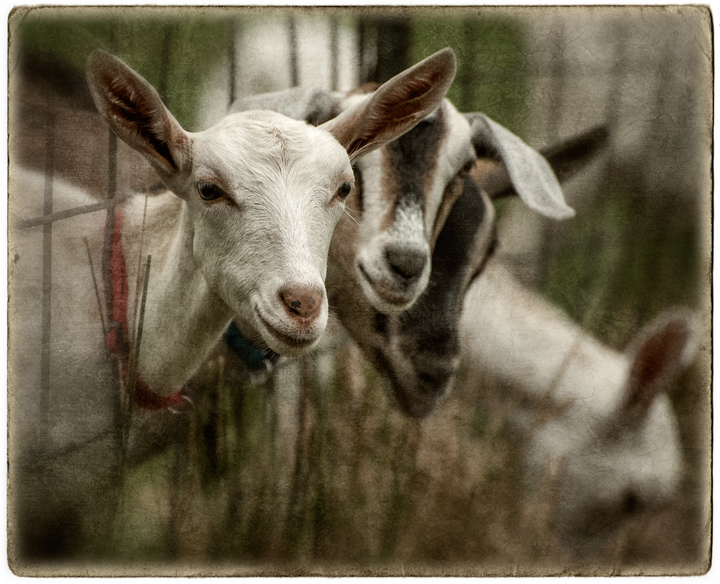
Goats at the FenceReligious and cultural traditions have provided the guidelines for the ethics of food consumption for much of human history, dictating rituals and taboos for the preparation and eating of non-human animals. Yet with the dawn of the secular age and the globalization of culture and economy, such rituals and cultural guidelines have largely fallen by the wayside in favor of economic efficiency and endless growth, leading to such cruel institutions as the factory farm that supplies cheap, abundant meat to a consumerist public. In this essay I will be focusing not on the evils of the factory farm, but rather on the ethical dilemma faced by the human omnivore who wishes to engage the question of eating from a non-dogmatic stand-point. What guidelines can we follow when making the choice every day of what to put into our bodies? Are there ways of finding deeper connection with our food, and the myriad creatures who become that food?

I am writing this essay from the perspective of an American citizen, raised in Northern California. The reason this fact is pertinent is because the culture of food in the United States is one that is constantly in flux, altering with the latest consumerist fad or medical study. Diets in this country change with great rapidity, which the food writer Michael Pollan takes to be a “sign of a national eating disorder.”[2] Such instability in a nation’s eating habits “would never have happened in a culture in possession of deeply rooted traditions surrounding food and eating.”[3] Pollan goes on to describe the “American paradox”: “a notably unhealthy people obsessed by the idea of eating healthily.”[4] Why is it that so many Americans struggle with knowing what to eat, or more importantly, what it is right to eat? The complexity of questions surrounding food not only arises from a loss in understanding of what is healthy for our own bodies, but also what is healthy for the bodies of the organisms who we consume. Is it possible to find an ethical way to live and eat on this Earth, or must we always be compromising our moral standing with each meal? Is there one right way for human beings to sustain themselves, or a multiplicity of ways? Or could it be there is no right way at all, no pathway to ethical purity, and rather we are meant to learn from the complexity of being incarnated in bodies that must consume other bodies, of animals or plants, in order to survive?

Humans in most parts of the world have inherited a traditional culture which “codifies the rules of wise eating in an elaborate structure of taboos, rituals, recipes, manners, and culinary traditions”[5] that act as guidance when it comes to consuming other species, particularly species of non-human animals. The nutrition researcher Sally Fallon draws on studies from a diversity of traditional cultures from around the world for her book Nourishing Traditions, in which she argues for a return to a diet rich in animal products, including fats, organ meats, raw dairy, and bone broths.[6] Her argument, based on the research conducted in the 1930s by Dr. Weston A. Price, is that these isolated populations subsisting on ancient, traditional diets were far healthier—with stronger bones, lack of tooth decay or degenerative diseases, and with greater longevity—than their Western counterparts.[7] Yet while she demonstrates the importance of animals as food for human health, Fallon does little to address the impact such a diet has on the non-human animals consumed. She naturally advocates for choosing products from animals who are pasture-raised and organic, but she does not address the larger issue of killing animals, or the loss of each individual life when an animal is slaughtered for consumption.

On the opposite side of the spectrum of healthy eating is Frances Moore Lappé, who first wrote Diet for a Small Planet in 1971. Lappé is addressing, especially in the first edition of her book, the issue of feeding the surplus of grain and soybeans produced in the United States to cattle as a means of making a profit on large quantities of cheap and fatty beef while also disposing of the excess grain grown by industrial agriculture. She exposes the wastefulness of the system by giving a few shocking numbers: it takes 16 pounds of grain and soybeans to produce one pound of beef,[8] and while that one pound of beef translates into about 500 food calories it takes 20,000 calories of fossil fuel to produce it.[9] Lappé also quotes the famous Newsweek statement that “The water that goes into a 1,000-pound steer would float a destroyer.”[10] She is advocating for a turn away from the American diet built around the presence of meat at every meal to a plant-based diet that relies on the protein complementarity of grains and legumes to provide the adequate amino acids for a healthy lifestyle. Interestingly, it was the later turn away in the early 2000s from the low-fat, minimal red meat, grain-based diet that Lappé advocates that inspired Michael Pollan to write his own book on food, The Omnivore’s Dilemma.

A simple summary would say that Fallon and Lappé are arguing for nearly opposite diets, although both advocate for eating high quality, organic produce grown locally and preferably on a small, sustainable scale. As Lappé and her daughter, Anna Lappé, write in their book Hope’s Edge: The Next Diet for a Small Planet, eating organic and local food is a decision that is “defining of who we are.”[11] One major contrast between Fallon and Lappé is that Fallon’s dietary recommendations are focused more on human health, while Lappé’s are focused on ecological health. Yet they are at times completely at odds with each other in what foods they recommend humans should be eating for optimum physical health. For example, Lappé says that she has come to find “that human beings need eat no flesh to be healthy,”[12] and that one could completely eliminate all meat and fish and still get enough protein.[13] Meanwhile, Fallon argues that fat and protein from animal products are the essential building blocks of the human body, and that the vitamins A and D supplied by animal fats are necessary for the body to even assimilate protein.[14] Furthermore, Fallon points out that animal protein is the only complete protein, meaning it supplies all eight essential amino acids not synthesized by the human body.[15] Lappé has a direct argument against the need to eat animal products for complete protein because certain plant foods can be combined to create “protein complementarity,” when the deficiency of amino acids in one food is made up for by an excess in another and vice versa, such as with grains and legumes.[16] Peter Singer and Jim Mason, in their book The Ethics of What We Eat, have written that there is no difference in the quality of soy protein in comparison to meat protein.[17] However, Fallon describes in some detail that soybeans have a higher phytate content than most legumes and contain potent enzyme inhibitors making them difficult to digest unless fermented. Relying on unfermented tofu and soymilk as a protein replacement for meat and raw milk can lead to mineral and enzyme deficiency.[18]

Yet other ways in which Lappé’s and Fallon’s argument directly contradict each other are in the discussion of saturated fats and cholesterol. Lappé cites studies which have shown that diets high in animal protein can lead to atherosclerosis, the hardening of the arteries caused by deposits of fatty acids on the artery walls.[19] She also writes that high blood cholesterol is correlated with an increase in the ingestion of cholesterol and saturated fats, both from animal products and in the latter case also from tropical plant oils.[20] Her recommendation is instead to consume polyunsaturated fats from plant sources, such as safflower, sunflower, corn, and soybeans.[21] Singer and Mason point out that some studies have found that those who eat a diet low or entirely excluding meat tend to live longer.[22] Fallon argues the completely opposite case, pointing to a study in which subjects who ate more saturated fat and cholesterol were healthier overall, and that “weight gain and cholesterol levels had an inverse correlation with fat and cholesterol intake in the diet.”[23] By explaining the molecular structure of saturated, monounsaturated, and polyunsaturated fats Fallon demonstrates how the unstable nature of polyunsaturated plant oils easily go rancid and should never be heated or cooked with because of their molecular instability.[24]

Fallon points to the high quantity of animal fats in the traditional diets of the Japanese, Swiss, Austrian, Greek and, of course, the French, among others, to demonstrate the health and longevity of these groups of people when following their traditional cultural cuisines.[25] Even in reference to the traditional diets of our human ancestors Fallon and Lappé report opposing views. Lappé writes, “I advocate a return to the traditional diet on which our bodies evolved—a plant-centered diet in which animal foods play a supplemental role.”[26] In diametric opposition Fallon writes,

Our primitive ancestors subsisted on a diet composed largely of meat and fat, augmented with vegetables, fruit, seeds and nuts. Studies of their remains reveal that they had excellent bone structure, heavy musculature and flawless teeth. Agricultural man added milk, grains and legumes to this diet.[27]

Fallon also gives archaeological evidence against eating a primarily vegan diet: “Skulls of prehistoric peoples subsisting almost entirely on vegetable foods have teeth containing caries and abscesses and show evidence of bone problems and tuberculosis as well.”[28] Yet there is also much research that has been done on healthy ways to eat primarily plant-based diets, and Singer and Mason argue that a well-planned vegan diet can support the human body at any stage of life.[29] Since the time when our ancestors were living on either plant-based diets supplemented with animal products, or meat-based diets augmented with vegetation, human beings have come to learn much about the world we live in, including about the nature of our bodies and the food we put into them. Our lifestyles have also changed, for better and for worse, since our primitive ancestors lived on their simpler diets of whole, unprocessed foods.

With so many contradictions, are we any closer to solving the omnivore’s dilemma of what we are meant to eat and how? Lappé says people often find it surprising that she does not consider herself to be a vegetarian. “Over the last ten years,” she writes, “I’ve hardly ever served or eaten meat, but I try hard to distinguish what I advocate from what people think of as ‘vegetarianism’.”[30] Professor Lindsay Allen also speaks to how ideology can get in the way of conveying a more important message. In conversation with Singer and Mason she said,

“I’m not against veganism, I’m against people who, often because of an animal-rights ideology, don’t take the trouble to learn about what they should be eating. People come out with self-righteous attitudes and lots of pure malarkey about how you can get vitamin B12 from plants or from the soil.”[31]

Perhaps, while the specifics of what and who we eat is important, the way in which we approach eating it is just as essential. Lappé supports this by saying, “A ‘correct diet,’ one centered in the plant world, one based in less processed and nonchemically treated foods, is not a ‘should’ as much as a freeing step.”[32] Lappé puts the human relationship with food into a larger context, in which our diets become a symbol and practice for the role we wish to play in the world.

A change in diet is not an answer. A change in diet is a way of experiencing more of the real world, instead of living in the illusory world created by our current economic system, where our food resources are actively reduced and where food is treated as just another commodity.[33]

Further into Diet for a Small Planet Lappé elaborates on this point more deeply:

What we eat is only one of those everyday life choices. Making conscious choices about what we eat, based on what the earth can sustain and what our bodies need, can remind us daily that our whole society must do the same—begin to link sustainable production with human need.[34]

On these last two points I believe Lappé and Fallon would at last come into agreement. How we choose to eat is a profound statement about our complicity or lack thereof with the larger economic and political system. It is the most intimate way to take actions that directly affect others, because every single morsel of food that passes our lips is comprised of another species. That is interconnection, that is dependence.

Conscious eating, as Lappé says, is based on two essential factors: ‘on what the earth can sustain’ and ‘what our bodies need.’ Neither of those factors can be determined universally, because every situated ecosystem is unique and every body is unique. Thus what is best to eat within one ecosystem will not be in another; likewise, the best balance of plant and animal foods for my body will be radically different from the needs of someone who was raised in another part of the world, or who has an entirely different ethnic background than I do. Part of the human project of relearning to eat in a way that the Earth can sustain is by recognizing and respecting the unique differences between all of our needs and situations. For example, the 14th Dalai Lama, who one might expect as a Buddhist to be a vegetarian, in fact is not. While Buddhism does not prohibit the eating of meat, it does indicate that animals should not be killed for food. The Dalai Lama had been living for some time as a vegetarian but became severely ill, with complications worsened by hepatitis. The Dalai Lama’s physician recommended he begin eating meat, and within a short period of time he regained his health.[35]

The Dalai Lama’s situation is one in which he had to make a decision against the rules ascribed by the religious tradition in which he participates. Yet for many people worldwide, and for countless generations into the past, it was the religious and cultural traditions that guided how human beings ate, particularly in relation to animals. Paul Waldau writes in his essay, “Seeing the Terrain We Walk”: “Religious traditions, with their impact on worldviews and lifestyles, influences not only the way adherents think, see, and talk about the world, but also the ways they act toward ‘others,’ whether human or otherwise.”[36] This holds true particularly in terms of the human relationship with animals. Waldau also writes, “The first of the central inquiries in the religion and animals field is, thus, about matters we generally call ‘ethical’ or ‘moral’.”[37] Religion has provided the moral guideposts for millennia, but in a country such as the United States in which multiple world views and beliefs reign, no such guidelines are universal—unless it they are the guidelines of the market, which have given us factory farming and Pollan’s American paradox.

One of the rituals practiced in multiple religions worldwide was that of sacrifice, particularly non-human animal sacrifice. To focus on one religious lineage, in the biblical world sacrifice was an “unquestioned given,” according to Jonathan Klawans.[38] But as Klawans, David Fraser, and others are careful to point out in their assessments of the Hebrew sacrificial tradition, the moment of the animal’s death is but one step in a long process, beginning with a lifetime of care for the flock from which the sacrificed animal is chosen. The emphasis on care for the animals gives birth to what Fraser calls the “pastoralist ethic.”[39] The only way one can really understand what it means to sacrifice an animal, to take the life of another being on behalf of God, is to first understand what it means to be a shepherd, a loving caretaker, of those animals.[40] This sense of care is what we have lost in the industrialized food system in which farm animals are referred to as “units of production,” commodities who have absolutely no laws governing their wellbeing whatsoever.[41] According to animal welfare laws the farm animals raised for slaughter in industrial agriculture are not considered to be animals at all.[42]

Scripture dictates that “the feelings of animals should be taken into consideration” when they are prepared for food and sacrifice.[43] This is why Leviticus and other voices in the Old Testament lay forth dietary laws to guide how religious adherents prepare and eat their food. Shechitah is the Hebrew term for the kosher slaughtering of a non-human animal, and because of its strict guidelines is considered to be the “quickest and most painless way to kill animals.”[44] Although not conducted by a shochet as rabbinic tradition would require, the killing of the two goats Sweetie and Peaches in which I participated followed the guidelines of shechitah fairly closely. This specifies exactly which parts of the animal are cut and how, as Ronald L. Androphy writes:

Most importantly, the act of shechitah not only severs the trachea and esophagus but it also severs the jugular veins and carotid arteries. The result is a sudden and voluminous outpouring of blood and immediate and acute anemia of the brain thus rendering the animal senseless instantaneously.[45]

During the deaths of Peaches and Sweetie I witnessed this moment of the blood pouring forth, how quickly the life ended and how, apparently, gently. I will quote a small section of what I wrote in my journal later on the day of this process:

Swiftly she brought the knife forward and sliced into the jugular vein. Crimson blood welled from the opening, pouring and pouring forth. I came forward to catch it in a clean, glass bowl. The animal’s fading pulse seemed to pass from him to the very air itself, beating through everything. I was grateful to stand so close, to look into this little animal’s beautiful deep brown eyes, to thank him, and to recognize the moment when life left him. The eye transformed. No longer a window to the soul it became a glass bead. The blood still poured forth.[46]

Practicing the act of killing with such intimacy makes it nearly, if not completely, impossible to not have a powerful emotional connection with the animal whose life is ending on behalf of the human beings who are sacrificing him and who will be eating his flesh.

Beyond the religious significance, there are many ideas of what the Hebrew practice of sacrifice is meant to dictate in regards to the actual eating of animal bodies. Because there was only one temple in which animals could be sacrificed, this has been seen by some scholars as an imposed limit on the amount of meat that should be eaten.[47] The eating of animal flesh is also seen by some as a condition of being in a fallen state, since in Genesis humans do not eat other animals in the Garden of Eden.[48] Some scholars see this as an indication that the ideal state would be a vegetarian one. However, Klawans points out that in the story of Genesis not only were no animals eaten in Eden, no cooked food was either.[49] If one were attempting to eat a diet based solely on what was consumed in Paradise one would have to live entirely on raw foods—which our evolutionary ancestors did at one point in the distant past, although we had not yet evolved into our modern Homo sapien form.

The desire to live upon the Earth as purely as possible may have some roots in this cultural longing for a golden age, a time when humans were living in a mythic paradise. Yet our every move in this world causes some harm to other beings, no matter how much we try to prevent it. To be in denial of our own continual causation of suffering is to deny the pain of others. Donna Haraway writes in her book When Species Meet, “There is no way to eat and not to kill, no way to eat and not to become with other mortal beings to whom we are accountable, no way to pretend innocence and transcendence or a final peace.”[50] The problem lies, in the end, less in what we did not do, what we abstained from, but rather in what suffering we caused that we then denied to acknowledge. Haraway also writes, “Caring means becoming subject to the unsettling obligation of curiosity, which requires knowing more at the end of the day than at the beginning.”[51] Caring about our human place in the world and the impact we necessarily have on other species, “Earth Others,” as Val Plumwood calls all other non-human beings,[52] is recognizing that we cannot extricate ourselves from the mess of being alive—“mess” being a particularly appropriate term because of its use as a term to refer to food. Haraway refers to other species—our companion animals, the species we eat, the bacteria in our gut—as messmates.[53] As long as we eat we are always in the mess. Furthermore, the term “companion” comes from the Latin cum panis, meaning “with bread.”[54] All species with whom we eat, who we eat, and who eat us, are in some way or other our companions.

Forgetting that we can never extricate ourselves from the suffering caused, in some form, by eating may be a product of the human denial that we too can be eaten. Plumwood speaks of this in her powerful essay “Being Prey,” in which she describes her experience of surviving a crocodile attack in the bush in Australia. She says, “It seems to me that in the human supremacist culture of the West there is a strong effort to deny that we humans are also animals positioned in the food chain.”[55] When arguing whether or not it is right to kill another species for food, it can be important to remember that all beings must, at some point, die. As a culture, Westerners are in active denial of this profound fact. Haraway writes, “I do not think we can nurture living until we get better at facing killing. But also get better at dying instead of killing.”[56] If there is one thing I learned from actively participating in the deaths of Peaches and Sweetie it was the importance of going through the act of taking life, of witnessing death, if we are going to consume the flesh, or even the milk and eggs, of non-human animals. With the world structured as it is today, perhaps we need not personally take life for every body we consume—although this may be the most ethical preference for some. But I do feel it is important to remember and honor that moment of death with each meal that is composed of the life of Earth Others—and that is every meal because, as the poet Gary Snyder writes, “There is no death that is not somebody’s food, no life that is not somebody’s death.”[57]

Biodiversity is one of the gifts of the Earth, the “iridescent variation of aspect”[58] through which our planet manifests its eternal creativity. Biodiversity does not just occur at a species level, but within species as well; one aspect of that diversity is the myriad ways human cultures have developed relationships with the species that become our food. If you find yourself facing the omnivore’s dilemma of what and how to eat, I would offer that the answer may lie in learning to listen: to the suffering of the species we eat, to the bioregions in which we live to understand what these ecosystems most love to produce in abundance, to the quiet voices of our own bodies—our intuition and our messmates—who will tell us what we need to eat and how. Food is the most daily reminder we may have that we humans are utterly dependent on the Earth because of the many species we consume. Instead of seeking spiritual or ethical purity, perhaps we might choose to sink further into the spiritual mess of embodied life on this Earth.


Works Cited

Androphy, Ronald L. “Shechitah.” In Judaism and Animal Rights. Edited by Roberta Kalechofsky. Marblehead, MA: Micah Publications, 1992.

Cerulli, Tovar. “The Dalai Lama: On Meat and Moral Gymnastics.” A Mindful Carnivore, October 15, 2010. http://tovarcerulli.com/2010/10/the-dalai-lama-on-meat-and-moral-gymnastics/.

Fallon, Sally. Nourishing Traditions: The Cookbook That Challenges Politically Correct Nutrition and the Diet Dictocrats. Washington, DC: New Trends Publishing, 2001.

Findlay, John, “The Logical Peculiarities of Neoplatonism.” In The Structure of Being: A Neoplatonic Approach. Edited by R. Baine Harris, Albany, NY: State University of New York, 1982.

Haraway, Donna J. When Species Meet. Minneapolis, MN: University of Minnesota Press, 2008.

Lappé, Francis Moore. Diet for a Small Planet. New York, NY: Random House Publishing Group, 1991.

Pollan, Michael. The Omnivore’s Dilemma. New York, NY: The Penguin Press, 2006.

Plumwood, Val. “Being Prey.” In The New Earth Reader: The Best of Terra Nova. Edited by David Rothenberg and Marta Ulvaeus. Cambridge, MA: MIT Press, 1999.

–––––. Environmental Culture: The Ecological Crisis of Reason. New York, NY: Routledge,

Singer, Peter and Jim Mason. The Ethics of What We Eat: Why Our Food Choices Matter. United States: Rodale, Inc., 2006.

Snyder, Gary. “Grace.” Co-Evolution Quarterly, 43 (Fall 1984).

Sunstein, Cass and Martha Nussbaum, eds. Animal Rights: Current Debates and New Directions. New York, NY: Oxford University Press, 2004.

Tarnas, Becca. “Of Blood and Stars.” Essay for Hill of the Hawk course, October 24, 2012.

Waldau, Paul and Kimberley Patton, eds. A Communion of Subjects. New York, NY: Columbia University Press, 2006.


[1] Gary Snyder, “Grace,” Co-Evolution Quarterly, 43 (Fall 1984): I.

[2] Michael Pollan, The Omnivore’s Dilemma: A Natural History of Four Meals (New York, NY: The Penguin Press, 2006), 2.

[3] Pollan, The Omnivore’s Dilemma, 2.

[4] Ibid, 3.

[5] Pollan, The Omnivore’s Dilemma, 4.

[6] Sally Fallon, Nourishing Traditions: The Cookbook That Challenges Politically Correct Nutrition and the Diet Dictocrats (Washington, DC: New Trends Publishing, 2001), xi-xii.

[7] Fallon, Nourishing Traditions, xi-xii.

[8] Frances Moore Lappé, Diet for a Small Planet (New York, NY: Ballantine Books, 1991), 9.

[9] Lappé, Diet for a Small Planet, 10.

[10] Ibid, 76.

[11] Frances Moore Lappé and Anna Lappé, qtd. in Peter Singer and Jim Mason, The Ethics of What We Eat (Emmaus, PA: Rodale, Inc., 2006), 140.

[12] Lappé, Diet for a Small Planet, xxviii.

[13] Ibid, 159.

[14] Fallon, Nourishing Traditions, 29.

[15] Ibid, 26.

[16] Lappé, Diet for a Small Planet, 160.

[17] Singer and Mason, The Ethics of What We Eat, 232.

[18] Fallon, Nourishing Traditions, 62.

[19] Lappé, Diet for a Small Planet, 122.

[20] Ibid, 123.

[21] Ibid, 124.

[22] Singer and Mason, The Ethics of What We Eat, 225.

[23] Fallon, Nourishing Traditions, 5.

[24] Ibid, 8-9.

[25] Ibid, 7.

[26] Lappé, Diet for a Small Planet, 209.

[27] Fallon, Nourishing Traditions, 26-7.

[28] Ibid, 27.

[29] Singer and Mason, The Ethics of What We Eat, 224.

[30] Lappé, Diet for a Small Planet, 13.

[31] Lindsay Allen, qtd. in Singer and Mason, The Ethics of What We Eat, 226.

[32] Lappé, Diet for a Small Planet, xxix.

[33] Ibid, 26.

[34] Lappé, Diet for a Small Planet, 107.

[35] Tovar Cerulli, “The Dalai Lama: On Meat and Moral Gymnastics,” A Mindful Carnivore, October 15, 2010, http://tovarcerulli.com/2010/10/the-dalai-lama-on-meat-and-moral-gymnastics/.

[36] Paul Waldau, “Seeing the Terrain We Walk: Features of the Contemporary Landscape of ‘Religion and Animals’,” in A Communion of Subjects, eds. Paul Waldau and Kimberley Patton (New York, NY: Columbia University Press, 2006), 53.

[37] Waldau, “Seeing the Terrain We Walk,” 41.

[38] Jonathan Klawans, “Sacrifice in Ancient Israel: Pure Bodies, Domesticated Animals, and the Divine Shepherd,” in A Communion of Subjects, eds. Paul Waldau and Kimberley Patton (New York, NY: Columbia University Press, 2006), 66.

[39] David Fraser, “Caring for Farm Animals: Pastoralist Ideals in an Industrialized World,” in A Communion of Subjects, eds. Paul Waldau and Kimberley Patton (New York, NY: Columbia University Press, 2006), 548.

[40] Klawans, “Sacrifice in Ancient Israel,” 67.

[41] Lappé, Diet for a Small Planet, xxviii.

[42] David J. Wolfson and Mariann Sullivan, “Foxes in the Hen House – Animals, Agribusiness, and the Law: A Modern American Fable,” in Animal Rights: Current Debates and New Directions, eds. Cass Sunstein and Martha Nussbaum (New York, NY: Oxford University Press, 2004), 206.

[43] Dan Cohn-Sherbok, “Hope for the Animal Kingdom: A Jewish Vision,” in A Communion of Subjects, eds. Paul Waldau and Kimberley Patton (New York, NY: Columbia University Press, 2006), 83.

[44] Cohn-Sherbok, “Hope for the Animal Kingdom,” 85.

[45] Ronald L. Androphy, “Shechitah,” in Judaism and Animal Rights, ed. Roberta Kalechofsky (Marblehead, MA: Micah Publications, 1992), 76.

[46] Becca Tarnas, “Of Blood and Stars,” essay for Hill of the Hawk course, October 24, 2012, 4.

[47] Roberta Kalechofsky, “Hierarchy, Kinship, and Responsibility: The Jewish Relationship to the Animal World,” in A Communion of Subjects, eds. Paul Waldau and Kimberley Patton (New York, NY: Columbia University Press, 2006), 97.

[48] Klawans, “Sacrifice in Ancient Israel,” 73.

[49] Ibid, 74.

[50] Donna J. Haraway, When Species Meet, (Minneapolis, MN: University of Minnesota Press, 2008), 295.

[51] Haraway, When Species Meet, 36.

[52] Val Plumwood, Environmental Culture: The Ecological Crisis of Reason (New York, NY: Routledge, 2002), 146.

[53] Haraway, When Species Meet, 17.

[54] Ibid.

[55] Val Plumwood, “Being Prey,” in The New Earth Reader: The Best of Terra Nova, eds. David Rothenberg and Marta Ulvaeus, (Cambridge, MA: MIT Press, 1999).

[56] Haraway, When Species Meet, 81.

[57] Gary Snyder, “Grace,” Co-Evolution Quarterly, 43 (Fall 1984): I.

[58] John Findlay, “The Logical Peculiarities of Neoplatonism,” in The Structure of Being: A Neoplatonic Approach, ed. R. Baine Harris (Albany, NY: State University of New York, 1982), 1.

Campaign for Farm Service: Empower You(th), Feed A Nation

When I was eighteen years old my life was changed by a profound yet simple experience: I learned how to grow my own food. Working on a biodynamic farm in Northern California I learned how to build healthy compost piles, prepare beds for planting, nurture lettuce, garlic, cucumbers, melons, and an abundance of other crops until they ripened to maturity, to prune and train tomato plants to maximize their fullest succulent potential, to feed and care for cows who produce milk, sheep who produce wool, chickens who produce eggs, and draft horses who worked the land with us. Perhaps most importantly I learned how to work hard in the hot sun over long days, and to take responsibility for my own ecological footprint upon this planet.

Lettuce
Photo by Becca Tarnas.

The majority of food grown in the United States is not produced in the manner I have described above. The current food production system is dominated by industrialized commercial agriculture, which produces a small number of crops on large tracts of land cultivated as monocultures, fertilized with petroleum-based nitrogen fertilizers, and continuously sprayed with deadly chemical pesticides and herbicides. The bulk of these uniformly-produced crops are distributed by a minimal number of multi-national corporations. Both the number of farms and the number of corporations are rapidly decreasing as all aspects of the food system are consolidated into a few large organizations. When few corporations are allowed to amass such a monopoly on trade, smaller scale producers, such as the farmers with whom I worked, can no longer compete in the market, and consumers are given less choice in what kinds of food they can purchase.

Over the last half century the number of farmers has decreased while the size of farms has increased. In the 1960s, government policies pushed for fewer farmers working larger tracts of land because technological advances in farming equipment could make farms more efficient than human labor alone.[1] As of 1997, 61% of agricultural products grown in the United States were produced on only 163,000 farms. Of these farms 63% were contracted to larger corporations which processed and distributed their products.[2] Today the number of farms is continuing to decrease because the same policies have been pushing for greater economic efficiency on farms. The current U.S. farm system, which is heavily subsidized by taxpayers, could not survive if it were not for the support of government policies.[3] Changing government policy in regards to food production is key to decentralizing and reforming the system to make it more sustainable and resilient for both the land and its farmers.

The governing laws, policies, and world view of the United States is oriented entirely toward the health and well-being of the economy, not the ecosystems or even the human population who give the nation its substance and meaning. If the United States, along with the rest of Earth’s nations, is to survive the current ecological crises—climate change, ocean acidification, deforestation, desertification, pollution, biodiversity loss, mass extinction, and a host of other issues—policies will have to be changed to recognize not only human and corporate rights, but rights that acknowledge the entirety of the Earth community as well. Such a shift to Earth-based governance is recognized as Earth Law or Earth Jurisprudence, a movement inspired by the work of the geologian Thomas Berry, and promoted by Cormac Cullinan,[4] Linda Sheehan, and others involved with the Earth Law Center.[5] Earth Law is slowly entering the legal world through the discussion of Earth Rights, and the writing of such historical documents as the Universal Declaration of Rights of Mother Earth, released on Earth Day in 2010.[6] The Earth-centric perspective inherent to Earth Law gives ecosystems the right to be healthy, which translates to the right to exist, persist, and sustain itself. The importance of recognizing the rights of “Earth Others,” as the ecofeminist Val Plumwood calls nonhuman beings of the Earth community, is to begin to move away from the anthropocentric perspective that is currently degrading the health of our planet.[7] Currently all of our laws serve, first and foremost, human interests.

Food is a particularly compelling issue on which to focus because it is a symbol and daily reminder of our dependence upon a healthy Earth. The food we put into our bodies is comprised entirely of other species, whether plant, fungus, or animal, and is nourished by the complex interactions of solar radiation, the hydrologic cycle, bacteria, minerals, insects, and many other factors. The quality of our food determines the quality of our health, and in the long run our ability to survive. In terms of Earth Law and questions of the rights of Earth Others, how might food be produced if the plants, animals, soils, and waters on which we depend each had their own right to health? What if agricultural land had rights? For example, the right of soil not to be eroded, of aquifers and ground water not to be depleted and contaminated, or of land to be free of contamination by pesticides, herbicides, and fertilizers? What if human beings were given the right to always have access to healthy, uncontaminated food with higher nutritional value?

There are many different ways these issues might be addressed, but it seems that implementing some kind of shift to universal production of organic agriculture would be necessary in order to grant the right of health to agricultural land, and the right for human beings to have access to clean food. Organic agriculture can be a sustainable endeavor when it is designed to mimic a natural ecosystem on a small scale.[8] Examples of such biomimicry techniques include animal husbandry—using composted animal manure to fertilize fields—and intercropping—in which multiple plant species are grown together in harmonious symbiotic relationship—among many other practices employed on organic and biodynamic farms. Usually the costs of transitioning to organic production, and of acquiring organic or biodynamic certification status, are born by the producer, which can be a barrier for many small-scale farmers and open the door for large corporations to come in and take over the organic niche market.[9] Scale is an important factor because the larger the farm the less likely it is that the farm will be able to maintain ethical and sustainable practices in the long term. Land cannot be cared for if efficiency is the bottom line, and large-scale farming production tend to prioritize short-term efficiency over long-term attention and care.

In a world governed by these ideals of capitalist efficiency, the initial costs of converting a conventional farm to organic production can be quite high and discourage farmers from changing. One major drawback to organic agriculture is the need for more human labor if the practice is to be sustainable. Organic farms that try to remain competitive in a corporate market usually rely on machines to till large tracts of land and suppress weed growth.[10] To decrease fossil fuel use and implement sustainable practices, farmers would either have to pay their workers a higher salary for more labor or employ more farm hands, both of which would be a high increase in expenditure.

Tomatoes
Photo by Becca Tarnas.

Unavailability of arable land is another obstacle to organic farming, but this can partially be overcome with the use of urban plots and green roofing on city buildings. Green roofing is a method of covering the roofs of urban buildings with gardens. It is a simple and effective idea that keeps cities cooler in summer by converting much of the cities’ carbon dioxide emissions back into oxygen, and helping clean the air of other pollutants. The gardens also contribute to the food consumed by urban dwellers, which otherwise would have to be transported across the country. Green roofing would cut transportation costs and energy usage.[11]

Food is essential to all human beings in a way that no other commodity is. Therefore, reconnecting people to food production is vital to changing attitudes toward farmers and the cost of food. In order to overcome the shortage of farm workers necessary to convert conventional industrialized farms to organic agriculture, I am proposing a required civil service system that could be implemented in the United States for all young people when they graduate from high school. This plan is not dissimilar to European civil service policies, called Zivildienst, in such countries as Germany and Austria, where conscientious objectors to the required military service can opt to do community service instead. Such a solution is radical and would require a fundamental change in values, but it could also bring about the kind of change needed to fix the food system in the United States.

Under this policy, when a U.S. citizen turns eighteen she or he would be required to submit a form demonstrating eligibility for farm service. She or he would work either on a farm in a rural area, or on a green roof plot in a city. On the service form citizens would indicate their future plans, such as whether they would be attending college or university, or working at a job outside of their farm work. They would also be able to show preference for an urban or rural working environment. Distribution would be based on state, so that people would not have to be taken far from their families. If someone wished to work out of state that could also be arranged.

Each citizen would serve the equivalent of at least two years, with the time distributed according to one’s school and work schedules. A person could work full-time on a farm project and complete his or her required service in two years. Those who chose this method would receive a salary based on the income of an average job in their living area. This money would be provided by the government from the funds currently spent on crop and fossil fuel subsidies. If the farm workers already had employment to which they would be returning after their service was complete, they might also opt to be on a sabbatical salary at those jobs to secure their positions.

A part-time arrangement could be made for those currently holding half-time civilian jobs, so that they would not need to leave their work positions. On the other hand, full-time students would be able to work every summer for four years, or every other summer for eight. Those who chose to work in a rural area would usually work full-time, whereas those working in urban areas could work either full or part-time depending on their preferences and skills. If a person wished, he or she could serve one year and then spend their second year training new farm hands. After two years, those who wished to continue farming could do so on a full-time salary.

Living arrangements would be made according to each person’s lifestyle, work, familial situation, and marital status. Those who farmed in a rural area would live on or near the farms. Those who farmed in the city would have the option of living anywhere in or near that city. If possible, it could be arranged for workers to live in the building under their allotted green roof. Persons or families who have houses with green roofs or personal vegetable gardens could have the possibility of exemption from the farm service if they fulfilled a certain quota of food production.

According to Lewis Mumford, the benefits of smaller-scale agriculture, in the hands of more people, brings diversity and stability:

The small scale method of production, resting mainly on human skill . . . [while] remaining under active direction of the craftsman or farmer, each group developing its own gifts, through appropriate arts and social ceremonies, as well as making discreet use of wide diffusion and its modest demands . . . [These methods have] great powers of adaptation and recuperation.[12]

An increase in gardens and workers would make U.S. cities into partially self-contained ecosystems able to provide much of their own food. A larger proportion of the carbon dioxide and pollution in city air would be converted to oxygen or decreased, and more green spaces would be available for citizens to enjoy. Furthermore, the universal availability of organic produce would start to make the overall population healthier, and undermine the corporate control of the majority of our current food system. The generations of young farm workers would be given the same opportunity I was at age eighteen, of learning to use the skills of my body, mind, and heart in service of the Earth and a healthier humanity, connecting not only with plants and animals, but with soil, water, and weather as well.

Corn
Photo by Becca Tarnas.

A number of changes such as these over the next few decades could make the United States a country with partially self-sustaining cities and small-scale rural farms that produce organic food that is both less expensive and safer to eat. This plan would not be easy to implement within the current world system, and would have to be adjusted in many ways to fit the diversity of this country. However, major, radical changes do need to be made to change the practices of food production and the education of most citizens in regards to their food. I believe that the education provided to youth by working on farms will begin to foster a more Earth-centric world view that will help nurture in young individuals the love of our planet so greatly needed at this time.

Currently there are no policies in motion to introduce a plan such as this in the United States. However, it possible to begin to implement it on a smaller scale to test out how it works in certain areas. The San Francisco Bay Area might be an ideal location in which to attempt such an experiment, not only because the Northern California climate is ideal for growing many kinds of produce but also because San Francisco has been called “the place where new ideas meet the least amount of resistance.”[13] Furthermore, several organizations in the Bay Area are already doing work in this field, and likely would be open to experimenting with such a program: for example, the EcoCenter at Heron’s Head Park in San Francisco’s Hunter’s Point, a project of Literacy for Environmental Justice,[14] or the Food First organization in Oakland.[15] At a different level, the farm service proposal could supplement the work already being done by such programs as Americore or Teach for America. The slogan for such a campaign could possibly be “Empower You(th), Feed A Nation!”

Ultimately, the goal of instituting a youth farm service program would be to change the way Americans are interacting with the Earth. Food is an issue that affects every single person, indeed every organism, and indicates the interconnection between all beings on planet Earth. Introducing every young person in a country to the means by which their nourishment is created would empower them to be self-sustaining and to know that their survival is in their own hands. The education provided by such a program could literally be life-saving. But it would also foster a care for other species, for the plants and animals with which these youth would interact daily for at least two years. Learning to farm would also fundamentally change the human relationship to waste, teaching that there is no such place as “away” to which waste can be thrown. Rather it would bring ideas such as composting and reuse into the everyday rhythm of life. After a few generations of such a program I can imagine that the policies passed by the adults who have learned to grow their own food would be far more Earth-centered than our current policies today.

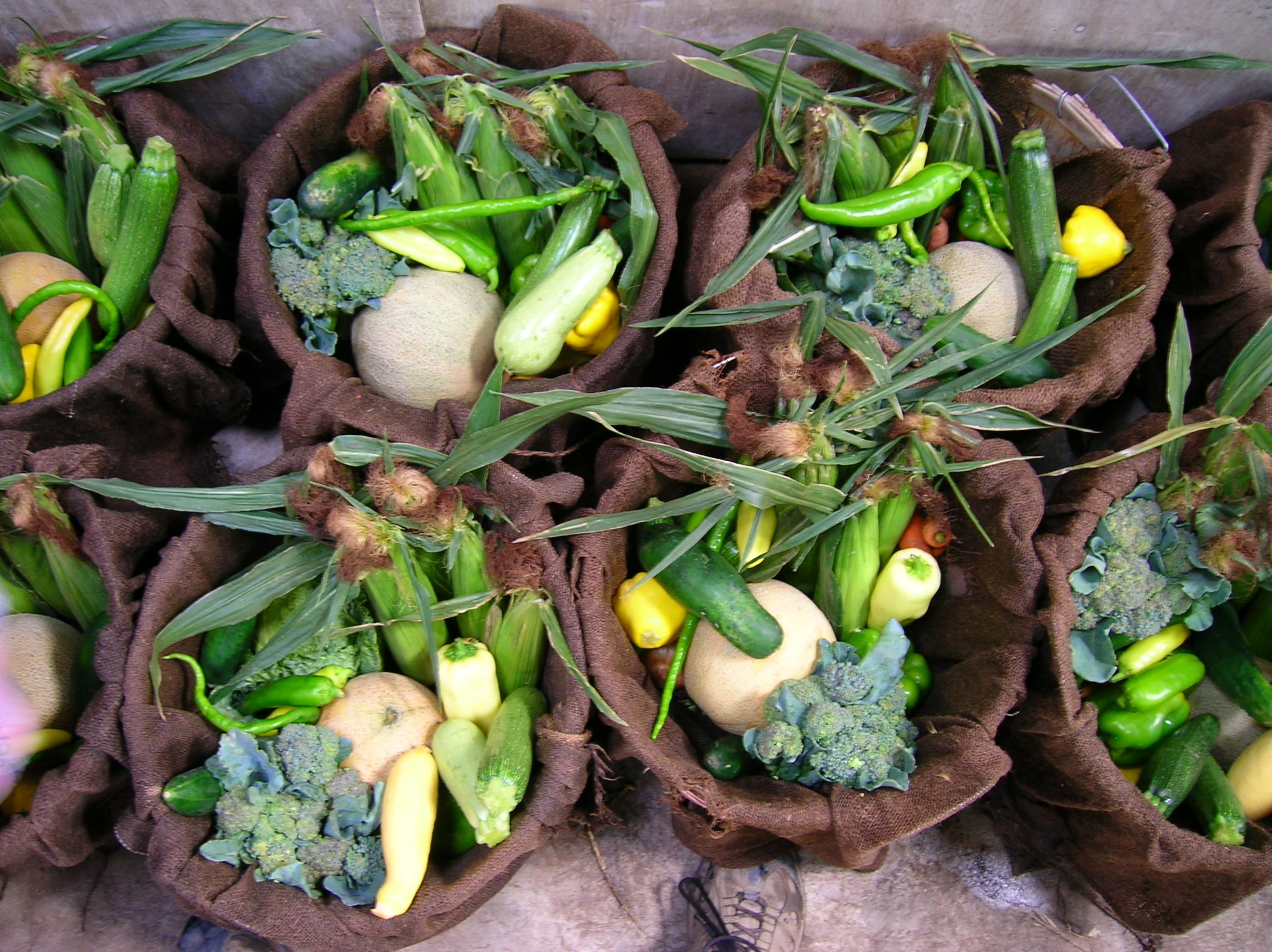
Biodynamic Produce
Photo by Becca Tarnas.


Works Cited

Cullinan, Cormac. Wild Law: A Manifesto for Earth Justice. White River Junction, VT: Chelsea Green Publishing, 2011.

Earth Law Center. Accessed May 8, 2014. http://earthlawcenter.org/.

“Food First.” Accessed May 8, 2014. http://foodfirst.org/.

Global Alliance for the Rights of Nature. “Universal Declaration of Rights of Mother Earth.” Accessed May 8, 2014. http://therightsofnature.org/universal-declaration/.

Green Roofs for Healthy Cities. “Green Roof Benefits.” Accessed May 8, 2014. http://www.greenroofs.org/index.php/about/greenroofbenefits.

Kirschenmann, Frederick. “The Current State of Agriculture.” In The Essential Agrarian Reader, edited by Norman Wirzba, 101-119. Washington D.C.: Shoemaker & Hoard, 2004.

Literacy for Environmental Justice. “EcoCenter at Heron’s Head Park.” Accessed May 8, 2014. http://ecocenterheronshead.blogspot.com/.

Newsham, Brad. “The Spiritual Center of the Earth.” SF Gate, November 23, 1999. Accessed May 8, 2014. http://www.sfgate.com/entertainment/article/The-Spiritual-Center-Of-the-Earth-2894518.php.

Plumwood, Val. Environmental Culture: The Ecological Crisis of Reason. New York, NY: Routledge, 2002.

Pollan, Michael. The Omnivore’s Dilemma. New York: The Penguin Press, 2006.

Raynolds, Laura. “Organic and Fair Trade Movements in the Global Food Networks.” In Ethical Sourcing in the Global Food System. Edited by Stephanie Barrientos & Catherine Dolan, 49-61. Sterling, VA: Earthscan, 2006.


[1] Frederick Kirschenmann, “The Current State of Agriculture,” in The Essential Agrarian Reader, ed. Norman Wirzba (Washington D.C.: Shoemaker & Hoard, 2004), 101.

[2] Kirschenmann, “The Current State of Agriculture,” 102.

[3] Ibid, 117.

[4] Cormac Cullinan, Wild Law: A Manifesto for Earth Justice (White River Junction, VT: Chelsea Green Publishing, 2011).

[5] “Earth Law Center, accessed May 8, 2014, http://earthlawcenter.org/.

[6] “Universal Declaration of Rights of Mother Earth,” Global Alliance for the Rights of Nature, accessed May 8, 2014, http://therightsofnature.org/universal-declaration/.

[7] Val Plumwood, Environmental Culture: The Ecological Crisis of Reason (New York, NY: Routledge, 2002), 146.

[8] Kirschenmann, “The Current State of Agriculture,” 113.

[9] Laura Raynolds, “Organic and Fair Trade Movements in the Global Food Networks,” in Ethical Sourcing in the Global Food System, ed. Stephanie Barrientos & Catherine Dolan (Sterling, VA: Earthscan, 2006), 52, 57.

[10] Michael Pollan, The Omnivore’s Dilemma (New York: The Penguin Press, 2006), 159-60.

[11] “Green Roof Benefits,” Green Roofs for Healthy Cities, accessed May 8, 2014, http://www.greenroofs.org/index.php/about/greenroofbenefits.

[12] Lewis Mumford, qtd. in Kirschenmann, “The Current State of Agriculture,” 108.

[13] Brad Newsham, “The Spiritual Center of the Earth,” SF Gate, November 23, 1999, accessed May 8, 2014, http://www.sfgate.com/entertainment/article/The-Spiritual-Center-Of-the-Earth-2894518.php.

[14] “EcoCenter at Heron’s Head Park,” Literacy for Environmental Justice, accessed May 8, 2014, http://ecocenterheronshead.blogspot.com/.

[15] “Food First,” accessed May 8, 2014, http://foodfirst.org/.

To Be In Relationship: How Do Animals Make You Human?

Reverence, fear, disgust, delight—these are just some of the responses that spontaneously, and uncontrollably, arise in me upon contact with different individuals of various animal species. How I feel morally and intellectually about a particular individual, a select species, or even that vague abstraction that somehow refers to all nonhuman animals in a simple, all encompassing term—animals—often differs from my somatic and emotional response in a concrete situation. I do not have a universal relationship to the multitude of species we humans call “animals,” because there is nothing universal about this homogenized Other, except that we name them so. Or is there?

My relationship with animals began at birth, the moment I became a separate animal being from the body of my mother. I cannot say that relationship began at conception, because until I actually passed through the birth canal my mother and I were one animal organism. But relationship begins with duality, and as I gazed back on the being who birthed me my first relationship formed. But my first relationship with an animal outside of my own species? I cannot name the first nonhuman animal I encountered, because it was earlier than my first memory. Perhaps it was a deer, or a bird, as we lived in a redwood canyon on the Big Sur coast. I do know the first species to have a major impact on me though, and their presence has remained a constant throughout my life: Felis catus, the house cat.Maine Coon Cat

Since I was a young child I seemed to be a magnet for cats. If I entered someone’s home and a cat was present, she or he would usually find me. If the cat happened to be shy, I usually would find her instead. I would delight in their softness, their playfulness, the mature dignity and kittenish adolescence constantly co-present in one, small, furry body. Cats and I have always seemed to have an understanding, an easy, almost telepathic communication. There is no hierarchy, we both seem to feel like we are equals. To the surprise of several people I know, cats will almost always come when I call them by name. And of course, I too come when I, by them, am called.

Perhaps as a karmic twist to this lifelong species bond, I have never really had a cat of my own. Perhaps I am not able to “own” a cat, and therein the problem arises. Twice I tried to be the companion species to a cat, but both times ended in tragedy. My first kitten I was forced to return to the animal shelter because of the unfortunate allergic reaction of a family member. My mother and I called constantly for days until we heard he had been given another home. I never forgot him, and often still wonder where he made his new abode. This was now twenty years ago. My other cat, who I brought home in high school, lived two delightful years in my house before dying of an unexpected blood clotting condition. He died, ironically, of an oversized heart.

The cats that came into my life were not mine to own, but rather visitors that came through as a reminder of the human ability to communicate with other species, if only we humble ourselves to try. My most recent feline engagement has been with a large, champagne-colored tomcat with crystal blue eyes by the name of Shasta. My first evening, just two months ago, after moving into my new house in the Sunset district of San Francisco I saw Shasta’s pale and eager face peering in the study window from the garden. I sat on the doorstep and we exchanged pleasantries. Now Shasta returns every day, often three times a day or more, for a chat, some affection, and a little play. The relationship is purely social, and because we do not feed Shasta there is no hierarchy or relation of dependence between us.

But what of other nonhuman animal species besides Felis catus? The cat is a species I am rather biased in favor of, and if I am honest I must admit that I feel far less of a desire for intimate communion with most other domesticated species. At ages eighteen and nineteen I lived on a biodynamic farm where I was given the task of caring for—feeding, watering, herding, milking, and shearing—the cows, sheep, chickens, and horses resident there. Although excited for this chance at connection and even education, I found I did not have the same high rapport with the particular members of these species as I did with Felis. Some individuals I connected with more than others, as would be expected, but I never felt I could communicate as well as I would like. I often felt clumsy and awkward with these animals, unable to fully grasp what was needed of me, or maybe even what it was I was asking of them. Perhaps it was the inherent hierarchy already established, before I ever set foot on the farm, between the human species and these nonhuman individuals, that got our relationship off to this uncomfortable start. As much as I wish not to admit it, I have at times even found myself to be disgusted by these particular domestic species, finding their pungent smell and unclean fur and feathers to be repulsive. This is not something I admire in myself, and I must ask myself why this unwelcome reaction arises within me.

CowsA domesticated farm animal is brought into the human realm, but not usually welcomed in as a member of the family—of course, blessedly, there are exceptions. The odd juxtaposition of a nonhuman animal, with its instincts and biological necessities, with the human realm within which it is contained but can neither influence nor alter, indeed makes for an uncomfortable situation. Long removed from even a memory of native habitat, these domesticated nonhumans live in much closer proximity to the full cycle of their biology than any wild animal or domesticated human is almost ever expected to do. Eating, shitting, sleeping, mating, birthing, all take place within a much smaller habitat than these animals’ wild ancestors once enjoyed. Is my own felt disgust not of, but rather on behalf of these domesticated beings? What, rather, is it in the human condition that I find disgusting when such an encounter is taking place? Does my disgust really have anything to do with the cow who stands before me, or is it a disgust with my own species, a disgust even with myself, with my own animal body whose biological necessities I would rather not own or acknowledge?

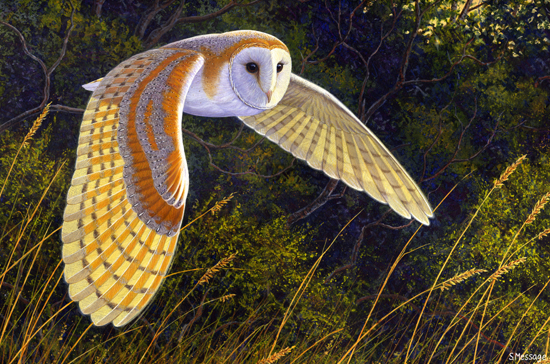
Over the course of my life, my relationship with wild animals has been radically different than with domesticated animals. The inherent otherness, the mystery created by distance and a sense of freedom, all give to my encounters with wild animals—from deer to snakes, mountain lions to hawks, butterflies to owls—a mixture of reverence and fear. This response, like that to the domesticated farm animals, seems to arise out of a pre-given intuition of hierarchy. The wonder I feel at the glimpse of an animal whose presence is fleeting seems to inform me that I am not an equal to this being. Indeed, in my human ordinariness I am not at the pinnacle of any hierarchy. Perhaps this is the reason that animals are able to become religious and spiritual symbols for the human species: they are beings that live outside the realm of common day. They can run from us, hide, attack, or ignore. They do not come when called because we have never been told their names.Barn Owl

But what of the miracle, the delight, when one of these beings does respond to our attempts at communication? It is as though a god has peered back at you, as though you could speak a language you did not know already resided in your heart, in your blood, in the beating rhythm of your consciousness. When a deer takes a step toward you rather than away, when a hawk looks you straight in the eye, a butterfly comes to a quiet rest in your palm, or an owl clings to the ledge of your kitchen window while beating his wings against the glass as though he has an urgent message only you can hear, somehow the distance between human and animal has been bridged. Remember me, their voices seem to say. Remember yourself. We both come from each other.

Trees: When Property Is Divided

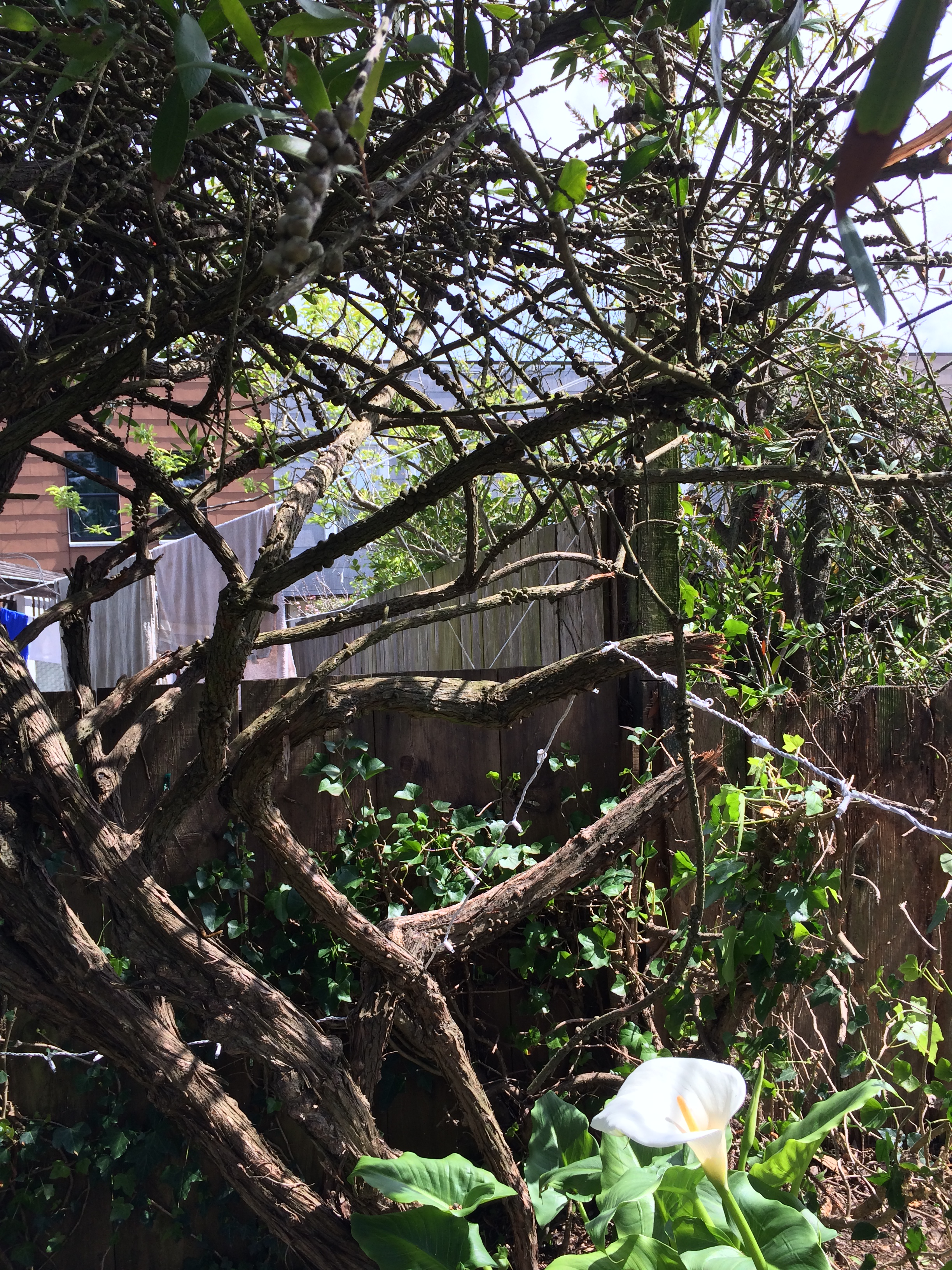
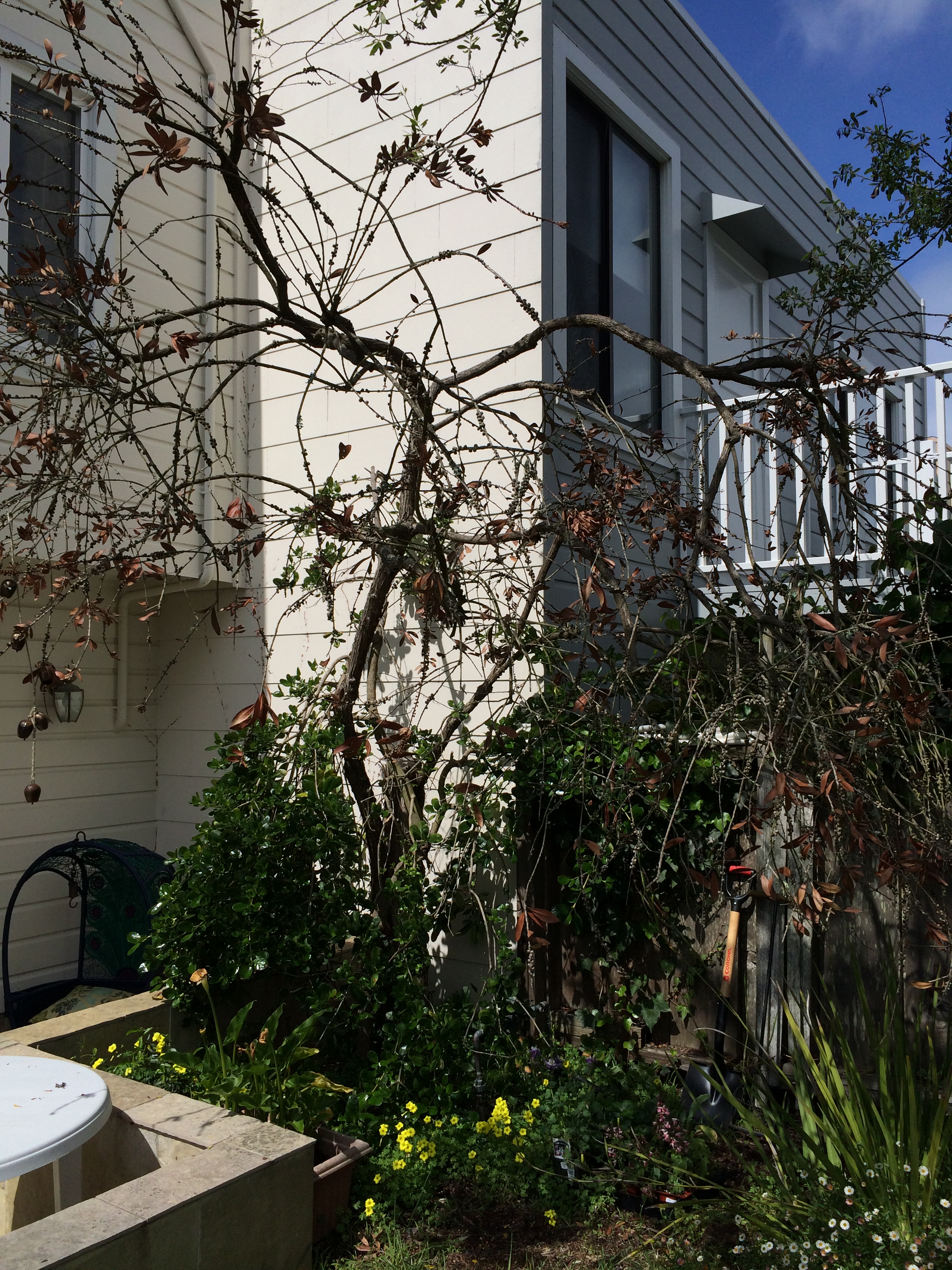
This morning I awoke to the sound of the fence in my back garden being torn down. Stepping outside I saw the ivy growing along both sides of the fence had been ripped away, and the two trees that grow directly against the fence had had their branches severed directly along the property line. Although the trunks of these trees stand on our side of the fence, because our garden is north of the neighbor’s the trees have grown with their branches reaching south toward the sunlight, and a significant amount of each tree had been wantonly removed. After some research I learned that everything that had transpired was legal, unless the trimming of the trees eventually causes them to die. How might this situation have unfolded differently if trees themselves were accorded their own rights, and their legal standing was not contingent upon the rights of the owners on whose land they grow?

Cut Bottlebrush Tree

In California a tree is the property of the person on whose land the trunk is growing, even if the majority of the branches extend across a neighboring property line. Legally the neighbor may trim the branches on their property so long as it does not inflict fatal damage to the tree. Although in most states the deliberate injury of a tree is not a crime, in fifteen states including California the intentional damaging of a tree can lead to arrest, fines, or even jail time. However, such damage is not usually prosecuted in residential situations and most often pertains to commercial timber or Christmas tree operations.

The owner of a tree may be compensated if the tree is harmed to the point of fatal damage. Such compensation is to cover the cost of the removal of the dead tree and the replanting of a new one, any loss to the property value that the tree’s loss may incur, and any out-of-pocket expenses paid by the owner in an attempt to save the injured tree. In rare situations the owner may also be compensated for aesthetic loss or mental anguish caused by the tree’s damage or destruction. However, this point is not usually argued if the aesthetic damage to the tree has only occurred where the tree’s branches have crossed the neighboring property line.

All of these laws are based on the premise that land, and the vegetation growing upon it, can be owned by human beings. The autonomy of the tree is not taken into account because the tree is not legally recognized as having its own right to grow. Furthermore, individual trees are also part of a larger ecosystem, providing home and habitat to numerous creatures whose lives will be disturbed and even destroyed if significant portions of a tree are severed. Invisible property lines do not enter into the consciousness of tree organisms and those in symbiotic relationship with them, yet they are punished for trespassing nonetheless, often resulting in harm to their integrity as whole beings. Interestingly, a tree whose trunk stands directly within a property boundary but whose branches cross the property line is more likely to be subject to damage than a tree whose trunk sits upon the property line itself. In the latter case the tree—called a boundary tree—is then the shared property of the neighbors and all care and decisions regarding said tree must be discussed between the property owners before any pruning or removal decisions can be made regarding the tree.

Cut Manzanita Tree
Cut Manzanita Tree

In the biblical story of Solomon and the child, two mothers are arguing over ownership of a child, each claiming to be his mother. Solomon’s solution is to divide the child in half with a sword so each mother may have her equal share. The true mother of the child gives up her claim so that the child might live, and thus has her child returned to her whole and well by Solomon. In the case of a tree it seems a similar argument could be made: the wholeness and integrity of the living, growing tree should be taken into account rather than dividing it, and damaging its potential to live as a whole organism, based on the desires of the humans laying claim to, or authority over, parts of it.

If trees were accorded their own rights and legal standing, and were recognized by law to be autonomous individuals no matter where they grow, then decisions regarding the pruning of the tree would likely have to be made by committee, or with a human individual representing the desires of the tree. The example of the boundary tree, in which all neighbors whose property the tree touches are responsible for its care and well-being, seems like a possible compromise for how to deal with trees whose branches, but not trunk, cross a property line. But in the long term it seems a shift in world view is needed in which the rights of autonomous individuals are according not only to human beings but to the many diverse species that make up our Earth community.

Previously Trimmed and Now Deceased Bottlebrush Tree

Bibliography

Nolo: Law for All. “California Law on Property Disputes Between Neighbors.” Accessed March 27, 2014. http://www.nolo.com/legal-encyclopedia/california-laws-neighbor-property-disputes-65220.html

Nolo: Law for All. “Trees and Neighbors FAQ.” Accessed March 27, 2014. http://www.nolo.com/legal-encyclopedia/trees-neighbors-faq-29134-2.html

Nolo: Law for All. “When A Neighbor Damages Or Destroys Your Tree.” Accessed March 27, 2014. http://www.nolo.com/legal-encyclopedia/neighbor-tree-damage-46933.html

The Red Book and the Red Book: Jung, Tolkien, and the Convergence of Images

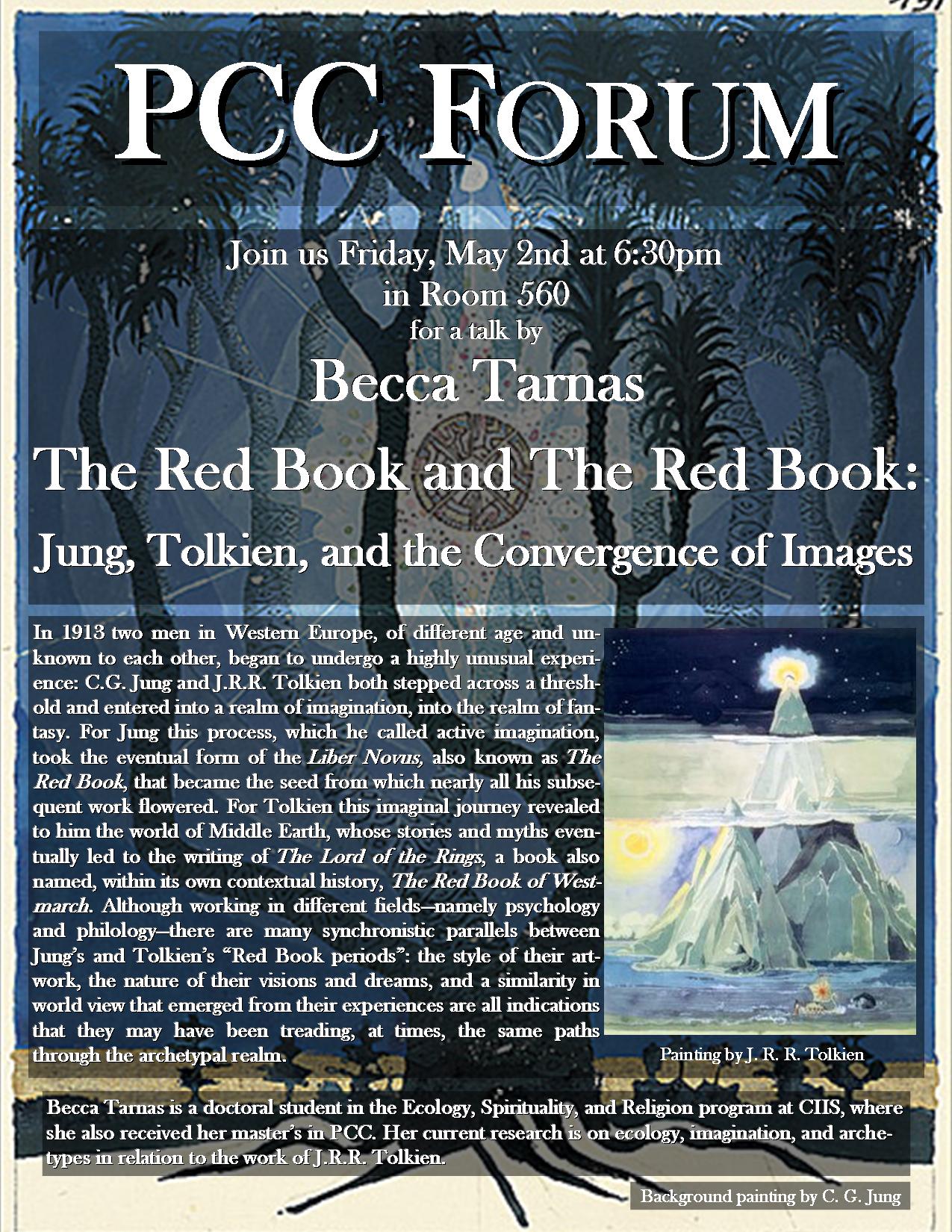
This semester I am undertaking an independent study in which I will be exploring The Red Book of Carl Gustav Jung and bringing it into dialogue with what J.R.R. Tolkien called The Red Book of Westmarch, the fictional narrative that became the key books of his Middle-Earth legendarium, The Hobbit and The Lord of the Rings. Jung’s Red Book period began in 1913, the same year that Tolkien began his own practice of active imagination in his illustrated book entitled The Book of Ishness. Using additional material from both Jung and Tolkien, as well as contemporary secondary sources, in conjunction with some of the insight provided by archetypal astrology, I will explore the similarities (and significant differences) between what was emerging through both of these men’s creative imaginations.

I will be culminating the independent study with a paper that I will post on this website, and with a PCC Forum lecture that will be filmed and also posted. If anyone has source material or other recommendations for this project I would greatly appreciate the feedback!

Jung and Tolkien

Preliminary Bibliography

C.G. Jung – The Red Book

C.G. Jung – The Basic Writings of C.G. Jung

C.G. Jung – Memories, Dreams, Reflections

C.G. Jung, Meredith Sabini (ed.) – The Earth Has A Soul: The Nature Writings of C.G. Jung

J.R.R. Tolkien – The Lord of the Rings

J.R.R. Tolkien – The Hobbit

J.R.R. Tolkien – The Silmarillion

J.R.R. Tolkien – The Letters of J.R.R. Tolkien

J.R.R. Tolkien – The History of Middle-Earth

Humphrey Carpenter ­– J.R.R. Tolkien: A Biography

Wayne G. Hammond & Christina Scull (ed.) – J.R.R. Tolkien: Artist & Illustrator

Verlyn Flieger – A Question of Time: J.R.R. Tolkien’s Road to Faerie

Lance Owens – J.R.R. Tolkien: An Imaginative Life – A Series of Three Illustrated Lectures (Audio)

Following the Day Star

“To philosophize is to learn how to die.”
– Cicero

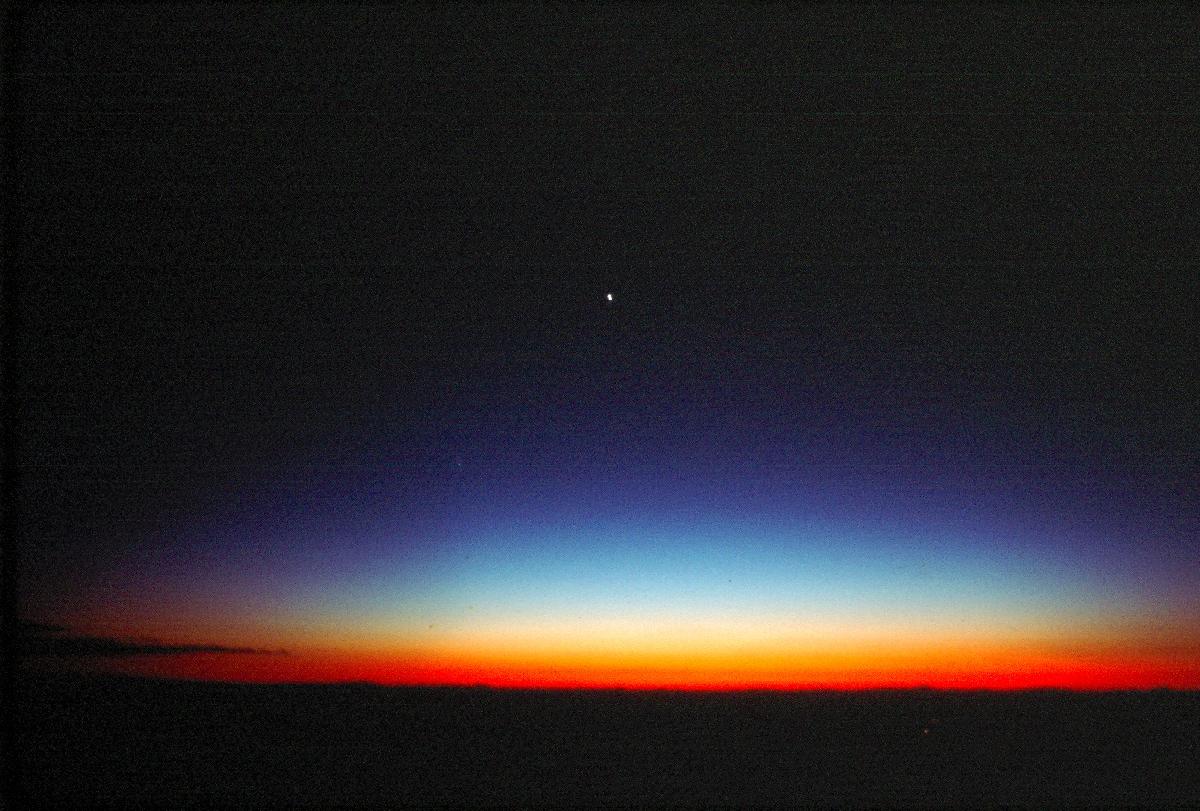
Night comes softly following the glory of sunset. The sun dies in a blaze of color, hues of gold and magenta, blood orange and dusty rose. When the sun sinks below the horizon it is as though it has taken hold of all the colors of the waking world and pulled them from out of the landscape, like dye extracted from cloth, and trailed them in streaming splendor toward the dying sun. The landscape bleeds out its colors, fading to a twilight gray, while the dying ember of the sun shines forth in one final burst of magnificence. At last, when the day star appears to sink beneath the wine-dark horizon, the colors depart with it, the inky black of night oozing out across the open canvas of the sky.

Moon and Venus SunsetWait patiently. The liminal space seems to be most still now, in this time that is neither day nor night. The world seems to hold its breath. Then, with a gasp of wonder, the dusk is pierced by the first white star of the evening. It is there, where it was not a moment before, yet the exact moment it appeared is unknown. In cooling quiet the sky bedecks herself in jewels, webs and nets of storied interconnection, shapes that have walked the sky since before ever human eyes beheld their patterns.

Socrates drank the hemlock at sunset.

No sunset is ever the same. If you are present to witness one, you cannot bring yourself to look away. The sunset is like a moment out of time; yet it is the moment that makes time be as well.

In the period of time right before to his execution, Socrates spoke to his students of the rhythms of life and death. “Well then,” he spoke, “is there an opposite to living, as sleeping is the opposite of being awake?” “Being dead,” one student answers.[1]

Sleep follows waking, waking follows sleep. Dawn comes after each long night. Does death too birth into new life? How can we know? How do we prepare ourselves for our own sunset, the inevitable ending of this life? Plato’s dialogue Apology tells of the trial and condemnation of Socrates, in which he says

To fear death, gentlemen, is no other than to think oneself wise when one is not, to think one knows what one does not know. No one knows whether death may not be the greatest of all blessings for a man, yet men fear it as if they knew that it is the greatest of evils.[2]

Here Socrates claims that no one knows if death is a great blessing, yet in the dialogues that lead up to his inevitable demise he seems to have an increasingly clearer understanding that death is indeed a gift.

Many of Plato’s dialogues carry implicitly the theme of death in their tone and setting. Plato was just crossing into his third decade of life when his teacher Socrates was condemned to death by the city of Athens. He did not begin writing the dialogues until some time after the execution of his mentor, but the impression of that pivotal moment underlies nearly every dialogue composed. Socrates’ death is imprinted upon each of Plato’s dialogues as words and images are upon the face of a wax tablet. Other philosophies may be engraved over the initial impression, but through the palimpsest can often be read the echo of this early, defining tragedy.

In the Republic, as Socrates and his students are choosing how best to educate the future guardians of their ideal city, they decide the young guardians should “be told stories that will make them least afraid of death.”[3] Socrates begins reciting lines that must be expunged from the poetry of Greek tradition, censoring and editing to find the tales that will shape the future guardians into the philosopher-kings they are meant to become. But in his dialogues Plato is not only editing the old myths; he is bringing forth new myths as well, illustrating them with images that have since been impressed up the philosophic imagination of the Western world for two and a half thousand years.

While some dialogues literally recount the story of Socrates’ trial, imprisonment, and execution, others carry the weight of his death more symbolically. The Republic opens with Socrates saying “I went down to the Piraeus yesterday. . .” in language echoing Odysseus’s “I went down to Hades” in Homer’s epic. One of the first characters we meet is the aging Cephalus, who seems rapidly to be approaching death. Yet the dramatic date of the dialogue is set some twenty to thirty years after the historical Cephalus passed away. Plato’s dialogue is evidently not taking place in the land of the living.

At Socrates’ request Cephalus begins speaking of what it is like to approach death:

When someone thinks his end is near, he becomes frightened and concerned about things he didn’t fear before. It’s then that the stories we’re told about Hades, about how people who’ve been unjust here must pay the penalty there—stories he used to make fun of—twist his soul this way and that for fear they’re true . . . . he is filled with foreboding and fear, and he examines himself to see whether he has been unjust to anyone.[4]

These are the stories that Socrates later refers to that he wishes to censor: stories that ignite a fear of death. Yet it is these very stories that inspire an examination of justice in one’s life. Does not this indicate that the stories do some good?

In the Phaedo, the dialogue that ends in Socrates’ execution, the philosopher says to his gathered students, “I am not so resentful, because I have good hope that some future awaits men after death, as we have been told for years, a much better future for the good than for the wicked.”[5] Here too, Socrates gives reference to myths of Hades for his understanding of the underworld. But Socrates also has his own assurance that death is the right course for him, that it is nothing to fear. During his trial, as laid out in the Apology, he refers to his “familiar sign,” the daemon that accompanies and guides his actions by negating what he ought not to do. Socrates comes to find that his daemon has not opposed anything that he said during his trial.

What do you think is the reason for this? I will tell you. What has happened to me may well be a good thing, and those of us who believe death to be an evil are certainly mistaken. I have convincing proof of this, for it is impossible that my familiar sign did not oppose me if I was not about to do what is right.[6]

His absolute trust in the guidance of his daemon is remarkable. This assuredness appears to come from an inherent trust Socrates has in the way he has spent his life; if the guidance of the daemon has led him to follow a just life, this guidance must be true. Furthermore, his daemon is one whom Socrates chose himself, if indeed the myth that ends the Republic is meant to be read in such a way. As depicted in the Myth of Er, reincarnating souls choosing their next lifetimes are told “Your daemon or guardian spirit will not be assigned to you by lot; you will choose him.”[7] The guidance one receives in life is freely chosen by each individual before birth.

In the Phaedo, Socrates refutes the idea that there might be but a single path to Hades. Rather, he says,

I think it is neither one nor simple, for then there would be no need of guides; one could not make any mistake if there were but one path. As it is, it is likely to have many forks and crossroads; and I base this judgment on the sacred rites and customs here.[8]

The many paths to Hades can also be read symbolically: there are many paths one can choose in life; if there were but one then leading a just life would not be a free decision made with the help of one’s chosen daemon, rather it would be predetermined and unchangeable. One’s lot would be cast and there would be naught to strive for.

Within the prison Socrates tells his gathered followers that “The one aim of those who practice philosophy in the proper manner is to practice for dying and death.”[9] Considering all that philosophy seems to cover in its practice, this statement carries significant weight. But Socrates goes on to explain exactly what he means by this statement. He defines death, saying that it is, “namely, that the body comes to be separated by itself apart from the soul.”[10] The action of the philosopher is to contemplate the divine Forms or Ideas, and to do this he must reach for the Ideas not with his bodily senses but through thought alone, with the soul. The philosopher is therefore in a state most closely related to death, a separating of the soul from the body.

If we are ever to have pure knowledge, we must escape from the body and observe things in themselves with the soul by itself. It seems likely that we shall, only then, when we are dead, attain that which we desire and of which we claim to be lovers, namely, wisdom.[11]

As a philosopher, Socrates does not claim to ever have attained wisdom, and here we see that he does not believe it to be possible while one is alive and incarnated in physical form. Yet not much earlier in this same dialogue he emphasizes to his disciples that one must not end one’s life to attain the wisdom that is accessible after death. “There is the explanation that is put in the language of the mysteries,” he says, “that we men are in a kind of prison, and that one must not free oneself or run away.”[12] A reason exists for incarnation, for this being one with a body.Venus Sunset

The Myth of Er in the Republic tells of how souls after death are led to heaven or hell and, after a specific amount of time in one or the other place, are brought forth again to choose new lives and to be born anew. Socrates notes that most of the souls who come from heaven choose less virtuous lives due to their ignorance, while those souls ascending from their time in hell are able to choose more wisely because of the suffering they have witnessed and experienced.[13] Only the philosopher is able to choose a virtuous life and also enjoy the rewards of heaven. By studying philosophy, Socrates says,

he will be able, by considering the nature of the soul, to reason out which life is better and which worse and to choose accordingly, calling a life worse if it leads the soul to become more unjust, better if it leads the soul to become more just, and ignoring everything else: We have seen that this is the best way to choose, whether in life or death.[14]

The philosopher’s ability to discern a good life is presumably because, as said in the Phaedo, it is only after death that one is able to directly perceive the Forms and to attain wisdom. Yet it seems that not any soul is able to attain wisdom after death, otherwise all of the other souls coming from heaven to choose their new lives would not be plagued by ignorance and choose difficult new lives. Plato seems to be indicating that it is only one who has been a philosopher in life that has the ability after death to reach wisdom.

Plato has often been accused of being a dualist who denies the value of the body, instead privileging the soul and the abstract realm of the Forms. While a soul-body dualism seems to be implicit in Plato’s dialogues, the utter denial of the body may not be a full reading of Plato’s project. The philosopher in life is not one who has attained wisdom; he is a lover of wisdom and not in possession of it. Only by being a philosopher, one who loves but does not possess wisdom, can one choose a just life when one reincarnates. And it is only by being in a body, and therefore at a certain distance from the Forms, that one can actually become a philosopher.

The doctrine of the Forms indicates that an archetype exists for each thing that we experience in the earthly realm, from the more concrete Ideas of Bed, Horse, and Tree, to the more abstract Ideas of Justice, Truth, and the Good. Would this not also indicate that there must be an Idea for Death? Is there an archetypal expression of the mysterious transition that ends all lives? In the ancient Greek world Cronus, later to be named Saturn by the Romans, was the god of Time who ruled endings, mortality, finitude, old age, and death. Saturn was the outermost planet known to the ancients, the furthest celestial body visible to the naked eye. Saturn was the guardian of the threshold, the last circle of the wandering planets inside the crystalline sphere of the fixed stars that encircled the cosmos.

The nature of the Forms is such they can be approached by the philosopher in thought, but never attained while he lives. So too it is with death, that direct knowledge of death is unattainable while alive; as one is dying one comes ever closer to death, yet does not ever fully know what it is until one has actually died. Just as Saturn represents the guardian of the threshold, death too may be such a guardian, standing at the gateway to the realm of Forms: the first Form to be attained by the soul may be Death itself.

How then does one spend one’s life preparing to cross this threshold, cultivating the philosophic way of life? If, as Socrates said in the Phaedo, there is a mirroring between sleeping and waking, death and life, what further insight can be drawn forth from these parallels? After death Socrates says we are released from our bodies and the soul is able, without hindrance, to contemplate the eternal Forms. In embodied life the philosopher strives for the Forms in thought, never fully attaining them but coming ever closer with practice. In the Apology Socrates describes what he sees as the two options for what comes after death: “either the dead are nothing and have no perception of anything, or it is, as we are told, a change and a relocating for the soul from here to another place.”[15] Death is either “like a dreamless sleep”[16] or a “change from here to another place”[17] where one would encounter the “true jurymen who are said to sit in judgment there” and the “other demi-gods who have been upright in their own life.” [18] If death is the former, Socrates says “it is an advantage, for all eternity would then seem to be no more than a single night”[19] and if it is the latter he says, “I am willing to die many times if that is true.”[20] In the parallel between sleep and death, if the former is like a dreamless sleep then the latter, in which one meets gods and heroes, and encounters the realm of eternal Ideas, may be likened to a night rich with dreaming in which one encounters images strange and familiar, beings of all kinds from humans and animals, to mythic creatures, the living Earth, and gods and deities. Dreaming too is like entering into a realm of archetypes.

If death can be likened to entering a realm of dreams, what is it that the philosopher does in life to bring himself closer to that realm? The philosopher contemplates the eternal Forms, but what does this in practice look like? In the Symposium, as Socrates and Aristodemus are walking to the home of Agathon for dinner, Socrates begins to get lost in thought. “As they were walking, Socrates began to think about something, lost himself in thought, and kept lagging behind. Whenever Aristodemus stopped to wait for him, Socrates would urge him to go on ahead.”[21] When Aristodemus arrives Agathon asks of him, “‘But where is Socrates? How come you didn’t bring him along?” So I turned around (Aristodemus said), and Socrates was nowhere to be seen.”[22] Once Socrates has been located, standing still in contemplation on a neighbor’s porch, Aristodemus says, “‘Leave him alone. It’s one of his habits: every now and then he just goes off like that and stands motionless, wherever he happens to be. I’m sure he’ll come in very soon, so don’t disturb him; let him be.”[23] What is it that Socrates is doing? He is clearly lost in thought, but to a degree beyond what most people do. He has the air of one lost in a dream but in waking life; perhaps in contemplating the realm of eternal Forms the philosopher becomes a daydreamer, meditating upon dreams more real than common life.

The Symposium takes place over the course of a single night, the story bookended by sunset and sunrise. Socrates is the only one to stay awake through the entire course of the night, departing quietly at dawn to go about his day. Within the narrative of the dialogue, another story is told of Socrates when he slips into one of his daydreaming states. The tale, spoken by Alcibiades, is worth quoting at length, as it gives a beautiful character picture of Socrates, this man who “as a whole . . . is unique; he is like no one else in the past and no one in the present—this is by far the most amazing thing about him.”[24] So Alcibiades describes:

One day, at dawn, he started thinking about some problem or other; he just stood outside, trying to figure it out. He couldn’t resolve it, but he wouldn’t give up. He simply stood there, glued to the same spot. By midday, many soldiers had seen him, and, quite mystified, they all told everyone that Socrates had been standing there all day, thinking about something. He was still there when evening came, and after dinner some Ionians moved their bedding outside, where it was cooler and more comfortable (all this took place in the summer), but mainly in order to watch if Socrates was going to stay out there all night. And so he did; he stood on the very same spot until dawn! He only left next morning, when the sun came out, and he made his prayers to the new day.[25]

The imagery of the sun in this story is prominent, with the period of thought or daydreaming beginning at dawn and not reaching completion until the following sunrise. In the Republic, Socrates gives the image of the sun as a metaphor for the Good. “This is what I called the offspring of the good,” he says, “which the good begot as its analogue. What the good itself is in the intelligible realm, in relation to understanding and intelligible things, the sun is in the visible realm, in relation to sight and visible things.”[26] But, from an earthly perspective, the sun dies every night, descending below the horizon in a flaring forth of color. The sun pulls the clear definition of all that has illuminated, the bright hues of the landscape, into the underworld with it. To follow the images of the sun we must dream, or learn to contemplate them in thought or dialogue through the night.

Socrates, the only member of the Symposium to stay awake through the entire night, was in the same way caught in thought all through the long night during the summer campaign of which Alcibiades speaks. The work of the philosopher takes place within the embodied realm, for once he has passed the threshold of death he is no longer a lover of wisdom; he has attained wisdom and is no longer a practitioner of philosophia. To be a philosopher is to prepare to cross the threshold of death by always striving to remain in a state closest to death. Thus Socrates, the true lover of wisdom, stays awake through the night to try to consciously understand the Forms in their completeness, so he might recognize them once he too crosses with the Sun below the horizon. “As long as I draw breath and am able,” he says in the Apology, “I shall not cease to practice philosophy.”[27]

The death of Socrates was a literal event in the life of Plato, but the dialogues that poured forth afterwards are a mythological eulogy that has elevated Socrates from human status to that of mythic daemon, a mentor and conscience to guide the dawning philosophical tradition as it walked across Greece’s borders and began its criss-crossing journey throughout the Eurasian continent, leading it eventually to cross the encircling seas and make its wanderings throughout other continents as well.

Socrates was executed at sunset. It is those who remain who are asked to contemplate the long night. It is those who remain who must await the dawn. But in that quiet twilight moment between the sun’s departure and the descent of dark night, we wait for the arrival of that first shining star, the wanderer who appears in the metaxic realm of dusk. As night deepens, the star known by the ancients to be the shining symbol of Love blazes forth ever brighter in the darkening western sky. Never far from the sun, this brightest of planets circles sometimes closer, sometimes further from the celestial image of the Good. It stands as a guide for those called to follow, to be lovers also of wisdom.

“Evening star, you bring all things
which the bright dawn has scattered . . .”
– Sappho

 Moon, Venus, Jupiter

Work Cited

Plato. Plato: Complete Works. Edited by John M. Cooper. Indianapolis, IN: Hackett, 1997.


[1] Plato, Phaedo, trans. G.M.A. Grube, in Plato: Complete Works, ed. John M. Cooper (Indianapolis, IN: Hackett, 1997), 62, 71c.

[2]Plato, Apology, trans. G.M.A. Grube, in Plato: Complete Works, ed. John M. Cooper (Indianapolis, IN: Hackett, 1997), 27, 29a-b.

[3] Plato, Republic, trans. G.M.A Grube, in Plato: Complete Works, ed. John M. Cooper (Indianapolis, IN: Hackett, 1997), 1022, 386a.

[4] Plato, Republic, 975, 330d-e.

[5] Plato, Phaedo, 55, 63c.

[6] Plato, Apology, 35, 40b-c.

[7] Plato, Republic, 1220, 617d.

[8] Plato, Phaedo, 92, 108a.

[9] Plato, Phaedo, 55, 64a.

[10] Ibid, 56, 64c.

[11] Ibid, 58, 66e.

[12] Ibid, 54, 62b.

[13] Plato, Republic, 1222, 619d.

[14] Ibid, 1221, 618d-e.

[15] Plato, Apology, 35, 40c-d.

[16] Ibid, 40d.

[17] Ibid, 40e.

[18] Ibid, 41a.

[19] Ibid, 40e.

[20] Ibid, 41a.

[21] Plato, Symposium, trans. A. Nehamas and P. Woodruff, in Plato: Complete Works, ed. John M. Cooper (Indianapolis, IN: Hackett, 1997), 460, 174d-e.

[22] Plato, Symposium, 460, 174e.

[23] Ibid, 461, 175b.

[24] Plato, Symposium, 503, 221c.

[25] Ibid, 502, 220c-d.

[26] Plato, Republic, 1129, 508b.

[27] Plato, Apology, 27, 29d.

Crossing the Threshold: The Ecological Road into Mordor

Great stories become symbols as they are encountered again and again by successive generations, as they are read in the context of currently unfolding lives. Stories become a part of the ecology in which they are told, participating in shaping the cultural landscape and being reshaped by it as well. Homer, Plato, Dante, Shakespeare—these are but a few of the authors whose stories have withstood the slow wearing and reshaping of the passing river of time; they are narratives that have become changing symbols for those who have taken them up in their own time. J.R.R. Tolkien’s Middle-Earth legendarium, principally his Lord of the Rings epic, has been called by several scholars a myth for our time, a symbol of the age in which we live. As one Tolkien scholar writes, The Lord of the Rings is a tale that “will bear the mind’s handling, and it is a book that acquires an individual patina in each mind that takes it up, like a much-caressed pocket stone or piece of wood.”[1] Such is the gift of a story written not as prescriptive allegory, but rather as what Tolkien preferred to see as “history, true or feigned, with its various applicability to the thought and experience of readers.”[2] It is the flexible applicability of Tolkien’s narrative that allows it to be adapted and molded according to the needs and desires of the generations encountering it, providing a symbolic foil to the world in which it is being retold.

Artwork by Christoffer Relander.

Tolkien began writing his mythology during a time of rapid transformation in Europe, as he witnessed increasing industrialization overwhelm the rural landscape of his native England. His stories carry much of the melancholy rendered by this loss of ecological beauty, and seem to plant seeds of warning for upcoming generations as more and more of the Earth’s landscapes are being turned to solely human uses. The ecological awareness at the heart of Tolkien’s world may contribute to its particular applicability to the current time period in which we face massive anthropogenic ecological destruction. Methods of engagement with the ecological crisis are innumerably diverse, a reflection of the broad scale of the problems with which the Earth community is challenged. Philosophical approaches to ecology and environmentalism have sought different means of engaging with the very concept of nature, as well as the dualisms created between human and nature, self and other, subject and object, that have contributed to making the Earth crisis what it is. Can Tolkien’s tales of Middle-Earth provide a symbolic mirror for some of these approaches, from ecofeminism, to dark ecology, to process ethics? By bringing such frameworks into dialogue with narrative, can new concepts be born through their interminglings and diversions?

This study of Middle-Earth as an ecological foil will go in several different directions, although they will all address overlapping issues related to how concepts of unity and difference play significant roles in the human relationship to the Earth. I will be using Tolkien’s narrative in two ways: on the one hand, by looking at it from the outside to see how it might change the engagement of the reader—as a participant in an imaginal world—with the primary world in which she lives; and on the other hand, by diving into the world itself and studying the characters directly as examples of individuals engaging in different ways with their own world. I will first explore the role art plays in shaping the human relationship with the Earth, seeing how art can both cultivate a sense of identity with the natural world, but also how it can give a clearer view of the diversity and inherent difference in that world. Crossing the threshold and entering into Middle-Earth itself we can continue exploring themes of identity and difference, remoteness and entanglement, duality and unity, by bringing such thinkers as Timothy Morton, Val Plumwood, Pierre Hadot, Slavov Zizek, and Alfred North Whitehead into dialogue with Tolkien’s work.

Imaginal worlds and the stories which take place within them can provide what Tolkien calls a “recovery,” a “regaining of a clear view.”[3] He goes on to elaborate what such a clear view can offer, saying:

I do not say “seeing things as they are” and involve myself with the philosophers, though I might venture to say “seeing things as we are (or were) meant to see them”—as things apart from ourselves. We need, in any case, to clean our windows; so that the things seen clearly may be freed from the drab blur of triteness or familiarity—from possessiveness.[4]

Although he mentions not wanting to involve himself with the philosophers, for the purpose of this essay I will be drawing Tolkien’s narratives into philosophical dialogue. The ecophenomenologist Neil Evernden offers a complementary, although somewhat reoriented, view to Tolkien’s on the role that art and the humanities can play in ecology: quoting Northrop Frye to make his point, Evernden says, “the goal of art is to ‘recapture, in full consciousness, that original lost sense of identity with our surroundings, where there is nothing outside the mind of man, or something identical with the mind of man.’”[5] Evernden’s perspective dissolves the boundary between the human and the natural world, whereas Tolkien’s sharpens awareness that there is a surrounding world that cannot be possessed by the human. Both perspectives, however, lead to a reorientation of values in which the natural world cannot become forgotten or taken for granted. They both call forth a sense of wonder.

The French philosopher Pierre Hadot points towards how art can create continuity between humanity and nature, offering another perspective for regaining the clear view of which Tolkien speaks:

If . . . people consider themselves a part of nature because art is already present in it, there will no longer be opposition between nature and art; instead, human art, especially in its aesthetic aspect, will be in a sense the prolongation of nature, and then there will no longer be any relation of dominance between nature and mankind.[6]

Art offers to the spectator the possibility of becoming a participant, to engage at a personal level with the subject as portrayed by the work of art. The human subject can no longer encounter the other in the art as solely objective for, as Evernden writes, “The artist makes the world personal—known, loved, feared, or whatever, but not neutral.”[7] For Tolkien, art is what gives to the creations of the imagination “the inner consistency of reality”[8] that allows both the designer and spectator to enter into the created world. We have the possibility of entering fully into a world such as Tolkien’s and seeing its applicability to our own world, which is what makes it such a potent symbol for our own actions.

Entering into Middle-Earth we find ourselves in the Shire, the quiet, sheltered landscape inhabited by Hobbits. The Shire is insolated from the outside world, its inhabitants peacefully oblivious to the wider world, its borders guarded unbeknownst to the Hobbits by human Rangers of the North. The Lord of the Rings can be seen as a literary example and metaphor of overcoming the dualism between self and other, human and nature, and subject and object. It tells the story of how four Hobbits leave their isolated world—and also world view—of the Shire to journey into the diverse landscapes of Middle-Earth and encounter the many peoples shaped by those lands. They realize they are but one small part of a larger, diverse ecology of beings. As Morton writes in his book Ecology Without Nature,

The strangeness of Middle-Earth, its permeation with others and their worlds, is summed up in the metaphor of the road, which becomes an emblem for narrative. The road comes right up to your front door. To step into it is to cross a threshold between inside and outside.[9]

Morton is quite critical of Tolkien, seeing Middle-Earth as an “elaborate attempt to craft a piece of kitsch,” a closed world where “however strange or threatening our journey, it will always be familiar” because “it has all been planned out in advance.”[10] This criticism is, in many ways, the exact opposite of what Tolkien describes the very aim of fantasy to be, to free things ‘from the drab blur of triteness or familiarity—from possessiveness.’ Is this an indication that Tolkien has failed in his project, or rather that Morton is misreading what it is that Tolkien is attempting to do? Morton begins his analysis of Middle-Earth by saying,

The Shire . . . depicts the world-bubble as an organic village. Tolkien narrates the victory of the suburbanite, the “little person,” embedded in a tamed yet natural-seeming environment. Nestled into the horizon as they are in their burrows, the wider world of global politics is blissfully unavailable to them.[11]

In many ways this is a true characterization of the Shire at the start of the tale. There is an idyllic pastoralism to the Shire that is cherished by many of Tolkien’s readers, but it is also a realm of sheltered innocence as Morton points out, a Paradise before the Fall. However, by substituting this image of the Shire for the whole of Middle-Earth, Morton misses an essential aspect of the narrative: the Hobbits must depart from the Shire and encounter the strangeness and diversity of the larger world. The Hobbits, who may start out as ‘little suburbanites,’ cannot accomplish the tasks asked of them without first being transformed through the suffering and awakening that comes from walking every step of their journey. To return to Morton’s quote about the Road, once the ‘threshold between inside and outside’ has been crossed, the traveler cannot return to his former innocence. It is a shift in world view. The Hobbits can never return to the solipsistic world that existed prior to that crossing. This is an essential move that is also being asked of the human species in our own time; to cross out of our anthropocentric world view to encounter the great and imperiled diversity of the wider world.

Artwork by Christoffer Relander.

While the Hobbits’ journey can serve as a metaphor for the journey the human species is being called to take—to awaken to the crisis at hand and leave our anthropocentric world view—The Lord of the Rings can be read symbolically from another perspective in which different characters represent alternative approaches to the natural world that have been taken by humanity over the course of history. These differing approaches have been laid out by Pierre Hadot in his “essay on the history of the idea of nature,” The Veil of Isis. Using mythic terms, these are what Hadot calls the Orphic and Promethean attitudes:

Orpheus thus penetrates the secrets of nature not through violence but through melody, rhythm, and harmony. Whereas the Promethean attitude is inspired by audacity, boundless curiosity, the will to power, and the search for utility, the Orphic attitude, by contrast, is inspired by respect in the face of mystery and disinterestedness.[12]

The three primary methods of the Promethean attitude, according to Hadot, are experimentation, mechanics, and magic, each of which seek to manipulate nature for some specific end. In Middle-Earth the Promethean approach is used by the Dark Lord Sauron, and later by the wizard Saruman, as they each seek to employ technology to gain power and dominion over others. Hadot writes of the Promethean attitude: “Man will seek, through technology, to affirm his power, domination, and rights over nature.”[13] As Treebeard says of Saruman, “He is plotting to become a Power. He has a mind of metal and wheels; and he does not care for growing things, except as far as they serve him for the moment.”[14] Saruman’s drive for power is a mere shadow and an echo of Sauron’s: the emblematic symbol of the power of technology in The Lord of the Rings is of course the One Ring itself, a device or machine that takes away the free will of those who use it.

Hadot’s consideration of magic as an aspect of the Promethean attitude is quite similar to Tolkien’s own views on magic, although this might not be expected with a first glance at his works. Tolkien differentiates between magic and enchantment, seeing magic as the technological manipulations of the Enemy, while enchantment is the exquisite creations of peoples such as the Elves. Tolkien writes in one of his letters that “the Elves are there (in my tales) to demonstrate the difference”[15] between magic and enchantment. He goes on to say, “Their ‘magic’ is Art, delivered from many of its human limitations: more effortless, more quick, more complete . . . . its object is Art not Power, sub-creation not domination and tyrannous re-forming of Creation.”[16] Elvish enchantment might be seen as an example of Hadot’s Orphic approach to nature, with its focus on poetry, music, art, holistic science, myth and contemplation.

The Orphic attitude holds the belief that “if nature has hidden certain things, then it had good reasons to hide them.”[17] It is an approach that seeks to come to understanding through contemplating the whole, without reducing it into simplistic parts. This is illustrated by the difference between the two Istari, or wizards, Gandalf the Grey and Saruman the White. In his bid for power, Saruman has renounced his rank as White Wizard rather to become Saruman of Many Colors. He mocks the symbol represented by his former color, proclaiming:

“White!” he sneered. “It serves as a beginning. White cloth may be dyed. The white page can be overwritten; and the white light can be broken.”

“In which case it is no longer white,” said [Gandalf]. “And he that breaks a thing to find out what it is has left the path of wisdom.”[18]

Saruman has moved from being one of the Wise, those who bring an Orphic approach to all they undertake, to a dark Promethean figure seeking domination, power, and control over others.

The attitudes Sauron and Saruman take towards the lands and peoples of Middle-Earth can be better understood through the ecofeminist Val Plumwood’s model of anthropocentrism, which she recognizes as the dominant human culture’s relationship with nature. Her language is particularly appropriate for mapping onto The Lord of the Rings because she refers to the dualism between One and Other as played out in this form of hegemonic centrism. In this symbolic mapping, the One represents the centralized power of the Lord of the One Ring, while the Other represents the diversity of the Free Peoples of Middle-Earth and their multiplicity of cultures and landscapes. Plumwood’s anthropocentric model demonstrates the ways in which the One approaches the Other, particularly through means of homogenization, backgrounding, incorporation or assimilation, and instrumentalism. A breakdown of these terms follows, each of which can be seen in the way Tolkien’s dark powers seek to dominate and control the peoples of Middle-Earth:

• Homogenization – “The model promotes insensitivity to the marvelous diversity of nature, since differences in nature are attended to only if they are likely to contribute in some obvious way to human welfare.”[19]

• Backgrounding – “Nature is represented as inessential and massively denied as the unconsidered background to technological society.”[20]

• Incorporation (Assimilation) – “The intricate order of nature is perceived as disorder, as unreason, to be replaced where possible by human order in development, an assimilating project of colonisation.”[21]

• Instrumentalism – “In anthropocentric culture, nature’s agency and independence of ends are denied, subsumed in or remade to coincide with human interests, which are thought to be the source of all value in the world. Mechanistic worldviews especially deny nature any form of agency of its own.”[22]

Sauron seeks to turn all of Middle-Earth to his own devices, by reducing the great diversity of the land’s peoples to mere tributes and instruments. The power of the One Ring is that it can bring all beings, even the land itself, under its dominion: “One Ring to rule them all and in the darkness bind them.”[23] Sauron’s darkness is homogenous, erasing all difference, backgrounding all who do not fit his plans, and incorporating and using as instruments those who do.

The key actions to the three great victories accomplished by the Free Peoples of Middle-Earth are carried out by characters or races that have been forgotten or backgrounded in just the way Plumwood describes: Sauron is overthrown by the actions of Frodo and Sam, two small Hobbits of a race he considered too unimportant to account for in his schemes; Saruman is defeated by the Ents whom he dismissed as mere myth; and the Witch-King of Angmar is overthrown by the shieldmaiden Eowyn, whose coming was concealed by the patriarchal language that referred to her entire race as Men—leaving the arrogant Lord of the Nazgûl to be defeated at the hands of a woman. As Elrond says at the Council held in Rivendell that decides the fate of the Ring, “This quest must be attempted by the weak with as much hope as the strong. Yet such is oft the course of deeds that move the wheels of the world: small hands do them because they must, while the eyes of the great are elsewhere.”[24]

There are, of course, flaws with Tolkien’s work that a perspective such as Plumwood’s would be quick to point out. For example, it is a largely androcentric work, with the majority of the characters being male. It also has a Eurocentric focus, as Middle-Earth was intended by Tolkien to be set in Europe, although in an imaginary time: “The theatre of my tale is this earth,” Tolkien wrote in one letter, “the one in which we now live, but the historical period is imaginary.”[25] Critics such as Morton point out that “For Tolkien, dwarves, elves, hobbits, and talking eagles are welcome others, but swarthy ‘southern’ or ‘eastern’ men are not.”[26] Although I do not want to discount these valid criticisms, I will point out some subtleties that emerge in the text that complexify Morton’s simple rendering of good and evil in Tolkien’s world.

For example, when Sam witnesses the violent death of a Southron man he finds himself contemplating what the character of this man might have been in life.

He was glad he could not see the dead face. He wondered what the man’s name was and where he came from; and if he was really evil of heart, or what lies or threats had led him on the long march from his home; and if he would not really rather have stayed there in peace.[27]

In this moment I believe Tolkien is asking the reader to contemplate the same: to not take the presentation of the other at face value, but rather to look deeper. He is bringing moral complexity into a story that has often been initially perceived to present a Manichean vision of evil and good. Often the struggle between good and evil takes place within a single person, as can be seen emblematically in Frodo and Sméagol’s internal struggles with their own potential for evil, and even Gandalf and Aragorn’s wrestling with the corrupting influence of power. “Nothing is evil in the beginning,” Elrond says. “Even Sauron was not so.”[28]

One’s actions, and not one’s inherent being, are what turn a person evil in Tolkien’s world. The process philosopher Alfred North Whitehead, writes on the nature of evil and its root in inhibiting, either through violence or neglect, the potential for beauty in the world. For Whitehead, the evil of violence “lies in the loss to the social environment.”[29] He also writes,

Evil in itself leads to the world losing forms of attainment in which that evil manifests itself . . . . Thus evil promotes its own elimination by destruction, or degradation, or by elevation. But in its own nature it is unstable.[30]

An example of this can be seen at times throughout The Lord of the Rings when the Orcs, acting as evil minions doing the bidding of Sauron or Saruman, turn on each other during a dispute and often end up killing one another in their anger—often eliminating a danger otherwise needing to be faced by the protagonists. As Brian Henning writes, “Whitehead’s insight is that violence and force tend to be self-defeating in that they undermine the very social structures that make them possible.”[31] Another case is Saruman, who cuts the trees of Fangorn to feed his fires, allowing him to raise an industrial army. Without doing this harm, which is what makes him evil to begin with, he would not have triggered the anger of the Ents, leading to his defeat. Finally, a more abstract illustration of how evil undermines itself can be seen in Sauron. Gandalf says of Sauron that “the only measure that he knows is desire, desire for power; and so he judges all hearts. Into his heart the thought will not enter that any will refuse it, that having the Ring we may seek to destroy it. If we seek this, we shall put him out of reckoning.”[32] Sauron’s desire for power, which is what initially corrupts him and turns him evil, is also that which is his undoing, for it blinds him to the moral will of others, resulting in his utter demise.

One must be careful of the way in which one relates to the actions of evil in the world. Creating a dualism between oneself and what one sees as evil can lead to what Hegel, from the perspective of Morton, called the Beautiful Soul. Morton writes, “The Beautiful Soul suffers from seeing reality as an evil thing ‘over yonder.’ Is this not precisely the attitude of many forms of environmentalism?”[33] He goes on to say,

It’s that the gaze that constitutes the world as a thing ‘over yonder,’ is evil as such. The environmental fundamentalism that sees the world as an essential, living Earth that must be saved from evil, viral humans is the very type of the Beautiful Soul’s evil gaze.[34]

The evil of the Beautiful Soul’s gaze is only evil when one remains at a remove from what one perceives as evil out in the world. So long as it remains a distant gaze, evil can flourish in the world. “How do we truly exit from the Beautiful Soul?” Morton asks. “By taking responsibility for our attitude, for our gaze. On the ground this looks like forgiveness. We are fully responsible for the present environmental catastrophe, simply because we are aware of it.”[35] The burden of the One Ring is that Frodo must take responsibility for it once he is aware that the world is imperiled by it. It is his task to take responsibility for the Ring, and the longer he is in possession of it the more he is corrupted by its power. “The only way is in and down. . .” as Morton says.[36] Frodo and Sam not only go down into the heart of Mordor, they also face the capacity for evil in themselves. Indeed, Frodo must take responsibility for his inability to destroy the Ring, but in doing so he also must forgive himself, for only in his failure was the task actually able to be accomplished.

Artwork by Christoffer Relander.

The approach of going ‘in and down’ is what Morton has called dark ecology. “Dark ecology is melancholic: melancholy is the Earth’s humour, and the residuum of our unbreakable psychic connection to our mother’s body, which stands metonymically for our connection with all life forms.”[37] There is a melancholy too that is inherent to the heart of The Lord of the Rings. With the destruction of the One Ring, the Three Rings of the Elves are also stripped of their power, and all that was wrought with them in symbiotic harmony with beauty of the Earth begins to fade and pass away. Interconnection is at the heart of this story, the power of good intrinsically interwoven and even dependent on the power of evil, and vice versa. Destroying the One Ring is choosing to lose the great beauty created by the Elves to allow the greater beauty of a free Middle-Earth to flourish. It is a moral decision according to Henning’s kalogenic ethics of creativity, but it is a tragic, a melancholic decision as well. The Lord of the Rings concludes with a sense of bittersweet mourning, the mourning of all that has passed, the mourning of the end of an age.

In reference to the ecological crisis, the philosopher Slavoj Zizek writes on what hope we have for the future:

We have to accept that, at the level of possibilities, our future is doomed, the catastrophe will take place, it is our destiny—and, then, on the background of this acceptance, we should mobilize ourselves to perform the act that will change destiny itself by inserting a new possibility into the past.[38]

In many ways the future of Middle-Earth is also doomed, poised on the edge of ruin. Late in the story Pippin asks Gandalf:

“Tell me,” he said, “is there any hope? For Frodo, I mean; or at least mostly for Frodo.”

Gandalf put his hand on Pippin’s head. “There never was much hope,” he answered. “Just a fool’s hope.”[39]

‘On the background of this acceptance,’ as Zizek has said, we must then make our decision, the melancholic choice that leads us ‘in and down’ into the darkness of the world, a darkness mirrored potentially in each of us as well, whose very success leads to mourning. When Frodo first learns that he is in possession of the One Ring, that it is his responsibility to face the darkness head on, he confides to Gandalf:

“I wish it need not have happened in my time,” said Frodo.

“So do I,” said Gandalf, “and so do all who come to see such times. But that is not for them to decide. All we have to decide is what to do with the time that is given us.”[40]


Works Cited

Evernden, Neil. “Beyond Ecology: Self, Place, and the Pathetic Fallacy.” The North American Review 263 (Winter 1978).

Hadot, Pierre. The Veil of Isis: An Essay on the History of the Idea of Nature. Translated by Michael Chase. Cambridge, MA: The Belknap Press of Harvard University Press, 2006.

Henning, Brian G. The Ethics of Creativity: Beauty, Morality, and Nature in a Processive Cosmos. Pittsburgh, PA: University of Pittsburg Press, 2005.

Morton, Timothy. Ecology Without Nature: Rethinking Environmental Aesthetics. Cambridge, MA: Harvard University Press, 2009.

–––––. “Thinking Ecology: The Mesh, the Strange Stranger, and the Beautiful Soul.” Collapse 6 (2010): 265-293.

Plumwood, Val. Environmental Culture: The Ecological Crisis of Reason. New York, NY: Routledge, 2002.

J.R.R. Tolkien. The Lord of the Rings. Boston, MA: Houghton Mifflin Company, 1994. 

–––––. The Tolkien Reader. New York, NY: Ballantine Publishing Group, 1966.

Whitehead, Alfred North. Religion in the Making. Edited by Judith A. Jones. New York, NY: Fordham University Press, 1996.

Zizek, Slavoj. “Nature and Its Discontents.” SubStance 37:3 (2008): 37-72.


[1] Peter Beagle, “Tolkien’s Magic Ring,” in The Tolkien Reader (New York, NY: Ballantine Publishing Group, 1966), xii.

[2] J.R.R. Tolkien, Foreword to The Lord of the Rings (Boston, MA: Houghton Mifflin Company, 1994), 5.

[3] J.R.R. Tolkien, “On Fairy Stories,” in The Tolkien Reader (New York, NY: Ballantine Publishing Group, 1966), 77.

[4] Tolkien, “On Fairy Stories,” 77.

[5] Northrop Frye, qtd. in Neil Evernden, “Beyond Ecology: Self, Place, and the Pathetic Fallacy,” The North American Review 263 (Winter 1978): 99.

[6] Pierre Hadot, The Veil of Isis: An Essay on the History of the Idea of Nature, trans. Michael Chase (Cambridge, MA: The Belknap Press of Harvard University Press, 2006), 92.

[7] Evernden, “Beyond Ecology: Self, Place, and the Pathetic Fallacy,” 100.

[8] Tolkien, “On Fairy Stories,” 68.

[9] Timothy Morton, Ecology Without Nature: Rethinking Environmental Aesthetics (Cambridge, MA: Harvard University Press, 2009), 98.

[10] Morton, Ecology Without Nature, 98.

[11] Morton, Ecology Without Nature, 97.

[12] Hadot, The Veil of Isis, 96.

[13] Ibid, 92.

[14] Tolkien, The Lord of the Rings: The Two Towers, II, iv, 76.

[15] J.R.R. Tolkien, The Letters of J.R.R. Tolkien, ed. Humphrey Carpenter, with Christopher Tolkien (New York, NY: Houghton Mifflin Company, 2000), 146.

[16] Tolkien, The Letters of J.R.R. Tolkien, 146.

[17] Hadot, The Veil of Isis, 91.

[18] Tolkien, The Lord of the Rings: The Fellowship of the Ring, I, ii, 272.

[19] Val Plumwood, Environmental Culture: The Ecological Crisis of Reason (New York, NY: Routledge, 2002), 107.

[20] Plumwood, Environmental Culture, 108.

[21] Ibid, 109.

[22] Ibid.

[23] Tolkien, The Lord of the Rings: The Fellowship of the Ring, I, ii, 59.

[24] Tolkien, The Lord of the Rings: The Fellowship of the Ring, II, ii, 283.

[25] Tolkien, The Letters of J.R.R. Tolkien, 239.

[26] Morton, Ecology Without Nature, 99.

[27] Tolkien, The Lord of the Rings: The Two Towers, IV, iv, 269.

[28] Tolkien, The Lord of the Rings: The Fellowship of the Ring, II, ii, 281.

[29] Alfred North Whitehead, Religion in the Making, ed. Judith A. Jones, (New York, NY: Fordham University Press, 1996), 97.

[30] Whitehead, Religion in the Making, 96.

[31] Brian G. Henning, The Ethics of Creativity: Beauty, Morality, and Nature in a Processive Cosmos (Pittsburgh, PA: University of Pittsburg Press, 2005), 114.

[32] Tolkien, The Lord of the Rings: The Fellowship of the Ring, II, ii, 283.

[33] Timothy Morton, “Thinking Ecology: The Mesh, the Strange Stranger, and the Beautiful Soul,” Collapse 6 (2010): 287-288.

[34] Morton, “Thinking Ecology: The Mesh, the Strange Stranger, and the Beautiful Soul,” 290.

[35] Ibid, 291.

[36] Ibid, 293.

[37] Morton, “Thinking Ecology: The Mesh, the Strange Stranger, and the Beautiful Soul,” 293.

[38] Slavoj Zizek, “Nature and Its Discontents,” SubStance 37:3 (2008): 68.

[39] Tolkien, The Lord of the Rings: The Return of the King, V, iv, 88.

[40] Tolkien, The Lord of the Rings: The Fellowship of the Ring, I, ii, 60.

The Ethics of Creativity: Affirming Beauty and Tragedy

Can a system of ethics be based upon beauty? Is a kalocentric world view enough to counter the biocentric, and most often anthropocentric, ethics that are shaping the destruction of Earth’s systems by human beings? Perhaps most importantly, can an ethic that leans on aesthetics produce tangible changes for good in the world? Brian Henning seems to think so, as he argues in The Ethics of Creativity, his book on the moral applicability of Alfred North Whitehead’s process philosophy.

The ethics of creativity is rooted in Whitehead’s concept of concrescence, in which each actual occasion, each infinitesimal “drop of experience,”[1] moves through a four stage process of datum, satisfaction, process, and decision,[2] in which the occasion feels itself in its subjective immediacy before perishing into objective immortality. Whitehead’s term “concrescence” is from the Latin concrēscere, meaning “to grow together.”[3] Concrescence is the process by which each actual occasion, or event, is constituted by its internal relations to all other events. “Each actual occasion is, in this sense, its relationship to the universe.”[4] For Whitehead, individuality is composed of reference to all others as well as to the whole. Concrescence is the process by which “the many become one, and are increased by one.”[5]

Whitehead’s “category of the ultimate”[6] is Creativity: the harmonizing process of concrescence makes creativity kalogenic—for each event to be actual it must to some degree or other be beautiful. Drawing on Charles Hartshorne, Henning writes, “The zero of aesthetic value is the zero of actuality.”[7] All of reality, therefore, has value. Due to concrescence, by which ‘the many become one, and are increased by one,’ each event has value for itself, for others, and for the whole. Henning writes, “Whitehead’s insistence that every individual has value not only for itself, but for others and for the whole of reality, establishes a rich axiological foundation for the development of an organic moral philosophy.”[8] Henning is trying to formulate an ethical system that mirrors the “creative process of the universe itself.”[9] He asserts that “morality must always aim at achieving the most harmonious, inclusive, and complex whole possible.”[10]

Henning applies the ethics of creativity primarily to the ecological crisis, an issue that urgently calls for a rethinking of ethics and morality. He says,

One of the greatest services that a Whiteheadian moral philosophy can provide to contemporary environmental and moral philosophies is to provide the metaphysical basis for understanding not only the locus and scope of intrinsic value, but also its nature.[11]

When Henning applies the ethics of creativity to real world situations in the latter sections of his book, that is when both the gifts and the flaws of the system become most apparent. He describes the two forms of ugliness and evil possible in a Whiteheadian universe: anesthesia, “which involves the frustration of greater possibilities by the interposition of lesser achievements,”[12] such as the inhibition of a greater form of beauty potentially open to an organism; and violence, “which involves the active destruction and inhibition of past achievements of beauty.”[13] The former refers to the inhibition of future achievements, the latter to the past. The good of the individual and of the whole are kept in balance by affirming the real value of each, and by refusing “to accept a dichotomy between the interests of the one and the many.”[14] As a system applied to hypothetical circumstances Henning’s ethics of creativity often seems to provide a superior course of moral action than other systems of ethics based in, for example, utilitarianism or deep ecology. Yet the ethics of creativity is also subject to the fallibility of individual subjectivity and understanding that upsets the consistency of other ethical systems.

Perhaps one of the most compelling aspects of the ethics of creativity and its triadic system of value is the affirmation of tragedy when a moral decision is made. Henning offers the example of choosing between killing a malaria-infected mosquito that is about to bite a human infant, and allowing the mosquito to achieve its aim and sacrificing the child. Henning asserts that to save the child and kill the mosquito allows for greater beauty and complexity to be achieved in the world because the potential for beauty in the human child is greater than that of the mosquito. This is, of course, the natural answer that most human beings (including myself) would give when faced with this situation, although it might not align with the moral systems of mosquitoes. There is a degree of anthropocentrism implicit in ascribing the higher potential for beauty (although perhaps not complexity) to the child. This may be seen as a flaw in Henning’s working of Whitehead’s metaphysics. However, Henning writes,

The aim is not merely to give preference to the more complex individual; the aim in our moral decision making is to determine what would achieve the most harmonious and intense whole with regard to the individuals involved.[15]

He goes on to say, “To choose the mosquito over the infant would be to affirm the less beautiful of two options. Thus, the destruction of the mosquito would be tragic but morally justifiable” (emphasis added).[16] The element of tragedy in our moral decision-making, if truly mourned, I feel affirms the loss of beauty that occurs with each decision. The very act of mourning that tragedy increases the beauty in the universe. A system of ethics should not provide easy answers to moral dilemmas; rather it should allow every side of the ethical decision to be felt by the moral agent, just as in Whitehead’s system each actual occasion feels the whole of the universe with each concrescence.

Rose


Works Cited

Henning, Brian G. The Ethics of Creativity: Beauty, Morality, and Nature in a Processive Cosmos. Pittsburgh, PA: University of Pittsburg Press, 2005.

Whitehead, Alfred North. Process and Reality. New York, NY: The Free Press, 1985.


[1] Brian G. Henning, The Ethics of Creativity: Beauty, Morality, and Nature in a Processive Cosmos (Pittsburgh, PA: University of Pittsburg Press, 2005), 32.

[2] Henning, The Ethics of Creativity, 33.

[3] Ibid, 32.

[4] Ibid.

[5] Alfred North Whitehead, Process and Reality (New York, NY: The Free Press, 1985), 21.

[6] Whitehead, Process and Reality, 21.

[7] Henning, The Ethics of Creativity, 103.

[8] Ibid, 5.

[9] Ibid, 3.

[10] Ibid.

[11]Ibid, 2-3.

[12] Henning, The Ethics of Creativity, 113.

[13] Ibid.

[14] Ibid, 3.

[15] Henning, The Ethics of Creativity, 188.

[16] Ibid.

Spheres of Identity and Difference

Dive into any moment of the rich cosmogenesis of Plato’s Timaeus and you may find yourself swimming through celestial waters rife with symbolic imagery that unfold into a myriad display of applicable meaning. When the Same, the Different, and Being are brought together in a dynamic primordial mixture, the Soul of the World is born, a Soul that echoes and is echoed by the physical cosmos that is composed of fire, air, earth, and water. The shape and motion of the World Soul mirrors the shape and motion of the physical world, which can primarily be seen in the movement of the spheres of heaven, the motion of the planets and fixed stars around their earthly axis. When the Demiurge crafts the immortal spark present in every mortal human—the human soul—the Demiurge draws from the mixture of the Same, the Different, and Being of which the World Soul was composed. If the World Soul mirrors the motion of the cosmos, does this indicate the human soul does as well, as it too is made from the same, though slightly altered, substance as the first Soul? Additionally, can the illustration of Timaeus’ geocentric cosmos still carry symbolic meaning when read from a heliocentric perspective?

The DemiurgeThe substance of the World Soul is first divided into geometrical portions that are brought harmoniously back together to create the three-dimensional structure of the cosmos as we perceive it. This compound is then split in two and rejoined at the centers, before each is bent back upon itself and rejoined again to create two concentric spheres. This process of dividing and rejoining, over and over again to create the structure of Soul, mirrors the ingredients that were brought together to form the Soul in the first place: the Same, the Different, and Being. The Different brings division, the Same reunites that which has been divided, and thus they continue to form Being; it is a dialectic of creation. Once this substance has been shaped into the two spheres, the Demiurge “decreed that the outer movement should be the movement of the Same, while the inner one should be that of the Different.”[1] The sphere of the Same remains whole, while the sphere of the Different is once again divided into “seven unequal circles.”[2] The Demiurge “set the circles to go in contrary directions: three to go at the same speed, and the other four to go at speeds different from both each other’s and that of the other three.”[3] We see here the different motions of the planetary orbits, perceived during Plato’s time to revolve around the fixed sphere of the Earth: “The Earth he devised to be our nurturer, and because it winds around the axis that stretches throughout the universe, also to be the maker and guardian of the day and night.”[4] The sphere of the Same is the outermost circle of the fixed stars, which moves about the Earth to the right, while the Earth itself was understood to rotate on its axis causing day and night.

Timaeus’ account of the creation of the ensouled cosmos reflects the most sophisticated astronomical knowledge of his time, including the observations that the pathways traced by the seven planets were erratically wandering, something seemingly contrary to the belief that the heavens were a “moving image of eternity.”[5] The Demiurge creates the cosmos as a begotten model of the eternal Forms, yet because it is an imitation and not the Forms themselves the cosmos is not itself eternal. Plato describes that which is eternal as “always changeless and motionless”[6] whereas the ordered cosmos is always in motion. As Plato writes, it is the nature of the Forms on which the cosmos is modeled

to be eternal, but it isn’t possible to bestow eternity fully upon anything that is begotten. And so [the Demiurge] began to think of making a moving image of eternity: at the same time as he brought order to the universe, he would make an eternal image, moving according to number, of eternity remaining in unity. This number, of course, is what we now call “time.”[7]

The planets, and the gods embodying them, “came to be in order to set limits to and stand guard over the numbers of time.”[8] The differing speeds of their motions determine the course and divisions of time: the Sun’s “chief works would be to shine upon the whole universe and to bestow upon all those living things appropriately endowed and taught by the revolution of the Same and the uniform, a share in number”;[9] the Moon inscribes the course of a month, the Sun the course of a year. The spheres of the Different divide into the differentiations of time the sempiternal quality of the fixed celestial sphere of the Same.

Timaeus observes that few people have taken note of the temporal length of the other planetary orbits. He says, “Nobody has given them names or investigated their numerical measurements relative to each other. And so people are all but ignorant of the fact that time really is the wanderings of these bodies, bewilderingly numerous as they are and astonishingly variegated.”[10] Was it really the case that few people in Plato’s time knew that the orbit of Mars was two years, Jupiter’s twelve, or Saturn’s twenty-nine? Or is Plato pointing toward some other ignorance in relation to the wandering motion of the planets? Timaeus goes on to say directly after this statement:

It is nonetheless possible, however, to discern that the perfect number of time brings to completion the perfect year at that moment when the relative speeds of all eight periods have been completed together and, measured by the circle of the Same that moves uniformly, have achieved their consummation. This, then, is how as well as why those stars were begotten which, on their way through the universe, would have turnings. The purpose was to make this living thing as like as possible to that perfect and intelligible Living Thing, by way of imitating its sempiternity.[11]

The ordered cosmos is an imitation of the eternal Forms, but “the resemblance still fell short”[12] nonetheless of the perfect model. The wanderings of the planets are an indication of that imperfect imitation. Yet in the previous passage Plato seems to be indicating a time in which the eight spheres will all be aligned, the ‘perfect number of time’ that will complete the ‘perfect year’ and elevate the cosmos to the level of perfection of the eternal Forms.Perceiving the Cosmos

How is this passage to be read from a heliocentric perspective, from a world view shaped by the Copernican Revolution? Is the consummation of that ‘perfect year’ reflective of a time when the wanderings of the planets are no longer erratic, but rather are in continuous geometrical motion, a true ‘moving image of eternity’?

The Soul of the World contains within it these continual motions of the Same and the Different, as it appears to strive for the perfection of the eternal Forms. This striving towards perfection, according to Plato, is also the task of the philosopher as he or she moves towards Wisdom. Indeed, the motions of the cosmos and the motions of the human soul appear to be parallel as they continue to move in their variegated orbits towards the eternal Forms, towards Goodness, Beauty, and Truth, towards Wisdom. If the philosopher is truly to be a lover of Wisdom he or she must remain as that: a lover and not possessor of Wisdom. So too the cosmos cannot possess the Forms of which it is a reflection; instead it is in a loving dance with eternity, the motions we witness across the sky with the passing of each night. Yet both the World Soul of the cosmos and the soul of the philosopher may still strive for that ‘perfect year,’ the consummation of all motion into one moment when eternity and time, the soul and Wisdom, are united.

Work Cited

Plato. Plato: Complete Works. Edited by John M. Cooper. Indianapolis, IN: Hackett, 1997.


[1] Plato, Timaeus, trans. Donald J. Zeyl, in Plato: Complete Works, ed. John M. Cooper (Indianapolis, IN: Hackett, 1997), 1240, 36c.

[2] Plato, Timaeus, 1240, 36d.

[3] Ibid.

[4] Ibid, 1244, 40c.

[5] Ibid, 1241, 37d.

[6] Plato, Timaeus, 1241, 38a.

[7] Ibid, 1241, 37d.

[8] Ibid, 1242, 38c.

[9] Ibid, 1242, 39b.

[10] Plato, Timaeus, 1243, 39c-39d.

[11] Ibid, 1243, 39d-39e.

[12] Ibid, 1243, 39e.