Mary Wollstonecraft Shelley: Unveiling the Modern Shadow

I am excited to say this essay was accepted by Kepler College to be displayed on their website. To read the article there please follow this link.

———————————————————————————————————————————

Born Mary Godwin, Mary Wollstonecraft Shelley was the daughter of the revolutionary feminist writer Mary Wollstonecraft, whose powerful treatise, Vindication of the Rights of Woman, opened up new avenues of possibility for the education of women at the commencement of the 19th century. Her daughter was one such beneficiary of Wollstonecraft’s desire to reform women’s education, going on to publish the wildly popular novel Frankenstein at the young age of 20. A look at the planetary aspects of Mary Shelley’s natal chart, using the perspective of archetypal astrology, can help illustrate how the archetypal energies correlated with the planets of our solar system were expressed in her personal life and in her writing, with a particular focus on her masterwork, Frankenstein. An analysis of the world transits, and the personal transits they form to Shelley’s natal chart, at the time of the publication of Frankenstein provide further insight into Shelley’s writing.

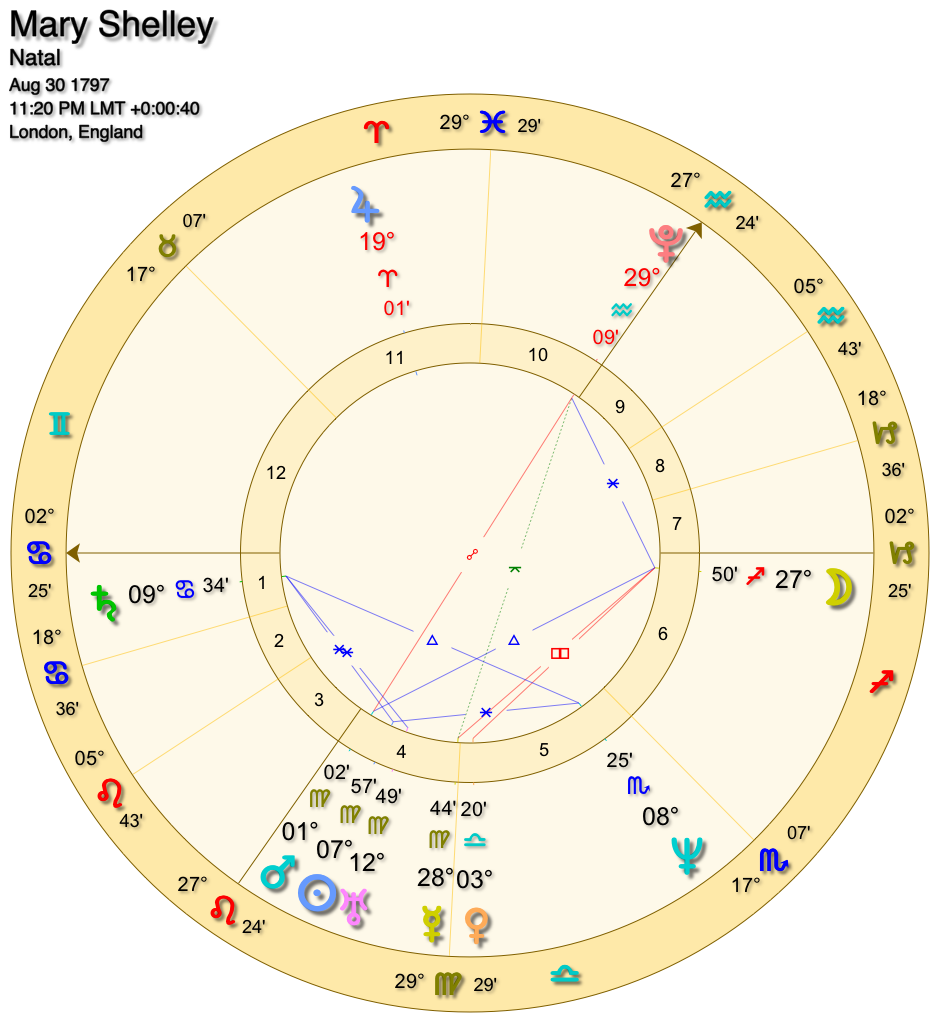
Mary ShelleyMary Godwin, who became Mary Shelley upon her marriage to the Romantic poet Percy Shelley, was born August 30, 1797 at 11:20 pm in London, England. Most prominent in her chart is a triple conjunction of the Sun, Mars, and Uranus in the sign of Virgo, in a tight 180° opposition to Pluto, with Mars closest to Pluto in the opposition. The Sun is archetypally correlated with the principle of the self, of one’s central identity and focus, and the areas in which one shines or expresses oneself most prominently. Uranus, the first of the outer planets to be discovered in the modern era, is correlated with the revolutionary impulse, with breakthrough, rebellion, genius, brilliance, technology, electricity, the young, and the new. Sun-Uranus aspects are often found in the natal charts of brilliant individuals whose work has provided some kind of breakthrough or revolutionary shift in consciousness or worldview, from Copernicus, Galileo, and Kepler, to Newton, Kant, and Freud.[1] The planet Uranus is archetypally correlated with the Greek myth of Prometheus, the Titan who stole fire (a symbol for consciousness) from the Gods and gave it to humanity. Mary Shelley’s husband, Percy Shelley, was also a Sun-Uranus figure. His expression of the archetypal complex can clearly be seen in his poem Prometheus Unbound.

Mary Shelley’s personal expression of the Sun-Uranus combination comes through in the brilliance of her individual expression in her breakthrough first novel, which even has the apt subtitle The Modern Prometheus. The character of Victor Frankenstein is that of a rebel seeking to create life by means of technological innovation, all of which are Uranian themes. He desires to create new life alone, not as father and mother, but to elevate himself to the role of God the Father, the individual solar hero on his quest of technological prowess. Frankenstein takes on the role of both father and mother, rebelling against the order of nature, doing so in an act of technological breakthrough and brilliance. While working, Frankenstein speaks of those he would create, saying “No Father could claim the gratitude of his child so completely as I should deserve theirs.”[2] Yet, he must also suffer the consequences of achievement. Like Prometheus, whose gift to humanity leads to his eternal punishment—chained to a rock while an eagle consumes his liver each day only to have it grow back again each night—Frankenstein is haunted by the life he gave, the monster he created out of his own hubris and ambition.Mary Shelley Chart

Mary Shelley’s Sun-Mars-Uranus triple conjunction is, as mentioned above, in opposition to Pluto. The Uranus-Pluto opposition Shelley is born under is the primary transit that defined the tumultuous era of the French Revolutionary Period. The Uranus-Pluto impulse is toward revolutionary change on a mass scale, the liberation of the repressed and the oppressed, and the unleashing of the taboo. It is the same transit that defined the 1960s countercultural era and our current moment of world revolutions and protests, from the Arab Spring to the Occupy Movement, to the overturning of the Defense of Marriage Act in the United States this current summer.

An interesting connection between Mary Shelley and her mother, Mary Wollstonecraft, is that Wollstonecraft was born with Uranus square Pluto in 1759 and published her masterwork, Vindication of the Rights of Woman, under the Uranus-opposite-Pluto in 1792. Her daughter was born just five years later in 1797 under the same Uranus-Pluto transit, and she went on to publish her own masterpiece, Frankenstein, under the subsequent Uranus square Pluto that was just beginning to come into the orb of influence in 1818. Both mother and daughter’s writing has a revolutionary quality: they were both breaking through the gender barrier in their era that oppressed female writers, and female expression as a whole.

The quality of Shelley’s Frankenstein also expresses Uranus-Pluto archetypal themes in the eruption of the shadow in her story which tells of the creation, through the Uranian technological spark of life, of a Plutonic monster. Shelley reveals and shines light upon (Sun-Uranus) the potential monstrosity (Pluto) of technology (Uranus), as well as the hubris of the modern age and the notion of progress, demonstrating how the sudden break (Uranus) with from the course of nature (Pluto) can unleash (Uranus) tremendous horrors (Pluto). In Frankenstein’s words he describes,

One secret which I alone possessed was the hope to which I dedicated myself; and the moon gazed on my midnight labors, while, with unrelaxed and breathless eagerness, I pursued nature to her hiding places.[3]

The relentless pursuit of nature, the reference to ‘her hiding places,’ and even the idea of a ‘secret. . . possessed’ evoke the underworld nature of the Plutonic, while the sense of the technological secret of life held by a single individual reflects the Sun-Uranus complex. Interestingly, this pursuit of nature is echoed by Dr. Frankenstein’s vengeful pursuit of the monster across the northern wilderness in the latter portion of the book.

The manner in which the horror of Shelley’s narrative unfolds clearly reflects not only her Sun-Uranus conjunction opposite Pluto, but also the Mars-Pluto opposition that is part of this larger complex in her natal chart. Mars correlates with the archetype of the warrior, with a potential range of manifestations from energy, action, and athleticism, to anger and even violence. The archetype of Pluto deepens any archetype with which it is in aspect, so the Mars-Pluto combination can potentially come through as a deep rage or potentially murderous violence, which is clearly expressed in the revenge of the monster of Shelley’s narrative. That Shelley has the Sun in aspect with her Mars-Pluto opposition can be seen in the individual embodiment of the violent shadow, both literally in the monster but also in the individual acts of Frankenstein that brought about the monster’s creation.

Briefly, I would like to touch on a few other aspects in Shelley’s chart that come through in the nature and style of her writing. Shelley has a tight Sun-Neptune sextile which is beautifully captured in a sentence she used to describe herself as a child: “As a child I scribbled. . . Still I had a dearer pleasure than this, which was the formation of castles in the air.”[4] The archetype of Neptune correlates, in one form of its expression, with the imagination and transcendence, which come through in this whimsical, imaginal quote illustrating Shelley’s innate ability to create imaginative narrative. She is also born with a Mercury-Venus conjunction, which can be seen in the beautiful, lyrical quality of her writing. The archetype of Mercury correlates with all forms of communication and expression—from writing, to thinking, speaking, and sensing—while the archetype of Venus correlates to beauty and artistry. Shelley’s Mercury-Venus can also be seen in the romantic fairy-story qualities of some of her other works, such as The Dream or The Heir of Mandolfo. Furthermore, Mercury is in a tight sextile to the Moon in Shelley’s chart, an example of which is the narrative form in which Frankenstein is written: a series of letters. Letter-writing is often intimate and familiar, and in this case also familial, all of which are Lunar qualities, in this instance expressed in Mercurial written form.

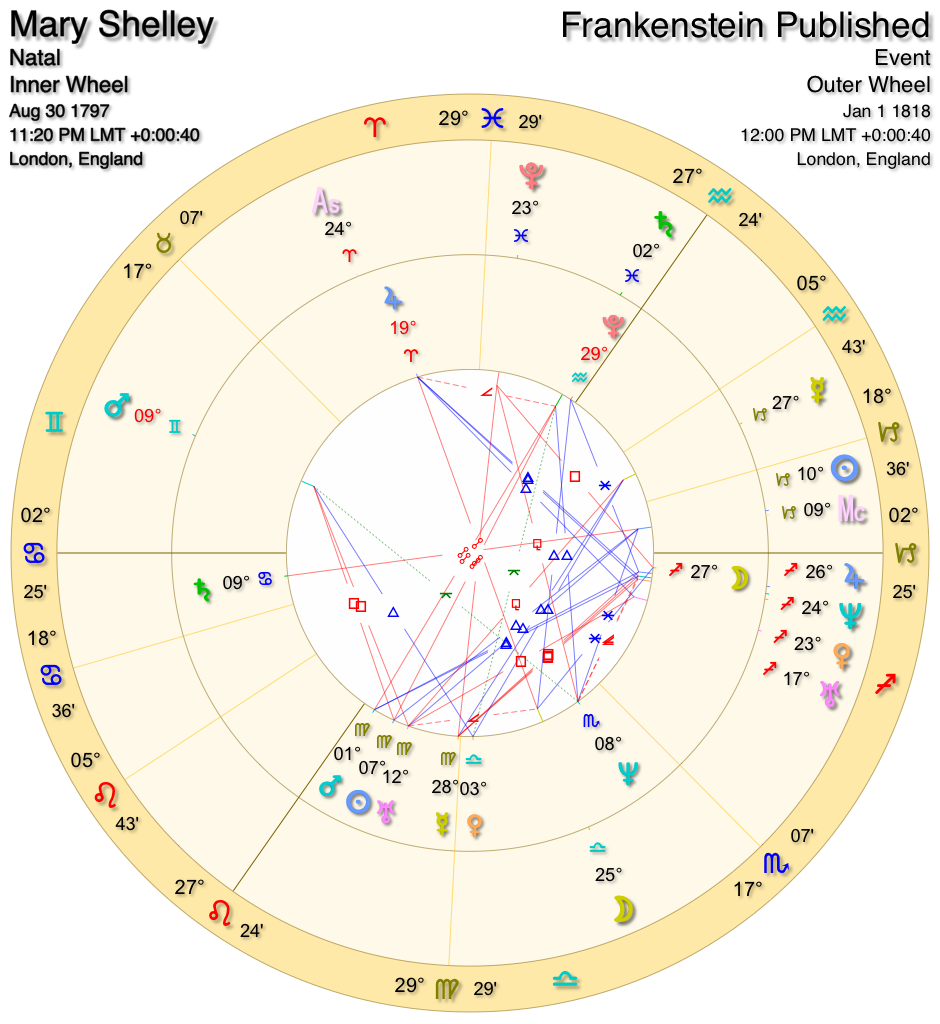
Frankenstein Published TransitsWhile much more could be elaborated in Mary Shelley’s natal chart, I would like to turn to the world transits that were in the sky at the time Frankenstein was published, on January 1, 1818. On that day, and for a short time before and after the publication date, there was a stellium in Sagittarius of Venus, Jupiter, Uranus and Neptune, with the smaller orbit of Venus bringing it briefly into the longer conjunction of Jupiter, Uranus, and Neptune, and the even longer conjunction of Uranus-Neptune that defined much of the Romantic era. While there are many complex ways in which this quadruple conjunction manifested in world events, the particular expression in relation to the publication of Frankenstein can be seen in the successful release of a beautiful piece of literary art produced by the creative imagination. The archetype of Jupiter grants success to whatever it touches, while Venus relates to the artistic expression, and Neptune to the imagination behind the project. Jupiter-Uranus alignments in world history regularly correlate to successful breakthroughs and the inauguration of new initiatives, and have been found to correlate with the first successful publications of numerous authors, including of course Mary Shelley.[5]

In her personal transits, the Venus-Jupiter-Uranus-Neptune stellium was conjoining Shelley’s natal Moon. While the archetype of the Moon is present in all individuals and certainly cannot be simply correlated with all women or “the feminine,” at the time Shelley lived women were often relegated or confined solely to the Lunar realms of home, family, and domestic matrimony by the then dominant patriarchal structures (which had largely appropriated the Solar archetypal role of the individual shining hero as a symbol of “the masculine”). The significance of the Venus-Jupiter-Uranus-Neptune stellium conjoining Shelley’s Moon can be seen in that she would have, in her time, been viewed, because she was a woman, as a Lunar figure who was successfully breaking out of the constrictive mold that did not encourage creative artistic or literary expression by women. The significance of the Moon in this particular case is not because she is a woman, but because of the primarily Lunar role women were usually required to take on. The archetypal energy of the successful Lunar figure is doubled by a transit that would have lasted for only a few hours on the particular day of publication: the Moon in the sky was transiting in opposition to Shelley’s natal Jupiter, which may have provided an increased sense of emotional joy and success for her.

Another significant world transit that was just beginning to come into orb at the time of publication, but which would have become more exact as the book was disseminated and read by the public, was the Saturn-Pluto conjunction of 1818. The energy of this transit would have been intensified for Shelley because, at the time of publication, Saturn was conjoining her natal Pluto as well. The archetype of Saturn is the reality principle that correlates to mortality, death, and gravity, but also to maturity and wisdom; Saturn is archetypally both hard consequences and the learning acquired from consequences. Saturn-Pluto correlates to the shadow side of the encapsulated egoic will to power that is so clearly expressed in Frankenstein. In his book on archetypal astrology, Cosmos and Psyche, Richard Tarnas describes Frankenstein as Shelley’s “prophetic Gothic masterpiece that depicted the monstrous shadow of the technological will to power.”[6] Shelley’s tale is one of death (Saturn) and destruction (Pluto), of moral (Saturn) depravity (Pluto), and of the Saturnian consequences of the soaring heights of Dr. Frankenstein’s, and modernity’s, Sun-Uranus visions of progress.

Interestingly, the day Frankenstein was published the Sun in the sky was transiting opposite Shelley’s natal Saturn, shining a light on the principle of death, as well as the profound consequences of individual actions. Frankenstein is also a shining (Sun) example of a piece of narrative art that has withstood the test of time (Saturn) and come down to us today as a revered piece of literature: another expression of the Sun-Saturn archetypal complex that brought this book into the world from the pen of Mary Shelley.

To read the complete works of Mary Shelley the kindle edition very inexpensive and available here.

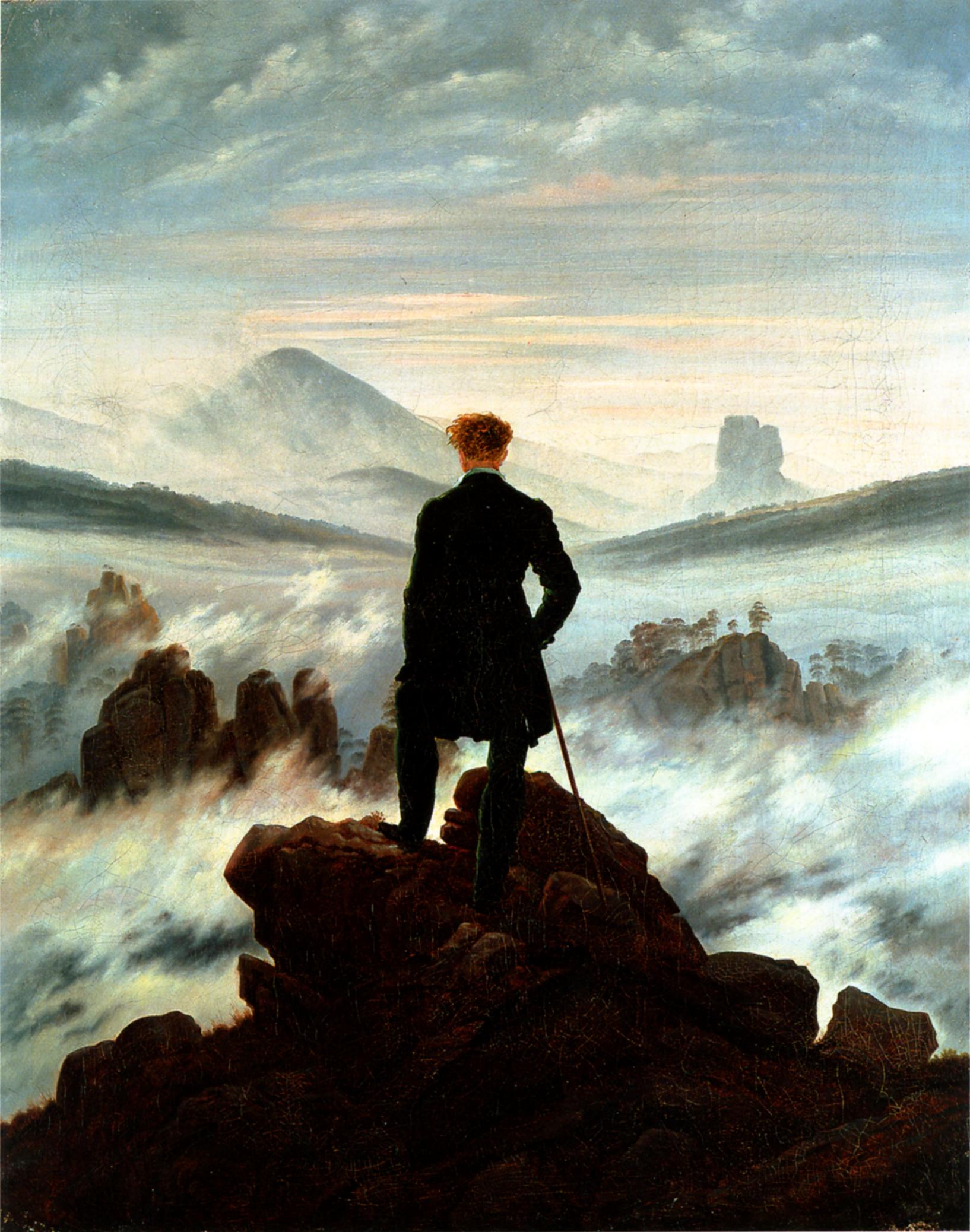
The Wanderer Above the Sea of Fog

Works Cited

Shelley, Mary. The Original Frankenstein or The Modern Prometheus. Edited by Charles

E Robinson. New York, NY: Vintage Classics, 2008.

Tarnas, Richard. Cosmos and Psyche: Intimations of a New World View. New York, NY: Viking Penguin, 2006.

Tarnas, Richard. Prometheus the Awakener: An Essay on the Archetypal Meaning of the

Planet Uranus. Woodstock, CT: Spring Publications, 1995.

Teacher, Janet Bukovinsky. Women of Words: A Personal Introduction to Thirty-Five

Important Writers. Philadelphia, PA: Courage Books, 1994.


[1] Richard Tarnas, Prometheus the Awakener: An Essay on the Archetypal Meaning of the Planet Uranus, (Woodstock, CT: Spring Publications, 1995).

[2]Mary Shelley, The Original Frankenstein or The Modern Prometheus, ed. Charles E Robinson (New York, NY: Vintage Classics, 2008).

[3] Shelley, Frankenstein.

[4] Shelley, qtd. in Janet Bukovinsky Teacher, Women of Words: A Personal Introduction to Thirty-Five Important Writers (Philadelphia, PA: Courage Books, 1994), 17.

[5] Richard Tarnas, Cosmos and Psyche: Intimations of a New World View, (New York, NY: Viking Penguin, 2006).

[6] Richard Tarnas, Cosmos and Psyche, 268.

Jane Austen: A Stroll Through “Mansfield Park”

My father says that with Jane Austen, not a single word is out of place. Each sentence is composed with the utmost precision, an attention to detail and subtlety that distinguishes her writing, and sets it high on the pedestal of the greatest English writers. She wrote at a time when, in her own words, “Men have had every advantage of us in telling their own story.”[1] Her works tell the story women were not often given the opportunity to tell, unveiling the intimate details of home, marriage, and the inner folds of emotion tucked away in the country houses of rural England.

Jane AustenPart of my purpose with this Women of Words project is to read works by female authors that I have never read, and to write a short essay on each author from various perspectives, sometimes literary, sometimes personal, sometimes astrological, or often a combination of these different perspectives. If I have already read something written by the chosen author, I will choose another work of hers, perhaps a piece less well-known. This was the case with Jane Austen. I have had the great pleasure of reading several of her novels already over the years: Sense and Sensibility, Pride and Prejudice, and Emma. I must say I enjoyed each of these immensely and could not rank one as a favorite over another. The characters and their individual development, the dialogue, the prose—all are exquisite. I look forward to the day I can re-enter these provincial worlds again, whether it is by falling passionately in love alongside Marianne Dashwood, or coming to greater self-understanding with Elizabeth Bennet, or undergoing deep emotional maturation alongside Emma Woodhouse.

Having already read the three most well-known of Austen’s novels I chose Mansfield Park as my next endeavor for this project. Mansfield Park tells the story of a young girl, Fanny Price, who is brought to the countryside by her wealthy Aunt Bertram and her uncle, Sir Thomas, to be provided with a better upbringing and social opportunity than she would have had if she had been raised by her own lower class parents along with the rest of her siblings. Janet Bukovinsky Teacher describes Mansfield Park as a morality play on entering the church.[2] The primary focus of the plot is Fanny’s dedicated love for her cousin Edmund, who has been her dearest companion since he soothed her tears when she was first displaced into her new home. Drama unfolds when two eligible siblings, Henry and Mary Crawford, move to the neighborhood and upset a romantic tangle amongst nearly all the members of the Bertram family. As the second son, Edmund is destined to become a pastor, a vocation that leaves opposite impressions upon the two young ladies desiring his attention.Mansfield Park

Fanny Price is a sweet, demure, shy girl whose heroism seems to lie solely in her propriety and goodness. At times, there can be something frustrating about her to the contemporary sensibility. Why is she so physically weak? Why does she not stand up for herself, or express her own feelings? While the perspective of the story certainly makes one want to be on Fanny’s side, the actual qualities of her rival characters, particularly that of Mary Crawford, leave one wanting something more from Fanny, some act of heroism or engagement besides her shy propriety. Fanny’s quiet devotion to Edmund is admirable and certainly understandable, but at times his happiness seems far better suited to being with Mary. Mary’s supposed faults, which I will let the reader discover for him- or herself, are not ones that would easily withstand the test of time or feminism.

I often found the most enjoyable moments of the book to be when Austen’s writing steps out of the small, ordinary world of Fanny’s domestic sphere and connects with a more philosophical way of thinking, or enters into observation of the natural world and the greater cosmos. In one passage, when Fanny is walking with Mary through a garden, Fanny begins to muse on the nature of time and memory:

“How wonderful, how very wonderful the operations of time, and the changes of the human mind!”

And following the latter train of thought, she soon afterwards added: “If any one faculty of our nature may be called more wonderful than the rest, I do think it is memory. There seems something more speakingly incomprehensible in the powers, the failures, the inequalities of memory, than in any other of our intelligences. The memory is sometimes so retentive, so serviceable, so obedient—at others, so bewildered and so weak—and at others again, so tyrannic, so beyond controul!—We are to be sure a miracle every way—but our powers of recollection and of forgetting, do seem peculiarly past finding out.”[3]

This is one of those exquisite moments when the reader is permitted to see the deeper thoughts underlying Fanny’s shy demeanor. One can feel almost as though we are briefly permitted to see right through Fanny and into the thought of Austen herself, sharing one of her own contemplations upon the nature of human memory.

Austen was a contemporary of Coleridge and Wordsworth, and one can see the Romantic language of the era coming through in her own descriptions of the natural world. In a quiet scene in the family drawing room, Fanny is withdrawn by the window away from the conversations and flirtations of the Bertram sisters and the Crawfords. To her delight, Edmund joins her for a moment by the window.

Fanny. . . had the pleasure. . . of having [Edmund’s] eyes turned like hers towards the scene without, where all that was solemn and soothing, and lovely, appeared in the brilliancy of an unclouded night, and the contrast of the deep shade of the woods. Fanny spoke her feelings.

“Here’s harmony!” said she, “Here’s repose! Here’s what may leave all painting and all music behind, and what poetry only can attempt to describe. Here’s what may tranquilize every care, and lift the heart to rapture! When I look out on such a night as this, I feel as if there could be neither wickedness nor sorry in the world; and there certainly would be less of both if sublimity of Nature were more attended to, and people were carried more out of themselves by contemplating such a scene.”[4]

A similar Romantic sensibility is evoked toward the novel’s ending, while Fanny is visiting her parents in town. Fanny is contemplating with melancholy the loss of the beauty of spring in the countryside:

It was sad to Fanny to lose all the pleasures of spring. She had not known before what pleasures she had to lose passing March and April in town. She had not known before, how much the beginnings and progress of vegetation had delighted her.—What animation both of body and mind, she had derived from watching the advance of that season which cannot, in spite of its capriciousness, be unlovely, and seeing its increasing beauties, from the earliest flowers, in the warmest divisions of her aunt’s garden, to the opening of leaves of her uncle’s plantations, and the glory of his woods.—To be losing such pleasures was no trifle; to be losing them, because she was in the midst of closeness and noise, to have confinement, bad air, bad smells, substituted for liberty, freshness, fragrance, and verdure, was infinitely worse.[5]

It is interesting to note the strong influence of both the weather and landscape on the unfolding of everyday events in Austen’s novels. They remind the contemporary reader of the differences between the world before and after the invention of the automobile and the construction of major road networks. Social relations, travel plans, family visits, and even physical exercise are far more susceptible to the fluctuations in climate than they would be today.

One of my favorite scenes in Mansfield Park is a conversation that takes place between Edmund Bertram and Mary Crawford as they are walking through the woods of a neighboring estate. It is early in their acquaintance, and a subtle flirtation has begun to develop between them, to Fanny’s chagrin. Mary, at this time, is much more taken with Edmund than he seems to be with her, which starts to come through in the following dialogue. The substance of the conversation itself is on the nature of time as seen from their differing perspectives, views which seem to have something of a gender bias. Mary begins the conversation:

“I am really not tired, which I almost wonder at; for we must have walked at least a mile in this wood. Do not you think we have?”

“Not half a mile,” was his sturdy answer; for he was not yet so much in love as to measure distance, or reckon time, with feminine lawlessness.

“Oh! you do not consider how much we have wound about. We have taken such a very serpentine course; and the wood itself must be half a mile long in a straight line, for we have never seen the end of it yet, since we left the first great path.”

“But if you remember, before we left that first great path, we saw directly to the end of it. We looked down the whole vista, and saw it closed by iron gates, and it could not have been more than a furlong in length.”

“Oh! I know nothing of your furlongs, but I am sure it is a very long wood; and that we have been winding in and out ever since we came into it; and therefore when I say that we have walked a mile in it, I must speak within compass.”

“We have been exactly a quarter of an hour here,” said Edmund, taking out his watch. “Do you think we are walking four miles an hour?”

Oh! do not attack me with your watch. A watch is always too fast or too slow. I cannot be dictated to by a watch.”[6] (Emphasis added.)

Austen reinforces many of the gender norms of her day, including views on manners and propriety of behavior. The primary concern of the women in Austen’s novels is their marriagability, a stark contrast to her revolutionary forebear, Mary Wollstonecraft. Yet Austen herself never wed. She once accepted a suitor’s offer, but by the next morning she had changed her mind and reversed her answer. She seems to express some of her views on a woman’s choice to marry, and whom she is to marry, through the voice of Fanny Price when she says,

“I should have thought,” said Fanny, after a pause of recollection and exertion, “that every woman must have felt the possibility of a man’s not being approved, not being loved by some one of her sex, at least, let him be ever so generally agreeable. Let him have all the perfections in the world, I think it ought not to be set down as certain, that a man must be acceptable to every woman he may happen to like himself.”[7]

To touch briefly on Austen’s birth chart, because we know her exact birth time we are able to know that she has a tight Moon-Saturn conjunction in Libra. Austen is born on December 16, 1775 at 11:45 pm in Stevenston, England. The Moon archetypally relates to the home, domesticity, relationship, emotional expression, and feeling. Saturn, on the other hand, correlates with constraint and restraint, hard work, discipline, reserve, and a serious disposition. Austen’s Moon-Saturn conjunction is expressed archetypally as the quiet sphere of the home that is depicted in all of her novels, as well as the emotional struggles and maturation of her lead female characters. Her detailed descriptions of the quiet day-to-day experiences of living in the English countryside, and the work of securing a husband and home, all correlate to Moon-Saturn. She also did all of her written work (Saturn) in the parlor of her home (Moon), and even would hide the stories she was writing when visitors came calling.Jane Austen's Birth Chart

Another significant aspect in Austen’s natal chart is her Mercury in opposition to a broad Jupiter-Uranus conjunction. The archetype of Mercury comes through as all forms of communication, from writing and speaking, to  thinking, the intellect, and education. Jupiter correlates archetypally with expansion, success, and celebration, while Uranus relates to change, revolution, rebellion, innovation, and ingenious breakthroughs. The Jupiter-Uranus combination correlates with expansion of horizons, successful breakthroughs, and rapidly opening world views and perspectives. Although Austen lived in a constrained home environment, which correlates to her Moon-Saturn conjunction—never moving from her family home—she was able to expand her horizons and those of all her readers through her writing, which correlates to her Mercury in opposition to Jupiter and Uranus. The breakthrough quality of her exquisite novels—from the first, Sense and Sensibility, which she published anonymously, claiming only on the title page that it was “By A Lady”—have rippled through history and come down to us today as the beloved stories of the extraordinary, yet everyday, women of the English countryside.

To read Mansfield Park the kindle edition is free and available here.

Works Cited

Austen, Jane. Mansfield Park. Oxford, England: Oxford University Press, 1988.

Teacher, Janet Bukovinsky. Women of Words: A Personal Introduction to Thirty-Five Important Writers. Philadelphia, PA: Courage Books, 1994.


[1] Jane Austen, qtd. in Janet Bukovinsky Teacher, Women of Words: A Personal Introduction to Thirty-Five Important Writers (Philadelphia, PA: Courage Books, 1994), 12.

[2] Teacher, Women of Words, 12.

[3] Jane Austen, Mansfield Park (Oxford, England: Oxford University Press, 1988), 208-209.

[4] Austen, Mansfield Park, 113.

[5] Austen, Mansfield Park, 431-432.

[6] Austen, Mansfield Park, 94-95.

[7] Ibid, 353.

Mary Wollstonecraft: Voice of Women’s Liberation

“For if it be allowed that women were destined by Providence to acquire human virtues, and by the exercise of their understandings, that stability of character which is the firmest ground to rest our future hopes upon, they must be permitted to turn to the fountain of light, and not forced to shape their course by the twinkling of a mere satellite.”[1]

– Mary Wollstonecraft

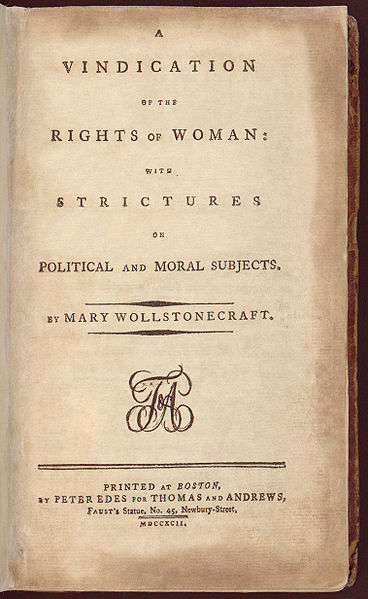
 The role of women in 18th century England was constrained almost solely to the realm of marriage and motherhood, and few women had the means to raise their voices in protection of their rights. Yet one woman, Mary Wollstonecraft, had a voice so powerful that she is considered by many to have been the first feminist to rise out of Europe. In her emphatic treatise Vindication of the Rights of Woman, Wollstonecraft speaks out with little restraint about her thoughts on women’s education, women’s duties as mothers and wives, and women’s roles and rights in society. She opens her book with a letter bearing her primary argument:

Contending for the rights of women, my main argument is built on this simple principle, that if she be not prepared by education to become the companion of man, she will stop the progress of knowledge, for truth must be common to all, or it will be inefficacious with respect to its influence on general practice. And how can woman be expected to co-operate, unless she know why she ought to be virtuous?[2]

Mary WollstonecraftWollstonecraft’s writing carries tremendous force and is often punctuated by words and phrases penned entirely in capital letters, driving her point and opinion home. “The rights of woman may be respected, if it be fully proved that reason calls for this respect, and loudly demands justice for one half of the human race.”[3] She steps out of her era’s convention of using the term “Man” to refer to “Humanity,” instead emphasizing that there is a half of the human race who has been made invisible by the very language that describes their species. As Janet Bukovinsky Teacher writes, “No English-speaking woman had ever been so audacious as to question the validity of marriage as she did, or to suggest that men might be preventing women from pursuing their rightful place in society.”[4] Wollstonecraft held radical views not only on women’s rights, but also on divorce and even abortion. Vindication of the Rights of Woman was published during the period of the French Revolution, and in many ways Wollstonecraft is carrying much of the revolutionary energy of the times and channeling it into the transformative power of her words.

The primary focus of Wollstonecraft’s treatise on women’s rights is the manner in which women were educated in her time. Women’s education consisted almost exclusively of learning the arts to acquire a husband, and did little to develop women’s reason, understanding, sense of virtue, and physical strength. The prime target of her rebuttal is Jean-Jacques Rousseau, who argued in his treatise Emile, or On Education that men and women ought to be educated in entirely different manners because of their fundamentally different natures. Rousseau writes of women and men, saying,

In what they have in common, they are equal. Where they differ, they are not comparable. A perfect woman and a perfect man ought not to resemble each other in mind any more than in looks, and perfection is not susceptible of more or less. In the union of the sexes each contributes equally to the common aim, but not in the same way. From this diversity arises the first assignable difference in the moral relations of the two sexes.[5]

While Rousseau does not go on the unfold what he means by “In what they have in common, they are equal,” he does argue that women should be “passive and weak,” and should “put up little resistance” because they are “made specially to please man.”[6] In Wollstonecraft’s paraphrase of Rousseau’s argument, he goes on to say

that a woman should never, for a moment feel herself independent, that she should be governed by fear to exercise her natural cunning, and made a coquettish slave in order to render her a more alluring object of desire, a sweeter companion to man, whenever he chooses to relax himself.[7]

Wollstonecraft brings forward the many ways this limited and constraining view on women’s education and capabilities is detrimental not only to women but to the society as a whole. If a woman is kept ignorant by her education of all subjects except how to adorn herself to attract a husband, how will she be able to educate her children? Her ignorance will then pass on to her children who will comprise the next generation of individuals structuring society.

The patriarchal logic behind keeping women ignorant was in part based upon the idea that if women were ignorant they might remain innocent of the world’s hardships, and therefore be virtuous. But Wollstonecraft argues that pure innocence is only to be valued in children, not adult women, and that “Women are not allowed to have sufficient strength of mind to acquire what really deserves the name of virtue.”[8]  It is the faculty of reason that allows human beings to move toward virtue. She goes on to say “In fact, it is a farce to call any being virtuous whose virtues do not result from the exercise of its own reason.”[9] Later in the treatise Wollstonecraft returns to the relationship of reason to virtue when she writes,

But it is vain to attempt to keep the heart pure, unless the head is furnished with ideas, and set to work to compare them, in order, to acquire judgment, by generalizing simple ones; and modesty by making the understanding damp the sensibility.[10]

In Wollstonecraft’s time an unmarried woman’s honor was based not upon her ability to think, to engage in intelligent conversation, or on her personal accomplishments, but almost solely upon her chastity. Wollstonecraft addresses this notion with disgust, saying, “Nay the honour of a woman is not made even to depend on her will.”[11] Yet she argues that if a woman’s education is focused so exclusively on the arts that will win her a husband, then how can she help but be promiscuous once she is married? She will have been prepared for nothing but a fanciful notion of romance that will soon fade as her husband realizes she can do little else but be the coquettish slave of Rousseau’s fantasies. And to men like Rousseau she says,

The man who can be contented to live with a pretty useful companion without a mind, has lost in voluptuous gratifications a taste for more refined enjoyments; he has never felt the calm satisfaction that refreshes the parched heart, like the silent dew of heaven—of being beloved by one who could understand him.[12]

It is not surprising that much of the backlash against Vindication of the Rights of Woman came not from men but from women who saw themselves targeted by Wollstonecraft’s harsh criticisms. Women adept at the arts to which their curtailed education disposed them would have found Wollstonecraft’s arguments disturbing, insulting, and even threatening. Yet Wollstonecraft insists that it is not the nature of woman that confines her to such narrow forms of expression but rather the conditioning impressed upon her from childhood.Vindication of the Rights of Woman

In a woman’s education “Strength and usefulness are sacrificed to beauty.”[13] An interest in beauty and ways of dress are not inherent to women but rather the only interests that have been cultivated by their education. Wollstonecraft argues that it is no more natural for a woman to be exclusively interested in her own beauty than “false ambition” is natural to men. Rather, both are driven by a love for power. For women the only means to gain power is through marriage, therefore physical beauty becomes their only fully developed faculty. “Taught from their infancy that beauty is woman’s sceptre, the mind shapes itself to the body, and, roaming round its gilt cage, only seeks to adorn its prison.”[14] Wollstonecraft goes on to describe how a woman’s education saps her character until she is reduced to the physically and mentally weakened dependent creature men tell her she is.

Every thing that [women] see or hear serves to fix impressions, call forth emotions, and associate ideas, that give a sexual character to the mind. False notions of beauty and delicacy stop the growth of their limbs and produce a sickly soreness, rather than a delicacy of organs; and thus weakened by being employed in unfolding instead of examining the first associations, forced on them by every surrounding object, how can they attain the vigour necessary to enable them to throw off their factitious character?—where find strength to recur to reason and rise superior to a system of oppression, that blasts the fair promises of spring?[15]

Wollstonecraft eventually makes clear that it is the collective oppression by men that has kept women so constrained for countless centuries. The general assumption of her era was that women’s overall inferiority to men was a fact, an issue which Wollstonecraft challenges vigorously. She writes that if women indeed are inferior to men, which she does not concede then, in her words,

I shall only insist, that men have increased that inferiority till women are almost sunk below the standard of rational creatures. Let their faculties have room to unfold, and their virtues to gain strength, and then determine where the whole sex must stand in the intellectual scale.[16]

Only tyrants and sensualists, Wollstonecraft insists, would want women to be oppressed to the level of blindly obedient slaves.

Strengthen the female mind by enlarging it, and there will be an end to blind obedience; but, as blind obedience is ever sought for by power, tyrants and sensualists are in the right when they endeavour to keep women in the dark, because the former only want slaves, and the latter a plaything.[17]

Wollstonecraft goes on to ask why men would want blind obedience when rationally developed principles would ensure a more just and virtuous society. She even likens the oppression of women to that of enslaved Africans, seeming to call for revolutionary reform on both fronts in society.

Why subject [woman] to propriety—blind propriety, if she be capable of acting from a nobler spring, if she be an heir of immortality? Is sugar always to be produced by vital blood? Is one half of the human species, like the poor African slaves, to be subject to prejudices that brutalize them, when principles would be a surer guard only to sweeten the cup of man?[18]

Finally, Wollstonecraft calls upon God, the creator of the universe, to answer for the condition of women:

Gracious creator of the whole human race! hast thou created such a being as woman, who can trace thy wisdom in thy works, and feel that thou alone art by thy nature, exalted above her—for no better purpose? Can she believe that she was only made to submit to man her equal; a being, who, like her, was sent into the world to acquire virtue? Can she consent to be occupied merely to please him; merely to adorn the earth, when her soul is capable of rising to thee? And can she rest supinely dependent on man for reason, when she ought to mount with him the arduous steps of knowledge?[19]

Wollstonecraft had fully extricated herself from the false webs of deceit that continuously told women that their inferior position in society was based upon man’s God-given right for domination.

Much of Vindication of the Rights of Woman is dedicated to looking at the affect of women’s rights and education upon marriage and family. Wollstonecraft held the opinion that a marriage should be based not on passionate love, which she saw as transitory and fickle, but rather upon mutual respect and friendship. She believes that “a master and mistress of a family ought not to continue to love each other with passion.”[20] Marriage, in Wollstonecraft’s opinion, is primarily in service of raising a family and educating children to enter the world, an idea that seems very much at odds with contemporary liberal views on marriage. For Wollstonecraft, “Love is. . . an arbitrary passion.”[21] Yet she also goes on to say that “Supposing, however, for a moment, that women were, in some future revolution of time, to become, what I sincerely wish them to be, even love would acquire more serious dignity, and be purified in its own fires.”[22] Love can only be pure and dignified if first both parties can approach each other as equals.

Mary Wollstonecraft Birth ChartI would like to briefly touch upon some aspects of Mary Wollstonecraft’s astrological chart that can further illuminate her character and writings. Wollstonecraft was born at the new moon and therefore has a Sun-Moon conjunction in her natal chart. Simply put, the archetypal energy of the Sun relates to one’s central identity and focus, the areas in which one shines in one’s lifetime. The archetype of the Moon, on the other hand, carries the aspects of one’s emotions and feelings, and one’s ability to nurture, care for, and nourish in relationship. The Moon is particularly connected to the mother-child relationship, as well as the physical body. In the patriarchal West, especially during Wollstonecraft’s lifetime, the solar principle was strongly appropriated by the cultural role held by men, while women were usually dominant in the lunar home realm with little room to step into a solar identity in the world. Wollstonecraft’s Sun-Moon conjunction seems to express itself through her impulse to shine a light on the rights of women who have been operating almost exclusively in the realm of the home in the primary role of motherhood. Wollstonecraft is bringing the solar focus of her inquiry into the lunar realm, and encouraging women to step out into their individual solar power.

Wollstonecraft is also born with Uranus square Pluto in her natal chart; the archetypal expression of Uranus relates to the revolutionary impulse for creative breakthrough, liberation, and change, while the archetype of Pluto is connected to power, evolution, and transformation, to what is oppressed and repressed, and to massive scale and tectonic movement. Interestingly, Wollstonecraft published Vindication of the Rights of Woman in 1792, at the same time the French Revolution was raging across the Channel, when Uranus was opposing Pluto in the world transits. She is expressing this powerful revolutionary energy in the tremendous force of her words which are explicitly calling for mass liberation of women from the oppression of patriarchy. She writes, “It is time to effect a revolution in female manners, time to restore to them their lost dignity, and make them, as a part of the human species, labour by reforming themselves to reform the world.”[23] The Uranus-Pluto opposition of the late 18th century—the next axial alignment of those two planets after the square in the sky when Wollstonecraft was born—was in a transiting T-square to Wollstonecraft’s natal Moon. This transit perfectly correlates with her bringing mass revolutionary energy into the lunar realms of home and motherhood and calling for women to transform their relationships with their minds, bodies, children, and husbands. She writes that a woman’s first duty is to herself and her second is to her children, a reversal of what most women in her time were raised to believe: “Speaking of women at large, their first duty is to themselves as rational creatures, and the next, in point of importance, as citizens, is that, which includes so many, of a mother.”[24]

Finally, Wollstonecraft also calls on women to respect the female body into which they were born, acknowledging their ability to grow as individuals and move toward virtue, rationality, and goodness. “She who can discern the dawn of immortality, in the streaks that shoot athwart the misty night of ignorance, promising a clearer day, will respect, as a sacred temple, the body that enshrines such an improvable soul.” For women today, Wollstonecraft’s words have opened up many doorways that were long closed to those of female gender. Yet I cannot help but wonder, now that we are once again in a period when Uranus and Pluto are in axial alignment, what greater revolutions on behalf of women would a Mary Wollstonecraft of today call upon us to enact?


To read A Vindication of the Rights of Woman the kindle edition is free and available here.

For further reading on Mary Wollstonecraft an interesting blog entitled Vindications of the Rights of Mary is available here.


Works Cited

Rousseau, Jean-Jacques. Emile or On Education. Translated by Allan Bloom. New York, NY: Basic Books, 1979.

Teacher, Janet Bukovinsky. Women of Words: A Personal Introduction to Thirty-Five Important Writers. Philadelphia, PA: Courage Books, 1994.

Wollstonecraft, Mary. Vindication of the Rights of Woman (Kindle Edition), 1792.


[1] Mary Wollstonecraft, Vindication of the Rights of Woman (Kindle Edition), 1792, Ch 2.

[2] Wollstonecraft, Vindication of the Rights of Woman, Section: “To M. Talleyrand Perigord, Late Bishop of Autun.”

[3] Wollstonecraft, Vindication of the Rights of Woman, Section: “To M. Talleyrand Perigord, Late Bishop of Autun.”

[4] Janet Bukovinsky Teacher, Women of Words: A Personal Introduction to Thirty-Five Important Writers (Philadelphia, PA: Courage Books, 1994), 7.

[5] Jean-Jacques Rousseau, Emile or On Education, trans. Allan Bloom (New York, NY: Basic Books, 1979), 358.

[6] Rousseau, Emile or On Education, 358.

[7] Wollstonecraft, Vindication of the Rights of Woman, Ch. 2.

[8] Wollstonecraft, Vindication of the Rights of Woman, Ch. 2.

[9] Ibid.

[10] Ibid, Ch. 7.

[11] Ibid, Ch. 4.

[12] Wollstonecraft, Vindication of the Rights of Woman, Ch. 5.

[13] Ibid, Ch. 2.

[14] Ibid, Ch. 3.

[15] Wollstonecraft, Vindication of the Rights of Woman, Ch. 6.

[16] Ibid, Ch. 2.

[17] Wollstonecraft, Vindication of the Rights of Woman, Ch. 2.

[18] Ibid, Ch. 9.

[19] Wollstonecraft, Vindication of the Rights of Woman, Ch. 4.

[20] Ibid, Ch. 2.

[21] Ibid, Ch. 6.

[22] Ibid.

[23] Wollstonecraft, Vindication of the Rights of Woman, Ch. 3.

[24] Ibid, Ch. 9.

The Infinite Dynamic Stairway: Exploring Anne Conway’s Philosophy

A Woman Philosopher

A sole treatise is all that the world has inherited of the philosophical thought of Lady Anne Finch, Viscountess of Conway, yet aspects of her unique system and cosmology can be traced in quiet echoes through the work of several of the great names that came after her, from Leibniz, Blake, and Goethe, to Bergson and Whitehead, to contemporary feminist and ecological thinkers. Her legacy is obscured, it seems, primarily by her gender, for she lived in a time when a university education was denied to women and her name was not even included on the title page of her only publication.[1] Except in rare cases, such as in the work of Leibniz, Anne Conway’s influence on subsequent thinkers can only be traced by a shadowy similarity of content, rather than directly by name. Yet she has been called “the profoundest and most learned of the female metaphysical writers of England”[2] by James Crossley, and “the most important woman philosopher in seventeenth century England” by Sarah Hutton.[3]

Jacob's Ladder

Conway was the “Heroine pupil”[4] of the Cambridge Platonist Henry More, who said in his dedication to her of Antidote Against Atheisme that she is one “whose Genius I know to be so speculative, and Wit so penetrant, that in the knowledge of things as well Natural as Divine, you have not onely out-gone all of your own Sex, but even of that other also, whose ages have not given them over-much the start of you.”[5] In his letters to Conway, More addresses her as, in Hutton’s words, an “exceptional woman: a kind of secular saint, remarkable for her virtue and piety, not the equal of men but their superior.”[6] What can we find of this ‘exceptional woman’ in the single manuscript we have of her own words? What was Conway articulating that More, along with the other men of Conway’s intellectual circle, held her in such admiration? Conway was a truly independent mind, drawing from such diverse sources as Plato and Origen, Behmenism and Quakerism, and the Lurianic Kabbalah,[7] to craft a critique of the early modern philosophies of Descartes, Hobbes, and Spinoza, and even aspects of More’s work as well.[8] To quote Carol Wayne White at length, Conway’s The Principles of the Most Ancient and Modern Philosophy

may be viewed as an invaluable cultural artifact of the early modern period, depicting Conway as a high Renaissance thinker who keenly integrated occult knowledge, alchemy, ancient wisdom, and the new mode of organizing reason, or “science” represented by the mechanists. In it, she introduced a conceptualization of “processional nature” that is measured and authorized by the worth of ancient and marginalized wisdoms. The result is a unique Christian cosmology or mystical naturalism that affirms a continuum of “life-affirming impulses” stretching from God through the most inconspicuous minutiae of perceived materiality.[9]

In the Principles we are presented with a “cross-fertilisation of Cartesianism and Platonism”[10] planted in the rich soils of ancient esotericism and watered generously with Conway’s own original thought. Although brief, it is the fullest philosophical system written in English by a woman in the seventeenth century.[11]

The Three Species of Existence

Conway presents a vision of the continuum of all existence, argued as a rationally deducible religious truth.[12] Conway’s treatise opens with a rewriting of the Trinity and a delineation of the three substances or species of existence: God, Christ, and Creation. Conway writes, “In God there is no time, change, arrangement, or division of parts.”[13] She describes the Trinity not as “three distinct persons”[14] but rather as a “triune deity,” with distinct powers rather than parts: “a triplicity of God, divine wisdom, and divine will.”[15] Conway goes on to say of God that “He is also in a true and real sense an essence distinct from his creatures, although not divided or separate from them but present in everything most closely and intimately in the highest degree.”[16] She differentiates God from God’s creatures not dualistically but rather as one end of an infinite continuum is differentiated from its other end, like an infinite spectrum of light fading towards dimness.[17] God is simultaneously distinct and above Creation, while “intimately present” in all created beings as well.[18]

Drawing on Kabbalistic influences, Conway describes God diminishing God’s own brilliant light for the sake of God’s creatures.[19] In the space of diminished light arises the second species or substance, the Middle Nature between God and creation: the Messiah, the Logos, Christ.[20] Conway maintains the divinity of Christ not as a person of a triune God ontologically separate from Creation, but rather as the Mediator between God and Creation.[21] “The first concept,” Conway writes on the Trinity, “is the infinite God himself, considered above and beyond his creation; the second is the same God insofar as he is the Messiah; the third is the same God insofar as he is with the Messiah in creatures.”[22] These three substances, the only three substances as Conway clearly emphasizes, share spirit as a universal characteristic. “Deity was present in everything,” White comments, “most closely and intimately, and in the highest degree.”[23] Yet for all that God, Christ, and Creation hold in common they remain infinitely differentiated, not in essence but in expression with relation to mutability, and therefore also in relation to time.

The first of the three kinds of being, God, is altogether immutable. “God was always a creator and will always be a creator because otherwise he would change.”[24] Conway goes on to say that “while he is in time, he is not bound by time.”[25] Because God is absolutely perfect God does not move toward greater perfection, and without movement or change there is perforce no time in God; God is eternally at eternity.

God’s creatures are both within time and bound by it, and therefore mutable and susceptible to change. Such mutability arises from what Conway calls the “indifference of will,” which “is the basis for all mutability and corruptibility in creatures, so that there would be no evil in creatures if they were not mutable.”[26] This indifference of the will Conway believes is something God does not have because of God’s divine goodness:

For this reason God is both a most free agent and a most necessary one, so that he must do whatever he does to and for his creatures since his infinite wisdom, goodness, and justice are a law to him which cannot be superceded.[27]

God is immutable, bound by goodness but free from time, while creatures are mutable toward goodness or evil and are subject to the motion of time. It is interesting to note that the indifference, or freedom, of the will of which Conway writes is not only a property of human beings, but of all creatures. In this particular sense she does not give humans a privileged position in Creation.

Christ, as the Middle Nature, the soul generated by God’s partially diminished light[28]—the space the Kabbalah calls tsimtsum[29]—shares in both the nature of God and the nature of Creation. Christ, unlike God, is mutable, but only toward an ever-increasing perfection of goodness; unlike creatures, Christ cannot change toward evil. Conway writes, “Christ cannot become evil but he can become good and consequently he partakes both of divinity and creatureliness as well as eternity and time.”[30] Like the Cambridge Platonists Henry More and Ralph Cudworth, Conway articulated the existence of a “fluid intermediary” between spirit and matter, but in Conway’s system, as Jacqueline Broad writes, Conway differed from her contemporaries by “advocating a monistic theory of created substances.”[31] Conway is clear, in an unnamed refutation of Spinoza, that her system is not pantheism because if all were one substance “sin and devils would be nothing but parts or the slightest modification of this divine being.”[32] Nor is it dualism because Christ is the Mediator between God and Creation, a being that participates in both divine and created substance, permeating both and uniting them through love.

In Conway’s system Christ seems to play a role differing from the orthodox Christian views of her time. Later in her life Conway converted to Quakerism, and it was through some of her Quaker ties, as well as her reading of the Kabbalah and other ancient texts, that allowed her to question the universality of Christian doctrine. Her treatise shows sympathies for other religious perspectives: for example, when she is rewriting the Trinity as three distinct powers instead of persons, she notes how the reference to distinct persons may be “a stumbling block and offense to Jews, Turks, and other people.”[33] In White’s words, Conway also questioned, “How could Christianity be a universal religion if Christian soteriology required a belief in the historical figure of Jesus Christ?”[34] The Christ of Conway’s philosophical system is a mediating being called by many names, not only Christ and the “soul of the Messiah,” but also the Kabbalistic Adam Kadmon, [35] the Middle Nature not made or created by God, but generated by God.[36] “Such a mediator is necessary by the very nature of things,” writes Conway, “because otherwise a gap would remain and one extreme would have been united with the other extreme without a mediator, which is impossible and against the nature of things.”[37] The Middle Nature unites “the creator with his creatures, in which union their happiness lay.”[38] The Christ of Conway’s philosophy, as the loving mediator, is not dissimilar to Plato’s realm of metaxy, in which daemons, such as Eros and Logos, carry prayers and blessings between mortals and gods.

Continuum of Spirit and Matter

Anne Conway was introduced to Henry More by her brother John Finch who was studying under More at Cambridge University.[39] Conway had not always held all the views she expressed in her posthumously published treatise, and came to More with several questions regarding God’s goodness and justice, as well as the nature of the soul.[40] In a letter dated 1652 Conway writes, “Upon the Reading of your Poem of the Prae-existence of the Soul, and serious thinking of it, I desir’d to be satisfied in Four Particulars, which are these.”

       First, Whether God did create the Matter for the Enjoyment of Souls, since they fell by it?

Secondly, Whether the Soul could Enjoy the Matter without being Clothed in Corporeity; and if it could not, how it can be the Fall of the Soul that makes it Assume a Body?

Thirdly, Upon Supposition most of the Souls fell; Why did not all Assume Bodies together: And how Adam can be said to be the first Man, and all Men to Fall in him, since they Fell before: And how the Souls of Beasts and Plants came into Bodies?

Fourthly, How Man can be Restor’d, to what he Fell from; And why the Devils that Fell; cannot? Why Christ’s Death should Extend more to One than to the Other?[41]

As Terryl Givens comments on these questions, such genuine inquiry into the preexistence of the soul without dismissal had “little precedent or parallel” in the history of philosophy, especially during the early modern period.[42] Conway continued in her pursuit of these and other related questions in her philosophical studies and intellectual salons, and finally offered her own answers to some of them in the Principles. Her understanding of the relation of spirit to matter, which arguably is the primary subject of her treatise, reconciles many of the questions she posed to More in the aforementioned letter, from how the soul relates to the human body, to the souls of other species, and finally to the restoration of all who have fallen away from God.

Conway argues that all of Creation, as the third substance of being next to Christ and God, is a single substance. All of creation is one spiritual substance, a continuum from body to soul, from spirit to matter. For Conway, the unity of created substance explains how the soul and body can relate to each other, the causal connection between mind and body that Descartes saw as completely incompatible and distinct.[43] In the same language that she uses to describe the continuum of God through Christ to Creation as a gradual diminution of God’s light, she writes of body as only the darkened form of spiritual light. “Truly,” she writes, “every body is a spirit and nothing else, and it differs from a spirit only insofar as it is darker. . . Consequently, the distinction between spirit and body is only modal and incremental, not essential and substantial.”[44] Conway’s primary influence on her belief in a spirit-matter continuum is her reading of the Lurianic Kabbalah,[45] a version of the Kabbalah drawn from the teachings of Isaac Luria, a Jewish zaddik from the sixteenth century whose writings carry strains of Plotinus’ and Origen’s thought.[46]

Illustrating her point further Conway writes, “spirit and body are of one original nature and substance, and that body is nothing but fixed and condensed spirit, and spirit nothing but volatile body or body made subtle.”[47] Both spirit and matter, according to Conway, can be located in time and space and have mutual influence upon each other.[48] In this latter respect, Conway holds a position contrary to More and the other Cambridge Platonists, who believe that the body is impenetrable and divisible, while spirit is penetrable and indivisible.[49] Carolyn Merchant, who sees great value in Conway’s philosophy overall, nevertheless charges that Conway’s system is “simply a reduction of all reality to the idealist category of spirit.”[50] Broad points out that “one might be led to believe that when Conway collapses the distinction between soul and body, she is more concerned to emphasise the spirituality of matter, rather than the other way around.”[51] But as Broad goes on to emphasize, “Conway’s spiritual particles are not quite ‘spiritual’ in the orthodox sense, because they are always extended and (potentially) divisible and impenetrable.”[52] Furthermore, unlike the Platonic and Cartesian views, Conway has “unorthodox conceptions of bodies, as alive, self-moving, perceptive, and penetrable,” and she has “materialistic views of the soul, as extended, divisible, and capable of being penetrable.”[53] Rather than merely collapsing all of reality into the category of spirit as Merchant suggests, Conway seems to be emphasizing the similarity of spirit and matter and their affinity as gradations of a single substance that is neither spirit nor matter essentially, but characterized simultaneously by material and spiritual properties. That spirit and matter are the same substance explains how they are able to relate to each other, but it is their distinction that allows them to be in relationship, which is required for their evolution and movement toward perfection. Both difference and similarity, as Conway understands it, are required for the purposeful motion of Creation to exist.

Anti-Cartesianism

Conway was introduced to philosophy through Cartesianism, taught to her by More through their correspondence.[54] She was not taught to take Descartes’ system as dogma, however, and in the end her own philosophy became a refutation of the Cartesian mind-body dualism: she even went so far as to call her treatise “anti-Cartesianism.”[55] The primary question she puts to Descartes, More, and others who hold similar views, is the interaction problem: if bodies are impenetrable and divisible and souls are penetrable and indivisible, how can they possibly interact? She argues that impenetrability is the mode of matter rather than its essence, and that matter can be penetrated by substance when in a subtler, more spiritual form.[56] She offers the metaphor of iron, which cannot be penetrated by another “equally course body” but can be penetrated by a body more subtle than it: “namely, by fire, which enters it and penetrates all its parts.”[57] So it is also with the soul and its body that they are able to be intimately present in one another as fire is to iron.

The soul has an affinity for its body because they are alike; they are one substance expressing itself in opposite modalities. Conway draws an analogy between, on the one hand, the body-soul relationship and, on the other hand, the relationship, love, and cooperation of a wife and husband.[58] But unlike other philosophies that use gendered metaphor for the soul and body, Conway emphasizes the similarity between women and men rather than how they differentiate to explain their love for each other. As Broad writes, “Her argument relies upon the supposition that men and women love one another because they have the same nature.”[59] Furthermore, Conway writes of the need the soul has for the body to be complete; the body retains the image of the spirit so that it might exist as a being:

Spirit is light or the eye looking at its own proper image, and the body is the darkness which receives this image. And when the spirit beholds it, it is as if someone sees himself in a mirror. But he cannot see himself reflected in the same way in clear air or in any diaphanous body, since the reflection of an image requires a certain opacity, which we call body. . . Just as every spirit needs a body to receive and reflect its image, it also needs a body to retain the image.[60]

In order for a person to have memory her spirit must have a body, for the body is what retains the image of the spirit. “Every spirit has its own body and every body its own spirit,” Conway writes.[61]

Seemingly in response to the first two of her own questions to More about the soul, Conway speaks of the “great love and desire which spirits or souls have for bodies, and especially those bodies with which they are united and in which they dwell.”[62] Not only this, but it is the goodness of the body that moves the soul to love it, a goodness which is shared by the nature of the soul—a view starkly contrasted with both the Platonic and Cartesian conceptions of the body.[63]

One position from which Conway argues for the unity of the soul with the body is from the experience of pain—something with which Conway was deeply familiar. From a young age Conway suffered chronic ill health and severe pain, primarily in the form of incapacitating headaches that left her bedridden for long periods of time.[64] She was often so weak she took to conducting her philosophical salons in her own bedroom—a practice tremendously uncommon for the time.[65] It is interesting to note that she wrote the Principles during her last two years of life, when her health and physical pain were at their worst.[66] In reference to the concept of soul-body dualism she writes,

Why does the spirit or soul suffer so with bodily pain? For if when united to the body it has no corporeality or bodily nature, why is it wounded or grieved when the body is wounded, whose nature is so different? . . . If one says that only the body feels pain but not the soul, this contradicts the principle of those who affirm that the body has no life or perception.[67]

It is on this subject of the ontological status of matter with which Conway most strongly disagrees with Descartes, Hobbes, More, and other like-minded dualists: is matter dead and inert, or is it vital and perceptive?[68] Based on her initial arguments for the continuum of all reality and the intimate presence of God in God’s creatures, she asks, “Since every creature shares certain attributes with God, I ask what attribute produces dead matter, or body, which is incapable of life and sense for eternity?”[69] In White’s words, Conway “asserted that all substances have some element, or at least potential possession, of thought or mentality.”[70] From this position Conway argues further that animals are not soulless automatons as Descartes declared, but rather they too, like human beings, “have some kind of spirit which possesses thought, sense, love, and various other properties.”[71]

An Ecological Ethic

The vitality Conway saw running through all of Creation, and the unity of nature, led her to perceive “a certain universal love in all creatures for each other.”[72] It is this perspective held by Conway that led such ecologically oriented thinkers as Merchant and White to draw on her philosophy for an ecological ethic. Merchant writes on Conway’s philosophical system:

Its emphasis on the life of all things as gradations of soul, its lack of a separate distinction between matter and spirit, its principle of an immanent activity permeating nature, and its reverence for the nurturing power of the earth endowed it with an ethic of the inherent worth of everything alive.[73]

Meanwhile, from White’s perspective: “Conway’s religious philosophy placed emphasis on the life of all things and compelled its adherents to adopt an ethic of care for the inherent worth of everything alive.” White goes on to say, “She offers a religious cosmology resonating with ethical force regarding proper relations among all forms of nature.”[74] Conway is articulating an utterly different approach to the cosmos—a “mystical naturalism” as White calls it—from the mechanistic world view that so powerfully captivated the modern mind and subsequently shaped the very face of the Earth through industrialization.

The Dynamic Stairway

Merchant draws on Conway for her vitalist, organicist perspective, saying “Conway based her system of creation not on the machine but on the great, hierarchical chain of being, modified to incorporate an evolution or transmutation to higher forms, based on the acquisition of goodness and perfection.”[75] Conway maintains the Platonic view that Creation continually and infinitely moves toward the Good.[76] Indeed, as Broad points out, Conway agrees with the Cambridge Platonists in emphasizing the spiritual purpose behind Creation, which is to move to greater and greater spiritual perfection and goodness.[77] Because all of Creation is a single substance, it is not the essence of Creation that changes toward the Good but rather its mode, or expression.[78] Yet, as previously mentioned, what differentiates Creation from God is its mutability, and what differentiates Creation from Christ is its mutability not only toward goodness but toward evil as well—a difference made possible by creatures’ ability to have indifference or freedom of the will.

Between created beings—humans, plants, animals, water, minerals, and so forth—only a finite difference exists, making it possible for creatures to perfect themselves through the ‘hierarchical chain of being.’[79] This chain of being Conway compares to an infinite staircase, in which the steps extend infinitely yet the distance between each step remains finite.[80] Such is the finite distance between created species. Animals can become human, plants can become animals and so on, but also vice versa. Conway seems to have two different perspectives on how such mutation occurs. For one, she seems literally to hold that one species can become another, an idea she likely adopted from her close friend and fellow Quaker convert Francis Mercury van Helmont.[81] She writes of such mutation saying,

daily experience teaches us that various species can change into each other: earth changes into water, water into air, air into fire and ether and, vice versa, fire into air, air into water, etc., and these are nevertheless distinct species.[82]

She also goes on to describe more unusual transmutations of species, such as wheat into barley, worms into flies, and other aspects of the still widely believed theory of spontaneous generation that would not be disproved until the nineteenth century by Louis Pasteur.

In addition to Conway’s conception of the changeability of species into each other at a material level, she also has an alternate perspective on how a member of one species becomes that of another: echoing the Kabbalah,[83] and even aspects of More and Cudworth’s thought that was influenced by ancient sources,[84] Conway presents the idea of metempsychosis, a transmigration of souls after death from one species to another depending on how the life of that soul was lived.[85] The character of the soul will give shape to the body with which it is united—whether it be animal, vegetable, human, angel, or demon—an idea not dissimilar to Aristotle’s, and later Aquinas’s, conception of the soul as the form of the body.[86] The transmigration of souls is an expression of God’s justice in Conway’s cosmology, souls ascending or descending the infinite stairway according to their behavior not only towards fellow humans but in the treatment of animals and other species also.[87] For this perspective Conway seems to be drawing on the work of Origen, introduced to her by More, who “proposes a principle of change running through all created things,” change that is both moral and ontological.[88]

In continued agreement with Origen, who had been dismissed by the Catholic Church as a heretic centuries prior to the Renaissance revival of his thought, Conway asserts that God’s goodness would not allow God to punish souls eternally for their wrongdoings.[89] In a refutation of the Calvinist system still dominant in England during her lifetime, Conway believed punishment not to be eternal damnation but rather part of the continual movement of Creation towards goodness.[90] The benevolence and love of God would not allow God to act as a tyrant eternally punishing God’s own creations. Echoing Origen’s concept of apokatastasis[91] and the Kabbalistic notion of tikkun,[92] Conway believed in, as Givens defines it, “the eventual salvation and restoration of all spirits—even that of Satan himself.”[93]

Creatures can ascend or descend the hierarchical stairway infinitely, but Conway is clear they will never ascend to the point of equaling God in God’s perfection. “For the highest excellence of a creature,” she writes, “is to be infinite only in potentiality, not in actuality. That is, it is always able to become more perfect and more excellent to infinity, although it never reaches this infinity.”[94] God is infinitely greater than the infinite potential of God’s creatures in the way that “one infinity is greater than another.”[95] God is like a perfect sphere that no other geometrical shape can approach: even if a geometrical shape has an infinite number of sides it will never become the smooth curve of a sphere.[96]

Souls As Ruling Spirits

Some disagreement exists between interpreters of Conway’s text on whether she believed in the preexistence of souls as her teacher More did. After all, it was his poem “Prae-existence of the Soul” that inspired her series of questions regarding the nature of souls. Hutton argues that Conway did not share More’s belief in the Origenist doctrine of preexistence, although she did agree with other aspects of Origen’s thought as has been previously mentioned.[97] Givens, on the other hand, clearly asserts that Conway did agree with More on preexistence,[98] which he draws from her text when she writes, “Creatures, although they are not coeternal with God, nevertheless have existed for an infinite time from the beginning.”[99] Yet Conway also goes on to say, “In different senses, creatures have existed and not existed from eternity.”[100] How one interprets this depends on what one understands souls to be: are they individual personalities that have existed from the beginning? Or rather is the single substance constituting all of Creation what has existed from eternity, and souls are constituted later by the process of eternal motion toward goodness?

Just as Creation is a multitude within the unity of a single substance, and the Trinity a triune within a single Spirit, Conway has a similar conception of all creatures. Not only are God’s creatures “infinite and created in an infinity of ways”[101] but also that “in every creature, whether spirit or body, there is an infinity of creatures, each of which contains an infinity in itself, and so on to infinity.”[102] This idea, drawn by Conway from the Kabbalah,[103] gives rise to the conception that not only is every body composed of a multitude of bodies, but furthermore so is every spirit.[104] How then is one to understand where the concept of personhood arises? If all of the spirit-matter continuum is perceptive and vital, albeit to varying degrees, what part of myself can assert “I am”? Conway writes that just as the parts that make up a body are arranged in a certain order so too are spirits arranged, to be governed by a principle ruling spirit[105]—not unlike Emerson’s conception of the Over-Soul, or Whitehead’s dominant monad. There is not a single ruling spirit, but rather a hierarchy of ruling spirits, “such that one is the principle ruler, another has second place, and a third commands others below itself. . . Thus every human being, indeed every creature whatsoever, contains many spirits and bodies.”[106] These ruling spirits are organized along the continuum from matter to God, who is the ultimate leader of the multitude of spirits.

The dynamic multiplicity of Creation’s unity is another aspect that differentiates the spiritual being of creatures from the spiritual being of God: Creation is composed at the primary level of spiritual monads—a concept that greatly inspired Leibniz[107]—whereas God is not.[108] While creatures, as previously mentioned, can be divided to infinity, Conway writes that this is only a mathematical possibility, but not one that God, bound by goodness, would allow to occur physically. For if divided to the smallest mathematical monad, instead of merely the smallest physical monad, a creature would cease its vital motion and thus no longer have the ability to move toward perfection and goodness.[109] Something in which the motion has ceased would be dead matter, which Conway has already deemed to not exist due to the goodness of God.

Finally, Conway asserts that the infinite multiplicity of creatures is actually what allows them to have the capacity for motion and the ability to strive for perfection. “A creature,” she writes, “because it needs the help of its fellow creatures, must be multiple in order to receive this help.”[110] All creatures need their fellow creatures; despite their multiplicity no creature can ever be separated from Creation because they are all ultimately of one nature, one being.[111] Referring back to the principle ruling spirit that organizes the multiplicity of spirits to compose the soul and body of a creature, Conway clarifies that even this ruling spirit itself is multiple:

It is called central because all the other spirits come together in it, just as lines from every part of the circumference meet in the center and go forth from this center. Indeed, the unity of spirits composing this central predominant spirit is firmer and more tenacious than that of other spirits    . . . This unity is so great that nothing can dissolve it.[112]

Because it is God’s nature to be immutable, God has been a creator from eternity; as such, creatures also have existed from eternity because God has always created.[113] From this position Conway concludes to the Christian doctrine of the eternal existence of the soul, while simultaneously maintaining the multiplicity of that soul. She writes, “Thus it happens that the soul of every human being will remain a whole soul for eternity and endure without end, so that it may receive proper rewards for its labor.”[114] Conway affirms the eternal existence of the soul not only forward in time but backward, while also affirming the evolution of Creation, in which creatures learn from embodied action and morally guided metempsychosis.

Sacred Relationality

Conway’s religious philosophy holds that the role of Creation is ultimately to recognize and move toward its own divine nature, a belief that draws on the diverse influences of Platonic, Kabbalistic, Gnostic, Neoplatonic, and alchemical sources.[115] Her system of natural mysticism, which might also be characterized as an early modern form of process panentheism, can be seen quietly reflected in aspects of the monadology of Leibniz,[116] the organicism of Blake,[117] the morphology of Goethe,[118] the vitalism of Bergson,[119] and the process philosophy of Whitehead.[120] Her protest against a mechanical world view[121] and the Cartesian soul-body dualism has been picked up by contemporary feminists and ecological thinkers alike as they find a voice in solidarity hailing from the pivotal time of the early modern period.[122] As White notes,

Her early modern perspectives thus provide a remarkable antecedent for new naturalistic impulses in religious studies, particularly current reconstructions of nature that challenge “dominion-over-nature” ideologies derived from early scientific and modern conceptions.[123]

Yet Conway’s name is rarely included in major histories of philosophy, despite the brilliance of her thought that was recognized by her colleagues. The patriarchal tide of Western history swept her under its strong current to become a name infrequently retrieved. Nevertheless, the ocean of history is wide and the tides of the world are changing. Conway’s brief treatise may yet resurface in a significant way as humanity searches for answers within our historical lineages, answers from thinkers who present a cosmology that can remind us of our connection not only to each other but to the divinity of the planet on which we live and the cosmos through which we travel. Her emphasis on multiplicity within unity brings awareness to the relationality of the entire cosmos, to the love inspired by the simultaneous affinity and difference of all beings held together in dynamic union. In the picture White paints of Conway’s vision she says, “For Conway, the love among all creation constitutes a sacral universe where the shared love among all entities is based on a processional view of natural phenomena participating in the divine life.”[124] Conway’s may be one of the voices we need to hear in order to learn how to remain afloat upon the changing tides of a universe woven of sacred, multiplicitous unity.

References

Broad, Jacqueline. Women Philosophers of the Seventeenth Century. Cambridge, England: Cambridge University Press, 2004.

Conway, Anne. The Principles of the Most Ancient and Modern Philosophy. Edited and translated by Allison P. Coudert and Taylor Course. Cambridge, England: Cambridge University Press, 1996.

Givens, Terryl L. When Souls Had Wings: Pre-Mortal Existence in Western Thought. New York, NY: Oxford University Press, 2012.

Hutton, Sarah. Anne Conway: A Woman Philosopher. Cambridge, England: Cambridge University Press, 2004.

Merchant, Carolyn. The Death of Nature: Women, Ecology and the Scientific Revolution. San Francisco, CA: Harper San Francisco, 1990.

More, Henry. “The Epistle Dedicatory.” In An Antidote Against Atheisme: or an Appeale      to the Natural Faculties of the Minds of Man, whether there be not a God. London, England, 1653.

Ward, Richard. The Life of the Pious and Learned Henry More. Edited by Sarah Hutton et al. Dordrecht, Netherlands: Kluwer, 2000.

White, Carol Wayne. The Legacy of Anne Conway: Reverberations from a Mystical Naturalism. New York, NY: State University of New York Press, 2008.

Worthington, John. The Diary and Correspondence of Dr. John Worthington. Edited by James Crossley. Manchester, England: The Chetham Society, 1847.


[1] Carolyn Merchant, The Death of Nature: Women, Ecology and the Scientific Revolution (San Francisco, CA: Harper San Francisco, 1990), 254.

[2] John Worthington, The Diary and Correspondence of Dr. John Worthington, ed. James Crossley (Manchester, England: The Chetham Society, 1847), 142, note 1.

[3] Sarah Hutton, qtd. in Jacqueline Broad, Women Philosophers of the Seventeenth Century (Cambridge, England: Cambridge University Press, 2004), 65.

[4] Richard Ward, The Life of the Pious and Learned Henry More, ed. Sarah Hutton et al. (Dordrecht, Netherlands: Kluwer, 2000), 123.

[5] Henry More, “The Epistle Dedicatory” in An Antidote Against Atheisme: or an Appeale to the Natural Faculties of the Minds of Man, whether there be not a God (London, England, 1653).

[6] Sarah Hutton, Anne Conway: A Woman Philosopher (Cambridge, England: Cambridge University Press, 2004), 29.

[7] Merchant, The Death of Nature, 255.

[8] Hutton, Anne Conway: A Woman Philosopher, 2, 49.

[9] Carol Wayne White, The Legacy of Anne Conway: Reverberations from a Mystical Naturalism (New York, NY: State University of New York Press, 2008), 48.

[10] Hutton, Anne Conway: A Woman Philosopher, 3.

[11] Ibid, 5-6.

[12] Ibid, 55.

[13]Anne Conway, The Principles of the Most Ancient and Modern Philosophy, ed. and trans. Allison P. Coudert and Taylor Course (Cambridge, England: Cambridge University Press, 1996), 9.

[14] Conway, The Principles of the Most Ancient and Modern Philosophy, 10.

[15] Hutton, Anne Conway: A Woman Philosopher, 65.

[16] Conway, The Principles of the Most Ancient and Modern Philosophy, 9.

[17] Ibid, 10-11.

[18] Ibid, 50.

[19] Terryl L. Givens, When Souls Had Wings: Pre-Mortal Existence in Western Thought, (New York, NY: Oxford University Press, 2012), 163.

[20] Conway, The Principles of the Most Ancient and Modern Philosophy, 10-11.

[21] Hutton, Anne Conway: A Woman Philosopher, 65.

[22] Conway, The Principles of the Most Ancient and Modern Philosophy, 11.

[23] White, The Legacy of Anne Conway, 49.

[24] Conway, The Principles of the Most Ancient and Modern Philosophy, 13.

[25] Ibid, 14.

[26] Ibid, 15.

[27] Ibid, 16.

[28] Conway, The Principles of the Most Ancient and Modern Philosophy, 24.

[29] White, The Legacy of Anne Conway, 53.

[30] Conway, The Principles of the Most Ancient and Modern Philosophy, 23.

[31] Broad, Women Philosophers of the Seventeenth Century, 70.

[32] Conway, The Principles of the Most Ancient and Modern Philosophy, 31.

[33] Conway, The Principles of the Most Ancient and Modern Philosophy, 10.

[34] White, The Legacy of Anne Conway, 22.

[35] Conway, The Principles of the Most Ancient and Modern Philosophy, 10.

[36] Ibid, 25.

[37] Ibid.

[38] Ibid, 11.

[39] Hutton, Anne Conway: A Woman Philosopher, 17.

[40] Hutton, Anne Conway: A Woman Philosopher, 55.

[41] Ward, The Life of the Pious and Learned Henry More, 169.

[42] Givens, When Souls Had Wings, 158.

[43] White, The Legacy of Anne Conway, 45.

[44] Conway, The Principles of the Most Ancient and Modern Philosophy, 39-40.

[45] Broad, Women Philosophers of the Seventeenth Century, 73.

[46] Givens, When Souls Had Wings, 163.

[47] Conway, The Principles of the Most Ancient and Modern Philosophy, 61.

[48] White, The Legacy of Anne Conway, 52.

[49] Hutton, Anne Conway: A Woman Philosopher, 42.

[50] Merchant, The Death of Nature, 263.

[51] Broad, Women Philosophers of the Seventeenth Century, 72.

[52] Broad, Women Philosophers of the Seventeenth Century, 78.

[53] Ibid.

[54] Hutton, Anne Conway: A Woman Philosopher, 4.

[55] Conway, The Principles of the Most Ancient and Modern Philosophy, 64.

[56] Broad, Women Philosophers of the Seventeenth Century, 76.

[57] Conway, The Principles of the Most Ancient and Modern Philosophy, 50.

[58] Conway, The Principles of the Most Ancient and Modern Philosophy, 38.

[59] Broad, Women Philosophers of the Seventeenth Century, 78.

[60] Conway, The Principles of the Most Ancient and Modern Philosophy, 38.

[61] Ibid, 39.

[62] Ibid, 46.

[63] Conway, The Principles of the Most Ancient and Modern Philosophy, 48.

[64] Hutton, Anne Conway: A Woman Philosopher, 33-4.

[65] White, The Legacy of Anne Conway, 11.

[66] Hutton, Anne Conway: A Woman Philosopher, 34.

[67] Conway, The Principles of the Most Ancient and Modern Philosophy, 58.

[68] Broad, Women Philosophers of the Seventeenth Century, 69.

[69] Conway, The Principles of the Most Ancient and Modern Philosophy, 45.

[70] White, The Legacy of Anne Conway, 3-4.

[71] Conway, The Principles of the Most Ancient and Modern Philosophy, 32.

[72] Ibid, 47.

[73] Merchant, The Death of Nature, 254-5.

[74] White, The Legacy of Anne Conway, 4.

[75] Merchant, The Death of Nature, 260.

[76] Broad, Women Philosophers of the Seventeenth Century, 83.

[77] Ibid, 85.

[78] Conway, The Principles of the Most Ancient and Modern Philosophy, 29.

[79] Conway, The Principles of the Most Ancient and Modern Philosophy, 33.

[80] Ibid, 34.

[81] Merchant, The Death of Nature, 254-5.

[82] Conway, The Principles of the Most Ancient and Modern Philosophy, 34.

[83] White, The Legacy of Anne Conway, 53.

[84] Merchant, The Death of Nature, 260-1.

[85] Conway, The Principles of the Most Ancient and Modern Philosophy, 36.

[86] White, The Legacy of Anne Conway, 57.

[87] Conway, The Principles of the Most Ancient and Modern Philosophy, 35.

[88] Hutton, Anne Conway: A Woman Philosopher, 70.

[89] Givens, When Souls Had Wings, 163.

[90] White, The Legacy of Anne Conway, 52.

[91] Givens, When Souls Had Wings, 97.

[92] Ibid, 163.

[93] Ibid, 98.

[94] Conway, The Principles of the Most Ancient and Modern Philosophy, 33.

[95] Ibid, 17.

[96] Ibid, 67.

[97] Hutton, Anne Conway: A Woman Philosopher, 70.

[98] Givens, When Souls Had Wings, 164.

[99] Conway, The Principles of the Most Ancient and Modern Philosophy, 12.

[100] Ibid.

[101] Ibid, 16.

[102] Ibid, 17.

[103] Broad, Women Philosophers of the Seventeenth Century, 73.

[104] Conway, The Principles of the Most Ancient and Modern Philosophy, 39.

[105] Conway, The Principles of the Most Ancient and Modern Philosophy, 39.

[106] Ibid, 39.

[107] Merchant, The Death of Nature, 264.

[108] White, The Legacy of Anne Conway, 50.

[109] Conway, The Principles of the Most Ancient and Modern Philosophy, 20.

[110] Conway, The Principles of the Most Ancient and Modern Philosophy, 54.

[111] Ibid, 52.

[112] Ibid, 55.

[113] Ibid, 13.

[114] Ibid, 55.

[115] White, The Legacy of Anne Conway, 26.

[116] Merchant, The Death of Nature, 257.

[117] White, The Legacy of Anne Conway, 69.

[118] Ibid, 70.

[119] Ibid, 77.

[120] Ibid, 83.

[121] Merchant, The Death of Nature, 268.

[122] Broad, Women Philosophers of the Seventeenth Century, 80.

[123] White, The Legacy of Anne Conway, ix.

[124] White, The Legacy of Anne Conway, 92.

The Harmonic Nonbeing of Evil: Plotinus’s Neoplatonic Mysticism

If a candle burns alone in the darkness, and the flame and its emanating light are all that exist, whence comes the darkness? If everything that exists is One, and the One is Good, whence comes evil? The paradox of Plotinus’s Neoplatonism is before us, the paradox of how all of existence emanates from the One and yet evil still operates in the world. For Plotinus, is evil real or an illusion? If all is One, is anything real, or is all an illusion? Finally, what is the role of the human being, the human soul—in relation, participation, unity, or differentiation—with the One? And with evil?

Candle Flame

Neoplatonism was born in Rome through the writings and teachings of the Platonic philosopher Plotinus in the year 265 ce. Carrying forward Plato’s philosophy while drawing on 600 years of philosophical, religious, and cultural development in the Mediterranean, Plotinus conceived of a “suprarational mysticism”[1] of the divine, the One without a second, in which the universe is a living continuum, from the inanimate matter of minerals to the luminosity of the gods.[2] The One is all things, yet also it is no thing; in order for the One to generate being, it in itself is not being.[3] The One exists, but it exists outside of being and time.[4] “The One,” writes Richard Tarnas, “also called the Good, in an overflow of sheer perfection produces the ‘other’—the created cosmos in all its variety—in a hierarchical series of gradations moving away from this ontological center to the extreme limits of the possible.”[5] The One is like the flame of a candle and the emanating light is the “other,” the overflowing of utmost perfection. A flame cannot help but emit light, and light cannot emanate without a source. They are inseparable, and yet distinct nonetheless. Jacob Sherman describes the emanation of the many from the One thus: “The doctrine of emanation of Plotinus. . . pictures the many as epiphenomena that proceed from the One but do not remain within the One. . . Plotinus’s One remains unmoved within itself, and the many are distinct from this One.”[6] Although the One radiates all things into being, the One itself cannot be interacted with. The candle flame will burn us, while the light will not: the flame and light are distinguishable, and it is clear that while the flame creates the light, the light does not cause the flame.

As existence emanates from the One it radiates out in hierarchical gradations like the fading brightness of a candle’s light. The brightest, closest to the One, is the Intellect, which then radiates out to Soul. Tarnas writes, “The three ‘hypostases’—One, Intellect, and Soul—are not literal entities but rather spiritual dispositions.”[7] Individual human souls, as well as the World Soul, derive from this hypostasis Soul.[8] Again, there is no ultimate difference between these aspects of the One, but rather a more subtle distinction: the light further from the candle flame is distinctly less bright than the closer but it is the same light.

Contemplating the spiritual distinctions of the One brings into question the reality of the world, and particularly the reality of the individual human soul as individual. According to Plotinus, the human soul contains all the hierarchical stratifications of the One; part of the human soul never left the One, never left the core of the candle flame.[9] Yet Plotinus also speaks of the soul’s descent away from the One, into incarnation, saying, “Those souls which descend deepest show their light furthest down.”[10] What is being illuminated by their light? Once again, whence comes the darkness? Sherman writes,

Plotinus’s emanation cosmology sees the contraction of form as an isolated mass surrounded on both sides by two infinities; form floats upon the surface of the chaotic illimitation of nonbeing, and gazes heavenward to the infinite pleromatic vaults of the One’s ineffable simplicity.[11]

This image portrays a dynamic tension between the One, which is outside of being, and the ‘chaotic illimitation of nonbeing’: what emerges between these two different yet parallel infinities is form, existence. A contradiction seems to exist in Plotinus’s thought, for although the One may not have a second, something else seems to exist in relationship to the One by its very nonexistence. All that emanates from the One Plotinus deems to be Good; thus the evil experienced within the world must either not emanate from the One—and therefore not exist—or, if evil is real, then it must be part of the One. Finally, in paradoxical contrast to these first two possibilities, perhaps evil does exist in such utter contrast to the One it can only be named nonbeing, which is what Sherman’s image seems to present. This third possibility appears to place, in a non-spatial sense, both the nonbeing of evil and the One that generates all things, outside of being itself.

Plotinus seems to hold contradictory views on the subject of evil throughout his writings. At times evil appears to be a presence on the edge of being, at the point when the emanation of the One ceases. At others evil seems to be a tangible part of the One expressed by the material realm. Finally, evil also appears to arise only in relationship: the relationship between soul and body, between spirit and matter, and in the interactions between incarnated individuals. Evil shifts from a noun to a verb; it is not a being but rather an action; there are no evil people, only evil deeds.

The individual soul moves away from the divine Intellect and descends into material reality by turning away from the totality of the One and instead focusing inward upon itself. The soul becomes “a deserter from the totality; its differentiation has severed it; its vision is no longer set in the Intellectual; it is a partial thing, isolated, weak, full of care, intent upon the fragment; severed from the whole; it nestles in one form of being.”[12] By focusing on its own particularity the soul becomes particular, and thus an individual. Plotinus presents this movement of the soul as a fall, but he also affirms it as part of a larger movement “determined by the eternal law of nature.”[13] He goes on to say that “there is no inconsistency or untruth in saying the Soul is sent down by God.”[14] Yet once embodied the soul that exists on the periphery of the One’s emanation can potentially forget its origin, depending how far the soul descends. Plotinus writes, “As long as they have not touched the lowest region of process (the point at which non-being begins) there is nothing to prevent them rising once more.”[15] This image gives the sense that non-being, which has a “point” at which it “begins,” is an actual entity, the infinite chaos beyond the One’s power.

Encountering the knowledge of evil and gaining an understanding of sin will not in itself harm the human soul—if that soul returns quickly to its source.[16] According to some interpretations of Plotinus that evil exists outside the One as nonbeing, while according to others evil is present at the periphery of the One’s emanation in the material world. Tarnas writes,

The material world, existing in time and space and perceptible to the senses, is the level of reality furthest from unitary divinity. As the final limit of creation, it is characterized in negative terms as the realm of multiplicity, restriction, and darkness, as lowest in ontological stature—holding the least degree of real being—and as constituting the principle of evil.[17]

It seems clear from this excerpt that matter, and the principle of evil, are on the periphery of the One’s emanation: they have the ‘least degree of real being’ rather than complete nonbeing. Yet, just as it is difficult to differentiate the exact location at which a candle’s light has completely faded and utter darkness begins, the distinction between the end of being and the beginning of nonbeing may be equally blurred.

Plotinus emphasizes that to be in a body is to be “apt to body-punishment,”[18] and even goes so far as to say, “The soul is evil when it is thoroughly mixed with the body and shares its experiences and has all the same opinions.”[19] To live a divine life as an embodied soul one must have “detachment from all things here below, scorn all earthly pleasures.”[20] Lloyd Gerson elaborates on the point of the evil of matter:

As Plotinus reasons, if anything besides the One is going to exist, then there must be a conclusion of the process of production from the One. The beginning of evil is the act of separation from the One by Intellect, an act which the One itself ultimately causes. The end of the process of production from the One defines a limit, like the end of a river going out from its sources. Beyond the limit is matter or evil. (Emphasis added.)[21]

In Gerson’s interpretation of Plotinus, matter, and therefore evil, are caused by an act of the One. However, Plotinus also indicates in the Enneads that matter is still able to participate in the Good of the One, in seeming contradiction with himself. He writes,

No principle can prevent anything from partaking, to the extent of it own individual receptivity, in the nature of Good. If, therefore, Matter has always existed, that existence is enough to ensure its participation in the being which, according to each receptivity, communicates the supreme Good universally. (Emphasis added.)[22]

I emphasize Plotinus’s repeated point about matter’s individual receptivity because this indicates the limited participation matter is able to have with the Good. In turn, this excerpt of Plotinus can be contrasted with Tarnas’s interpretation of Plotinus’s Neoplatonism, which “portrayed nature as permeated by divinity, a noble expression of the World Soul. Stars and planets, light, plants, even stones possessed a numinous dimension.”[23] This image of numinous nature appears to indicate an intimate participation of matter in the Good, implying that matter itself is not evil.

If matter itself is not evil, but a human soul becomes evil by being in a material body, how can this contradiction be reconciled? Returning to Plotinus’s statement about the soul in the body we can reinterpret his words slightly: ‘The soul is evil when it is thoroughly mixed with the body and shares its experiences and has all the same opinions.’ The body, and matter in general, is only evil when it becomes an object of desire that impedes a soul from returning to its divine source. Matter can only be the goal of desire for beings who are self-conscious and able to choose material desire, specifically human beings. “This is not because body itself is evil,” Gerson writes.

The evil in bodies is the element in them that is not dominated by form. One may be desirous of that form, but in that case what one truly desires is that form’s ultimate intelligible source in Intellect. More typically, attachment to the body represents a desire not for form but a corrupt desire for the non-intelligible or limitless.[24]

Evil then can be interpreted not as an entity—it remains nonbeing—but as existing as an action. Acts of evil, or acts of any kind, take place within the unity of the One because the One is simultaneously a multiplicity. Plotinus writes, “In virtue of the unity the individual is preserved by the All; in virtue of the multiplicity of things having various contacts, difference often brings about mutual hurt; one thing, seeking its own need, is detrimental to another.”[25] He goes on to speak of the action of the entire Cosmos coordinating the beings within it:

The beings thus co-ordinated are not the causes; the cause is the co-ordinating All; at the same time it is not to be thought of as acting upon a material distinct from itself, for there is nothing external to it since it is the cause by actually being all.[26]

From this perspective, any punishments for wrongdoings, for temporary acts of evil, can be seen as medicine for the whole although they are experienced as suffering by the individual part.[27] Furthermore, unmerited suffering, for example from disease or poverty, Plotinus considers accidental consequences of the greater actions of the All, and not as individual punishments.[28]

As the One radiates out from itself, through Intellect, Soul, and on to incarnated materiality, the One’s emanations do not actually come into being until they look back at their source: their moment of contemplation is their moment of becoming. This brings up the question of what might happen if part of the emanation never looked back—would it never come into being? Might this be how evil can be present in the One’s creation? If something never looked back it would not come into being, making it nonbeing, meanwhile it is not a form of nonbeing that enters the One from outside. The monism is kept intact while the action of evil—of not looking back or literally re-specting the One—is accounted for within creation.

The soul’s encounter with evil is a necessity for the soul to be able to contemplate and respect the One. Plotinus writes, “Where the faculty is incapable of knowing without contact, the experience of evil brings the clearer perception of Good.”[29] Matter is only considered evil when it impedes the human soul from returning to the One, yet paradoxically evil also seems to be necessary for the soul to know how to turn back toward the One, toward the Good. Gerson writes, “To deny the necessity of evil is to deny the necessity of the Good.”[30] Evil’s role within the One is to produce a harmony that weaves through the notes of the melody of the Good. It is the self-consciously acting human soul that allows, through its actions, the necessity of evil to play its role in creation. The “negative reality” of evil, writes Tarnas, “plays a necessary role in a larger design, and ultimately affects neither the perfection of the One nor the well-being of the philosopher’s highest self”[31]—the highest aspect of the human soul that always remains with the One. The very perfection of the One seems only to be completed by the dynamic harmony evil provides. The candle flame is brightest, and therefore contingent upon, the very darkness that lets it shines forth.


Works Cited

Gerson, Lloyd. “Plotinus.” The Stanford Encyclopedia of Philosophy (Fall 2012 Edition). Edited by Edward N. Zalta. Accessed March 13, 2013. <http://plato.stanford.edu/archives/fall2012/entries/plotinus/&gt;.

Givens, Terryl L. When Souls Had Wings: Pre-Mortal Existence in Western Thought. New York, NY: Oxford University Press, 2012.

O’Brien, Elmer, ed., The Essential Plotinus. Indianapolis, IN: Hackett, 1981.

Plotinus. Enneads. V.2.1. Translated by A.H. Armstrong. 7 volumes. Cambridge, MA: Harvard University Press, 1966-88.

Plotinus. The Heart of Plotinus: The Essential Enneads. Edited by Algis Uzdavinys. Bloomington, IN: World Wisdom Inc., 2009.

Sherman, Jacob H. “A Genealogy of Participation.” In The Participatory Turn, edited by Jorge N. Ferrer and Jacob H. Sherman, 81-112. Albany, NY: State University of New York Press, 2008.

Tarnas, Richard. The Passion of the Western Mind: Understanding the Ideas That Have Shaped Our World View. New York, NY: The Random House Publishing Group, 1991.


[1]Richard Tarnas, The Passion of the Western Mind: Understanding the Ideas That Have Shaped Our World View, (New York, NY: The Random House Publishing Group, 1991), 84.

[2] Plotinus, The Heart of Plotinus: The Essential Enneads, ed. Algis Uzdavinys (Bloomington, IN: World Wisdom Inc., 2009), 136-7.

[3] Plotinus, Enneads, V.2.1, trans. A.H. Armstrong, 7 vols. (Cambridge, MA: Harvard University Press, 1966-88), 5:59.

[4] Terryl L. Givens, When Souls Had Wings: Pre-Mortal Existence in Western Thought (New York, NY: Oxford University Press, 2012), 76.

[5] Tarnas, The Passion of the Western Mind, 85.

[6] Jacob H. Sherman, “A Genealogy of Participation,” in The Participatory Turn, ed. Jorge N. Ferrer and Jacob H. Sherman (Albany, NY: State University of New York Press, 2008), 96.

[7] Tarnas, The Passion of the Western Mind, 85.

[8] Plotinus, The Heart of Plotinus, 136.

[9] Plotinus, The Heart of Plotinus, 137.

[10] Ibid, 139.

[11] Sherman, “A Genealogy of Participation,” 89.

[12] Plotinus, The Heart of Plotinus, 163-4.

[13] Ibid, 165.

[14] Ibid.

[15] Plotinus, The Heart of Plotinus, 146.

[16] Ibid, 165.

[17] Tarnas, The Passion of the Western Mind, 85.

[18] Plotinus, The Heart of Plotinus, 140.

[19] Plotinus, Enneads, I.2.3.

[20] Elmer O’Brien, ed., The Essential Plotinus (Indianapolis, IN: Hackett, 1981), 88 (Enneads VI, 9:9, 11).

[21] Lloyd Gerson, “Plotinus,” The Stanford Encyclopedia of Philosophy (Fall 2012 Edition), ed. Edward N. Zalta, accessed March 13, 2013, <http://plato.stanford.edu/archives/fall2012/entries/plotinus/&gt;, section 2, para. 15.

[22] Plotinus, The Heart of Plotinus, 166.

[23] Tarnas, The Passion of the Western Mind, 213.

[24] Gerson, “Plotinus,” section 2, para. 17.

[25] Plotinus, The Heart of Plotinus, 151.

[26] Ibid, 152.

[27] Ibid, 157.

[28] Plotinus, Enneads, IV.3.16-17.

[29] Plotinus, The Heart of Plotinus, 167.

[30] Gerson, “Plotinus,” section 2, para. 17.

[31] Tarnas, The Passion of the Western Mind, 85.

Reinhabiting Death

“Death is certain; the time of death is uncertain.”
– Second reflection of Buddhist practice[1] 

“When did we become human? One second to midnight.”
– Joanna Macy[2]

I am walking through a world of accelerating decay. I am walking through a world of exquisite beauty. I am living a life of sorrow and suffering. I am living a life of boundless joy. Somewhere, and at some time, I know my death is out there. We wander along life’s twisting roads, our paths occasionally coming breathlessly close. We almost know that we have met, but not quite. Sometimes I feel as though I am stalking my death, sometimes my death seems to almost deliberately be avoiding me. But then, one day, after walking around an inevitable bend, we encounter one another. Time halts.

I look deeply into my death’s eyes, seeing the beauty present in this moment, embodied in her. My death. And for her too I am death, the bringer of this life’s closing. We lock eyes. A smile plays across my lips, and a light giggle escapes on my breath. What is this? A sense of utmost relief. A release from the hold of incarnation. We reach up to touch each other’s hands and then, as if this was always meant to happen, we fall into a deep embrace, sinking into the comfort and warmth of each other’s presence.

Quietly we take each other’s hands and walk slowly together to a place where we can gaze out over the world, to take in all that we are leaving behind. I feel calm, at peace. Then, just as quietly, we sit down together, still hand in hand, our knees touching. She puts my hand on her heart and as we breathe together it feels as if every good deed, every kind gesture, each moment of grace in her life passes out through me and into the cosmos. As her life continues to flow through me our positions change, and her hand is upon my heart: now I too feel the release of letting all that I did and all that I was pour forth into the universe. And then there we sit, just two beings, outside of time.

As a culture, the West seems to have a disengaged relationship with death. We are often raised with little confrontation of the knowledge that this life someday will end. Somehow we see death as a possibility, rather than a certainty. Death is the greatest certainty we have in life, and yet it remains the greatest of mysteries as well. It is an ever-present reality to us, whether we acknowledge it or not. As Sean Kelly writes,

The natural and cultural dimensions of the human experience, however, cannot of themselves circumvent the fact that this Earth and all of its life forms, as indeed our sun and the entire physical cosmos within which they are embedded, are finite beings, with beginnings in time, and bound to inevitable death.[3]

For much of human history, when we contemplated the inevitability of our individual deaths, we had the comfort of a sense of continuity, remembering our ancestors behind us and our descendents whose lives await in the future. Continuity, perhaps, was as much an inevitability as our own death. Yet now humanity has entered a new period in which that continuity is no longer certain. The devastation of the ecological crises endangering every region of our home planet has made that continuity questionable. As Joanna Macy writes, the deleterious effects of the industrial growth society—from species extinction, to mass deforestation, to ocean acidification and climate change—“are warning signals that we live in a world that can end, at least as a home for conscious life. This is not to say that it will end, but it can end. That very possibility changes everything for us.”[4] As Kelly remarked, all finite entities of our physical reality will have an eventual, inevitable end, but the time scale on which Macy is speaking is one that could be experienced in a single lifetime: a reality so terrifying it has the ability to either stop us in our tracks in fear and apathy—or to give rise to the greatest creativity humanity has ever expended in service not of preserving our own personal lives, but of offering some hope to the very existence of future generations.

When we allow the realization of our potential collective death—as individuals, as a species, and as a planet—“to become conscious,” as Macy explains, “it is painful, but it also jolts us awake to life’s vividness, its miraculous quality, heightening our awareness of the beauty and uniqueness of each object and each being.”[5] Awareness of death not only awakens the possibility for our highest creative potential within life, but also brings up questions of what exists after the threshold of death: questions of personal and collective continuity not only on Earth but beyond this lifetime as well. It is in this context that Macy’s exercise, the Meditation on Death with which I opened this essay, was conducted.

The sense of peace, release, and well-being I experienced during the meditation with my death echoes many of the stories told by religions and spiritual traditions, and by individuals who have survived near death experiences. Contemplating one’s own personal death can lead to a beautiful acceptance of the inevitable, a realization that it may not be a doom but rather a gift. But shifting the contemplation of death to a collective level presents us with a great paradox: for while one’s own death may come to seem acceptable, or eventually even welcome, the idea of our entire human species, or the entirety of life on Earth, coming to an end is beyond the scope of tragedy. It feels impossible to transfer the sense of post-mortem peace to the loss of billions of individuals or whole species.

The severance of our continuity as a species, the “future canceled” as Macy writes, has only been realized as a global possibility since the atomic bomb was first exploded 1945.[6] As Robert J. Lifton explains, the possibility of species annihilation seems to have sliced the currently living generations off from any sense of connection to future descendents, but also from our ancestors who likely lived with a collective sense of species survival. Lifton argues, “We are thus among the first to live with a recurrent sense of biological severance.”[7] Interestingly, the remembrance of individual death under natural circumstances provides the opposite sense: not a severance, but a thread tying the generations together, as the elderly pass away and leave the world to their grandchildren, who will one day do the same for their own grandchildren.

Besides the biological continuity of familial generations, many cultural and religious traditions contain an understanding of spiritual continuity as well, in the form of the ideas of reincarnation and karma. From the perspective of reincarnation, as Christopher Bache puts it, “Death is but a pause that punctuates the seasons of our life, nothing more.”[8] Being able to see that some part of us carries on through multiple lifetimes releases us from the constraint imposed by the limited time of a single life. It makes death less of something to fear and more of a milestone upon a long, evolutionary journey. Yet death is much more than mere punctuation because, from Bache’s perspective, “the concept of reincarnation actually challenges the notion of personal survival because it ruptures the category of personal identity itself.[9] Bache and Kelly both write of the need to understand reincarnation without retaining the image of an individual, atomistic soul being reborn in life after life.[10] Bache continues, “We must eventually move beyond the atomistic vision of separate souls reincarnating for their individual evolution and begin to grasp the larger intentional fabric that our lives collectively express.”[11] Such a perspective shifts the focus away from the individual human being and broadens the horizon to include the collective: at the community, species, and possibly even planetary levels.

A major component of Macy’s “Work That Reconnects” is engagement through practices and exercises with the future generations whose potential existence we strive to bring to reality. Including the concept of rebirth in the practice of visualizing our future descendents can draw us even more personally into working for their well-being; not only might we be paving a smoother way for our great great grandchildren to walk, we ourselves in some form may be walking that path. Drawing from his research on reincarnation and the bardo, Bache suggests that rebirth may not be affected by linear time in the way we perceive it while incarnated. The possibility may exist for one to be born into any historical period, or even perhaps to be living multiple lives simultaneously.[12] “Each life,” as Kelly writes, “. . . however seemingly distant in our past or future—is always and already ensouled, is inalienably associated with its own soul, whose personal and singular drama is ever unfolding in the Eternal Now.”[13] The future is already present within us: biologically—in our ovaries, gonads, and dna, as Macy points out,—but also possibly spiritually—in our souls. Our present personality, along with our past and future personalities may coexist or participate in soul, an entity greater than anything with which our present personality can identify.

The other side to the equation of rebirth, the yin to reincarnation’s yang, is the concept of karma. Kelly writes,

The series of lives is said to be bound together by the law of Karma or its analogue, which, whether or not one believes in a transmigrating soul, provides continuity both before and beyond an individual life, and therefore also gives a ground for its value and meaning.[14]

The karma of our actions ripples forward into the future, affecting not only ourselves but all those who may come after. Nuclear waste and ecological devastation, Macy argues, may be the clearest physical example of how karma, in this case negative karma, ties together thousands of generations. Yet karma is not a fate engraved in stone, and how we choose to meet our karma will positively emanate into the future as well: as the Buddha said, if we cannot alter our karma, “all effort is fruitless.”[15] The fruit born by our effort is a selfless gift given to those who will inhabit our future world; yet it is also a gift to ourselves for the future we will inhabit. Bache describes a vision he had of that future with the following words: “I could see that the future we were creating was a future that we ourselves would participate in through future incarnations. We were doing this for God, for others, and also for ourselves.”[16]

The others:

Gray Wolf

Swallowtail Butterfly

Polar Bear

African Elephant

Blue Whale

“The Bestiary:” Macy’s poetic eulogy of those species leaving, or on the brink of departing, our planet forever—each name spoken, punctuated by the harsh beat of the drum.[17] Boom. A species erased. Boom. Yet another lost. The punctuating drum marks their permanent death. The accelerating drumbeat of extinction does not feel like a simple pause punctuating the seasons of life. Extinction is an irreversible loss, a diminishment of the wholeness and the creativity of our living planet.

The only sane response seems to be despair. Yet somehow despair is not the collective human response, at least at a conscious level. Macy observes, “Of all the dangers we face, from climate chaos to nuclear warfare, none is so great as the deadening of our response.”[18] Our cultural inability to confront death has extended to the numbness we feel in place of mourning, as the presence of thousands of our ecological companions is erased forever. Macy continues, “The energy expended in pushing down despair is diverted from more creative uses, depleting the resilience and imagination needed for fresh visions and strategies.”[19] By turning our empathy into apathy we seal ourselves off from the collective suffering of our planet: we either become numb or experience the world’s pain as solely our own, expressed in our personal pathologies, depressions, and diseases. Releasing the experience of one’s isolated suffering, while simultaneously living into and owning the despair that is such a real presence upon the Earth, unleashes the energy suppressing one’s grief and also may help release some of the suffering of the collective. Bache writes on this latter point saying, “Instead of seeing ‘my’ pain as existing separately from the suffering of ‘others,’ it becomes more natural to see it as a distinct nodal point within a collective field of suffering that runs throughout the species”—and, I would argue, throughout planet Earth as a whole.[20]

We are learning to confront grief and despair and to make it part of who we are. We are facing our mortality, learning to reinhabit death as a part of life and maturation. Macy writes, “We are confronting and integrating into our awareness our mortality as a species. We must do that so that we can wake up and assume the rights and responsibilities of planetary adulthood.”[21] Much of Western civilization has lost the ritualized initiation rites that serve to guide young people into the responsibilities of adulthood. Such rites of passage usually involve immense pain, a real confrontation with one’s mortality that helps forge the adolescent into the adult they will become. As Macy, Bache, and many others have suggested, the human species as a whole may be confronting such an initiatory rite in the imminent potential of our collective demise. “The specter of global death,” Bache writes, “that hangs over the postmodern era may be fueling a profound psychic transformation of our species.”[22] Bache goes on to describe what the container for that profound transformation seems to be:

The crisis of ecological sustainability is even more lethal than the nuclear crisis because it is not being generated by an overzealous military minority but by the very fabric of modern civilization. . . If there is a species ego-death in our immediate future, I think it will be triggered by the impending ecological crisis of sustainability.[23]

The ecological crisis forces us to face not only the mortality of our species and our planet, but also the deep shame that comes with the realization that we have done this to ourselves, shame that is more difficult to accept and perhaps even more repressed than our grief and despair.

I would argue that the rite of passage presented by the ecological crisis is not only an initiation for the human species, but for every species on this planet and perhaps even for the Earth itself. There may be an ego death of industrial civilization, but much of the suffering and confrontation with mortality of this rite of passage is being borne by the thousands of species going extinct at far too rapid a pace. They have borne the pain of this initiation far longer than we humans. To fully understand the depth of this rite of passage I believe humanity has to recognize that it is an initiation for the planet as a whole.

In a meditation to “re-story our identity as Gaia”[24] Macy offers the experience of imagining the entire existence of the Earth taking place within twenty-four hours, beginning at midnight. For much of the day the Earth is undergoing large-scale geologic processes, and not until five o’clock does organic life emerge. The evening is dedicated to the evolution of all living beings, and not until the last half hour of the day do mammals even evolve. “When did we become human?” Macy asks. “One second to midnight.”[25] In that one second before the clock strikes midnight all that we know of human existence takes place: every tribe is formed and reformed, every civilization rises and falls, every religion flourishes, every human to ever be born lives and eventually dies. The expansion of time felt by embracing a belief in reincarnation is suddenly compressed into that one second before midnight. Could that really be the time human souls have reincarnated within? If a spiritual continuity does exist between human lives, would not this continuity carry back throughout more of the twenty-four hours of our earthly evolution? Were we present with the beginning of life? The beginning of Earth? Might we have some spiritual continuity beyond even that beginning? And if so, what happens moving into the future, when the clock does eventually toll midnight?

A rite of passage is often related to the notion of the dark night of the soul. Perhaps it is only fitting that humanity would emerge during that dark night, in that one second before the midnight hour. Bache writes of his own personal understanding of our significance as a species, in connection with the greater whole of the cosmos:

How blind a species we are. How noble. How deep and profound the evolutionary currents that carry us. Sometimes the darkness stands out for me, sometimes the dawn. Increasingly it is the dawn.[26]

The midnight hour is the hour of mortality, death, the crossing of a threshold. It is the hour of transformation. Humanity may be undergoing a rite of passage but I believe it is an initiation in which we are one of many participating members. If we learn to support our fellow initiates, our fellow species, ecosystems, and biomes, then some of us may pass midnight. Eventually we, in an expanded sense of the term, may see the dawn.

Works Cited

Bache, Christopher M. Dark Night, Early Dawn: Steps to a Deep Ecology of Mind. Albany, NY: State University of New York Press, 2000.

Kelly, Sean “Integral Time and the Varieties of Post-Mortem Survival.” Integral Review. 4. No. 2 (2008): 5-30.

Lifton, Robert J. The Broken Connection. New York, NY: Simon and Schuster, 1979.

Macy, Joanna. World As Lover, World As Self: Courage for Global Justice and Ecological Renewal. Berkeley, CA: Parallax Press, 2007.


[1] Joanna Macy, World As Lover, World As Self: Courage for Global Justice and Ecological Renewal (Berkeley, CA: Parallax Press, 2007), 76.

[2] Macy, World As Lover, 183.

[3] Sean Kelly, “Integral Time and the Varieties of Post-Mortem Survival,” Integral Review, 4, No. 2 (2008): 6.

[4] Macy, World As Lover, 17.

[5] Ibid, 124.

[6] Macy, World As Lover, 174-5.

[7] Robert J. Lifton, The Broken Connection (New York, NY: Simon and Schuster, 1979), 338.

[8] Christopher M. Bache, Dark Night, Early Dawn: Steps to a Deep Ecology of Mind (Albany, NY: State University of New York Press, 2000), 41.

[9] Bache, Dark Night, Early Dawn, 42.

[10] Kelly, “Integral Time,” 24.

[11] Bache, Dark Night, Early Dawn, 34.

[12] Bache, Dark Night, Early Dawn, 133.

[13] Kelly, “Integral Time,” 23.

[14] Ibid, 6.

[15] Macy, World As Lover, 57.

[16] Bache, Dark Night, Early Dawn, 223.

[17] Macy, World As Lover, 87-90.

[18] Macy, World As Lover, 92.

[19] Ibid, 93.

[20] Bache, Dark Night, Early Dawn, 169.

[21] Macy, World As Lover, 184.

[22] Bache, Dark Night, Early Dawn, 215.

[23] Ibid, 232-3.

[24] Macy, World As Lover, 181.

[25] Ibid, 183.

[26] Bache, Dark Night, Early Dawn, 249.

Archai Journal: Death, Rebirth, and Revolution: Archetypal Dynamics and Personal Experience

Archai

Journal Publication

I am excited to announce that my essay “An Archetypal Glimpse into Teilhard’s Evolutionary Vision” has been published in the fourth issue of the Archai journal, Death, Rebirth, and Revolution: Archetypal Dynamics and Personal Experience.

The essay is available for free download here.

In this issue, leading figures in the field—including Richard Tarnas, Stanislav Grof, and Rod O’Neal—address topics such as the archetypal dynamics of astrology, personal encounters with the death-rebirth process in holotropic states of consciousness, and schisms and reformations within the Anglican church. This issue also contains an in-depth archetypal analysis of recent world events, including the revolutionary uprisings of the Arab Spring, the Occupy Movement, and some of the major political, economic, artistic, and technological developments of the 2007–2012 period. Other articles explore the ideas and creative works of figures as diverse as Plato, C. G. Jung, Pierre Teilhard de Chardin, Leonard Susskind, and Jim Henson.

For further details, please see the table of contents on the Archai website.

Towards an Imaginal Ecology: A First Glance

“The imagination is a tree. It has the integrative virtues of a tree. It is root and boughs. It lives between earth and sky. It lives in the earth and in the wind. The imagined tree becomes imperceptibly the cosmological tree, the tree which epitomizes the universe, which makes a universe…”
– Gaston Bachelard[1] 

California Sunset

Imagine a stream, choked, murky gray, oiled surface, sunken deep below the watermark-stained banks. Feel deep within your soul the hopelessness of this place, the deadening of your senses to the despair of the river. Allow your imagination to fill with the river’s pain. Now, slowly, begin to imagine those waters rising, gradually at first, then more and more quickly, flowing first as a muddy trickle, widening into an onrushing stream. Bulbous plants begin to flourish along the banks, setting roots into the silted bottom. Filth becomes food, the waters begin to run clear. Light, once again, sparkles on the rippling surface. Fish return. What has allowed such a transition to occur? A re-imagining of purpose.

The imagination plays many roles in our practice of ecology upon this exquisite, blue and green celestial gem we have named Earth. As our planet suffers the ravaging destruction of industrialization and the consumptive growth of human greed, humanity is beginning to re-imagine its purpose in relationship to the Earth. The imagination is a multifaceted gift to ecology, one that can connect us to both our past and future, that can connect us with spiritual strength and moral empathy, that allows us to see our human role in an enchanted cosmos. The imagination is the eye of the soul, a bridge between the rational mind and the physical world, the opening of a realm in which the true beauty of the anima mundi can be revealed. Aspects of what could be called “imaginal ecology” can be glimpsed throughout the work of Joanna Macy, Thomas Berry, Brian Swimme, Mary Evelyn Tucker, Christopher Bache, James Hillman, Theodore Roszak, David Abram, and many other thinkers; it resounds in the poetry and philosophy of the Romantics, Transcendentalists and German Idealists. Imaginal ecology flourishes in the articulations of the enchanted realm of Faërie penned by J.R.R. Tolkien, and other fiction writers whose work reveals the enchantment of the realm in which we live.

The moral imagination of which Macy speaks can allow us to situate ourselves in the experience of other beings, whether ancestors of our past, or plants and animals, ecosystems of our current Earth, even beings of the future. Through imaginal practice we can hear the needs of others and recognize them as our own. Macy writes, “The imagination needs to be schooled in order to experience our inter-existence with all beings in the web of life.”[2] We can gain spiritual and psychic courage by seeing with the imagination’s eye into our potentially dire future. The work of Bache allows one to envision such a future while learning to cultivate the spiritual center needed to stay grounded in such an unstable time. The grief and despair work of both Macy and Bache lay a solid foundation in reality that can act as the fertile ground from which creative solutions can sprout and flourish.

Imagination can carry us back through time to the flaring forth of our cosmos, and as we experience the unfolding of our universe our own role as human beings becomes clearer. As Swimme and Tucker write, “Every time we are drawn to look up into the night sky and reflect on the awesome beauty of the universe, we are actually the universe reflecting upon itself.”[3] Such a realization can reorient our actions into a more harmonious relationship to the Earth as we recognize that we also are the Earth in relationship to ourselves.

Because we are the cosmos in human form, the pain of the world is expressing itself through our human pains, through our pathologies and diseases. The work of ecopsychology practiced by Hillman, Roszak and others, which itself could be seen as a form of imaginal ecology, seeks to engage in the healing of the soul of the world, the anima mundi.

Abram suggests that the imagination exists not only in the human but in the Earth and the cosmos itself. The imagination of the Earth is diverse, and varies from region to region like the landscape, affording various insights and ideas that differ by location. Abram writes,

There are insights we come upon only at the edge of the sea, and others we glimpse only in the craggy heights. Some prickly notions are endemic to deserts, while other thoughts, too slippery to grasp, are met mostly in swamps. Many nomad thoughts migrate between different realms, shifting their habits to fit the terrain, orienting themselves by the wind and the stars.[4]

Our ability to create and sustain our existence, to imagine the future, is wholly dependent on this creativity gifted by the Earth.

The creative works of many authors and artists can serve ecology by offering a “recovery,” as Tolkien writes, giving us the opportunity of “regaining a clear view”[5] of the enchantment inherent to the world in which we live. They offer a view of a fantasy realm, which Tolkien calls Faërie, crafted out of the materials of our everyday world, just as the painter’s or sculptor’s materials are drawn also from nature.[6] Yet fantasy allows us to see these primary ingredients in a new way, once again marveling at the wonders of our own world.[7] Tolkien shows the overlap between our world and Faërie when he writes,

Faërie contains many things besides elves and fays, and besides dwarfs, witches, trolls, giants, or dragons: it holds the seas, the sun, the moon, the sky; and the earth, and all things that are in it: tree and bird, water and stone, wine and bread, and ourselves, mortal men, when we are enchanted.[8] (Emphasis added.)

Faërie could then be seen as the real cosmos but without the human, or rather, without the disenchanted human. Fantasy—expressed through any art form, from literature, to painting, to sculpture—allows us to look again at our own world with new eyes, for as Hillman writes, “We pay respect to it simply by looking again, re-specting, that second look with the eye of the heart.”[9] The role the imagination can play in ecology is to unlock the doorway to this realm, our own cosmos, and re-enter as re-enchanted human beings, reflecting on themselves in the form of the universe.

Bibliography

Abram, David. Becoming Animal: An Earthly Cosmology. New York, NY: Pantheon Books. 2010.

Bache, Christopher M. Dark Night, Early Dawn: Steps to a Deep Ecology of Mind. Albany, NY: State University of New York Press. 2000.

Bachelard, Gaston. On Poetic Imagination and Reverie. Putnam, CT: Spring Publications, Inc. 2005.

Berry, Thomas. Evening Thoughts: Reflecting on Earth as Sacred Community. San Francisco, CA: Sierra Club Books. 2006.

–––––. The Dream of the Earth. San Francisco, CA: Sierra Club Books. 1988.

–––––. The Great Work: Our Way Into the Future. New York, NY: Three Rivers Press. 1999.

–––––. The Sacred Universe: Earth, Spirituality, and Religion in the Twenty-First Century. New York, NY: Columbia University Press. 2009.

Hillman, James. The Thought of the Heart and the Soul of the World. Putnam, CT: Spring Publications, Inc. 2007.

Macy, Joanna. World As Lover, World As Self: Courage for Global Justice and Ecological Renewal. Berkeley, CA: Parallax Press, 2007.

Roszak, Theodore, Mary E. Gomes, and Allen D. Kanner, ed. Ecopsychology: Restoring the Earth, Healing the Mind. San Francisco, CA: Sierra Club Books. 1995.

Swimme, Brian and Mary Evelyn Tucker. Journey of the Universe. New Haven, CT: Yale University Press, 2011.

Swimme, Brian and Thomas Berry. The Universe Story. New York, NY: HarperCollins Publishers. 1994.

Tolkien, J.R.R. The Tolkien Reader. New York, NY: Ballantine Publishing Group. 1966.


[1] Gaston Bachelard, On Poetic Imagination and Reverie (Putnam, CT: Spring Publications, Inc, 2005), 85.

[2] Joanna Macy, World As Lover, World As Self: Courage for Global Justice and Ecological Renewal (Berkeley, CA: Parallax Press, 2007), 112.

[3] Brian Swimme and Mary Evelyn Tucker, Journey of the Universe (New Haven, CT: Yale University Press, 2011), 2.

[4] David Abram, Becoming Animal: An Earthly Cosmology (New York, NY: Pantheon Books, 2010), 118.

[5] J.R.R. Tolkien, “On Fairy Stories,” in The Tolkien Reader (New York, NY: Ballantine Publishing Group, 1966), 77.

[6] Tolkien, “On Fairy Stories,” 78.

[7] Ibid, 77.

[8] Ibid, 38.

[9] Hillman, The Thought of the Heart, 129.

The Great Mosaic: California’s Wilderness Garden

NATURE WRITING: A NATIVE PARK

This is not the wilderness. The crisp leaves rattle overhead as squirrels jump from branch to branch. The wind and sun alike are filtered through the dry, prickly foliage causing the reflective leaves to sparkle like the ruffled surface of a lake. Spiderwebs catch the westering light, near invisible threads stretching seemingly to nowhere. It is here that I encounter my subject, the tree who will be my emissary of Nature, a representative on behalf of landscape, ecosystem, Earth: Quercus chrysolepus, the canyon live oak, one of many oak species native to the California climate. I cannot presume to know this tree, but I will attempt to inquire, to observe, to learn, perhaps to better understand the land that generated us both.
Canyon Live OakThis oak is not in the wilderness. We have both grown up in the city of San Francisco. This particular Quercus lives within the Botanical Gardens of Golden Gate Park, in the California Native Plant section. It lives in an enclosed space surrounded by a human constructed city, a place that is artificial yet natural at the same time. This park is tended and cared for by human hands, not for food, clothing, or shelter, but as a place of beauty. This tree is not growing in the wilderness, but it is still a tree, it is still nature. Perhaps it is better to conduct this inquiry within the bounds of a city park, a place where human and non-human ecosystems coincide, where boundaries are less clear and the symbiotic role of the human in these micro-ecosystems is more apparent than in the places that have been designated pristine wilderness.

The live oak I sit beneath is several feet wide at the base of its trunk with seven thick boughs extending radially outward, branching again and again until they end in thin twigs clothed in the distinctively pointed, dull green leaves that characterize California’s oaks. Many brown leaves litter the wide, mossy paving stones and the small, fern-covered slope beneath its spreading branches. It is a chilly November day, and both the fallen leaves and the temperature bring to mind that autumn is well underway. The rough, cracked bark of the ochre branches are spotted with sea-foam green lichen. Toward the base of the trunk, nailed into the wood, hangs a small, black, metal sign printed with the words: Fagaceae, Quercus chrysolepus, Canyon Live Oak, Western North America.

Spreading out around the oak is a gardened landscape containing many of California’s native plant species. Within the enclosure of this park is likely a better representation of the plant species growing on the West Coast of North America before European settlement than anywhere else in California. It is a reproduction and preservation of the past, guarded and tended to remain in such a state. Paths wind between dense clusters of chaparral—which means “short, woody vegetation” in Spanish—that are comprised of manzanita, buck brush, chamise, nude buckwheat, scrub oak, mountain mahogany, toyon, California coffeeberry, and silk tassel bush. Around and beneath the denser patches of chaparral are herbs and flowers: matilija poppies, red maids, farewell-to-spring, melic grass, gilia, chia, and clover.[1] Although the composition of the plants reflects an ecosystem prior to European contact, the contemporary common names clearly do not.

Timothy Morton writes in his book Ecology Without Nature that “We discover how nature always slips out of reach in the very act of grasping it.”[2] As I sit beneath this live oak tree writing of the play of golden light across the waxy leaves of the chaparral, I am actually distancing myself from nature. The more I describe the landscape, the deeper I go into the writing and the further I depart from where I am situated in this moment.[3] Nature slips away as it is turned into written words, making what is tangible and alive transform into a piece of art, something that is no longer nature. This paradox may be worth keeping in mind as I enquire further into the nature of nature, the nature of the human being, and the boundaries that may or may not exist between us.Native California Garden

I have titled this essay “The Great Mosaic” for several reasons: the name refers to the diverse ecological microclimates of the landmass named California, as well as to the mosaics created by symbiotic human interaction with that landscape; but it also refers to the method of writing I am exploring in this piece. I will attempt to create a mosaic of language, forming puzzle pieces of nature writing, scientific and ecological study, and philosophical and historical inquiry that will fit together with the same diversity, incongruity, and complexity as the landscapes that inspired these words.

A DUALISTIC WORLD VIEW

It is becoming increasingly evident that human beings are rampantly destroying the ecosystems of the Earth. A primary reason for such destruction seems to be part of the Western world view as developed and inherited from the European tradition: a perceived dualism between the human and all other non-human entities, the latter often termed nature. If one is to address this dualism one needs to understand not only how it came to be, but also why it is a problem. Many, although certainly not all, environmentalists work on behalf of nature without actually addressing the underlying foundations of why they do their work, acting from a sense of reverence and love for an intrinsically valuable and good environment that must be saved from the marring touch of human hands. For this kind of environmentalist, the environment is defined as “that form of nature that is vulnerable to human-made devastation and disaster.”[4] The work such environmentalists do should not in any way be disregarded or dismissed. It is important work not to be taken lightly or for granted. What I hope to address is the world view behind their actions. Their work may ultimately be futile unless we can have a clearer understanding of the role of the human being, not as an alien destroyer of the natural world, but as a fundamental part of Earth’s ecosystems, a species that shapes and inhabits its ecological niche like all other species.

WITHOUT WILDERNESS, WITHOUT NATURE

“Scientific findings indicate that virtually every part of the globe, from the boreal forests to the humid tropics, has been inhabited, modified, or managed throughout our human past.”[5] As is clear in this quote from Arturo Gomez-Pompa and Andrea Kaus’s article “Taming the Wilderness Myth,” the idea of wilderness as a pristine, untouched landscape is increasingly being exposed—through the writings of William Cronon, M. Kat Anderson, Anna Lowenhaupt Tsing, James Fairhead, Melissa Leach, and many others—as an idealized myth of the Western psyche. Timothy Morton takes this perspective a step further by calling for not only a human practice of ecology without the idea of wilderness, but without even the concept of nature. The idea of nature will have to “wither away” for an “ecological” human state to be able to exist.[6] He writes that “in all its confusing, ideological intensity, nature ironically impedes a proper relationship with the earth and its life-forms, which would, of course, include ethics and science.”[7]

Cronon writes in his essay “The Trouble With Wilderness” that wilderness does not exist apart from the human, it is rather an entirely human construction.

Far from being the one place on earth that stands apart from humanity, it is quite profoundly a human creation—indeed, the creation of very particular human cultures at very particular moments in human history. It is not a pristine sanctuary where the last remnant of an untouched, endangered, but still transcendent nature can for at least a little while longer be encountered without the contaminating taint of civilization. Instead, it’s a product of that civilization, and could hardly be contaminated by the very stuff of which it is made.[8]

This is not to say that the land itself is shaped exclusively by human hands—indeed, quite the contrary—but rather that the human is a species interacting with the natural environment in ways that shape it like every other species that participates with that land.

CALIFORNIA AND ITS OAKS

The landscapes of California provide a clear example of ecosystems that have been preserved under the guise of untouched wilderness in some of the world’s most famous and majestic national parks. Far from being untouched, however, these ecosystems were formed in relationship to human inhabitants over thousands of years, and some species may even have become dependent on a symbiotic relationship with humans. Therefore, I will be concentrating specifically on the various oak species indigenous to California, to understand the role they play in their ecosystems, their relationships to humans, as well as to ecosystem disturbance, to fire, and to the virulent pathogen that causes sudden oak death which is now devastating oak populations across the state.

California is a richly diverse landscape supporting between 5,800 and 6,300 plant species that grow in a wide variety of ecosystem communities, making it one of the world’s greatest biodiversity hotspots.[9] California’s microclimates range from deserts to salt and freshwater marshes, coastal prairie, valley grasslands, shrublands, riparian and foothill woodlands, and coastal redwood, lower montane, and evergreen forests.[10] The state has been called by some “the great mosaic.”[11] The wealth of species diversity can be seen in the example of the coastal prairie grassland, in which the average of 22.6 plant species per square meter is higher than in any other grassland in the North America.[12]

There are nine major kinds of chaparral ecosystem in California, each defined by the dominant species in its community. The variety I was observing in San Francisco’s Botanical Gardens was the ceanothus chaparral, characterized by its abundance of buck brush (Ceanothus cuneatus).[13] Different oak species grow among this kind of chaparral, predominantly scrub oak (Quercus dumosa), a shorter, more shrub-like oak than the Quercus chrysolepus under which I was sitting.[14] Unlike the scrub oaks, canyon live oaks grow primarily in California’s moist ravines and canyons and can live to be three hundred years old. Foothill woodland ecosystems, which cover some three million acres of California land, are dominated by oak species. In the drier inland regions the endemic blue oak (Quercus douglasii) grows in stands from the Sacramento Valley to Los Angeles County. Often the blue oak grows in mixed stands along with valley oak (Quercus lobata), interior live oak (Quercus wislizenii), coastal live oak (Quercus agrifolia), and gray and foothill pine (Pinus sabiniana); blue oak also grows among chaparral species and even in pure stands solely comprised of Quercus douglasii.[15]

The largest species of California oak are the valley oaks, christened “monarchs of the soil” because of their enormous size. Their shade provides a nourishing microclimate rich with a diversity of understory species.[16] In the northern coastal regions of California the dominant oak species are California black oak and Oregon oak; further south coastal live oaks are the dominant species. Unlike the valley oak, live oaks have little to no undergrowth, giving their stands the look of well-tended parks.[17] Indeed, California has been compared not only to a park but also to a flower garden, or as John Muir named it “the Pacific land of flowers.”[18] While this concept of California as a park or garden may have seemed unusual to arriving Europeans who believed they were entering a pristine wilderness area, it actually was the case that they were entering a garden of sorts, a landscape that had been developing in symbiosis with the hundreds of indigenous tribes living in the area over the previous 12,000 to 13,500 years.[19]

THE WILD GARDEN

No country in the world was as well supplied by Nature, with food for man, as California, when first discovered by the Spaniards. Every one of its early visitors have left records to this effect—they all found its hills, valleys and plains filled with elk, deer, hares, rabbits, quail, and other animals fit for food; its rivers and lakes swarming with salmon, trout, and other fish, their beds and banks covered with mussels, clams, and other edible mollusca; the rocks on its sea shores crowded with seal and otter; and its forests full of trees and plants, bearing acorns, nuts, seeds and berries.[20]

This evocative excerpt from Titus Fey Cronise’s book The Natural Wealth of California, published in 1868, provides a delectable image of a veritable Garden of Eden ripe for the taking. Yet Cronise makes no mention of the thousands of people whose lifestyles were thoroughly integrated into this wealthy landscape, who had coaxed forth such abundance through cultural practices that cultivated the land not as an intensive farm but as an extended wild garden.

California’s high species diversity was matched by its diversity of indigenous peoples. Indeed, Fikret Berkes has written of correlations worldwide between cultural diversity and biodiversity, likely caused by human “disturbance” and rotational use of the land.[21] Some 500 to 600 tribes lived in California, with each tribe spread over multiple villages.[22] Estimates of California’s indigenous human population at the time of European contact ranges from 133,000 to 705,000 people, with the most widely accepted estimate at around 310,000.[23] The tribes that lived in what is now the San Francisco Bay Area, where I was sitting beneath the canyon live oak, were the Ohlone, Coast Miwok, and Pomo, among others.

Juan José Warner, a European traveler in the San Joaquin Valley in the 1830s, noted with some wonder that such large indigenous populations could thrive on land that was apparently not cultivated.[24] Yet what he did not see were the subsistence activities carried out by these different tribes that were a form of cultivation and conservation, a coaxing of abundance from the natural processes of the land. Native Californians gathered, hunted, fished, and quarried stone for tools.[25] The acorns of the canyon live oak were used by the Pomo to relieve coughs and sore throats. The oak stands and prairies provided ingredients for acorn bread, wild grass seed cakes, and a variety of edible bulbs. Indigenous peoples lit fires on the land that could burn through chaparral and other woody vegetation to open up pathways and restart the cycle of regenerative plant growth that provides new vegetable matter and attracts grazing herds.[26] Fire is critical to the California landscape and many plant species have developed both a resistance and dependence on it for their lifecycles to continue. The same acre of land burned about once every ten to fifteen years before European contact, and fire has been crucial in shaping at least three quarters of California’s flora.[27]

CREATIVE DESTRUCTION: FIRE AND DISEASE

Ecosystem resilience is defined as how much disturbance a system can take before it is fundamentally altered and becomes a new kind of ecosystem.[28] The four stages of ecosystem recovery after disturbance begin with the reorganization phase, in which the ecosystem is renewed, seeds open and begin to germinate; followed by the exploitative phase, in which pioneer species compete and colonize the landscape with rapid plant growth; the next is the conservation phase, during which growth slows and larger, perennial species dominate; the fourth phase is ecological disturbance, or the creative destruction phase, which begins the cycle anew. It is the phase of creative destruction that is activated by such activities as routine burning of the land. Such a disturbance releases what Lance Gunderson calls “accumulated ecological capital,” such as nutrients and dormant seeds, that can now germinate and grow into new plants.[29]

Another type of ecosystem disturbance can come in the form of insect or pathogen invasion.[30] Like fire, insects and pathogens can lead to a creative destruction phase but, also like a fire that burns too hot or for too long, such invasions can cause irreparable damage, pushing an ecosystem to the brink of collapse. An example of such an invasive pathogen is Phytophthora ramorum, which has been the cause of sudden oak death for thousands of oaks across California and Oregon. Thus far it is unknown which stands of oak trees will be infected or exactly how the disease is spread, but research has been conducted to locate the most susceptible parts of oak forests. The species of oak that have been most devastated are coastal live oaks (Quercus agrifoli), black oaks (Quercus kelloggi), and tanoaks (Lithocarpus densifloru).[31] It appears that the trees at highest risk for infection are those at the edge of forest clusters, those growing near stands of bay laurels, and also those in close proximity to hiking and biking trails.[32]

The pathogen can colonize several other species of plant without actually killing them, such as the California rhododendron, huckleberry, madrone, California buckeye, big leaf maple, and manzanita.[33] Many of these species grow in the understory of oak stands and only carry the pathogen on their leaves while the main stem of the plants remain uninfected. The disease can pass easily from this understory foliage to their terminal hosts, the oaks, during rain and wind storms.[34] Mortality of oaks is highest at the edge of forest stands where the presence of pathogen-colonized undergrowth is most prevalent.[35]

Lee Klinger, a scientist who has closely studied sudden oak death, has found a correlation between abundance of moss and lichens on oaks and diseased and weakened trees. The mosses and lichens contribute to acidification of the soil, which is detrimental to the health of the trees and often kills their fine root systems.[36] Klinger suggests that the compromised health of the oaks, due to acidification and lichen growth, are making the trees more susceptible to Phytophthora ramorum, aiding the spread of sudden oak death.

Studies conducted on sudden oak death throughout Northern California have indicated that Phytophthora ramorum infecting oaks is far less prevalent in areas that have been recently burned.[37] Interestingly, the presence of lichens and mosses are also greatly reduced in frequently burned forest stands.[38] Although three quarters of California’s vegetation, including oaks, are fire-adapted species, the frequency of fire is dramatically different than during the time before European settlement. The U.S. Forest Service suppresses most forest fires, and as a result large quantities of undergrowth and lichens can build up that once were regularly burned away. It is quite likely that fire suppression has played a major role in the spread of sudden oak death.

Many of the indigenous tribes of California had symbiotic relationships with the oak trees growing near them. They often tended to the trees by burning brush and undergrowth from beneath the oak, thus improving the fertility of the soil and suppressing pests or diseases that might be detrimental. The soil fertility was also enhanced through working seashell and bone fragments into the soil, and mulching with seaweed.[39] Klinger writes,

In my holistic view, the problem of sudden oak death is ultimately related to the profound ecological shift of the oak forests in California brought about by a fundamental change in management practices associated with white settlement of the lands. The oak forests that, for centuries, were tended by native people were suddenly abandoned.[40]

Klinger treats oak trees today with a holistic medicinal approach which aims not to treat sudden oak death, or eradicate Phytophthora ramorum, but to support the trees’ health so they are more resistant to pathogens.[41] He scrubs the moss and lichens from the trees to reduce acidification, then fertilizes the soil surrounding the oaks, essentially mimicking the effects of fire.[42] He is stepping in to fulfill an ecological niche critical to California’s oak-dominant landscapes that was once filled by a species often not considered to be an integral part of nature: the human being.

THE SUBLIME AND THE FRONTIER

Over a relatively brief period of time touching three centuries from the 18th to the 20th, the concept of wilderness shifted from a place of evil and desolation to the sublime cathedral of pristine perfection wrought by the hand of God. Romanticism and the Enlightenment were the two primary catalysts of this profound shift. Before this transformative period, as Cronon writes, “To be a wilderness then was to be ‘deserted,’ ‘savage,’ ‘desolate,’ ‘barren’—in short, a ‘waste,’ the word’s nearest synonym.”[43] Yet by the year 1862 Henry David Thoreau would be declaring “In Wildness is the preservation of the World,”[44] and just seven years later John Muir, upon his arrival in the Sierra Nevada Mountains, said “No description of Heaven that I have ever heard or read of seems half so fine.”[45]

The two sources that led to such a reverence for the concept of pristine, wild nature, according to Cronon, were the ideas of the Sublime, and of the Frontier. The Sublime comes to us through European Romanticism, whereas the Frontier is truly a concept of Americanism.[46] Cronon writes,

Indeed, it is not too much to say that the modern environmental movement is itself a grandchild of Romanticism and post-frontier ideology, which is why it is no accident that so much environmentalist discourse takes its bearings from the wilderness these intellectual movements helped create.[47]

Romantic thought is what birthed the concept of Nature that Morton finds so problematic. “The ‘thing’ we call nature becomes, in the Romantic period and afterward, a way of healing what modern society has damaged.”[48]

In both contrast and complement to Morton, Berkes traces the origins of the concept of nature, as an external environment, to post-Enlightenment thought and the Cartesian dualism of mind and body, spirit and matter, man and nature (I use the term “man” instead of the gender-inclusive “human” here purposefully).[49] Thoreau wrote a beautiful passage in The Maine Woods which captures both this Romantic notion of sublime awe and the Enlightenment dualism of man and nature:

It is difficult to conceive of a region uninhabited by man. We habitually presume his presence and influence everywhere. And yet we have not seen pure Nature, unless we have seen her thus vast and drear and inhuman, though in the midst of cities. Nature was here something savage and awful, though beautiful. I looked with awe at the ground I trod on, to see what the Powers had made there… It was the fresh and natural surface of the planet Earth, as it was made forever and ever,—to be a dwelling of man, we say,—so Nature made it, and man may use it if he can. Man was not to be associated with it. (My italics.) [50]

Nature, for Thoreau, is a place of sublime, terrifying beauty. It is a place where spirit and matter are able to be conjoined, an overcoming of the Cartesian dualism, but it can only be so if nature does not include the human. Nature is, as Morton writes, “a transcendental term in a material mask.”[51] The grand cathedrals of the natural world, for the Romantics and American conservationists, were places where the lone individual might have the chance to encounter the might of God.[52] This is, of course, not an experience unique to Euro-Americans; for example, the indigenous tribes living near the Arctic glaciers understood that the glaciers had a powerful sentience and would respond to human behavior.[53] The sacred in nature is certainly not isolated to the European tradition. However, it seems the idea of an untouched sacred wilderness, with a complete lack of human presence, is less common worldwide.

Morton makes a strong case against revering such a conception of Nature: “Putting something called Nature on a pedestal and admiring it from afar does for the environment what patriarchy does for the figure of Woman.”[54] He is clear though that he is not advocating for no environmentalism—or what he prefers to call “ecology” as this term encompasses so much more—but rather he is suggesting an “ecology to come,” an ecology of the future.[55] Many environmentalists are trying to preserve what they see as pristine wilderness, particularly places of supreme natural beauty or biodiversity.[56] But the problem with privileging such sublime locations of grandeur is that we choose to value some parts of the Earth over other, perhaps more humble, places, or endangered species over more “common” plants and animals.[57] New dualisms are created between wilderness and the garden, the park, or even our human dwellings.

The other source of the American notion of wilderness, besides the Romantic Sublime, is the American Frontier. As Euro-American settlers moved ever westward across the North American continent the idea of the frontier became a way to reconnect with one’s primitive origins, to experience what it meant to be a true American. As settlers reached the West Coast they shared a sense of loss, a lament for the “free land” that had been available to them.[58] But this is the heart of the problem of wilderness, or nature, and of the frontier: there never was free land. This land had been occupied and shaped by and with the thousands of tribes that had been living here for millennia.

AN EMPTIED WILDERNESS

Both the movement of the frontier and the movement to preserve national parks were, and still are, acts of violence against the indigenous people who belonged to this land. As national parks were emptied of their inhabitants it created the illusion for tourists that they were visiting, “raw nature,”[59] land as fresh and pristine as God first created it.[60] Activities that helped shape the land and ecosystems, such as hunting, gathering, and burning, have been made illegal in many, although not all, parks, and are now labeled arson and poaching.[61] The 1964 U.S. Wilderness Act defines wilderness as a place “where man himself is a visitor who does not remain.”[62] Cronon points out that the ideal of a natural landscape unworked by human hands can only be the fantasy of those who have never had to make their living from the land.

Only people whose relation to the land was already alienated could hold up wilderness as a model for human life in nature, for the Romantic ideology of wilderness leaves precisely nowhere for human beings actually to make their living from the land… If we allow ourselves to believe that nature, to be true, must also be wild, then our very presence in nature represents its fall. The place where we are is the place where nature is not.[63]

Wilderness, from such a perspective, is imagined to be an escape from history, from our human past.[64] We can enter the wilderness and leave behind our personal and collective histories, forgetting the violences committed so no trace might be left of the human being on these isolated preservations of nature. Yet any study of environmental history, which is an emerging branch of ecology, will show how human interaction has shaped nearly every landscape on Earth.[65]

Forests worldwide that were once thought to be pristine, for example, are actually the result of ecosystem resilience developed directly through human disturbance over thousands of years.[66] Forest islands amid the African savanna, once thought be the remains of an original primal forest, are now understood to have been brought forth from the grasslands and maintained through human care and nourishment.[67] By studying the environmental history of the landscape, Fairhead and Leach were able to see how the distribution of these forest islands follow the distribution of past and present village settlements.[68] Human interaction and engagement with the landscape in ways that are integrative and not domineering, have been shown in numerous cases to increase biodiversity and maintain resilient ecosystems.[69] A different example of this comes from India, where grazing water buffalo in Keoladeo maintained the biodiverse wetlands that otherwise would secede to less abundant grasslands.[70] Ecosystem resilience is defined by a system’s keystone species; perhaps the human is also a keystone species in many landscapes, able to build resilience and diversity if we can keep our own activities in check, within a threshold of sustainability.[71]

KEEPING THE LAND

The indigenous cultures that were able to cultivate such abundance in relationship to the California landscape over 13,000 years developed many social and cultural narratives, guidelines, and taboos for engaging with the land. Common terms used for this engagement have been “keeping the land,” “caring for the country,” or “taking care of the land.”[72] As Berkes defines it, tradition ecological knowledge is about moral and ethical human-ecological relations.[73] Cruikshank writes, “Narratives underscore the social content of the world and the importance of taking personal responsibility for changes in that world.”[74] This is a great contrast to the notion of pristine wilderness erased of any signs of our human past. In indigenous California nearly every place was named, even seemingly unimportant locations, usually for the subsistence activity carried out there.[75] The landscape was more than just a container for human knowledge though; it carries the memories of all past events, it is a mnemonic of social relations and responsibility.[76] The poet Gary Snyder writes, “In the old ways, flora and fauna and landforms are part of the culture.”[77]

Of course, being part of an indigenous culture, or possessing the knowledge of such a culture, is no guarantee that one will have a sustainable relationship with the Earth.[78] Not all indigenous cultures have consistently treated the land they live on well, and many examples exist of those who failed or did not survive.[79] But this does not mean there are not powerful lessons to learn from many of these cultural groups. It is true that the Earth must be conserved from the ravages of industrialism and greed, but not by the violent methods used to preserve the national parks of the United States. Such preservation is a form of embalming, a moment frozen in time, an erasure of the dynamic life forces that allow the Earth to be resilient and regenerative. It is a slow but eventual death knell, a false tilling of the soil to preserve a moment long gone, that does not allow new birth to take place. If the planet is divided solely into wild places and places domesticated for development neither will truly flourish to their full potential. Engagement of all species is required. If land is to be conserved, the human beings who shaped that ecosystem should be treated as a continual, integral part of that landscape as well.[80]

In her book Friction, Anna Lowenhaupt Tsing writes of “anthropogenic” landscapes, landscapes that are co-created with their human inhabitants, forming places that are neither domesticated nor wild.[81] For true conservation of the Earth, a form of conservation that includes human beings, to flourish it must rise up in the gaps, between the dualism of nature and human, like an acorn buried beneath a concrete sidewalk that eventually pushes up between the seemingly impenetrable slabs on either side. But the tender shoot will grow strong in its liminal space, forging a new path where none seemed to exist before, eventually emerging as a sturdy, powerful oak tree.

SOLSTICE OAK

The leaves whisper, drier even than when I first sat beneath this tree in mid-autumn. Winter has nearly set in; the branches are cold to the touch. The tree has changed little itself during this shift of the seasons, only its leaves have faded from dusty green to a crunchy brown. Yet I see this canyon live oak with new eyes now. Are the mosses and lichens growing up its branches weakening its health? Ferns grow right up to the base of the tree, and I know no fire will sweep through this park to clear the underbrush.

As I gaze west through the branches the sunlight streams through with the rich, deep golden glow so characteristic of the days around the winter solstice. In between the branches pale, white-winged insects flutter, their wings like an ethereal gauze in the sunset. There is no denying that the scene is magical. This sense of ecological wonder is a form of magic created between the human being and all other species we humble ourselves to approach in communion. The magic of this moment is one ignited specifically between myself, the dancing insects, and this truly majestic oak tree.

As I walk away from the oak, meandering through the winding paths in between the chaparral, I realize that this particular canyon live oak has something that many oaks in California once had, but no longer do. It has human caretakers, caretakers who will clear the underbrush and mosses away by hand, and who will nourish the soil so that the oak remains healthy. This oak is neither domesticated nor wild, but growing in the gap, the liminal space of a human-shaped park, thriving between the streets of San Francisco.

BIBLIOGRAPHY

Anderson, M. Kat. Tending the Wild: Native American Knowledge and the Management of California’s Natural Resources. Berkeley, CA: University of California Press, 2005.

Berkes, Fikret. Sacred Ecology. New York, NY: Routledge. 2012.

Cronon, William. “The Trouble with Wilderness; or, Getting Back to the Wrong Nature.” In Uncommon Ground: Rethinking the Human Place in Nature, edited by William Cronon, 69-90. New York, NY: W.W. Norton & Co, 1995. Accessed November 12, 2012. http://www.williamcronon.net/writing/Cronon_Trouble_with_Wilderness_1995.pdf

Cruikshank, Julie. “Glaciers and Climate Change: Perspectives from Oral Tradition.” Arctic 54 No. 4 (2001): 377-393.

Fairhead, James and Melissa Leach. Misreading the African Landscape: Society and Ecology in a Forest-Savanna Mosaic. Cambridge, England: Cambridge University Press, 1996.

Gomez-Pompa, Arturo and Andrea Kaus. “Taming the Wilderness Myth.” BioScience. 42 No. 4 (1992): 271-279. Accessed November 13, 2012.             http://campus.greenmtn.edu/faculty/gregbrown/NRM3061/biosciencearticle.pdf

Gunderson, Lance H. “Ecological Resilience—In Theory and Application.” Annual Review of Ecology, Evolution and Systematics 31 (2000): 425-439.

Kelly, Maggi and Ross K. Meentemeyer. “Landscape Dynamics of the Spread of Sudden Oak Death.” Photogrammetric Engineering & Remote Sensing. 68 No. 10 (2002): 1001-1009. Accessed October 16,             2012.http://www.asprs.org/a/publications/pers/2002journal/october/2002_oct_1001-1009.pdf

Klinger, Lee F. “A Holistic Approach to Mitigating Pathogenic Effects on Trees.” Paper presented at the Treework Environmental Practice Seminar XII, Trees, Roots, Fungi, Soil: Below-ground Ecosystem & Implications for Tree Health, at the Natural Museum Cardiff, Cardiff, UK, November, 13, 2008. Accessed December 18, 2012. http://suddenoaklifeorg.files.wordpress.com/2009/07/tep-paper-final.pdf

Moritz, Max A. and Dennis C. Odion. “Examining the Relationship Between Fire History and Sudden Oak Death Patterns: A Case Study in Sonoma County.” Paper presented at the Sudden Oak Death Second Science Symposium: The State of Our Knowledge, Monterey, California, January 18-21, 2005. Accessed December 18, 2012.             http://suddenoaklifeorg.files.wordpress.com/2009/04/psw_gtr196_004_037moritz.pdf

Morton, Timothy. Ecology Without Nature: Rethinking Environmental Aesthetics. Cambridge, MA: Harvard University Press, 2009.

Thoreau, Henry David. The Maine Woods. Harmondsworth, England: Penguin, 1988.

Tsing, Anna Lowenhaupt. Friction. Princeton, NJ: Princeton University Press, 2005.


[1] M. Kat Anderson, Tending the Wild: Native American Knowledge and the Management of California’s Natural Resources (Berkeley, CA: University of California Press, 2005), 30.

[2] Timothy Morton, Ecology Without Nature: Rethinking Environmental Aesthetics (Cambridge, MA: Harvard University Press, 2009), 19.

[3] Morton, Ecology Without Nature, 30.

[4] Anna Lowenhaupt Tsing, Friction (Princeton, NJ: Princeton University Press, 2005), 123.

[5]Arturo Gomez-Pompa and Andrea Kaus, “Taming the Wilderness Myth,” BioScience 42, no. 4 (1992): 273, accessed November 13, 2012, http://campus.greenmtn.edu/faculty/gregbrown/NRM3061/biosciencearticle.pdf.

[6] Morton, Ecology Without Nature, 1.

[7] Ibid, 2.

[8] William Cronon, “The Trouble with Wilderness; or, Getting Back to the Wrong Nature,” in Uncommon Ground: Rethinking the Human Place in Nature, ed. William Cronon (New York, NY: W.W. Norton & Co, 1995), 1, accessed November 12, 2012, http://www.williamcronon.net/writing/Cronon_Trouble_with_Wilderness_1995.pdf.

[9] Anderson, Tending the Wild, 25.

[10] Ibid, 26-34.

[11] Ibid, 26.

[12] Ibid, 28.

[13] Anderson, Tending the Wild, 30.

[14] Ibid.

[15] Ibid, 32.

[16] Ibid, 31.

[17] Ibid, 32.

[18] Anderson, Tending the Wild, 15.

[19] Ibid, 37.

[20] Titus Fey Cronise, qtd. in Anderson, Tending the Wild, 13.

[21] Fikret Berkes, Sacred Ecology (New York, NY: Routledge, 2012), 44.

[22] Anderson, Tending the Wild, 35.

[23] Ibid, 34.

[24] Ibid, 37-38.

[25] Ibid, 38.

[26] Fikret Berkes, Sacred Ecology, 89.

[27] Anderson, Tending the Wild, 17.

[28] Lance H. Gunderson, “Ecological Resilience—In Theory and Application,” Annual Review of Ecology, Evolution and Systematics 31 (2000): 426.

[29] Gunderson, “Ecological Resilience,” 430.

[30] Gunderson, “Ecological Resilience,” 430.

[31] Maggi Kelly and Ross K. Meentemeyer, “Landscape Dynamics of the Spread of Sudden Oak Death,” Photogrammetric Engineering & Remote Sensing 68 no. 10 (2002): 1001, accessed October 16, 2012, http://www.asprs.org/a/publications/pers/2002journal/october/2002_oct_1001-1009.pdf.

[32] Kelly and Meentemeyer, “Landscape Dynamics of the Spread of Sudden Oak Death,” 1005.

[33] Ibid, 1001.

[34] Ibid, 1002.

[35] Kelly and Meentemeyer, “Landscape Dynamics of the Spread of Sudden Oak Death,” 1006.

[36] Lee F. Klinger, “A Holistic Approach to Mitigating Pathogenic Effects on Trees” (paper presented at the Treework Environmental Practice Seminar XII, Trees, Roots, Fungi, Soil: Below-ground Ecosystem & Implications for Tree Health, at the Natural Museum Cardiff, Cardiff, UK, November, 13, 2008), 3, accessed December 18, 2012. http://suddenoaklifeorg.files.wordpress.com/2009/07/tep-paper-final.pdf

[37] Max A. Moritz and Dennis C. Odion, “Examining the Relationship Between Fire History and Sudden Oak Death Patterns: A Case Study in Sonoma County” (paper presented at the Sudden Oak Death Second Science Symposium: The State of Our Knowledge, Monterey, California, January 18-21, 2005), 173, accessed December 18, 2012. http://suddenoaklifeorg.files.wordpress.com/2009/04/psw_gtr196_004_037moritz.pdf.

[38] Klinger, “A Holistic Approach,” 4.

[39] Klinger, “A Holistic Approach,” 5.

[40] Ibid, 6.

[41] Ibid, 2.

[42] Ibid, 1.

[43] Cronon, “The Trouble with Wilderness,” 2.

[44] Henry David Thoreau, qtd in Cronon, “The Trouble with Wilderness,” 2, 19.

[45] John Muir, qtd in Cronon, “The Trouble with Wilderness,” 3.

[46] Cronon, “The Trouble with Wilderness,” 3.

[47] Cronon, “The Trouble with Wilderness,” 3-4.

[48] Morton, Ecology Without Nature, 22.

[49] Berkes, Sacred Ecology, 51.

[50] Henry David Thoreau, The Maine Woods (Harmondsworth, England: Penguin, 1988), 93.

[51] Morton, Ecology Without Nature, 14.

[52] Cronon, “The Trouble with Wilderness,” 4.

[53] Julie Cruikshank, “Glaciers and Climate Change: Perspectives from Oral Tradition,” Arctic 54 no. 4 (2001): 387-388.

[54] Morton, Ecology Without Nature, 5.

[55] Ibid, 6.

[56] Ibid, 9.

[57] Cronon, “The Trouble With Wilderness,” 16.

[58] Cronon, “The Trouble With Wilderness,” 7.

[59] Cruikshank, “Glaciers and Climate Change,” 390.

[60] Cronon, “The Trouble With Wilderness,” 9.

[61] Ibid, 10.

[62] Berkes, Sacred Ecology, 249.

[63] Cronon, “The Trouble With Wilderness,” 11,

[64] Cronon, “The Trouble With Wilderness,” 10.

[65] Berkes, Sacred Ecology, 30.

[66] Ibid, 79-80.

[67] James Fairhead and Melissa Leach, Misreading the African Landscape: Society and Ecology in a Forest-Savanna Mosaic (Cambridge, England: Cambridge University Press, 1996) 78-83.

[68] Fairhead and Leach, Misreading the African Landscape, 90.

[69] Berkes, Sacred Ecology, 44.

[70] Berkes, Sacred Ecology, 43.

[71] Gunderson, “Ecological Resilience,” 431.

[72] Berkes, Sacred Ecology, 40.

[73] Ibid, 11, 19.

[74] Cruikshank, “Glaciers and Climate Change,” 391.

[75] Anderson, Tending the Wild, 38.

[76] Berkes, Sacred Ecology, 6.

[77] Gary Snyder, qtd. in Anderson, Tending the Wild, 39.

[78] Berkes, Sacred Ecology, 78.

[79] Ibid, 241.

[80] Ibid, 252.

[81] Tsing, Friction, 174.

Prehending The Monster: A Dance With Whiteheadian Dragons

What does it mean to be a monster in a Whiteheadian universe? A world in which “the holy idea of process”[1] pervades, and all beings are defined in relationship to each other. A world in which God is unconscious and yet able to see all Time and Space, who gives limit and also meaning through infinite patience, a God who may indeed even be a dragon. “Seek out gold and sit on it.”[2] Infinitely patient, eternally growing with the accumulation of the experience of all lowly creatures, God becomes a creature himself bound within the immanent sphere of Time. How does one define oneself in such a world? How to know thyself when there is “No thread, no frailest hair between myself and the universal clutter”[3]?

Dragon

Beowulf is a poetic elegy of heroism, written by an unknown Anglo-Saxon imagination, which we have inherited from Europe’s Dark Ages. “Not that one age is darker than another,”[4] as a post-modern dragon proclaims. The novelist John Gardner has taken this Medieval text and offered it from a new perspective: the man-eating monster Grendel, whom the hero Beowulf defeats in his first battle, tells us his own story of how he came to be who he is. Gardner’s tale is woven of the post-modern philosophies existentialism and nihilism, framing Grendel’s solipsistic view of a disenchanted, mechanistic universe devoid of all meaning. Yet the narrative is also richly saturated with the thought, and even direct quotations of, the process philosopher Alfred North Whitehead, whose voice speaks through a worm from the ancient world, as well as an old priest enraptured with his musings on God, but also through each scene of the story’s unfolding.

It may be that Gardner was able to write Grendel’s tale through a Whiteheadian lens because something of Whitehead’s thought was already present in the original poem of Beowulf, although written some ten to thirteen centuries before Whitehead was ever born. Through Grendel one can begin to see glimpses in Beowulf of prehension and concrescence captured in narrative form, long before they were ever named as philosophical concepts. This study of ancient myth, imaginative poetry, and process philosophy is an exploration in which cause and effect are not dependent upon time, in which the hero’s final defeat can illustrate concrescence, Whitehead’s prehension can illuminate Grendel’s monstrosity, and Gardner’s dragon can give metaphor to the contemporary practice of creating concepts without images, and the dangerous bridges we may walk to understand them.

Grendel woke up in a mechanistic universe, to paraphrase John McDermott.[5] He contemplates the indifference of his world, the “cold mechanics of the stars.”[6] All things are inanimate to him, religion is lunatic, he is vastly alone, isolated. “Space hurls outward, falconswift, mounting like an irreversible injustice, a final disease.”[7] Yet, like so many “terrified by the eternal silence of these infinite spaces,”[8] Grendel seeks out meaning, even as he denies its existence: “Stars, spattered out through lifeless night from end to end, like jewels scattered in a dead king’s grave, tease, torment my wits toward meaningful patterns that do not exist.”[9]

It is as this post-modern “meaning-seeking speck of dust”[10] that Grendel has his first crisis of meaning, in which he sees the living values of what he thought of as the inanimate world. While trapped painfully between two trees, Grendel searches the landscape in vain for his mother, and the objects of the world each present themselves to him.

I twisted around as far as I could, hunting wildly for her shape on the cliffs, but there was nothing, or rather, there was everything but my mother. Thing after thing tried, cynical and cruel, to foist itself off as my mama’s shape… each thing trying to detach itself, lift itself out of the general meaningless scramble of objects, but falling back, melting to the blank, infuriating clutter of not-my-mother…. I seemed to see the whole universe, even the sun and sky, leaping forward, then sinking away again, decomposing.[11]

Grendel is having a cruel experience of the full presence of everything, a multiplicity of what Whitehead calls prehensions, in which everything is always present in, and creating the relational essence of, all other things. Whitehead writes,

The actual world is a manifold of prehensions; and a ‘prehension’ is a ‘prehensive occasion;’ and a prehensive occasion is the most concrete finite entity, conceived as what it is in itself and for itself, and not as from its aspect in the essence of another such occasion.[12]

Each entity in Grendel’s experience is actively putting itself forward; the objects and Grendel prehend each other, yet Grendel also prehends the absence of his mother—her very absence is a real entity that is defining the essence of each object in Grendel’s experience. “Every occasion is a synthesis of being and not-being.”[13] “Being,” in this case, refers to Grendel’s prehensions of all that is physically present, whereas “not-being” refers to his prehensions of what is only conceptually there as a desirable possibility—his mother.

In the trauma and pain of being caught in the tree, believing he is dying, Grendel is having an enchanted experience of the world that immensely contradicts his belief in a meaningless, inanimate universe. He has lost the ability for negative prehension, the “definite exclusion of that item from positive contribution to the subject’s own real internal constitution.”[14] He cannot filter out any presence; it is utterly overwhelming, this interconnection of all things.

At last Grendel is rescued, hours later, by his mother. As he lies safe within his subterranean cave he contemplates his experience and can only conclude that it was entirely projection: “‘The world resists me and I resist the world’ I said. “That’s all there is. The mountains are what I define them as….The world is all pointless accident… I exist, nothing else.’”[15] Grendel refuses to be changed by his experience. Yet, as he thinks on himself thinking, he comes to a realization: “I observe myself observing what I observe. It startles me. ‘Then I am not that which observes!’ I am lack. Alack! No thread, no frailest hair between myself and the universal clutter!”[16] The interconnectivity that is his essence, without which he is lack, sinks in. He experiences a reversal of Descartes’ Cogito ergo sum. I think therefore I am not. Grendel only exists in relation to the entirety of the universal clutter. Who then is he to be?

It is in this state of existential isolation that Grendel first encounters the Shaper. The Shaper is the name Grendel uses to refer to an old minstrel who has come to entertain the thanes of King Hrothgar beneath the golden eaves of Heorot. The Shaper cannot be allegorically exhausted in Gardner’s rendering. On one level the Shaper is clearly the forgotten Beowulf poet himself. His first lines are explicitly the opening lines of the Medieval poem, translated into English:

Hwæt! We Gar-Dena     in gear-dagum, 
þeod-cyninga,     þrym gefrunon, 
hu ða æþelingas     ellen fremedon.[17]

Lo, we have heard the honor of the Speardanes,
nation-kings, in days now gone,
how those battle-lords brought themselves glory.[18]

This puts the Shaper simultaneously inside and outside Grendel’s story. He is composing the tale, yet is also a character within it. Yet Grendel outlives him, so the Shaper writing the entirety of the Beowulf poem is an impossibility, as that poem carries on long past Grendel’s own death. The timing of their deaths contradict each other.

Grendel’s desire to find meaning is met by the song of the Shaper, images woven on the weft of his harp strings. “Even to me,” Grendel says, “incredibly, he had made it all seem true and very fine.”[19] He hears the roaring applause, following the song, of “men gone mad on art.”[20]

What was he? The man had changed the world, had torn up the past by its thick, gnarled roots and had transmuted it, and they, who knew the truth, remembered it his way—and so did I.[21]

The Shaper has the ability to create and reshape history with the power of his poetic imagination. J.R.R. Tolkien, arguably the greatest advocate for Beowulf as a work of creative imagination, perceives this ability of the Beowulf poet to make art appear as history. Beowulf was long studied as no more than a historical document, of little artistic or literary significance, until Tolkien shone a new light on its virtues. “The illusion of historical truth and perspective, that has made Beowulf seem such an attractive quarry,” Tolkien writes, “is largely a product of art.”[22] Tolkien tends to use the term art in a highly specific way: Art is what gives an “inner consistency of reality”[23] to a creation of the imagination. Art is what makes the imaginal real, and what gives the Shaper his great powers.

The Shaper of Gardner’s tale has more roles to play than one in Gardner’s Whiteheadian universe, and he may be no mere mortal poet. His ability to reshape history, to imbue it with beauty and meaning, thus inspiring Hrothgar’s people to lead better lives, bears strong resemblance to what Whitehead calls the “consequent nature of God.” Whitehead writes,

God’s role… lies in the patient operation of the overpowering rationality of his conceptual harmonization. He does not create the world, he saves it: or, more accurately, he is the poet of the world, with tender patience leading it by his vision of truth, beauty, and goodness.[24]

This characteristic of the Shaper is what so enchants Grendel, what draws him in with a desire to participate in the poetic image the Shaper weaves. “He takes what he finds,” Grendel says, “And by changing men’s minds he makes the best of it.”[25]

Finally, it is through Whiteheadian scholar Isabelle Stengers’ reading of Grendel that yet another role of the Shaper is revealed: the Shaper may be Whitehead himself in his mode of creating philosophical thought. Stengers writes that Whitehead “conceived philosophical thought as the Shaper himself conceives of history—as fabulation—and who has succeeded in making converge what should have diverged.”[26] Whitehead creates concepts as the Shaper sings his heroic tales: “Whitehead fabricates, composes, constructs—deliberately, technically, artificially—a universe whose facticity and fictional character cannot be denounced, because they are obvious.”[27] The only character in Grendel who can denounce the Shaper is the dragon. He says, “That’s where the Shaper saves them. Provides an illusion of reality—puts together all their facts with a gluey whine of connectedness. Mere tripe, believe me.”[28] The dragon can make such assured insults because he is granted a greater perspective on all existence; yet he too is limited, for he cannot see his own nature, a topic to which we will return.

Grendel is born into the body of a monster, cursed to be misunderstood in his actions at first sight. Thus he truly becomes a monster, choosing to murder viciously and devour crudely, only after this definition has been projected by others upon him. He sees himself as lack ever since he experienced the world as “not-my-mother,” a lack which awaits definition in relationship to others. But his grotesque physical form can only offer him one relationship. Eavesdropping at Hrothgar’s hall, Grendel hears the Shaper tell of the world’s creation by the greatest of gods, followed by a tale of two brothers: one killed the other, splitting the world into dark and light, and God cursed the murderer. As he listens Grendel realizes he is one of the accursed, doomed to darkness. Throughout Beowulf Grendel is often referred to as of Cain’s descent, an indication of the strange mix of early Christianity and northern mythologies that ignited the poet’s imagination.

þanon woc fela 
geosceaft-gasta;     wæs þæra Grendel sum, 
heoro-wearh hetelic.

And from Cain there sprang,
misbegotten spirits, among them Grendel,
the banished and accursed.[29]

Grendel is enchanted by the Shaper’s words. He believes his tales, even as he wishes for them to be untrue. In a fit of religious conversion Grendel rushes down to Heorot calling “Mercy! Peace!”[30] His presence incites fear in Hrothgar’s thanes and they attack the crying beast they believe to be threatening them. Grendel flees. He is saddled with Cain’s guilt before ever committing Cain’s crime. It is this burden that draws him to the dragon.

Premonitions of the dragon’s presence resound throughout the chapters of Grendel that lead up to the dragon’s introduction; whispers of “something deeper, an impression from another mind, some live thing old and terrible.”[31] Grendel begins to sense the dragon more and more as he sinks further into his own darkness and cravings for violence. “I could feel it all around me,” Grendel recalls, “that invisible presence, chilly as the first intimation of death, the dusty unblinking eyes of a thousand snakes.”[32] Grendel’s prehensions of the dragon seem to shift from non-being ever more toward being until finally he stands within the dragon’s presence. Yet it is never made clear if he ever encounters the dragon in the flesh, or whether the dragon always remains a conceptual prehension. Grendel sits in silence feeling an unknown presence. Then, he says, “I made my mind a blank and fell, sank away like a stone through earth and sea, toward the dragon.”[33]

“I know everything, you see,” the old voice wheedled. “The beginning, the present, the end. Everything. You now, you see the past and the present, like other low creatures: no higher faculties than memory and perception.” He stretched his mouth in a kind of smile, no trace of pleasure in it. But dragons, my boy, have a whole different kind of mind. “We see from the mountaintop: all time, all space. We see in one instant the passionate vision and the blowout. Not that we cause things to fail, you understand…. Dragons don’t mess with your piddling free will.”[34]

“Dragons, real dragons,” Tolkien writes, “are actually rare.”[35] The presence of the dragon in both Grendel and Beowulf is “richer in significance than his barrow is in gold.”[36] Gardner’s dragon hurls philosophy at Grendel with the ferocity of his fiery breath, and Grendel leaves more than a little singed by perplexity. The dragon’s mountaintop view of the universe—all time, all space in one instant—is a view, at least in Whitehead’s cosmology, only God can have. Like Whitehead’s God, the dragon can only know the universe, not alter its outcome. Whitehead’s God can know all the possibilities of the future, but it is the actual occasions themselves that determine the outcome. Creativity thus reigns supreme. “My knowledge of the future does not cause the future,” the dragon says. “It merely sees it, exactly as creatures at your low level recall things past.”[37]

Whitehead’s God, like the dragon, is a creature himself, a creation of ultimate creativity, just as the dragon is a creation of the creative imagination, “incarnate in time, walking in heroic history, and treading the named lands of the North.”[38] There are interesting parallels here with the gods of Norse mythology that was a deep wellspring of inspiration for the Beowulf poet. “In Norse, at any rate, the gods are within Time, doomed with their allies to death.”[39] Gardner’s dragon, like the Norse gods, knows he will eventually die. “A certain man will absurdly kill me.”[40] The man he refers to is, of course, Beowulf, although his name is never once mentioned in the entirety of Grendel. “A terrible pity—loss of a remarkable form of life. Conservationists will howl,”[41] he says with bitter irony. Perhaps it is here that fiction and philosophy diverge, for no such fate seems to await Whitehead’s God, unless we take a deep plunge into Nietzschean post-modern despair.

The dragon and God’s apparent omniscience brings to light the question of fate within Beowulf and Grendel’s stories. God can see all possibilities but not determine the outcome; the dragon seems to be able to see a single outcome but not have the ability to alter it—even his own actions always unfold according to what he has seen. If the dragon is indeed God he seems not to be aware of it, making him unconscious of his full omniscience. Fate certainly plays a prominent role within Beowulf, as we hear of how “one man lay down to his rest, already marked for death;”[42] that “doom abided”[43] in the high, golden gables of Heorot that someday they would burn; or finally, that Beowulf’s “fate hovered near, unknowable but certain”[44] as he went to face the dragon and his own demise.

Sceolde læn-daga 
æþeling ær-god     ende gebidan, 
worulde lifes,     ond se wyrm somod, 
þeah ðe hord-welan     heolde lange. 

After many trials,
he was destined to face the end of his days
in this mortal world; as was the dragon,
for all his long leasehold on the treasure.[45]

The role of fate in Beowulf is a clear sign of what has shifted in our philosophies since the Middle Ages, and what differentiates the Anglo-Saxon poem from Grendel. We have, in many ways, been released from a world in which “the Lord was weaving a victory on His war-loom”[46] into one where God can behold each possible string of the warp and weft but it is up to the tapestry to move the shuttle.

Gardner’s dragon explodes in a tirade against humanity’s inability to create a comprehensive philosophy when it becomes clear his words are not having the desired effect upon Grendel.

“Man” …He snorted fire. “They only think they think. No total vision, total system, merely schemes with a vague family resemblance, no more identity than bridges and, say, spiderwebs. But they rush across chasms on spiderwebs, and sometimes they make it, and that, they think, settles that!”[47]

In the “leap of imagination”[48] it takes to create truly new concepts sometimes one must run forth blindly, balanced on a spider’s thread over a bottomless chasm mired in fog. No images on which to grasp hold. Such is the adventure Stengers embarks on when she undertakes to “think with Whitehead.” In her introduction she warns:

It is a strange tongue that will gradually be elaborated here, a language that challenges all clear distinctions between description and tale-spinning, and induces a singular experience of disorientation in the heart of the most familiar experiences.[49]

Yet the work Whitehead, Stengers, and other process philosophers have taken on is to move away from what the dragon derides: “Simple facts in isolation, and facts to connect—ands and buts—are the sine qua non of all their glorious achievement.”[50] He goes on, succinctly summarizing Whitehead’s project in two simple sentences: “But there are no such facts. Connectedness is the essence of everything.”[51]

Connectedness is the essence of everything. Grendel experienced just this as he searched the landscape of “not-my-mother” and instead encountered the universe rushing in at him with organic attention. But it is more than he can handle. It is more than most mortal beings can handle. The dragon knows this when he says, using direct quotes from Whitehead’s Modes of Thought,

Listen. Listen closely! An angry man does not usually shake his fist at the universe in general. He makes a selection and knocks his neighbor down. A piece of rock, on the other hand, impartially attracts the universe according to the law of gravitation. You grant there’s a difference?[52]

This form of selection is how we handle prehension without being overwhelmed as Grendel was when his ability for negative prehension dissipated. Furthermore, it is the method Grendel chooses from then on so that he can maintain the isolated boundaries of his mechanistic, meaningless world view. He chooses to direct his anger at the universe by brutally murdering and devouring the men of Hrothgar’s kingdom.

Connectedness is the essence of everything. As prehension is defined by Whitehead, nothing has any independent existence. All things “are only entities as within the totality; you cannot extract them from their environment without destruction of their very essence.”[53] If this is the case, by their very existence Grendel needs the humans to be who he is, and the humans need him. But they also are defined by the actions and existence of all the past; Grendel carries Cain’s guilt and the humans can only define him as such. “This unity of a prehension,” writes Whitehead, “defines itself as a here and now, and the things so gathered into the grasped unity have essential reference to other places and other times.”[54] The other places and times in which creatures like Grendel have acted violently toward human beings now weighs on Grendel’s own life, as the dragon mercilessly points out to him.

“Ah Grendel!” he said. He seemed that instant almost to rise to pity. “You improve them, my boy! Can’t you see that yourself? …You drive them to poetry, science, religion, all that makes them what they are for as long as they last. You are, so to speak, the brute existent by which they learn to define themselves.”[55]

The unity of prehension seems to have two important effects in this case. In some strange way the deep interconnectedness of everything begins to bear the weight of fate. Grendel cannot escape who he is meant to be in relation to all others. But prehension holds another effect: if the monster is not monstrous without humans, and humans are not human without the monster, their essence is not only defined against the other but as the other. Thus to reject the monster is also to be the monster. There is a monster inside each of us.

Whether or not we wish to interpret the dragon or the Shaper as aspects of Whitehead’s God, we are given a much more direct glimpse of his God in Grendel’s encounter with the old priest Ork. In Beowulf the God of Christian monotheism is unknown to the Danes, although he does seem to be known to Beowulf, who is a Geat, a foreigner.

Metod hie ne cuþon, 
dæda Demend,     ne wiston hie Drihten God, 
ne hie huru heofena Helm     herian ne cuþon, 
wuldres Waldend.

The Almighty Judge
of good deeds and bad, the Lord God,
Head of the Heavens and High King of the World,
was unknown to them.[56]

The God we meet in Ork’s spiritual revelation is, as Stengers points out, first God as principle of limitation from Science and the Modern World, followed by the God of infinite patience in Process and Reality.[57] “The King of the Gods is not concrete, but He is the ground for concrete actuality,”[58] Ork whispers in a trembling fit. “He is the eternal urge of desire establishing the purposes of all creatures. He is an infinite patience, a tender care that nothing in the universe be vain.”[59] Grendel watches in wonder as the priest sobs in the snow, overcome by his vision, by his realization of the nature of God. Whitehead writes, “The power of God is the worship He inspires.”[60] The worship to which Ork is inspired baffles Grendel because he has never encountered a being worthy of such worship. The dragon inspired terror, anger; the Shaper inspired enchantment, confusion, but neither inspired worship. The dragon and the Shaper do not hold the power that the priest, and before him Whitehead, feels emanating from the King of Gods.

“The ultimate evil is that Time is perpetual perishing, and being actual involves elimination,”[61] Ork cries forth. The encounter with death is a strong theme that courses through Beowulf, and subsequently Grendel.

Ure æghwylc sceal     ende gebidan 
worolde lifes;     wyrce se þe mote 
domes ær deaþe.

For every one of us, living in this world
means waiting for our end. Let whoever can
win glory before death.[62]

Tolkien describes poignantly the experiences of heroes as they live their lives fighting the long defeat against darkness: “…as in a little circle of light about their halls, men with courage as their stay went forward to that battle with the hostile world and the offspring of the dark which ends for all, even the kings and champions, in defeat.”[63] Perpetual perishing may indeed be the ultimate evil, but it is inevitable. In that inevitability, perhaps, is where the beauty and meaning lies. Every actual occasion, in its process of concrescence, becomes in relation to all other actual occasions. So too the hero becomes a hero in relationship to all the surrounding darkness. When concrescence is complete the actual occasion perishes into objective immortality, and thus participates in the concrescence of all other actual occasions. In his final defeat the hero too perishes, but he also perishes into immortality, the immortality born by the glory he has won. Thus God takes care that nothing in the universe is done in vain.

But what, then, of Grendel? He does not seek to win glory, to attain any form of immortality. What can be the meaning of the actions of one who still sees no meaning in the universe in which he lives? His entire journey has not changed him—he was born into the post-modern, encountered the enchanted pagan-Christianity of the Shaper, the undetermined fatalism of the dragon, the painful onslaught of interconnection between himself and all that was not-his-mother—yet by story’s end he is unchanged, a psychopath to experience. In his fatal encounter with Beowulf he recognizes the dragon within Beowulf, sees flames slip from the corners of his mouth, fiery wings ignite behind him. The words of the dragon are whispering through Beowulf, whether in reality or in Grendel’s hallucinating imagination it matters not, for they are all one: Beowulf, the dragon, Grendel. Each is not without the others.

Yet as Grendel escapes Beowulf’s grasp, leaving his arm and life force behind him, he reverts to his sense of meaningless once again, for the final time. He knows he has encountered another world view, the Whiteheadian philosopher embodied in Beowulf as well, and believes he understands him. “Understand his lunatic theory of matter and mind, the chilly intellect, the hot imagination, blocks and builder, reality as stress.”[64] Yet he defines himself to the last in opposition to this.

“It was an accident,” I bellow back. I will cling to what is true. “Blind, mindless, mechanical. Mere logic of chance.”[65]

He cannot change. He does not evolve through any process. This is not why he must die; death is the inevitable, the meaningful, the beautiful. He cannot change. That is what makes him a monster. And the potential to be that monster resides in each of us.

“Poor Grendel’s had an accident,” I whisper. “So may you all.”[66]


Bibliography

Gardner, John. Grendel. New York, NY: Vintage Books, 1989.

Heaney, Seamus, trans. Beowulf. New York, NY: W.W. Norton & Company, 2000.

Stengers, Isabelle. Thinking With Whitehead: A Free and Wild Creation of Concepts. Translated by Michael Chase. Cambridge, MA: Harvard University Press, 2011.

Tarnas, Richard. The Passion of the Western Mind: Understanding the Ideas That Have Shaped Our World View. New York, NY: The Random House Publishing Group. 1991.

Tolkien, J.R.R. The Monsters and the Critics. Edited by Christopher Tolkien. London, England: HarperCollins Publishers, 2006.

–––––. The Tolkien Reader. New York, NY: Ballantine Publishing Group. 1966.

Whitehead, Alfred North. Process and Reality. New York, NY: The Free Press, 1985.

–––––. Science and the Modern World. New York, NY: The Free Press, 1967.


[1] John Gardner, Grendel (New York, NY: Vintage Books, 1989), 159.

[2] Gardner, Grendel, 74.

[3] Ibid, 29.

[4] Ibid, 69.

[5] John J. McDermott, qtd. in Richard Tarnas, The Passion of the Western Mind: Understanding the Ideas That Have Shaped Our World View (New York, NY: The Random House Publishing Group, 1991), 417.

[6] Gardner, Grendel, 9.

[7] Ibid.

[8] Blaise Pascal, in Richard Tarnas, The Passion of the Western Mind, 420.

[9] Gardner, Grendel, 11.

[10] Richard Tarnas, “A Brief History of Western Thought,” course taught at the California Institute of Integral Studies, San Francisco, CA, October 5, 2012.

[11] Gardner, Grendel, 19.

[12] Alfred North Whitehead, Science and the Modern World (New York, NY: The Free Press, 1967), 71.

[13] Whitehead, Science and the Modern World, 163.

[14] Alfred North Whitehead, Process and Reality (New York, NY: The Free Press, 1985), 41.

[15] Gardner, Grendel, 28.

[16] Gardner, Grendel, 29.

[17] Seamus Heaney, trans., Beowulf (New York, NY: W.W. Norton & Company, 2000), 2.

[18] Gardner, Grendel, 41.

[19] Gardner, Grendel, 43.

[20] Ibid.

[21] Ibid.

[22] J.R.R. Tolkien, The Monsters and the Critics, ed. Christopher Tolkien (London, England: HarperCollins Publishers, 2006), 7.

[23] J.R.R. Tolkien, “On Fairy Stories,” in The Tolkien Reader (New York, NY: Ballantine Publishing Group, 1966), 68.

[24] Whitehead, Process and Reality, 346.

[25] Gardner, Grendel, 49.

[26] Isabelle Stengers, Thinking With Whitehead: A Free and Wild Creation of Concepts, trans. Michael Chase (Cambridge, MA: Harvard University Press, 2011), 503-504.

[27] Stengers, Thinking With Whitehead, 506.

[28] Gardner, Grendel, 65.

[29] Heaney, trans., Beowulf, 88-89.

[30] Gardner, Grendel, 51.

[31] Ibid, 48.

[32] Ibid, 50.

[33] Gardner, Grendel, 56.

[34] Gardner, Grendel, 62-63.

[35] Tolkien, The Monsters and the Critics, 12.

[36] Ibid, 16.

[37] Gardner, Grendel, 63.

[38] Tolkien, The Monsters and the Critics, 17.

[39] Ibid, 25.

[40] Gardner, Grendel, 70.

[41] Gardner, Grendel, 70.

[42] Heaney, trans., Beowulf, 87.

[43] Ibid, 7.

[44] Ibid, 165.

[45] Heaney, trans., Beowulf, 158-159.

[46] Ibid, 47.

[47] Gardner, Grendel, 64.

[48] Whitehead, Process and Reality, 4.

[49] Stengers, Thinking With Whitehead, 3.

[50] Gardner, Grendel, 64.

[51] Ibid.

[52] Gardner, Grendel, 69.

[53] Whitehead, Science and the Modern World, 65.

[54] Ibid, 69.

[55] Gardner, Grendel, 72-73.

[56] Heaney, trans., Beowulf, 14-15.

[57] Stengers, Thinking With Whitehead, 3.

[58] Gardner, Grendel, 131.

[59] Ibid, 132.

[60] Whitehead, Science and the Modern World, 192.

[61] Gardner, Grendel, 132.

[62] Heaney, trans., Beowulf, 96-97.

[63] Tolkien, The Monsters and the Critics, 18.

[64] Gardner, Grendel, 172.

[65] Ibid, 173.

[66] Ibid, 174.