
In September of this year I will be offering a presentation on Imaginal Ecology at the Symbiosis Gathering held at the Woodward Reservoir, California. For a description of my talk please see the Symbiosis website.
In September of this year I will be offering a presentation on Imaginal Ecology at the Symbiosis Gathering held at the Woodward Reservoir, California. For a description of my talk please see the Symbiosis website.
On this New Moon in the heart of spring, I wish to share my comprehensive exam on The Red Book of C.G. Jung, which has been my primary academic focus since the start of this year. This is the second of my two comprehensive exams for my dissertation on the Red Books of Jung and Tolkien. My first exam, on the works and context of J.R.R. Tolkien, can be found here. As with the previous exam, much of the material I’ve written will be part of my dissertation, so I am again not posting it in its entirety, but rather sharing the introduction to give a taste of the work.
A Comprehensive Exam
on
The Red Book of C.G. Jung
“The years when I was pursuing my inner images were the most important in my life—in them everything essential was decided. It all began then; the later details are only supplements and clarifications of the material that burst forth from the unconscious, and at first swamped me. It was the prima materia for a lifetime’s work.”
– C.G. Jung, Memories, Dreams, Reflections[1]
“But your vision will become clear only when you look into your own heart. Without, everything seems discordant; only within does it coalesce into unity. Who looks outside dreams; who looks inside awakens.”
– C.G. Jung, Letter to Fanny Bowditch, October 22, 1916[2]
Introduction
The sea, the mountains, the infinite expanse of stars, the fiery depths, the darkness of the abyss—the world recorded on the pages of C.G. Jung’s Red Book is not the physical domain of the outer world, the world of common day. It is the realm where dreams and fantasy visions arise. It is the wellspring of imagination. It is the natural habitat of the soul, the place where the depths of the psyche are encountered. Many creative individuals have attested to the existence of this second world and have recorded their experiences there in the forms of art, literature, and mystical revelation.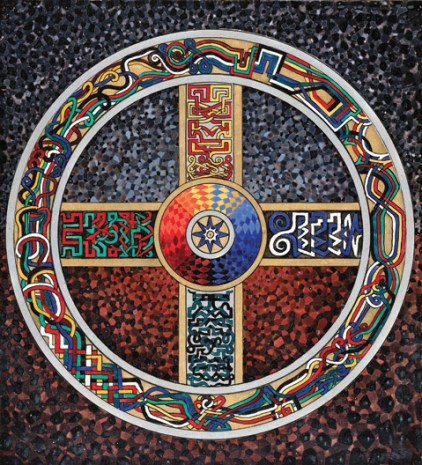
Beginning in 1913, Jung began to engage with a series of profound, visionary fantasies, an encounter with inner images and figures that would change the course of his life. Some say that Jung had gone insane, others that he had received a revelation. Perhaps he had descended to the source where such visions emerge, whether such visions are the delusions of the insane, who are entirely severed from outer reality, or the revelations of the mystics who remind us, as Nietzsche says, that “the world is deep, deeper than day can comprehend.”[3] But rather than proclaiming himself a new prophet, Dr. Jung instead maintained his scientifically-oriented, empirical perspective: he sought an understanding of the origins of the visions, dreams, and fantasies. The journey toward understanding their source led him through the veil into the collective unconscious, the realm of archetypes.
In an effort to understand the meaning of his visionary wanderings, Jung chose to craft a record of his experience in an exquisite, leather-bound volume with the words Liber Novus—the New Book—etched in gold along its red spine. Sonu Shamdasani, editor of The Red Book, has described Jung’s unique project as “a literary work of psychology.”[4] Liber Novus can be seen as the meeting of many rivers, an intersection of psychology, art, literature, and religion—an expression of the efflorescence of human experience.
To enter into an understanding relationship with this unusual work, it must be situated: first in relation to Jung’s biography, and then in relation to the arena of world events in which Jung’s experiences were unfolding. Thus, I begin by focusing on this pivotal period in Jung’s life, drawing from several biographical perspectives and scholarly positions. Next, I look into the practice of active imagination to better understand the method Jung employed to engage with his emerging fantasies. From here I enter into a distillation of The Red Book itself, drawing forward a narrative summary of the three sections Jung composed: Liber Primus, Liber Secundus, and Scrutinies. Finally, I conclude by exploring the implications of The Red Book, first as it shaped Jung’s subsequent theories and writings, and secondly, how its publication in the twenty-first century has begun to change depth psychology, as well as our understanding of the ontology of imagination.
[1] C.G. Jung and Aniela Jaffé, Memories, Dreams, Reflections, trans. Richard and Clara Winston (New York: Vintage Books, 1989), 199.
[2] C.G. Jung, C.G. Jung Letters, Vol. 1: 1906-1950, ed. Gerhard Adler and Aniela Jaffé, trans. R.F.C. Hull, Bollingen Series XCV: 1 (Princeton, NJ: Princeton University Press, 1973), 33.
[3] Friedrich Nietzsche, Thus Spoke Zarathustra, trans. R.J. Hollingdale (London: Penguin Books, 2003), 333.
[4] Sonu Shamdasani, Jung Stripped Bare by His Biographers, Even (London: Karnac, 2005), 25, note 59.
Bibliography
Bair, Deirdre. Jung: A Biography. New York: Little Brown, 2003.
Brutsche, Paul. “On Aspects of Beauty in C.G. Jung’s Red Book.” ARAS Connections: Image and Archetype 1 (2010).
Corbin, Henry. “Mundus Imaginalis, or The Imaginary and the Imaginal.” Translated by Ruth Horine. En Islam Iranien: Aspects Spirituels et Philosophiques, tome IV, livre 7. Paris, France: Gallimard, 1971.
Drob, Sanford L. Reading The Red Book: An Interpretive Guide to C.G. Jung’s Liber Novus. New Orleans, LA: Spring Journal Books, 2012.
Giegerich, Wolfgang. “Liber Novus, That is, The New Bible: A First Analysis of C.G. Jung’s Red Book.” Spring: A Journal of Archetype and Culture 83 (Spring 2010): 361-411.
Goldenberg, Naomi. “Archetypal Theory and the Separation of Mind and Body.” In Weaving the Visions: New Patterns in Feminist Spirituality. Edited by Judith Plaskow and Carol P. Crist, 244-55. San Francisco, CA: Harper & Row, 1989.
Hall, James A. Jungian Dream Interpretation: A Handbook of Theory and Practice. Toronto, Canada: Inner City Books, 1983.
Hannah, Barbara. Jung: His Life and Work. Wilmette, IL: Chiron Publications, 1997.
Hillman, James and Sonu Shamdasani. Lament of the Dead: Psychology after Jung’s Red Book. New York: W.W. Norton & Company, 2013.
Hoeller, Stephen A. The Gnostic Jung and the Seven Sermons of the Dead. Wheaton, IL: Quest Books, The Theosophical Publishing House, 1982.
–––––. “Jung, Kabbalah, and Gnosis.” Psychological Perspectives 55:2 (2012): 163-81.
Irvine, Ian. “Jung, Alchemy, and the Technique of Active Imagination.” In Alchemy and Imagination, part 3. Croydon, Victoria, Australia: Mercurius, 2010.
Jeromson, Barry. “The Sources of Systema Munditotius: Mandalas, Myths and a Misinterpretation.” Jung History 2:2 (2007): 20-26.
–––––. “Systema Munditotius and Seven Sermons: Symbolic Collaborators in Jung’s Confrontation with the Dead.” Jung History 1:2 (2005-2006): 6-10.
Jung, C.G. Aion: Researches into the Phenomenology of Self. 2nd edition. Vol. 9, part 2 of The Collected Works of C.G. Jung. Translated by R.F.C. Hull. Edited by H. Read, M. Fordham, G. Adler, and W. McGuire. Bollingen Series XX. Princeton, NJ: Princeton University Press, 1968.
–––––. Analytical Psychology: Notes of the Seminar Given in 1925. Edited by William McGuire. Bollingen Series XCIX. Princeton, NJ: Princeton University Press, 1989.
–––––. “Answer to Job.” In The Portable Jung. Edited by Joseph Campbell. Translated by R.F.C. Hull, 519-650. New York: Viking, 1971, Penguin, 1976.
–––––. The Archetypes and the Collective Unconscious. 2nd edition. Vol 9, part 1 of The Collected Works of C.G. Jung. Translated by R.F.C. Hull. Edited by H. Read, M. Fordham, G. Adler, and W. McGuire. Bollingen Series XX. Princeton, NJ: Princeton University Press, 1968.
–––––. C.G. Jung Letters, Vol. 1: 1906-1950. Edited by Gerhard Adler and Aniela Jaffé. Translated by R.F.C. Hull. Bollingen Series XCV: 1. Princeton, NJ: Princeton University Press, 1973.
–––––. “The Concept of the Collective Unconscious.” In The Portable Jung. Edited by Joseph Campbell. Translated by R.F.C. Hull, 59-69. New York: Viking, 1971, Penguin, 1976.
–––––. Mysterium Coniunctionis. 2nd edition. Vol 14 of The Collected Works of C.G. Jung. Translated by R.F.C. Hull. Edited by H. Read, M. Fordham, G. Adler, and W. McGuire. Bollingen Series XX. Princeton, NJ: Princeton University Press, 1970.
–––––. “Psychology of the Transference.” In The Practice of Psychotherapy. Vol. 16 of The Collected Works of Carl Gustav Jung. Translated by R.F.C. Hull. Edited by H. Read, M. Fordham, G. Adler, and W. McGuire, Bollingen Series XX, 163-338. Princeton, NJ: Princeton University Press, 1985.
–––––. “The Psychology of the Unconscious Processes.” In Collected Papers on Analytical Psychology, 2nd edition. Edited by Constance Long. New York: Moffat Yard and Company, 1917.
–––––. The Red Book: Liber Novus. Edited by Sonu Shamdasani. Translated by Mark Kyburz, John Peck, and Sonu Shamdasani. New York: W.W. Norton & Company, 2009.
–––––. Symbols of Transformation. Vol. 5 of The Collected Works of C.G. Jung. Translated by R.F.C. Hull. Edited by H. Read, M. Fordham, G. Adler, and W. McGuire, Bollingen Series XX. Princeton, NJ: Princeton University Press, 1956.
Jung, C.G. and Aniela Jaffé. Memories, Dreams, Reflections. Translated by Richard and Clara Winston. New York: Vintage Books, 1989.
McLynn, Frank. Carl Gustav Jung. London: Bantam, 1996.
Nietzsche, Friedrich. Thus Spoke Zarathustra. Translated by R.J. Hollingdale. London: Penguin Books, 2003.
Owens, Lance. S. “The Hermeneutics of Vision: C.G. Jung and Liber Novus.” The Gnostic: A Journal of Gnosticism, Western Esotericism and Spirituality 3 (July 2010): 23-46.
–––––. “Jung and Aion: Time, Vision, and a Wayfaring Man.” Psychological Perspectives 54 (2011): 253-89.
Owens, Lance S. and Stephen A. Hoeller. “Carl Gustav Jung and The Red Book: Liber Novus.” In Encyclopedia of Psychology and Religion, 2nd edition. Edited by David A. Leeming. New York, Springer Reference, 2014. Accessed on May 2, 2016. http://link.springer.com/referenceworkentry/10.1007%2F978-1-4614-6086-2_9071.
Ribi, Alfred. The Search for Roots: C.G. Jung and the Tradition of Gnosis. Los Angeles, CA: Gnosis Archive Books, 2013.
Shamdasani, Sonu. C.G. Jung: A Biography in Books. New York: W.W. Norton & Company, 2012.
–––––. “C.G. Jung and the Red Book.” Paper presented at the Library of Congress, Washington, D.C., June 19, 2010.
–––––. Jung Stripped Bare by His Biographers, Even. London: Karnac, 2005.
–––––. “Who Is Jung’s Philemon? An Unpublished Letter to Alice Raphael.” Jung History 2:2 (2007): 5-7.
Shamdasani, Sonu and John Beebe. “Jung Becomes Jung: A Dialogue on Liber Novus (The Red Book).” Psychological Perspectives 53:4 (2010): 410-36.
Sherry, Jay. “A Pictorial Guide to The Red Book.” ARAS Connections: Image and Archetype 1 (2010).
Von Franz, Marie-Louise. Alchemical Active Imagination. Boston, MA: Shambhala, 1997.
–––––. C.G. Jung: His Myth in Our Time. Translated by William H. Kennedy. Toronto, Canada: Inner City Books, 1998.
Wilhelm, Richard, trans. The Secret of the Golden Flower: A Chinese Book of Life. Orlando, FL: Harcourt Brace & Company, 1962.
Wilson, Colin. Lord of the Underworld: Jung and the Twentieth Century. Wellingborough, UK: The Aquarian Press, 1984.
I had the great pleasure of being interviewed by Gordon White, host of the London-based podcast Rune Soup. We discussed the synchronicity of the “Red Books” of Jung and Tolkien, as well as the role of the imaginal and the mythic in ecology. The podcast is available for download or can be listened to directly below.
This essay, originally written in May 2013, has now been published in the inaugural issue of Re-Imagining Magazine, a publication created by the Chicago Wisdom Project.
“To speak, to ask to have audience today in the world, requires that we speak to the world, for the world is in the audience; it too is listening to what we say.”[1] With these words James Hillman opens his essay “Anima Mundi” in which he speaks of the return of soul to the world. Such is the task we face as a species, as human beings, as we learn to cultivate a different kind of relationship with our planet, the Earth which supports our very existence. But what eyes can we use to see the soul of the world? What languages can we speak to call out to the anima mundi? With what ears shall we listen to hear the Earth’s voices in reply?
To read the rest of this article please see: “Towards An Imaginal Ecology”

[1] James Hillman, The Thought of the Heart and the Soul of the World (Putnam, CT: Spring Publications, Inc., 2007), 91.

We in the Northern Hemisphere find ourselves in the heart of the darkest time of year, the Solstice—from the Latin solstitium, when the Sun stands still. Tonight we enter the longest night, when the stars are visible across the sky for the greatest number of hours each year.
At this time when the stars are longest open to our gaze, we are pleased to announce the return of Archai: The Journal of Archetypal Cosmology. Founded in 2008, Archai is an academic journal originally edited by Keiron Le Grice, Rod O’Neal, and Bill Streett—all alumni of PCC. Four issues of the journal were published from 2009 to 2012, defining the discipline of archetypal cosmology and the theoretical foundations of the subject. Keiron, Rod, and Bill have decided to step back from their editorial duties to focus on other commitments, and we would like to acknowledge the great service they have given to the discipline of archetypal cosmology.
Earlier this year Archai was passed on to two new editors, Grant Maxwell and Becca Tarnas, who have been in the process of bringing into print the journal’s next installment, Saturn and the Theoretical Foundations of an Emerging Discipline. Issue 5, to be published in early 2016 will feature an array of voices from the field of archetypal cosmology including Richard Tarnas, Jessica Garfield-Kabbara, Delia Shargel, and Drew Dellinger, among several others.
In anticipation of the forthcoming publication, we are delighted to share with you Archai’s new website, Archai.org, which will feature the regular publication of articles from the journal’s archive, as well as access to purchase Issue 5 in both print and eBook format. We encourage you to follow the website for regular articles and updates, and to join us on Facebook for further information and dialogue.
We will be hosting a launch event for Issue 5 in early 2016 at which our authors and editorial team will participate in a panel discussion to share their work and to invite future collaboration.
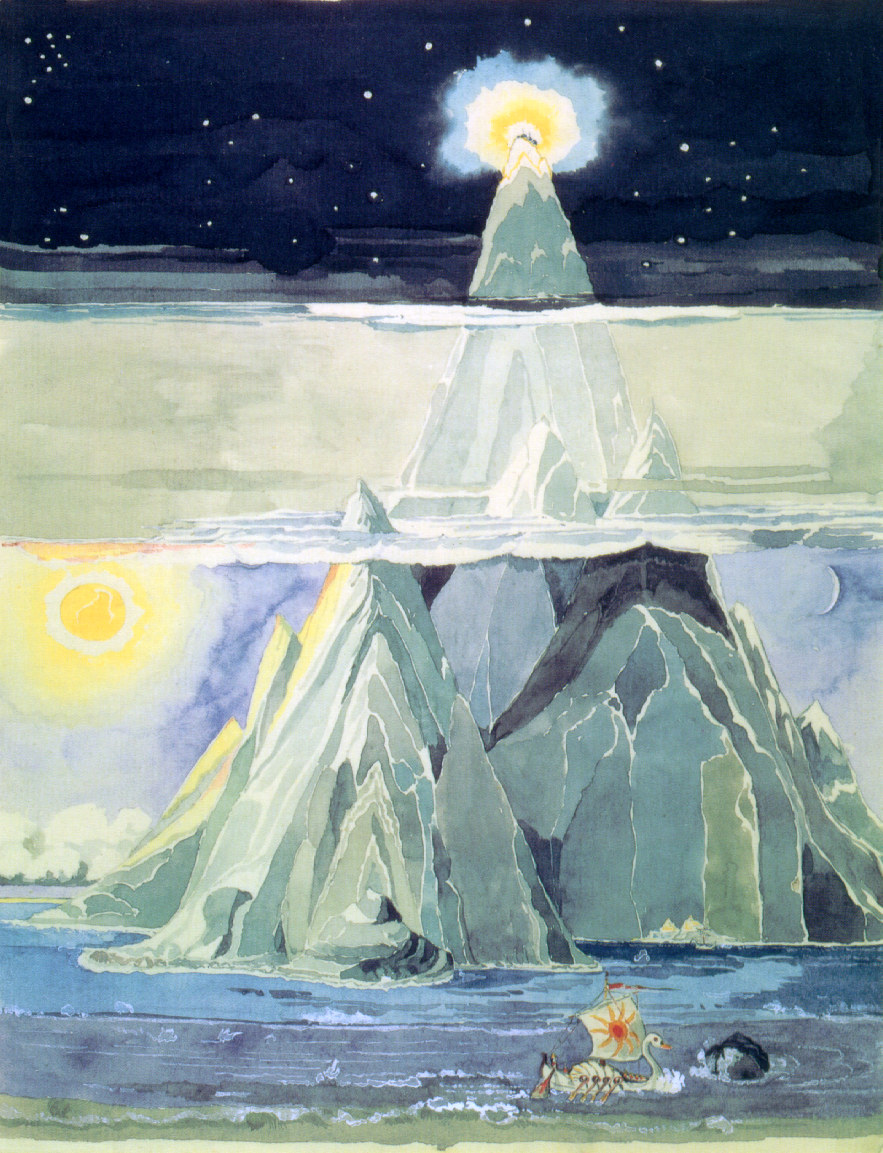
On this last New Moon of 2015, I am sharing the introduction to my comprehensive exam on the works and context of J.R.R. Tolkien, the composition of which has been my primary occupation over the last seven months. This is the first of two comprehensive exams to be written for my dissertation on the Red Books of Tolkien and C.G. Jung. Because much of the material in the exam will be included in my dissertation I am not posting it publicly, rather allowing it to gestate until the full book is ready to publish. But I wished to share something of the labor of love in which I have been most recently engaged.
A Comprehensive Exam
on
The Works & Context of J.R.R. Tolkien
“On the edge of a valley one of Professor Tolkien’s characters can pause and say: ‘It smells like elves.’ It may be years before we produce another author with such a nose for an elf. The professor has the air of inventing nothing. He has studied trolls and dragons at first hand and describes them with that fidelity which is worth oceans of ‘glib’ originality.”
– C.S. Lewis, Review of The Hobbit[1]
O Elbereth! Gilthoniel!
We still remember, we who dwell
In this far land beneath the trees,
Thy starlight on the Western Seas.
– J.R.R. Tolkien, The Fellowship of the Ring[2]
Introduction
When Professor J.R.R. Tolkien of Oxford, England set out to write a mythology, he did not know he would end up writing one of the most beloved works of literature of the 20th century. Indeed, he did not know of Hobbits or the King of Gondor, or even of Mount Doom. But he did know about Elves, and Middle-Earth, the endless Sea, and the far shores of Faërie. He knew he wanted to write poems and tell stories that had a particular “quality of strangeness and wonder,” stories that would bring “the satisfaction of certain primordial human desires”: the desire “to survey the depths of space and time” and “hold communion with other living things.”[3]  And this he did, penning thousands of pages that came to tell the many myths of Middle-Earth.
Over the course of his lifetime, Tolkien published the books The Hobbit and The Lord of the Rings, the short stories Leaf by Niggle, Farmer Giles of Ham, and Smith of Wootton Major, and the book of poetry The Adventures of Tom Bombadil and Other Verses from the Red Book. He translated the medieval English poems Sir Gawain and the Green Knight, Pearl, and Sir Orfeo, and wrote scholarly papers on Beowulf and the Ancrene Wisse. But, except for the twelve long years dedicated to the composition of his masterwork, The Lord of the Rings, Tolkien’s primary creative occupation was writing and re-writing the cosmogonic myths and epic tales of the Silmarillion, a book never published in his lifetime. Indeed, when he passed away in 1973, he left behind him “the serried ranks of box files that contained . . . like beads without a string, the raw material of ‘The Silmarillion.’”[4] As his publisher Rayner Unwin says: “although over the years some authors have written at greater length, few if any have left behind a more purposeful yet inchoate creative complexity than Tolkien.”[5] But, thanks to the decades-long effort of Tolkien’s son Christopher, the world can now read these pages, published as a compact narrative in The Silmarillion, and in the vast drafts and retellings found in Unfinished Tales and the twelve volumes of The History of Middle-Earth.
Who knows what form the Silmarillion may have taken if Tolkien had given it the same level of perfectionist revisioning that he gave The Lord of the Rings. But perhaps that is not how the tales of the Silmarillion were meant to be told. Perhaps they were meant to be received in the way primary myth is: with overlapping narratives and changing names, some stories drawn with great detail in both poetry and prose, others sketched as tales to be glimpsed in the background. Exploring the world of Middle-Earth can be like crossing a threshold into another realm, losing sight even of the pages in one’s hands, as far landscapes and poignant beauties pierce to the depths of one’s experience.
As his philological collaborator Simone D’Ardenne writes, “Tolkien’s personality was so rich, so diverse, so vast and so elusive” that to paint any portrait of his life will inherently be inadequate.[6] Although born in South Africa in 1892, Tolkien spent the majority of his life in England, only going to the European continent a few times, or occasionally across the water to Ireland. But this does not mean he was untraveled. Tolkien arguably explored more distant lands than many, but they are lands only found in the imagination. In this comprehensive exam I seek to understand Tolkien’s life and work in the context of his imaginal experiences, and the people and ideas that supported him in having them.
I begin with Tolkien’s family and friends, the literary midwives who helped him bring his mythology to birth. From there I turn to Tolkien’s artwork, the paintings, drawings, and sketches that he made before his writing had begun to take shape. I focus primarily on the early years when he was illustrating The Book of Ishness, although Tolkien continued throughout his life to make beautiful works of art to accompany his stories. From these images I shift to language, the subject that was central to the person Tolkien was. Not only was he a professional philologist and professor of Anglo-Saxon, first at Leeds University and later at Oxford, he was an artist of language as well, inventing words, grammar, and etymology for multiple languages of Middle-Earth. Finally, I turn to an exploration of Tolkien’s experience of the imagination, looking particularly through the lens of his theory of Sub-creation. To conclude, I touch on the connection between Tolkien’s work and The Red Book of C.G. Jung, the subject on which my subsequent dissertation will be focused.
Tolkien’s personality was multifaceted; one could encounter him as “the Christian, or the friend, the artist or the humanist, the father or the teacher,” as D’Ardenne writes.[7] Many possibilities are open to us for exploring who he was. In an obituary written long in advance of Tolkien’s death, his close friend C.S. Lewis says: “He was a man of ‘cronies’ rather than of general society and was always best after midnight (he had a Johnsonian horror of going to bed) and in some small circle of intimates where the tone was at once Bohemian, literary, and Christian.”[8] If he was best in his small circle of intimates, perhaps that is the place to meet him first—among his own Fellowship.
[1] C.S. Lewis, qtd. in Philip Zaleski and Carol Zaleski, The Fellowship: The Literary Lives of the Inklings (New York, NY: Farrar, Straus and Giroux, 2015), 209.
[2] J.R.R. Tolkien, The Lord of the Rings: The Fellowship of the Ring (New York, NY: Houghton Mifflin Company, 1994), 78.
[3] J.R.R. Tolkien, On Fairy-Stories, ed. Verlyn Flieger and Douglas A. Anderson (London, England: HarperCollinsPublishers, 2014), 4.
[4] Rayner Unwin, “Early Days of Elder Days,” in Tolkien’s Legendarium: Essays on The History of Middle-Earth, ed. Verlyn Flieger and Carl F. Hostetter (Westport, CT: Greenwood Press, 2000), 247
[5]Unwin, “Early Days of Elder Days,” 6.
[6] Simone D’Ardenne, “The Man and Scholar,” in J.R.R. Tolkien, Scholar and Storyteller: Essays in Memoriam, ed. Mary Salu and Robert T. Farrell (Ithaca, NY: Cornell University, 1979), 33.
[7] D’Ardenne, “The Man and Scholar,” 33.
[8] C.S. Lewis, “Professor J.R.R. Tolkien: Creator of Hobbits and Inventor of a New Mythology” in J.R.R. Tolkien, Scholar and Storyteller: Essays in Memoriam, ed. Mary Salu and Robert T. Farrell (Ithaca, NY: Cornell University, 1979), 15.
Bibliography
Barfield, Owen. Poetic Diction: A Study in Meaning. Oxford, England: Barfield Press, 2010.
Caldecott, Stratford. The Power of the Ring: The Spiritual Vision Behind The Lord of the Rings and The Hobbit. New York, NY: The Crossroad Publishing Company, 2012.
Campbell, Joseph. The Hero with a Thousand Faces. Novato, CA: New World Library, 2008.
Carpenter, Humphrey. The Inklings: C.S. Lewis, J.R.R. Tolkien, Charles Williams and Their Friends, London, England: HarperCollinsPublishers, 2006.
–––––. J.R.R. Tolkien: A Biography. New York, NY: Houghton Mifflin Company, 2000.
Chance, Jane, ed. Tolkien and the Invention of Myth. Lexington, KY: The University Press of Kentucky, 2004.
–––––. Tolkien the Medievalist. Routledge Studies in Medieval Religion and Culture. New York, NY: Routledge, 2003.
Croft, Janet Brennan and Leslie A. Donovan, eds. Perilous and Fair: Women in the Works and Life of J.R.R. Tolkien. Altadena, CA: Mythopoeic Press, 2015.
Curry, Patrick. Deep Roots in a Time of Frost: Essays on Tolkien. Zürich, Switzerland: Walking Tree Publishers, 2014.
–––––. Defending Middle-Earth. Edinburgh, Scotland: Floris Books, 1997.
Dickerson, Matthew and Jonathan Evans. Ents, Elves, and Eriador: The Environmental Vision of J.R.R. Tolkien. Lexington, KY: The University Press of Kentucky, 2006.
Duriez, Colin. The Oxford Inklings: Lewis, Tolkien and Their Circle. Oxford, England: Lion Books, 2015.
–––––. Tolkien and C.S. Lewis: The Gift of Friendship. Mahwah, NJ: Hidden Spring, 2003.
–––––. Tolkien and The Lord of the Rings: A Guide to Middle-Earth. Mahwah, NJ: Hidden Spring, 2001.
Edwards, Raymond. Tolkien. London, England: Robert Hale Limited, 2014.
Flieger, Verlyn. “But What Did He Really Mean?” Tolkien Studies 11 (2014): 149-66.
–––––. Green Suns and Faërie: Essays on J.R.R. Tolkien. Kent, OH: The Kent State University Press, 2012.
–––––. Interrupted Music: The Making of Tolkien’s Mythology. Kent, OH: The Kent State University Press, 2005.
–––––. A Question of Time: J.R.R. Tolkien’s Road to Faërie. Kent, OH: The Kent State University Press, 1997.
–––––. Splintered Light: Logos and Language in Tolkien’s World. Kent, OH: The Kent State University Press, 2002.
Flieger, Verlyn and Carl F. Hostetter, eds. Tolkien’s Legendarium: Essays on The History of Middle-Earth. Westport, CT: Greenwood Press, 2000.
Garth, John. Tolkien and the Great War: The Threshold of Middle-Earth. New York, NY: Houghton Mifflin Company, 2003.
Hammond, Wayne G. and Christina Scull. The Art of The Hobbit by J.R.R. Tolkien. New York, NY: Houghton Mifflin Harcourt Publishing Company, 2012.
–––––. The Art of The Lord of the Rings by J.R.R. Tolkien. New York, NY: Houghton Mifflin Harcourt Publishing Company, 2015.
–––––. J.R.R. Tolkien: Artist & Illustrator. New York, NY: Houghton Mifflin Company, 2000.
Jung, C.G. The Red Book: Liber Novus. Edited by Sonu Shamdasani. Translated by Mark
Kyburz, John Peck, and Sonu Shamdasani. New York, NY: W.W. Norton & Company, 2009.
Knight, Gareth. The Magical World of the Inklings. Cheltenham, England: Skylight Press, 2010.
Lang, Andrew. The Red Fairy Book. Mineola, NY: Dover Children’s Classics, 1966.
Lee, Stuart D. ed. A Companion to J.R.R. Tolkien. New York, NY: John Wiley & Sons, Ltd., 2014.
Lobdell, Jared, ed. A Tolkien Compass. Chicago, IL: Open Court Publishing Company, 2003.
Lönnrot, Elias. Kalevala: Land of Heroes. Translated by W.F. Kirby. London, England: Everyman’s Library, 1966.
Milbank, Alison. Chesterton and Tolkien as Theologians: The Fantasy of the Real. New York, NY: T&T Clark, 2007.
Noel, Ruth S. The Languages of Tolkien’s Middle-Earth. Boston, MA: Houghton Mifflin Company, 1974.
O’Neill, Timothy R. The Individuated Hobbit: Jung, Tolkien and the Archetypes of Middle-Earth. Boston, MA: Houghton Mifflin Company, 1979.
Owens, Lance. “Lecture I: The Discovery of Faërie.” In J.R.R. Tolkien: An Imaginative Life. Salt Lake City, UT: Westminster College, 2009. http://gnosis.org/tolkien/lecture1/index.html.
–––––. “Tolkien, Jung, and the Imagination.” Interview with Miguel Conner. AeonBytes Gnostic Radio, April 2011. http://gnosis.org/audio/Tolkien-Interview-with-Owens.mp3.
Reilly, R.J. Romantic Religion: A Study of Barfield, Lewis, Williams, and Tolkien. Athens, GA: University of Georgia Press, 1971.
Salu, Mary and Robert T. Farrell, eds. J.R.R. Tolkien, Scholar and Storyteller: Essays in Memoriam. Ithaca, NY: Cornell University, 1979.
Scull, Christina and Wayne G. Hammond. The J.R.R. Tolkien Companion and Guide, Vol. 1: Chronology. New York, NY: Houghton Mifflin Company, 2006.
–––––. The J.R.R. Tolkien Companion and Guide, Vol. 2: Reader’s Guide. New York, NY: Houghton Mifflin Company, 2006.
Shippey, Tom. J.R.R. Tolkien: Author of the Century. New York, NY: Houghton Mifflin Company, 2002.
–––––. The Road to Middle-Earth: How J.R.R. Tolkien Created a New Mythology. New York, NY: Houghton Mifflin Company, 2003.
Skogemann, Pia. Where the Shadows Lie: A Jungian Interpretation of Tolkien’s The Lord of the Rings. Wilmette, IL: Chiron Publication, 2009.
Tolkien, Christopher. Pictures by J.R.R. Tolkien. New York, NY: Houghton Mifflin Company, 1992.
Tolkien, J.R.R. The Adventures of Tom Bombadil. Edited by Christina Scull and Wayne Hammond. London, England: HarperCollinsPublishers, 2014.
–––––. The Annotated Hobbit. Annotated by Douglas A. Anderson. New York, NY: Houghton Mifflin Company, 2002.
–––––. Beowulf. Edited by Christopher Tolkien. New York, NY: Houghton Mifflin Company, 2014.
–––––. The Children of Húrin. Edited by Christopher Tolkien. New York, NY: Houghton Mifflin Company, 2007.
–––––. The History of Middle-Earth. Vol. 1-12. Edited by Christopher Tolkien. New York, NY: Houghton Mifflin Company, 2010.
–––––. The Letters of J.R.R. Tolkien. Edited by Humphrey Carpenter, with Christopher Tolkien. New York, NY: Houghton Mifflin Company, 2000.
–––––. The Lord of the Rings. New York, NY: Houghton Mifflin Company, 1994.
–––––. The Monsters and the Critics. Edited by Christopher Tolkien. London, England: HarperCollinsPublishers, 2006.
–––––. On Fairy-Stories. Edited by Verlyn Flieger and Douglas A. Anderson. London, England: HarperCollinsPublishers, 2014.
–––––. The Silmarillion. New York, NY: Houghton Mifflin Company, 2001.
–––––. Sir Gawain and the Green Knight, Pearl, and Sir Orfeo. London, England: HarperCollinsPublishers, 1995.
–––––. Smith of Wootton Major. Edited by Verlyn Flieger. London, England: HarperCollinsPublishers, 2005.
–––––. Tales from the Perilous Realm. London: England: HarperCollinsPublishers, 1997.
–––––. The Tolkien Reader. New York, NY: Ballantine Publishing Group, 1966.
–––––. Unfinished Tales: Of Númenor and Middle-Earth. Edited by Christopher Tolkien. New York, NY: Houghton Mifflin Company, 1980.
Zaleski, Philip and Carol Zaleski. The Fellowship: The Literary Lives of the Inklings. New York, NY: Farrar, Straus and Giroux, 2015.
Zimbardo, Rose A. and Neil D. Isaacs, eds. Understanding The Lord of the Rings: The Best of Tolkien Criticism. New York, NY: Houghton Mifflin Company, 2004.
I am not going to tell you a story of this world. And I am going to tell you a story of this world. It is for you to find out where the story came from. Or I will tell you. Or something in between.
For no apparent reason the One chose to become many. For no apparent reason. The key here is whether it was apparent, not whether it was without reason. How can one ascertain the appearances of the reason of the One? The One alone knows the reason for being, and from thence does faith in the One arise. A faith based on reason. But no apparent reason.
We are going to enter a world together. Likely it is a world with which you are deeply familiar. Or somewhat familiar if you have chosen me (or I have chosen myself) to be your guide into this world. But to enter the world together we must, on this day, begin outside it. Usually we awaken already within the circles of this world, if we have chosen to explore it. But today we shall suspend time—for who is more able to suspend time than that which (or whom) we wish to encounter on this journey? We shall suspend time and enter the imagination of a world before time, the world before the world, the world even before the waking into reality of imagination.
I wish to explore Creativity as Trickster. If, as Lewis Hyde claims, Trickster Makes This World, who makes Trickster? The ambiguity, the shape-shifting, the amorality, the potential and paradox: these qualities of the Trickster are birthed from Creativity. Is the Trickster really Trickster? Or does Creativity take hold for some time, and make Trickster what Trickster is?
The world into which were are entering is one that happened to be penned by a single author, or so it is often said. You probably already know his name if you know me. Can you imagine that moment when a cosmogonic myth made itself apparent to a single human imagination? What must that have felt like? How many times has that happened in the history of our one species? How many beginnings have been retold of our world?
J.R.R. Tolkien coined the term “sub-creation” to describe the desire to create and experience Art, what he saw as the shaping and crafting of imaginal experience into artistic form. Yet Tolkien used the term “sub-creator” because he believed the desire to create arose within created beings because they in turn were first created by a divine Creator. “We make in our measure and in our derivative mode, because we are made: and not only made, but made in the image and likeness of a Maker.”[1] Tolkien saw himself as a sub-creator, making Art—an enchanted, Secondary World—under the creative imagination of God. But the Secondary World Tolkien shaped, a world called Arda, is one that tells the stories of other sub-creators, other divinely created beings who wished to create in their own measure and derivative mode. A world within a world, sub-creators under sub-creators. The desire to create itself, what we might call the embodiment of Creativity, has a Trickster form. Yet no single figure in Tolkien’s world remains Trickster for long: rather the Trickster energy appears to move on, igniting creativity and even chaos, yet ultimately bringing more beauty into the world for its disruption.
I would like to turn to Tolkien’s cosmogonic myth, called the Ainulindalë, the Music of the Ainur. Again, can you imagine that moment when a cosmogonic myth made itself apparent to a single human imagination? The Ainulindalë began with Eru, the One, who first made the Ainur, spirits of divine thought. Eru, called also Ilúvatar in the world of Arda, inspired the Ainur to make music—and they did. Their singing, unbeknownst to them, shaped the world they would eventually build. The Ainur are the first sub-creators under Ilúvatar, shaping the divine imagining they received from Eru. The musical strands wove together and formed the first harmonies:
. . . a sound arose of endless interchanging melodies woven in harmony that passed beyond hearing into the depths and into the heights, and the places of the dwelling of Ilúvatar were filled to overflowing, and the music and the echo of the music went out into the Void, and it was not void.[2]
But one among the Ainur wished not to be a sub-creator, one whose musical threads were woven into the melodies of all others seamlessly. He wished to be a creator in his own right. His name is Melkor, and at this moment he is the first embodiment of the Trickster in the Deeps of Time before the world of Arda is brought into being. “He had gone often alone into the void places seeking the Imperishable Flame; for desire grew hot within him to bring into Being things of his own . . . . Yet he found not the Fire, for it is with Ilúvatar.”[3] Melkor’s thoughts and desires began to give rise to a new music, a strand of melody that clashed with the harmonies already in motion. Some of the Ainur followed his lead and soon the music became “a sea of turbulent sound.”[4] From amidst the “raging storm”[5] Ilúvatar, with a smile, brought forth a new theme. Again Melkor’s discord ignited disruptive clashing and violent disharmony. And in response Ilúvatar drew forward a third theme. The two melodies played simultaneously, conflicting yet interwoven: “there were two musics progressing at one time before the seat of Ilúvatar, and they were utterly at variance. The one was deep and wide and beautiful, but slow and blended with an immeasurable sorrow, from which its beauty chiefly came.”[6] Melkor’s music was loud, violent, drowning, and repetitive, “but it seemed that its most triumphant notes were taken by the other and woven into its own solemn pattern.”[7] The rebellion of Melkor, the desire for individual creativity apart from the Creativity of the One, was ultimately woven into the very patterning of the third theme of music making it all the more beautiful. For it was the sorrow of the third theme, sorrow in response to the violence of the disharmony, that gave it its profound beauty.
Many Trickster themes are woven into this narrative, although the Trickster is not embodied by one being alone. The Trickster energy moved quickly from being to being, never settling but still creating the dynamism of the moment. In Melkor’s rebellion and Ilúvatar’s creative response, the Trickster moved between them, crossing the boundaries between Creator and sub-creator. The Music of the Ainur is the moment of Creation, when the world is first imagined into being. It cannot be done again, and there are no mistakes. Disharmony is part of the world’s story from the beginning, and the suffering it causes gives rise to greater beauty than if all were melodious. So it is that Trickster does indeed make this world, or rather shapes it, by being many agents of creativity in succession.
After the making of the Music, Ilúvatar showed another of the most powerful Ainur how the discordant Music of Melkor had reshaped his own Music, that which had made the waters:
Seest thou not how here in this little realm in the Deeps of Time Melkor hath made war upon thy province? He hath bethought him of bitter cold immoderate, and yet hath not destroyed the beauty of thy fountains, nor of thy clear pools. Behold the snow, and the cunning work of frost! Melkor hath devised heat and fires without restraint, and hath not dried up thy desire nor utterly quelled the music of the sea. Behold rather the height and glory of the clouds, and the everchanging mists; and listen to the fall of rain upon the Earth![8]
To this, the Ainu of the Waters responded: “Truly, Water is become now fairer than my heart imagined, neither had my secret thought conceived the snowflake, nor in all my music was contained the falling of the rain.”[9]
In his rebellion Melkor became identified with the Trickster. He had wandered through the Void looking for the Secret Fire, that which grants true Being to the creative impulse. To Melkor is seemed “that Ilúvatar took no thought for the Void, and he was impatient of its emptiness.”[10] As Lewis Hyde writes, the Trickster “embodies and enacts that large portion of our experience where good and evil are hopelessly intertwined. He represents the paradoxical category of sacred amorality.”[11] Melkor faced the darkness of the Void looking for the Imperishable Flame of Creativity, searching for consciousness in unconsciousness. As Tanya Wilkinson writes, “The archetypal Trickster faces both ways, toward consciousness and unconsciousness, embodying contradiction.”[12] Melkor’s desire to create was the gift bestowed on him by the Creator, but it was a gift he sought to wrest to his own devices, and the violence of his attempt to rip away that gift and make it solely his own changed the course of all subsequent actions. Ilúvatar showed the Ainur a vision of their Music, that they might see how their melodies each unfolded into form. Ilúvatar then said: “And thou, Melkor, wilt discover all the secret thoughts of thy mind, and wilt perceive that they are but a part of the whole and tributary to its glory.”[13] Perhaps here the One outwitted the Trickster, and became Trickster himself.
Melkor’s role in the beginning was ambiguous, as the role of the Trickster should be. He is the mightiest of the Ainur, “given the greatest gifts of power and knowledge,”[14] and his desire to use those gifts walks the boundary of good and evil. The evils he caused served the ultimate good of Ilúvatar, sorrow and suffering making the poignant beauty of Creation. Only later, when Melkor’s fall was complete, when he became identified no longer as a sub-creator under the One but simply a being marring the sub-creations of the other powerful Ainur, did he lose his ambiguous position. No longer was he named Melkor, meaning “He who arises in Might,”[15] but Morgoth, “the Black Enemy.”[16] If the Trickster is to be found at the boundary, the place of ambiguity, then the moment Melkor chose not to remain in that ambiguity he ceased to be the Trickster. Creative Trickster energy moved on, and found its home in other sub-creators who walk the fine line between good and evil, following the ambiguous path of ingenuity and clever creativity.
Melkor has a foil among the Ainur, one who also desired to make his own independent creations: Aulë, who longed for beings to whom he could teach craft and wisdom. Like the other Ainur, Aulë had recognized that the third themes of the Music signified the coming of the Children of Ilúvatar, the Eldar and Edain—Elves and Humans—who would people the world. Yet Aulë was impatient for their coming, and instead crafted a new race of beings, the Naugrim, called also the Dwarves. In this moment Ilúvatar came to him, and we are able to see here most clearly the divine relationship between Creator and sub-creator. Ilúvatar spoke to Aulë saying: “For thou hast from me as a gift thy own being only, and no more; and therefore the creatures of thy hand and mind can live only by that being, moving when thou thinkest to move them, and if thy thought be elsewhere, standing idle. Is that thy desire?”[17] Aulë replied with an explanation of his seeming rebellion, so like Melkor’s rebellion in many ways: it came not from a desire for power and lordship in his own right but from a desire for “things other than I am, to love and to teach them.”[18] But it was the inherent desire to create, to be a sub-creator, that Aulë gave most convincing voice to: “Yet the making of things is in my heart from my own making by thee; and the child of little understanding that makes a play of the deeds of his father may do so without thought of mockery, but because he is the son of his father.” This supplication of the sub-creator is not that of the Trickster, but its effect on the One is such that the Naugrim awaken with their own individual life and wills, independent of their maker. Something new is introduced that would have not existed otherwise, without the seeming rebellion of the sub-creator, or the unexpected move of the Creator to give them life.
A sub-creator shapes a world within a world, Art from the raw material of Imagination. A world within a world naturally has its boundaries, but while within the world it can be difficult to see where the boundaries lie, if it is possible to see them at all. Only when a new world is created do we see that boundary drawn, the moment sub-creator and Creator work together to breathe life into new form. The Trickster waits at the boundaries, the crossroads, the borders, leaping between those who dare to draw a line against what has come before to make something new and different.
In this world we have entered the Trickster seems particularly evasive, changing names and changing shapes, crossing from good to evil and back before there was good and evil to cross between. If he who seems to be a Trickster falls from grace, the Trickster energy moves on, finds somewhere else to be. The Trickster seems to be Creativity itself, the Imperishable Flame that gives life, that is within Ilúvatar and yet is not Ilúvatar. And what is the Imperishable Flame, the Secret Fire?
Why was there a great Music to begin with? Why were the Ainur brought into being? For no apparent reason . . . Is that not the sign of the Trickster?
Works Cited
Hyde, Lewis. Trickster Makes This World: Mischief, Myth, and Art. New York, NY: Farrar, Straus and Giroux, 1998.
Tolkien, J.R.R. “On Fairy-Stories.” In The Monsters and the Critics. Edited by Christopher Tolkien. London, England: HarperCollins Publishers, 2006.
–––––. The Silmarillion. New York, NY: Houghton Mifflin Company, 2001.
Wilkinson, Tanya. Persephone Returns: Victims, Heroes and the Journey from the Underworld. Berkeley, CA: PageMill Press, 1996.
[1] J.R.R. Tolkien, “On Fairy-Stories” in The Monsters and the Critics, ed. Christopher Tolkien (London, England: HarperCollins Publishers, 2006), 145.
[2] J.R.R. Tolkien, The Silmarillion (New York, NY: Houghton Mifflin Company, 2001), 15.
[3] Tolkien, The Silmarillion, 16.
[4] Tolkien, The Silmarillion, 16.
[5] Ibid.
[6] Ibid, 16-17.
[7] Ibid, 17.
[8] Tolkien, The Silmarillion, 19.
[9] Ibid.
[10] Ibid, 16.
[11] Lewis Hyde, Trickster Makes This World: Mischief, Myth, and Art (New York, NY: Farrar, Straus and Giroux, 1998), 10.
[12] Tanya Wilkinson, Persephone Returns: Victims, Heroes and the Journey from the Underworld (Berkeley, CA: PageMill Press, 1996), 153.
[13] Tolkien, The Silmarillion, 17.
[14] Ibid, 16.
[15] Ibid, 340.
[16] Tolkien, The Silmarillion, 341.
[17] Ibid, 43.
[18] Ibid.
There are moments in life when you feel deeply grateful for the family you were born into. I’m blessed to have had many such moments, but I’m feeling it with particular poignancy of late. Throughout most of my childhood and teens my father was busy writing the book Cosmos and Psyche: Intimations of a New World View. In my family it was known simply as “the Book.” While I knew my dad was an astrologer and cultural historian, it wasn’t until after I finished my undergraduate degree that I came to find my own scholarly path aligned so closely with his, drawing me into the world of archetypal cosmology, depth psychology, and philosophy.
As a child I was able to see the years of work and research that went into creating Cosmos and Psyche, and the moment of familial pride and gratitude I am now feeling arises from the fact that that book is being adapted into a film: Changing of the Gods. I could not imagine the project being in better hands: the producer Kenny Ausubel, one of the co-founders of Bioneers—the great annual conference that addresses issues of ecological justice—and the director Louie Schwartzberg, whose exquisite visionary films show the depth and breadth of the interconnected wisdom of the cosmos. Finally, John Cleese will be the on-screen host, leading the audience through the journey of discovering an archetypal world view.
For me personally there is another profound synchronicity connected to those who are creating this film: the director Louie Schwartzberg’s birthday is February 21, 1950—the exact same day and year as my dad’s birthday—giving them the same birth chart. Furthermore, the producer Kenny Ausubel, whose initial vision it was to bring Cosmos and Psyche to the screen, was born on April 20, 1949, the exact same day and year as my mother’s birthday. So in many ways I feel as though this film is a sibling to me.
______________________________________________________________________________________________________________
The Changing of the Gods Kickstarter campaign is now in its final days of fundraising to bring together the community support for this film project. I want to encourage each of you from the depths of my heart to contribute if you so feel called. To see this story on the screen and make it accessible to a world audience through image and music would be a dream come true.

I am delighted to announce two events coming up later this year at which I will be presenting. The first event is the conference Re-Enchanting the Academy at Christchurch Canterbury University in England, which will take place September 25-27. I will be presenting on my ongoing dissertation research into the synchronistic parallels of the two “Red Books” of C.G. Jung and J.R.R. Tolkien. The abstract for my presentation is available here: The Synchronicity of the Two Red Books: Jung, Tolkien, and the Imaginal Realm. The Re-Enchanting the Academy Conference Program is now available as well and it looks like there will be a fantastic line-up. I’ll be presenting on Saturday afternoon during the panel session from 1:30-3:00 pm.

Since the opportunity to go to England does not arise every day, I will be staying a couple weeks in the British Isles to do research in the Tolkien archives at the Bodleian Library of Oxford University, the institution where Tolkien both attended school as an undergraduate and taught as a professor for much of his life. I am hoping to come across some artwork of his, particularly from his early sketchbook entitled The Book of Ishness, that has not yet been published. Who knows what further parallels may lie between the art of the Professor and the great Swiss Doctor? I will also get to travel to Cambridge University to visit my wonderful dissertation chair Jacob Sherman, who is currently holding the three-year post of University Lecturer in Philosophy of Religion.
The second event which I am announcing is a lecture and workshop offered through the Idaho Friends of Jung in Boise, taking place November 13-14. I will be presenting on the same subject as above, but will have both the Friday evening lecture and the Saturday morning workshop to delve more deeply into the material through dialogue with the participants. The descriptions of the lecture and workshop are available here: The Synchronicity of the Two ‘Red Books’: Jung, Tolkien, and the Imaginal Realm.
Thank you all so much for the support that has allowed me to be bringing these ideas further out in to the world!
This short piece was written as a contribution to a longer essay written by Robert McDermott for the anthroposophical magazine Being Human, edited by John Beck. It appears alongside contributions from Matt Segall and Jeremy Strawn within the context of Robert’s article, Spirituality Affirmed By CIIS.
 Why do Waldorf students learn to knit? Why are we introduced to the letter M through the story of a double-peaked mountain, or to V through a tale told in a steep valley? Why are numbers split by Prince Divide, but increased rapidly by Princess Multiply and her little companion butterfly named Of? Why is each classroom wall painted in the ascending order of the rainbow’s spectrum?
As a child in a Waldorf School, the reasoning behind the lessons we engaged in—whether of craftworks and art, bodily expression and poetic movement, of color, sound, and story—were not usually explained to us. In Rudolf Steiner’s pedagogy, the importance lies as much in how a subject is taught as it does in what is taught. Waldorf Schools create not only a unique curriculum, but a unique environment, an atmosphere that one inhales on a day to day basis. If one word could be chosen to capture what such an environment nurtures and develops, it is the capacity of the child’s imagination. If the portal of imagination is allowed to remain open, if it is nourished and kept safe, strengthened and tested through adolescence to maturity, then the reasons behind the teaching of every form of creative practice—from material arts, to etheric movement, from astral knowledge, to personal wisdom—become apparent on their own.
While the spiritual science of anthroposophy is not explicitly taught to Waldorf students, except sometimes as an optional course to graduating high school seniors, the place within the student’s soul in which spiritual science can come to be understood is nurtured through the long arc of the curriculum. When the time comes to leave the imaginative womb of Waldorf education, questions regarding the why of Steiner’s methods may come forth.
As a graduate student whose childhood was shaped by Steiner’s educational approach, I found that the Philosophy, Cosmology, and Consciousness program at CIIS felt like a mature extension of my Waldorf Schooling. Here I was invited not only to continue to keep the doorway to the imaginal open wide, unlike at many other universities and graduate institutions, but I could also begin to explore the reasons behind the form of education that shaped me. Not only is Steiner directly taught in PCC, but many of the graduate program’s other courses can engage with questions initially brought forth by some of my high school and even grade school classes. A continuity of ideas flows between these forms of education, which I feel stems not only from a recognition of the body, soul, and spirit as channels of knowledge and wisdom, but also a profound respect for the power of the imaginative vision.
 Becca Tarnas