Mary Wollstonecraft Shelley: Unveiling the Modern Shadow

I am excited to say this essay was accepted by Kepler College to be displayed on their website. To read the article there please follow this link.

———————————————————————————————————————————

Born Mary Godwin, Mary Wollstonecraft Shelley was the daughter of the revolutionary feminist writer Mary Wollstonecraft, whose powerful treatise, Vindication of the Rights of Woman, opened up new avenues of possibility for the education of women at the commencement of the 19th century. Her daughter was one such beneficiary of Wollstonecraft’s desire to reform women’s education, going on to publish the wildly popular novel Frankenstein at the young age of 20. A look at the planetary aspects of Mary Shelley’s natal chart, using the perspective of archetypal astrology, can help illustrate how the archetypal energies correlated with the planets of our solar system were expressed in her personal life and in her writing, with a particular focus on her masterwork, Frankenstein. An analysis of the world transits, and the personal transits they form to Shelley’s natal chart, at the time of the publication of Frankenstein provide further insight into Shelley’s writing.

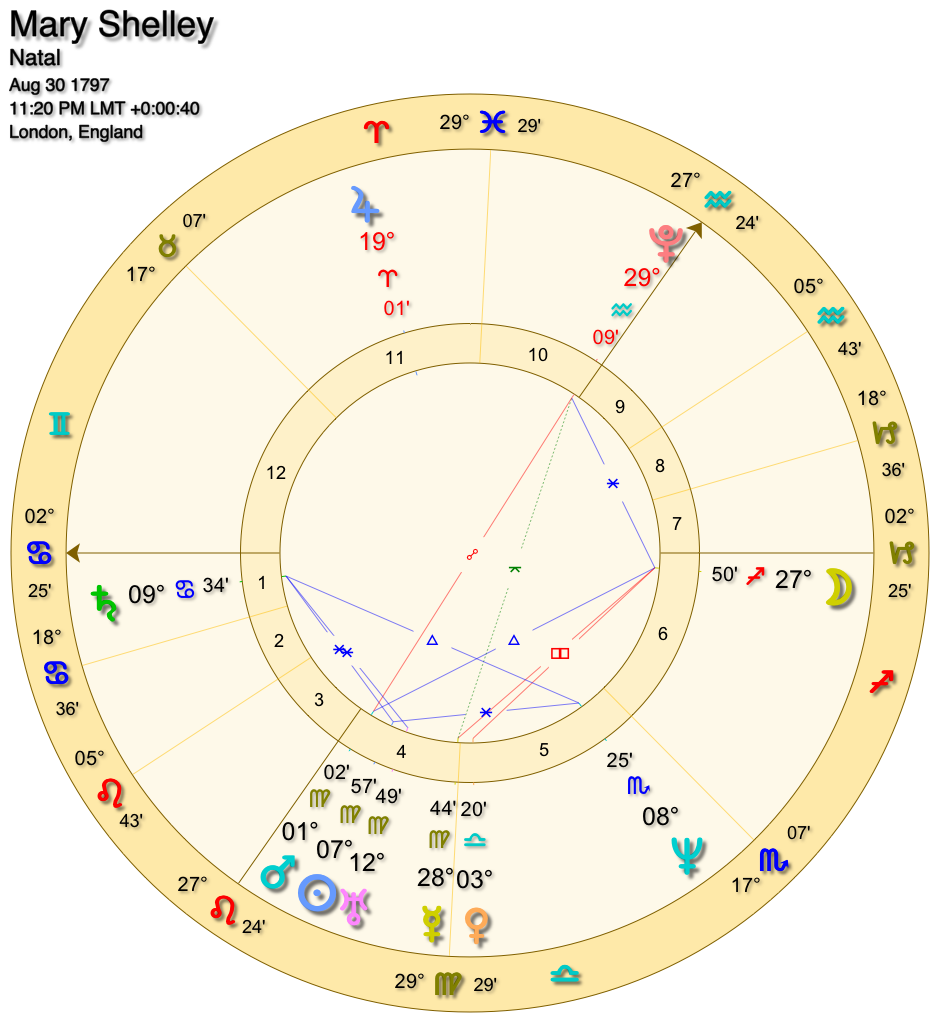
Mary ShelleyMary Godwin, who became Mary Shelley upon her marriage to the Romantic poet Percy Shelley, was born August 30, 1797 at 11:20 pm in London, England. Most prominent in her chart is a triple conjunction of the Sun, Mars, and Uranus in the sign of Virgo, in a tight 180° opposition to Pluto, with Mars closest to Pluto in the opposition. The Sun is archetypally correlated with the principle of the self, of one’s central identity and focus, and the areas in which one shines or expresses oneself most prominently. Uranus, the first of the outer planets to be discovered in the modern era, is correlated with the revolutionary impulse, with breakthrough, rebellion, genius, brilliance, technology, electricity, the young, and the new. Sun-Uranus aspects are often found in the natal charts of brilliant individuals whose work has provided some kind of breakthrough or revolutionary shift in consciousness or worldview, from Copernicus, Galileo, and Kepler, to Newton, Kant, and Freud.[1] The planet Uranus is archetypally correlated with the Greek myth of Prometheus, the Titan who stole fire (a symbol for consciousness) from the Gods and gave it to humanity. Mary Shelley’s husband, Percy Shelley, was also a Sun-Uranus figure. His expression of the archetypal complex can clearly be seen in his poem Prometheus Unbound.

Mary Shelley’s personal expression of the Sun-Uranus combination comes through in the brilliance of her individual expression in her breakthrough first novel, which even has the apt subtitle The Modern Prometheus. The character of Victor Frankenstein is that of a rebel seeking to create life by means of technological innovation, all of which are Uranian themes. He desires to create new life alone, not as father and mother, but to elevate himself to the role of God the Father, the individual solar hero on his quest of technological prowess. Frankenstein takes on the role of both father and mother, rebelling against the order of nature, doing so in an act of technological breakthrough and brilliance. While working, Frankenstein speaks of those he would create, saying “No Father could claim the gratitude of his child so completely as I should deserve theirs.”[2] Yet, he must also suffer the consequences of achievement. Like Prometheus, whose gift to humanity leads to his eternal punishment—chained to a rock while an eagle consumes his liver each day only to have it grow back again each night—Frankenstein is haunted by the life he gave, the monster he created out of his own hubris and ambition.Mary Shelley Chart
Mary Shelley’s Sun-Mars-Uranus triple conjunction is, as mentioned above, in opposition to Pluto. The Uranus-Pluto opposition Shelley is born under is the primary transit that defined the tumultuous era of the French Revolutionary Period. The Uranus-Pluto impulse is toward revolutionary change on a mass scale, the liberation of the repressed and the oppressed, and the unleashing of the taboo. It is the same transit that defined the 1960s countercultural era and our current moment of world revolutions and protests, from the Arab Spring to the Occupy Movement, to the overturning of the Defense of Marriage Act in the United States this current summer.

An interesting connection between Mary Shelley and her mother, Mary Wollstonecraft, is that Wollstonecraft was born with Uranus square Pluto in 1759 and published her masterwork, Vindication of the Rights of Woman, under the Uranus-opposite-Pluto in 1792. Her daughter was born just five years later in 1797 under the same Uranus-Pluto transit, and she went on to publish her own masterpiece, Frankenstein, under the subsequent Uranus square Pluto that was just beginning to come into the orb of influence in 1818. Both mother and daughter’s writing has a revolutionary quality: they were both breaking through the gender barrier in their era that oppressed female writers, and female expression as a whole.

The quality of Shelley’s Frankenstein also expresses Uranus-Pluto archetypal themes in the eruption of the shadow in her story which tells of the creation, through the Uranian technological spark of life, of a Plutonic monster. Shelley reveals and shines light upon (Sun-Uranus) the potential monstrosity (Pluto) of technology (Uranus), as well as the hubris of the modern age and the notion of progress, demonstrating how the sudden break (Uranus) with from the course of nature (Pluto) can unleash (Uranus) tremendous horrors (Pluto). In Frankenstein’s words he describes,

One secret which I alone possessed was the hope to which I dedicated myself; and the moon gazed on my midnight labors, while, with unrelaxed and breathless eagerness, I pursued nature to her hiding places.[3]

The relentless pursuit of nature, the reference to ‘her hiding places,’ and even the idea of a ‘secret. . . possessed’ evoke the underworld nature of the Plutonic, while the sense of the technological secret of life held by a single individual reflects the Sun-Uranus complex. Interestingly, this pursuit of nature is echoed by Dr. Frankenstein’s vengeful pursuit of the monster across the northern wilderness in the latter portion of the book.

The manner in which the horror of Shelley’s narrative unfolds clearly reflects not only her Sun-Uranus conjunction opposite Pluto, but also the Mars-Pluto opposition that is part of this larger complex in her natal chart. Mars correlates with the archetype of the warrior, with a potential range of manifestations from energy, action, and athleticism, to anger and even violence. The archetype of Pluto deepens any archetype with which it is in aspect, so the Mars-Pluto combination can potentially come through as a deep rage or potentially murderous violence, which is clearly expressed in the revenge of the monster of Shelley’s narrative. That Shelley has the Sun in aspect with her Mars-Pluto opposition can be seen in the individual embodiment of the violent shadow, both literally in the monster but also in the individual acts of Frankenstein that brought about the monster’s creation.

Briefly, I would like to touch on a few other aspects in Shelley’s chart that come through in the nature and style of her writing. Shelley has a tight Sun-Neptune sextile which is beautifully captured in a sentence she used to describe herself as a child: “As a child I scribbled. . . Still I had a dearer pleasure than this, which was the formation of castles in the air.”[4] The archetype of Neptune correlates, in one form of its expression, with the imagination and transcendence, which come through in this whimsical, imaginal quote illustrating Shelley’s innate ability to create imaginative narrative. She is also born with a Mercury-Venus conjunction, which can be seen in the beautiful, lyrical quality of her writing. The archetype of Mercury correlates with all forms of communication and expression—from writing, to thinking, speaking, and sensing—while the archetype of Venus correlates to beauty and artistry. Shelley’s Mercury-Venus can also be seen in the romantic fairy-story qualities of some of her other works, such as The Dream or The Heir of Mandolfo. Furthermore, Mercury is in a tight sextile to the Moon in Shelley’s chart, an example of which is the narrative form in which Frankenstein is written: a series of letters. Letter-writing is often intimate and familiar, and in this case also familial, all of which are Lunar qualities, in this instance expressed in Mercurial written form.
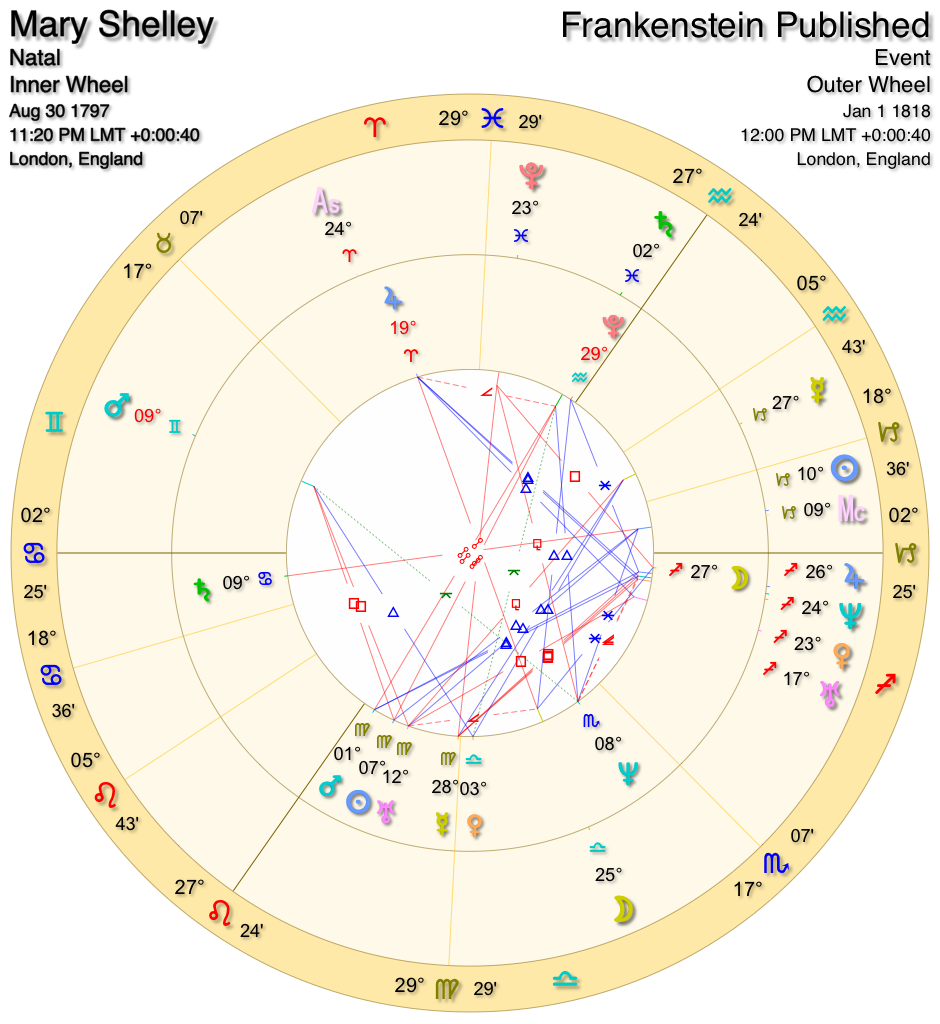
Frankenstein Published TransitsWhile much more could be elaborated in Mary Shelley’s natal chart, I would like to turn to the world transits that were in the sky at the time Frankenstein was published, on January 1, 1818. On that day, and for a short time before and after the publication date, there was a stellium in Sagittarius of Venus, Jupiter, Uranus and Neptune, with the smaller orbit of Venus bringing it briefly into the longer conjunction of Jupiter, Uranus, and Neptune, and the even longer conjunction of Uranus-Neptune that defined much of the Romantic era. While there are many complex ways in which this quadruple conjunction manifested in world events, the particular expression in relation to the publication of Frankenstein can be seen in the successful release of a beautiful piece of literary art produced by the creative imagination. The archetype of Jupiter grants success to whatever it touches, while Venus relates to the artistic expression, and Neptune to the imagination behind the project. Jupiter-Uranus alignments in world history regularly correlate to successful breakthroughs and the inauguration of new initiatives, and have been found to correlate with the first successful publications of numerous authors, including of course Mary Shelley.[5]

In her personal transits, the Venus-Jupiter-Uranus-Neptune stellium was conjoining Shelley’s natal Moon. While the archetype of the Moon is present in all individuals and certainly cannot be simply correlated with all women or “the feminine,” at the time Shelley lived women were often relegated or confined solely to the Lunar realms of home, family, and domestic matrimony by the then dominant patriarchal structures (which had largely appropriated the Solar archetypal role of the individual shining hero as a symbol of “the masculine”). The significance of the Venus-Jupiter-Uranus-Neptune stellium conjoining Shelley’s Moon can be seen in that she would have, in her time, been viewed, because she was a woman, as a Lunar figure who was successfully breaking out of the constrictive mold that did not encourage creative artistic or literary expression by women. The significance of the Moon in this particular case is not because she is a woman, but because of the primarily Lunar role women were usually required to take on. The archetypal energy of the successful Lunar figure is doubled by a transit that would have lasted for only a few hours on the particular day of publication: the Moon in the sky was transiting in opposition to Shelley’s natal Jupiter, which may have provided an increased sense of emotional joy and success for her.

Another significant world transit that was just beginning to come into orb at the time of publication, but which would have become more exact as the book was disseminated and read by the public, was the Saturn-Pluto conjunction of 1818. The energy of this transit would have been intensified for Shelley because, at the time of publication, Saturn was conjoining her natal Pluto as well. The archetype of Saturn is the reality principle that correlates to mortality, death, and gravity, but also to maturity and wisdom; Saturn is archetypally both hard consequences and the learning acquired from consequences. Saturn-Pluto correlates to the shadow side of the encapsulated egoic will to power that is so clearly expressed in Frankenstein. In his book on archetypal astrology, Cosmos and Psyche, Richard Tarnas describes Frankenstein as Shelley’s “prophetic Gothic masterpiece that depicted the monstrous shadow of the technological will to power.”[6] Shelley’s tale is one of death (Saturn) and destruction (Pluto), of moral (Saturn) depravity (Pluto), and of the Saturnian consequences of the soaring heights of Dr. Frankenstein’s, and modernity’s, Sun-Uranus visions of progress.

Interestingly, the day Frankenstein was published the Sun in the sky was transiting opposite Shelley’s natal Saturn, shining a light on the principle of death, as well as the profound consequences of individual actions. Frankenstein is also a shining (Sun) example of a piece of narrative art that has withstood the test of time (Saturn) and come down to us today as a revered piece of literature: another expression of the Sun-Saturn archetypal complex that brought this book into the world from the pen of Mary Shelley.

To read the complete works of Mary Shelley the kindle edition very inexpensive and available here.
The Wanderer Above the Sea of Fog

Works Cited

Shelley, Mary. The Original Frankenstein or The Modern Prometheus. Edited by Charles

E Robinson. New York, NY: Vintage Classics, 2008.

Tarnas, Richard. Cosmos and Psyche: Intimations of a New World View. New York, NY: Viking Penguin, 2006.

Tarnas, Richard. Prometheus the Awakener: An Essay on the Archetypal Meaning of the

Planet Uranus. Woodstock, CT: Spring Publications, 1995.

Teacher, Janet Bukovinsky. Women of Words: A Personal Introduction to Thirty-Five

Important Writers. Philadelphia, PA: Courage Books, 1994.


[1] Richard Tarnas, Prometheus the Awakener: An Essay on the Archetypal Meaning of the Planet Uranus, (Woodstock, CT: Spring Publications, 1995).

[2]Mary Shelley, The Original Frankenstein or The Modern Prometheus, ed. Charles E Robinson (New York, NY: Vintage Classics, 2008).

[3] Shelley, Frankenstein.

[4] Shelley, qtd. in Janet Bukovinsky Teacher, Women of Words: A Personal Introduction to Thirty-Five Important Writers (Philadelphia, PA: Courage Books, 1994), 17.

[5] Richard Tarnas, Cosmos and Psyche: Intimations of a New World View, (New York, NY: Viking Penguin, 2006).

[6] Richard Tarnas, Cosmos and Psyche, 268.

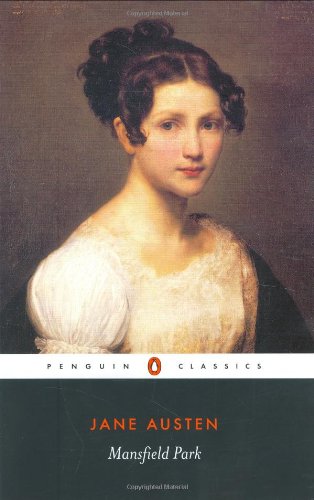
Jane Austen: A Stroll Through “Mansfield Park”

My father says that with Jane Austen, not a single word is out of place. Each sentence is composed with the utmost precision, an attention to detail and subtlety that distinguishes her writing, and sets it high on the pedestal of the greatest English writers. She wrote at a time when, in her own words, “Men have had every advantage of us in telling their own story.”[1] Her works tell the story women were not often given the opportunity to tell, unveiling the intimate details of home, marriage, and the inner folds of emotion tucked away in the country houses of rural England.

Jane AustenPart of my purpose with this Women of Words project is to read works by female authors that I have never read, and to write a short essay on each author from various perspectives, sometimes literary, sometimes personal, sometimes astrological, or often a combination of these different perspectives. If I have already read something written by the chosen author, I will choose another work of hers, perhaps a piece less well-known. This was the case with Jane Austen. I have had the great pleasure of reading several of her novels already over the years: Sense and Sensibility, Pride and Prejudice, and Emma. I must say I enjoyed each of these immensely and could not rank one as a favorite over another. The characters and their individual development, the dialogue, the prose—all are exquisite. I look forward to the day I can re-enter these provincial worlds again, whether it is by falling passionately in love alongside Marianne Dashwood, or coming to greater self-understanding with Elizabeth Bennet, or undergoing deep emotional maturation alongside Emma Woodhouse.

Having already read the three most well-known of Austen’s novels I chose Mansfield Park as my next endeavor for this project. Mansfield Park tells the story of a young girl, Fanny Price, who is brought to the countryside by her wealthy Aunt Bertram and her uncle, Sir Thomas, to be provided with a better upbringing and social opportunity than she would have had if she had been raised by her own lower class parents along with the rest of her siblings. Janet Bukovinsky Teacher describes Mansfield Park as a morality play on entering the church.[2] The primary focus of the plot is Fanny’s dedicated love for her cousin Edmund, who has been her dearest companion since he soothed her tears when she was first displaced into her new home. Drama unfolds when two eligible siblings, Henry and Mary Crawford, move to the neighborhood and upset a romantic tangle amongst nearly all the members of the Bertram family. As the second son, Edmund is destined to become a pastor, a vocation that leaves opposite impressions upon the two young ladies desiring his attention.Mansfield Park

Fanny Price is a sweet, demure, shy girl whose heroism seems to lie solely in her propriety and goodness. At times, there can be something frustrating about her to the contemporary sensibility. Why is she so physically weak? Why does she not stand up for herself, or express her own feelings? While the perspective of the story certainly makes one want to be on Fanny’s side, the actual qualities of her rival characters, particularly that of Mary Crawford, leave one wanting something more from Fanny, some act of heroism or engagement besides her shy propriety. Fanny’s quiet devotion to Edmund is admirable and certainly understandable, but at times his happiness seems far better suited to being with Mary. Mary’s supposed faults, which I will let the reader discover for him- or herself, are not ones that would easily withstand the test of time or feminism.

I often found the most enjoyable moments of the book to be when Austen’s writing steps out of the small, ordinary world of Fanny’s domestic sphere and connects with a more philosophical way of thinking, or enters into observation of the natural world and the greater cosmos. In one passage, when Fanny is walking with Mary through a garden, Fanny begins to muse on the nature of time and memory:

“How wonderful, how very wonderful the operations of time, and the changes of the human mind!”

And following the latter train of thought, she soon afterwards added: “If any one faculty of our nature may be called more wonderful than the rest, I do think it is memory. There seems something more speakingly incomprehensible in the powers, the failures, the inequalities of memory, than in any other of our intelligences. The memory is sometimes so retentive, so serviceable, so obedient—at others, so bewildered and so weak—and at others again, so tyrannic, so beyond controul!—We are to be sure a miracle every way—but our powers of recollection and of forgetting, do seem peculiarly past finding out.”[3]

This is one of those exquisite moments when the reader is permitted to see the deeper thoughts underlying Fanny’s shy demeanor. One can feel almost as though we are briefly permitted to see right through Fanny and into the thought of Austen herself, sharing one of her own contemplations upon the nature of human memory.

Austen was a contemporary of Coleridge and Wordsworth, and one can see the Romantic language of the era coming through in her own descriptions of the natural world. In a quiet scene in the family drawing room, Fanny is withdrawn by the window away from the conversations and flirtations of the Bertram sisters and the Crawfords. To her delight, Edmund joins her for a moment by the window.

Fanny. . . had the pleasure. . . of having [Edmund’s] eyes turned like hers towards the scene without, where all that was solemn and soothing, and lovely, appeared in the brilliancy of an unclouded night, and the contrast of the deep shade of the woods. Fanny spoke her feelings.

“Here’s harmony!” said she, “Here’s repose! Here’s what may leave all painting and all music behind, and what poetry only can attempt to describe. Here’s what may tranquilize every care, and lift the heart to rapture! When I look out on such a night as this, I feel as if there could be neither wickedness nor sorry in the world; and there certainly would be less of both if sublimity of Nature were more attended to, and people were carried more out of themselves by contemplating such a scene.”[4]

A similar Romantic sensibility is evoked toward the novel’s ending, while Fanny is visiting her parents in town. Fanny is contemplating with melancholy the loss of the beauty of spring in the countryside:

It was sad to Fanny to lose all the pleasures of spring. She had not known before what pleasures she had to lose passing March and April in town. She had not known before, how much the beginnings and progress of vegetation had delighted her.—What animation both of body and mind, she had derived from watching the advance of that season which cannot, in spite of its capriciousness, be unlovely, and seeing its increasing beauties, from the earliest flowers, in the warmest divisions of her aunt’s garden, to the opening of leaves of her uncle’s plantations, and the glory of his woods.—To be losing such pleasures was no trifle; to be losing them, because she was in the midst of closeness and noise, to have confinement, bad air, bad smells, substituted for liberty, freshness, fragrance, and verdure, was infinitely worse.[5]

It is interesting to note the strong influence of both the weather and landscape on the unfolding of everyday events in Austen’s novels. They remind the contemporary reader of the differences between the world before and after the invention of the automobile and the construction of major road networks. Social relations, travel plans, family visits, and even physical exercise are far more susceptible to the fluctuations in climate than they would be today.

One of my favorite scenes in Mansfield Park is a conversation that takes place between Edmund Bertram and Mary Crawford as they are walking through the woods of a neighboring estate. It is early in their acquaintance, and a subtle flirtation has begun to develop between them, to Fanny’s chagrin. Mary, at this time, is much more taken with Edmund than he seems to be with her, which starts to come through in the following dialogue. The substance of the conversation itself is on the nature of time as seen from their differing perspectives, views which seem to have something of a gender bias. Mary begins the conversation:

“I am really not tired, which I almost wonder at; for we must have walked at least a mile in this wood. Do not you think we have?”

“Not half a mile,” was his sturdy answer; for he was not yet so much in love as to measure distance, or reckon time, with feminine lawlessness.

“Oh! you do not consider how much we have wound about. We have taken such a very serpentine course; and the wood itself must be half a mile long in a straight line, for we have never seen the end of it yet, since we left the first great path.”

“But if you remember, before we left that first great path, we saw directly to the end of it. We looked down the whole vista, and saw it closed by iron gates, and it could not have been more than a furlong in length.”

“Oh! I know nothing of your furlongs, but I am sure it is a very long wood; and that we have been winding in and out ever since we came into it; and therefore when I say that we have walked a mile in it, I must speak within compass.”

“We have been exactly a quarter of an hour here,” said Edmund, taking out his watch. “Do you think we are walking four miles an hour?”

Oh! do not attack me with your watch. A watch is always too fast or too slow. I cannot be dictated to by a watch.”[6] (Emphasis added.)

Austen reinforces many of the gender norms of her day, including views on manners and propriety of behavior. The primary concern of the women in Austen’s novels is their marriagability, a stark contrast to her revolutionary forebear, Mary Wollstonecraft. Yet Austen herself never wed. She once accepted a suitor’s offer, but by the next morning she had changed her mind and reversed her answer. She seems to express some of her views on a woman’s choice to marry, and whom she is to marry, through the voice of Fanny Price when she says,

“I should have thought,” said Fanny, after a pause of recollection and exertion, “that every woman must have felt the possibility of a man’s not being approved, not being loved by some one of her sex, at least, let him be ever so generally agreeable. Let him have all the perfections in the world, I think it ought not to be set down as certain, that a man must be acceptable to every woman he may happen to like himself.”[7]

To touch briefly on Austen’s birth chart, because we know her exact birth time we are able to know that she has a tight Moon-Saturn conjunction in Libra. Austen is born on December 16, 1775 at 11:45 pm in Stevenston, England. The Moon archetypally relates to the home, domesticity, relationship, emotional expression, and feeling. Saturn, on the other hand, correlates with constraint and restraint, hard work, discipline, reserve, and a serious disposition. Austen’s Moon-Saturn conjunction is expressed archetypally as the quiet sphere of the home that is depicted in all of her novels, as well as the emotional struggles and maturation of her lead female characters. Her detailed descriptions of the quiet day-to-day experiences of living in the English countryside, and the work of securing a husband and home, all correlate to Moon-Saturn. She also did all of her written work (Saturn) in the parlor of her home (Moon), and even would hide the stories she was writing when visitors came calling.Jane Austen's Birth Chart

Another significant aspect in Austen’s natal chart is her Mercury in opposition to a broad Jupiter-Uranus conjunction. The archetype of Mercury comes through as all forms of communication, from writing and speaking, to  thinking, the intellect, and education. Jupiter correlates archetypally with expansion, success, and celebration, while Uranus relates to change, revolution, rebellion, innovation, and ingenious breakthroughs. The Jupiter-Uranus combination correlates with expansion of horizons, successful breakthroughs, and rapidly opening world views and perspectives. Although Austen lived in a constrained home environment, which correlates to her Moon-Saturn conjunction—never moving from her family home—she was able to expand her horizons and those of all her readers through her writing, which correlates to her Mercury in opposition to Jupiter and Uranus. The breakthrough quality of her exquisite novels—from the first, Sense and Sensibility, which she published anonymously, claiming only on the title page that it was “By A Lady”—have rippled through history and come down to us today as the beloved stories of the extraordinary, yet everyday, women of the English countryside.

To read Mansfield Park the kindle edition is free and available here.

Works Cited

Austen, Jane. Mansfield Park. Oxford, England: Oxford University Press, 1988.

Teacher, Janet Bukovinsky. Women of Words: A Personal Introduction to Thirty-Five Important Writers. Philadelphia, PA: Courage Books, 1994.


[1] Jane Austen, qtd. in Janet Bukovinsky Teacher, Women of Words: A Personal Introduction to Thirty-Five Important Writers (Philadelphia, PA: Courage Books, 1994), 12.

[2] Teacher, Women of Words, 12.

[3] Jane Austen, Mansfield Park (Oxford, England: Oxford University Press, 1988), 208-209.

[4] Austen, Mansfield Park, 113.

[5] Austen, Mansfield Park, 431-432.

[6] Austen, Mansfield Park, 94-95.

[7] Ibid, 353.

Sweet Sunset

Have you ever done yoga while a sheet of rain obliterates all visibility of the world around you? Or tasted drinking chocolate so rich and spicy that you would swear you are holding a melted bar of pure chocolate in the cup before you—or somehow been transported to the seductive marble counter of Vianne Rocher’s French-Mayan Chocolaterie? Or sat in a hot bath with crimson and peach rose petals strewn over the surface, the scents of jasmine and ylang ylang spiraling with the steam towards the ceiling, while bells toll the hour softly out the open window? This is just a taste of the joys I had the great privilege to experience in the second half of my visit to New Mexico, a week I am now looking back on with awe and gratitude for the level of both bliss and adventure I was able to experience.

Harp
Photo by Becca Tarnas

On the afternoon of the day I wrote my last post, I went with the friend I was staying with to pay a visit to an acquaintance of hers who is now a retired harp maker. His business was called Harps of Lorién, so I had a good feeling we would get along well. He had only kept two of his harps for himself—the last ones he made—and I had the great joy of being able to play them for a little while. The larger of the two harps had just under five octaves; a beautiful creation with a rich sound, especially in the upper register. The other harp was a lovely little lap harp with 27 strings, the kind I could easily imagine myself carrying on my back on some mythical adventure. Playing them I was reminded of a trilogy I recently read that a friend recommended to me: Riddle-Master by Patricia McKillip. The series is composed of three books, The Riddle-Master of HedHeir of Sea and Fire, and Harpist in the Wind. As one can imagine from the final book title, harps play a significant role in the unfolding of this story.

From harps we moved on to chocolate, a transition no one I know could complain of. I was brought to the Kakáwa Chocolate House where we were greeted with an extensive menu of both European and Meso-American drinking chocolates. After tasting several different samples I settled on the Chile Chocolate, which was made of 100% chocolate, coconut sugar, chile, and Mexican vanilla. The thick liquid was both sweet and spicy, rich and rounded, calming and awakening. It was, to say the least, amazing. Truly an extravagance.

Photo by Becca Tarnas

Our evening plans brought us into central Santa Fe where we had dinner at a restaurant called Blue Corn, followed by drinks at a nearby bar called Thunderbird. My astrological twin and I, of course, ordered the same drink, a cocktail of vodka and crisp pear. Our parallels no longer surprised us, especially when it was something as simple as choosing a drink, or wearing identical socks or pants. Our differences were becoming far more interesting to discover and explore.

The following day, Sunday, my friend and I went back to the land in Glorietta to hike around the area where she and her partner are building their home. The day was cooler than when we were up there on July 4th, or perhaps I was just becoming acclimated to the altitude and desert sun. Clouds were gathering on the edges of the horizon but we still baked under the clear blue of the sky directly over our heads. Walking through the forest of ponderosa pine and cedar I started to notice a distinct smell that would hit me every so often, almost like kaffir lime leaves. What was an essential ingredient of Thai food doing out here? Finally, when I smelled the scent again I stopped and looked all around me, making note of any different plants that might be nearby. To my right was a low tree with gnarled bark and pointed, needle-like leaves. Silver-green berries grew in clusters between the leaves. I took a step closer, realizing the kaffir smell came from this tree. A juniper. I never would have guessed the two smells would be so similar except through this accidental discovery.

Photo by Becca Tarnas

Passing under the eaves of this sparse forest we walked out into an open meadow, a long, snaking expanse of shrub-covered ground that formed a valley between two wooded hills. Gazing overhead we saw a hawk soaring, a local inhabitant my friend recognized because of the distinctive missing feather she had in one of her wings. We climbed up one of the hills to look back down on the meadow we had just crossed. Directly opposite on the hill facing us, at a point not much higher than where we stood, the dark entrance of a cave was just visible between the trees. My friend speculated that this cave might be the home of the hawk that was still circling above us, although she was not sure.

Photo by Becca Tarnas

After returning to downtown Santa Fe, I spent the rest of the afternoon on a quiet meander through the town’s streets, pausing at the stalls of artists and vendors, admiring the bright silver and turquoise that was a prominent theme of the jewelry for sale here. The clouds continued to gather in the sky, making their way towards the town, their dark underbellies heavy with rain. Finding myself in the grassy plaza I sat beneath a tree and took out my watercolors to begin painting a scene I had been holding in my mind since that morning.

The sunset that night was so brilliant—an explosion of bleeding vermillions and reds, rosy oranges and deep purples—that no photo could even begin to capture it. I sometimes wish I could bring a painting forth all in an instant, the colors pouring from my open imagination directly onto the page. But the exact wash of that particular sunset, the ways its unique colors flowed together and blended, is fading from my memory with as much certainty as it faded from that night sky.

Photo by Becca Tarnas

In many ways I feel my time in New Mexico was like that sunset: so beautiful and profound, surprising and unexpected, a crescendo of connection and experience. Returning to the grey fogs of San Francisco felt a little like a shock, the stark white of the sky such a contrast to the desert colors I still held within me, memories like precious gems, each expressing different emotions through their dynamic colors. My astrological twin and I are two Sagittarians who walked together down a spiraling path of an eternally growing checklist of activities: from baking cookies and pumpkin pie to turning our toenails into artistic canvases; from sampling at a delicious gluten-free bakery to a morning of pampering at the spa; from astrological readings and healing massages to crafting beautiful gift collages; from deep conversations and gorgeous laughter to the freedom of just being utterly silly. So much of what happened during my week in New Mexico was so simple, an extended playdate between two sisters, butterfly twins who had somehow only recently met—at least in this lifetime.

Photo by Becca Tarnas
Collage for the Dusk Twin
Photo by Becca Tarnas
Collage for the Dawn Twin

The Dynamism of New Mexico’s Skies

New Mexico has always called me, yet somehow this is my first time here. I came to Santa Fe seeking an adventure, and also the companionship of a new yet dear friend, someone who happens to be my astrological twin. It is a strange, amazing experience to find someone whose life seems to be a synchronicity with your own, from the profound to the mundane: from taking nearly the same picture at the same time in separate places, to owning the exact same dress given to us by our mothers, to having parallel life-transforming experiences at the same time. As we spend each day talking and sharing our lives, I find myself at this point more surprised by the differences than the similarities.

Photo by Becca Tarnas

Flying out of San Francisco, as I did a few days ago, I always find thrilling, perhaps because the plane rises first over the turquoise waters of the Bay and for a moment no land is visible from the tiny window. As the plane arcs over San Francisco I am always surprised at how compact and familiar the seven-by-seven miles of my home city are, how easily I can recognize the contours and shapes of the cityscape. The ragged edges of the retreating fog I see have left my home in summer sunlight. The line of fog continues along the coast as far as the eye can see. Turning inland the landscape rapidly becomes the dry reds, yellows, and browns of a water-starved world. Checkerboards of farmland dominate the landscape, then give way to the tangle of hills and mountains. Further east the mountains are dotted with the dark of sparse tree cover. The occasional vein of snow lies in a forgotten alpine crevice. Then clouds roll in below us and the white is blinding. I retreat into Nietzsche’s Thus Spoke Zarathustra.

Photo by Becca Tarnas

I arrived in Albuquerque and my friend and I drove north through the hilly desert landscape to Santa Fe and her beautiful home. The day unfolded idyllically, with yoga to shake off the air travel and a home-made dinner with kale, beat greens, and lettuce we harvested right from the garden outside. The rains started as we were eating, and our desert was a magnificent double rainbow arching across the sky. I couldn’t have asked for anything more. We went for a walk in a nearby park that is a prairie dog sanctuary where we traversed the spiraling path of a labyrinth crafted right out of the red soil, almost like it was part of the landscape. A single tree grew out from near the labyrinth’s center. To my amazement, this was the third completely unique labyrinth I had seen since arriving here.

July 4th, or Interdependence Day as the morning’s yoga teacher renamed it, we spent out in Glorietta on the land where my friend her partner are in the process of building their own sustainably constructed home. The area is forested but not densely; the hot sunshine easily passes through the pine and cedar leaves and branches to bake the red clay below. We walked up to view the deep hole in which they will soon put their home’s foundation. The house will be set beneath a towering ponderosa pine that seems to reign over the area. A small garden is thriving with squash and bean plants that have happily taken to the soil in this isolated location.

Photo by Becca Tarnas

A group of us, with members coming and going all day, spent the afternoon by a lovely swimming hole dug on a communal part of the property. A barbecue was burning most of the day by the waterside, and the food table was overflowing with abundance. The pond was a cooling relief as the day seemed to get hotter and hotter. Thick, lush grasses line the edge of the pond and the soft mud at the pool’s bottom is as gentle as a spa treatment. We swam and floated while a flock of swallows soared and darted overhead, occasionally diving down to the water’s surface for a drink or a bath. Staring up into the clear blue of the sky I felt a great sense of peace, watching the birds weaving their invisible wild weft overhead.

The blue stillness of the sky gave way to a live painting of dynamic clouds, shifting and turning over each other, changing shape and color by the moment. The day cooled into evening as the Earth turned away from the fiery Sun that defines the desert days, concealing it behind a stand of trees on the western hills. The twilight air took on shades of rose and violet, and a deep indigo spread out like ink on wet paper from the zenith of the sky.

Photo by Becca Tarnas

The following day, my friend and I made a road trip up to Taos, which I had been told by several people I had to see if given the opportunity. On the drive we passed a camel shaped rock, open fields with horses, red and gold desert plains, rising mountains, a wide winding stream. I really began to feel the magic of New Mexico, something that seems to spring from the alchemical mixing of the red land with the dynamism of the skies.

Taos is enchanting, its adobe style buildings the same colors as the landscape, with overflowing planters of flowers hanging from the wooden eaves surrounding the plaza in the town’s center. Artists’ tents were set up in the plaza where jewelry, pottery, and paintings were displayed. We wandered for some time, stopping here and there, following the shade from place to place. We had a long lunch at a restaurant off the plaza called G, where we split huevos rancheros and blue cornmeal blueberry pancakes. I don’t know if I could ever get tired of the flavors of New Mexico, the green chile that graces most dishes.

The clouds gathered in the sky and heavy drops began to descend as we left downtown Taos and headed west to the Rio Grande Gorge Bridge. As the two of us walked out onto the bridge the winds were so strong we had to hold onto the railing to not be blown off the sidewalk. The wind was powerful enough that it could even flutter my eyelids, holding them open to the spectacular view before me. The Rio Grande Gorge is a tectonic chasm yawning 800 feet below the slender span of the bridge on which we stood. The reddish-brown cliffs, dark in the stormy light, descended to a seemingly narrow river of silver-white waters. Lightning flashed in the distance illuminating looming, dark mountains while clouds raced like chariots across the sky. In this setting, the gorge looked less like it had been worn down over millennia by the perpetual flow of the river, but rather like it had been cloven by one of the mighty lightning flashes splitting the sky asunder.

Rio Grande Gorge
Photo by Becca Tarnas

Overpowered by the wind we retreated to the car just as the rain began to fall in earnest. Taking a winding route we searched for the Hanuman Temple that was located somewhere in the lush green valley between the gorge and downtown Taos. Our many mistaken turns, caused by a lack of street signs and a hilariously mis-proportioned hand-drawn map, took us past green fields and farms, some with horses and foals, others with herds of black cattle. The adobe houses looked almost as though they had arisen from the landscape itself, so well did they blend in. At last, just as we were giving up on the idea of finding the temple, the elusive road appeared to us and we drove up to an exquisite cluster of hand-built structures surrounded by an abundance of flowering gardens.

Photo by Becca Tarnas

Walking through the rain on a narrow path beneath plum and apple trees, we entered the Hanuman Temple where a brief ceremony was about to begin. A resident stepped forward to orient us, offering food and chai and the opportunity to explore the grounds. As singing swelled from the inner sanctum of the temple, we returned outside with chai in hand to see the open grassy fields and vegetable gardens. The land was amazingly lush compared to everywhere else I had seen so far in New Mexico. Following a strange bird call we found ourselves by a large sanctuary housing four peacocks. A tree grew in the center of the structure, and perched near the top was a large male whose magnificent tail feathers cascaded down the trunk. The smaller females were perched elsewhere around the sanctuary, or wandered along the ground below paying little attention to our presence.

We departed from the temple as late afternoon faded into early evening and made the drive back south to Santa Fe, all the while exchanging more parallel stories of our lives. The molten gold of the setting sun broke through the cloud cover creating a double rainbow that led us all the way home, its colored arches forming a gateway that we always seemed about to pass under, only to find it had once again retreated from our grasp.

Photo by Becca Tarnas

Mary Wollstonecraft: Voice of Women’s Liberation

“For if it be allowed that women were destined by Providence to acquire human virtues, and by the exercise of their understandings, that stability of character which is the firmest ground to rest our future hopes upon, they must be permitted to turn to the fountain of light, and not forced to shape their course by the twinkling of a mere satellite.”[1]

– Mary Wollstonecraft

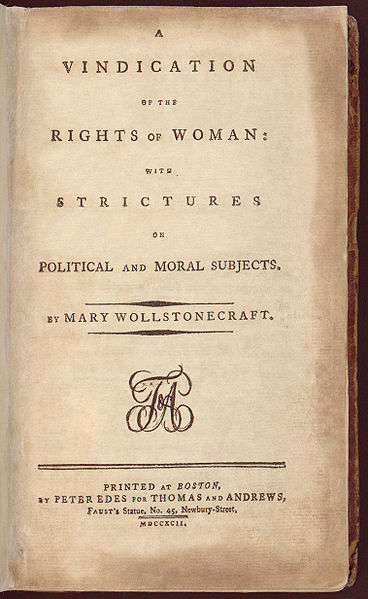
 The role of women in 18th century England was constrained almost solely to the realm of marriage and motherhood, and few women had the means to raise their voices in protection of their rights. Yet one woman, Mary Wollstonecraft, had a voice so powerful that she is considered by many to have been the first feminist to rise out of Europe. In her emphatic treatise Vindication of the Rights of Woman, Wollstonecraft speaks out with little restraint about her thoughts on women’s education, women’s duties as mothers and wives, and women’s roles and rights in society. She opens her book with a letter bearing her primary argument:

Contending for the rights of women, my main argument is built on this simple principle, that if she be not prepared by education to become the companion of man, she will stop the progress of knowledge, for truth must be common to all, or it will be inefficacious with respect to its influence on general practice. And how can woman be expected to co-operate, unless she know why she ought to be virtuous?[2]

Mary WollstonecraftWollstonecraft’s writing carries tremendous force and is often punctuated by words and phrases penned entirely in capital letters, driving her point and opinion home. “The rights of woman may be respected, if it be fully proved that reason calls for this respect, and loudly demands justice for one half of the human race.”[3] She steps out of her era’s convention of using the term “Man” to refer to “Humanity,” instead emphasizing that there is a half of the human race who has been made invisible by the very language that describes their species. As Janet Bukovinsky Teacher writes, “No English-speaking woman had ever been so audacious as to question the validity of marriage as she did, or to suggest that men might be preventing women from pursuing their rightful place in society.”[4] Wollstonecraft held radical views not only on women’s rights, but also on divorce and even abortion. Vindication of the Rights of Woman was published during the period of the French Revolution, and in many ways Wollstonecraft is carrying much of the revolutionary energy of the times and channeling it into the transformative power of her words.

The primary focus of Wollstonecraft’s treatise on women’s rights is the manner in which women were educated in her time. Women’s education consisted almost exclusively of learning the arts to acquire a husband, and did little to develop women’s reason, understanding, sense of virtue, and physical strength. The prime target of her rebuttal is Jean-Jacques Rousseau, who argued in his treatise Emile, or On Education that men and women ought to be educated in entirely different manners because of their fundamentally different natures. Rousseau writes of women and men, saying,

In what they have in common, they are equal. Where they differ, they are not comparable. A perfect woman and a perfect man ought not to resemble each other in mind any more than in looks, and perfection is not susceptible of more or less. In the union of the sexes each contributes equally to the common aim, but not in the same way. From this diversity arises the first assignable difference in the moral relations of the two sexes.[5]

While Rousseau does not go on the unfold what he means by “In what they have in common, they are equal,” he does argue that women should be “passive and weak,” and should “put up little resistance” because they are “made specially to please man.”[6] In Wollstonecraft’s paraphrase of Rousseau’s argument, he goes on to say

that a woman should never, for a moment feel herself independent, that she should be governed by fear to exercise her natural cunning, and made a coquettish slave in order to render her a more alluring object of desire, a sweeter companion to man, whenever he chooses to relax himself.[7]

Wollstonecraft brings forward the many ways this limited and constraining view on women’s education and capabilities is detrimental not only to women but to the society as a whole. If a woman is kept ignorant by her education of all subjects except how to adorn herself to attract a husband, how will she be able to educate her children? Her ignorance will then pass on to her children who will comprise the next generation of individuals structuring society.

The patriarchal logic behind keeping women ignorant was in part based upon the idea that if women were ignorant they might remain innocent of the world’s hardships, and therefore be virtuous. But Wollstonecraft argues that pure innocence is only to be valued in children, not adult women, and that “Women are not allowed to have sufficient strength of mind to acquire what really deserves the name of virtue.”[8]  It is the faculty of reason that allows human beings to move toward virtue. She goes on to say “In fact, it is a farce to call any being virtuous whose virtues do not result from the exercise of its own reason.”[9] Later in the treatise Wollstonecraft returns to the relationship of reason to virtue when she writes,

But it is vain to attempt to keep the heart pure, unless the head is furnished with ideas, and set to work to compare them, in order, to acquire judgment, by generalizing simple ones; and modesty by making the understanding damp the sensibility.[10]

In Wollstonecraft’s time an unmarried woman’s honor was based not upon her ability to think, to engage in intelligent conversation, or on her personal accomplishments, but almost solely upon her chastity. Wollstonecraft addresses this notion with disgust, saying, “Nay the honour of a woman is not made even to depend on her will.”[11] Yet she argues that if a woman’s education is focused so exclusively on the arts that will win her a husband, then how can she help but be promiscuous once she is married? She will have been prepared for nothing but a fanciful notion of romance that will soon fade as her husband realizes she can do little else but be the coquettish slave of Rousseau’s fantasies. And to men like Rousseau she says,

The man who can be contented to live with a pretty useful companion without a mind, has lost in voluptuous gratifications a taste for more refined enjoyments; he has never felt the calm satisfaction that refreshes the parched heart, like the silent dew of heaven—of being beloved by one who could understand him.[12]

It is not surprising that much of the backlash against Vindication of the Rights of Woman came not from men but from women who saw themselves targeted by Wollstonecraft’s harsh criticisms. Women adept at the arts to which their curtailed education disposed them would have found Wollstonecraft’s arguments disturbing, insulting, and even threatening. Yet Wollstonecraft insists that it is not the nature of woman that confines her to such narrow forms of expression but rather the conditioning impressed upon her from childhood.Vindication of the Rights of Woman

In a woman’s education “Strength and usefulness are sacrificed to beauty.”[13] An interest in beauty and ways of dress are not inherent to women but rather the only interests that have been cultivated by their education. Wollstonecraft argues that it is no more natural for a woman to be exclusively interested in her own beauty than “false ambition” is natural to men. Rather, both are driven by a love for power. For women the only means to gain power is through marriage, therefore physical beauty becomes their only fully developed faculty. “Taught from their infancy that beauty is woman’s sceptre, the mind shapes itself to the body, and, roaming round its gilt cage, only seeks to adorn its prison.”[14] Wollstonecraft goes on to describe how a woman’s education saps her character until she is reduced to the physically and mentally weakened dependent creature men tell her she is.

Every thing that [women] see or hear serves to fix impressions, call forth emotions, and associate ideas, that give a sexual character to the mind. False notions of beauty and delicacy stop the growth of their limbs and produce a sickly soreness, rather than a delicacy of organs; and thus weakened by being employed in unfolding instead of examining the first associations, forced on them by every surrounding object, how can they attain the vigour necessary to enable them to throw off their factitious character?—where find strength to recur to reason and rise superior to a system of oppression, that blasts the fair promises of spring?[15]

Wollstonecraft eventually makes clear that it is the collective oppression by men that has kept women so constrained for countless centuries. The general assumption of her era was that women’s overall inferiority to men was a fact, an issue which Wollstonecraft challenges vigorously. She writes that if women indeed are inferior to men, which she does not concede then, in her words,

I shall only insist, that men have increased that inferiority till women are almost sunk below the standard of rational creatures. Let their faculties have room to unfold, and their virtues to gain strength, and then determine where the whole sex must stand in the intellectual scale.[16]

Only tyrants and sensualists, Wollstonecraft insists, would want women to be oppressed to the level of blindly obedient slaves.

Strengthen the female mind by enlarging it, and there will be an end to blind obedience; but, as blind obedience is ever sought for by power, tyrants and sensualists are in the right when they endeavour to keep women in the dark, because the former only want slaves, and the latter a plaything.[17]

Wollstonecraft goes on to ask why men would want blind obedience when rationally developed principles would ensure a more just and virtuous society. She even likens the oppression of women to that of enslaved Africans, seeming to call for revolutionary reform on both fronts in society.

Why subject [woman] to propriety—blind propriety, if she be capable of acting from a nobler spring, if she be an heir of immortality? Is sugar always to be produced by vital blood? Is one half of the human species, like the poor African slaves, to be subject to prejudices that brutalize them, when principles would be a surer guard only to sweeten the cup of man?[18]

Finally, Wollstonecraft calls upon God, the creator of the universe, to answer for the condition of women:

Gracious creator of the whole human race! hast thou created such a being as woman, who can trace thy wisdom in thy works, and feel that thou alone art by thy nature, exalted above her—for no better purpose? Can she believe that she was only made to submit to man her equal; a being, who, like her, was sent into the world to acquire virtue? Can she consent to be occupied merely to please him; merely to adorn the earth, when her soul is capable of rising to thee? And can she rest supinely dependent on man for reason, when she ought to mount with him the arduous steps of knowledge?[19]

Wollstonecraft had fully extricated herself from the false webs of deceit that continuously told women that their inferior position in society was based upon man’s God-given right for domination.

Much of Vindication of the Rights of Woman is dedicated to looking at the affect of women’s rights and education upon marriage and family. Wollstonecraft held the opinion that a marriage should be based not on passionate love, which she saw as transitory and fickle, but rather upon mutual respect and friendship. She believes that “a master and mistress of a family ought not to continue to love each other with passion.”[20] Marriage, in Wollstonecraft’s opinion, is primarily in service of raising a family and educating children to enter the world, an idea that seems very much at odds with contemporary liberal views on marriage. For Wollstonecraft, “Love is. . . an arbitrary passion.”[21] Yet she also goes on to say that “Supposing, however, for a moment, that women were, in some future revolution of time, to become, what I sincerely wish them to be, even love would acquire more serious dignity, and be purified in its own fires.”[22] Love can only be pure and dignified if first both parties can approach each other as equals.

Mary Wollstonecraft Birth ChartI would like to briefly touch upon some aspects of Mary Wollstonecraft’s astrological chart that can further illuminate her character and writings. Wollstonecraft was born at the new moon and therefore has a Sun-Moon conjunction in her natal chart. Simply put, the archetypal energy of the Sun relates to one’s central identity and focus, the areas in which one shines in one’s lifetime. The archetype of the Moon, on the other hand, carries the aspects of one’s emotions and feelings, and one’s ability to nurture, care for, and nourish in relationship. The Moon is particularly connected to the mother-child relationship, as well as the physical body. In the patriarchal West, especially during Wollstonecraft’s lifetime, the solar principle was strongly appropriated by the cultural role held by men, while women were usually dominant in the lunar home realm with little room to step into a solar identity in the world. Wollstonecraft’s Sun-Moon conjunction seems to express itself through her impulse to shine a light on the rights of women who have been operating almost exclusively in the realm of the home in the primary role of motherhood. Wollstonecraft is bringing the solar focus of her inquiry into the lunar realm, and encouraging women to step out into their individual solar power.

Wollstonecraft is also born with Uranus square Pluto in her natal chart; the archetypal expression of Uranus relates to the revolutionary impulse for creative breakthrough, liberation, and change, while the archetype of Pluto is connected to power, evolution, and transformation, to what is oppressed and repressed, and to massive scale and tectonic movement. Interestingly, Wollstonecraft published Vindication of the Rights of Woman in 1792, at the same time the French Revolution was raging across the Channel, when Uranus was opposing Pluto in the world transits. She is expressing this powerful revolutionary energy in the tremendous force of her words which are explicitly calling for mass liberation of women from the oppression of patriarchy. She writes, “It is time to effect a revolution in female manners, time to restore to them their lost dignity, and make them, as a part of the human species, labour by reforming themselves to reform the world.”[23] The Uranus-Pluto opposition of the late 18th century—the next axial alignment of those two planets after the square in the sky when Wollstonecraft was born—was in a transiting T-square to Wollstonecraft’s natal Moon. This transit perfectly correlates with her bringing mass revolutionary energy into the lunar realms of home and motherhood and calling for women to transform their relationships with their minds, bodies, children, and husbands. She writes that a woman’s first duty is to herself and her second is to her children, a reversal of what most women in her time were raised to believe: “Speaking of women at large, their first duty is to themselves as rational creatures, and the next, in point of importance, as citizens, is that, which includes so many, of a mother.”[24]

Finally, Wollstonecraft also calls on women to respect the female body into which they were born, acknowledging their ability to grow as individuals and move toward virtue, rationality, and goodness. “She who can discern the dawn of immortality, in the streaks that shoot athwart the misty night of ignorance, promising a clearer day, will respect, as a sacred temple, the body that enshrines such an improvable soul.” For women today, Wollstonecraft’s words have opened up many doorways that were long closed to those of female gender. Yet I cannot help but wonder, now that we are once again in a period when Uranus and Pluto are in axial alignment, what greater revolutions on behalf of women would a Mary Wollstonecraft of today call upon us to enact?


To read A Vindication of the Rights of Woman the kindle edition is free and available here.

For further reading on Mary Wollstonecraft an interesting blog entitled Vindications of the Rights of Mary is available here.


Works Cited

Rousseau, Jean-Jacques. Emile or On Education. Translated by Allan Bloom. New York, NY: Basic Books, 1979.

Teacher, Janet Bukovinsky. Women of Words: A Personal Introduction to Thirty-Five Important Writers. Philadelphia, PA: Courage Books, 1994.

Wollstonecraft, Mary. Vindication of the Rights of Woman (Kindle Edition), 1792.


[1] Mary Wollstonecraft, Vindication of the Rights of Woman (Kindle Edition), 1792, Ch 2.

[2] Wollstonecraft, Vindication of the Rights of Woman, Section: “To M. Talleyrand Perigord, Late Bishop of Autun.”

[3] Wollstonecraft, Vindication of the Rights of Woman, Section: “To M. Talleyrand Perigord, Late Bishop of Autun.”

[4] Janet Bukovinsky Teacher, Women of Words: A Personal Introduction to Thirty-Five Important Writers (Philadelphia, PA: Courage Books, 1994), 7.

[5] Jean-Jacques Rousseau, Emile or On Education, trans. Allan Bloom (New York, NY: Basic Books, 1979), 358.

[6] Rousseau, Emile or On Education, 358.

[7] Wollstonecraft, Vindication of the Rights of Woman, Ch. 2.

[8] Wollstonecraft, Vindication of the Rights of Woman, Ch. 2.

[9] Ibid.

[10] Ibid, Ch. 7.

[11] Ibid, Ch. 4.

[12] Wollstonecraft, Vindication of the Rights of Woman, Ch. 5.

[13] Ibid, Ch. 2.

[14] Ibid, Ch. 3.

[15] Wollstonecraft, Vindication of the Rights of Woman, Ch. 6.

[16] Ibid, Ch. 2.

[17] Wollstonecraft, Vindication of the Rights of Woman, Ch. 2.

[18] Ibid, Ch. 9.

[19] Wollstonecraft, Vindication of the Rights of Woman, Ch. 4.

[20] Ibid, Ch. 2.

[21] Ibid, Ch. 6.

[22] Ibid.

[23] Wollstonecraft, Vindication of the Rights of Woman, Ch. 3.

[24] Ibid, Ch. 9.

Archai Journal: Death, Rebirth, and Revolution: Archetypal Dynamics and Personal Experience

Archai

Journal Publication

I am excited to announce that my essay “An Archetypal Glimpse into Teilhard’s Evolutionary Vision” has been published in the fourth issue of the Archai journal, Death, Rebirth, and Revolution: Archetypal Dynamics and Personal Experience.

The essay is available for free download here.

In this issue, leading figures in the field—including Richard Tarnas, Stanislav Grof, and Rod O’Neal—address topics such as the archetypal dynamics of astrology, personal encounters with the death-rebirth process in holotropic states of consciousness, and schisms and reformations within the Anglican church. This issue also contains an in-depth archetypal analysis of recent world events, including the revolutionary uprisings of the Arab Spring, the Occupy Movement, and some of the major political, economic, artistic, and technological developments of the 2007–2012 period. Other articles explore the ideas and creative works of figures as diverse as Plato, C. G. Jung, Pierre Teilhard de Chardin, Leonard Susskind, and Jim Henson.

For further details, please see the table of contents on the Archai website.

The Diamond Vision Gallery

This series of four paintings is a visual response to the content of Chris Bache’s course The Birth of the Diamond Soul, offering different images of the reincarnating soul both inside and outside the influence of time and space, as well as an homage to the devastation of the ecological crisis and how it may be the catalyst for the forging of the Diamond Soul.

THE OVERSOUL

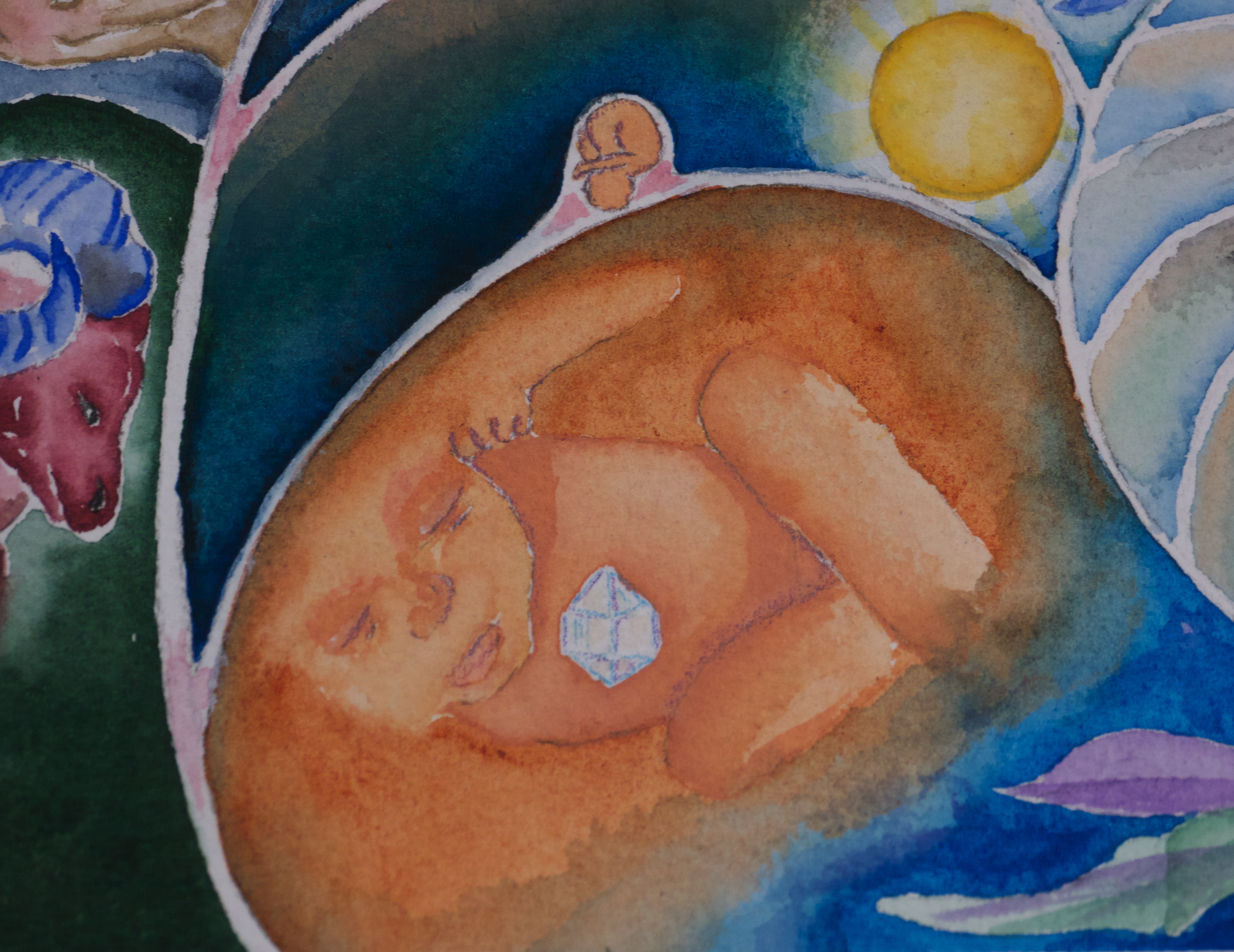
The Oversoul is a term used by Bache in his book Lifecycles to describe the larger soul overseeing, but also incorporating, each incarnating human life. It is simultaneously a single entity, but also a family of entities nested within each other, and ultimately nested within the larger and larger spheres of existence. This painting is one representation of the Oversoul, pictured as a nautilus, an image Bache provided in class. The chambers of the nautilus each represent a human incarnation, yet the whole shell is the full soul. I have depicted a waiting fetus gestating within each chamber as a symbol of these lives. The life about to be born resides in the outermost chamber, with a diamond in potentia within his heart. The diamond represents the Diamond Soul being forged slowly over the course of each lifetime. A second diamond resides in the center of the nautilus representing the ultimate birth of the Diamond Soul at the end of the incarnational process.

The pantheon of planets within the nautilus and the zodiacal signs surrounding it indicate the archetypal influences on each life and upon the soul as a whole, each chamber of the nautilus having a different perspective and relationship to the signs and planets that characterize that particular life. The baby about to be born residing in the outermost chamber is within the realm of Pisces, both as a fetus in the aquatic realm of the womb, but also as a symbol of our current times since we are in the Age of Pisces.

The vision of this painting came to me nearly in complete form when I began contemplating the nautilus as a metaphor for the Oversoul. To my delight, each of the zodiacal signs took on a life of their own as I painted them, as I had not pictured their exact form before drawing them in. I was particularly surprised by the form Sagittarius took, as a horseshoe doubling as a bow with an arrow. The animals also each took on their own personality seemingly independent of my intentions for them. The real surprise came as the baby being born into the Age of Pisces, for it was pure synchronous chance that the nautilus opened into the sign of Pisces, yet it seemed to fit perfectly with the concept behind the painting.

THE DIAMOND SOUL NEBULA

In an effort to visualize the concept of the Diamond Soul, Bache introduced us to several images from the natural world that might represent parts of the Diamond Soul, ranging from blossoming flowers to nebulae. This particular nebula, the Cat’s Eye Nebula, is one that conveys the idea in an especially evocative way, with its ethereal explosion and heavenly sacrificial blooming. The core of the nebula, as can be seen in all the images captured of it, is a pure white space resembling a diamond.

I found in my attempts to paint this nebula with watercolor that portraying the light and darkness, the veiled colors of the celestial event, was much more difficult than I had previously expected and took more than one try. When one looks at a photograph of a nebula it is the qualities of the whole that are so compelling, but in painting it I had the experience of becoming intimately familiar with each part, trying to understand where the colors blend and where they do not, yet also attempting to capture the whole as well. The only adjustment I made from the image as I painted it was emphasizing the diamond at the heart, forged in the layers upon layers of light and color.

DROUGHT AND HOPE

This painting of a drought-ridden desert with a single sapling growing in it is less an image of the Diamond Soul, but rather of the birth canal humanity seems to be entering before such soul transformation is possible. The painting is a representation of the changes rapidly being wrought upon the globe by human-induced climate change, and was particularly inspired by Bill McKibben’s book Eaarth: Making a Life on a Tough New Planet. McKibben provides the data that clearly demonstrates that global warming is no longer a future threat, it is a current reality. On a personal level this understanding was reinforced by a road trip I took across the American Continent this July while creating the concepts for this gallery. From Nevada to Michigan temperatures soared above 100° F, usually averaging at 104° but sometimes even reaching 108°. Fields were dry and often barren, and many cornfields showed yellowing leaves coated in a layer of dust. Yet oil wells continued to pump in these same fields by the roadside, and every building we entered was blasting arctic temperatures of air conditioning, all fueled by coal and oil burning power plants.

In the painting a young woman is bending over an olive sapling, seemingly watering it with her tears. It is ambiguous if this is the last plant left growing in this barren desert, or if it is the first that has managed to survive. I chose the olive as this single plant because of the great lineage of symbolism connected to the olive, particularly in the Western tradition. The olive is the tree of Athens, mythically a gift from the Grecian goddess Athena who gave it to provide wood, oil, and fruit to the people of Athens. In return they named their city-state after her. Athens is the birthplace of democracy and as such the olive may also symbolize the democratic process. The olive is part of the painting to pose the question of the role of democracy, or perhaps its absence, in the onset and unfolding of the ecological crisis.

The olive is also a symbol from the Hebrew tradition, a sign of hope in the Old Testament. When Noah sends a dove from the Ark to search for signs of land, the dove returns upon the second journey with an olive branch. The olive thus is the first growing plant after a devastating environmental catastrophe, the Great Flood, and also able to emerge out of a desert, but in the biblical case it is a desert of sea water.

The woman’s body is painted in a multitude of colors to represent all races that will be affected by the ravages of climate change, yet it also has an ethereal quality to it, almost resembling the sparkling surface of a diamond, as perhaps she is approaching the stage of a Diamond Soul.

Finally, the labyrinth in the background represents the circuitous route of the human journey, of the soul’s journey, and of our pathway to learning and wisdom.

BREATHING TIME

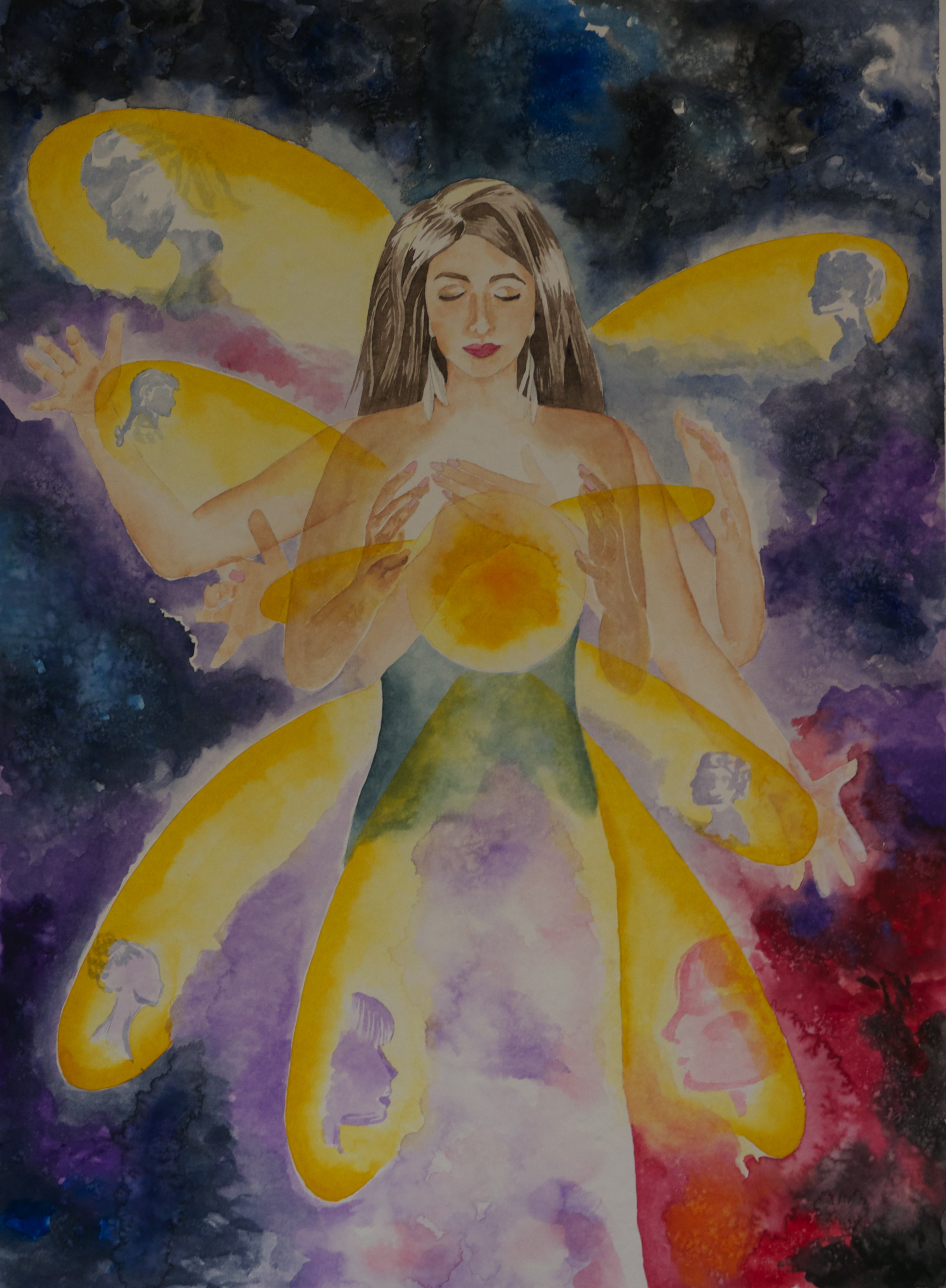
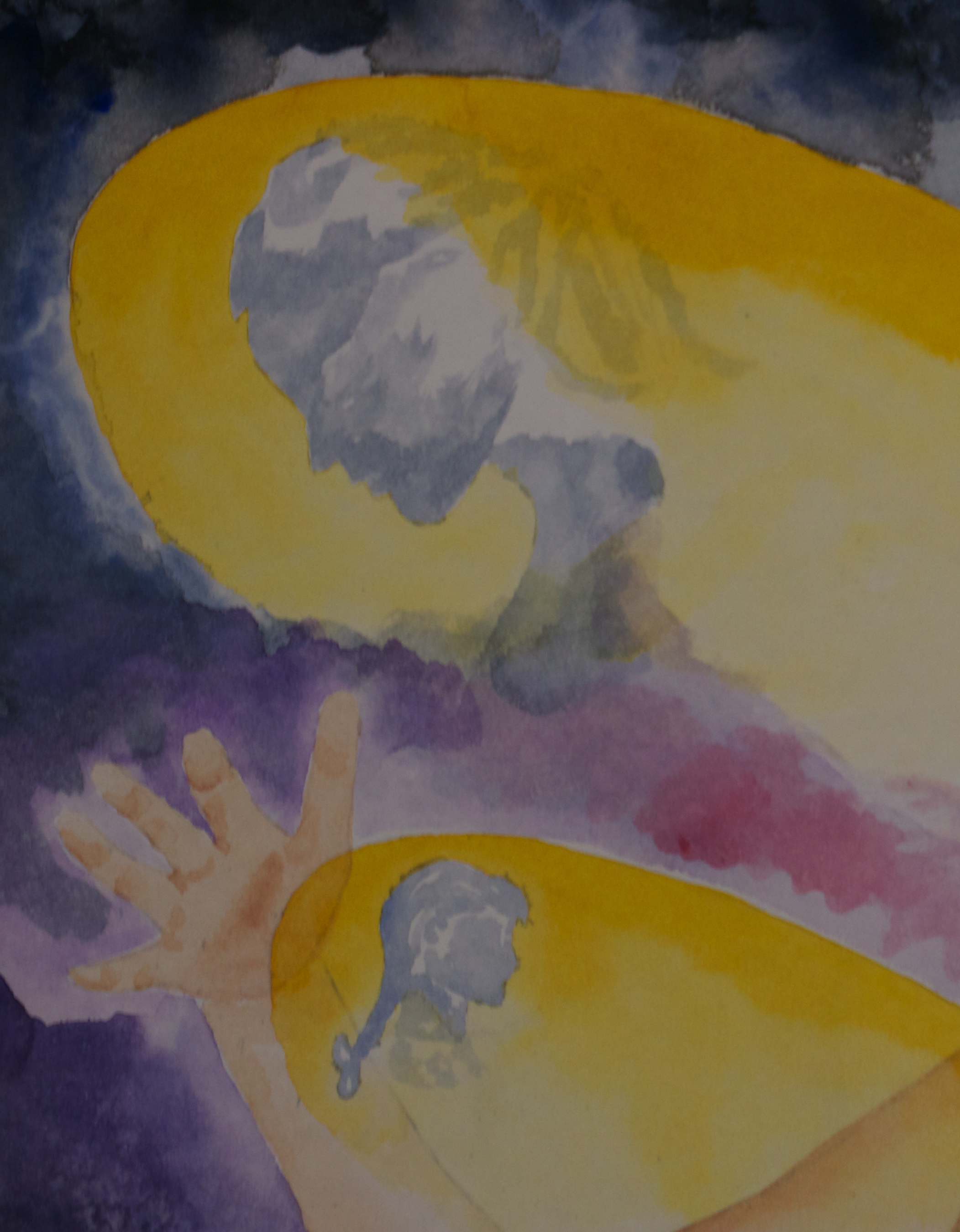
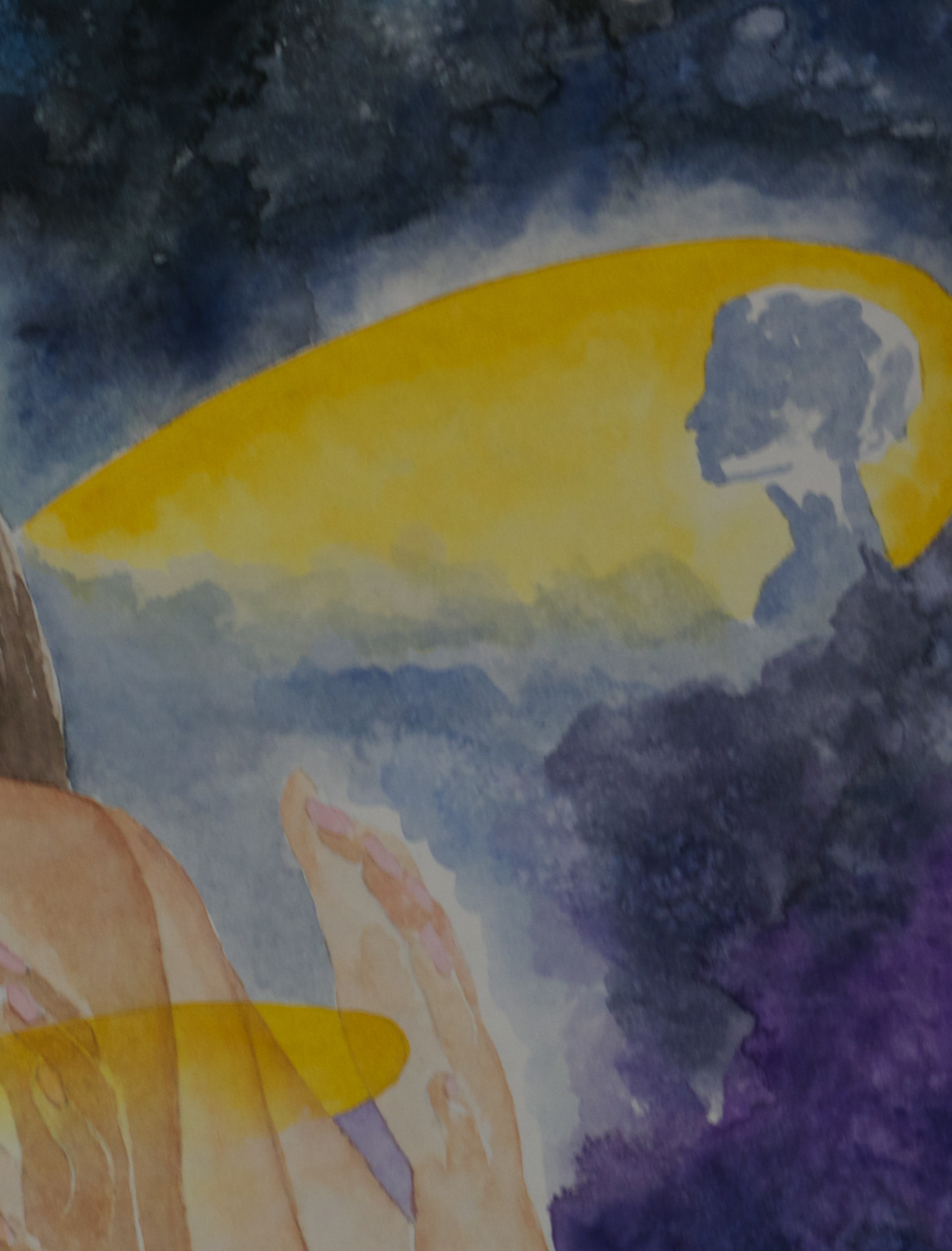
Breathing Time was inspired by a meditative exercise presented by Bache during the Diamond Soul course in which each breath we took represented one hundred years, or approximately one human life. Eventually we brought the movement of our hands into this meditation, each expansion and contraction of the hands representing a lifetime. The energy created by this movement we slowly gathered into a sphere at our centers, then held it like a ball of light, before pressing the energy into our hearts and letting it fill our bodies. This painting is a visual representation of that meditation as I saw it during the exercise itself.

In the painting, within the arcs of energy created by the breath and the moving hands are revealed faces, each one the face of a previous life. The faces are the color of the murky, nebulaic background indicating that the air may be packed full of these faces, full of lifetimes, but only the ones that are swept over with the meditative energy are revealed in that moment. There may be an infinity of faces present, just as we likely have an infinity of lifetimes to our souls.

BIBLIOGRAPHY

Bache, Christopher M. Lifecycles: Reincarnation and the Web of Life. New York, NY: Paragon House, 1994.

Bache, Christopher M. Dark Night, Early Dawn: Steps to a Deep Ecology of Mind. Albany, NY: State University of New York Press, 2000.

Grof, Stanislav. Psychology of the Future: Lessons from Modern Consciousness Research. Albany, NY: State University of New York Press, 2000.

Grof, Stanislav. The Cosmic Game: Explorations of the Frontiers of Human Consciousness. Albany, NY: State University of New York Press, 1998.

McKibben, Bill. Eaarth: Making a Life on a Tough New Planet. New York, NY: St. Martin’s Griffin, 2011.

A Long-Expected Journey

So it begins…

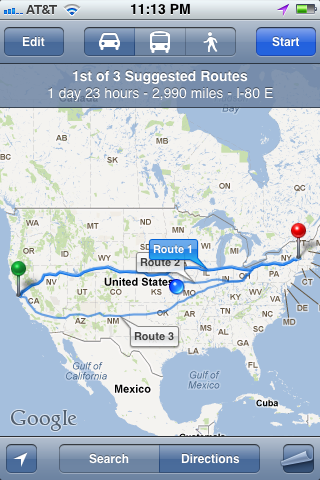
This is the first day of a long-awaited journey, one that is two years in planning, and will at last be embarked upon. Two people, a Ford Focus, 18 days, and 6,000 miles (at least!) This morning Matt and I depart upon our cross-country road trip from San Francisco, California to Bennington, Vermont and back. The purpose? To retrieve my belongings that have been languishing peacefully in my dear uncle and aunt’s basement. The true purpose? To have an adventure, a real one, by driving deep into the heart of the American continent, and emerging on the other side to inhale the breeze on the Atlantic coast.

The first leg of the journey may indeed be the longest, as we leave the Bay Area and head east, aiming to arrive in Wendover, Utah by late evening. We will be camping out for our first two nights, before meeting up with family and friends for the remaining overnights of the trip. Our initial plan had been to drive through Colorado, but the wildfires blazing throughout the state have influenced us to reroute north. I am curious if we will see smoke along the way, or if we will be fully out of range. Climate change is indeed doing its damage, from the fires in the West, to the tornadoes in the Midwest and the East, and the 118° temperatures in Kansas. We will be experiencing the rapid changing of our planet first-hand on these travels.

Our planned route for the journey after Utah is to camp again in Cheyenne, Wyoming, then stay with my fraternal family in Kansas City, Kansas, Matt’s family in Cincinnati, Ohio, my paternal family in West Bloomfield, Michigan, before arriving in Bennington, Vermont to stay with more family and pack up my belongings. From the Green Mountain State we’ll drive to the Pioneer Valley, Massachusetts, where I went to school at Mount Holyoke College, and we’ll stay with friends in the area. Our next destination is New York City to stay with another friend, and then we’ll turn our eyes homeward once more. Another pass through Cincinnati and Kansas city, and then a stay with Matt’s aunt in Aspen, Colorado if the pass there is unobstructed by wildfire. If it is, my desire is to turn southwards and see some desert-land before we cruise back into the chilly humidity of our fog-bound San Francisco home.

We are outfitted for the trip with few items of clothing, but a multitude of entertainment: dozens of podcasts of This American LifeFresh AirWait Wait Don’t Tell Me, as well as an obscure Tolkien podcast entitled An Unexpected Podcast. We will also have the treat to listen to Matthew Stelzner’s archetypal astrology podcast Correlations to help us stay attuned to the outer planets as we travel across the surface of our own home planet. Finally, we have the rare privilege of listening to a large collection of audio tapes I salvaged out of my father’s studio: lectures by Joseph Campbell, Rupert Sheldrake, Terrence McKenna, Bruno Barnhart, Robert McDermott, and several others. And lastly, if we can listen to the stereo no more, Matt will have his books on Schelling for his Ph.D. comprehensive exam, and I will have a few books of my own: The Road to Middle Earth by Tom Shippey, On The Road by Jack Kerouac, Spell of the Sensuous by David Abram, and, if a copy stumbles into my hand soon, The Cosmic Game by Stan Grof.

May the stars smile down upon us as we begin this journey, may the unexpected adventures be merry, and the expected ones all the sweeter for occurring,may the road be swift and safe, and may the landscapes be the deep pool from which I’ll fill the cup of my imagination. To quote a great traveller in the wilds of the imaginary, let me conclude:

The Road goes ever on and on
Down from the door where it began.
Now far ahead the Road has gone,
And I must follow, if I can,
Pursuing it with eager feet,
Until it joins some larger way
Where many paths and errands meet.
And whither then? I cannot say.

Heralding the Coming God: Schelling’s Philosophy of the Persephone Myth

From its root there grew
a hundred blooms which had a scent so sweet that all
the wide heaven above and all the earth and all
the salt swelling of the sea laughed aloud.
And then the girl too wondered at it, she reached out
her hands to take this thing of such delight,
but the earth with wide paths gaped in the plain of Nysia,
and He Who Accepts So Many, the lord, sprang upon her
with his immortal horses, that son of Chronos with many names.
– From “Hymn to Demeter”[1]

For Friedrich Wilhelm Joseph von Schelling, the truth of God could be found in the mythologies of antiquity. Schelling’s philosophy of mythology explores the presence of God in the world as revealed through cultural myths and religious revelation. He primarily focused on Greek mythology, with a particular concentration on the Cabiri gods of the island of Samothrace, which he felt empirically confirmed an early image of the nature of God which he had worked out in his own metaphysical ontology.[2] The Cabiri myth, and the mystery initiation rituals associated with it have widespread connections throughout the ancient world, both within the Mediterranean and beyond. The most prevalent correlation to the Cabiri, as Schelling discusses in his essay The Deities of Samothrace, is the myth of Persephone’s abduction to the underworld and subsequent return, which mirrors both the succession of the seasons throughout the year and the cyclical development of a plant. Persephone’s story is both a metaphor and a symbol for Schelling’s God, a God who is also in an eternal, dynamic process that leads to the creation of the world in his own image.[3]

The ontology of Schelling’s God was based initially on the writings of Jakob Böhme in combination with earlier works of his own.[4] God exists as two poles, one of absolute free will and the other of necessity, and each pole can be understood through Schelling’s positive and negative philosophies respectively.[5] Schelling paints “a portrait of a God who constitutes himself as a duality-in-unity” and it is the continuous tension and harmonization of this polarity that gives God a dynamic, living, and even evolving existence.[6] Of these two poles, the pole of necessity has within it its own polarized structure, which also is in a process of tension and harmonization. First, there is the initial force that is the dark ground of all being, a centripetal potency of “pure subjectivity” that draws all things eternally into itself. The second force is one of “pure objectivity,” a centrifugal potency eternally radiating forth. The opposing tensions of these two forces are in continual struggle with each other, and can only be reconciled by a third potency, one that would not be present without the other two. This third uniting potency is love, which harmonizes and brings an unstable balance between the first two, before the third potency is overcome and the cycle begins anew.[7]

While Schelling writes that this interaction of the three potencies is in God’s “past” he also calls it an “eternal process,” indicating that it is atemporal and not subject to linear time.[8] However, God’s pole of necessity is ultimately subordinate to the pole of freedom, or pure will, which brings true balance to the tension between the centripetal and centrifugal forces within the necessity pole. The third potency of the necessity pole, love, mediates between freedom and necessity, allowing for harmony in God’s being.[9] It is through this highest principle of freedom that God is able to freely create the world in the image of God’s own being. Thus the world has the same polar structure as God, and the repeating process of tension, imbalance, and harmony echoes throughout every layer of creation’s existence.[10] The forces of centration and expansion exist in the world as the polarities of the real and the ideal, the corporeal and the spiritual. They too are brought into balance through love, which acts as the mediator between the world and the transcendent aspect of God. The pole of freedom exists in creation as human creativity and free will, in a parallel image of God’s own freedom.[11] Upon coming into relationship with creation, God’s freely created mirror, God is able to become conscious of Godself.[12] “Since nothing is outside of God, the very knowledge of God is simply the nonfinite knowledge which God has of himself in the eternal self-affirmation, that is, it is itself the being of God and is in this being.”[13] Yet not only is the world a reflection of God’s image, but God also enters into creation and is revealed historically in the mythologies and religious revelations of human culture.[14]

By investigating the mythologies of antiquity Schelling was able to perceive an intimation of the structure of God that he had worked out in his philosophy. The island of Samothrace in the Aegean Sea was home to the initiation rites of the Cabiri, which reveal a sequence of gods nearly identical to those in the myth of Persephone, central to the comparable mystery rites of Eleusis.[15] While Schelling indicated there were seven, or even possibly eight, Cabiri gods, he names the first four in The Deities of Samothrace: Axieros, Axiokersa, Axiokersos, and Kasmilos. These four gods are understood to be the Hellenic gods Demeter, Persephone, Hades, and Hermes.[16]

In the most prevalent version of this myth, Persephone is the daughter of Demeter, the goddess of the grain, and Zeus, king of the Olympian gods. While playing in the meadows, Persephone is drawn to an exquisite flower grown as a temptation by Gaia, at the bidding of Zeus. As Persephone plucks the flower, the earth gapes open and she is abducted against her will by Hades, Lord of the Underworld. In grief, Demeter flies about the earth searching for her daughter, and when she discovers that the abduction of her daughter was sanctioned by Zeus she desolates the landscape in her fury. In fear of her wrath, and to save the fertile earth from destruction, Zeus sends his messenger Hermes to the Underworld to retrieve Persephone. Yet, while she was in the realm of shades, Persephone ate six seeds of the pomegranate fruit, thus tying her forever to that domain; for whoever eats the food of the dead must remain in the Underworld. As a compromise, Zeus decrees that Persephone must spend six months in the Underworld, one for each seed, and six months with her mother in the light of the sun. So it is that mother and daughter are reunited, but only for a time, and each year the cycle continues, causing the wheel of the seasons to turn as Persephone the maiden of the upper world descends to become Queen of the Underworld each winter.[17]

While the structure of the story remains relatively similar, innumerable versions of this myth exist in which the cultural lineage of the gods is revealed through their many names and relationships to each other. The grain goddess Demeter was initially a goddess of Crete where her lover was the god Plautos, a name strikingly similar to Pluto, the Roman name of Hades.[18] Although in this myth Persephone, who was born on Crete, is the daughter of Demeter and Zeus, there is another myth in which Zeus seduces Persephone and she gives birth to Dionysos.[19] Schelling writes that according to Heraclitus, Hades and Dionysos were really the same god, and in other understandings of the Greek pantheon Zeus and Hades are interchangeable as well, as both are called the “son of Chronos with many names.”[20]

In the myth of the Cabiri, Hades and Dionysos are both associated with the name Axiokersos, the third god in the sequence of Samothrace.[21] Additionally, Persephone’s Cabiri name is Axiokersa, which contains the root “Kersa,” derived from the Hebrew hrs, or Ceres, the Roman name of Demeter.[22] Thus Schelling and other sources conclude that Demeter and Persephone are really one and the same, two parts of a continuous cyclical being.[23] Demeter’s Cabiri name, Axieros, Schelling has translated as “hunger,” “poverty,” “yearning,” “seeking,” and “longing.”[24] She is the first god of the Cabiri sequence, in a continuous state of seeking and drawing all things in toward her.[25] Culturally, Demeter is an older goddess figure than her Olympian brothers, and can in many ways be considered first, the fertile ground of being out of which the harvest grows.[26]

The fourth god of the Cabiri is Kasmilos, also called Kadmilos or Camillus, and is best known as Hermes, the messenger god.[27] The name Kasmilos has roots in the word “Kadmiel” which Schelling translates as “he who goes before the god.” Hermes is the messenger and servant of Zeus, highest of the gods, and acts as a mediator between Zeus and the first three gods of the Cabiri. It is from this ranking that Schelling infers that the Cabiri must be in a sequence, from lowest to highest, all heralding the coming of a higher god, which may be equated with Zeus, or ultimately Schelling’s Christian God.[28]

The Cabiri simultaneously herald the coming of the highest God, and also constitute a symbol of the structure of Schelling’s God. On Samothrace the first three Cabiri were collectively called Hephaestos, and Schelling writes that “The creation of Hephaestos is the world of necessity.”[29] Thus the first Cabiri comprise the pole of necessity in Schelling’s God: Axieros and Axiokersa symbolize the primary ground of being and the force of centration, and Axiokersos is the force of expansion.[30]

Schelling writes “Ceres is the moving power through whose ceaseless attraction everything, as if by magic, is brought from the primal indeterminateness to actuality or formation.”[31] With Demeter and Persephone as two sides of the same goddess Ceres, Demeter represents the formless “primal indeterminateness” and Persephone, who is born from Demeter, is that same power but actualized into form.

Whereas the first of the Cabiri can be equated with the first power… in its pure, unstructured aspect in the necessity pole in God, the second Cabiri goddess symbolizes that power as transformed into the first potency, which is the foundation of a dimension, or a region, of actual being.[32]

Axiokersos, who is both Hades and Dionysos, is the Lord of the Underworld, ruler of spirits and the realm of the dead, and thus symbolizes the second potency of Schelling’s God.[33] The second potency is the realm of spirit in the creation, but as Schelling’s translator Robert Brown writes, “…the spirit world is to be fully actualized only in an afterlife which souls enter upon death.”[34]

The third uniting potency, which Schelling emphasized does not have its own constitution, is symbolized by Kasmilos, or Hermes, who mediates not only between the first two potencies but between the pole of necessity and the pole of freedom, or between the triangle of Demeter, Persephone, and Hades, and Zeus.[35] The pole of freedom in Schelling’s God is pure will and balances the pole of necessity, just as finally Zeus intervenes and creates a cyclical harmony between Demeter, Persephone, and Hades.[36]

This myth, in its many forms, served as the basis of the various Greek mystery rites, from the initiations of Samothrace, the rituals of Thesmophoria or the “Festival of Sorrow,” to the Eleusinian mystery rites.[37] While some scholars believed the secret of all the ancient mystery rites was “the doctrine of the unity of god,” Schelling disagreed with this notion in part, deeming that it would be impossible for a secret monotheism to exist in deceit of a public polytheism.[38] Rather, it seems that the unity experienced in the mysteries was both an understanding of the necessary unity of the gods within the sequence of the Cabiri myth, and also the union of the initiates with the divine.[39]

Because it was forbidden to reveal what occurred during the rites, we do not have a full picture of the initiatory rite of passage. We do know that participants consumed a grain drink called kykeon, a mixture of barley, water, and mint, which was said the be the drink Demeter requested after her fast during which she desolated the earth in her rage against Zeus and Hades.[40] Also included in this drink was the psychedelic rye fungus ergot, also called Mutterkorn, or “mother grain,” in German.[41] It is likely that the mind-expanding quality of this drink, as well as the ceremonies enacted during the rites, allowed the initiates to understand the ultimate unity and contingency of the gods within the sequence of the Cabiri myth, as they herald the higher God into manifestation.[42] Even the name Cabiri seems to be descended from the Hebrew term Chabir, “which expresses simultaneously inseparable connection and magical union.”[43]

The holy, revered teaching of the Cabiri, in its profoundest significance, was the representation of the insoluble life itself as it progresses in a sequence of levels from the lowest to the highest, a representation of the universal magic and of the theurgy ever abiding in the whole universe, through which the invisible, indeed the super-actual, incessantly is brought to revelation and actuality.[44]

Like Elohim, the plural name of the Godhead in the Old Testament, the Cabiri are one, not differentiated but still distinct; so too are the potencies of Schelling’s God, each distinct with their own qualities, yet ultimately constituting a whole.[45]

The sequence of the mystery rites paralleled the sequence of the Cabiri myth, and it seems that initiates each underwent the journey of Persephone to the Underworld. Plutarch wrote that “to die is to be initiated” and even the word “to die” in Greek, teleutan, is related to the word for initiation, teleisthai.[46] Yet, like Persephone, the initiates returned to the light of day and were reunited with Demeter, an ultimate rebalancing and reconciliation.[47]

Just as the story of Persephone mirrors the cycle of the seasons, it also mirrors the growth of a plant from a seed embedded in the earth to a shoot flowering and finally fruiting. Another name for Persephone was Kore, from koros meaning “sprout;” Persephone also translates as “she who shines in the dark,” symbolizing the dormant life of the seed underground, as well as her shining presence as Queen of the Underworld.[48] Persephone’s descent is a necessary process, a cycle of death and regeneration vital for life to continue. It is as though the flower Gaia grew to tempt Persephone to the brink of Hades’ realm was grown in service of the greater need of earth’s fertility.[49] Even the symbol of this single beautiful flower carries the dynamic of the entire myth within it.

Demeter and Persephone both symbolize the first potency of Schelling’s God, but Demeter is the first potency before creation and Persephone the first potency after, just as the seed and the shoot are one plant, before and after the germination process. The world is created in the image of God, and as such has the same ontological structure as God.[50] Thus the poles of necessity and freedom, and within the pole of necessity the force of centration and physicality, and the force of expansion and spirituality, all unified by love, ripple out and can be found within every structure of the created universe. As Brown writes, “Because the potencies of being are not exhausted in whatever severally exemplifies or symbolizes them, they can recur at various levels within an extended hierarchy.”[51] The polarities can be found in the growth of plants, the cycles of the seasons, and the polytheistic pantheons of antiquity. They overlap and combine, the mythological gods intertwined with earth’s natural processes.[52]

Schelling believed that because God had entered creation, God was being revealed in a historical evolution from the ancient stories of mythology to the revelations of the religions, disclosing each potency in sequence, leading ultimately to knowledge of God as a whole.[53] The Cabiri are at the evolutionary stage of the full revelation of God’s pole of necessity, but intimations of the next stages are also present in that mythology. Kasmilos, or Hermes, is the herald of the coming God, who is both the Olympian Zeus and a God higher than Zeus. Schelling mentioned that there were either seven or eight Cabiri, and it seems that Zeus was both the seventh, as a link in the sequence, and also the eighth, as the final God who is manifested by the relationships of the first seven.[54] Each participant of the sequence is divine, as Schelling writes in one of his aphorisms: “Yet not only the whole as whole is divine. For so is also the part and the particular by itself.”[55]

As a Christian, Schelling believed that God was revealed fully in the revelation of Christ. The fallen state of the world is a manifestation of the first potency, but God acted through the spirituality of the second potency to bring new harmony and balance to creation. This manifestation of the second potency is the incarnation of Christ. The teaching of Christ is that of love, which is the third unifying principle, which leads ultimately to a full union with the divine.[56]

The polarized structure of God and the world has been in an eternal cyclical process that has also been evolving linearly through time. The Godhead is both revealed in the course of time and outside of it altogether. In the mythology of Samothrace, time is located above all of the gods, which can also be seen in the family tree of the Cabiri: Chronos, who represents time, is either the father or the grandfather of all the gods in that story.[57] Schelling also wrote, “Because the gods come forth in succession, they themselves are only the offspring of almighty time;” time is the true creator and permeates all things.[58] Yet Schelling’s God existed before time and is caught in an “eternal process,” therefore his God is also outside of time.[59] It seems that ultimately Schelling’s God is both subject to time yet also free of it, just as God has one pole of necessity and one pole of freedom.

The final question remains then, what will happen when the creation ultimately unites with God through the mediation of love? Through this process God has become fully conscious of Godself and the poles are completely balanced. As both subject to and free of time will the cycle end in harmonious balance or, like a seed planted in the earth, will a new creation germinate and sprout to a truly new florescence?

Appendix

Just as the structure of God’s being can be found throughout the creation of nature, it is also mirrored in the realm of archetypal astrology, especially as it pertains to Schelling’s own birth chart. Schelling was born January 27, 1775, at 3:00 am in Ragaz Switzerland, Germany. The most prevalent aspect in his chart is a stellium of four planets: Sun, Mercury, Venus, and Pluto. The configuration of these four planets correlates perfectly with the Cabiri myth, and thus corresponds to his ontology of God as well. Venus represents the first potency, and like the Cabiri myth relates simultaneously to both Demeter and Persephone. Venus is the archetype of beauty, as portrayed by the young maiden Persephone, and also of flowers and that which grows upon the earth. As the archetype of love, Venus also relates to the loving bond between mother and daughter in this myth. Pluto correlates directly to Hades and Dionysos, both of whom are represented by this archetype. Pluto rules the Underworld and the entire death-rebirth process, which is the primary theme of both this myth and the mystery rites associated with it. Mercury correlates to its namesake Hermes, and acts as mediating messenger, but also a bringer of love, represented by the Mercury-Venus combination. Finally, the Sun represents the Godhead, which the first four gods are heralding, the ultimate shining principle in its singularity and perfection, bringing all the other archetypes into a single conception of God.

An additional aspect of note is that Schelling’s birth chart has Saturn in a trine with the Sun-Pluto stellium, which can be seen as both the inherent structure of the Godhead, but also the prevalence of time as the true creator and that which drives the evolution of God’s creation.

Works Cited

Baring, Anne, and Jules Cashford. The Myth of the Goddess: Evolution of an Image. London, England: Viking Arkana, 1991.

Metzner, Ralph. Green Psychology: Transforming Our Relationship to the Earth. Rochester, VT: Park Street Press, 1999.

Schelling, Friedrich Wilhelm Joseph von. “Schelling’s Aphorisms of 1805.” Translated by Fritz Marti. Idealistic Studies 14.3 (1984): 237-258.

Schelling, Friedrich Wilhelm Joseph von. Schelling’s Treatise on “The Deities of Samothrace.” Translated by Robert F. Brown. Missoula, MT: Scholars Press, 1977.


[1] Anne Baring and Jules Cashford, The Myth of the Goddess: Evolution of an Image (London, England: Viking Arkana, 1991), 370.

[2] Friedrich Wilhelm Joseph von Schelling, Schelling’s Treatise on “The Deities of Samothrace,” trans. Robert F. Brown (Missoula, MT: Scholars Press, 1977), 45.

[3] Schelling, Samothrace, 47.

[4] Ibid, 45.

[5] Ibid, 48, 46.

[6] Ibid, 47.

[7] Ibid, 48.

[8] Schelling, Samothrace, 48.

[9] Ibid, 49.

[10] Ibid, 47.

[11] Ibid, 50.

[12] Ibid, 49-50

[13] Friedrich Wilhelm Joseph von Schelling, “Schelling’s Aphorisms of 1805,” trans. Fritz Marti, Idealistic Studies 14.3 (1984): 250.

[14] Schelling, Samothrace, 47.

[15] Schelling, Samothrace, 15.

Ralph Metzner, Green Psychology: Transforming Our Relationship to the Earth (Rochester, VT: Park Street Press, 1999), 128.

[16] Schelling, Samothrace, 16-17, 56.

[17] Metzner, Green Psychology, 128-129.

Baring and Cashford, Goddess, 364-372.

[18] Ibid, 366.

[19] Ibid, 367.

[20] Schelling, Samothrace, 21.

Baring and Cashford, Goddess, 370, 383.

[21] Schelling, Samothrace, 21.

[22] Ibid, 20, 52.

[23] Baring and Cashford, Goddess, 364.

[24] Schelling, Samothrace, 18, 20.

[25] Ibid, 18.

[26] Baring and Cashford, Goddess, 367.

[27] Schelling, Samothrace, 21.

[28] Ibid, 22.

[29] Ibid, 24.

[30] Schelling, Samothrace, 49, 52.

[31] Ibid, 20.

[32] Ibid, 52.

[33] Ibid, 52.

[34] Ibid, 53.

[35] Schelling, Samothrace, 49, 53.

[36] Ibid, 49.

Metzner, Green Psychology, 128.

[37] Baring and Cashford, Goddess, 374.

Metzner, Green Psychology, 128.

[38] Schelling, Samothrace, 24-25.

[39] Ibid, 28.

Baring and Cashford, Goddess, 382.

[40] Ibid, 377, 380.

[41] Metzner, Green Psychology, 144.

[42] Schelling, Samothrace, 28.

[43] Ibid, 39-40, note 113.

[44] Ibid, 29.

[45] Ibid, 40, note 118.

[46] Baring and Cashford, Goddess, 381.

[47] Ibid, 377.

Metzner, Green Psychology, 144.

[48] Baring and Cashford, Goddess, 368-369.

[49] Ibid, 383.

[50] Schelling, Samothrace, 50.

[51] Ibid, 56.

[52] Schelling, Samothrace, 58.

[53] Ibid, 55, 59.

[54] Ibid, 56.

[55] Schelling, “Aphorisms,” 246.

[56] Schelling, Samothrace, 58-59.

[57] Schelling, Samothrace, 19.

[58] Ibid, 33, note 44.

[59] Ibid, 61, note 8, 48.

Ode to Venus

This poem was composed by the twelve women in my Women’s Venus Circle. Each woman wrote a single, ten-syllable line, which we each spontaneously read aloud when we felt it best fit the flow of the poem. In order of the lines, this poem was composed by Rebecca Farrar, Molly Johnstone, Erica Jones, Becca Tarnas, Elizabeth McAnally, Jessica Garfield-Kabbara, Lydia Harutoonian, Kerri Welch, Delia Shargel, Alexandra Heller, Annabelle Niebel Drda, and Teresa Adams.

In love and beauty we come together:
Clamshell of pink, my heart opens anew,
Curling waves line my heart’s divine life smiles,
Sweet ethereal songs overflowing,
Femininity rising from the sea.
Beloved, touch me in the womb of your night,
My virginity, blessed in love’s embrace,
Heart expanding, stretching thin, welcome pain,
Cupped in your lovely, mutilated hands.
Behold the goddess behind every face,
In your heart, echoes of infinite birth pain.
I love to walk under stars shining bright.