Re-Enchantment in Canterbury

The River Stroud and the Westgate Gardens – Photo by Becca Tarnas

Canterbury: I couldn’t have imagined a better place to hold a conference titled Re-Enchanting the Academy. Although cars run on the narrow streets and the ninety-degree angles of contemporary buildings can be found throughout the city, one can feel the Chaucerian age palpably. Cobblestones, thatched roofs, white walls between dark wooden beams that seem to bow out at the middle, as if the centuries are weighing on the building like a elderly man carries a potbelly. Canals and bridges, gardens and stone walls, crawling ivy touched by the crimson blush of early autumn—the air seemed to tingle with enchantment, but an old, slow enchantment, one that has settled deep into the stones along with the overgrown moss.

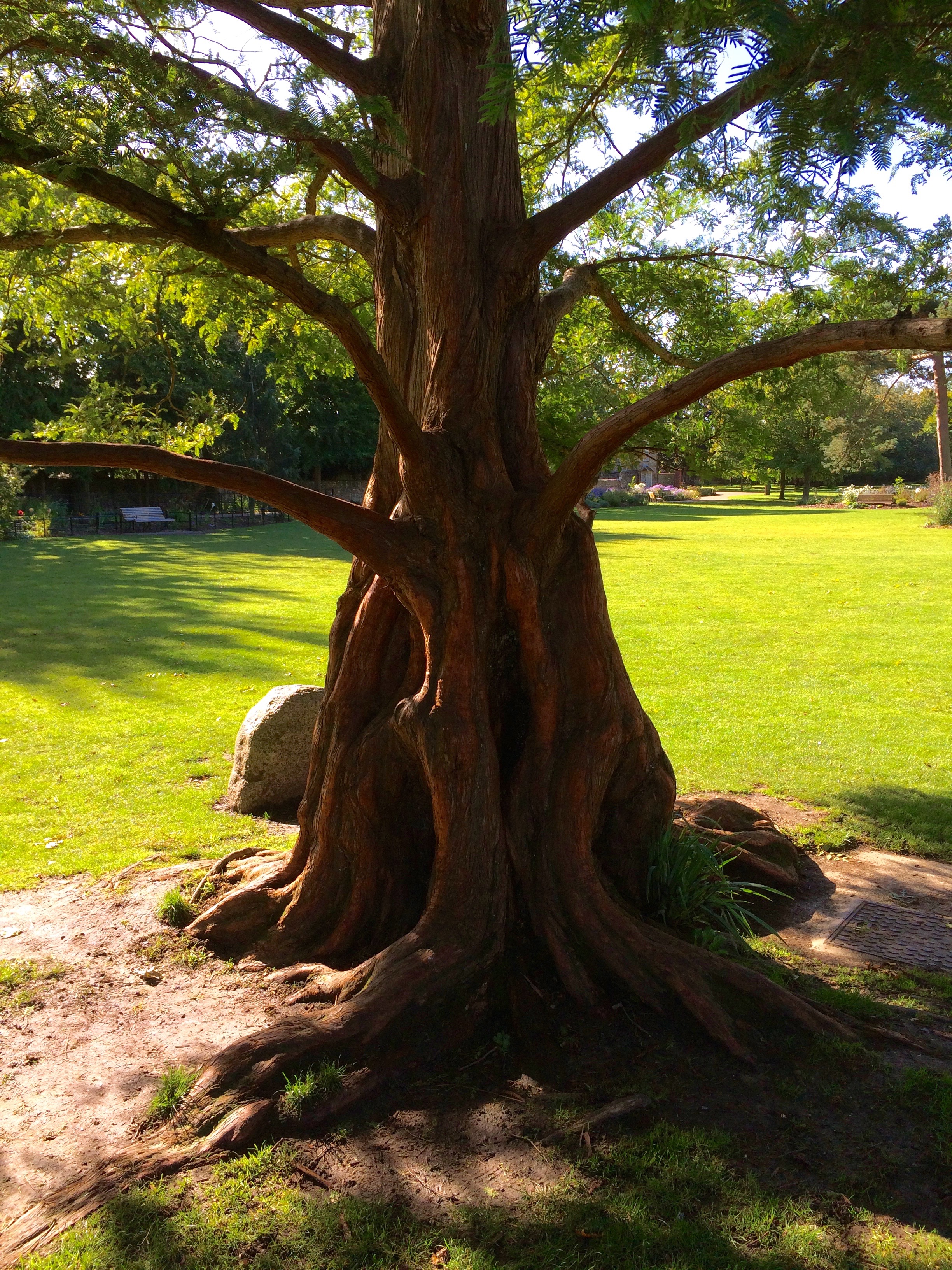
English Redwood – Photo by Becca Tarnas

I came in to Canterbury after a non-stop flight from San Francisco to London Heathrow, and an adventure of trains and tubes, until I was deposited at the Canterbury East station as I approached twenty-four hours of being awake. Trailing my little suitcase I walked up the exceedingly narrow cobbled sidewalks to a hostel I’d booked ahead. A brief wander into town later and my first cup of English tea, I fell into a jet-lagged sleep.

Or tried to. For a variety of reasons I had a terrible night at the hostel and, desperate for a sense of peace and solitude, I checked out early the next morning and managed to find a lovely hotel right in the heart of Canterbury. For the rest of my stay I was grateful to myself for making this decision, so that I might have the space, comfort, and rest to engage fully in the conference. I must say, something about that first difficult night has made all the pleasures of the rest of my trip so far all the sweeter.

Greyfriars Chapel – Photo by Becca Tarnas

After getting my hotel situation sorted, I had a few hours to myself to wander in the morning sun. My feet carried me to the Westgate Towers that have stood at the entrance to the old city for six hundred years. Through the gate I found myself on a bridge over the Stour River, and stretching away on either side of the river were the beautiful Westgate Gardens, a meandering array of lawns, flowers, stone arches, twisting trees, and pathways. I even came across a California redwood, who had adapted to the English soil by growing up with curves and twists, rather than tall and straight like the redwoods on my home coast. I also found my way to Greyfriars Chapel, a small chapel built in 1267 that spans a narrow river.

Eventually the time came to meet Patrick Curry, one of the keynote speakers of the conference, for lunch at the Goods Shed near the Canterbury West station. Goods Shed is a large, barn-like structure filled with stands where piles of colorful organic produce are arranged, and counters selling cheeses, breads, meats, fish, and deserts. Moments later Patrick and his partner walked through the door, and we sat down to an exquisite lunch together: cappuccino, elderflower elixir, a vegetarian platter of grilled squash and eggplant, tomato toast, creamy soup, poached egg, and several other tasty arrangements. Among our topics discussed was Patrick’s new book, Deep Roots in a Time of Frost: Essays on Tolkien, of which he kindly gave me a copy.

St. Martin's Priory – Photo by Becca Tarnas
St. Martin’s Priory – Photo by Becca Tarnas

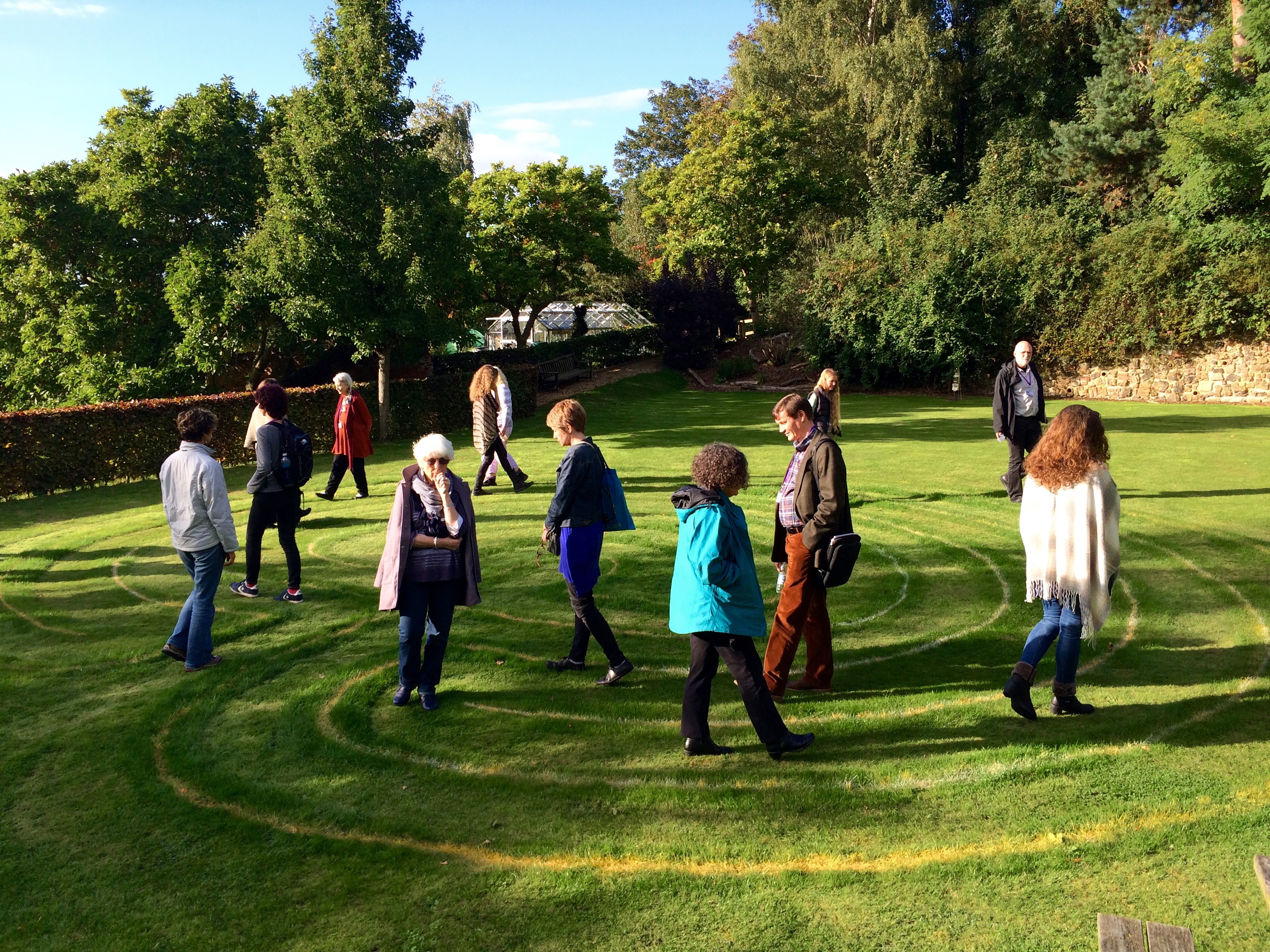
Lunch led us straight to the conference, which Patrick opened with his talk: “The Enchantment of Learning and the Fate of Our Times.” He addressed the need to leave the door open to enchantment, but not to try to force or tame it. One cannot make enchantment happen, one can only cultivate the conditions that allow for its occurrence. With that note to start on we set off on three days of presentations, usually two tracks running simultaneously. The conference was held primarily in St. Martin’s Priory at Canterbury Christ Church University, a gorgeous brick building surrounded by truly enchanting gardens, filled with roses, apple trees, and even a labyrinth set up for one of the conference workshops.

Presentations ranged from psychogeography to depth psychology, the Book Fairy (that moment when you encounter just the right passage or phrase that sets you off on a new train of thought or research), astrology and astrological music, poetry and myth, and the need to re-invite the feminine, the body, and the Earth back into the academy. One issue I brought up in relation to some of the material was the need to address patriarchy both inside and outside the academy, without shaming men who want to be allies, and without recreating an essentialist gender binary. Through this conversation I encountered a wonderful astrologer, who happened to have been friends with my Dad for twenty years. We found that not only did we share a common astrological world view, but her sister is also a harpist! As we chatted together walking merrily home at sunset I felt like I had somehow found my fairy godmother.

My own presentation took place on Saturday afternoon, the third on a panel with the Jungians Jean Hinson Lall and Roderick Main, both of whom I was honored to follow. I presented on my dissertation work, Jung’s and Tolkien two Red Books, and found I had a receptive and supportive audience with wonderful questions and feedback. For me the dialogue carried on long into the evening and the conference dinner.

Conference Labyrinth – Photo by Becca Tarnas

The magnificent Canterbury Cathedral was just a street away from my hotel, so I woke up early Sunday morning to attend communion, primarily from the desire to see and feel the cathedral from the inside in a role that wasn’t a tourist. The air was so still as I approached, my footsteps echoing on the cobblestones and my breath visible in the morning air. Entering inside I was overwhelmed by the majesty of the building, the long stone steps leading higher and further into the nave. This cathedral was founded by St. Augustine in 597 BCE when he came over from Rome to be the first Archbishop of Canterbury, and over the centuries it was expanded and rebuilt, including in 1070 after a major fire destroyed much of the cathedral. I felt a profound mixture of emotions, in part inspired by the minimal attendance in relation to the grandeur of the building. Turning inward I could feel the centuries upon centuries of people who had come here to worship, able to see and hear in my imagination the full crowds that once would have overflowed this hall. Yet now all was nearly quiet.

Ritual. If we are to revive enchantment we need ritual, but it must be ritual that is meaningful for who we are now. Perhaps for many we are in a time between rituals, seeking the meaning that will enchant.

Soon the conference was coming to a close. I was amazed to find that many of the ideas brought forward, presented by individuals from several parts of the world, were frequently ones I had encountered in some form at CIIS. Over the course of the weekend I came to value at a new level the education I am getting at my little institute in California. Yet to engage with so many others specifically on these topics was invaluable.

A final stop at the Goods Shed once again for a piece of quiche, and Patrick and I hopped on the train to London. From there new explorations would soon ensue…

Canterbury Cathedral – Photo by Becca Tarnas

Whitehead and Archetypal Cosmology

This paper was presented at the conference “Seizing an Alternative: Toward An Ecological Civilization,” held in Claremont, California at Pomona College. The section of the conference was titled “Alienation from Nature,” and the track, organized by Matthew Segall, was called “Late Modernity and Its Re-imagining.”

This conference is titled “Seizing an Alternative,” a title that implies the alternative is already here, it is not something new that must be invented. The alternative has been present all along, waiting, urging us even, to open our imaginations to the possibility that this alternative is, in a sense, the very essence—a hidden essence—of our world. At this conference our section has been addressing the alienation from the rest of the cosmos felt by the human being in late modernity. And each talk in our track has been revealing, in its own way, the deep interconnection that has always been present between us and our world. We are our world. The cosmic web has not been cut, although part of our human journey has been to feel as though the threads of our existence have been severed.

In 1983 a conference was held at this same university, organized primarily by Catherine Keller and David Ray Griffin. The conference was called “Archetypal Process,” and sought to bring into dialogue the process philosophy of Whitehead and the archetypal psychology of Carl Gustav Jung and James Hillman. As Griffin pointed out, process philosophy and archetypal psychology are both postmodern movements, but postmodern in a different sense from the “relativistic, nihilistic, deconstructive postmodernism” that might better be called “ultramodernism, or mostmodernism.”[1] Process philosophy and archetypal psychology, in Griffin’s words, are examples of “a constructive, reconstructive, or revisionary postmodernism, in which many of the presuppositions of modernity are challenged and revised.”[2] They are postmodern movements that “both want to return soul and divinity to the world.”[3] In his talk at the conference, James Hillman spoke of the need for a metaphysics that could support archetypal psychology. Hillman had abandoned Jung’s metaphysics in order to save his psychology. Yet this was not enough. Metaphysics is always operative, whether one acknowledges it or not. What Hillman sought was a metaphysics of praxis, a metaphysics that supported the practice of psychology, the practice of soul-making—an alchemical metaphysics. Whitehead can provide such a metaphysics, a cosmology in which soul can do its work.

Hillman spoke in his talk of that word, cosmology: it both “refers to the astronomical order of the heavenly bodies, and it also has a metaphysical meaning, according to Whitehead’s Process and Reality.”[4] As Whitehead says, cosmology is a scheme “of general ideas in terms of which every element of our experience can be interpreted.”[5] What if we do as Hillman suggested, and “keep together the two meanings, astronomical and metaphysical?”[6] Allow me to quote Hillman, in his ever-eloquent stylings, on what it would mean to maintain the unity of the two meanings of the word cosmology:

Let us say that the astronomical bodies (the planets) offer metaphysical bodies (the Gods [or one might say the archetypes]) by means of whom every element of experience can be interpreted. What is beyond in both meanings are the heavenly bodies. These afford some nouns and adjectives, some processes and some realities. The planetary persons fill the void of the beyond with the myths of their bodies and the bodies of their myths. This cosmology is a psychological field—a field because metaphysics is placed in imaginal locations; psychological because the planets are persons with traits, with behaviors, and in relation with one another.[7]

Hillman is offering us a vision of an archetypal cosmology, an archetypally-patterned, astronomically-grounded cosmology­.

In his work with Stanislav Grof on non-ordinary and expanded states of consciousness, Richard Tarnas came to find, in his words, “a highly significant––indeed a pervasive––correspondence between planetary movements and human affairs.”[8] What is this correspondence? It is perceptible in the position of the planets at one’s birth, as well as in the transiting movement of the planets in relation to the birth chart throughout one’s life, and the ever-changing dynamics of the planets’ relational positions to each other. It is a correspondence of an archetypal character. Archetypal astrology. It is a continuously ongoing, universally visible form of synchronicity, what Jung describes as a meaningful coincidence between an inner event and an outer event. Archetypal astrology is an empirically-based, yet mythopoetically informed, practice—tracking the ongoing archetypal interconnection between psyche and cosmos, microcosm and macrocosm.

While Tarnas and others have put forward substantial evidence for the astrological perspective, demonstrating the multifaceted ways in which astrology works, today I want to explore another question: why does astrology work? What does the recognition of the highly precise, yet poetically subtle, correspondence between planetary movements and events on Earth indicate about the nature of the cosmos? In dialogue with this question Whitehead’s process philosophy can, perhaps, offer us a metaphysical foundation.

Before moving forward, a word on the nature of archetypes. Perhaps this can best be conveyed by Jung himself, the great diviner of the archetypal patterning of the human psyche. To quote Jung:

A kind of fluid interpenetration belongs to the very nature of all archetypes. They can only be roughly circumscribed at best. Their living meaning comes out more from their presentation as a whole than from a single formulation. Every attempt to focus them more sharply is immediately punished by the intangible core of meaning losing its luminosity. No archetype can be reduced to a simple formula. It is a vessel which we can never empty, and never fill. It has a potential existence only, and when it takes shape in matter it is no longer what it was. It persists throughout the ages and requires interpreting ever anew. The archetypes are the imperishable elements of the unconscious, but they change their shape continually.[9]

As this quote from Jung illustrates, it is the very nature of the archetypes to not be fully definable and describable, without misrepresenting and dulling their divine luminosity. Thus, moving forward, I want to acknowledge the impossibility of capturing archetypal presence in a single metaphysical system that explains in totality how they operate in the world.

In his introduction to the book that emerged from the “Archetypal Process” conference, Griffin draws a parallel between Jung’s concept of archetypes and Whitehead’s concept of eternal objects, each being part of an explanation of formal causation. For Whitehead, an eternal object is “any entity whose conceptual recognition does not involve a necessary reference to any definite actual entities of the temporal world.”[10] An eternal object is a potentiality relevant to some actual occasion, a possibility not yet defined by actuality. Eternal objects are like Platonic Forms in that they are real apart from any of their particular expressions, but unlike Plato’s Forms, their reality is “deficient in actuality”[11] according to Whitehead. Because of this deficiency, eternal objects long to enter into actuality, to ingress into actual occasions. All the ways in which we describe this world—the adjectives—these are the eternal objects: the colors, shapes, feelings, smells, tastes, qualities. Archetypes we come to understand through such qualities, but archetypes are the unifying fields or gravitational attractors that draw together a complex array of eternal objects into singular, though always fluid, form.

Grant Maxwell, who spoke yesterday in this track, has written about the relation between Whitehead’s eternal objects and Jung’s archetypes. He posits that planetary archetypes and eternal objects are both examples of formal causation, a mode of causality forbidden by modern materialism. He also suggests they should not be directly equated. I agree. I would speculate that planetary archetypes include both the potentiality of Whitehead’s eternal objects and the incarnate experience of actual occasions. Archetypes are not just eternal objects or potentials, because they would seem to have more agency and autonomy that Whitehead grants to eternal objects. Archetypes are complex personalities, persons even in Hillman’s language, yet there is a metaphorical unity to their complexity. “All ways of speaking of archetypes,” Hillman writes, “are translations from one metaphor to another.”[12]

To explore metaphor more deeply, we can make a slight turn toward Owen Barfield, the anthroposophically-informed philosopher who wrote such works as Saving the Appearances and Poetic Diction. Barfield posits an understanding of the evolution of consciousness in which the physical and psychical, material and spiritual, bodily and ensouled qualities of all entities in the world were once unified in the experience of ancient human consciousness. Only over the slow course of history have these concepts been separated from each other—subjective from objective—so that even now my language describing this to you inherently reflects this split. I must speak of object and subject, body and spirit. To give an example Barfield uses to illustrate this: when we translate the Latin word spiritus into English, spiritus can mean “wind,” “breath,” or “spirit” depending on the context. Yet for the ancient speakers of the word spiritus it meant all three of these words, and perhaps more, all at once—they were a unified whole in which the physical is utterly indistinguishable from its psychical, ensouled presence.

Yet these words are inherently related to one another at their source. They are examples of “true metaphor” in Barfield’s understanding. The way certain eternal objects complexify and ingress as archetypal beings is an example of such “true metaphor.” As Hillman said, “All ways of speaking of archetypes are translations from one metaphor to another.”[13] The infinite array of eternal objects that express the qualities of Saturn, or Venus, or Neptune, or any of the other planetary archetypes, are metaphorically related to one another, a relation that was much more apparent to ancient consciousness than to modern consciousness. This is how the ancients knew what names to give the planets, which physical planets belonged to which Gods, because the meaning of the celestial bodies was directly apparent to them. The world has changed because we have changed in our participation with it. Yet it still continues to change. The music of the spheres may have been silent for many in late modernity, yet now—at the turn of the tides—we are beginning to relearn the score.

For Whitehead the source of all things is creativity. Creativity is primary. Creativity is the realm of pure potential. Chaos. Griffin has referred to Whitehead’s philosophy as “process theology,” “especially when the chief focus is on God and other questions of ‘ultimate concern’ (Paul Tillich), such as ultimate origin, order, value, and meaning.”[14] In Whitehead’s scheme, God is not the ultimate. Creativity is. God is that which orders the chaos of pure potentiality into the hierarchy of eternal objects—and, I would posit, into the archetypes. God takes chaos and turns it into cosmos, but God is born of that chaos. God is the first concrescence, an everlasting concrescence, the first experiential achievement of chaos becoming cosmos.

An image I find compelling to illustrate this—chaos becoming cosmos—is that of a prism refracting white light into an iridescent rainbow. The white light is that realm of pure potentiality, chaotic creativity. In Whitehead’s scheme the prism itself is God, that which refracts the indefinite into the definite, that differentiates pure light into the colors of the rainbow. Each color is an archetype—red clearly different from blue, yellow distinct from purple. But within the band of light that is each color an infinity of shades is at play. Every shade of green could be seen as every possible eternal object that could ingress as an expression of Venus, or every shade of blue the endless possibilities of Neptune. They are still the same light as the white light, but the prism—which could be identified with God—has ordered them into colors.

What makes a rainbow so spectacular? Why do we stop to take note of them? Because we can see them. A rainbow makes light itself visible. The rainbow is a symbol of divine possibility entering into the world, yearning for our participation in its beauty.

The moment a child takes her first breath can be seen as the first concrescence of that child independently of the mother’s body. The child herself is a society of actual occasions, each of which are also concrescing in this moment, making up the experience of the newborn. This moment, the first inhalation, is when the birth chart of an individual is set. The archetypal energies expressed throughout the rest of an individual’s life reflect the planetary configurations, the archetypal relationships, or eternal potentialities, of this particular moment. At the time of birth all of the actual occasions that have ever been, that have perished into objective immortality to use Whitehead’s term, become one— are prehended by the actual occasion that is the newborn child in that moment—before also perishing. Every archetypal expression that has ever manifested is gifted to the child. Yet the past actual occasions that are most felt by the concrescing actual occasion are those that are immediately prior. Thus the positions of the planets and their correlated archetypal energies, that are being enacted everywhere upon the Earth, are what is most immediately inherited by the child in her first moment of independence. As the child continues to live and grow, her subjectivity—the crest of her concrescing wave—continues to inherit the archetypally ordered actual occasions, as can be seen in the unfolding of astrological transits. Yet the birth chart is still effective, and can still be seen in the progression of the individual’s life. How can this be so? How can a past actual occasion, from the moment of birth, be more archetypally influential than other past actual occasions?

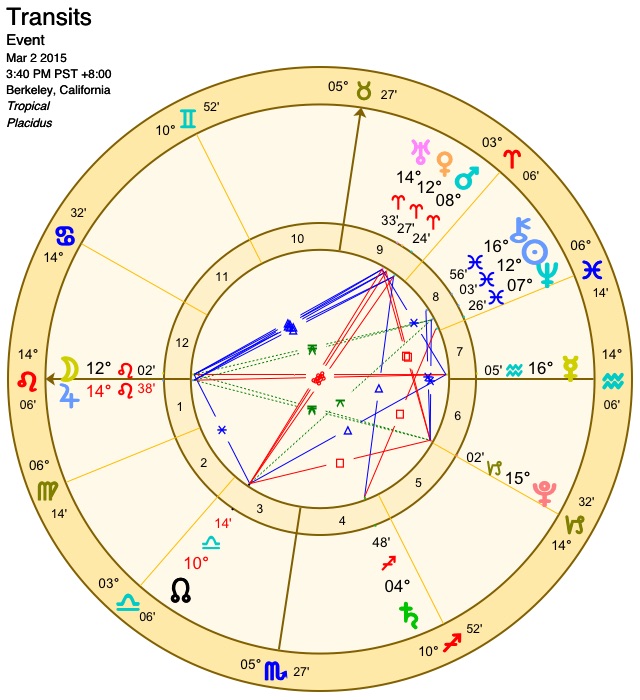
Let us return to the image of God as an eternally concrescing actual occasion, never perishing but continuously feeling the procession of the cosmic community of finite actual occasions. Perhaps in this understanding of God we can glimpse what may be happening in relation to the actual occasion when the individual’s birth chart is set. It is almost like the actual occasion that concresced with the child’s first intake of air is also an everlasting concrescence, one that continues from that moment forward. Each preceding concrescence takes place within the gestalt set by that first concrescence—which is how transits to the birth chart could be experienced by the individual. The birth chart is like the prism of that individual’s life, refracting the archetypal potential into the archetypal particulars of this person. That moment when the birth chart is set concresces onward, even beyond the bodily death of the individual. We see transits to the birth chart still being operative long after the person carrying that chart has died: for instance, when a renaissance of interest in someone’s work occurs after their death. As an example, (and please excuse my more technical astrological language for a moment) as this conference is being held Neptune in the sky is exactly crossing Whitehead’s natal Mercury-Uranus square, bringing a revisioning and reimagining of world view, which relates to Neptune-Uranus, to Whitehead’s ingenious philosophical system, which relates to Mercury-Uranus.

Like the dipolar nature of Whitehead’s God, the archetypes too seem to have a primordial pole and a consequent pole. The primordial pole orders the realm of eternal objects so that they can ingress as relevant possibilities into the actual occasions of the cosmic community, while the consequent pole feels the experiences of this world community and continuously adjusts the ordering of the eternal objects. So too, I believe, it is with the archetypes. For as they ingress into living manifestation, we participate in their becoming, we co-creatively engage their archetypal qualities through our own lives. The archetypes also have a consequent nature, one that feels what we feel, and that forever reshapes the potentialities for the future ingression of the archetypes, in our own lives and in the lives of future generations. Our participation is enacting an evolution in the archetypes themselves.

We are being called upon to seize an alternative. We are being called upon to participate. By consciously engaging with the archetypes as we co-creatively manifest them, we are reshaping the potentialities with which they will manifest in the future. No future is yet set. But the past occasions that will inform it are here now. A rainbow makes white light visible. Let’s look forward with eyes open.

Bibliography

Griffin, David Ray, ed. Archetypal Process: Self and Divine in Whitehead, Jung, and Hillman. Evanston, IL: Northwestern University Press, 1989.

Hillman, James. Re-Visioning Psychology. New York, NY: Harper Perennial, 1992.

Jung, C.G. “The Psychology of the Child Archetype.” In The Archetypes and the Collective Unconscious: Collected Works of Carl Gustav Jung. Translated by R. F. C. Hull, Edited by H. Read, M. Fordham, G. Adler, W. McGuire. Princeton, NJ: Princeton University Press, 1940.

Maxwell, Grant. “Archetype and Eternal Object: Jung, Whitehead, and the Return of Formal Causation.” Archai: The Journal of Archetypal Cosmology Volume 3 (Winter 2011): 51-71.

Tarnas, Richard. Cosmos and Psyche: Intimations of a New World View. New York, NY: Viking Penguin, 2006.

Whitehead, Alfred North. Process and Reality. New York, NY: The Free Press, 1985.

Cosmos

[1] David Ray Griffin, “Introduction,” in Archetypal Process: Self and Divine in Whitehead, Jung, and Hillman, ed. David Ray Griffin (Evanston, IL: Northwestern University Press, 1989), 6.

[2] Griffin, “Introduction,” 6-7.

[3] David Ray Griffin, “Preface,” in Archetypal Process: Self and Divine in Whitehead, Jung, and Hillman, ed. David Ray Griffin (Evanston, IL: Northwestern University Press, 1989), vii.

[4] James Hillman, “Back to Beyond: On Cosmology,” in Archetypal Process: Self and Divine in Whitehead, Jung, and Hillman, ed. David Ray Griffin (Evanston, IL: Northwestern University Press, 1989), 220.

[5] Alfred North Whitehead, Process and Reality (New York, NY: The Free Press, 1985), 3.

[6] Hillman, “Back to Beyond: On Cosmology,” 220.

[7] Hillman, “Back to Beyond: On Cosmology,” 220.

[8] Richard Tarnas, Cosmos and Psyche: Intimations of a New World View (New York, NY: Viking Penguin, 2006), 68-69.

[9] C.G. Jung, “The Psychology of the Child Archetype” (1940) in The Archetypes and the Collective Unconscious, Collected Works of Carl Gustav Jung, trans. R. F. C. Hull, ed. H. Read, M. Fordham, G. Adler, W. McGuire, (Princeton, NJ: Princeton University Press), 179.

[10] Whitehead, Process and Reality, 44.

[11] Ibid, 34.

[12] James Hillman, Re-Visioning Psychology (New York, NY: Harper Perennial, 1992), xix.

[13] Hillman, Re-Visioning Psychology, xix.

[14] Griffin, “Introduction,” 3.

Archetypal Ecology: Drought in a Rhythmic Cosmos

“In the last part of May the sky grew pale and the clouds that had hung in high puffs for so long in the spring dissipated. The sun flared down on the growing corn day after day until a line of brown spread along the edge of each green bayonet. The clouds appeared, and went away, and in a while they did not try anymore. The weeds grew darker green to protect themselves, and they did not spread any more. The surface of the earth crusted, a thin hard crust, and as the sky became pale, so the earth became pale, pink in the red country and white in the gray country.

. . . And as the sharp sun struck day after day, the leaves of the young corn became less stiff and erect; they bent in a curve at first, and then, as the central ribs of strength grew weak, each leaf tilted downward. Then it was June and the sun shone more fiercely. The brown lines on the corn leaves widened and moved in on the central ribs.”
– John Steinbeck, The Grapes of Wrath[1]

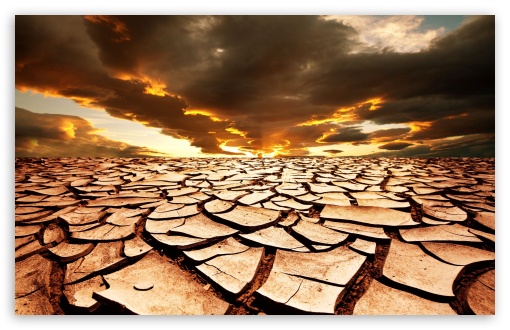
Dry earth, cloudless skies. Waiting, anticipating, counting days, weeks, months. Perhaps years. When will the rain fall? The moisture slowly leaves the soil, plants begin to die. The emotional atmosphere is defined by denial and groundless hope, anxiety and concern, worry and prayer. Dust builds, crops fail. Water—translucent and fluid, so easy to take for granted when in abundance, all one can think about when it is lacking.
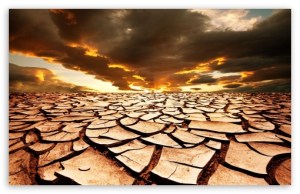
DroughtWhat is a drought? Droughts are evasively difficult to define, even by those who study their patterns extensively. Essentially a drought is constituted by a lack of precipitation in a certain area, extended over a significant period of time.[2] Of course, the precipitation levels and length of time rain is absent will all vary from bioregion to bioregion, which is part of what makes a clear definition of drought so evasive. The human experience of drought is a complex interplay of unusual or unexpected natural events, such a lower precipitation, combined with the demands human beings put on water resources. Due to a variety of complicated interacting factors, droughts can have widespread and devastating consequences.

The words opening this essay are drawn from John Steinbeck’s iconic book The Grapes of Wrath, which narrates the story of migrant farming families who had to abandon their fields and homes on the Great Plains when the 1930s Dust Bowl droughts decimated their crops and whipped up blinding dust storms that choked plants and blackened skies. Many factors went into making this one of the worst 20th century droughts in North America, including a lack understanding of the Great Plains ecology, the widespread introduction of mechanized farming, and the crippling economic crash of the Great Depression that began in 1929. The deep-rooted native grasses of the Great Plains had been ploughed by homesteading settlers and overgrazed by their livestock, leaving the unanchored soil tremendously vulnerable to the wind.[3]

When the Dust Bowl droughts hit the Great Plains in three successive waves, in 1934, 1936, and 1939, vast numbers of farmers migrated across the United States to the fertile crescent of Central California to eke out a living harvesting the fruits and vegetables growing in abundance here. California’s Central Valley is still the breadbasket—or rather “fruit and vegetable basket”— of the United States, growing the vast majority of fresh produce not only for the country but for international export.[4] “No other state, or even combination of states, can match California’s output per acre,” the journalist Brian Palmer writes.[5] Yet it now seems the cornucopia of agriculture in the U.S. may be facing an insurmountable obstacle.

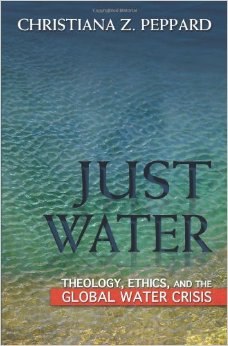
Now in 2015, California is entering its fourth year of drought, eleven trillion gallons of water shy of relief,[6] with only about a year of surface water left stored in the state’s reservoirs.[7] California was able to become the land of plentiful bounty through heavy irrigation, and now as the Sierra Nevada snowpack is a fraction of what it should be, farmers are turning more frequently to pumping groundwater. Groundwater is drawn from underground aquifers, massive geological formations that have held vast amounts of pristine waters for millennia. Some water experts refer to such water as “fossil water” because it will never replenish on any meaningful human timescale. As Christiana Z. Peppard writes in her book Just Water,

Most aquifers take upward of ten thousand years to refill—an extraordinarily long time, considering that just as many years ago, our ancestors were scribbling on cave walls with hard rocks. Many aquifers take much, much longer to refill—on the order of millions of years.[8]

As the drought worsens the state’s nonrenewable water sources are being rapidly drained to maintain maladaptive agricultural practices—namely highly irrigated, industrial agriculture in a semi-arid bioregion. Human actions, including continuously increasing greenhouse gas emissions that are inducing anthropogenic climate change, are exacerbating the consequences of the recent diminishment in rainfall.[9] The lack of precipitation during the Dust Bowl was only part of what made the 1930s droughts so devastating. Another major factor was the methods of mechanized agriculture, which did not take into account the basic ecology of the landscape and stripped the soil of its capability to hold moisture. Today we seem to be having a repetition of history.

Drought is often referred to as “a creeping phenomenon”[10] and “an elusive climate event.”[11] Scientifically predicting the onset of a drought cannot be done more than a month or two in advance, because prediction “depends on the ability to forecast two fundamental meteorological surface parameters, precipitation and temperature,” according to the National Drought Mitigation Center.[12] The historical record indicates the inherent variability of the climate, making long-term forecasts elusive because, as the Drought Center States:

. . . anomalies of precipitation and temperature may last from several months to several decades. How long they last depends on air–sea interactions, soil moisture and land surface processes, topography, internal dynamics, and the accumulated influence of dynamically unstable synoptic weather systems at the global scale.[13]

While different bioregions each have their own rhythms of wet and dry spells that repeat with varying degrees of stability, the capacity to determine the length and impact of any given drought remains evasive. As Ivan Ray Tannehill wrote eloquently back in 1947:

The first rainless day in a spell of fine weather contributes as much to the drought as the last, but no one knows how serious it will be until the last dry day is gone and the rains have come again. . . we are not sure about it until the crops have withered and died.[14]

How any given drought is defined, and its duration and impact on the land and its human inhabitants—both immediate and lasting—all shape how droughts are perceived.

Three North American droughts stand out as the most severe of the 20th century, according to the National Oceanic and Atmospheric Administration. These are the 1930s Dust Bowl drought, the major 1950s drought in the central United States, and the late 1980s drought covering the West Coast to the Great Plains.[15] Today’s drought in the U.S. West may be joining that list. “In the California and Nevada region,” recently stated the climatologist Kelly Redmond, “this is among the worst we’ve seen it in the last 120 years or so.”[16] Of course, this statement refers particularly to the region being affected by the current drought, but Redmond’s statement is nonetheless significant.

As a life-long California resident I have become increasingly aware of the drought’s impacts on my home state. Discussions of water shortage have become commonplace, ranging from wondering if the state’s mandatory 25% reductions in water usage are enough,[17] to questioning why the cuts do not apply to the agricultural sector that uses 80% of the state’s water,[18] and sitting with the real possibility that this drought may not end and California’s climate has fundamentally changed. Another issue has also come to the foreground of my attention, one that scientists would certainly not be inclined to look at in relation to drought patterns. Like factors such a temperature and precipitation, this is also a naturally recurring cycle grounded in the rhythms of the natural world, but rather than an ecosystem pattern it is a solar system pattern, a much larger scale than meteorologists take into account.

If we turn our eyes to the cosmos, we can see that currently the planet Saturn and the planet Neptune are at a 90° angle to each other, forming what is called a square aspect. The alignment began in January 2014, when the two planets came within 10° of each other, and will end in October 2017 when they pass out of the same 10° range. If one looks back at an ephemeris to see where these same planets were during the three most prominent North American droughts of the 20th century, an interesting pattern appears: in 1934-38 Saturn was in 180° opposition to Neptune in the sky, the same years as the worst of the Dust Bowl droughts; in 1950-56 Saturn was conjoined with Neptune in the same place on the ecliptic, the same years as the 1950s drought; and in 1987-91 Saturn and Neptune were also in a conjunction, encompassing the years of the late 1980s drought.

What is the significance of such planetary alignments and their correlations to these droughts? As has been argued by Richard Tarnas in Cosmos and Psyche: Intimations of a New World View, a significant body of evidence has come forward indicating a profound correlation between the positions of the planets and events unfolding on Earth in human history and world events, individual biography and psychology, and even in natural ecological events. What emerged from this body of evidence was a revival of an ancient practice long-dismissed by the modern paradigm, re-engaged with new rigor and empiricism. As the Jungian psychologist and professor Keiron Le Grice writes,

Archetypal astrology, as this new approach been called, is based on an observed correspondence between the planets in the solar system and specific themes, qualities, and impulses associated with a set of universal principles and thematic categories known as planetary archetypes. Each of the planetary bodies, as well as the Sun and the Moon, is associated with a distinct archetypal principle.[19]

The planetary archetypes associated with each planet are expressed in world events in multivalent and multidimensional ways. As Tarnas writes,

. . . an essential characteristic of this analysis was that it did not predict specific events or personality traits. Rather, it articulated the deeper archetypal dynamics of which events and traits were the concrete expression. This is seemed to do with astonishing precision and subtlety.[20]

While Cosmos and Psyche looks at a vast array of cultural, social, artistic, scientific, psychological, and political events in relation to several planetary alignments, for this study I am focusing on one particular phenomenon—namely droughts—in relation to the corresponding planetary alignments. To begin, I am looking at the relationship between droughts and the Saturn-Neptune cycle of alignments, before looking further at certain apparent anomalies to this pattern and from there exploring the more nuanced dynamics unfolding in relation to specific drought events.

As previously mentioned, the droughts of the mid-1930s, early to mid-1950s, and late 1980s all took place under Saturn-Neptune alignments, as is our current drought in the western U.S. today. Why does Saturn-Neptune archetypally correlate with drought? The archetype of Saturn relates to contraction, negation, restriction, lack, and boundaries; it is the principle of time and structure, decay and death, loss and endings. Any archetype with which Saturn comes into relationship it will problematize, negate, constrain and create obstacles. The archetype of Neptune, on the other hand, is the principle of fluidity, boundlessness, and interconnectivity, that which unifies and merges, dissolves and dilutes; Neptune is the archetype of oceanic oneness, transcendent spirituality, the heavenly cosmos, image and imagination, illusion and mirage—it is the principle of water itself, both as symbol and physical liquid.

One can see how the combination of archetypal qualities associated with Saturn and Neptune manifest as drought: lack of water, low moisture, negation of water’s life-giving properties. To draw some images from the Dust Bowl, Saturn-Neptune came through not only in the absence of precipitation, but in the dry particles of dust that flowed boundless across the land, reducing visibility and even blackening the skies. The Saturnian themes of lack, absence, dryness, reduction, and darkness are present here, combined with the Neptunian qualities of rainwater, boundlessness, clarity of vision and perception, and the image of the celestial sky (all negated, blocked, and obscured by the previously mentioned Saturnian characteristics). Another expression of the Saturn-Neptune alignment that contributed to the Dust Bowl droughts was the lack of understanding of the intricate interconnected dynamics of ecosystem structures that led to the agricultural practice of ploughing the deep-rooted grassed that retained moisture and maintained soil structure. Again, Neptune comes through as the soil moisture and interconnected unity of the ecosystem, while Saturn is present in the structures, retention and maintenance, the anchoring roots, and even the sharp cut of the metal plow. The elusive quality of droughts and the scientific difficulty in defining them also have a Saturn-Neptune quality, as Saturn relates to difficulty and definition, Neptune to the slippery aspects of evasiveness and illusion.

The Saturn-Neptune opposition came into 15° orb (recognized by archetypal astrologers as the general range when archetypally correlated events occur) in 1934, and was in exact alignment in 1936-7 when the drought was at its worst. The third wave of drought that came in during 1939 was after the Saturn-Neptune opposition had moved past operative alignment—a topic we will explore later in this essay.

An opposition between two planets is the same configuration as a Full Moon, when the Moon is on one side of the Earth and the Sun on the other. The completion of that cycle is the New Moon, when the Sun and the Moon are conjoined in the same place in the sky relative to the Earth. After the Saturn-Neptune opposition of the mid-1930s, when they were in the “Full Moon” alignment, these two planets reached the conclusion of their cycle, or the “New Moon” alignment, in the conjunction of the 1950s. Saturn started to come into 15° orb with Neptune in 1950, right as the drought began in the southwestern states, and was having a major impact on Oklahoma, Kansas, and Nebraska by 1953 when the conjunction was exact. According to the National Oceanic and Atmospheric Administration,

By 1954, the drought encompassed a ten-state area reaching from the mid-west to the Great Plains, and southward into New Mexico. The area from the Texas panhandle to central and eastern Colorado, western Kansas and central Nebraska experienced severe drought conditions.[21]

While the Saturn-Neptune conjunction went out of orb in 1955, the drought ended when the 1957 spring rains began to pour down on the parched soil. Like in the 1930s, the effects of the drought persisted beyond the Saturn-Neptune transit under which they commenced—again, a topic we will explore later in the essay.

Now to turn to the third of the major 20th century North American droughts, the 1987-89 drought that severely affected the West Coast and the northern Great Plains. Although the late 1980s drought covered just 36% of the United States, compared to the Dust Bowl’s 70%, it was the costliest drought, indeed the costliest natural disaster of any kind to effect the U.S., with damages and losses exceeding approximately $39 billion.[22] As the environmental studies and philosophy professor Dale Jamieson describes,

Much of the United States spent the summer [of 1988] in the grip of extreme heat and serious drought. Fires raged in Yellowstone National Park, agricultural production declined dramatically, and water levels in the Mississippi River system dropped precariously, resulting in channel closings and ship groundings.[23]

Sure enough, beginning in 1987 Saturn had started to conjoin Neptune again, one full cycle after the 1950s conjunction. Once again the themes of Saturnian lack of Neptunian rains can be seen here, as well as the loss (Saturn) of an idealized, pristine (Neptune) national park, and the grounding (Saturn) of water-going vessels (related to both archetypes as Saturn is the container and Neptune the water) in the river systems. This was the first drought of this magnitude in the U.S. since the 1950s and it took the population by surprise, which is partially why the damage was so great.[24] Interestingly, Saturn and Neptune were joined in a rare triple conjunction by the planet Uranus at this time—archetypally Uranus relates to the unexpected, the sudden and the disruptive, which can be seen in the unanticipated severity and consequences of the late 1980s drought.

What about the intervening Saturn-Neptune opposition of 1970-73 and the following opposition of 2004-07? It happens that in 1972-73 the El Niño Southern Oscillation was particularly strong, causing droughts in multiple locations around the globe.[25] As Jamieson remarks:

The El Niño of 1972-73 brought worldwide devastation and was followed by other climate anomalies. Drought-related famine killed hundreds of thousands of people in African Sahel and in India. Drought struck other countries as well, including the United States. Crop failures brought the Soviet Union into the world grain market. . . .[26]

The patterning of strong El Niño and La Niña events (they are ranked weak, moderate, and strong) correlates with surprising consistency to two major outer planetary cycles, which we will explore more closely toward the end of this analysis.

The most recent opposition of Saturn and Neptune in 2004-08 manifested in major climate events that carried the Saturn-Neptune archetypal complex, but in many ways expressed the opposite side of the archetypal spectrum from a drought. The major climate events of the 2004-08 were the Indonesian tsunami of December 2004, and Hurricane Katrina in August 2005. Each exhibited strong Saturn-Neptune characteristics, as Tarnas describes,

death caused by water, the ocean as source of suffering and loss, contamination of water, water-borne and infectious diseases, numberless haunting images of death and sorrow transmitted throughout the world and permeating collective consciousness.[27]

Like under drought conditions, water is the cause of death, suffering, and loss, but in the case of hurricanes and tsunamis it is the flooding of water, rather than its lack, which brings about the Saturnian devastation. To draw a parallel image, the dust storms of the 1930s Dust Bowl drought looked like a “massive wall of blowing dust that resembled a land-based tsunami.”[28]

Even though this Saturn-Neptune opposition was characterized by such destructive watery events, a major drought was occurring in the Amazon rainforest at the same time, beginning in 2005. The Amazon drought was so severe it lasted until 2010, two years after the Saturn-Neptune transit had ended. Like the major North American droughts of the 1930s and 1950s, the Amazon drought extended beyond the Saturn-Neptune alignment under which it started. They all ended under a different alignment of two outer planets, Saturn and Pluto. While we have been looking closely at the Saturn-Neptune themes associated with drought, Pluto in relationship with Saturn has a significantly different quality.

Pluto is associated with the principle of elemental power, depth, and intensity; with that which compels, empowers, and intensifies whatever it touches, sometimes to overwhelming and catastrophic extremes. . . . It is the dark, mysterious, taboo, and often terrifying reality that lurks beneath the surface of things, beneath the ego, societal conventions, and the veneer of civilization, beneath the surface of the Earth, that is periodically unleashed with destructive and transformative force.[29]

When Saturn and Pluto align, the same Saturnian themes of constraint, obstacles, oppression, suffering, and death are present but instead acting upon the powerful intensity of the Pluto archetype described above. Saturn-Pluto alignments are associated with,

especially challenging historical periods marked by a pervasive quality of intense contraction: eras of international crisis and conflict, empowerment of reactionary forces and totalitarian impulses, organized violence and oppression, all sometimes marked by lasting traumatic effects.[30]

What is the significance of so many of the most devastating droughts of the last century ending during Saturn-Pluto transits? While the drought events themselves reflect the Saturn-Neptune themes of extended periods of time without precipitation, the long-term impacts of such meteorological changes can cause tremendous suffering on a mass scale with conditions of food scarcity leading to famine and potentially death, much more reflective of the qualities of Saturn-Pluto.

This project has been to research which planetary alignments correlated with the most significant droughts of the last century or so, for which we have the most accurate records and dates. The repeated correlation between major droughts and the Saturn-Neptune cycle certainly has compelling evidence, but anomalies to the pattern must exist. After all, because of the multivalence and indeterminacy of archetypal manifestations, the occurrence of a drought under every single Saturn-Neptune alignment would seem to indicate a fixed rigidity to the archetypal expressions that is not supported by the larger astrological evidence. As Tarnas writes, “I gradually came to recognize that, contrary to its traditional reputation and deployment, such an astrology is not concretely predictive but, rather, archetypally predictive.”[31] Noticing how the 1930s, 1950s, and 2000s droughts concluded under Saturn-Pluto alignments, I decided to look at the correlations with the other major droughts my research had turned up.

In her book This Changes Everything, Naomi Klein draws forward evidence that every major volcanic eruption for which we have accurate records has been followed by debilitating drought around the globe. Looking at her research I recognized an additional overlying correlation: each of these events in which there was a sequence of volcanic eruption, drought, and famine, correlated with a Saturn-Pluto or Saturn-Neptune alignment, and almost always both in succession. What is archetypally significant about the relationship of Saturn-Pluto alignments with volcanic eruptions is that Pluto is the principle of volcanic, eruptive power unleashing from the underworld realm, while Saturn is the problematic and often dire consequences caused by such eruptions.

We can begin by looking at Mount Pinatubo in the Philippines, which erupted June 12, 1991 when the Saturn-Neptune conjunction (which correlated with the devastating late 1980s western U.S. drought) was at 20° orb, the outer range of when archetypally relevant correlations have been observed for conjunctions, while the Saturn-Pluto square was entering 12° orb, right at the penumbral phase when correlations begin to be more frequent for squares (conjunctions and oppositions appear to have a wider orb of influence ranging 15°-20°, while squares have a slightly narrower orb of 10°-15°). Large sections of Africa were already suffering from drought, under the Saturn-Neptune conjunction just ending, and by 1992 when the Saturn-Pluto alignment was tightening in orb there was a 20% reduction in precipitation in southern Africa, and a 10-15% reduction in South Asia which had a negative impact on approximately 120 million people.[32]

Cycling back to the previous quadrature alignment of Saturn and Pluto, the conjunction of 1980-84, Mexico’s El Chichón volcano erupted from March to September 1982 as the conjunction was approaching exact alignment. The eruption led to low precipitation and drought, particularly affecting the African continent where 20 nations were already suffering from drought conditions.[33] While there had been a Saturn-Neptune square in from 1978 to late 1980, the African droughts are recorded to have begun in early 1981, right at the tale end of the alignment. The El Chichón eruption seems to have severely exacerbated the drought conditions, giving them a particularly Saturn-Pluto quality.

The three years with the lowest global average precipitation in the last half century were after the eruptions of Pinatubo, Chichón, and the 1963 eruption of Mount Agung in Bali.[34] Agung’s detonation occurred under the Saturn-Neptune square of 1961-64, and also corresponded with low global precipitation and drought. In the U.S. the drought was experienced most strongly in the Northeast, the Midwest, and the Great Plains, and this drought too concluded under the Saturn-Pluto opposition of the mid-1960s.[35] It is interesting to note, however, that Agung did not erupt under a Saturn-Pluto alignment but rather a Uranus-Pluto transit. Further research would need to be done to discern the differences in quality and effects of this volcanic eruption compared to those that become active under Saturn-Pluto alignments.

To conclude this particular inquiry we will look at the eruption of two other volcanoes clearly connected with widespread drought: Alaska’s Mount Katmai eruption in 1912, and Iceland’s Laki volcano in 1783. While Katmai did not erupt under Saturn-Pluto, the drought-related famine hit in 1913-14 under a Saturn-Pluto conjunction,[36] killing 125,000 people in western Africa alone.[37] To look further back into history, Laki erupted in Iceland in 1783 under a Saturn-Neptune square, which was followed by famine and plague in Egypt, Japan, India, Western and Central Europe under the Saturn-Pluto conjunction in the following two years.[38] A more in-depth study than this one could explore the nuances of each of these volcanic eruptions and their related droughts and famines, particularly to see what particular differences may exist if an eruption occurred under Saturn-Neptune versus Saturn-Pluto. Each combination, while having the Saturnian elements in common, manifest quite differently in world events. Yet there seems to be a significant relationship between these two planetary alignments and the unfolding impacts of drought-related events.

As mentioned earlier in this essay, the patterning of strong El Niño and La Niña events—according to records kept since the middle of the 20th century—happen to correlate every time with a Saturn-Neptune or Saturn-Pluto quadrature alignment. In 1957-58, 1965-66, and 1982-83 El Niño coincided with a Saturn Pluto transit, while in 1972-73, 1987-88, and 1997-98 El Niño coincided with a Saturn-Neptune transit. Furthermore, the La Niña climate patterns of 1973-74, 1988-89, and 1999-2000 all aligned with Saturn-Neptune quadrature transits, and in 1975-76 and 2010-11 correlated with Saturn-Pluto.[39] The pattern is only present for the strong oscillations, however, because the moderate and weak ones are too frequent to appear to have astrological significance. The effects of each of these La Niña and El Niño events, and whether they had a more Neptunian or Plutonic impact, would be interesting to look into for further research.

I would like to look at one final archetypally correlated pattern before concluding this essay, which relates to why the Dust Bowl droughts in the 1930s were so devastating, not only ecologically but economically. As mentioned at the beginning of this essay, the Dust Bowl followed directly on the heels of the Great Depression, which greatly exacerbated the impact caused by the droughts. The Depression played out under a rare T-square configuration of Saturn, Uranus, and Pluto that lasted from 1929 to 1933.[40] A configuration of these three planets correlates with the collapse and breakdown of old structures, often unleashing powerful forces of destruction and transformation. As Tarnas writes, “Entrenched assumptions and expectations confront the unpredictable and the disruptive. . . . Such periods have generally been marked by critical events and cultural phenomena that both climax and catalyze longer-term processes.”[41] The instability and social collapse that followed the Depression left farmers far more economically vulnerable when the Dust Bowl struck.

The next time such a T-square alignment of Saturn, Uranus, and Pluto came into the sky was in 2008-11, lining up exactly with the economic collapse of the Great Recession. One can see the clear diachronic patterning in the breakdown of social and institutional structures, unleashing powerful reactionary forces of revolution and rebellion worldwide—from Occupy Wall Street, to the Arab Spring, to the Black Lives Matter movements and many others still playing out on the world stage under the continuing Uranus-Pluto square that will last till the end of this decade.

Not only did the 2008-11 Saturn, Uranus, Pluto T-square line up with the Recession but—to look at another pattern we have been studying—the volcano Eyjafjallajökull erupted in Iceland in April and May 2010, sending vast amounts of ash and particulates into the atmosphere and grounding aircraft for days.[42] While Klein did not use Eyjafjallajökull as an example of a volcanic eruption followed by drought, I noticed that major droughts occurred worldwide following the eruption, still under the Saturn-Uranus-Pluto alignment: beginning in 2010-11 droughts began in the U.S., Mexico, China, East Africa, the Sahel, Australia, and the South Pacific island Tuvalu. Indeed, because so many droughts are occurring worldwide, and because of the difficulty in clearly defining drought and predicting its conclusion, greater hindsight may be needed to determine the duration and impact of these droughts that opened the current decade. What I particularly want to draw attention to is the diachronic patterning of the Saturn-Uranus-Pluto T-square followed by a Saturn-Neptune transit correlated with an economic crash and major droughts—which happened both in the 1930s and is unfolding before us today.

To fill in the picture further, I looked back to the T-square of Saturn, Uranus, and Pluto just prior to the 1930s T-square, that occurred in the mid-1870s. In North China the worst drought over the past three hundred years was unfolding beginning in 1876 right as Saturn, Uranus, and Pluto were not only in a T-square configuration, but as Jupiter aligned to form a Grand Cross[43] (Saturn opposite Uranus and Jupiter opposite Pluto, respectively) greatly amplifying and magnifying the energies. The drought led to one of the worst famines in world history, leading to the deaths of between 9 and 14 million people.[44] The haunting depictions of the famine, of adults and children alike trying to survive off grass and tree bark,[45] and allegedly at times resorting to human flesh,[46] express the most shadowy aspects of the Saturn-Uranus-Pluto alignment—societal collapse, mass suffering and death, and even the reversion to the Plutonic barbarity of cannibalism to stay alive.

Today, the drought does not exist in the western U.S. only. Globally we are entering into a fresh water crisis for which we, as of yet, have no viable solutions in place. Peppard gives a concise definition of what the global fresh water crisis is:

Fresh water is essential for every human being, society, and ecosystem. There is no substitute for fresh water. But it represents less than 2.5 percent of all available water on earth. Our current rates and types of fresh water use are unsustainable, even while demand for fresh water continues to rise. The causes of global fresh water scarcity are complex but can be traced to increased demand for fresh water, coupled with unsustainable rates of extraction and consumption of fresh water (especially from nonrenewable groundwater sources such as deep aquifers).[47]

The current Saturn-Neptune square is bringing such issues as the global water crisis and the impacts of sustained drought to the forefront of the collective consciousness. The solutions required to address such issues are complex and diverse. Peppard points out that we do not have a global water crisis, but rather crises plural:

. . . while there is a universal need for fresh water, there is no such thing as a universal solution to fresh water scarcity. The water situation facing the Sahara desert or the Tibetan plateau is simply not the same as that in Brazil or Seattle. The shape of human or ecosystem need depends very much on the particular context, and responses to fresh water scarcity will be appropriate only insofar as they take this into account. Therefore, it is more accurate to speak of fresh water crises in the plural than of a singular fresh water crisis.[48]

Peppard’s book, Just Water, was published in 2014 during the first year of the current Saturn-Neptune square. One can hear the archetypal themes in her language, the Saturnian need, scarcity, problems, and crises in the unifying, universal Neptunian realm of water.

Saturn-Neptune alignments bring such issues as the universal need for water and its impending scarcity to the forefront, yet they are also time periods that offer the opportunity to address such issues in an archetypally relevant way. Major gains were made under previous Saturn-Neptune alignments in the realm of protecting clean air and water sources: the U.S. Clean Air Act was passed 1963 under Saturn-square-Neptune, and the Clean Water Act in 1972 under the following Saturn-Neptune conjunction. Under the same alignment the Marine Mammal Protection Act was also passed in 1972, and the Safe Drinking Water Act in 1974; in Canada the Water Act was passed in 1970 and Clean Air Act in 1971.[49] Measures could be passed today that similarly address the need for universal access to clean fresh water.

The Saturn-Neptune archetypal complex has many gifts as well as challenges, both for those born with the alignment in their natal charts and for the collective when the transit is in the sky as it is today. Saturn-Neptune brings the ability to imagine practical solutions to concrete problems, to build a bridge between one’s spiritual ideals and the real challenges facing the human community, to bring, as Tarnas writes,

. . . spiritual values (Neptune) into practical expression and enduring embodiment (Saturn) both within and against the resistances of concrete social and political structures (also Saturn), through hard work and disciplined pragmatic organization (also Saturn.)[50]

The gifts of Saturn-Neptune can become the medicine to its challenges, providing one with the ability to see through the denial and delusions related to the current ecological crises, and to pragmatically envision a more universally just world. “In its perhaps most admirable form,” Tarnas writes, “the Saturn-Neptune complex appears to be associated with the courage to face a hard and often tragic reality without illusion and still remain true to the ideals and dreams of a better world.”[51] By recognizing both the shadow and gifts of our archetypally patterned past, perhaps now we can learn from the rhythms of the cosmos and change the course of the stream of the future—and making sure there is still water flowing in that stream as well.

Works Cited

Bramall, Chris. Chinese Economic Development. New York, NY: Routledge, 2009.

California Drought. “State Water Board Adopts 25 Percent Mandatory Water Conservation Regulation.” May 5, 2015. Accessed May 13, 2015. http://ca.gov/drought/.

Committee of the China Famine Relief Fund. The Great Famine. Shanghai, China: American Presbyterian Mission Press, 1879.

Cook, Benjamin I., Toby R. Ault and Jason E. Sperdon. “Unprecedented 21st Century Drought Risk in the American Southwest and Central Plains.” Science Advances, February 12, 2015. Accessed May 13, 2015. doi: 10.1126/sciadv.1400082. http://advances.sciencemag.org/content/1/1/e1400082.

Famiglietti, James. “California Has About One Year of Water Stored. Will You Ration Now?” Los Angeles Times, March 12, 2015. Accessed March 23, 2015. http://www.latimes.com/opinion/op-ed/la-oe-famiglietti-drought-california-20150313-story.html.

Gillette, H.P. “A Creeping Drought Under Way,” Water and Sewage Works, March 1950.

Jamieson, Dale. Reason in a Dark Time: Why the Struggle Against Climate Change Failed—And What It Means for Our Future. New York, NY: Oxford University Press, 2014.

Klein, Naomi. This Changes Everything. New York, NY: Simon & Schuster, 2014.

Le Grice, Keiron. “The Birth of a New Discipline.” Archai: The Journal of Archetypal Cosmology Volume 1 (Summer 2009): 3-29.

Loughlin, Sue. “Eyjafjallajökull Eruption, Iceland.” British Geological Survey. Updated August 9, 2010. Accessed May 13, 2015. http://www.bgs.ac.uk/research/volcanoes/icelandic_ash.html.

National Drought Mitigation Center. “Predicting Drought.” 2015. Accessed May 11, http://drought.unl.edu/DroughtBasics/PredictingDrought.aspx.

National Drought Mitigation Center. “What Is Drought?” 2015. Accessed May 11, 2015. http://drought.unl.edu/DroughtBasics/WhatisDrought.aspx.

National Weather Service. “The ‘Black Sunday’ Dust Storm of 14 April 1935.” Updated February 12, 2015. Accessed May 11, 2015. http://www.srh.noaa.gov/oun/?n=events-19350414.

NOAA Paleoclimatology Program. “20th Century Drought.” November 12, 2003. Accessed May 11, 2015. http://www.ncdc.noaa.gov/paleo/drought/drght_history.html.

NOAA Paleoclimatology Program. “North American Drought: A Paleo Perspective.” November 12, 2003. Accessed May 11, 2015. http://www.ncdc.noaa.gov/paleo/drought/drght_story.html.

NOAA Paleoclimatology Program. “Why Are We Concerned About Drought?” November 12, 2003. Accessed May 11, 2015. http://www.ncdc.noaa.gov/paleo/drought/drght_alleve.html.

Null, Jan. “El Niño and La Niña Years and Intensities.” Golden Gate Weather Services. Updated May 6, 2015. Accessed May 11, 2015. http://ggweather.com/enso/oni.htm.

Palmer, Brian. “The C-Free Diet: If We Didn’t Have California What Would We Eat?” Slate, July 10, 2013. Accessed May 12, 2015. http://www.slate.com/articles/health_and_science/explainer/2013/07/california_grows_all_of_our_fruits_and_vegetables_what_would_we_eat_without.html.

Peppard, Christiana Z. Just Water: Theology, Ethics, and the Global Water Crisis. Maryknoll, NY: Orbis Books, 2014.

Phillips, Tony. “Needed: 11 Trillion Gallons to Replenish California Drought.” NASA Science: Science News, December 16, 2014. Accessed February 23, 2015. http://science.nasa.gov/science-news/science-at-nasa/2014/16dec_drought/.

Reyes, Emily Alpert. “Brown Defends Not Requiring Water Cuts for California Farmers.” Los Angeles Times, April 5, 2015. Accessed May 13, 2015. http://www.latimes.com/local/lanow/la-me-ln-gov-brown-agriculture-water-restrictions-20150405-story.html.

Steinbeck, John. The Grapes of Wrath. New York, NY: Penguin Books, 1992.

Tannehill, Ivan Ray. Drought and Its Causes and Effects. Princeton, NJ: Princeton University Press, 1947.

Tarnas, Richard. Cosmos and Psyche: Intimations of a New World View. New York, NY: Viking Penguin, 2006.

Tarnas, Richard. “The Ideal and the Real.” Archai: The Journal of Archetypal Cosmology Volume 1 (Summer 2009): 175-99.

Vekshin, Alison. “Drought Transcends State Lines as U.S. West Turns Ever-More Arid.” Bloomberg Politics, May 11, 2015. Accessed May 11, 2015. http://www.bloomberg.com/politics/articles/2015-05-11/drought-transcends-state-lines-as-u-s-west-turns-ever-more-arid.

Wilhite, Donald A. and Margie Buchanan Smith. “Drought As Hazard: Understanding the Natural and Social Context.” In Drought and Water Crises: Science, Technology, and Management Issues. Edited by Donald A. Wilhite. Boca Raton, FL: CRC Press, Taylor & Francis Group, 2005.

Worster, Donald. Dust Bowl: The Southern Plains in the 1930s. New York, NY: Oxford University Press, 2004.

[1] John Steinbeck, The Grapes of Wrath (New York, NY: Penguin Books, 1992), 3.

[2] Donald A. Wilhite and Margie Buchanan Smith, “Drought As Hazard: Understanding the Natural and Social Context,” in Drought and Water Crises: Science, Technology, and Management Issues, ed. Donald A. Wilhite (Boca Raton, FL: CRC Press, Taylor & Francis Group, 2005), 5.

“What Is Drought?” National Drought Mitigation Center, 2015, accessed May 11, 2015, http://drought.unl.edu/DroughtBasics/WhatisDrought.aspx.

[3] Donald Worster, Dust Bowl: The Southern Plains in the 1930s (New York, NY: Oxford University Press, 2004), 4-5.

[4] Brian Palmer, “The C-Free Diet: If We Didn’t Have California What Would We Eat?” Slate, July 10, 2013, accessed May 12, 2015, http://www.slate.com/articles/health_and_science/explainer/2013/07/california_grows_all_of_our_fruits_and_vegetables_what_would_we_eat_without.html.

[5] Palmer, “The C-Free Diet.”

[6] Tony Phillips, “Needed: 11 Trillion Gallons to Replenish California Drought,” NASA

Science: Science News, December 16, 2014, accessed February 23, 2015, http://science.nasa.gov/science-news/science-at-nasa/2014/16dec_drought/.

[7] Jay Famiglietti, “California Has About One Year of Water Stored. Will You Ration

Now?” Los Angeles Times, March 12, 2015, accessed March 23, 2015, http://www.latimes.com/opinion/op-ed/la-oe-famiglietti-drought-california-20150313-story.html.

[8] Christiana Z. Peppard, Just Water: Theology, Ethics, and the Global Water Crisis (Maryknoll, NY: Orbis Books, 2014), 26.

[9] Benjamin I. Cook, et al. “Unprecedented 21st Century Drought Risk in the American Southwest and Central Plains,” Science Advances February 12, 2015, accessed May 13, 2015, doi: 10.1126/sciadv.1400082, http://advances.sciencemag.org/content/1/1/e1400082.

[10] H.P. Gillette, “A Creeping Drought Under Way,” Water and Sewage Works, March 1950: 104-5.

[11] “North American Drought: A Paleo Perspective,” NOAA Paleoclimatology Program, November 12, 2003, accessed May 11, 2015, http://www.ncdc.noaa.gov/paleo/drought/drght_story.html.

[12] “Predicting Drought,” National Drought Mitigation Center, 2015, accessed May 11, 2015, http://drought.unl.edu/DroughtBasics/PredictingDrought.aspx.

[13] Ibid.

[14] Ivan Ray Tannehill, Drought and Its Causes and Effects (Princeton, NJ: Princeton University Press, 1947), 597.

[15] “20th Century Drought,” NOAA Paleoclimatology Program, November 12, 2003, accessed May 11, 2015, http://www.ncdc.noaa.gov/paleo/drought/drght_history.html.

[16] Kelly Redmond, qtd in Alison Vekshin, “Drought Transcends State Lines as U.S. West Turns Ever-More Arid,” Bloomberg Politics, May 11, 2015, accessed May 11, 2015, http://www.bloomberg.com/politics/articles/2015-05-11/drought-transcends-state-lines-as-u-s-west-turns-ever-more-arid.

[17] “State Water Board Adopts 25 Percent Mandatory Water Conservation Regulation,” California Drought, May 5, 2015, accessed May 13, 2015, http://ca.gov/drought/.

[18] Emily Alpert Reyes, “Brown Defends Not Requiring Water Cuts for California Farmers,” Los Angeles Times, April 5, 2015, accessed May 13, 2015, http://www.latimes.com/local/lanow/la-me-ln-gov-brown-agriculture-water-restrictions-20150405-story.html.

[19] Keiron Le Grice, “The Birth of a New Discipline,” Archai: The Journal of Archetypal Cosmology Volume 1 (Summer 2009): 5.

[20] Richard Tarnas, Cosmos and Psyche: Intimations of a New World View (New York, NY: Viking Penguin, 2006), 66.

[21] “20th Century Drought.”

[22] “20th Century Drought.”

[23] Dale Jamieson, Reason in a Dark Time: Why the Struggle Against Climate Change Failed—And What It Means for Our Future (New York, NY: Oxford University Press, 2014), 31.

[24] “20th Century Drought.”

[25] Jan Null, “El Niño and La Niña Years and Intensities,” Golden Gate Weather Services, updated May 6, 2015, accessed May 11, 2015, http://ggweather.com/enso/oni.htm.

[26] Jamieson, Reason in a Dark Time, 25.

[27] Tarnas, Cosmos and Psyche, 471.

[28] “The ‘Black Sunday’ Dust Storm of 14 April 1935,” National Weather Service, updated February 12, 2015, accessed May 11, 2015, http://www.srh.noaa.gov/oun/?n=events-19350414.

[29] Tarnas, Cosmos and Psyche, 99.

[30] Tarnas, Cosmos and Psyche, 209.

[31] Ibid, 67.

[32] Naomi Klein, This Changes Everything (New York, NY: Simon & Schuster, 2014), 272.

[33] Klein, This Changes Everything, 274.

[34] Ibid.

[35] “Why Are We Concerned About Drought?” NOAA Paleoclimatology Program, November 12, 2003, accessed May 11, 2015, http://www.ncdc.noaa.gov/paleo/drought/drght_alleve.html.

[36] This Saturn-Pluto conjunction aligned with the beginning of World War I, just as the Saturn-Pluto square that concluded the 1930s droughts aligned with the beginning of World War II, and the Saturn-Pluto opposition of the mid-1960s that concluded the early 1960s droughts aligned with the Vietnam War.

[37] Klein, This Changes Everything, 274.

[38] Ibid, 273.

[39] Null, “El Niño and La Niña Years and Intensities.”

[40] A T-square consists of a 180° opposition and two 90° squares.

[41] Tarnas, Cosmos and Psyche, 479.

[42] Sue Loughlin, “Eyjafjallajökull Eruption, Iceland,” British Geological Survey, updated August 9, 2010, accessed May 13, 2015, http://www.bgs.ac.uk/research/volcanoes/icelandic_ash.html.

[43] A Grand Cross consists of two 180° oppositions and four 90° squares between them, creating a cross with the Earth in the middle.

[44] Chris Bramall, Chinese Economic Development (New York, NY: Routledge, 2009), 139.

[45] Committee of the China Famine Relief Fund, The Great Famine (Shanghai, China: American Presbyterian Mission Press, 1879), 71.

[46] China Famine Relief Fund, The Great Famine, 66.

[47] Peppard, Just Water, 21.

[48] Peppard, Just Water, 35.

[49] Klein, This Changes Everything, 202.

[50] Richard Tarnas, “The Ideal and the Real,” Archai: The Journal of Archetypal Cosmology Volume 1 (Summer 2009): 186.

[51] Tarnas, Cosmos and Psyche, 477.

The Synchronicity of the Two Red Books: An Astrological Analysis

“But whoever looks from inside, knows that everything is new. The events that happen are always the same. But the creative depths of man are not always the same.”
– C.G. Jung, The Red Book[1]

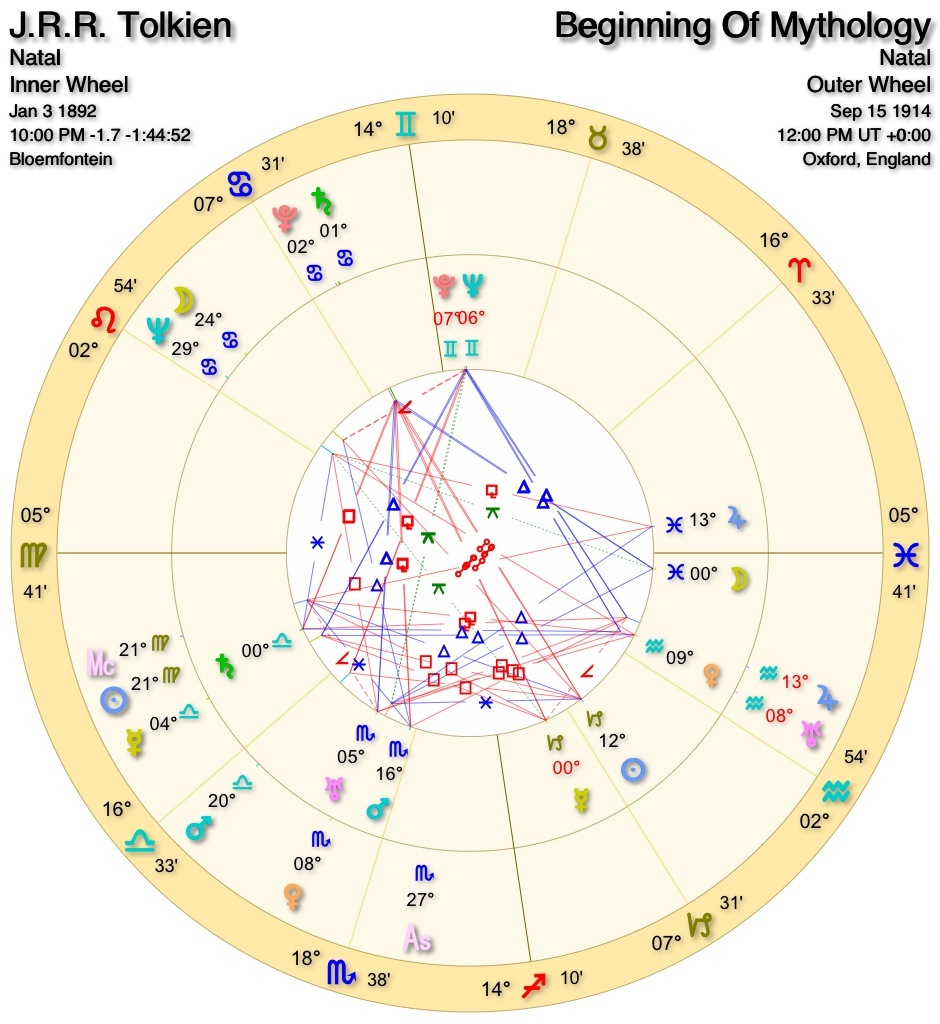
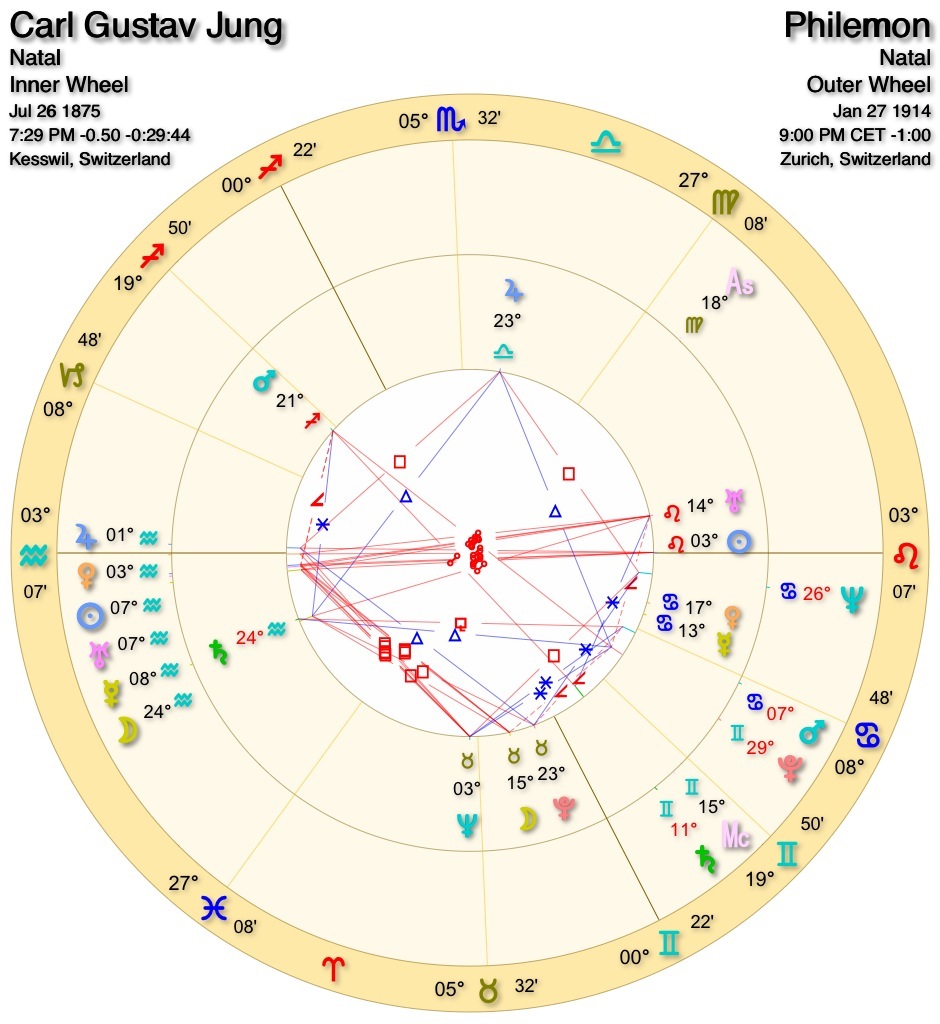
As I have already explored in the essay “The Red Book and the Red Book: Jung, Tolkien, and the Convergence of Images,” C.G. Jung and J.R.R. Tolkien simultaneously underwent profound experiences of the imaginal realm, transformative encounters with the deep psyche that became the prima materia for their lifeworks. While I have previously analyzed the synchronicity of the two Red Books through the parallel images, symbols, and stories brought forward by each of their authors, I have not delved too far into the significance of their synchronic timing. Jung’s and Tolkien’s deep imaginal experiences both began around 1913 and continued until the end of that decade, although the particular vein of creativity set in motion during that time lasted for each of them until the close of the 1920s.

Jung's Red BookThe primary experiences of active imagination for Jung were from 1913 to 1917, but his Red Book period is considered to have lasted until 1930, when he left off inscribing and illustrating his imaginal encounters onto the pages of the Liber Novus. Nearly simultaneously, from 1912 to 1928, Tolkien was illustrating The Book of Ishness, his sketchbook that contained a series of visionary drawings and paintings. The early years of this project were the most abundant, but he continued intermittently to add fantastical images until the end of the 1920s. Meanwhile during the heart of those years, from 1916 to 1925, Tolkien was primarily dedicated to the composition of his mythology, the great cosmogonic cycles that narrate the creation of Arda and the First Age of the world.

Why is the synchronic timing of Jung’s and Tolkien’s imaginal experiences important? Is it simply another coincidence? Or does it intimate some deeper, more profound implication concerning the nature of human existence in the cosmos? One hermeneutic method of unpacking the significance of this timing is archetypal astrology, which reveals the underlying archetypal patterns of the times through the correlated positions of the planets. When two or more planets come into geometrical alignment, the correlated archetypal energies can be seen unfolding multivalently in human and worldly events for the duration of the alignment. When the slower-moving outer planets of Saturn, Uranus, Neptune, and Pluto align with each other, whole epochs of history, lasting years to decades depending on the configuration, reflect the relevant archetypal qualities in myriad ways.

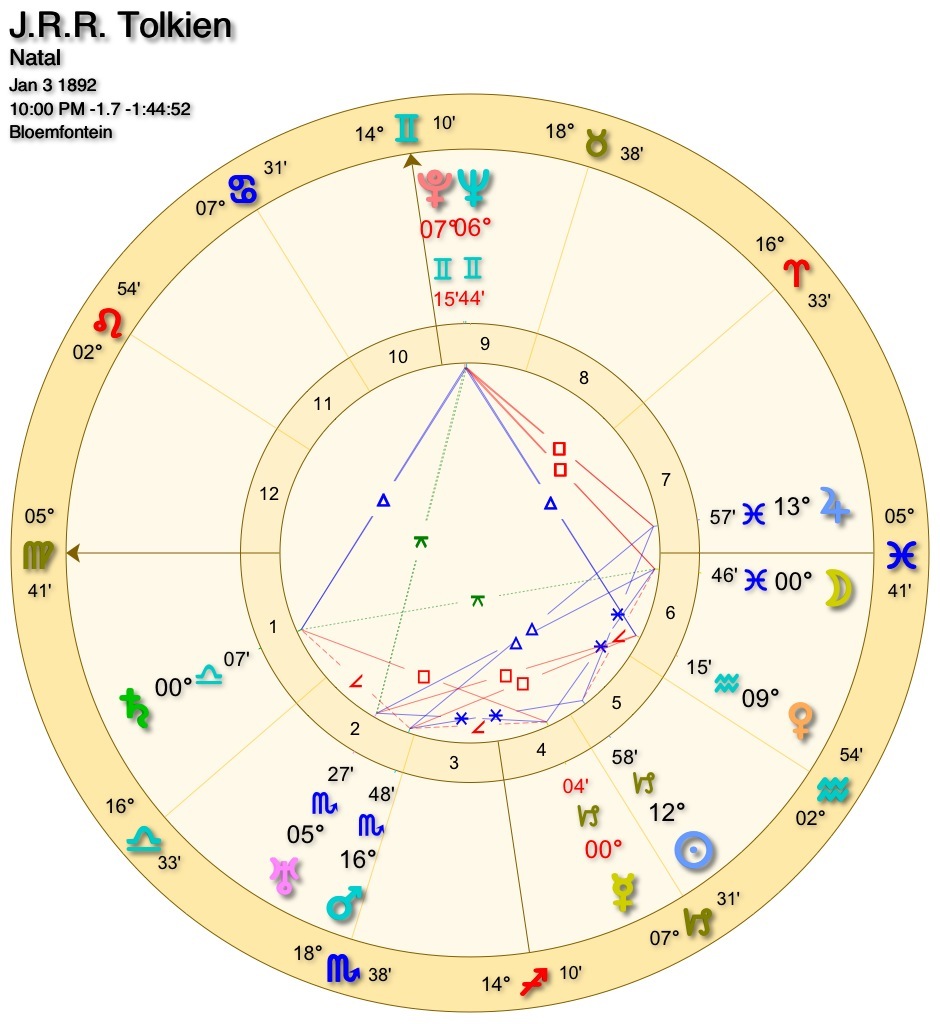
Archetypal astrology provides a lens that can shed new light on our understanding of Jung’s and Tolkien’s experiences during this time period. By looking at the world transits during the years of their imaginal encounters we will be able to see the larger archetypal gestalt in which these experiences were emerging, while touching on Jung’s and Tolkien’s natal charts will illuminate the archetypal patterning of their individual psyches and how this may have further shaped the character of their experiences. Furthermore, we will look at the unfolding personal transits Tolkien and Jung underwent during their Red Book periods, honing in on several significant dates throughout this time, to see how the same world transits interacted with their unique birth charts, indicating differing modes of creative expression for the same archetypal energies.

The planetary alignment that correlates most significantly with Jung’s and Tolkien’s awakening to the imaginal is the opposition of Uranus and Neptune that lasted from 1899 to 1918.[2] The most potent time of both men’s visionary periods took place in the sunset years of this alignment, from 1913 to 1917. In the modern astrological tradition, the archetype of Neptune, as Richard Tarnas writes, “is considered to govern the transcendent dimensions of life, imaginative and spiritual vision, and the realm of the ideal.”[3] Neptune “rules both the positive and negative meanings of enchantment—both poetic vision and wishful fantasy, mysticism and madness, higher realities and delusional unreality.”[4] Furthermore, “the Neptune principle has a special relation to the stream of consciousness and the oceanic depths of the unconscious, to all nonordinary states of consciousness, to the realm of dreams and visions, images and reflections.”[5] In contrast, the planet Uranus, as Tarnas articulates,

is empirically associated with the principle of change, rebellion, freedom, liberation, reform and revolution, and the unexpected breakup of structures; with sudden surprises, revelations and awakenings, lightning-like flashes of insight, the acceleration of thoughts and events; with births and new beginnings of all kinds; and with intellectual brilliance, cultural innovation, technological invention, experiment, creativity, and originality.[6]

When the archetypal natures of these two planets, Uranus and Neptune, come into relationship with each other, personal and world events with increasing frequency tend to reflect their combined energies. Repeatedly throughout the world’s cultural history Uranus-Neptune alignments correlate with

widespread spiritual awakenings, the birth of new religious movements, cultural renaissances, the emergence of new philosophical perspectives, rebirths of idealism, sudden shifts in a culture’s cosmological and metaphysical vision, rapid collective changes in psychological understanding and interior sensibility . . . and epochal shifts in a culture’s artistic imagination.[7]

The first couple of decades of the twentieth century, when the Uranus-Neptune opposition was in effect, was a period of tremendous cultural and artistic innovation and creativity. As Sonu Shamdasani, the editor of The Red Book, writes, “On all sides, individuals were searching for new forms with which to depict the actualities of inner experience, in a quest for spiritual and cultural renewal.”[8] Jung’s and Tolkien’s unexpected awakenings to active imagination and fantasy, and their subsequent outpourings of creative genius, perfectly exemplify the characteristic manifestations of Uranus-Neptune alignments. In Jung’s words, “Our age is seeking a new spring of life. I found one and drank of it and the water tasted good.”[9] His use here of liquid metaphors and symbols—spring, drank, water—are particularly characteristic of the Neptune archetype.

Uranus-Neptune alignments also correlate with “cosmic epiphany” and the “birth of new forms of artistic expression,”[10] which can be seen in the unique artistic format of Jung’s Red Book, and the new languages and mythological composition of Tolkien’s cosmogonic cycles.

If it were possible to briefly summarize the essence of the material that emerged for Jung and Tolkien at this time—an impossible task—one might say that it is an expression of “the quintessential Uranus-Neptune theme of a radical transformation of the God-image and a revolutionary new understanding of the divine will acting in history.”[11] Jung’s Red Book can be seen as a participation in the death and rebirth of God, a renewal of the sacred through an encounter with soul. Similarly, the myths Tolkien began to compose during this same period are a new expression of the creation of the world, a reemergence of God’s creativity in an imaginal realm. As Shamdasani writes, “Jung held that the significance of these fantasies was due to the fact that they stemmed from the mythopoeic imagination which was missing in the present rational age.”[12] Tolkien also would have agreed with this statement as is evidenced in his poem Mythopoeia, of which the following is a fragment:

Though now long estranged,
man is not wholly lost nor wholly changed.
Disgraced he may be, yet is not dethroned,
and keeps the rags of lordship once he owned,
his world-dominion by creative act:
not his to worship the great Artefact,
man, sub-creator, the refracted light
through whom is splintered from a single White
to many hues, and endlessly combined
in living shapes that move from mind to mind.[13]

Although human beings have fallen, in Tolkien’s view, and become estranged from the divine imagination by the emergence of disenchanted rationality, we are still able to become alchemical vessels for that sacred creativity, to refract the light of the mythopoeic imagination into our own fantasies and imaginal encounters.

Figure 1: C.G. Jung’s Birth Chart

During the primary visionary years of Jung’s Red Book period, the previously discussed Uranus-Neptune world transit was crossing his natal Sun-Neptune square (see Figure 1). In an individual’s birth chart, the Sun is an expression of the personal identity, the autonomous self imbued with conscious awareness, the personality and ego identity, the will to be and to exist, as well as what the individual identifies him or herself to be. Jung’s Sun square Neptune can be seen multivalently expressed throughout his life, for example, in his personal exploration of the archetypal realm, his permeability of identity to the imaginal and spiritual, his later understanding of the Self as an archetype, and his lifelong effort to bring individual consciousness and the archetypal unconscious into fruitful relationship.

Figure 2: Jung’s First Red Book Vision

At the time Jung’s imaginal experiences began, the Uranus-Neptune opposition of the early twentieth century was crossing not only his natal Sun-Neptune, but the Ascendant-Descendent axis of his chart, the horizon of his birth moment, initiating both a dissolution and liberation of his identity (see Figure 2). The Uranus-Neptune transit was activating and awakening Jung to the eternal vastness of the archetypal realm, drawing forward encounters with imaginal figures who confronted his personal assumptions about the nature of spiritual reality and the psyche, leading to a descent and dissolution of his Solar egoic identity in an encounter with his soul.

Figure 3: The Beginning of Tolkien’s Mythology

The same Uranus-Neptune opposition was also shaping the archetypal atmosphere of Tolkien’s imaginal encounters, but the transit was crossing a different part of his chart, and thus manifesting in a realm other than his Solar identity. When Tolkien wrote the first words of his Middle-Earth mythology in September 1914 the Uranus-Neptune opposition was crossing his natal Venus, whose corresponding archetype relates to art, beauty, artistic creativity, and aesthetic expression (see Figure 3). Because at this time Uranus and Neptune were widening in their orb, now ten degrees apart, Uranus was tightly conjunct Tolkien’s Venus, while Neptune had yet to come into potently effective orb with his Venus. However, over the next several years, from 1916 to 1922, when Tolkien’s mythology was pouring forth from a seeming wellspring of imaginative creativity, Neptune was in tighter opposition to his natal Venus. That the Uranus-Neptune opposition crossed Tolkien’s Venus, rather than the Sun as it did for Jung, is reflected in his chosen form of expression for the emerging material: Tolkien channeled the stream of imaginal energy into the artistic form of mythopoeic narrative, rather than using the experiences as tools to explore his own psyche and personal identity as Jung did. Interestingly, after 1915 all of Tolkien’s works of art were illustrations for his stories, unlike the earliest visionary drawings in The Book of Ishness which have no explanation for their origins other than their titles. Other powerful forces were coming through for Tolkien in those early years of creativity which we will explore later in this essay, but it seems that only once Uranus and Neptune activated his natal Venus did he find his preferred artistic outlet for the imaginal visions he was receiving.

While the long Uranus-Neptune transit crossing Jung’s Sun and Tolkien’s Venus reflect the larger gestalt of the experiences they were each undergoing, a deeper look at their individual transits will reveal the nuanced differences in their experiences and their individual expressions of those encounters. While the larger arc of this project is to show the uncanny convergence of Jung’s and Tolkien’s explorations of the imaginal realm, the current analysis of their divergence will help to unveil the cosmic underpinnings of their unique creative expressions.

A repeated vision shared in different manifestations by Jung and Tolkien was that of a Flood, or the Great Wave as Tolkien called it. While we know that Tolkien’s Great Wave visions came to him throughout his life beginning in childhood, primarily as dreams, we do not have specific dates for their occurrence. However, Jung’s first Flood vision took place on October 17, 1913 while on a train journey. He saw an immense flood that engulfed all the lands of Europe, destroying civilization and carrying floating rubble and corpses in its wake. The waters then turned to blood.[14] Two weeks later he had the vision again; eventually he would come to recognize it as a premonition of the coming First World War.

Besides the Uranus-Neptune opposition on Jung’s Sun previously discussed, another major world transit was beginning to come into orb at this time: Saturn conjunct Pluto. As Tarnas writes, Saturn-Pluto alignments coincide with

especially challenging historical periods marked by a pervasive quality of intense contraction: eras of international crisis and conflict, empowerment of reactionary forces and totalitarian impulses, organized violence and oppression, all sometimes marked by lasting traumatic effects.[15]

Less than a year after Jung’s Flood vision, World War I broke out in Europe when the Saturn-Pluto conjunction was in almost exact alignment. Yet during the previous autumn of 1913, Jung had been granted a painful premonition of that war as the wide Saturn-Pluto conjunction was in opposition to his natal Mars, the archetype of the warrior, of battle, anger, and violence (see Figure 4). Jung’s vision contained the combined Mars-Saturn-Pluto themes in the images of mass destruction and violent death, and the bloody wave of battle engulfing the continent. Yet the experience was also a precognitive visionary awakening reflective of the Uranus-Neptune alignment previously explored.

Figure 4: Jung’s Flood Vision

The same Saturn-Pluto conjunction that corresponded with Jung’s Flood vision and World War I was also transiting Tolkien’s chart, but in his case it was opposing his natal Mercury. The archetype of Mercury relates to language, speech, thought, writing, the intellect, education, and all forms of communication. Tolkien’s greatest love, it might be argued, was for languages, for their phonetic sound and resonant meaning, their evolutions and transformations, and their histories and lineages. Tolkien was born with his natal Mercury in an exact square to Saturn, which can be seen in his appreciation for ancient languages and literature (he disliked nearly all literature written after Chaucer, instead dedicating himself to medieval epics like Beowulf and the Norse and Icelandic sagas such as the Elder Edda), his meticulous attention to the details of language and expression, his painstaking and repeated revisions of all his manuscripts striving for an unattainable level of perfection, and his habit of what he called “niggling” over the finesses of his invented languages (see Figure 5). As Tolkien’s biographer Humphrey Carpenter writes, “Tolkien had a passion for perfection in written work of any kind, whether it be philology or stories. This grew from his emotional commitment to his work, which did not permit him to treat it in any manner other than the deeply serious.”[16] All this eloquently expresses the Saturn archetype of seriousness, the old and the ancient, precision, strict standards, revision and correction, meticulous attention to details, all in relation to Mercury’s realm of language and writing.

Figure 5: J.R.R. Tolkien’s Natal Chart

Pluto slowly transited Tolkien’s natal Mercury-Saturn from 1909 to 1919, the years which encompassed his education at Oxford in Philology, his deeply painful separation from the love of his life Edith Bratt (who later became his wife), the visionary drawings in The Book of Ishness, the composition of his first Middle-Earth poem The Voyage of Earendel, his fighting in World War I including in the Battle of the Somme, the deaths of two of his closest friends, and the earliest compositions of The Silmarillion stories including the cosmogonic myth called the Ainulindalë. As Saturn conjoined Pluto in the sky leading up to World War I, the powerful transformational energies associated with Pluto that had already been working on Tolkien’s mind found a Saturnian form and structure in his invention of languages and the creation of myths to accompany them. If anything truly sets Tolkien apart in the realm of fiction authors it is that he developed multiple, fully-fledged imaginal languages with their own syntax and etymology, languages that feel ancient and powerful in tone and character, with grammatical structures that trace their linguistic evolution through time—all Mercury-Saturn-Pluto themes. During these years it was as though his linguistic capabilities had been opened to the evolutionary stream of language itself, and he was able to participate in the generation and rebirth of new linguistic structures.

Interestingly, coming out of the ten-year transit of Pluto across Tolkien’s Mercury, Pluto then began to oppose Tolkien’s natal Sun, a transit that lasted until the end of the 1920s as he continued to compose the cycles of the First Age of Middle-Earth. Thus, the nearly twenty-year transit of Pluto across his wide Sun-Mercury conjunction entirely encompassed the years Tolkien was writing the myths of The Silmarillion. This was the time period when Tolkien was having the powerful visionary experiences that became the prima materia of his later, more refined works: The Red Book of Westmarch, known better as The Hobbit and The Lord of the Rings.

To return to that pivotal moment in the late summer of 1914, when Saturn was conjunct Pluto and the destructive wave of the First World War had been unleashed across the continent of Europe, another potent transit was in the sky, also activating significant aspects of both Tolkien’s and Jung’s charts. At that time the planet Jupiter had come into the Uranus-Neptune alignment, making a conjunction with Uranus that lasted from December 1913 to January 1915. Archetypally, Jupiter is associated with “the principle of expansion and magnitude, providence and plenitude, liberality, elevation and ascendency, and with the tendency to experience growth and progress, success, honor, good fortune, abundance, aggrandizement, prodigality, excess and inflation.”[17] In time periods when Jupiter was aligned with Uranus, as Tarnas writes, “An expansively and buoyantly energizing quality characterized such eras, one that often engendered a certain creative brilliance and the excitement of experiencing suddenly expanded horizons.”[18] As we examined earlier, at this time Uranus was opposing Jung’s Sun, while it was conjoining Tolkien’s Venus. Thus, when Jupiter entered the configuration the expansive, elevating, liberating, breakthrough qualities associated with the Jupiter-Uranus combination could be seen in the profound shift that took place for each of these men during this fourteen-month period.

Under the Jupiter-Uranus conjunction transiting his Venus (see Figure 6), Tolkien encountered the names Earendel and Middle-Earth in the lines of an old Anglo-Saxon poem, both of which played profoundly prominent roles in his mythology. After this discovery, Tolkien composed on September 24, 1914 the poem The Voyage of Earendel the Evening Star, now recognized as the first written work in the Middle-Earth legendarium. Truly it was a breakthrough moment, as Tolkien was finding expression for the images and languages that had been coming to him for the last few years. After this point he began to write more stories about Middle-Earth and the peoples that inhabited this land, the Eldar, the many races of Elvenfolk living in the imaginal realm.

Earendel Poem
Figure 6: Tolkien’s Earendel Poem

Coinciding with this same Jupiter-Uranus alignment, Jung’s Red Book visions were taking a profound turn. A new figure had entered into his imaginal experiences, a wise guide and teacher, one who instructed Jung in a caring, loving, and spiritually illuminating way. This figure was Philemon, the ancient alchemical wisdom-keeper who became Jung’s mentor in the realm of Soul. In Shamdasani’s words, “To Jung, Philemon represented superior insight, and was like a guru to him.”[19] On the day that Philemon was first recorded appearing, January 27, 1914, a remarkable configuration of planets was in the sky. Not only was Jupiter conjunct Uranus in opposition to Neptune as previously discussed, but the Sun, Moon, Mercury, and Venus were also conjoining the longer Jupiter-Uranus conjunction (see Figure 7). This rare and powerful configuration was all crossing Jung’s natal Sun. Not only did this event occur at the new moon, when the Moon conjoins the Sun in a coniunctio of yin and yang energies, but the emergence of Philemon brought into Jung’s psyche a Solar figure representative of his higher self, or Self, whose teachings brought tremendous new insight and awakening, communicated with love, compassion, and wisdom. The transits on this day could be seen as the birth chart of Philemon, which itself would be a fruitful topic to explore in depth.

Figure 7: Jung’s First Encounter with Philemon

Finally, to conclude this brief archetypal study, I would like to look at one major aspect that both Jung and Tolkien carried throughout their lives, that can be seen not only reflected in their Red Book periods, but in the entirety of their lifeworks. This is the conjunction of Neptune and Pluto, which occurs when the long cycles of the two outermost planetary bodies align, a meeting that takes place approximately every five hundred years and lasts for about 25-30 years each time. Neptune-Pluto alignments have occurred at the rise and fall of civilizational epochs, the most pivotal moments in history when the entire paradigm of a culture dies and is reborn from the ashes, whether it is the fall of the Roman Empire and the beginning of the Middle Ages, the dawn of the Renaissance, or the turn of the 20th century. As Tarnas writes,

the major Neptune-Pluto cyclical alignments appear to have coincided with especially profound transformations of cultural vision and the collective experience of reality, which often took place deep below the surface of the collective consciousness. [20]

The most recent Neptune-Pluto conjunction took place from 1880 to 1905, and Jung was born on the cusp of the transit in 1875. Jung lived the first thirty years of his life in Neptune-Pluto’s culturally transformative gestalt, while Tolkien was born in 1892 with the conjunction within 1° orb (see Figures 1 and 5). While a full study could be given to the ways just this single alignment is apparent in both Jung’s and Tolkien’s entire oeuvre, I want to particularly attend to how two specific themes of this most recent Neptune-Pluto conjunction came through Jung and Tolkien: these manifestations are, as Tarnas describes them, “the dying of the gods that had ruled the Western spirit for two millennia and more” and the simultaneous “powerful upsurge of ‘the unconscious’ in many senses.”[21] The profound and transformative encounters with the deep psyche and imaginal realm that both Jung and Tolkien experienced in their lifetimes are highly reflective of the Neptune-Pluto conjunction they each carry. They both had an encounter of overwhelming potency with the collective unconscious by passing through the underworld gateway of imagination. The powerful visions of the Flood that initiated Jung’s descent, and Great Wave dreams that haunted Tolkien, are also clear expressions of Neptune-Pluto: consciousness being violently “flooded” by the unconscious with overwhelming images of decimating waters that destroy and subsume all in their path. Furthermore, the death and rebirth of God in Jung’s Red Book, and the rebirth of Creation and the fall from grace in Tolkien’s cosmogony are but a taste of the ways Neptune-Pluto manifested in their life works. In a time of disenchanted rational modernity these two men seem to have been chosen as alchemical vessels for a deep, cosmic truth to be reborn. As Jung wrote in the pages of The Red Book, “To give birth to the ancient in a new time is creation. . . . The task is to give birth to the old in a new time.”[22] This is the karmic task both Jung and Tolkien carried in their own ways, to encounter the gods in the archetypal realm, and to express their living truths on the pages of imagination.

Bibliography

Carpenter, Humphrey. J.R.R. Tolkien: A Biography. New York, NY: Houghton Mifflin Company, 2000.

Hammond, Wayne G. and Christina Scull. J.R.R. Tolkien: Artist & Illustrator. New York, NY: Houghton Mifflin Company, 2000.

Jung, C.G. Memories, Dreams, Reflections. Edited by Aniela Jaffé. Translated by Richard and Clara Winston. New York, NY: Vintage Books, 1989.

–––––. The Red Book: Liber Novus. Edited by Sonu Shamdasani. Translated by Mark Kyburz, John Peck, and Sonu Shamdasani. New York, NY: W.W. Norton & Company, 2009.

Owens, Lance. “Lecture I: The Discovery of Faërie.” In J.R.R. Tolkien: An Imaginative Life. Salt Lake City, UT: Westminster College, 2009. http://gnosis.org/tolkien/lecture1/index.html.

–––––. “Tolkien, Jung, and the Imagination.” Interview with Miguel Conner. AeonBytes Gnostic Radio, April 2011. http://gnosis.org/audio/Tolkien-Interview-with-Owens.mp3.

Tarnas, Richard. Cosmos and Psyche: Intimations of a New World View. New York, NY: Viking Penguin, 2006.

Tolkien, J.R.R. “Mythopoeia.” In Tree and Leaf, New York, NY: Houghton Mifflin, 1988.

–––––. The Letters of J.R.R. Tolkien. Edited by Humphrey Carpenter, with Christopher Tolkien. New York, NY: Houghton Mifflin Company, 2000.

–––––. The Lord of the Rings. New York, NY: Houghton Mifflin Company, 1994.

–––––. “On Fairy-Stories.” In The Monsters and the Critics. Edited by Christopher Tolkien. London, England: HarperCollins Publishers, 2006.

–––––. The Silmarillion. New York, NY: Houghton Mifflin Company, 2001.

[1] C.G. Jung, The Red Book: Liber Novus, ed. Sonu Shamdasani, trans. Mark Kyburz, et al. (New York, NY: W.W. Norton & Company, 2009), 239.

[2] Richard Tarnas, Cosmos and Psyche: Intimations of a New World View (New York, NY: Viking Penguin, 2006), 365.

[3] Tarnas, Cosmos and Psyche, 355.

[4] Ibid.

[5] Ibid.

[6] Tarnas, Cosmos and Psyche, 93.

[7] Ibid, 356.

[8] Sonu Shamdasani, “Introduction,” in Jung, The Red Book, 194.

[9] Jung, The Red Book, 210.

[10] Tarnas, Cosmos and Psyche, 412.

[11] Ibid, 411.

[12] Shamdasani, “Introduction,” in Jung, The Red Book, 208.

[13] J.R.R. Tolkien, “Mythopoeia,” in Tree and Leaf (New York, NY: Houghton Mifflin, 1988).

[14] Jung, Memories, Dreams, Reflections, ed. Aniela Jaffé, trans. Richard and Clara Winston (New York, NY: Vintage Books, 1989), 175.

[15] Tarnas, Cosmos and Psyche, 209.

[16] Humphrey Carpenter, J.R.R. Tolkien: A Biography (New York, NY: Houghton Mifflin Company, 2000), 142.

[17] Tarnas, Cosmos and Psyche, 294.

[18] Ibid.

[19] Shamdasani, “Introduction,” in Jung, The Red Book, 201.

[20] Tarnas, Cosmos and Psyche, 417.

[21] Tarnas, Cosmos and Psyche, 418.

[22] C.G. Jung, The Red Book: Liber Novus, ed. Sonu Shamdasani, trans. Mark Kyburz, et al. (New York, NY: W.W. Norton & Company, 2009), 311.

A Review of “Planet Narnia”: Finding the Hidden Gods

Many critics have said that C.S. Lewis’s Chronicles of Narnia seem to possess “little apparent coherence in design,” no clear continuity of tone or characters, or even consistent level of Christian allegory. Yet somehow these seven stories, penned “by an unlikely novice,” have gone on to “become some of the best-selling and most influential fables in the world.”[1] In a book that started out as his doctoral dissertation, Michael Ward lays out what he believes is the underlying scheme present in The Chronicles: each of the seven short novels is an homage to one of the seven planets of the ancient cosmos, expressed through the atmosphere and tone of each book. Not only does this provide an account for the great variations between each of the stories, it also offers a much greater depth of insight to The Chronicles as a whole, and also to the author who dreamt them into being.

Planet NarniaUpon completing this book, I was entirely convinced by Ward’s argument, and as someone who seeks to keep my own archetypal eye open to the astrological manifestations in our world, I could clearly see how each of Lewis’s books expressed the planetary aura in a subtle and implicit way. As Ward writes, this aura or atmosphere must “remain hidden, woven into the warp and woof of the story so that it comprises not an object for Contemplation but the whole field of vision within which the story is experienced.”[2] Ward’s methods for understanding the characteristics of each planet, as far as I could tell, were based entirely upon Lewis’s own expression of the planetary qualities in his other works, from his literary scholarship, to his Ransom Trilogy comprised of Out of the Silent Planet, Perelandra, and That Hideous Strength, to his poetry—particularly the poem entitled “The Planets,” which Ward was reading when the insight came to him about the underlying theme of The Chronicles. Ward did not draw on medieval sources of astrology, nor any contemporary works. Thus Ward’s depiction of the planetary archetypes was entirely through Lewis’s own perspective on them, which led to some interesting archetypal combinations that I will explore forthwith. Not only do each of The Chronicles of Narnia appear to subtly correlate to each of the ancient planets, as Lewis understood them from his breadth of knowledge about Medieval and Renaissance literature, but the expression of those planets is characterized by how they are each aspected in Lewis’s birth chart, which includes the archetypes of the three outer planets, Uranus, Neptune, and Pluto.

C.S. Lewis’s Birth Chart

The planetary correspondence to each novel (in the order Lewis wrote them) Ward has identified as follows:

The Lion, the Witch, and the Wardrobe ­– Jupiter
Prince Caspian – Mars
The Voyage of the Dawn Treader – Sun
The Silver Chair – Moon
The Horse and His Boy – Mercury
The Magician’s Nephew – Venus
The Last Battle – Saturn

Painting by Jeremiah Briggs

The first book, The Lion, the Witch, and the Wardrobe, expresses the Jupiterian archetype through its Jovial turn from winter to summer, the kingliness of the divine lion Aslan, the crowning of the four children and their peaceful rulership of Narnia, and many other subtle expressions that Ward points out. Lewis particularly favored the planet Jupiter, and it is interesting to note that while he is not born with Sun-Jupiter, as one might expect from his feeling of its centrality to his personality, he does have five planets in Sagittarius (six if including Chiron) which is the zodiac sign ruled by Jupiter. But another aspect that is interesting to note is that Lewis is born with Jupiter square Mars, and the theme of triumphant and victorious battle plays a major role in The Lion, the Witch, and the Wardrobe. Furthermore, Lewis is also born with Jupiter trine Neptune, which can be seen not only in the explicit religious and spiritual themes expressed in the novel, particularly in the self-sacrifice and resurrection of Aslan, but also in his choice of re-telling the Gospel story in the form of a fantasy novel. The story concludes by the shores of Narnia, by the great ocean ruled by Neptune, a symbol of the eternal realm. As Ward writes,

[Lewis] tells us that the waves break “for ever and ever,” as if they belong to an eternal realm; and this is indeed what he is wanting to evoke, what the whole book has been intended to evoke: a glimpse of supernatural reality, a window onto an aspect of the divine nature.[3]

We see Lewis’s Jupiter-Neptune expressed here in the depiction of an eternal realm, the supernatural reality, and the divine nature, all within the Jupiterian context of the novel that Ward has already laid forth.

Interestingly, in the summer of 1948 when Lewis began to write The Lion, the Witch, and the Wardrobe, he happened to be undergoing a long transit of Jupiter conjoining his natal Mercury—perfect for writing a novel with a strong Jupiterian theme.

Painting by Ludek Pesek

The second book written in the series, Prince Caspian, is an expression of the planet Mars, run through with martial themes of war and violence. The entire story centers on the War of Deliverance that liberates Narnia from the tyrannical rule of the usurper King Miraz, with the Old Narnians and Prince Caspian aided by the four Pevensie children who first appeared in The Lion, the Witch, and the Wardrobe. Yet many of the themes Ward draws forward that illustrate the Martian atmosphere of the story actually have a more complex Mars-Saturn quality: discipline and obedience in the chain of military command, the necessity of war, steadfast strength in battle, the integrity of the true warrior. And it naturally follows to mention that C.S. Lewis is born with Mars trine Saturn in his natal chart. As Ward concludes the chapter on Mars he writes the primary themes present in Prince Caspian: “Discipline—obedience—faithfulness—strength—growth.”[4] All of these qualities are manifestations of the planetary archetype of Saturn, but they are expressed through the Martian realm of the warrior in battle as portrayed in Prince Caspian. Thus, while the book is indeed an homage to Mars, it is Mars as seen through Lewis’s own Mars-Saturn complex.

SunThe Voyage of the Dawn Treader is clearly an expression of the Solar journey, as the heroes embark upon a sea voyage into the utter East, the land of the rising Sun. However, while much of the imagery in the tale is actually Neptunian—the atmosphere of the eternal ocean, the spiritual quest—many of the episodes within the story are Plutonic, which resonates with Lewis’s natal Sun-Pluto opposition (he does also have a very wide Sun-Neptune opposition). Much of the Solar imagery is alchemical, focusing on the transmutational and transformative power of the Solar gold. Ward writes about the “connection in [Lewis’s] imagination between Solar influence (improperly received) and the will to power;”[5] the will to power is a clear manifestation of Pluto. Much of the story is about the transformation of one’s personal greed, ambition, and desire for power, all qualities associated with Pluto, into service for a higher good. Furthermore, a central piece of the story is Eustace’s journey of being turned into a dragon—an expression of the Plutonic underworld demon—and being transformed into a better person for the experience. The Solar ego with which Eustace enters the story constellates the Plutonic dragon energy within himself, transforming his very being into a monster, and when he is reborn from the discarded scales of the dragon, like a snake shedding its skin, he is reborn as a new Solar hero, humble and able to be in service to the whole.

Painting by Oscar Nilsson

The Moon is the underlying theme of The Silver Chair, yet much of the imagery present in the story has little in common with an archetypal understanding of the Moon as an expression of emotion, feeling, caretaking, relationality, family, and nourishment. Indeed, the story is far more expressive of the two planets Lewis has in conjunction with the Moon: Neptune and Pluto. The story is darker than the previous three, and much of it is set in a dangerous land inhabited by vicious giants, and in Underland, the underworld realm of the witch reborn. The Neptunian theme is also carried throughout in the form of water and wetness, from rain and fog, to marshes, tears, and an underground lake. Prince Rilian, who the heroes are attempting to rescue, is under an evil (Pluto) enchantment (Neptune) cast by the vile (Pluto) sorcery (Neptune) of the witch-queen, who transforms (Pluto) into a giant, terrifying serpent (Pluto) through her magical (Neptune) powers (Pluto). Most of the Lunar imagery is distorted through the Plutonic lens with which Lewis perceived it, and Ward spends much of the chapter on The Silver Chair defining the Moon by its relational submission to the Sun—a repression of the Lunar that is not only evident in Lewis’s chart but in the patriarchal culture that shaped his views, a culture that has elevated the Solar at the expense of the denied and relegated Lunar. Interestingly, one way in which the Lunar is able to shine through in this story is when the young girl Jill asks if she may return home at the end of the narrative, the only character to make such a request in the entirety of the Narniad. Lewis’s own struggle integrating the Lunar archetype in his life is clearly present in its expression in The Silver Chair.

MercuryMercury, particularly in the form of Gemini (which is ruled by Mercury), is the god present in The Horse and His Boy. Ward shows this clearly in the multiplicity of twin imagery, and that the whole story orients around the delivering of a vital message. Yet Ward also points out that the ongoing patterning of the story is about two merging into one, whether it is the separated twins reconnecting, or the mistaken belief that the main characters were being chased by two lions when really it was but one. This theme of merging within the Mercurial context can be seen in Lewis’s natal Mercury-Neptune opposition, as Neptune has the capacity to dissolve boundaries and to unite all things into oneness. Furthermore, the Mercury-Neptune theme can be seen in Shasta’s encounter with Aslan, who is named simply “the Voice” in the text—a clear expression of Mercury within the divine Neptunian context.

The Magician’s Nephew, now placed as first in the series but published sixth, is an expression of Venus, but in a way complexified by the many aspects Lewis has to Venus in his natal chart, and the ways those aspects manifested in his life. Two of the major themes in the story are the near-fatal illness of the main character’s mother, and the birth of a new world, Narnia itself, sung into being by Aslan. Lewis is born with a Venus-Saturn conjunction and lost the first primary love relationship of his life at a young age, for his mother died when he was but nine years old. The shadow of this lost love is present throughout the story, as the character Diggory hopes to find some way of curing his mother’s illness. On the other hand, the creation of an entirely new world, sung into existence by the musical artistry of Aslan, is a reflection of Lewis’s natal Venus-Uranus conjunction, with the generative creativity of Uranus birthing through song (Venus) a verdant and vibrant world ringing with “newness” and “vitality.”[6] Sweetness also plays a role, whether in the sweet taste of the healing apple Diggory brings to his mother, or the “sweet natural sleep”[7] she enters into after eating it—a reflection of Lewis’s Venus-Moon opposition. This aspect is also present in Lewis’s seeming conflation of the Venusian and Lunar archetypes, describing Venus as motherly, fecund, fertile, and nourishing—qualities usually attributable to the Moon. (Because we do not know Lewis’s exact birth time, his Moon may be in tighter opposition to both Venus and Saturn if he was born earlier in the day—this would correlate to the death of his mother at an early age, a clear expression of the Moon-Saturn combination.)

VenusYet the Venusian imagery is complexified further in the character of Jadis, the beautiful yet terrible queen of the dying world of Charn, a world destroyed by her own hand, who becomes the first evil present in Narnia. Jadis is the witch we meet later in The Lion, the Witch, and the Wardrobe. Here one can witness Lewis’s Venus-Pluto opposition in the evil and destructive power (Pluto) of this beautiful queen (Venus).

Ward brings up an issue in this chapter that shows the clear influence of patriarchy on Lewis’s creative imagination. Each story expresses the planetary archetype most clearly through the character of Aslan, so Ward asks why in The Magician’s Nephew, as an homage to Venus, Aslan is not portrayed as female. He is taking the gendered imagery of the planets as gods and goddesses in the Hellenic pantheon quite literally in this question, ignoring the fact that the archetypes all express themselves in male and female form through each one of us. Ward writes, “Lewis was of the belief that major imaginative difficulties arose when one attempted to depict God in feminine terms.”[8] Besides the inherent sexism in this statement, an interesting point is being addressed: when the Divine is depicted as feminine, or as both masculine and feminine, the imaginative implications ripple through all levels of reality. Ward quotes Lewis as saying, “a child who had been taught to pray to a Mother in Heaven would have a religious life radically different from that of a Christian child.”[9] I actually agree with this statement, but not in the way that Lewis meant it. What a different world we might live in if the feminine aspect of the Divine had been given equal devotion as the male, or if the female, male, and non-gendered aspects of each planetary archetype were given equal recognition. Ward concludes by saying that the feminine aspect of Venus is still expressed through Aslan, but not by changing the lion’s gender.

. . . Aslan is feminized, but not to the complete expulsion of the masculine. And this is a fair representation of Venus, for Venus may be properly understood as containing a masculine element alongside her feminine ones.[10]

If only Lewis, and Ward, could have seen the way each archetype contains feminine and masculine elements, as they both recognized in relation to Venus.

SaturnThe Narniad concludes with The Last Battle, a tragic homage to the final planet of the ancient cosmos, Saturn. Lewis’s natal Saturn-Pluto opposition is deeply apparent in his depiction of Saturn’s domain. Ward writes that for Lewis “evil was perceived as a merciless power in his younger days; as weakness, sorrow, and death in his later years.”[11] The Last Battle is indeed tragic and filled with death (Saturn) and the destructive (Pluto) ending (Saturn) of the Narnian world. “Under the planet who is responsible for ‘fatal accidents,’” Ward writes, “everyone who is alive at the beginning of this story is dead by the end of it.”[12] Yet Lewis, and also Ward, seem unable to recognize the gifts and nobility of the Saturnian archetype, desiring rather to return to the Jupiterian themes that began The Chronicles of Narnia. This depiction of only the negative side of Saturn is also a reflection of how Saturn was understood by Medieval and Renaissance sources, which naturally shaped Lewis’s understanding of the archetype. The ending of The Last Battle begins to shift toward images of spring and rebirth, an awakening into a radically different world—the true Narnia where all the characters from previous ages are reborn and living in peace. Ward sees this as Saturn deferring to Jupiter, writing “the spirit of the sixth sphere [Jupiter] is also the spirit which dominates the universe beyond the seventh [Saturn].”[13] He goes on to say later in the chapter, “Indeed, it is only by virtue of his deferral to Jove that Saturn can exert his true influence, making his patients into contemplatives who see beyond sorrow.”[14] I would argue rather that this is not Saturn deferring to Jupiter, but rather Saturn being seen all the way through in the entirety of its archetypal spectrum, moving from sorrow and death to the contemplative wisdom granted by sitting with the inherent grief of such challenges and obstacles. Saturn’s medicine can be found still within the seventh sphere, without having to turn elsewhere for its gifts.

Although The Chronicles of Narnia, from Ward’s perspective, are an expression of the ancient Ptolemaic cosmos, the archetypes of the three outer planets are still present implicitly throughout the series. This is most apparent at the end of The Last Battle when there are clear intimations that there is a world beyond the threshold of Saturn. Ward writes, “Sorrow comes, but it is not total, not ‘full,’ there is something ‘beyond;’ Saturn does not have the last word.”[15] Indeed, Saturn does not have the last word, but not because there is a deferral to Jupiter; rather the threshold is at last crossed and we are able to enter the transpersonal realm of Uranus, Neptune, and Pluto. These three archetypes are all present and interwoven in the final pages of The Last Battle, as all of the characters enter into a radically new world, a true paradigm shift (Uranus) in a transcendent, heavenly, ideal realm (Neptune), because each character, indeed all of Narnia, has gone through a powerful cycle of death and rebirth (Pluto).

To conclude, I would want to both critique and compliment Ward for the insight of the project he undertook, searching for a hidden underlying theme that unifies the entirety of Lewis’s Chronicles of Narnia. As I have hopefully made clear here, I feel he has really hit the mark with his analysis, perceiving the archetypal qualities of the ancient planets as expressed by each of the seven tales—although those archetypal qualities are complexified by their expression through the lens of Lewis’s own natal chart aspects. Yet my critique of Ward’s book is of the way in which he expressed his profound insight. For he opens the book by stating his assurance that the planetary theme was one clearly devised by Lewis but intentionally kept secret for the rest of his life. Before laying out any of his evidence Ward writes, “I believe that I also have discovered a genuine literary secret, one that has lain open to view since the Chronicles were first published, but that, remarkably, no-one has previously perceived.”[16] His self-assurance, which echoes throughout the book, actually has the opposite effect upon the reader, casting into doubt his argument before the evidence has even been presented. Ward asserts again and again that the theme was intentionally created by Lewis and then kept as a guarded secret for decades. While it is clear from the evidence that The Chronicles do indeed express the planetary archetypes, I feel that the evidence would have stood more confidently on its own, without the investigations into Lewis’s reasons for keeping the theme a deeply hidden secret. The secrecy may indeed be so, but the pure literary evidence Ward puts forth actually speaks louder than his arguments—and there is a humility in the simple expression of the evidence when not overlaid by assertions of correct discovery. But perhaps that is my own stylistic preference.

As can be seen in the above analysis, even if Lewis consciously chose to offer each one of The Chronicles to the altar of its own planetary god, the other gods are still intermingled throughout the novels. For even when we try to contain the gods in their archetypal purity, our own biased lenses, influenced by our particular birth charts, will naturally shape how the gods choose to express themselves. As was carved above the doorway of C.G. Jung’s home: “Vocatus atque non vocatus deus aderit.” Called or not called, the god is present.

Work Cited

Ward, Michael. Planet Narnia: The Seven Heavens in the Imagination of C.S. Lewis. New York, NY: Oxford University Press, 2008.

[1] Michael Ward, Planet Narnia: The Seven Heavens in the Imagination of C.S. Lewis (New York, NY: Oxford University Press, 2008), 4.

[2] Ward, Planet Narnia, 18.

[3] Ward, Planet Narnia, 76.

[4] Ward, Planet Narnia, 99.

[5] Ward, Planet Narnia, 107.

[6] Ward, Planet Narnia, 181.

[7] Ibid, 183.

[8] Ward, Planet Narnia, 183.

[9] C.S. Lewis, qtd. in Ward, Planet Narnia, 184.

[10] Ward, Planet Narnia, 185.

[11] Ward, Planet Narnia, 192.

[12] Ibid, 201.

[13] Ibid, 207.

[14] Ibid, 211.

[15] Ward, Planet Narnia, 197.

[16] Ibid, 5.

The Beating Heart of Poetry: The Elegant Simplicity of “Poetic Diction”

Owen Barfield’s Poetic Diction—first published during his Saturn return—lays forth, in simple yet elegant terms, an argument for the evolution of consciousness. By tracing the differentiating meaning of words through the history of poetry, he reveals the participatory relationship of humanity with the cosmos. Barfield argues against the mainstream perspective held by philologists of his time that the origins of the words for abstract concepts find their roots in metaphors for concrete objects. Most philologists assumed words gained meaning by the use of intentional metaphors: for example, the contemporary word spirit has its roots in the ancient word for wind, therefore the assumption was that an ancient poet once decided to draw a metaphor between the blowing gusts of wind and the principle for life animating living beings.

Poetic DictionBarfield posits an alternative theory. From his understanding, these primal words are not metaphorical but rather contain within them the full meaning—the spectrum of spirit and wind and all between—in a single utterance. He writes that “these poetic, and apparently ‘metaphorical’ values were latent in meaning from the beginning.”[1] Only over time, and through a changing of consciousness in human beings, is the “undivided meaning”[2] of words split apart, so that now wind refers to a material reality and spirit to an abstract thought. Barfield argues that it is not the case that “the earliest words in use were ‘the names of sensible, material objects’ and nothing more.”[3] Rather, one “must suppose the ‘sensible objects’ themselves to have been something more; you must suppose they were not, as they appear to be at present, isolated, or detached, from thinking and feeling.”[4] Language, in Barfield’s view, reveals the ensoulment of the cosmos once perceptible to ancient human consciousness, a quality revealed through true metaphor. A true metaphor was once a single ancient word, a unified meaning expressed not only in human language but in the language of the world.

Barfield’s thesis holds profound implications for a question often asked of astrologers: how was it that the ancients knew what names to give the planets so that their corresponding mythic figures expressed the same archetypal characteristics that are still carried in the astrological manifestations apparent today? How was the planet Venus aptly named after the Goddess of Beauty, or Mercury after the Messenger of the Gods, when Venus in the birth chart relates to love, beauty, romance, and artistic expression, and Mercury relates to communication, thought, speech, intellect, writing, and learning? The question is being asked with the same modern mindset as the philologists who assumed that consciousness has remained the same throughout time, and that humanity has only come to understand the world better through the acquisition of knowledge. Rather, as Barfield articulates, to ancient consciousness a physical object was inherently imbued with resonant, ensouled presence. This is the ‘undivided meaning’ of which Barfield speaks, the metaphor that exists latently in the word before a later consciousness has split it asunder. Our contemporary language cannot fully capture this ‘undivided meaning’ even as I try to describe it, because in the language I am using psyche and physis long ago diverged from one another.

The consciousness that in modernity wiped away the horizon of meaning, to paraphrase Nietzsche, cannot perceive in the world the unity of archetype and object, universal and particular. They are fundamentally split, finally to the point of unrelatedness. Yet, reawakening within an archetypal cosmos, the unity of archetype and manifestation is once again apparent, but from the other side of a long history of differentiation. The undivided meaning of words has splintered again and again—the white light has passed through the prism to be refracted into a myriad of colors—and the consciousness living in a reenchanted, archetypally patterned world view can witness both the differentiation and unity at once. The language of the archetypes hearkens back to a time when the world reverberated with unified, ensouled, embodied meaning. Yet now it is possible, through conscious participation, to once again hear the song of the spheres. But instead of the cosmos simply singing to us as our ancestors once experienced it, we are able to read the score and, along with the cosmos, play its song back in harmony. Through his passion Barfield lets his readers feel the “beating heart of poetry”[5] as it once lived, and to recognize that its poetic rhythm is the beating heart of the cosmos itself.

Work Cited

Barfield, Owen. Poetic Diction: A Study in Meaning. Oxford, England: Barfield Press, 2010.

[1] Owen Barfield, Poetic Diction: A Study in Meaning (Oxford, England: Barfield Press, 2010), 77.

[2] Barfield, Poetic Diction, 71.

[3] Barfield, Poetic Diction, 77.

[4] Ibid, 78.

[5] Barfield, Poetic Diction, 123.

Is “Just Water” Just About Water?

“There are many types of wilderness, literal and figurative; there are many types of thirst, material and spiritual. But there is only one water molecule that sustains life in conditions of aridity; its presence or absence shapes human lives.”
– Christiana Peppard[1]

Not until my final day of reading this book did a friend point out to me the dual meaning of the title of Christiana Peppard’s short book Just Water. While it sounds as though Peppard may be indicating that the book is explicitly focused on water, the subtitle, Theology, Ethics, and the Global Water Crisis, indicate that the book is about much more, and that the “just” in the title is additionally pointing towards the justice issues bound up within the fresh water crises plaguing the planet. Just Water is about the justice of water, and Peppard is addressing the water crisis from the angle that access to fresh water is a right-to-life issue, particularly as defined by the Catholic Church. Just WaterFirst of all, I was struck by the astrological correlation in the world transits that took place over the roughly two week period when I was reading this book along with my classmates in the course Ecology in a Time of Planetary Crisis. Over this period of time the Sun has been in a conjunction with the planet Neptune, and the archetype of the Sun in world transits sheds light, and brings focus and clarity upon whatever it touches, which in this case is the Neptunian realm of water, spirituality, religion, and ethics. Furthermore, the Sun-Neptune conjunction is square to Saturn, which archetypally relates to crisis, conflict, shortage, pollution, and justice. Saturn-Neptune, which first came into orb about a year ago and will be in the sky for nearly three more years, can manifest in world events as drought, water shortage, contamination and toxicity, and conflicts over water rights, among many other multivalent expressions. To be reading Just Water when the Sun was aligned with this transit felt particularly significant. As for the content of the book itself, I found myself having mixed feelings about how the material was presented. The chapters relating directly to the global water crisis—or crises as Peppard points out, since the issues with water are diverse and differentiated based on local context—were extremely engaging, important to take in, and indeed quite frightening. The second chapter especially, titled “A Primer on the Global Fresh Water Crisis” laid out many of the hard facts of how human beings are using and wasting water, mining “fossil water” from aquifers that will never be replenished on a human timescale, and capitalizing on water packaged in disposable plastic bottles sold to those in first world countries who have easy access to clean tap water, while millions around the world do not have a guaranteed source of clean, fresh water. The global water crisis is afflicting those who are not causing it to a highly disproportionate degree, while those who are responsible are largely sheltered from the effects. The parts of the book with which I struggled most were when Peppard drew on the teaching of the Catholic Church, particularly Catholic Social Teaching (CST), as an ethical resource for how to address the water crises. While I felt she had a legitimate argument for drawing on CST, at the same time the chapters relating to the Church felt disjointed and at odds with the rest of the book, as though they were not fully integrated. If the title of the book had been Just Water: Catholic Theology, Ethics, and the Global Water Crisis I could have understood better where she was coming from, but in reading the book it felt like she was trying to use the Catholic voice as the sole ethical voice addressing the water crises. While this is not necessarily true, I still wish Peppard had defined her position more clearly from the beginning, even in the title, or that she had drawn on other religious and spiritual traditions to provide additional ethical perspectives on the issue of water rights. I came away from reading this book recognizing that the global water crisis is as dire as climate change, and yet does not receive nearly the level of press as global warming does. While I can go online and roughly calculate my carbon footprint, I do not know how to calculate my water footprint: the amount of water that goes into everything I use, from the water I drink and bathe in, to the water used to grow everything I eat, to the water used to make all of the products that see me through my day-to-day existence. I cannot even begin to fathom the scale of that water usage, and yet it feels so essential that I be able to access this information and somehow change my behavior based upon it.

Work Cited

Peppard, Christiana Z. Just Water: Theology, Ethics, and the Global Water Crisis. Maryknoll, NY: Orbis Books, 2014.

[1] Christiana Z. Peppard, Just Water: Theology, Ethics, and the Global Water Crisis (Maryknoll, NY: Orbis Books, 2014), 182.

Archetypal Astrological Counseling

Archetypal Astrology Counseling Website

“The stars are like letters which inscribe themselves at every moment in the sky . . . . Everything in the world is full of signs. . . . All events are coordinated. . . . All things depend on each other; as has been said, ‘Everything breathes together.’”
– Plotinus

I am excited to announce my archetypal astrology counseling practice, and the launch of my website ArchetypalPrism.com. The archetypal perspective has been a continual presence throughout my life, and I have been working intensively with astrology since 2010. The form of astrology I practice is known as Archetypal Cosmology and focuses primarily on the geometrical relationships between the planetary bodies of our solar system. I offer astrological consultations that explore both the natal chart—the position of the planets at the moment of one’s birth—as well as personal transits—the relationships formed between the continuous movements of the planets and the natal chart. If you are interested in having an astrological consultation with me, please visit my new website and email me through my Contact Page.

It would be an honor to explore the cosmos with you,
Becca

Current Transits