From Woods and Fields to the Sea

This final installment of my journey through England I’m writing on the early morning train from Plymouth to London. Out the window to my right I can see the thin crescent of a Moon approaching its new cycle, in an elegant line on the ecliptic with Venus, Mars, and Jupiter. The edges of the planetary bodies are crisp and clear in the cool morning air. The sky is slowly lightening, and I will see the sunrise while aboard this train.

The pace of going from Canterbury to London, to Cambridge and Oxford, was beginning to wear me out, and I was grateful the latter half of my travels would be spent in more relaxed environs. From out of Oxford I caught the train to Stroud. The last section of the train journey was especially beautiful, as we raced past a steep, green valley whose hillsides were embedded with old stone houses and churches, flower and vegetable gardens terraced directly into the slopes. The images flashed past before I could fully take them in, a brief glimpse into a world I could only imagine what it must be like to be a part of.

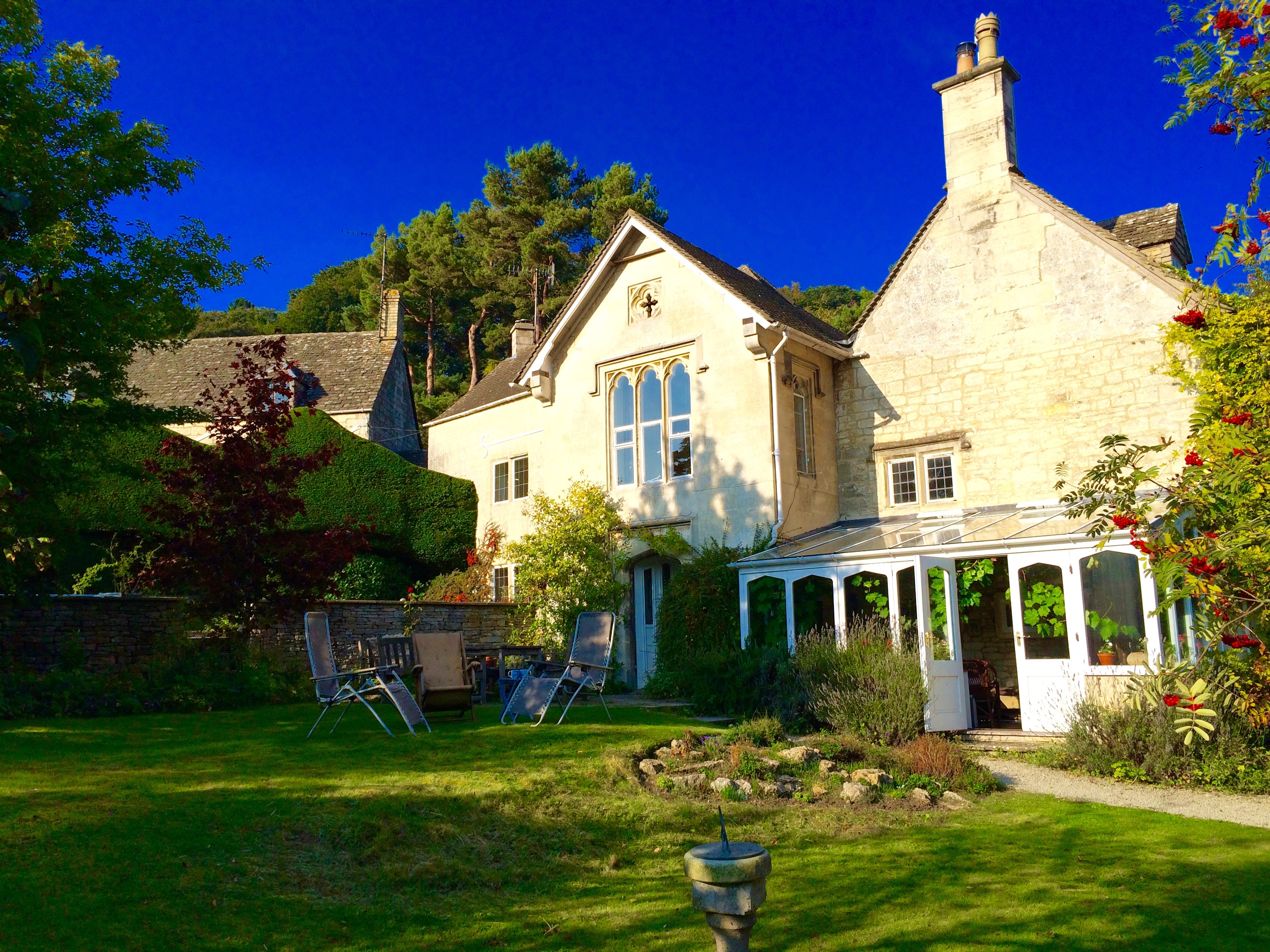
The Grange – Photo by Becca Tarnas
I was met at the train station by a dear family friend, who brought me to a local pub where we met up with his son, another friend of mine. The Woolspack is no ordinary pub. Like the village I had seen on my train journey, this pub is part of a small hillside community, the buildings constructed of old grey stone, gardens overflowing with flowers in every direction one might look. The pub itself looks over a deep green valley, with nothing but pastures and trees covering the facing hillside. We sat out on the stone patio amongst the trailing vines and blossoms. First to arrive at lunchtime it was perfectly quiet. No breeze stirred the air, and one could almost feel the movement of the warm lemon sunbeams in the stillness.

As our meal progressed—pints and jerusalem artichoke, cheese and hazelnuts, followed by a tray of coffees and an assortment of puddings—other families and couples and groups of friends settled in around us. But all maintained the reverent quiet of the still air and the warm October sunshine. Our conversation, seemingly inevitable in this setting, turned to fairies. This is the part of England where everyone knows there are fairies present. What if one were to write not a fairy-tale told by humans, but a human-tale told by fairies? What would they think of us? As we spoke I realized that the little girl at the table next to us was holding a conversation not dissimilar to ours: ‘But it was a real fairy! Why doesn’t she understand that I saw one?” the young lady asked.

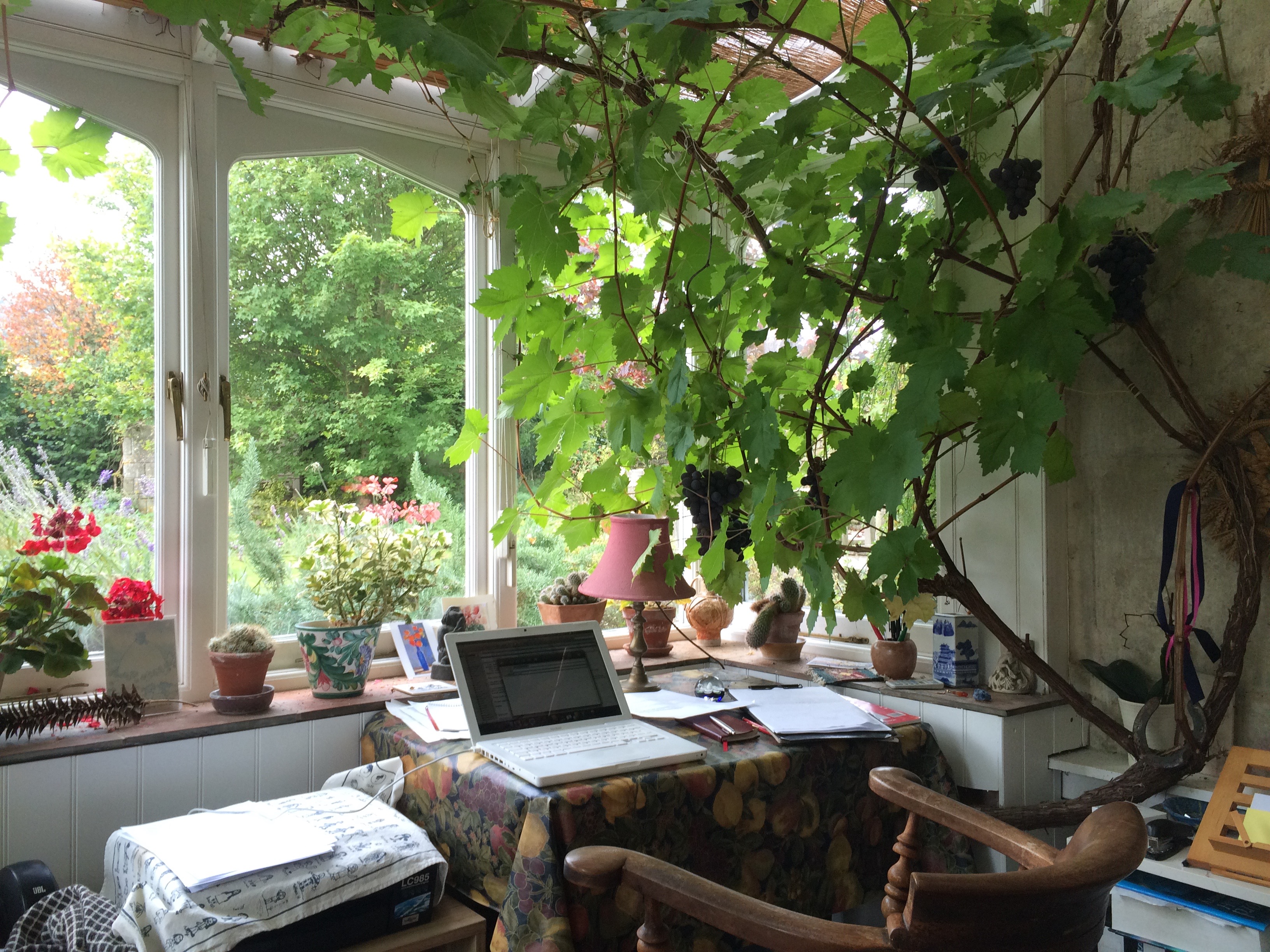
Grapevine Study – Photo by Becca Tarnas
Our meal concluded, we went on to The Grange, their family home in Sheepscombe. The village of Sheepscombe is also nestled in one of these wooded valleys, a collection of old stone houses, a single church still well attended on Sundays, a little post office and nearby pub, and many trails through the woods and hills in every direction. The Grange itself is an old house, once two separate buildings several centuries old, joined together by a third that was constructed in the 19th century. Lawns and gardens spread around it, a multitude of flowers and fruit trees thriving in the moist climate. There was quince and apple, and the vegetable gardens had the last of the raspberries and sweet peas. A towering beech stands majestically over the yard, its roots clothed in a spray of cyclamen, the enchanted little flower I keep encountering again and again during these travels. Perhaps my favorite part of the whole place was the study. At the front of the house is a glass sunroom, with desk and chairs and a wicker chaise. Growing inside the glass walls is a massive grape vine, trailing and twisting about the room, heavy with deep purple fruit. One can sit at the desk working with a cluster of grapes of mythic proportion dangling within reach, just inches from the little desk lamp.

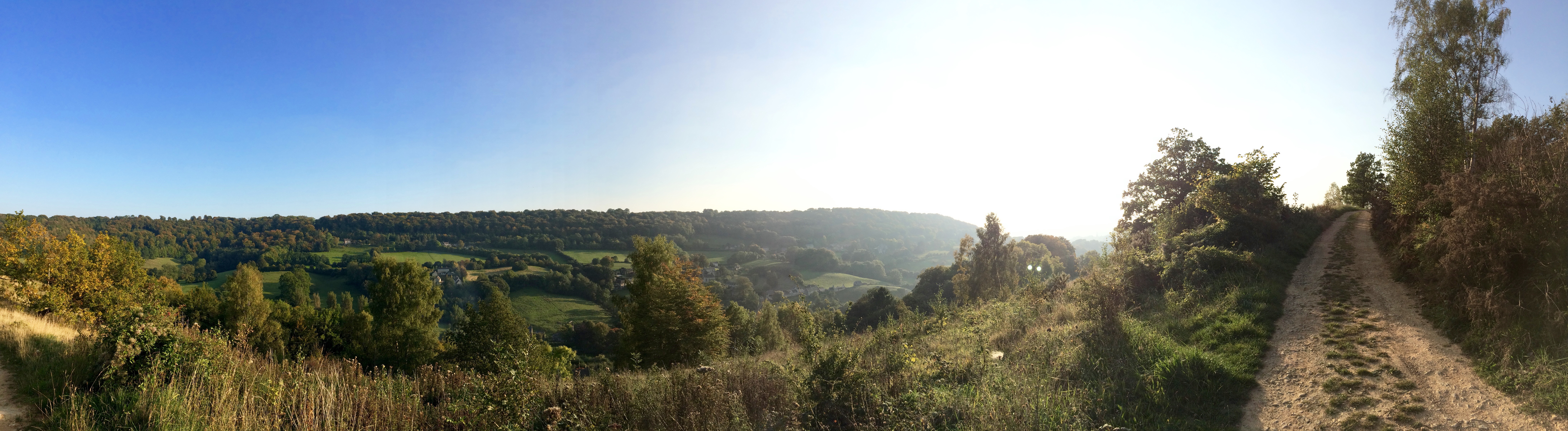
Ridge Above Sheepscombe – Photo by Becca Tarnas
We went for a short walk not long before sunset, under the wide leaves of the deciduous forest near the house, and up onto a ridge above the village. As the Sun and horizon neared one another a misty golden glow washed over everything. In the distance a narrow steeple stood up against the light, the church from a neighboring village.

Our evening in was wonderfully relaxing, dinner and conversation, and later reading by a warm sitting room fire.

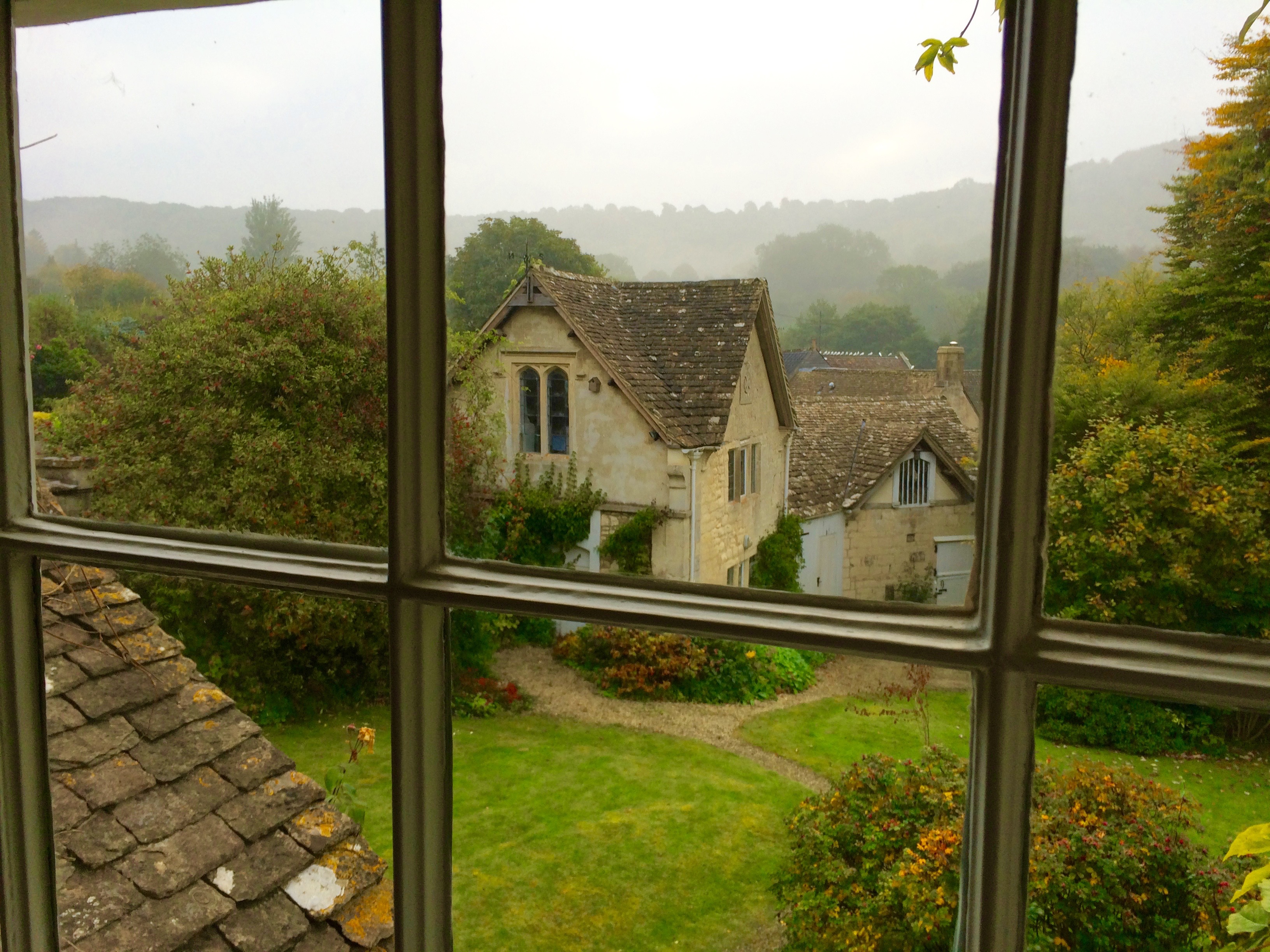
Morning Mist at the Grange – Photo by Becca Tarnas
Looking out the many-paned window from my upstairs bedroom, I could see that the mist had rolled in by morning, and I felt the turn away from summer into the cool of autumn. After a simple breakfast laid out on beautiful china in the kitchen—coffee, orange juice, fresh raspberries and blueberries, toast with honey, butter, and jam—we put on our coats and settled into the car for a drive across the Severn Firth, and into Wales. Near the border and in a wide and peaceful valley are the ruins of Tintern Abbey, the Cistercian cloister that inspired Wordsworth’s famous lines:

And I have felt
A presence that disturbs me with the joy
Of elevated thoughts; a sense sublime
Of something far more deeply interfused,
Whose dwelling is the light of setting suns,
And the round ocean and the living air,
And the blue sky, and in the mind of man;
A motion and a spirit, that impels
All thinking things, all objects of all thought,
And rolls through all things. Therefore am I still
A lover of the meadows and the woods,
And mountains; and of all that we behold
From this green earth; of all the mighty world
Of eye, and ear, —both what they half create,
And what perceive; well pleased to recognise
In nature and the language of the sense,
The anchor of my purest thoughts, the nurse,
The guide, the guardian of my heart, and soul
Of all my moral being.

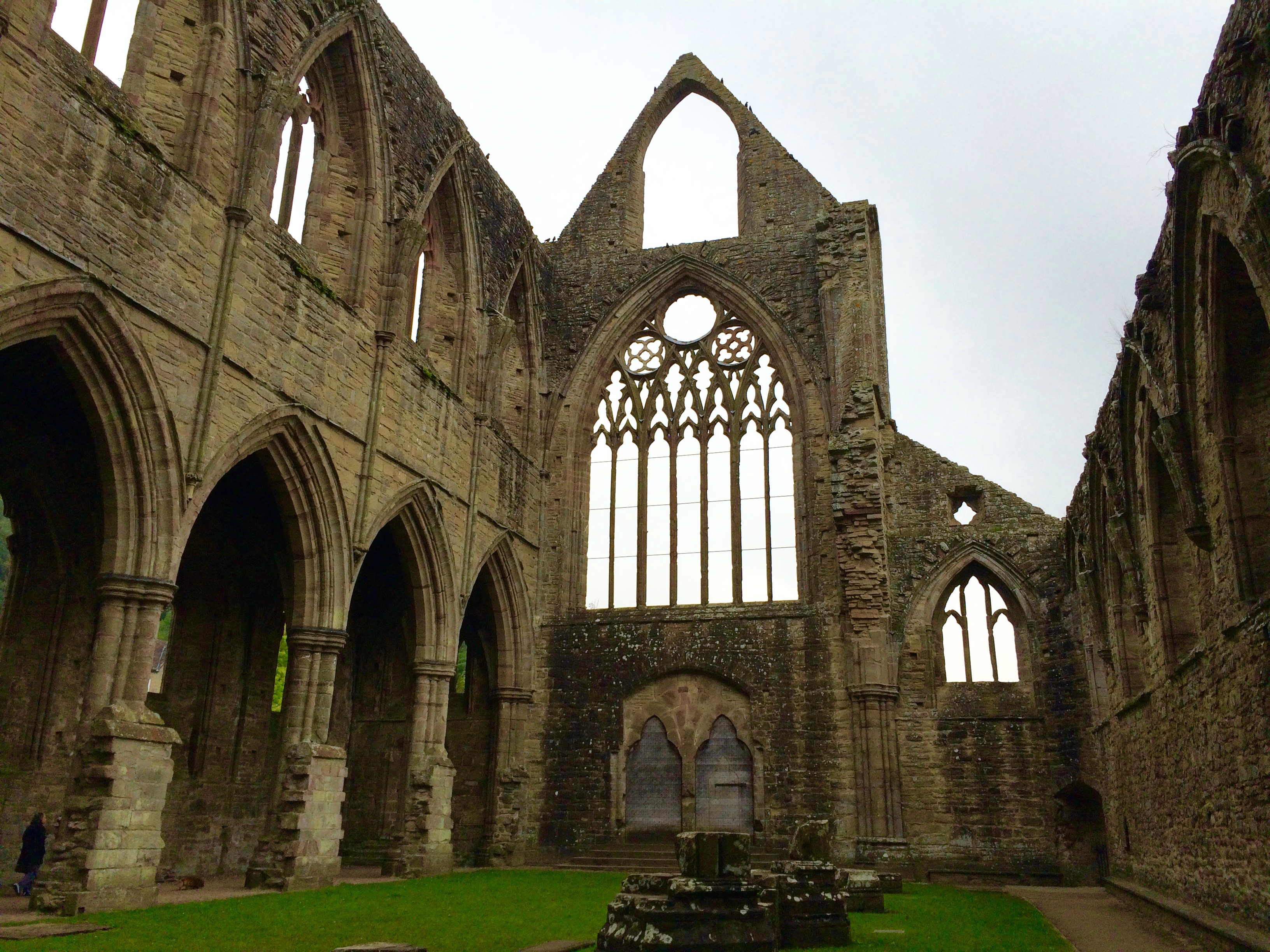
Tintern Abbey – Photo by Becca Tarnas
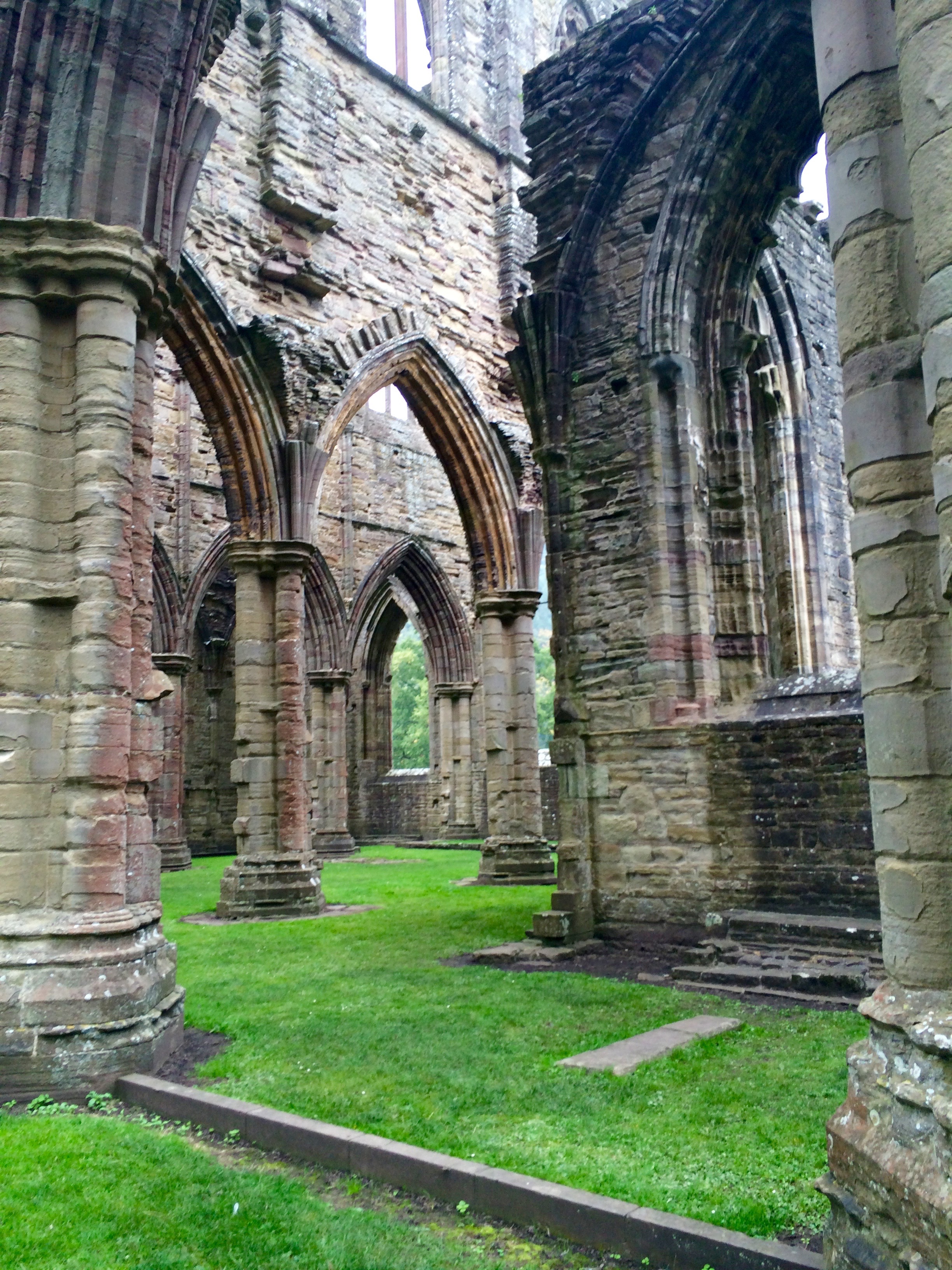
Built in 1131 by monks of the Cistercian order, Tintern Abbey’s location was chosen for its seclusion. The monks were largely self-sufficient, living off the land growing food and raising pasture animals. When King Henry VIII defied Rome and founded the Anglican Church, he abolished the many abbeys across Britain and took their wealth for his own. Now all that remains of this majestic place of worship are arched stone walls, ornately shaped where windows once spanned, and in some places nothing more than a pile of reddish stone and the outlines of foundations. Flocks of crows now make their home among the stones, creating a constant call and response as they wheel through the empty windows. Looking up I saw a lone white dove wing from an empty rose window to an open mossy ledge. The floor is now carpeted in soft green grass. There is no shelter from the wind.

Tintern Abbey – Photo by Becca Tarnas
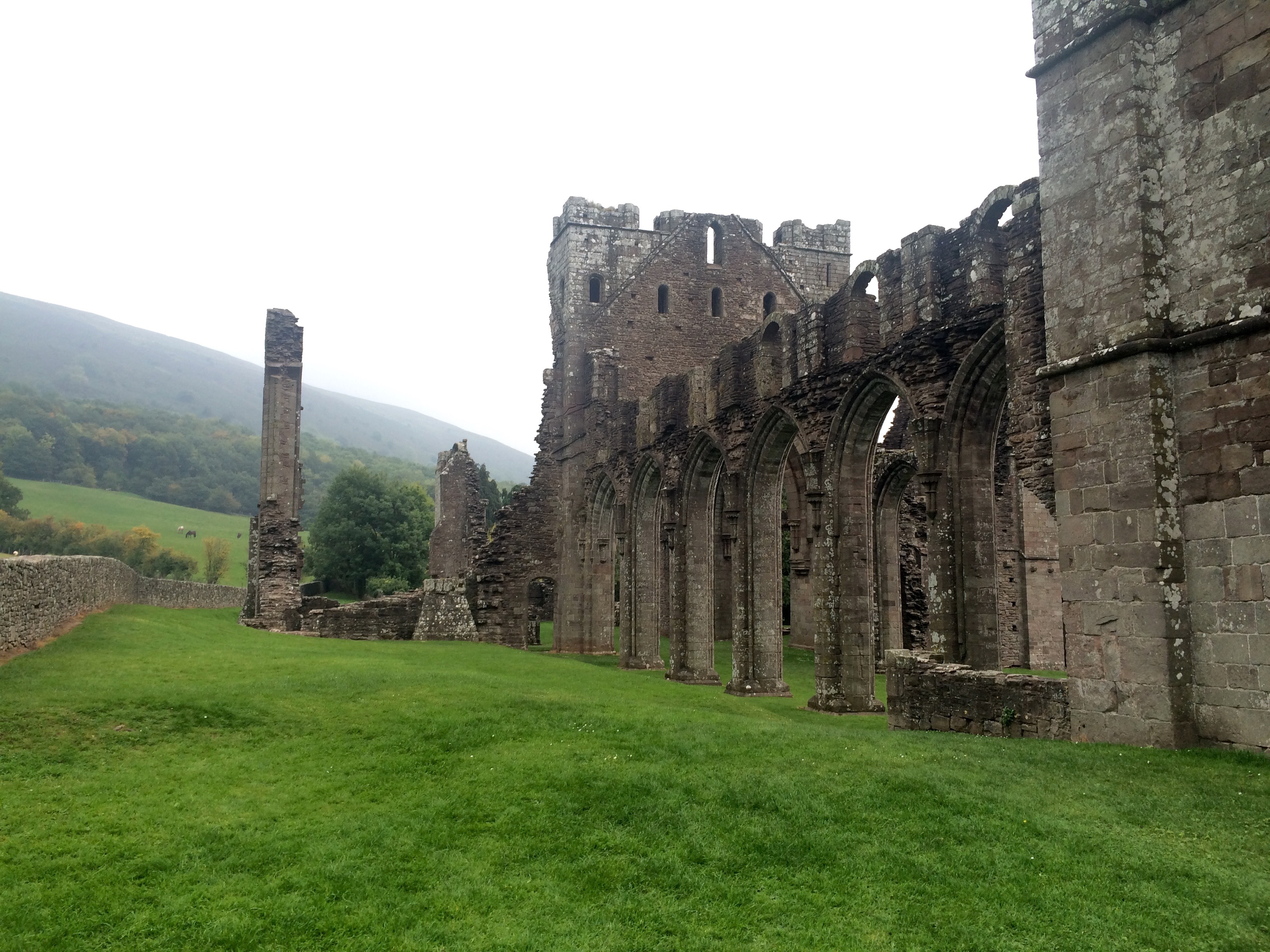
Following a warming bowl of sweet potato and cauliflower soup along with a half pint, we left Tintern behind us and wended through the hedge lanes a little deeper into Wales. Although much like England, there is still a tangible difference to the feeling of Wales. Green pastures and hills, forests and meanderings streams they have in common, but there is a quality in the air that is different. It feels quieter, less inhabited, suffused with a more ancient presence. Story feels like it is living in the land here. The names on the map roll off the tongue and change the quality of one’s consciousness in the speaking. Our route led us to Llanthony Priory, another ruin decimated by Henry VIII. Much less of it remains than at Tintern, and the priory seemed likely to have been more modest to begin with as well. Yet I actually found this place more compelling. Its arches and remaining walls, some of which were leaning over, were covered in moss and twisting vines. A long field extended up the hill behind it, dotted with sheep, and met the base of a red cliff descending down from the hilltop. The Welsh rocks are red, as can be seen on the cliff faces and in the stones in the ruins. Mist poured down over the slopes. A group of walkers had stopped by for hot coffee at the little hotel set up inside what remained standing of the priory. I imagined coming back here at some future time for a walking tour, spending the days outside tramping across the hills and fields, spending the nights in the pubs and inns that still dot the countryside.

Another cozy fire and supper back in Sheepscombe, and a brief stop over at the neighbors’ to see England’s rugby team knocked out of the World Cup by Australia, and my stay in this corner of England had come and gone.

Llanthony Priory – Photo by Becca Tarnas
Morning saw me at the train station in Stroud again, speeding past that same stone village built into the steep hillside. Now my train, the longest journey yet, led south and further south after that. Much of the way I had my nose in a book, glancing up now and then to see the changing scenery, although it was still consistently pastures and hedges for much of the ride. But toward the end of the last leg of the trip came a dramatic change. The fields gave way to coastline, first to narrow firths filled with sailboats, little towns visible across the way built right down to the docks at the water’s edge. It was a cold and grey day, the steely sky reflected in the choppy water. Once or twice the train passed a boat that had long ago sprung a leak and was now but a rotting skeleton, the ribs of the hull black against the lapping waves. Turning a corner the view opened out to a vast stretch of ocean, waves crashing against the rocky shore, white gulls wheeling in the spray. The train went into cliff tunnels and back out again, each new view more striking than the last.

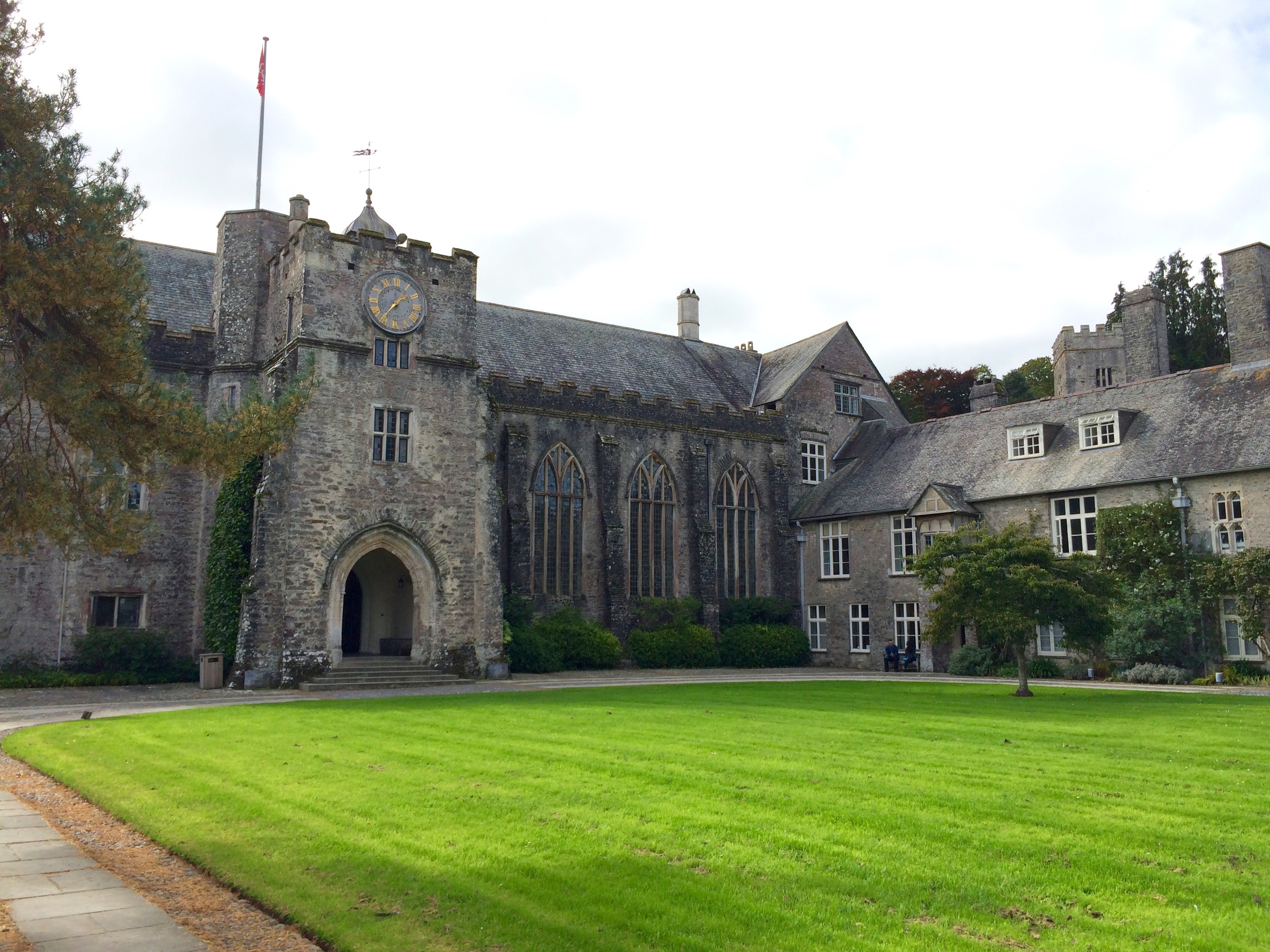
Dartington Hall – Photo by Becca Tarnas
Soon enough the slowing train pulled into the Totnes station. There on the platform waiting for me were my aunt and uncle, who I haven’t seen since they moved to England nearly five years ago. It was a reunion that has been long overdue. We came back to their home, set among the lovely pastures of a farm just outside of Ivybridge. Inside were so many memorable objects, art and furniture, dishes and decorations, that were so familiar to me from their home in Big Sur, a place that always will be intimately close to my heart. It was strange yet comforting to see them all the way over here in England.

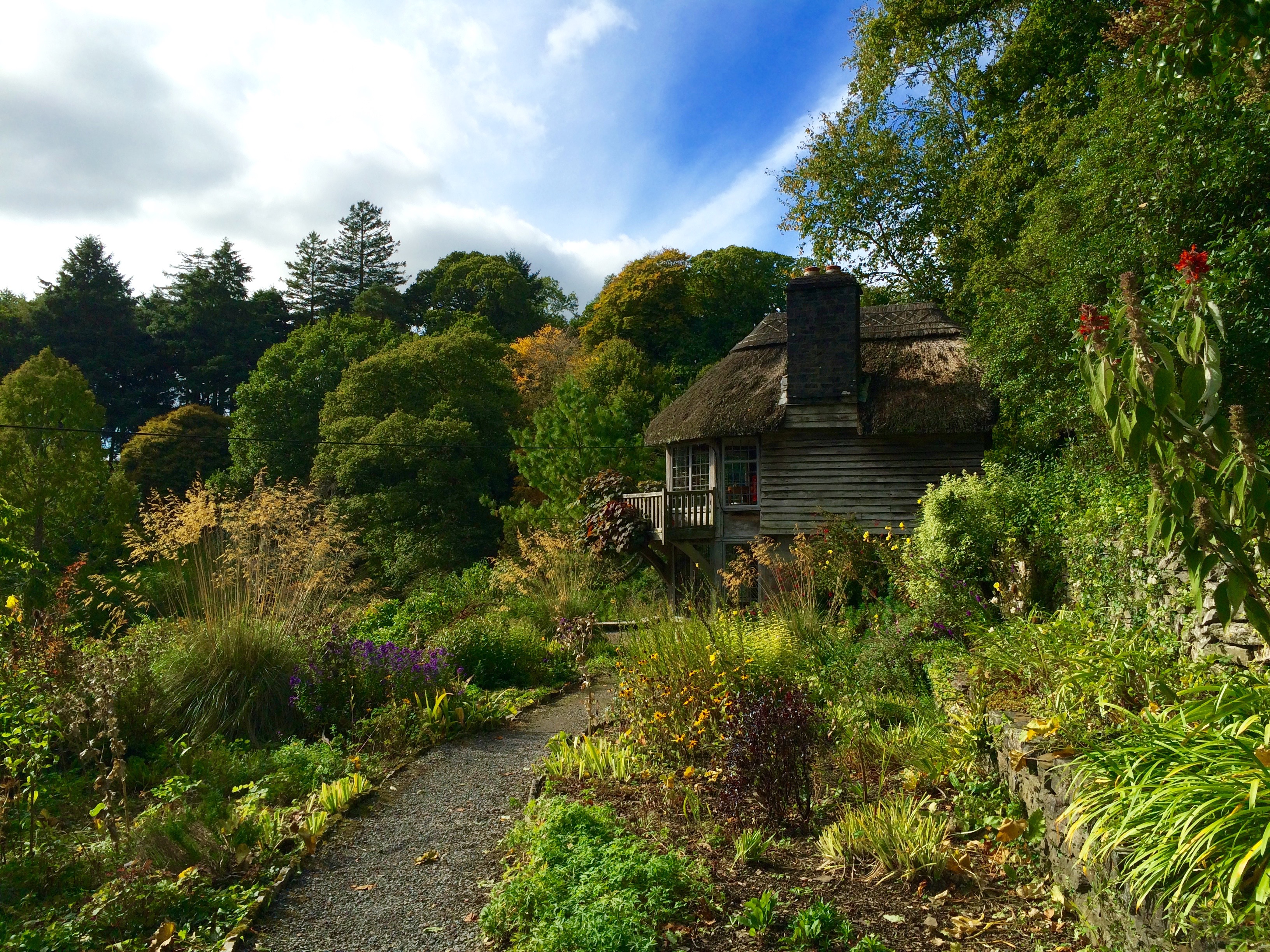
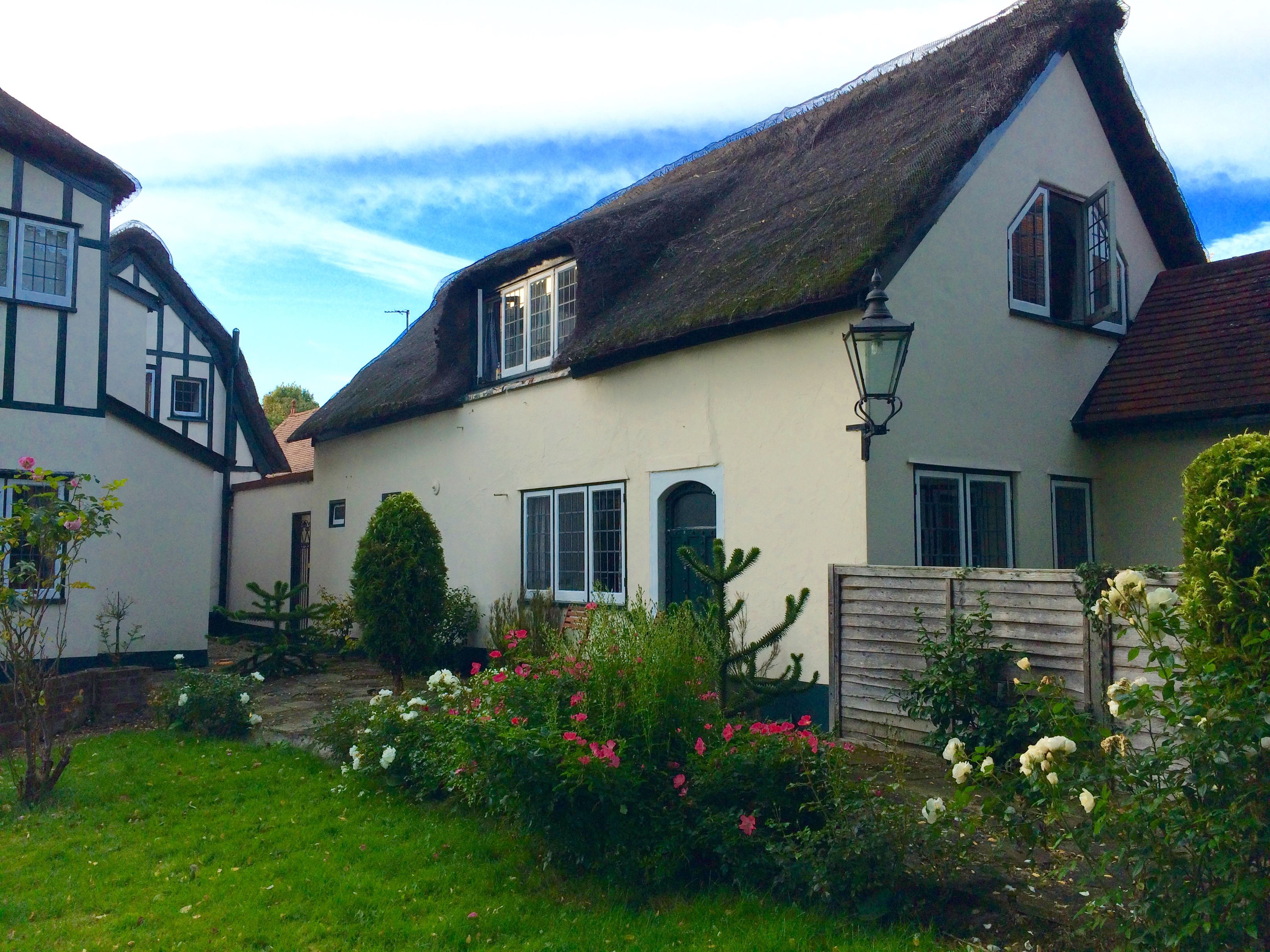
Cottage in Dartington Gardens – Photo by Becca Tarnas
We spent our time together walking outside and painting inside, quilling little coils of colored paper into art projects, reading with morning tea and watching movies while cuddling the cat, and simply catching up and sharing meals in each other’s company. On my last full day we went over to Schumacher College, which I’d always wanted to visit, and walked around the exquisite gardens of Dartington Hall, a magnificent building constructed on the estate initially in the 14th century. All about the hall are huge tended gardens, ancient trees with lawns running the slopes in between, with fountains and statues and flowers lining the paths and stairways. After a thorough wander through the gardens the three of us went down to Plymouth, for a late afternoon walk on Plymouth Hoe overlooking the sea and what was once the primary harbor of the famed British navy. Down at the docks are massive stone buildings that once held supplies for outfitting the ships—ropes and rigging, wood and sails, all fortified against any incoming attack from the sea. Now these buildings largely stand empty, except several on the ground level that have been repurposed into restaurants and cafés. We enjoyed a quiet dinner in one of these restaurants followed by a stroll along the water’s edge. Before long we returned to the quiet of home for a final night together before my departure from England.

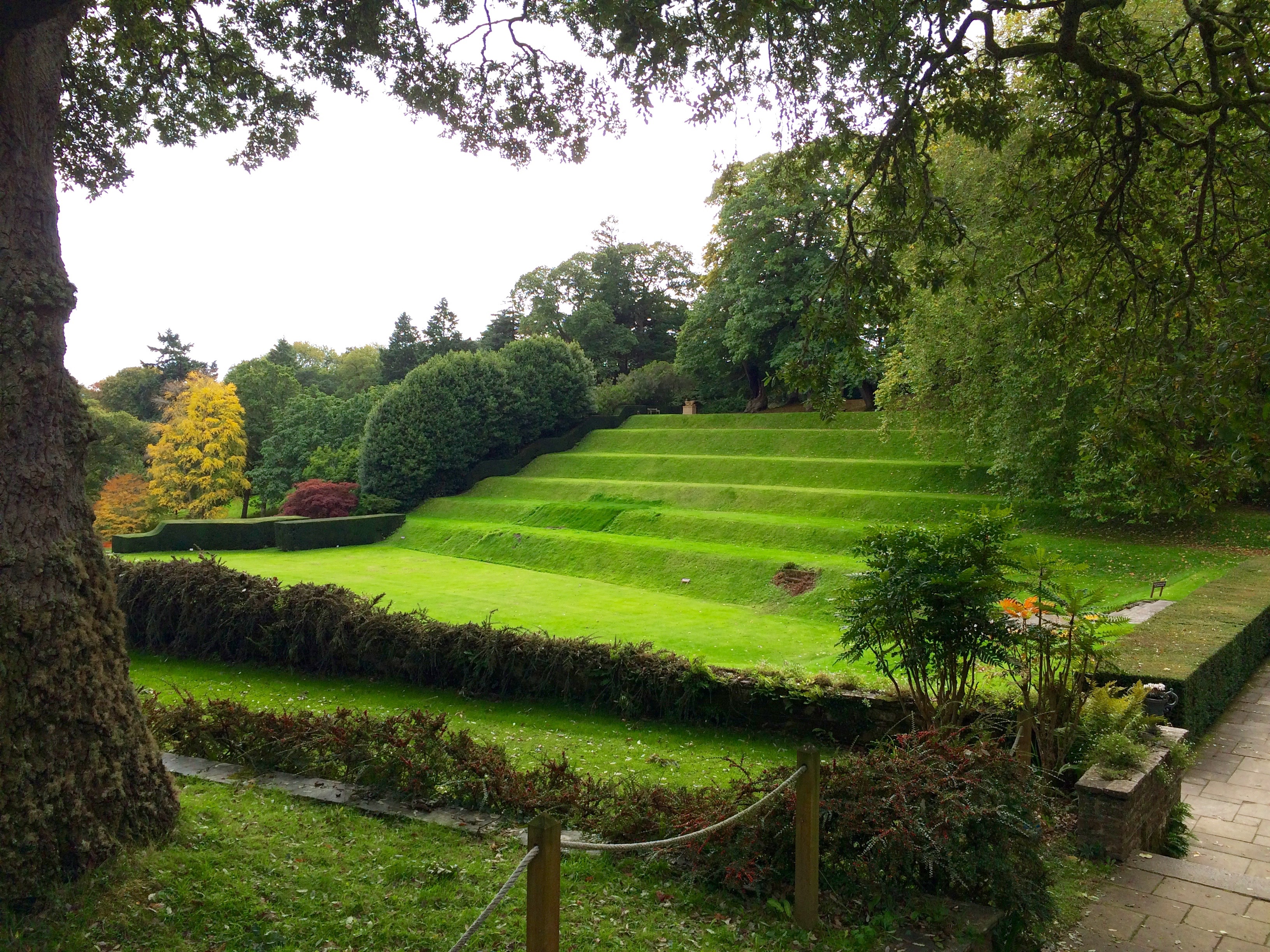
Croquet Lawn in Dartington Gardens – Photo by Becca Tarnas
As I’ve been writing this on the train, mist has been rising from the fields between dark trees and hedgerows. Only the Moon and Venus now remain visible in the periwinkle sky. As more time passes just a thinning crescent can be seen in the rising morning mists. A rich magenta glow now lights the horizon, the dark tops of clouds a heavy violet pushing back against the oncoming sunlight.

Sunrise over the calm morning water, first on the straights between the peninsulas, the dark patches visible at low tide contrasting with the colored mirror of the water, and then opening out to the sea itself, a clear pathway of warm sunlight illuminated from the horizon to the shore, where low waves roll against the sand. The train runs along the coast, passing into tunnels cut in the dark rock, then back out again into view of the spectacular scene. No matter how many times I witness the dawn, I will never cease to be in awe.

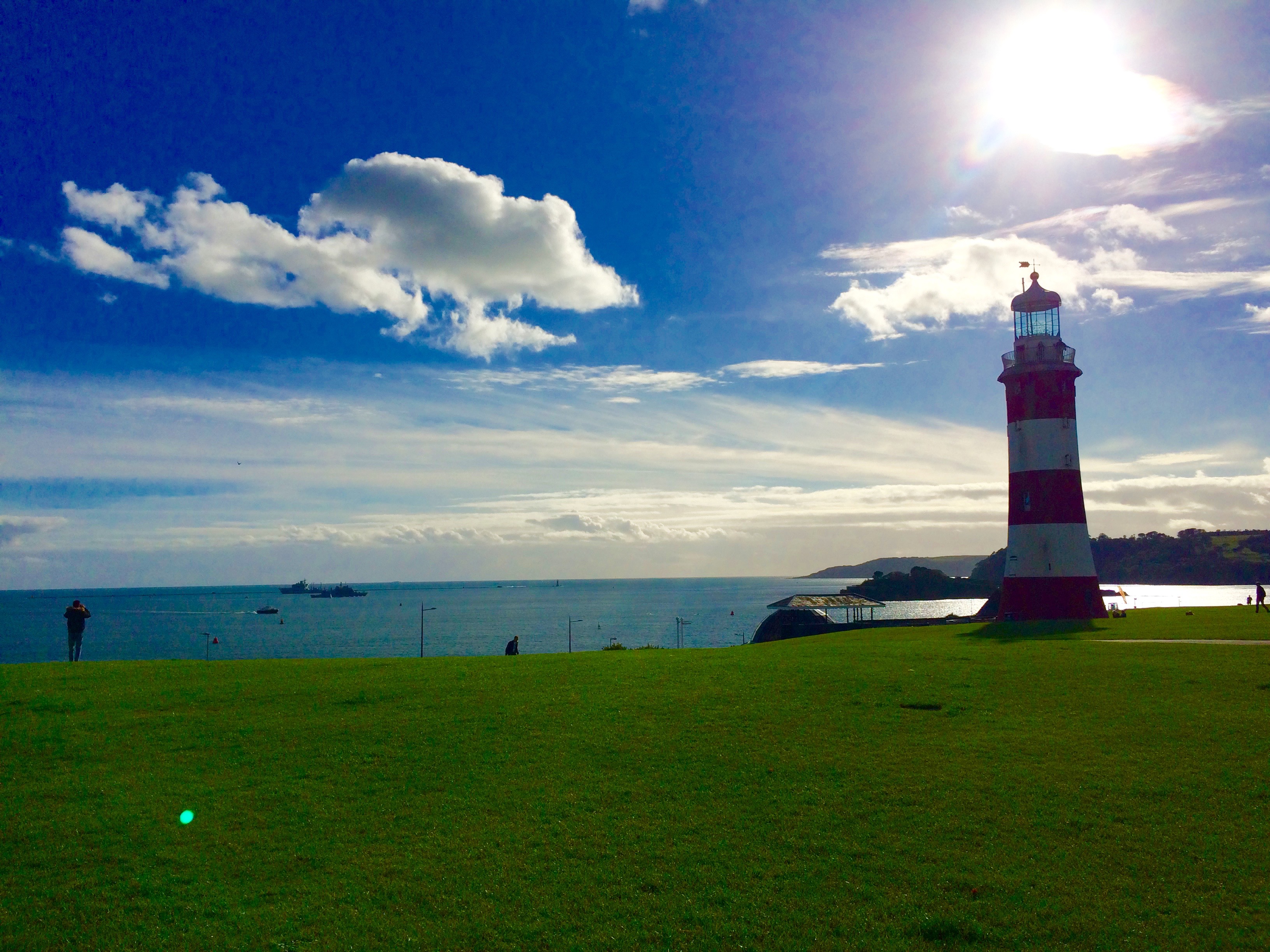
Plymouth Hoe – Photo by Becca Tarnas

The City of Dreaming Spires

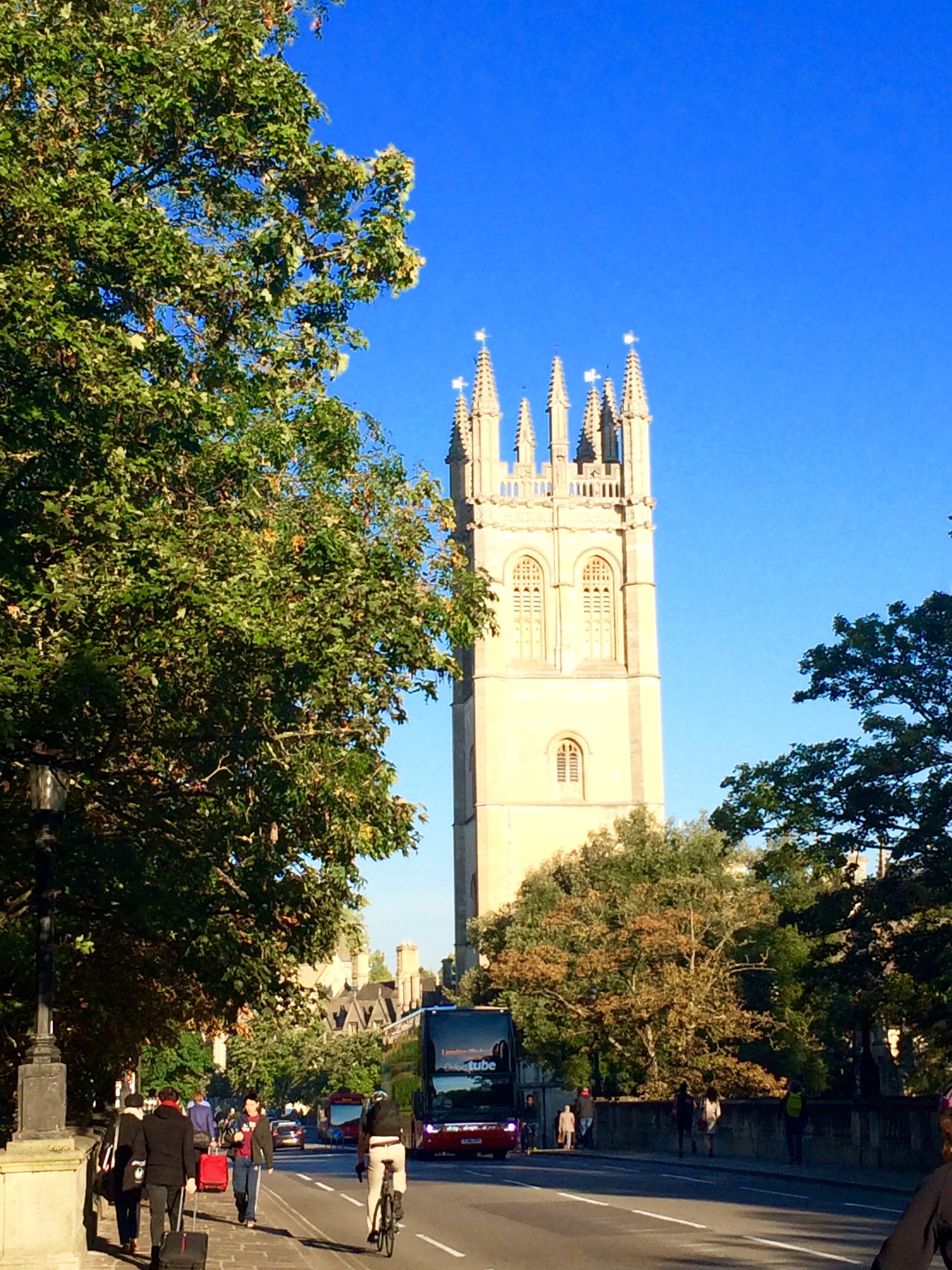
Magdalen Tower – Photo by Becca Tarnas

There is nothing quite like riding the train at magic hour, into the City of Dreaming Spires. I spent much of the day in London, including several important hours catching up with an old friend, having a fantastic brunch at The Breakfast Club in Soho, and walking through Hyde Park during the sunny, warm afternoon. As the day dwindled toward evening I walked from Warwick Avenue to Paddington Station, past canal boats floating low in the water covered in bright, chipping paint and overgrown planter boxes of flowers.

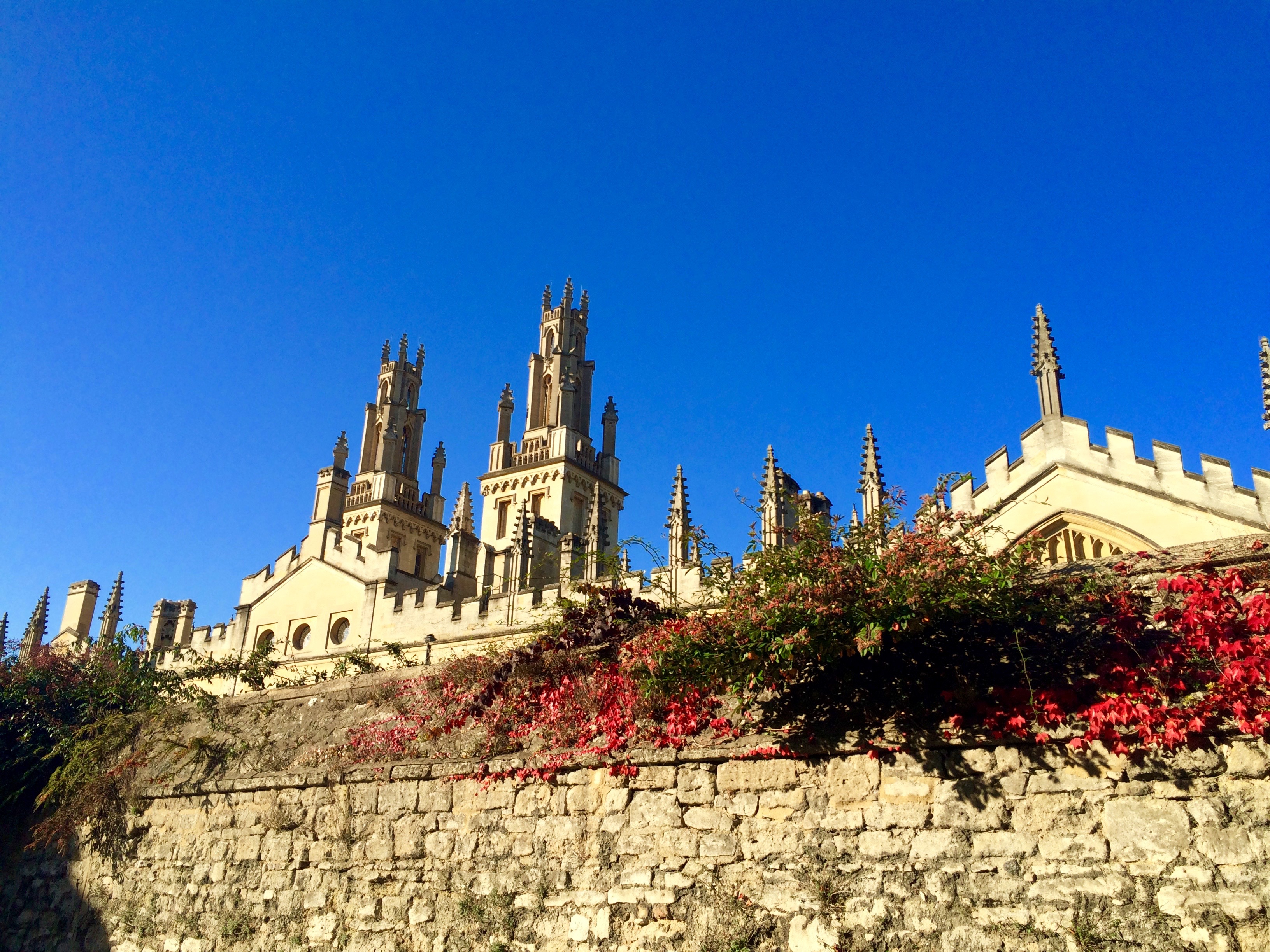
The departing sun set the sky alight in lavender, periwinkle, rose and indigo while the train sped toward Oxford. I chose to walk the mile and a half from the station to my lodgings in a friend’s college rooms so I could take in the city along the way. Sure enough I passed beneath the lit steeple of the University Church of St. Mary the Virgin, and not long after the tower at Magdalen College, where C.S. Lewis spent much of his teaching career. Crossing the bridge over the River Cherwell I could look back and see clearly why Oxford has been called the City of Dreaming Spires: the old college buildings send up spire after stone spire into the starry night air.

I arrived into my rooms which were warm and welcoming, filled with familiar books, including a shrine with Jung’s Red Book upon it. I found it somewhat amazing (although not surprising once I reflected on whose room I was occupying and our similar academic interests) that I had come halfway around the planet to study Tolkien’s visionary artwork, the contents of his Red Book, in the Bodleian Library, and right in my bedroom would be an accessible copy of the other Red Book to which I am comparing the results. It felt like an affirmation I was in the right place.

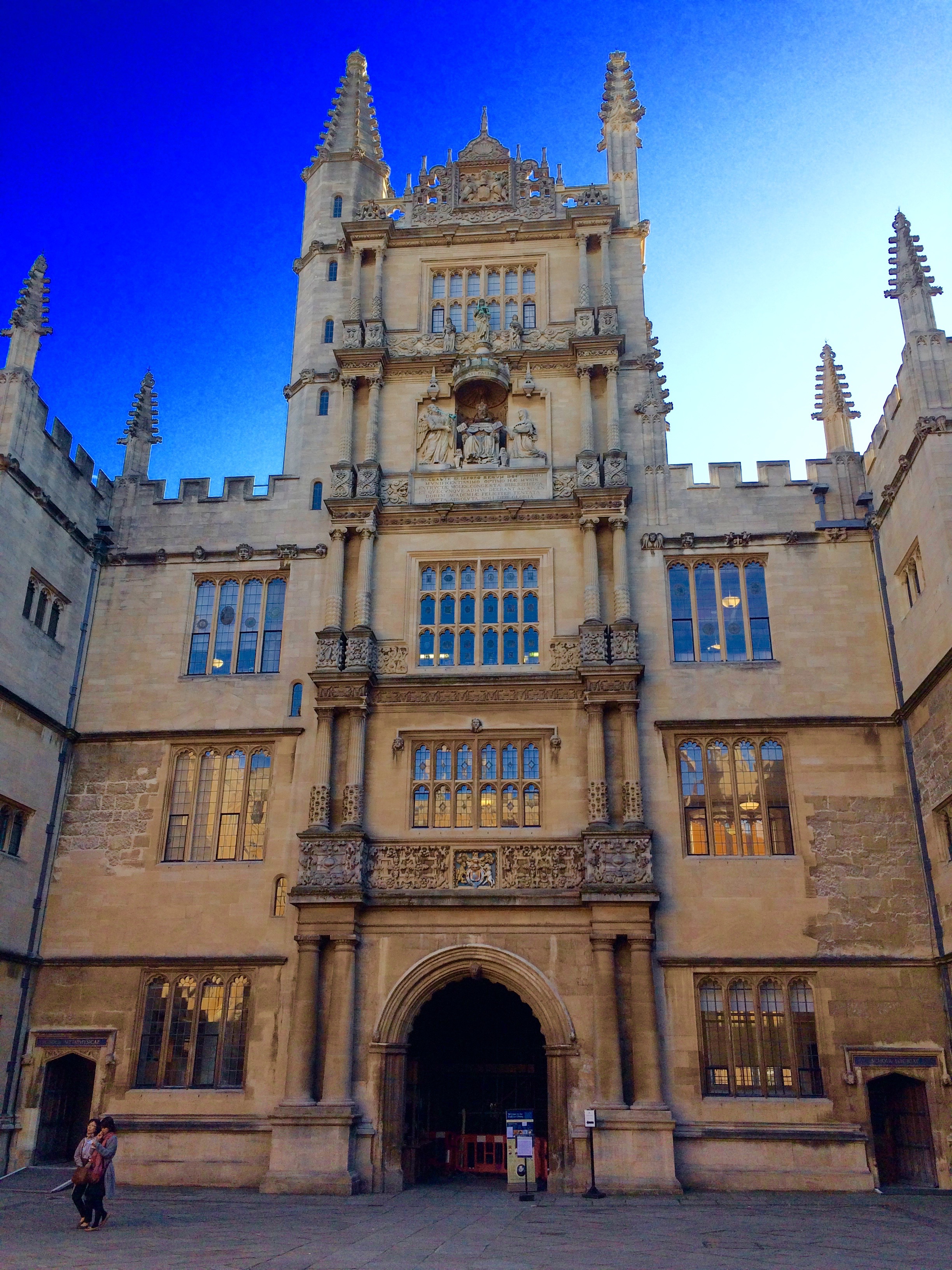
The Bodleian Library – Photo by Becca Tarnas

Early the following morning I awoke, soon to realize I was shaking—with anticipation, nerves, excitement, I wasn’t entirely sure. I planned to arrive at Admissions in the Bodleian at 9:00 am as they opened, and hopefully if all went well in getting my reader’s card I’d be meeting with the head archivist of the Tolkien special collection by 9:30. Walking through the streets of Oxford, down Queen’s Lane and under Oxford’s own Bridge of Sighs toward the library, I felt a deep sense of connection to this place. Ten years ago I once had the dream of attending this university, and now again that desire was reawakened. I could feel the past presence of those literary figures who had shaped me in such a formative way. Something in the heart of Oxford was calling to me once more.

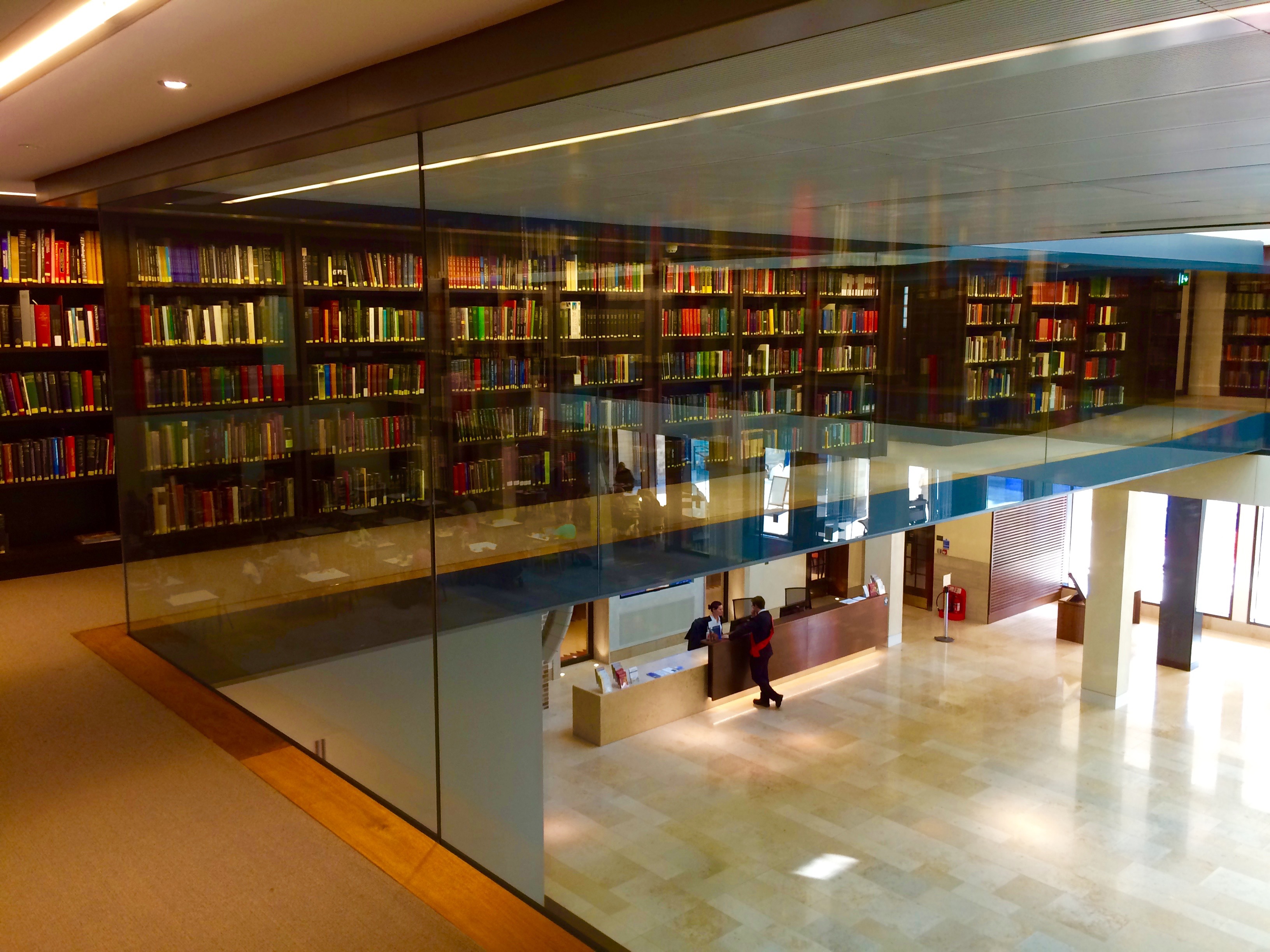
I entered first the oldest building of the Bodleian, which had many doors branching off the courtyard with signs over their doors reading Schola Naturalis Philosophae and Schola Moralis Philosophae, among several others. Soon I was redirected toward the Weston Library, a newer building although still seemingly old to my eyes. I entered Admissions, handed in the various forms explaining my research purposes along with three (three!) forms of identification. To my relief I was approved without much delay but, before handing me my reader’s card, I was to swear an oath aloud that ran four lines long:

Bodleian Library Oath

Then to the lockers where I left all my belongings except a pencil and blank sheets of paper, through the secure entryway, up the stairs and into the reading room. There I was met by the Tolkien archivist, a wonderful woman who has what I felt to be one of the most admirable and enviable positions in the library. We spoke for a little while about my research goals and then she set me up at a table with the first of four boxes of Tolkien’s artwork that I would be studying over this morning and the following.

The Reference Library in the Weston – Photo by Becca Tarnas

My hands shook a little as I opened the first box, but I soon relaxed into the process, turning from one drawing to the next. What did I find there? Well, I’ve signed too many forms to risk revealing much here without the permission of the Tolkien Trust. But I’ll just simply say that I believe I found what I came for, that my thinking in these areas has been affirmed, and perhaps someday I will be able to express the fullness of what I saw in my dissertation. Much of Tolkien’s great art has been published already, for which I am immensely grateful. But a few pieces remain hidden which would be wonderful if they could be seen by the wider world. And the sequence itself of the artwork has its own story to tell.

After several hours and even more pages of notes I decided it was time for a change of scene, so I packed up and departed the library. I made a brief stop in Blackwell’s Bookshop, my favorite book store in the world that I hadn’t been inside of for about five years. Of course they had a whole Inklings section right up at the front, and I was able to get a copy of Verlyn Flieger’s edited edition of Tolkien’s fantastic essay “On Fairy-Stories,” first given in 1939 as the Andrew Lang lectures at the University of St. Andrews in Scotland. They also had lovely little editions of several of Tolkien’s short stories; I limited myself to two: Smith of Wootton Major and The Adventures of Tom Bombadil and Other Verses from the Red Book, each with accompanying introductory and critical essays.

The Eagle and Child – Photo by Becca Tarnas

Lunch at the Eagle and Child pub seemed the only appropriate place to go next, so I walked up St. Giles to the legendary “Bird and Baby,” and was soon sitting in the back room with a pint and vegetable pie, gazing at oil portraits of Tolkien and Lewis and scribbling notes on my morning’s research.

That afternoon I met up with a family friend who happens to be teaching in Oxford for the next two months, so we spent the next several hours catching up and discussing ideas on an array of topics, from philosophy and religion, to literature and travel. We walked home through Oxford in the evening together, conversation still well underway.

Morning found me once again in the Sir Charles Mackerras Reading Room, pouring over more drawings. But finally the time came for me to depart and I left with reluctance. Would I have the opportunity to again be a researcher in these halls? I hope my life may take such a turn.

For the afternoon I had a special pilgrimage planned: a long walk from Oxford city center first to 20 Northmoor Road, where Tolkien and his family lived seventeen years, and then on a few more miles up to the Wolvercote Cemetery where Tolkien and his wife Edith are buried beneath one gravestone. It felt important to me to walk, to really put in the time and effort and make it to each place on foot.

20 Northmoor Road – Photo by Becca Tarnas

I noticed as I was walking down Northmoor Road I was shaking a little again. The wooden gate bears a metal number 20, and bushes and blackberry vines grow about the entrance. Someone else has made their home here now, and it looks simple and well-kept. The only distinguishing feature is a small blue plaque near the gable of the roof stating:

J.R.R. Tolkien
Author of The Lord of the Rings
Lived here 1930-1947

I tried to imagine what it might have been like to live here, raising four children, preparing lectures, marking exams, and writing thousands upon thousands of pages of fantasy and Elvish lexicons during some of the spare hours in between. I peered at the smaller house next door, number 22, where the Tolkiens had lived for a shorter period before, from 1926 to 1930. Eventually I continued on my way, grateful to have glimpsed these two homes.

The walk up to Wolvercote Cemetary was actually much longer than I expected, and a few times I thought I might be lost. I started to worry I wasn’t going in the right direction, or worse yet that I was but had somehow mistaken the cemetery and was walking far out of my way for nothing. I departed the road I had been on, thinking perhaps the cemetery was further east. I began to walk down an unfamiliar road when suddenly I had a strong sense to turn around. I did, and following intuition more than anything else I realized I was now on Banbury Road, the very road the cemetery was meant to be on. Sure enough just several hundred feet further, and a little sign pointed me into a wide, grassy cemetery. A brass plaque indicated to follow the signs to Tolkien’s grave. I had made it.

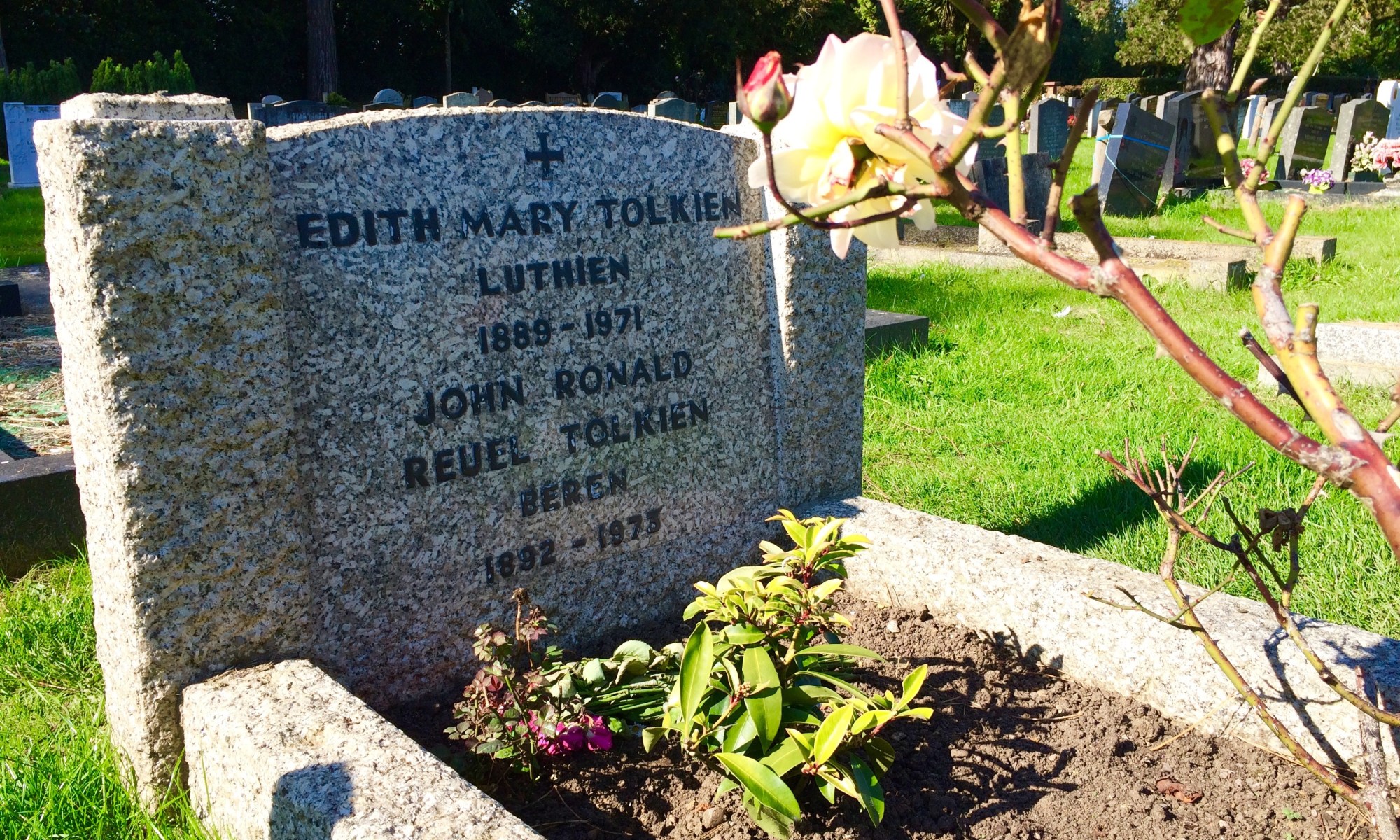
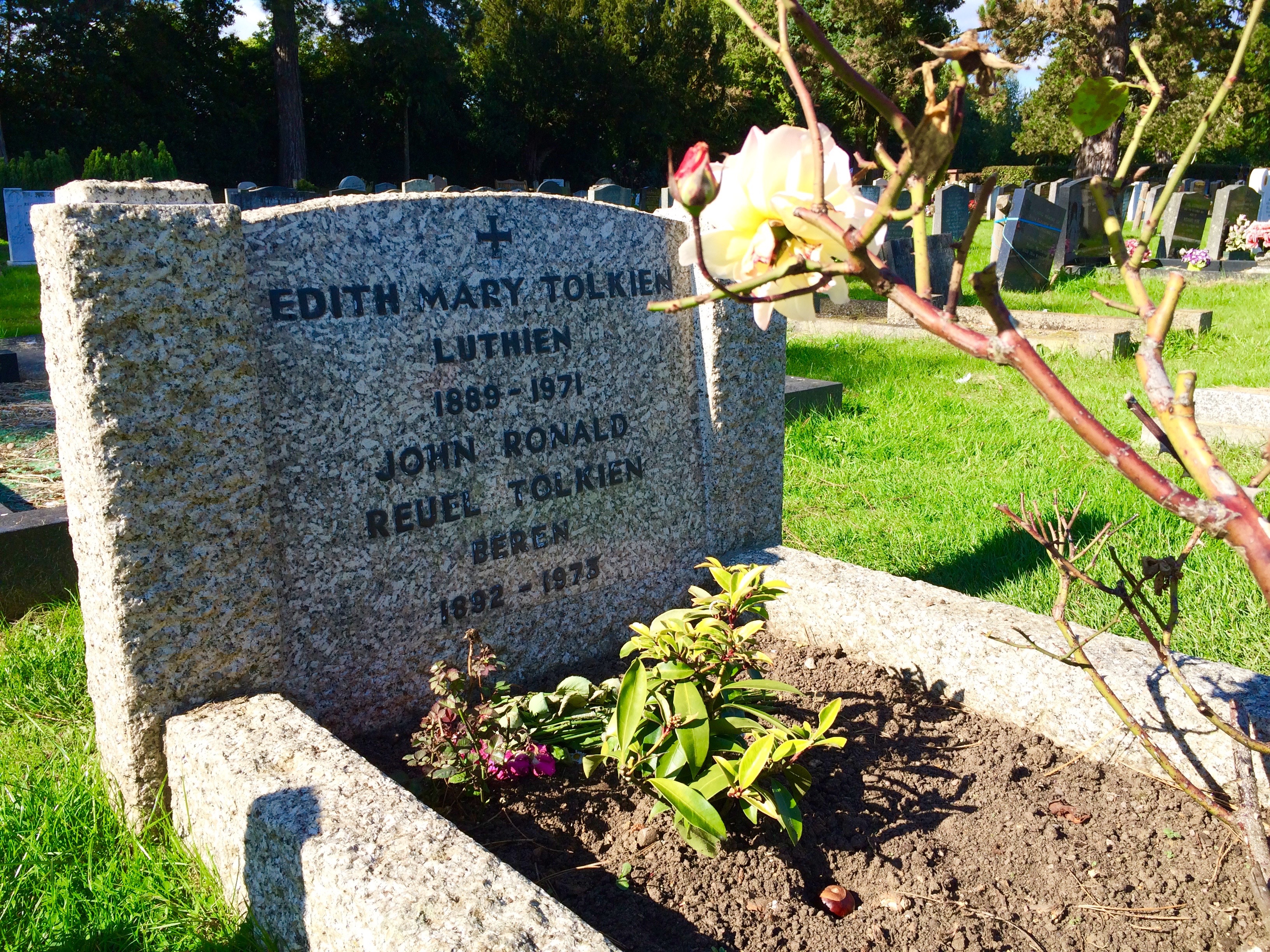
The Tolkiens are buried right near the back of the cemetery, a modest plot with a granite stone at the head and a rose bush with a few blooms, their fading petals marking the end of summer. The stone reads:

Edith Mary Tolkien
Luthien
1889-1971

John Ronald Reuel Tolkien
Beren
1892-1973

I cannot recount here all the emotions that arose in me at the sight of this grave. I’ll simply say it was a deeply meaningful experience, far more than I was even expecting. I spent a long time there. At one moment a strong wind picked up, shaking the trees. I was reminded of when the wind blew through the trees as Tolkien and Lewis were on Addison’s Walk by Magdalen College, the night that Lewis had his conversion experience, which Tolkien commemorated in his poem “Mythopoeia.” Finally I felt it was time to depart. As I turned away I saw a small, pure white feather on the ground. Rarely do I collect tokens of remembrance, but this time I felt the feather was for me.

The Tolkiens' Grave – Photo by Becca Tarnas
The Tolkiens’ Grave – Photo by Becca Tarnas

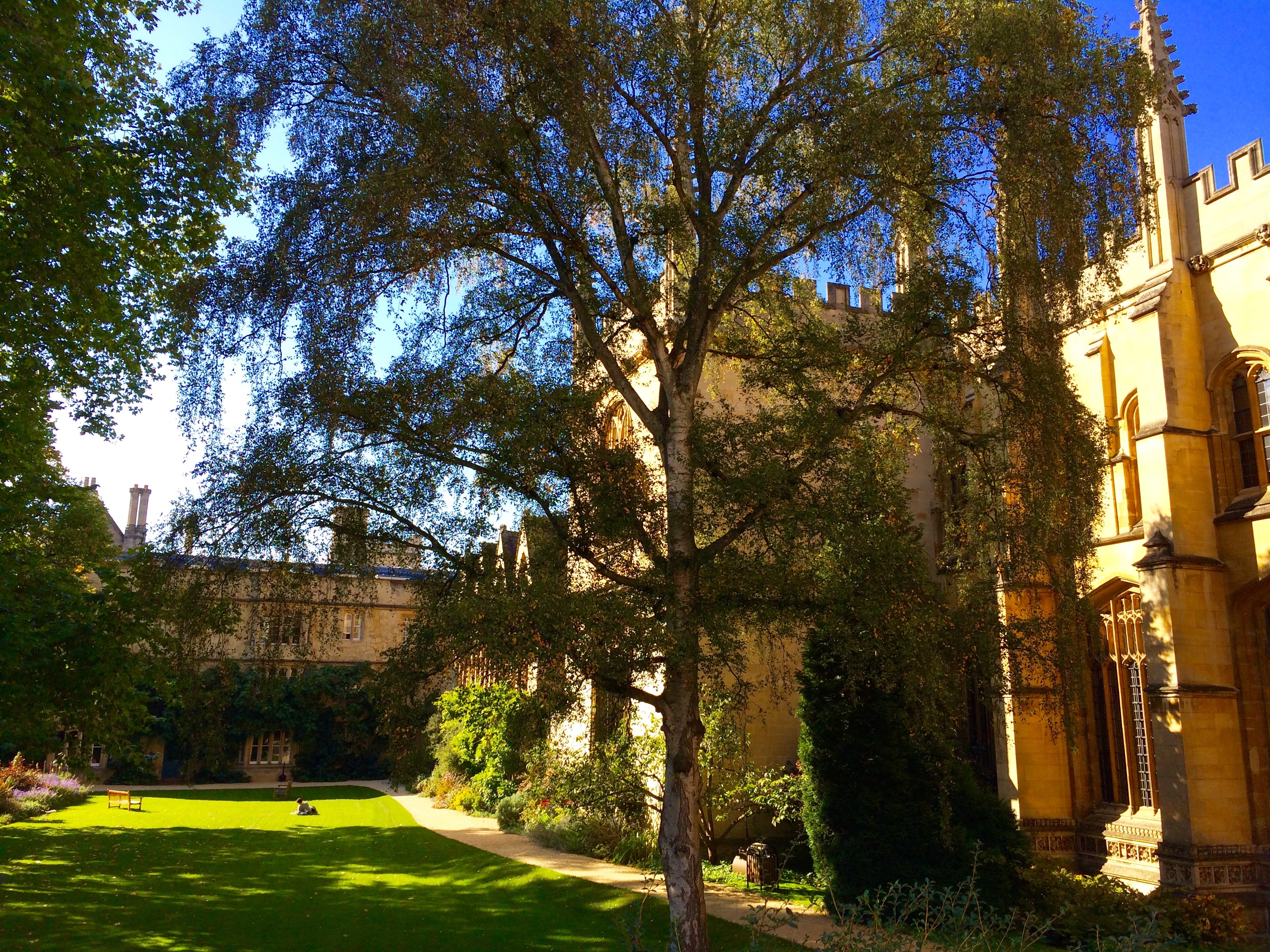
It was a joy to rest my feet as I sat on the upper deck of the bus back toward city center, right at the front window so I could see clearly the whole return journey. I felt in a place of great peace. Arriving back into the heart of Oxford, I walked over to Exeter College, where Tolkien studied as an undergraduate, and was able to enter with my newly acquired reader’s card. (“I’m a visiting researcher, may I enter the college?”) Passing the emerald green quad I entered first the chapel, where a tapestry of the Adoration of the Magi adorned the front left-hand wall. A copper bust of Tolkien stood near the back, not too far from the door. Although small, Exeter’s chapel is exquisite. From there I somehow found myself in the Fellows’ Garden, a peaceful lawn bathed in sunlight, trees and flowers scattered throughout, a large fig climbing the stone wall by the private college library. Toward the back right of the garden is a small pond filled with water lilies, and a stone staircase ascending the outer wall of the college. Coming to the top of the stairs I found myself with a spectacular view looking out toward the round Radcliffe Camera, the tower of the University Church just beyond it. Below me a crowd of tourists happened to be walking by, but up here on the wall of Exeter College I was secluded, in the peace of an idyllic garden where generations have come to study outside.

Exeter Fellows' Garden – Photo by Becca Tarnas
Exeter Fellows’ Garden – Photo by Becca Tarnas

After Exeter I went on to visit two more colleges: Christ Church College, which is by far the largest and wealthiest, with vast meadows stretching beyond it, and Magdalen, where C.S. Lewis was situated. Walking down the echoing corridor beside the Magdalen quad I had an internal image of black-robed students walking down these same halls, when suddenly I turned a corner and a whole choir of schoolboys in the very black robes I had been imagining processed down the passageway before me, turning quickly (and the smallest ones in the back shoving each other) into an arched doorway to the left. My footsteps carried me further until I passed out of the wrought-iron gates and across the small bridge over the River Cherwell onto the pathway of Addison’s Walk. Turning left I walked for a ways beside the river, stopping when I came to the next bridge and seeing to my right in the meadow a large herd of deer. All of the females and fawns were standing eating grass, while the two males with antlers—one significantly larger and presumably older than the other—sat on the ground on either side of the herd. After a moment in quiet reflection beside the deer, I turned back the way I’d come. I noticed a few things I had missed on the way in: a few large stumps that had been carved into thrones rooted directly into the ground, and a small moored boat that looked like it must belong to Ratty from Wind in the Willows.

Radcliffe Camera & University Church – Photo by Becca Tarnas

By now completely exhausted from all my walking, I returned to the University Church which had a garden café at the bottom, and sat with a perfect cup of English tea and a scone, replete with clotted cream and strawberry jam. Just refreshed, I went to meet the same family friend I had joined the afternoon prior and we walked together over to Christ Church chapel to attend Evensong. It’s one thing to tiptoe into the college chapels when no one is there and take in the art and carvings on the walls, it’s another to come in when candles are lit and the air vibrates with the voices of young men and boys in the choir.

Thus, after a beautiful dinner and evening, my time in Oxford was coming to a close. The following morning I packed everything up and walked back toward the train station the same way I had walked in. An autumn mist had descended on the city, turning the morning Sun’s light into diffused rays that scattered across the yellow stones and fading trees. I felt a reluctance to leave this place. But if I am meant to return to the dreaming spires at some point in the future then I must trust that I will.

Dreaming Spires by Morning Light – Photo by Becca Tarnas

A Return Ticket from London to Cambridge

The first thing I notice about London is the speed: everything and everyone is moving about at such a pace, and in so many different directions all at once. Stepping off the train arriving from sleepy Canterbury, I was immediately swept up into a stream of life not my own. One must choose a direction and keep pace, or risk being battered about on all sides, a single leaf caught in the cross-currents of many hurried winds.

The River Cam – Photo by Becca Tarnas

The complex interactive network of the London Underground is actually surprisingly easy to handle, and puts all of our local Bay Area public transportation to deep shame (I’ve had this feeling repeatedly on this trip, with each new train journey wishing we had the same kind of sophisticated system in the States). I found my way to the Bakerloo line and was deposited before long at the quiet station of Warwick Avenue, where I emerged into the slanting golden light of a warm London evening. Walking past elegant blocks of brick and white plaster apartment buildings, with ornate iron railings outlining the front steps, I came without much trouble to the flat of a dear friend and his family, where I was welcomed with open arms.

The River Cam – Photo by Becca Tarnas

I spent a tremendously peaceful evening there, meeting for the first time my friend’s wonderful two-and-a half-year-old daughter, and getting to hear all about her life in her own excited little voice. When morning came we had an active round of monkeys jumping on the living room guest bed—the broken monkeys miraculously healing and coming back to bounce in ever-decreasing numbers once more.

Come mid-morning I set out from the flat, making my way on the tube to King’s Cross station to get my ticket up to Cambridge for the day to visit my professor Jake Sherman. Ticket in hand I quickly realized I would be leaving from Platform 10 at King’s Cross—just a quarter of a station from the legendary departure point of the Hogwarts Express. Try as I might the wall wouldn’t give. But I knew it was already September 28, a full four weeks after the entryway had closed. Besides, I had another train to catch to an equally magnificent institution of learning.

Jake met me right at the station in Cambridge, and we set off toward the heart of the town at a brisk pace. The closer to the center we came the older the buildings appeared, more ornate and closer together. Our exploration began at Emmanuel College, where Jake is currently teaching in the post of University Lecturer in Philosophy of Religion. The scale of Emmanuel, or Emma College as Jake called it, felt like it would make a good academic home. Some of the magnificent colleges I was to see later, such as Clare or King’s, were almost overwhelming in their grandeur. But there was something about Emma that felt just right.

Stepping into the college chapel, Jake showed me the many figures who adorned the stained glass, from Origen and Johannes Scotus Eriugena, to Benjamin Whichcote and John Smith the Cambridge Platonists, and John Harvard, the founder of Harvard University in the States. The gardens outside seemed a Romantic paradise, with winding paths and a pond inhabited by ducks and coy, swimming among the tall reeds and flowers.

King's College Chapel – Photo by Becca Tarnas
King’s College Chapel – Photo by Becca Tarnas

From Emmanuel our tour went seemingly zigzagging in many directions, from one ancient and beautiful building to the next. We saw the oldest church in Cambridge, and not too far away another that was perfectly round, built by one of the Knights Templar in reflection of the houses of worship in Jerusalem. The Cam River, for which the town and university are named, winds its way past these ancient buildings, spanned by many beautiful bridges in the course of its meanderings. We crossed several, passing from one college to the next. Perhaps the most striking is the Bridge of Sighs, built in reflection of the same bridge in Venice.

As we walked Jake shared with me the history and traditions of the colleges we saw, or famous individuals who once studied there. Cambridge is so rich with history and genius that it is almost too much to dedicate more than a plaque to the luminary who emerged however many centuries ago from its tutelage. Almost any other town or institution would have a museum or building dedicated to its famous students, but here they are passing names, murmured in connection to one of the great colleges that has stood as a place of learning for centuries.

To come from a conference on Re-Enchanting the Academy straight into Cambridge, and to be able to see it through Jake’s eyes, someone who has participated in its traditions and lineage, I was able to recognize the enchantment of the academy that is still inherent to a place like Cambridge. The rituals and traditions run so deep and have been passed on from matriculating class to matriculating class for centuries. Often they are deeply embodied, ritualized traditions. Part of re-enchanting the academy may be awakening to the enchantment already present and acknowledging how much it plays a role in the learning that takes place within the academic walls.

King's College Chapel – Photo by Becca Tarnas
King’s College – Photo by Becca Tarnas

Certainly the college that impressed me the most was King’s, especially its magnificent chapel. Entering inside I felt a state of awe descend upon me. The foundation of the chapel was laid by King Henry VI in 1441, but it took a century to complete under the subsequent patronage of Richard III and Henry VII. While the Choir design is much simpler, according to Henry VI’s wishes, the Ante-chapel where we entered is alive with ornate carvings, depicting Tudor roses, dragons and dogs, and forests of curling leaves. It would take weeks to observe all the details carved directly into the stone. The ceiling however, outshines all the rest. It is a soaring fan-vault ceiling, the largest of its kind in the world. The pillars of the chapel ascend like tree trunks into the air, their fanning branches meeting each other across the ceiling, creating an intricate web that gives one the sense of walking through a forest of living stone.

Come late afternoon we took our leave of Cambridge and, walking for a short while by the Cam, turned down a track that traversed the green fields outside the town. It was magic hour, the waning light coming forth in rose and golds, casting the rich green of the fields into a soft vermillion glow. We passed fields of cows and grouse, under arching tunnels of trees, along leafy hedgerows dividing the landscape. There was little to indicate the century I was in, and visions from Blake, Wordsworth, and Austen all came to mind. At last we entered the little village of Grantchester, and passing the six-hundred-year-old Green Man pub where we would later have dinner, arrived at Byron’s Mews, the cottage that was once Byron’s stable, next door to Byron’s Lodge where he allegedly housed his various mistresses. I’d stepped into the most idyllic English picture, entering a garden where I met two beautiful children picking apples from one of the many orchard trees.

Following dinner, drinks, pencil drawings and conversation, my time in Cambridge had all too quickly come to a close. I sat on the train back to London feeling blessed and exhausted, struggling to stay awake wrapped in my warm coat. Of course I have struggled that my dissertation advisor is all the way over in England as I complete the last few years of my degree, but now seeing where he is situated I cannot help but feel he is in the right place. Cambridge is certainly the most beautiful university I have ever seen. Yet for me personally, I also felt something missing. I had a feeling whatever it was I might find in Oxford. But that’s another journey, one to take place the following day.

Byron's Mews – Photo by Becca Tarnas
Byron’s Mews – Photo by Becca Tarnas

Re-Enchantment in Canterbury

The River Stroud and the Westgate Gardens – Photo by Becca Tarnas

Canterbury: I couldn’t have imagined a better place to hold a conference titled Re-Enchanting the Academy. Although cars run on the narrow streets and the ninety-degree angles of contemporary buildings can be found throughout the city, one can feel the Chaucerian age palpably. Cobblestones, thatched roofs, white walls between dark wooden beams that seem to bow out at the middle, as if the centuries are weighing on the building like a elderly man carries a potbelly. Canals and bridges, gardens and stone walls, crawling ivy touched by the crimson blush of early autumn—the air seemed to tingle with enchantment, but an old, slow enchantment, one that has settled deep into the stones along with the overgrown moss.

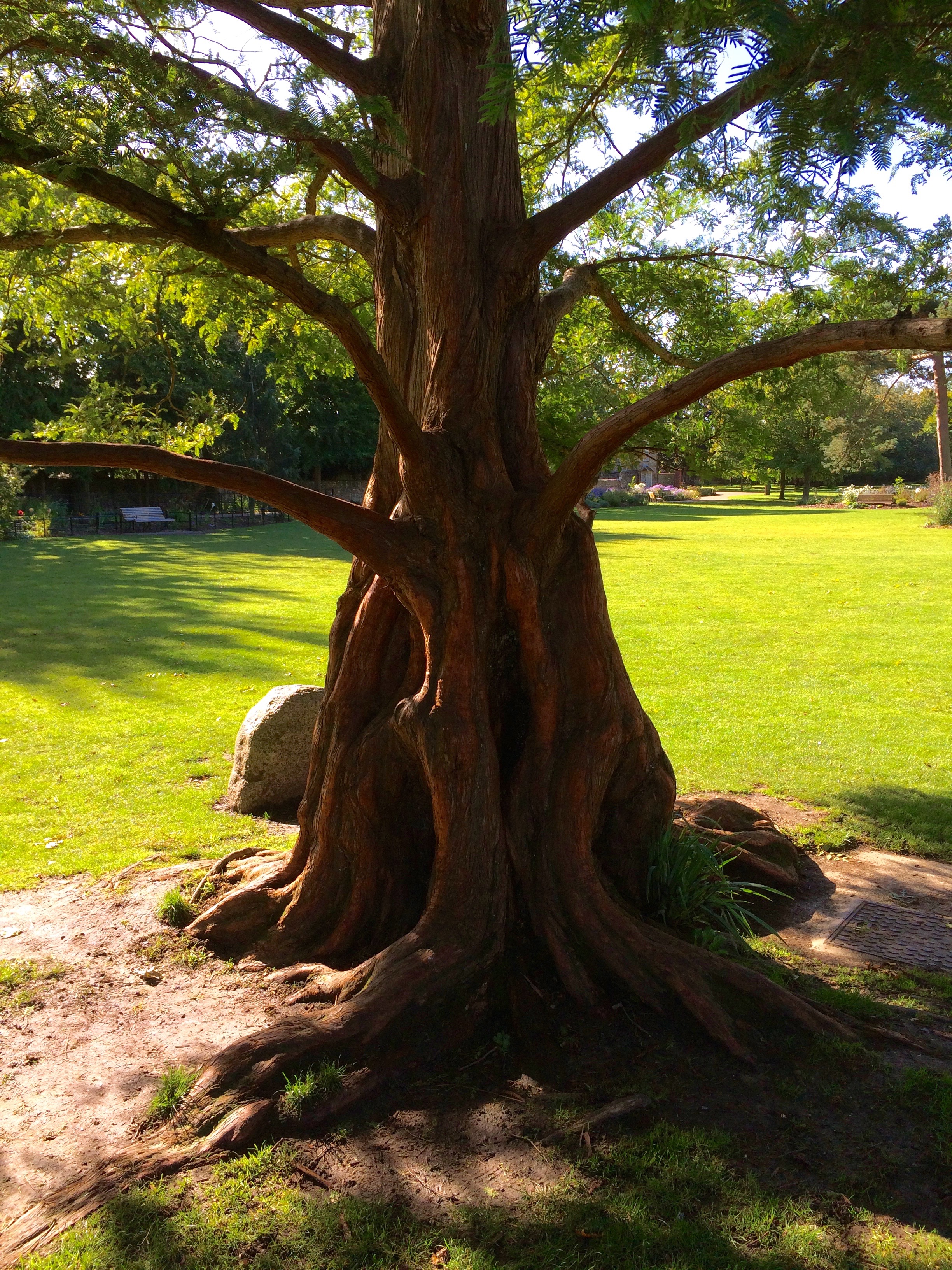
English Redwood – Photo by Becca Tarnas

I came in to Canterbury after a non-stop flight from San Francisco to London Heathrow, and an adventure of trains and tubes, until I was deposited at the Canterbury East station as I approached twenty-four hours of being awake. Trailing my little suitcase I walked up the exceedingly narrow cobbled sidewalks to a hostel I’d booked ahead. A brief wander into town later and my first cup of English tea, I fell into a jet-lagged sleep.

Or tried to. For a variety of reasons I had a terrible night at the hostel and, desperate for a sense of peace and solitude, I checked out early the next morning and managed to find a lovely hotel right in the heart of Canterbury. For the rest of my stay I was grateful to myself for making this decision, so that I might have the space, comfort, and rest to engage fully in the conference. I must say, something about that first difficult night has made all the pleasures of the rest of my trip so far all the sweeter.

Greyfriars Chapel – Photo by Becca Tarnas

After getting my hotel situation sorted, I had a few hours to myself to wander in the morning sun. My feet carried me to the Westgate Towers that have stood at the entrance to the old city for six hundred years. Through the gate I found myself on a bridge over the Stour River, and stretching away on either side of the river were the beautiful Westgate Gardens, a meandering array of lawns, flowers, stone arches, twisting trees, and pathways. I even came across a California redwood, who had adapted to the English soil by growing up with curves and twists, rather than tall and straight like the redwoods on my home coast. I also found my way to Greyfriars Chapel, a small chapel built in 1267 that spans a narrow river.

Eventually the time came to meet Patrick Curry, one of the keynote speakers of the conference, for lunch at the Goods Shed near the Canterbury West station. Goods Shed is a large, barn-like structure filled with stands where piles of colorful organic produce are arranged, and counters selling cheeses, breads, meats, fish, and deserts. Moments later Patrick and his partner walked through the door, and we sat down to an exquisite lunch together: cappuccino, elderflower elixir, a vegetarian platter of grilled squash and eggplant, tomato toast, creamy soup, poached egg, and several other tasty arrangements. Among our topics discussed was Patrick’s new book, Deep Roots in a Time of Frost: Essays on Tolkien, of which he kindly gave me a copy.

St. Martin's Priory – Photo by Becca Tarnas
St. Martin’s Priory – Photo by Becca Tarnas

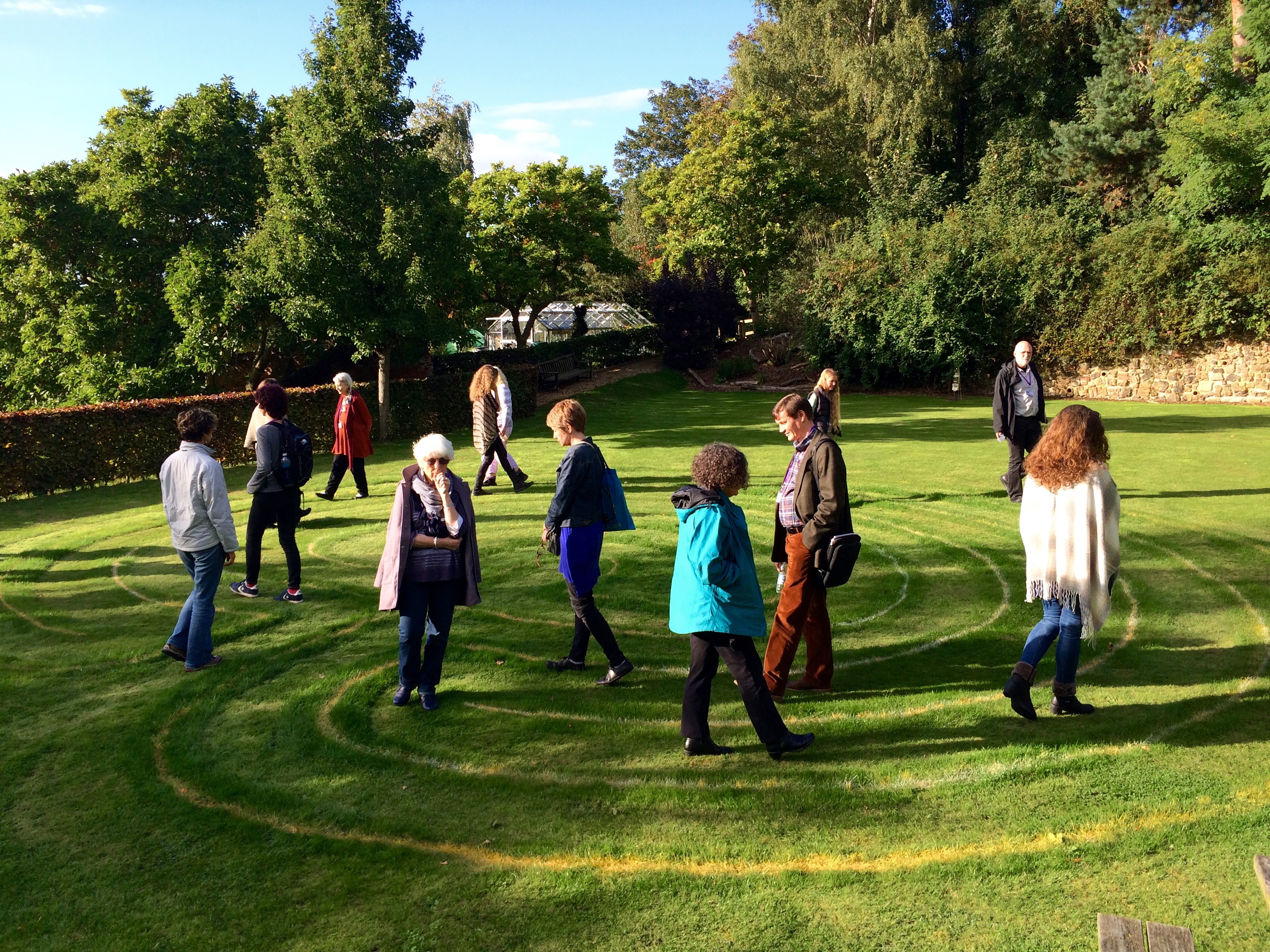
Lunch led us straight to the conference, which Patrick opened with his talk: “The Enchantment of Learning and the Fate of Our Times.” He addressed the need to leave the door open to enchantment, but not to try to force or tame it. One cannot make enchantment happen, one can only cultivate the conditions that allow for its occurrence. With that note to start on we set off on three days of presentations, usually two tracks running simultaneously. The conference was held primarily in St. Martin’s Priory at Canterbury Christ Church University, a gorgeous brick building surrounded by truly enchanting gardens, filled with roses, apple trees, and even a labyrinth set up for one of the conference workshops.

Presentations ranged from psychogeography to depth psychology, the Book Fairy (that moment when you encounter just the right passage or phrase that sets you off on a new train of thought or research), astrology and astrological music, poetry and myth, and the need to re-invite the feminine, the body, and the Earth back into the academy. One issue I brought up in relation to some of the material was the need to address patriarchy both inside and outside the academy, without shaming men who want to be allies, and without recreating an essentialist gender binary. Through this conversation I encountered a wonderful astrologer, who happened to have been friends with my Dad for twenty years. We found that not only did we share a common astrological world view, but her sister is also a harpist! As we chatted together walking merrily home at sunset I felt like I had somehow found my fairy godmother.

My own presentation took place on Saturday afternoon, the third on a panel with the Jungians Jean Hinson Lall and Roderick Main, both of whom I was honored to follow. I presented on my dissertation work, Jung’s and Tolkien two Red Books, and found I had a receptive and supportive audience with wonderful questions and feedback. For me the dialogue carried on long into the evening and the conference dinner.

Conference Labyrinth – Photo by Becca Tarnas

The magnificent Canterbury Cathedral was just a street away from my hotel, so I woke up early Sunday morning to attend communion, primarily from the desire to see and feel the cathedral from the inside in a role that wasn’t a tourist. The air was so still as I approached, my footsteps echoing on the cobblestones and my breath visible in the morning air. Entering inside I was overwhelmed by the majesty of the building, the long stone steps leading higher and further into the nave. This cathedral was founded by St. Augustine in 597 BCE when he came over from Rome to be the first Archbishop of Canterbury, and over the centuries it was expanded and rebuilt, including in 1070 after a major fire destroyed much of the cathedral. I felt a profound mixture of emotions, in part inspired by the minimal attendance in relation to the grandeur of the building. Turning inward I could feel the centuries upon centuries of people who had come here to worship, able to see and hear in my imagination the full crowds that once would have overflowed this hall. Yet now all was nearly quiet.

Ritual. If we are to revive enchantment we need ritual, but it must be ritual that is meaningful for who we are now. Perhaps for many we are in a time between rituals, seeking the meaning that will enchant.

Soon the conference was coming to a close. I was amazed to find that many of the ideas brought forward, presented by individuals from several parts of the world, were frequently ones I had encountered in some form at CIIS. Over the course of the weekend I came to value at a new level the education I am getting at my little institute in California. Yet to engage with so many others specifically on these topics was invaluable.

A final stop at the Goods Shed once again for a piece of quiche, and Patrick and I hopped on the train to London. From there new explorations would soon ensue…

Canterbury Cathedral – Photo by Becca Tarnas

Announcement of Events

I am delighted to announce two events coming up later this year at which I will be presenting. The first event is the conference Re-Enchanting the Academy at Christchurch Canterbury University in England, which will take place September 25-27. I will be presenting on my ongoing dissertation research into the synchronistic parallels of the two “Red Books” of C.G. Jung and J.R.R. Tolkien. The abstract for my presentation is available here: The Synchronicity of the Two Red Books: Jung, Tolkien, and the Imaginal Realm. The Re-Enchanting the Academy Conference Program is now available as well and it looks like there will be a fantastic line-up. I’ll be presenting on Saturday afternoon during the panel session from 1:30-3:00 pm.

Jung - Dragon
Painting by C.G. Jung for The Red Book.

Since the opportunity to go to England does not arise every day, I will be staying a couple weeks in the British Isles to do research in the Tolkien archives at the Bodleian Library of Oxford University, the institution where Tolkien both attended school as an undergraduate and taught as a professor for much of his life. I am hoping to come across some artwork of his, particularly from his early sketchbook entitled The Book of Ishness, that has not yet been published. Who knows what further parallels may lie between the art of the Professor and the great Swiss Doctor? I will also get to travel to Cambridge University to visit my wonderful dissertation chair Jacob Sherman, who is currently holding the three-year post of University Lecturer in Philosophy of Religion.

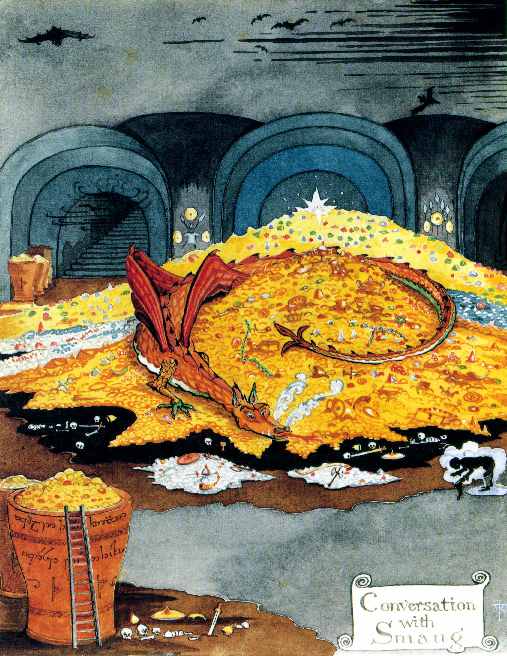
Tolkien – Smaug
Painting by J.R.R. Tolkien for The Hobbit.

The second event which I am announcing is a lecture and workshop offered through the Idaho Friends of Jung in Boise, taking place November 13-14. I will be presenting on the same subject as above, but will have both the Friday evening lecture and the Saturday morning workshop to delve more deeply into the material through dialogue with the participants. The descriptions of the lecture and workshop are available here: The Synchronicity of the Two ‘Red Books’: Jung, Tolkien, and the Imaginal Realm.

Thank you all so much for the support that has allowed me to be bringing these ideas further out in to the world!

From Waldorf to CIIS: Knowing Imagination

This short piece was written as a contribution to a longer essay written by Robert McDermott for the anthroposophical magazine Being Human, edited by John Beck. It appears alongside contributions from Matt Segall and Jeremy Strawn within the context of Robert’s article, Spirituality Affirmed By CIIS

Waldorf Painting of MountainWhy do Waldorf students learn to knit? Why are we introduced to the letter M through the story of a double-peaked mountain, or to V through a tale told in a steep valley? Why are numbers split by Prince Divide, but increased rapidly by Princess Multiply and her little companion butterfly named Of? Why is each classroom wall painted in the ascending order of the rainbow’s spectrum?

As a child in a Waldorf School, the reasoning behind the lessons we engaged in—whether of craftworks and art, bodily expression and poetic movement, of color, sound, and story—were not usually explained to us. In Rudolf Steiner’s pedagogy, the importance lies as much in how a subject is taught as it does in what is taught. Waldorf Schools create not only a unique curriculum, but a unique environment, an atmosphere that one inhales on a day to day basis. If one word could be chosen to capture what such an environment nurtures and develops, it is the capacity of the child’s imagination. If the portal of imagination is allowed to remain open, if it is nourished and kept safe, strengthened and tested through adolescence to maturity, then the reasons behind the teaching of every form of creative practice—from material arts, to etheric movement, from astral knowledge, to personal wisdom—become apparent on their own.

While the spiritual science of anthroposophy is not explicitly taught to Waldorf students, except sometimes as an optional course to graduating high school seniors, the place within the student’s soul in which spiritual science can come to be understood is nurtured through the long arc of the curriculum. When the time comes to leave the imaginative womb of Waldorf education, questions regarding the why of Steiner’s methods may come forth.

As a graduate student whose childhood was shaped by Steiner’s educational approach, I found that the Philosophy, Cosmology, and Consciousness program at CIIS felt like a mature extension of my Waldorf Schooling. Here I was invited not only to continue to keep the doorway to the imaginal open wide, unlike at many other universities and graduate institutions, but I could also begin to explore the reasons behind the form of education that shaped me. Not only is Steiner directly taught in PCC, but many of the graduate program’s other courses can engage with questions initially brought forth by some of my high school and even grade school classes. A continuity of ideas flows between these forms of education, which I feel stems  not only from a recognition of the body, soul, and spirit as channels of knowledge and wisdom, but also a profound respect for the power of the imaginative vision.

Whitehead and Archetypal Cosmology

This paper was presented at the conference “Seizing an Alternative: Toward An Ecological Civilization,” held in Claremont, California at Pomona College. The section of the conference was titled “Alienation from Nature,” and the track, organized by Matthew Segall, was called “Late Modernity and Its Re-imagining.”

This conference is titled “Seizing an Alternative,” a title that implies the alternative is already here, it is not something new that must be invented. The alternative has been present all along, waiting, urging us even, to open our imaginations to the possibility that this alternative is, in a sense, the very essence—a hidden essence—of our world. At this conference our section has been addressing the alienation from the rest of the cosmos felt by the human being in late modernity. And each talk in our track has been revealing, in its own way, the deep interconnection that has always been present between us and our world. We are our world. The cosmic web has not been cut, although part of our human journey has been to feel as though the threads of our existence have been severed.

In 1983 a conference was held at this same university, organized primarily by Catherine Keller and David Ray Griffin. The conference was called “Archetypal Process,” and sought to bring into dialogue the process philosophy of Whitehead and the archetypal psychology of Carl Gustav Jung and James Hillman. As Griffin pointed out, process philosophy and archetypal psychology are both postmodern movements, but postmodern in a different sense from the “relativistic, nihilistic, deconstructive postmodernism” that might better be called “ultramodernism, or mostmodernism.”[1] Process philosophy and archetypal psychology, in Griffin’s words, are examples of “a constructive, reconstructive, or revisionary postmodernism, in which many of the presuppositions of modernity are challenged and revised.”[2] They are postmodern movements that “both want to return soul and divinity to the world.”[3] In his talk at the conference, James Hillman spoke of the need for a metaphysics that could support archetypal psychology. Hillman had abandoned Jung’s metaphysics in order to save his psychology. Yet this was not enough. Metaphysics is always operative, whether one acknowledges it or not. What Hillman sought was a metaphysics of praxis, a metaphysics that supported the practice of psychology, the practice of soul-making—an alchemical metaphysics. Whitehead can provide such a metaphysics, a cosmology in which soul can do its work.

Hillman spoke in his talk of that word, cosmology: it both “refers to the astronomical order of the heavenly bodies, and it also has a metaphysical meaning, according to Whitehead’s Process and Reality.”[4] As Whitehead says, cosmology is a scheme “of general ideas in terms of which every element of our experience can be interpreted.”[5] What if we do as Hillman suggested, and “keep together the two meanings, astronomical and metaphysical?”[6] Allow me to quote Hillman, in his ever-eloquent stylings, on what it would mean to maintain the unity of the two meanings of the word cosmology:

Let us say that the astronomical bodies (the planets) offer metaphysical bodies (the Gods [or one might say the archetypes]) by means of whom every element of experience can be interpreted. What is beyond in both meanings are the heavenly bodies. These afford some nouns and adjectives, some processes and some realities. The planetary persons fill the void of the beyond with the myths of their bodies and the bodies of their myths. This cosmology is a psychological field—a field because metaphysics is placed in imaginal locations; psychological because the planets are persons with traits, with behaviors, and in relation with one another.[7]

Hillman is offering us a vision of an archetypal cosmology, an archetypally-patterned, astronomically-grounded cosmology­.

In his work with Stanislav Grof on non-ordinary and expanded states of consciousness, Richard Tarnas came to find, in his words, “a highly significant––indeed a pervasive––correspondence between planetary movements and human affairs.”[8] What is this correspondence? It is perceptible in the position of the planets at one’s birth, as well as in the transiting movement of the planets in relation to the birth chart throughout one’s life, and the ever-changing dynamics of the planets’ relational positions to each other. It is a correspondence of an archetypal character. Archetypal astrology. It is a continuously ongoing, universally visible form of synchronicity, what Jung describes as a meaningful coincidence between an inner event and an outer event. Archetypal astrology is an empirically-based, yet mythopoetically informed, practice—tracking the ongoing archetypal interconnection between psyche and cosmos, microcosm and macrocosm.

While Tarnas and others have put forward substantial evidence for the astrological perspective, demonstrating the multifaceted ways in which astrology works, today I want to explore another question: why does astrology work? What does the recognition of the highly precise, yet poetically subtle, correspondence between planetary movements and events on Earth indicate about the nature of the cosmos? In dialogue with this question Whitehead’s process philosophy can, perhaps, offer us a metaphysical foundation.

Before moving forward, a word on the nature of archetypes. Perhaps this can best be conveyed by Jung himself, the great diviner of the archetypal patterning of the human psyche. To quote Jung:

A kind of fluid interpenetration belongs to the very nature of all archetypes. They can only be roughly circumscribed at best. Their living meaning comes out more from their presentation as a whole than from a single formulation. Every attempt to focus them more sharply is immediately punished by the intangible core of meaning losing its luminosity. No archetype can be reduced to a simple formula. It is a vessel which we can never empty, and never fill. It has a potential existence only, and when it takes shape in matter it is no longer what it was. It persists throughout the ages and requires interpreting ever anew. The archetypes are the imperishable elements of the unconscious, but they change their shape continually.[9]

As this quote from Jung illustrates, it is the very nature of the archetypes to not be fully definable and describable, without misrepresenting and dulling their divine luminosity. Thus, moving forward, I want to acknowledge the impossibility of capturing archetypal presence in a single metaphysical system that explains in totality how they operate in the world.

In his introduction to the book that emerged from the “Archetypal Process” conference, Griffin draws a parallel between Jung’s concept of archetypes and Whitehead’s concept of eternal objects, each being part of an explanation of formal causation. For Whitehead, an eternal object is “any entity whose conceptual recognition does not involve a necessary reference to any definite actual entities of the temporal world.”[10] An eternal object is a potentiality relevant to some actual occasion, a possibility not yet defined by actuality. Eternal objects are like Platonic Forms in that they are real apart from any of their particular expressions, but unlike Plato’s Forms, their reality is “deficient in actuality”[11] according to Whitehead. Because of this deficiency, eternal objects long to enter into actuality, to ingress into actual occasions. All the ways in which we describe this world—the adjectives—these are the eternal objects: the colors, shapes, feelings, smells, tastes, qualities. Archetypes we come to understand through such qualities, but archetypes are the unifying fields or gravitational attractors that draw together a complex array of eternal objects into singular, though always fluid, form.

Grant Maxwell, who spoke yesterday in this track, has written about the relation between Whitehead’s eternal objects and Jung’s archetypes. He posits that planetary archetypes and eternal objects are both examples of formal causation, a mode of causality forbidden by modern materialism. He also suggests they should not be directly equated. I agree. I would speculate that planetary archetypes include both the potentiality of Whitehead’s eternal objects and the incarnate experience of actual occasions. Archetypes are not just eternal objects or potentials, because they would seem to have more agency and autonomy that Whitehead grants to eternal objects. Archetypes are complex personalities, persons even in Hillman’s language, yet there is a metaphorical unity to their complexity. “All ways of speaking of archetypes,” Hillman writes, “are translations from one metaphor to another.”[12]

To explore metaphor more deeply, we can make a slight turn toward Owen Barfield, the anthroposophically-informed philosopher who wrote such works as Saving the Appearances and Poetic Diction. Barfield posits an understanding of the evolution of consciousness in which the physical and psychical, material and spiritual, bodily and ensouled qualities of all entities in the world were once unified in the experience of ancient human consciousness. Only over the slow course of history have these concepts been separated from each other—subjective from objective—so that even now my language describing this to you inherently reflects this split. I must speak of object and subject, body and spirit. To give an example Barfield uses to illustrate this: when we translate the Latin word spiritus into English, spiritus can mean “wind,” “breath,” or “spirit” depending on the context. Yet for the ancient speakers of the word spiritus it meant all three of these words, and perhaps more, all at once—they were a unified whole in which the physical is utterly indistinguishable from its psychical, ensouled presence.

Yet these words are inherently related to one another at their source. They are examples of “true metaphor” in Barfield’s understanding. The way certain eternal objects complexify and ingress as archetypal beings is an example of such “true metaphor.” As Hillman said, “All ways of speaking of archetypes are translations from one metaphor to another.”[13] The infinite array of eternal objects that express the qualities of Saturn, or Venus, or Neptune, or any of the other planetary archetypes, are metaphorically related to one another, a relation that was much more apparent to ancient consciousness than to modern consciousness. This is how the ancients knew what names to give the planets, which physical planets belonged to which Gods, because the meaning of the celestial bodies was directly apparent to them. The world has changed because we have changed in our participation with it. Yet it still continues to change. The music of the spheres may have been silent for many in late modernity, yet now—at the turn of the tides—we are beginning to relearn the score.

For Whitehead the source of all things is creativity. Creativity is primary. Creativity is the realm of pure potential. Chaos. Griffin has referred to Whitehead’s philosophy as “process theology,” “especially when the chief focus is on God and other questions of ‘ultimate concern’ (Paul Tillich), such as ultimate origin, order, value, and meaning.”[14] In Whitehead’s scheme, God is not the ultimate. Creativity is. God is that which orders the chaos of pure potentiality into the hierarchy of eternal objects—and, I would posit, into the archetypes. God takes chaos and turns it into cosmos, but God is born of that chaos. God is the first concrescence, an everlasting concrescence, the first experiential achievement of chaos becoming cosmos.

An image I find compelling to illustrate this—chaos becoming cosmos—is that of a prism refracting white light into an iridescent rainbow. The white light is that realm of pure potentiality, chaotic creativity. In Whitehead’s scheme the prism itself is God, that which refracts the indefinite into the definite, that differentiates pure light into the colors of the rainbow. Each color is an archetype—red clearly different from blue, yellow distinct from purple. But within the band of light that is each color an infinity of shades is at play. Every shade of green could be seen as every possible eternal object that could ingress as an expression of Venus, or every shade of blue the endless possibilities of Neptune. They are still the same light as the white light, but the prism—which could be identified with God—has ordered them into colors.

What makes a rainbow so spectacular? Why do we stop to take note of them? Because we can see them. A rainbow makes light itself visible. The rainbow is a symbol of divine possibility entering into the world, yearning for our participation in its beauty.

The moment a child takes her first breath can be seen as the first concrescence of that child independently of the mother’s body. The child herself is a society of actual occasions, each of which are also concrescing in this moment, making up the experience of the newborn. This moment, the first inhalation, is when the birth chart of an individual is set. The archetypal energies expressed throughout the rest of an individual’s life reflect the planetary configurations, the archetypal relationships, or eternal potentialities, of this particular moment. At the time of birth all of the actual occasions that have ever been, that have perished into objective immortality to use Whitehead’s term, become one— are prehended by the actual occasion that is the newborn child in that moment—before also perishing. Every archetypal expression that has ever manifested is gifted to the child. Yet the past actual occasions that are most felt by the concrescing actual occasion are those that are immediately prior. Thus the positions of the planets and their correlated archetypal energies, that are being enacted everywhere upon the Earth, are what is most immediately inherited by the child in her first moment of independence. As the child continues to live and grow, her subjectivity—the crest of her concrescing wave—continues to inherit the archetypally ordered actual occasions, as can be seen in the unfolding of astrological transits. Yet the birth chart is still effective, and can still be seen in the progression of the individual’s life. How can this be so? How can a past actual occasion, from the moment of birth, be more archetypally influential than other past actual occasions?

Let us return to the image of God as an eternally concrescing actual occasion, never perishing but continuously feeling the procession of the cosmic community of finite actual occasions. Perhaps in this understanding of God we can glimpse what may be happening in relation to the actual occasion when the individual’s birth chart is set. It is almost like the actual occasion that concresced with the child’s first intake of air is also an everlasting concrescence, one that continues from that moment forward. Each preceding concrescence takes place within the gestalt set by that first concrescence—which is how transits to the birth chart could be experienced by the individual. The birth chart is like the prism of that individual’s life, refracting the archetypal potential into the archetypal particulars of this person. That moment when the birth chart is set concresces onward, even beyond the bodily death of the individual. We see transits to the birth chart still being operative long after the person carrying that chart has died: for instance, when a renaissance of interest in someone’s work occurs after their death. As an example, (and please excuse my more technical astrological language for a moment) as this conference is being held Neptune in the sky is exactly crossing Whitehead’s natal Mercury-Uranus square, bringing a revisioning and reimagining of world view, which relates to Neptune-Uranus, to Whitehead’s ingenious philosophical system, which relates to Mercury-Uranus.

Like the dipolar nature of Whitehead’s God, the archetypes too seem to have a primordial pole and a consequent pole. The primordial pole orders the realm of eternal objects so that they can ingress as relevant possibilities into the actual occasions of the cosmic community, while the consequent pole feels the experiences of this world community and continuously adjusts the ordering of the eternal objects. So too, I believe, it is with the archetypes. For as they ingress into living manifestation, we participate in their becoming, we co-creatively engage their archetypal qualities through our own lives. The archetypes also have a consequent nature, one that feels what we feel, and that forever reshapes the potentialities for the future ingression of the archetypes, in our own lives and in the lives of future generations. Our participation is enacting an evolution in the archetypes themselves.

We are being called upon to seize an alternative. We are being called upon to participate. By consciously engaging with the archetypes as we co-creatively manifest them, we are reshaping the potentialities with which they will manifest in the future. No future is yet set. But the past occasions that will inform it are here now. A rainbow makes white light visible. Let’s look forward with eyes open.

Bibliography

Griffin, David Ray, ed. Archetypal Process: Self and Divine in Whitehead, Jung, and Hillman. Evanston, IL: Northwestern University Press, 1989.

Hillman, James. Re-Visioning Psychology. New York, NY: Harper Perennial, 1992.

Jung, C.G. “The Psychology of the Child Archetype.” In The Archetypes and the Collective Unconscious: Collected Works of Carl Gustav Jung. Translated by R. F. C. Hull, Edited by H. Read, M. Fordham, G. Adler, W. McGuire. Princeton, NJ: Princeton University Press, 1940.

Maxwell, Grant. “Archetype and Eternal Object: Jung, Whitehead, and the Return of Formal Causation.” Archai: The Journal of Archetypal Cosmology Volume 3 (Winter 2011): 51-71.

Tarnas, Richard. Cosmos and Psyche: Intimations of a New World View. New York, NY: Viking Penguin, 2006.

Whitehead, Alfred North. Process and Reality. New York, NY: The Free Press, 1985.

Cosmos

[1] David Ray Griffin, “Introduction,” in Archetypal Process: Self and Divine in Whitehead, Jung, and Hillman, ed. David Ray Griffin (Evanston, IL: Northwestern University Press, 1989), 6.

[2] Griffin, “Introduction,” 6-7.

[3] David Ray Griffin, “Preface,” in Archetypal Process: Self and Divine in Whitehead, Jung, and Hillman, ed. David Ray Griffin (Evanston, IL: Northwestern University Press, 1989), vii.

[4] James Hillman, “Back to Beyond: On Cosmology,” in Archetypal Process: Self and Divine in Whitehead, Jung, and Hillman, ed. David Ray Griffin (Evanston, IL: Northwestern University Press, 1989), 220.

[5] Alfred North Whitehead, Process and Reality (New York, NY: The Free Press, 1985), 3.

[6] Hillman, “Back to Beyond: On Cosmology,” 220.

[7] Hillman, “Back to Beyond: On Cosmology,” 220.

[8] Richard Tarnas, Cosmos and Psyche: Intimations of a New World View (New York, NY: Viking Penguin, 2006), 68-69.

[9] C.G. Jung, “The Psychology of the Child Archetype” (1940) in The Archetypes and the Collective Unconscious, Collected Works of Carl Gustav Jung, trans. R. F. C. Hull, ed. H. Read, M. Fordham, G. Adler, W. McGuire, (Princeton, NJ: Princeton University Press), 179.

[10] Whitehead, Process and Reality, 44.

[11] Ibid, 34.

[12] James Hillman, Re-Visioning Psychology (New York, NY: Harper Perennial, 1992), xix.

[13] Hillman, Re-Visioning Psychology, xix.

[14] Griffin, “Introduction,” 3.