Forever Jung? C.G. Jung’s Continued Relevance During Challenging Times

Over the autumn equinox weekend, September 19–21, the East West Psychology Program at the California Institute of Integral Studies will be co-hosting a hybrid online/in-person conference with the San Francisco Jung Institute entitled, Forever Jung? C.G. Jung’s Continued Relevance During Challenging Times.

The keynote speakers of the event will be John Beebe and Richard Tarnas, and many other CIIS faculty will be offering presentations. My own graduate program at CIIS, the Philosophy, Cosmology, and Consciousness program, is well-represented with Sean Kelly, Matthew Segall, and myself all offering presentations.

My own presentation is titled “Jung’s Participatory Imagination.” Here is the description of my talk:

The Red Book of C.G. Jung is a personal record of one man’s experiential encounter with the great mystery of the unconscious. And yet, The Red Book also documents powerful visions and fantasies with collective import pertaining, in some ways, to the whole of humanity. This presentation posits the idea that the fantasies Jung encountered through the practice of active imagination can be understood not just as a subjective experience, nor as an objective spiritual disclosure, but as a participatory co-creation between the human faculty of the imagination and the archetypes of the collective unconscious.

Please visit the Conference Website for more information and to register!

The Mythopoetic Imagination of J.R.R. Tolkien: Reading “The Lord of the Rings”

“All we have to decide is what to do with the time that is given us.”

Have you always wanted to read The Lord of the Rings but never got around to it? Or have you been longing to return to Middle-earth, but perhaps have been waiting for the right occasion to do so? If the answer is yes, the moment could be ripe to take a journey through this great myth for our time—alongside a fellowship of student travelers and with a guide who has been exploring this world for nearly twenty-nine years.

It is my absolute honor and joy to be teaching the course “The Mythopoetic Imagination of J.R.R. Tolkien: Reading The Lord of the Rings” in collaboration with Kosmos Institute this Autumn 2025. Please join us as we spend twelve weeks reading our way through J.R.R. Tolkien’s great work, The Lord of the Rings.

Learn More and Register

Course Description

The Lord of the Rings by J.R.R. Tolkien has been a beloved story to several generations since its publication in the mid-1950s. The story has a timeless quality to it, and engages with a complex struggle between good and evil, death and immortality, power and freedom. The Lord of the Rings blends otherworldly romance with the high rhetoric of epic mythology, at times interwoven with the internal depths of the nineteenth century novel and the political climate of the twentieth century. As Tolkien’s close friend and colleague C.S. Lewis once said: “Nothing quite like it has been done before. This book is like lightning from a clear sky . . . here are beauties which pierce like swords and burn like cold iron.”

The Lord of the Rings is a text treated by many as a sacred text, one to be returned to year after year, or read aloud with loved ones. The Lord of the Rings has become a myth for our time. This course offers a journey through Tolkien’s magnum opus in a community of learning, guided by a scholar who has spent more than two decades engaging Tolkien’s writings and artwork. This course is designed both for newcomers to Tolkien’s narrative, and for veteran travelers through Middle-earth’s many realms. Together we will explore the grand themes and hidden nuances of Tolkien’s epic story, connecting The Lord of the Rings to the larger mythology of Middle-earth, and situating Tolkien’s process of writing within his own powerful experiences of the imaginal realm.  

To learn more and register, please visit: Kosmos Institute – The Mythopoetic Imagination of J.R.R. Tolkien

Summer 2023 Speaking Engagements

The season has already been off to a rich start full of travels, beginning with a research trip to Prague and the Rhine Valley, a constellation of inspiring astrological stars at NORWAC in Seattle, the enchanting Jung by the Sea conference in Cornwall, England, and attendance at the world’s largest psychedelic conference, with a total of 12,000 participants, at Psychedelic Science 2023 in Denver, Colorado.

Polhawn Fort, Cornwall

Recordings of the presentations I gave at NORWAC and Jung by the Sea are available for those who were unable to attend these events in person. At NORWAC, I gave two talks: “Permutations of Venus” and “Psychedelics and Astrology: A Symbiotic Relationship.” The latter talk offers a glimpse into some of the material I’ve been working with during this last year of research, for those who might be curious what I’ve been up to! At Jung by the Sea, I presented once again on “The Synchronicity of the Two Red Books: Jung, Tolkien, and the Imaginal Realm,” although there were some new elements of the talk particularly related to the exquisite setting on the cliffs of the Cornish coast, and I feel this was my best presentation of the work thus far. It was an extraordinary honor to present this material not only to this insightful Jungian audience, but especially to my fellow presenters, several of whom were major inspirations during my research into the two Red Books: Liz Greene, Tom Cheetham, and—the editor of Jung’s Red Book himself—Sonu Shamdasani.

As the summer progresses, I’ll be focusing almost entirely on writing—albeit with the delightful exception of three new talks I’ll be presenting to the astrological community. On Sunday, July 2, I’m returning to Adam Elenbaas’s Nightlight Astrology speaker series to present on “Jupiter-Uranus: The Creative Genius” in anticipation of the Jupiter-Uranus conjunction that is just beginning and will enliven our collective zeitgeist for the next 14 months.

A few weeks later on Saturday, July 22, I’ll be offering a presentation for NCGR San Francisco titled “The Compassionate Astrologer,” exploring practical guidance on how to create an ethical and therapeutic container in which the astrology client is empathically mirrored, while also being empowered to fall in love with their own birth chart. Although this presentation description refers to working with clients, the material is applicable for anyone who practices astrology, whether the seasoned professional or the novice astrology student.

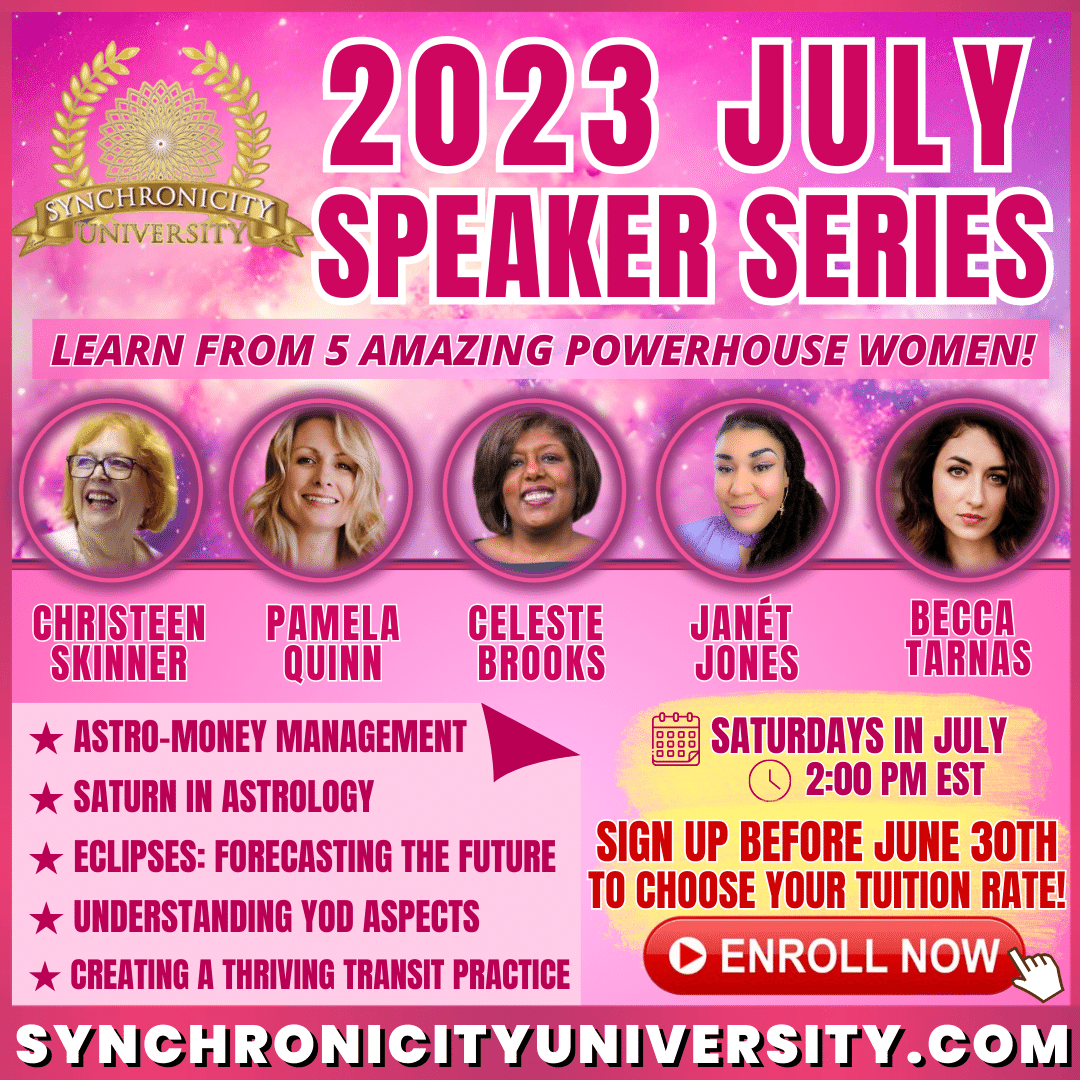
Finally, on Saturday, August 5, I’ll be giving a class at Nadiya Shah’s Synchronicity University on “Creating a Thriving Transit Practice.” In the class, I’ll be giving step-by-step instructions on how to calculate your own transits using just your birth chart and an ephemeris. This is an extremely empowering and liberating skill to have for all astrology enthusiasts and will allow you to deepen your practice and enhance your relationship to the starry sky above you and its archetypal dynamics within you. This is one of the more practical classes I have offered, and I’m excited to enter into the technical details with a new group of astrology students. If you sign up before June 30, you can choose your own tuition rate for the entire summer series that Synchronicity University is offering—a rare opportunity to learn from five different female teachers over the course of a month.

Whether you decide to attend one talk or all of them, or go back to catch the recordings of those already past, I would be so delighted to know this material is reaching those who need to hear it at this time. May your summer months be resplendent with new adventures, wild awakenings, and timely insights!

Imagination as Birthright

Originally published in Imaginezine on October 9, 2021.

Close your eyes and turn your gaze inward. At first the image is dark, a soft warm glow behind the eyelids. But before long, a vision begins to take form.

The light increases and colors begin to differentiate: greens and yellows, deep browns and a hint of pale blue. The interplay of dappled light and shadow dances before your gaze. The edges clarify, crisp lines and measured dimensions extending in all directions around you. You look down and notice your feet nestled in cool grass. A meandering pathway stretches before you, winding around the roots of majestic trees, towering above you and filling the sky with their leafy branches. You take a step forward and hear water falling to your right. A short distance into these woods, a small stream begins to flow parallel to the grassy path you tread. It gathers in lilting pools, and the slim beams of sunlight that escape between the tree branches send dazzling sparkles across the surface of the swirling waters. As your focus on these glimmers of sun softens and blurs, the vision fades, and before you could mark the transition you find yourself seated back at your desk, physical eyes open, wondering where you just went.

This is the power of the imagination. The faculty of imagination has the ability to take our consciousness anywhere: to any time or place, from every region of the Earth to the farthest reaches of the evolving cosmos. We can visit the birth of time when the universe flared forth into being. We can enter into a yet unlived future, imagining a dystopian urban wasteland or an ecologically balanced utopia. We can cross the threshold into other worlds, whether Middle-earth, Narnia, Earthsea, or Wakanda.

In the modern era, the philosophical and scientific perspectives on imagination defined the products of this faculty as something unreal—simply made up, a mere fantasy. When speaking about imagination, the modern mind needs to use disparaging words to make clear that such expressions have no validity: it was “just your imagination,” “merely a fantasy,” “only a dream.” Such words rob the imagination of its power, or at least attempt to do so.

For without the imagination there would be no innovation, no scientific or technological breakthroughs, no great works of art, literature, and architecture. Civilization itself is built upon foundations of imagination, dreamed into being and imagined into reality.

The time has come to reclaim the imagination, to nurture its innate abilities in children and teach once again the techniques of its cultivation to adults. Imagination is inherent to humanity, and perhaps even to every species of the Earth community, a hidden property of the cosmos itself. Just as we need disciplines to hone our crafts and spiritual practices—from writing and painting, dance and carpentry, to meditation and prayer, yoga asanas and qi gong—so too we need disciplines to hone our ability to imagine: active imagination, lucid dreaming, visualization, intuitive art-making, and automatic writing.

So close your eyes and see where your inner vision and senses take you. The journey into the imaginal realm is your cosmic birthright.

Return to Middle-Earth: Reading J.R.R. Tolkien’s The Lord of the Rings

When dark times are upon us, we need support to sustain us through the long night. The myths and great legends of our cultural heritages provide tales of courage and heroism, beauty and sacrifice, and offer an archetypal pattern to follow in our own lives. Far from escapism, the literary imagination can carry us towards wise ways of taking on seemingly unsurmountable challenges, rebirthing ancient knowledge into new times and situations.

As the weight of the world seems only to grow heavier, I invite you to join me on a journey to an imaginal time that resembles our own more and more by the day. After a hiatus last year, it is my honor to offer for the third time my Nura Learning course Journey to the Imaginal Realm: Reading J.R.R. Tolkien’s The Lord of the Rings. Whether you are new to Middle-earth or are familiar with its well-trod paths, we welcome you to join our literary fellowship, traveling through Tolkien’s chapters in good company. We depart on our journey on the autumn equinox, Wednesday, September 22—a day affectionately known as Hobbit Day.

What does it mean to be a Ring-bearer in such times? What humble heroic role do we each have to play in our own fellowship? I am sure many of us are asking the same questions as Frodo, wishing such events need not have happened in our time. But we can remember, as the wise Gandalf himself says: “…so do all who live to see such times. But that is not for them to decide. All we have to decide is what to do with the time that is given us.”

Learn More and Register

Course Description

The Lord of the Rings by J. R. R. Tolkien has been a beloved story to several generations since its publication in the mid-1950s. The story has a timeless quality to it, and engages with a complex struggle between good and evil, death and immortality, power and freedom. The Lord of the Rings blends otherworldly romance with the high rhetoric of epic mythology, at times interwoven with the internal depths of the nineteenth century novel and the political climate of the twentieth century. As Tolkien’s close friend and colleague C. S. Lewis once said: “Nothing quite like it has been done before. This book is like lightning from a clear sky . . . here are beauties which pierce like swords and burn like cold iron.”

The Lord of the Rings is a text treated by many as a sacred text, one to be returned to year after year, or read aloud with loved ones. The Lord of the Rings has become a myth for our time. This course, now in its second year running, offers a journey through Tolkien’s magnum opus in a community of learning, guided by a scholar who has spent more than two decades engaging Tolkien’s writings and artwork. This course is designed both for newcomers to Tolkien’s narrative, and for veteran travelers through Middle-earth’s many realms. Together we will explore the grand themes and hidden nuances of Tolkien’s epic story, connecting The Lord of the Rings to the larger mythology of Middle-earth, and situating Tolkien’s process of writing within his own powerful experiences of the imaginal realm.

To learn more and register, please visit: Nura Learning: Journey to the Imaginal Realm 

Jung’s Red Book and Active Imagination

This Wednesday, June 9 at 7:30–9:30 pm Pacific time I will be offering an online presentation for the C.G. Jung Society of Vancouver entitled “Jung’s Red Book and Active Imagination.” The presentation is based on the chapter I wrote for the fourth volume of Jung’s Red Book for Our Time: Searching for Soul Under Postmodern Conditions, edited by Murray Stein and Thomas Arzt.

Register for the Event!

In this talk I will speak about Jung’s Red Book, and how the active imagination fantasies Jung experienced can be understood as a co-creation of the human faculty of imagination in participatory relationship with the archetypes of the collective unconscious. After the presentation we will have time for questions and dialogue!

Jung’s Participatory Imagination

This Sunday, August 30 I will be offering an online presentation for the Carl Jung Depth Psychology Reading Group. The presentation is titled “The Participatory Imagination,” and is based upon the chapter I wrote for the fourth volume of Jung’s Red Book for Our Time: Searching for Soul Under Postmodern Conditions, edited by Murray Stein and Thomas Arzt.

In this talk I will speak about Jung’s Red Book, and how the active imagination fantasies Jung experienced can be understood as a co-creation of the human faculty of imagination in participatory relationship with the archetypes of the collective unconscious. These are ideas that arose while I was writing my dissertation, and while they have implicitly informed many of my presentations and classes, this is the first time I am giving a lecture entirely devoted to this topic! After the presentation we will have time for questions and dialogue.

For those unable to attend the live event, the recording is now available:

Talking Creation, Faërie, and Facing 2020 on Rune Soup

It’s a potent week for podcasts! Gordon White and I had our third and perhaps most compelling and exploratory conversation yet on his podcast Rune Soup. We discussed J.R.R. Tolkien’s notion of Faërie, fantasy, and imagination, connecting the principles outlined in his groundbreaking essay “On Fairy-Stories” with his creation myth the Ainulindalë: theory and practice of the sub-creative imagination. In our discussion of my new book, Journey to the Imaginal Realm, we also spoke of how The Lord of the Rings provides a powerful mythos for facing the great challenges in our current era, which are reaching a new peak in 2020. The podcast is available for download or can be listened to directly below.