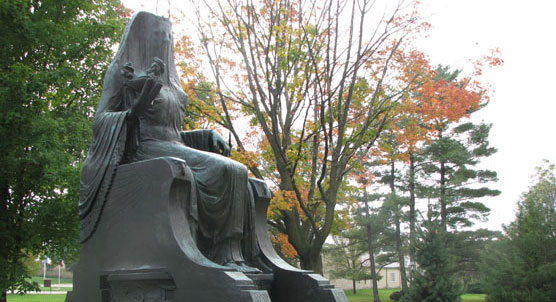
Bridging Our Attitudes Toward Nature

“Phusis kruptesthai philei”

For twenty-five hundred years the concept of Nature has evolved through the writings of Western History. The myriad meanings of the Greek word phusis have unfolded through history as Nature personified, Nature divine, Nature hidden, Nature secretive, nature separate from humanity, nature inclusive of humanity, nature as dead matter, Nature as art, Nature as All. Pierre Hadot traces this winding history in his book-length essay The Veil of Isis by examining the famous aphorism attributed to the philosopher Heraclitus, “phusis kruptesthai philei,” usually translated as “Nature loves to hide.”[1] Using these three cryptic words, whose meaning it seems also loves to hide, Hadot explores the many different ways this aphorism could be—and has been—translated, and the various effects such interpretations have had upon the continuing relationship humanity has with the world into which we each are born. Hadot perceives how traditional metaphors such as Heraclitus’ phrase will

hold sway for centuries over successive generations like a kind of program to be realized, a task to be accomplished, or an attitude to be assumed, even if, throughout the ages, the meaning given to these sentences, images, and metaphors can be profoundly modified.[2]

He goes on to note that “To write the history of a thought is sometimes to write the history of a series of misinterpretations.”[3]

Isis Veiled

Why is it that Nature loves to hide? What is it she—for in Hadot’s traced lineage Nature is always unquestioningly personified as female—is hiding, and from whom is she hiding it? History has offered many answers, from Nature as divine mystery, to Nature as weak and inferior and thus wrapped up in shame, Nature as clothed in imagination, Nature as malicious toward humanity, Nature protective of humanity: all of these and more have been reasons given for why Nature’s veils have been deemed so difficult to peel away.

At the beginning of the nineteenth century, the metaphor of the veils and the secrets of Nature never ceases to fade, until it gives way to amazement before an unveiled Nature, which, in Goethe’s expression, henceforth became “mysterious in full daylight,” in the nudity of her presence.[4]

The image of veiled Nature has tempted the curiosity of humanity from deep into our ancestral memory until the present day, although the understanding of who and what Nature is has shifted dramatically over that time.

Hadot posits two archetypal narratives to illustrate what he sees as the primary approaches humanity has taken in the quest to unveil Nature: the Promethean and the Orphic. In Hadot’s own words, these approaches or perspectives can be understood as follows:

Orpheus thus penetrates the secrets of nature not through violence but through melody, rhythm, and harmony. Whereas the Promethean attitude is inspired by audacity, boundless curiosity, the will to power, and the search for utility, the Orphic attitude, by contrast, is inspired by respect in the face of mystery and disinterestedness.[5]

The Promethean attitude is based upon a notion of progress in which humanity will some day attain all of nature’s veiled secrets so that they might be put to use for the betterment of the human species. The three main methods of the Promethean attitude, as Hadot delineates them, are that of experimentation, mechanics, and magic, all of which manipulate nature in some way for a specific end. In this perspective Nature is seen as hiding her secrets out of hostility for humanity, keeping her knowledge hidden due to a kind of spite.

The Orphic attitude takes the approach that “if nature has hidden certain things, then it had good reasons to hide them.”[6] In many ways the Orphic is an antidote to the Promethean, although it extends far beyond that as well. The Orphic approach is that of approaching nature through the contemplation of art, poetry, music, classical physics, and myth. Hadot’s archetypal analysis of nature is itself an Orphic approach, in that he draws on myth and art to unfold the meanings of humanity’s changing relationship to the natural world.

In our current era of ecological destruction and crisis, understanding what is at stake and how we came to this precipice is key to moving in a new direction. If we do not have an understanding of what humanity has perceived nature to be throughout history then we have little chance of knowing how to heal our relationship to that which we call nature. Although in The Veil of Isis Hadot seems to favor more of an Orphic approach, in that it is more holistic, contemplative, non-violent, and non-exploitative, it could be that finding a bridge between the two perspectives is a better way forward. Although a deep chasm has often separated the two, Hadot offers examples of individual thinkers who embody both perspectives within themselves. For example, to dive back toward Western philosophy’s beginnings, Hadot demonstrates how Plato carries both a Promethean and Orphic attitude within his works. In the Timaeus, “Plato represents the world fashioned in an artisanal way,” but that world can also be understood through mechanical, mathematical models.[7] Plato saw phusis as divine art.[8] For Hadot, the view of nature as art is in itself part of a solution for overcoming the division of human and nature that has contributed to create the ecological crisis.

If. . . people consider themselves a part of nature because art is already present in it, there will no longer be opposition between nature and art; instead, human art, especially in its aesthetic aspect, will be in a sense the prolongation of nature, and then there will no longer be any relation of dominance between nature and mankind.[9]

Hadot’s work is not prescriptive, yet he indicates that finding bridges may be what is needed: a bridge between Promethean and Orphic, a bridge between humanity and nature—and in many ways art is able to fill this bridging role.


Work Cited

Hadot, Pierre. The Veil of Isis: An Essay on the History of the Idea of Nature. Translated by Michael Chase. Cambridge, MA: The Belknap Press of Harvard University Press, 2006.


[1] Pierre Hadot, The Veil of Isis: An Essay on the History of the Idea of Nature, trans. Michael Chase (Cambridge, MA: The Belknap Press of Harvard University Press, 2006), 1.

[2] Hadot, The Veil of Isis, xiii.

[3] Hadot, The Veil of Isis, 14.

[4] Ibid, 87.

[5] Hadot, The Veil of Isis, 96.

[6] Ibid, 91.

[7] Hadot, The Veil of Isis, 97.

[8] Ibid, 22.

[9] Ibid, 92.

Prehending The Monster: A Dance With Whiteheadian Dragons

What does it mean to be a monster in a Whiteheadian universe? A world in which “the holy idea of process”[1] pervades, and all beings are defined in relationship to each other. A world in which God is unconscious and yet able to see all Time and Space, who gives limit and also meaning through infinite patience, a God who may indeed even be a dragon. “Seek out gold and sit on it.”[2] Infinitely patient, eternally growing with the accumulation of the experience of all lowly creatures, God becomes a creature himself bound within the immanent sphere of Time. How does one define oneself in such a world? How to know thyself when there is “No thread, no frailest hair between myself and the universal clutter”[3]?

Dragon

Beowulf is a poetic elegy of heroism, written by an unknown Anglo-Saxon imagination, which we have inherited from Europe’s Dark Ages. “Not that one age is darker than another,”[4] as a post-modern dragon proclaims. The novelist John Gardner has taken this Medieval text and offered it from a new perspective: the man-eating monster Grendel, whom the hero Beowulf defeats in his first battle, tells us his own story of how he came to be who he is. Gardner’s tale is woven of the post-modern philosophies existentialism and nihilism, framing Grendel’s solipsistic view of a disenchanted, mechanistic universe devoid of all meaning. Yet the narrative is also richly saturated with the thought, and even direct quotations of, the process philosopher Alfred North Whitehead, whose voice speaks through a worm from the ancient world, as well as an old priest enraptured with his musings on God, but also through each scene of the story’s unfolding.

It may be that Gardner was able to write Grendel’s tale through a Whiteheadian lens because something of Whitehead’s thought was already present in the original poem of Beowulf, although written some ten to thirteen centuries before Whitehead was ever born. Through Grendel one can begin to see glimpses in Beowulf of prehension and concrescence captured in narrative form, long before they were ever named as philosophical concepts. This study of ancient myth, imaginative poetry, and process philosophy is an exploration in which cause and effect are not dependent upon time, in which the hero’s final defeat can illustrate concrescence, Whitehead’s prehension can illuminate Grendel’s monstrosity, and Gardner’s dragon can give metaphor to the contemporary practice of creating concepts without images, and the dangerous bridges we may walk to understand them.

Grendel woke up in a mechanistic universe, to paraphrase John McDermott.[5] He contemplates the indifference of his world, the “cold mechanics of the stars.”[6] All things are inanimate to him, religion is lunatic, he is vastly alone, isolated. “Space hurls outward, falconswift, mounting like an irreversible injustice, a final disease.”[7] Yet, like so many “terrified by the eternal silence of these infinite spaces,”[8] Grendel seeks out meaning, even as he denies its existence: “Stars, spattered out through lifeless night from end to end, like jewels scattered in a dead king’s grave, tease, torment my wits toward meaningful patterns that do not exist.”[9]

It is as this post-modern “meaning-seeking speck of dust”[10] that Grendel has his first crisis of meaning, in which he sees the living values of what he thought of as the inanimate world. While trapped painfully between two trees, Grendel searches the landscape in vain for his mother, and the objects of the world each present themselves to him.

I twisted around as far as I could, hunting wildly for her shape on the cliffs, but there was nothing, or rather, there was everything but my mother. Thing after thing tried, cynical and cruel, to foist itself off as my mama’s shape… each thing trying to detach itself, lift itself out of the general meaningless scramble of objects, but falling back, melting to the blank, infuriating clutter of not-my-mother…. I seemed to see the whole universe, even the sun and sky, leaping forward, then sinking away again, decomposing.[11]

Grendel is having a cruel experience of the full presence of everything, a multiplicity of what Whitehead calls prehensions, in which everything is always present in, and creating the relational essence of, all other things. Whitehead writes,

The actual world is a manifold of prehensions; and a ‘prehension’ is a ‘prehensive occasion;’ and a prehensive occasion is the most concrete finite entity, conceived as what it is in itself and for itself, and not as from its aspect in the essence of another such occasion.[12]

Each entity in Grendel’s experience is actively putting itself forward; the objects and Grendel prehend each other, yet Grendel also prehends the absence of his mother—her very absence is a real entity that is defining the essence of each object in Grendel’s experience. “Every occasion is a synthesis of being and not-being.”[13] “Being,” in this case, refers to Grendel’s prehensions of all that is physically present, whereas “not-being” refers to his prehensions of what is only conceptually there as a desirable possibility—his mother.

In the trauma and pain of being caught in the tree, believing he is dying, Grendel is having an enchanted experience of the world that immensely contradicts his belief in a meaningless, inanimate universe. He has lost the ability for negative prehension, the “definite exclusion of that item from positive contribution to the subject’s own real internal constitution.”[14] He cannot filter out any presence; it is utterly overwhelming, this interconnection of all things.

At last Grendel is rescued, hours later, by his mother. As he lies safe within his subterranean cave he contemplates his experience and can only conclude that it was entirely projection: “‘The world resists me and I resist the world’ I said. “That’s all there is. The mountains are what I define them as….The world is all pointless accident… I exist, nothing else.’”[15] Grendel refuses to be changed by his experience. Yet, as he thinks on himself thinking, he comes to a realization: “I observe myself observing what I observe. It startles me. ‘Then I am not that which observes!’ I am lack. Alack! No thread, no frailest hair between myself and the universal clutter!”[16] The interconnectivity that is his essence, without which he is lack, sinks in. He experiences a reversal of Descartes’ Cogito ergo sum. I think therefore I am not. Grendel only exists in relation to the entirety of the universal clutter. Who then is he to be?

It is in this state of existential isolation that Grendel first encounters the Shaper. The Shaper is the name Grendel uses to refer to an old minstrel who has come to entertain the thanes of King Hrothgar beneath the golden eaves of Heorot. The Shaper cannot be allegorically exhausted in Gardner’s rendering. On one level the Shaper is clearly the forgotten Beowulf poet himself. His first lines are explicitly the opening lines of the Medieval poem, translated into English:

Hwæt! We Gar-Dena     in gear-dagum, 
þeod-cyninga,     þrym gefrunon, 
hu ða æþelingas     ellen fremedon.[17]

Lo, we have heard the honor of the Speardanes,
nation-kings, in days now gone,
how those battle-lords brought themselves glory.[18]

This puts the Shaper simultaneously inside and outside Grendel’s story. He is composing the tale, yet is also a character within it. Yet Grendel outlives him, so the Shaper writing the entirety of the Beowulf poem is an impossibility, as that poem carries on long past Grendel’s own death. The timing of their deaths contradict each other.

Grendel’s desire to find meaning is met by the song of the Shaper, images woven on the weft of his harp strings. “Even to me,” Grendel says, “incredibly, he had made it all seem true and very fine.”[19] He hears the roaring applause, following the song, of “men gone mad on art.”[20]

What was he? The man had changed the world, had torn up the past by its thick, gnarled roots and had transmuted it, and they, who knew the truth, remembered it his way—and so did I.[21]

The Shaper has the ability to create and reshape history with the power of his poetic imagination. J.R.R. Tolkien, arguably the greatest advocate for Beowulf as a work of creative imagination, perceives this ability of the Beowulf poet to make art appear as history. Beowulf was long studied as no more than a historical document, of little artistic or literary significance, until Tolkien shone a new light on its virtues. “The illusion of historical truth and perspective, that has made Beowulf seem such an attractive quarry,” Tolkien writes, “is largely a product of art.”[22] Tolkien tends to use the term art in a highly specific way: Art is what gives an “inner consistency of reality”[23] to a creation of the imagination. Art is what makes the imaginal real, and what gives the Shaper his great powers.

The Shaper of Gardner’s tale has more roles to play than one in Gardner’s Whiteheadian universe, and he may be no mere mortal poet. His ability to reshape history, to imbue it with beauty and meaning, thus inspiring Hrothgar’s people to lead better lives, bears strong resemblance to what Whitehead calls the “consequent nature of God.” Whitehead writes,

God’s role… lies in the patient operation of the overpowering rationality of his conceptual harmonization. He does not create the world, he saves it: or, more accurately, he is the poet of the world, with tender patience leading it by his vision of truth, beauty, and goodness.[24]

This characteristic of the Shaper is what so enchants Grendel, what draws him in with a desire to participate in the poetic image the Shaper weaves. “He takes what he finds,” Grendel says, “And by changing men’s minds he makes the best of it.”[25]

Finally, it is through Whiteheadian scholar Isabelle Stengers’ reading of Grendel that yet another role of the Shaper is revealed: the Shaper may be Whitehead himself in his mode of creating philosophical thought. Stengers writes that Whitehead “conceived philosophical thought as the Shaper himself conceives of history—as fabulation—and who has succeeded in making converge what should have diverged.”[26] Whitehead creates concepts as the Shaper sings his heroic tales: “Whitehead fabricates, composes, constructs—deliberately, technically, artificially—a universe whose facticity and fictional character cannot be denounced, because they are obvious.”[27] The only character in Grendel who can denounce the Shaper is the dragon. He says, “That’s where the Shaper saves them. Provides an illusion of reality—puts together all their facts with a gluey whine of connectedness. Mere tripe, believe me.”[28] The dragon can make such assured insults because he is granted a greater perspective on all existence; yet he too is limited, for he cannot see his own nature, a topic to which we will return.

Grendel is born into the body of a monster, cursed to be misunderstood in his actions at first sight. Thus he truly becomes a monster, choosing to murder viciously and devour crudely, only after this definition has been projected by others upon him. He sees himself as lack ever since he experienced the world as “not-my-mother,” a lack which awaits definition in relationship to others. But his grotesque physical form can only offer him one relationship. Eavesdropping at Hrothgar’s hall, Grendel hears the Shaper tell of the world’s creation by the greatest of gods, followed by a tale of two brothers: one killed the other, splitting the world into dark and light, and God cursed the murderer. As he listens Grendel realizes he is one of the accursed, doomed to darkness. Throughout Beowulf Grendel is often referred to as of Cain’s descent, an indication of the strange mix of early Christianity and northern mythologies that ignited the poet’s imagination.

þanon woc fela 
geosceaft-gasta;     wæs þæra Grendel sum, 
heoro-wearh hetelic.

And from Cain there sprang,
misbegotten spirits, among them Grendel,
the banished and accursed.[29]

Grendel is enchanted by the Shaper’s words. He believes his tales, even as he wishes for them to be untrue. In a fit of religious conversion Grendel rushes down to Heorot calling “Mercy! Peace!”[30] His presence incites fear in Hrothgar’s thanes and they attack the crying beast they believe to be threatening them. Grendel flees. He is saddled with Cain’s guilt before ever committing Cain’s crime. It is this burden that draws him to the dragon.

Premonitions of the dragon’s presence resound throughout the chapters of Grendel that lead up to the dragon’s introduction; whispers of “something deeper, an impression from another mind, some live thing old and terrible.”[31] Grendel begins to sense the dragon more and more as he sinks further into his own darkness and cravings for violence. “I could feel it all around me,” Grendel recalls, “that invisible presence, chilly as the first intimation of death, the dusty unblinking eyes of a thousand snakes.”[32] Grendel’s prehensions of the dragon seem to shift from non-being ever more toward being until finally he stands within the dragon’s presence. Yet it is never made clear if he ever encounters the dragon in the flesh, or whether the dragon always remains a conceptual prehension. Grendel sits in silence feeling an unknown presence. Then, he says, “I made my mind a blank and fell, sank away like a stone through earth and sea, toward the dragon.”[33]

“I know everything, you see,” the old voice wheedled. “The beginning, the present, the end. Everything. You now, you see the past and the present, like other low creatures: no higher faculties than memory and perception.” He stretched his mouth in a kind of smile, no trace of pleasure in it. But dragons, my boy, have a whole different kind of mind. “We see from the mountaintop: all time, all space. We see in one instant the passionate vision and the blowout. Not that we cause things to fail, you understand…. Dragons don’t mess with your piddling free will.”[34]

“Dragons, real dragons,” Tolkien writes, “are actually rare.”[35] The presence of the dragon in both Grendel and Beowulf is “richer in significance than his barrow is in gold.”[36] Gardner’s dragon hurls philosophy at Grendel with the ferocity of his fiery breath, and Grendel leaves more than a little singed by perplexity. The dragon’s mountaintop view of the universe—all time, all space in one instant—is a view, at least in Whitehead’s cosmology, only God can have. Like Whitehead’s God, the dragon can only know the universe, not alter its outcome. Whitehead’s God can know all the possibilities of the future, but it is the actual occasions themselves that determine the outcome. Creativity thus reigns supreme. “My knowledge of the future does not cause the future,” the dragon says. “It merely sees it, exactly as creatures at your low level recall things past.”[37]

Whitehead’s God, like the dragon, is a creature himself, a creation of ultimate creativity, just as the dragon is a creation of the creative imagination, “incarnate in time, walking in heroic history, and treading the named lands of the North.”[38] There are interesting parallels here with the gods of Norse mythology that was a deep wellspring of inspiration for the Beowulf poet. “In Norse, at any rate, the gods are within Time, doomed with their allies to death.”[39] Gardner’s dragon, like the Norse gods, knows he will eventually die. “A certain man will absurdly kill me.”[40] The man he refers to is, of course, Beowulf, although his name is never once mentioned in the entirety of Grendel. “A terrible pity—loss of a remarkable form of life. Conservationists will howl,”[41] he says with bitter irony. Perhaps it is here that fiction and philosophy diverge, for no such fate seems to await Whitehead’s God, unless we take a deep plunge into Nietzschean post-modern despair.

The dragon and God’s apparent omniscience brings to light the question of fate within Beowulf and Grendel’s stories. God can see all possibilities but not determine the outcome; the dragon seems to be able to see a single outcome but not have the ability to alter it—even his own actions always unfold according to what he has seen. If the dragon is indeed God he seems not to be aware of it, making him unconscious of his full omniscience. Fate certainly plays a prominent role within Beowulf, as we hear of how “one man lay down to his rest, already marked for death;”[42] that “doom abided”[43] in the high, golden gables of Heorot that someday they would burn; or finally, that Beowulf’s “fate hovered near, unknowable but certain”[44] as he went to face the dragon and his own demise.

Sceolde læn-daga 
æþeling ær-god     ende gebidan, 
worulde lifes,     ond se wyrm somod, 
þeah ðe hord-welan     heolde lange. 

After many trials,
he was destined to face the end of his days
in this mortal world; as was the dragon,
for all his long leasehold on the treasure.[45]

The role of fate in Beowulf is a clear sign of what has shifted in our philosophies since the Middle Ages, and what differentiates the Anglo-Saxon poem from Grendel. We have, in many ways, been released from a world in which “the Lord was weaving a victory on His war-loom”[46] into one where God can behold each possible string of the warp and weft but it is up to the tapestry to move the shuttle.

Gardner’s dragon explodes in a tirade against humanity’s inability to create a comprehensive philosophy when it becomes clear his words are not having the desired effect upon Grendel.

“Man” …He snorted fire. “They only think they think. No total vision, total system, merely schemes with a vague family resemblance, no more identity than bridges and, say, spiderwebs. But they rush across chasms on spiderwebs, and sometimes they make it, and that, they think, settles that!”[47]

In the “leap of imagination”[48] it takes to create truly new concepts sometimes one must run forth blindly, balanced on a spider’s thread over a bottomless chasm mired in fog. No images on which to grasp hold. Such is the adventure Stengers embarks on when she undertakes to “think with Whitehead.” In her introduction she warns:

It is a strange tongue that will gradually be elaborated here, a language that challenges all clear distinctions between description and tale-spinning, and induces a singular experience of disorientation in the heart of the most familiar experiences.[49]

Yet the work Whitehead, Stengers, and other process philosophers have taken on is to move away from what the dragon derides: “Simple facts in isolation, and facts to connect—ands and buts—are the sine qua non of all their glorious achievement.”[50] He goes on, succinctly summarizing Whitehead’s project in two simple sentences: “But there are no such facts. Connectedness is the essence of everything.”[51]

Connectedness is the essence of everything. Grendel experienced just this as he searched the landscape of “not-my-mother” and instead encountered the universe rushing in at him with organic attention. But it is more than he can handle. It is more than most mortal beings can handle. The dragon knows this when he says, using direct quotes from Whitehead’s Modes of Thought,

Listen. Listen closely! An angry man does not usually shake his fist at the universe in general. He makes a selection and knocks his neighbor down. A piece of rock, on the other hand, impartially attracts the universe according to the law of gravitation. You grant there’s a difference?[52]

This form of selection is how we handle prehension without being overwhelmed as Grendel was when his ability for negative prehension dissipated. Furthermore, it is the method Grendel chooses from then on so that he can maintain the isolated boundaries of his mechanistic, meaningless world view. He chooses to direct his anger at the universe by brutally murdering and devouring the men of Hrothgar’s kingdom.

Connectedness is the essence of everything. As prehension is defined by Whitehead, nothing has any independent existence. All things “are only entities as within the totality; you cannot extract them from their environment without destruction of their very essence.”[53] If this is the case, by their very existence Grendel needs the humans to be who he is, and the humans need him. But they also are defined by the actions and existence of all the past; Grendel carries Cain’s guilt and the humans can only define him as such. “This unity of a prehension,” writes Whitehead, “defines itself as a here and now, and the things so gathered into the grasped unity have essential reference to other places and other times.”[54] The other places and times in which creatures like Grendel have acted violently toward human beings now weighs on Grendel’s own life, as the dragon mercilessly points out to him.

“Ah Grendel!” he said. He seemed that instant almost to rise to pity. “You improve them, my boy! Can’t you see that yourself? …You drive them to poetry, science, religion, all that makes them what they are for as long as they last. You are, so to speak, the brute existent by which they learn to define themselves.”[55]

The unity of prehension seems to have two important effects in this case. In some strange way the deep interconnectedness of everything begins to bear the weight of fate. Grendel cannot escape who he is meant to be in relation to all others. But prehension holds another effect: if the monster is not monstrous without humans, and humans are not human without the monster, their essence is not only defined against the other but as the other. Thus to reject the monster is also to be the monster. There is a monster inside each of us.

Whether or not we wish to interpret the dragon or the Shaper as aspects of Whitehead’s God, we are given a much more direct glimpse of his God in Grendel’s encounter with the old priest Ork. In Beowulf the God of Christian monotheism is unknown to the Danes, although he does seem to be known to Beowulf, who is a Geat, a foreigner.

Metod hie ne cuþon, 
dæda Demend,     ne wiston hie Drihten God, 
ne hie huru heofena Helm     herian ne cuþon, 
wuldres Waldend.

The Almighty Judge
of good deeds and bad, the Lord God,
Head of the Heavens and High King of the World,
was unknown to them.[56]

The God we meet in Ork’s spiritual revelation is, as Stengers points out, first God as principle of limitation from Science and the Modern World, followed by the God of infinite patience in Process and Reality.[57] “The King of the Gods is not concrete, but He is the ground for concrete actuality,”[58] Ork whispers in a trembling fit. “He is the eternal urge of desire establishing the purposes of all creatures. He is an infinite patience, a tender care that nothing in the universe be vain.”[59] Grendel watches in wonder as the priest sobs in the snow, overcome by his vision, by his realization of the nature of God. Whitehead writes, “The power of God is the worship He inspires.”[60] The worship to which Ork is inspired baffles Grendel because he has never encountered a being worthy of such worship. The dragon inspired terror, anger; the Shaper inspired enchantment, confusion, but neither inspired worship. The dragon and the Shaper do not hold the power that the priest, and before him Whitehead, feels emanating from the King of Gods.

“The ultimate evil is that Time is perpetual perishing, and being actual involves elimination,”[61] Ork cries forth. The encounter with death is a strong theme that courses through Beowulf, and subsequently Grendel.

Ure æghwylc sceal     ende gebidan 
worolde lifes;     wyrce se þe mote 
domes ær deaþe.

For every one of us, living in this world
means waiting for our end. Let whoever can
win glory before death.[62]

Tolkien describes poignantly the experiences of heroes as they live their lives fighting the long defeat against darkness: “…as in a little circle of light about their halls, men with courage as their stay went forward to that battle with the hostile world and the offspring of the dark which ends for all, even the kings and champions, in defeat.”[63] Perpetual perishing may indeed be the ultimate evil, but it is inevitable. In that inevitability, perhaps, is where the beauty and meaning lies. Every actual occasion, in its process of concrescence, becomes in relation to all other actual occasions. So too the hero becomes a hero in relationship to all the surrounding darkness. When concrescence is complete the actual occasion perishes into objective immortality, and thus participates in the concrescence of all other actual occasions. In his final defeat the hero too perishes, but he also perishes into immortality, the immortality born by the glory he has won. Thus God takes care that nothing in the universe is done in vain.

But what, then, of Grendel? He does not seek to win glory, to attain any form of immortality. What can be the meaning of the actions of one who still sees no meaning in the universe in which he lives? His entire journey has not changed him—he was born into the post-modern, encountered the enchanted pagan-Christianity of the Shaper, the undetermined fatalism of the dragon, the painful onslaught of interconnection between himself and all that was not-his-mother—yet by story’s end he is unchanged, a psychopath to experience. In his fatal encounter with Beowulf he recognizes the dragon within Beowulf, sees flames slip from the corners of his mouth, fiery wings ignite behind him. The words of the dragon are whispering through Beowulf, whether in reality or in Grendel’s hallucinating imagination it matters not, for they are all one: Beowulf, the dragon, Grendel. Each is not without the others.

Yet as Grendel escapes Beowulf’s grasp, leaving his arm and life force behind him, he reverts to his sense of meaningless once again, for the final time. He knows he has encountered another world view, the Whiteheadian philosopher embodied in Beowulf as well, and believes he understands him. “Understand his lunatic theory of matter and mind, the chilly intellect, the hot imagination, blocks and builder, reality as stress.”[64] Yet he defines himself to the last in opposition to this.

“It was an accident,” I bellow back. I will cling to what is true. “Blind, mindless, mechanical. Mere logic of chance.”[65]

He cannot change. He does not evolve through any process. This is not why he must die; death is the inevitable, the meaningful, the beautiful. He cannot change. That is what makes him a monster. And the potential to be that monster resides in each of us.

“Poor Grendel’s had an accident,” I whisper. “So may you all.”[66]


Bibliography

Gardner, John. Grendel. New York, NY: Vintage Books, 1989.

Heaney, Seamus, trans. Beowulf. New York, NY: W.W. Norton & Company, 2000.

Stengers, Isabelle. Thinking With Whitehead: A Free and Wild Creation of Concepts. Translated by Michael Chase. Cambridge, MA: Harvard University Press, 2011.

Tarnas, Richard. The Passion of the Western Mind: Understanding the Ideas That Have Shaped Our World View. New York, NY: The Random House Publishing Group. 1991.

Tolkien, J.R.R. The Monsters and the Critics. Edited by Christopher Tolkien. London, England: HarperCollins Publishers, 2006.

–––––. The Tolkien Reader. New York, NY: Ballantine Publishing Group. 1966.

Whitehead, Alfred North. Process and Reality. New York, NY: The Free Press, 1985.

–––––. Science and the Modern World. New York, NY: The Free Press, 1967.


[1] John Gardner, Grendel (New York, NY: Vintage Books, 1989), 159.

[2] Gardner, Grendel, 74.

[3] Ibid, 29.

[4] Ibid, 69.

[5] John J. McDermott, qtd. in Richard Tarnas, The Passion of the Western Mind: Understanding the Ideas That Have Shaped Our World View (New York, NY: The Random House Publishing Group, 1991), 417.

[6] Gardner, Grendel, 9.

[7] Ibid.

[8] Blaise Pascal, in Richard Tarnas, The Passion of the Western Mind, 420.

[9] Gardner, Grendel, 11.

[10] Richard Tarnas, “A Brief History of Western Thought,” course taught at the California Institute of Integral Studies, San Francisco, CA, October 5, 2012.

[11] Gardner, Grendel, 19.

[12] Alfred North Whitehead, Science and the Modern World (New York, NY: The Free Press, 1967), 71.

[13] Whitehead, Science and the Modern World, 163.

[14] Alfred North Whitehead, Process and Reality (New York, NY: The Free Press, 1985), 41.

[15] Gardner, Grendel, 28.

[16] Gardner, Grendel, 29.

[17] Seamus Heaney, trans., Beowulf (New York, NY: W.W. Norton & Company, 2000), 2.

[18] Gardner, Grendel, 41.

[19] Gardner, Grendel, 43.

[20] Ibid.

[21] Ibid.

[22] J.R.R. Tolkien, The Monsters and the Critics, ed. Christopher Tolkien (London, England: HarperCollins Publishers, 2006), 7.

[23] J.R.R. Tolkien, “On Fairy Stories,” in The Tolkien Reader (New York, NY: Ballantine Publishing Group, 1966), 68.

[24] Whitehead, Process and Reality, 346.

[25] Gardner, Grendel, 49.

[26] Isabelle Stengers, Thinking With Whitehead: A Free and Wild Creation of Concepts, trans. Michael Chase (Cambridge, MA: Harvard University Press, 2011), 503-504.

[27] Stengers, Thinking With Whitehead, 506.

[28] Gardner, Grendel, 65.

[29] Heaney, trans., Beowulf, 88-89.

[30] Gardner, Grendel, 51.

[31] Ibid, 48.

[32] Ibid, 50.

[33] Gardner, Grendel, 56.

[34] Gardner, Grendel, 62-63.

[35] Tolkien, The Monsters and the Critics, 12.

[36] Ibid, 16.

[37] Gardner, Grendel, 63.

[38] Tolkien, The Monsters and the Critics, 17.

[39] Ibid, 25.

[40] Gardner, Grendel, 70.

[41] Gardner, Grendel, 70.

[42] Heaney, trans., Beowulf, 87.

[43] Ibid, 7.

[44] Ibid, 165.

[45] Heaney, trans., Beowulf, 158-159.

[46] Ibid, 47.

[47] Gardner, Grendel, 64.

[48] Whitehead, Process and Reality, 4.

[49] Stengers, Thinking With Whitehead, 3.

[50] Gardner, Grendel, 64.

[51] Ibid.

[52] Gardner, Grendel, 69.

[53] Whitehead, Science and the Modern World, 65.

[54] Ibid, 69.

[55] Gardner, Grendel, 72-73.

[56] Heaney, trans., Beowulf, 14-15.

[57] Stengers, Thinking With Whitehead, 3.

[58] Gardner, Grendel, 131.

[59] Ibid, 132.

[60] Whitehead, Science and the Modern World, 192.

[61] Gardner, Grendel, 132.

[62] Heaney, trans., Beowulf, 96-97.

[63] Tolkien, The Monsters and the Critics, 18.

[64] Gardner, Grendel, 172.

[65] Ibid, 173.

[66] Ibid, 174.

The Fantastic Imagination: Sub-creating Tolkien’s Middle-Earth

The road toward truth is circuitous and winding, and passes through many realms. It may be that this path will lead you not outward to the world of objective facts and figures but deep inward, to a realm residing in the soul. This realm has been given innumerable names: the mundus imaginalis, the world of the imagination, Faërie, or by one seer of this Secondary World: Middle-Earth. It is a place we all have been at some point in our lives, and it takes a myriad of forms. Yet some wanderers may choose to linger on the misty, sylvan paths under Faërie’s diamond stars longer than others, revealing enchanted truths and realities hidden to those who choose to remain almost exclusively in the world of common day.

A mythology wields great power and has a desire to be told: thus it became the task of one English philologist, John Ronald Reuel Tolkien, to imagine the mythic world of Middle-Earth into being. During the decades when he crafted Middle-Earth Tolkien often felt as though the mythology was not being made by him, but rather coming through him. In part to explain this experience, Tolkien described his building of Middle-Earth as a Sub-creation, an intertwined outpouring of both invention and inspiration. These ideas, and the power of the imagination to create reality, relate closely to the philosophical explorations of Samuel Taylor Coleridge, in his delineations of the Primary and Secondary Imaginations, their relationship to each other, and their ultimate source.

Middle-Earth

Tolkien composed a world with roots deeply grown into the rich soils of our own world; to achieve this, he employed the powers of language, cartography, history, and legend. Yet, as the willing reader steps through the page into Middle-Earth, the landscape and peoples one encounters seem to have a life of their own, as if a spark of vitality had been breathed by a Primary Creator into the realm Tolkien wove from the resources of his own genius. Whether humanity was indeed given life and form by an ultimate Creator or not, we have been endowed with the ability to create in our own right; sometimes these creations may be gifted their own life and become as real as we are, while still residing within a Secondary World accessible through the imagination that bridges to our Primary World. Why some of our creations are granted such life and others not is a mystery beyond my ability to fathom, but it could perhaps be that some are meant to have their own life and truth, an idea which Tolkien expresses in The Lord of the Rings through Gandalf, when he speaks to Frodo about Bilbo’s finding of the Ring of Power:

Behind that there was something else at work, beyond any design of the Ring-maker. I can put it no plainer than by saying that Bilbo was meant to find the Ring, and not by its maker. In which case you also were meant to have it. And that may be an encouraging thought.[1]

It too may be that Tolkien was meant to bring the mythology of Middle-Earth into being through his writing, and as such it was given the authenticity and truth that so many feel when they traverse its woods and mountains, and converse with its inhabitants as they walk along their roads.

As Henry Corbin points out, the current predominant usage of “the term ‘imaginary’ is equated with the unreal, with something that is outside the framework of being and existing.”[2] Yet one may find quite the opposite: the imaginary, or the imaginal, exists in the innermost place of our souls, and thus is internal and intrinsic to the outer world we call reality. Tolkien is an avid explorer of this realm, which he sometimes calls Faërie, and seems to attest to its reality in an almost off-hand way in his essay “On Fairy Stories.”[3] Tom Shippey sees this as a sign of Tolkien talking down to his readers: “Repeatedly he plays the trick of pretending that fairies are real––they tell ‘human stories’ instead of ‘fairy stories,’ they put on plays for men ‘according to abundant records,’ and so on.”[4] While this could certainly be interpreted that way, it seems rather that Tolkien may actually be describing what he knows of Faërie, as a genuine traveler in the perilous realm. Tolkien valued viewing the world symbolically and mythically, perceiving reality as a whole through the organ of the imagination.[5] As Peter Beagle writes, “I believe that Tolkien has wandered in Middle-Earth” and that he “believes in his world, and in all those who inhabit it.”[6] For Tolkien, Beagle, and many others, Middle-Earth was not “created, for it was always there.”[7]

Tolkien’s own experience of writing was that he was “recording what was already ‘there,’ somewhere: not of ‘inventing’.”[8] He also expressed that “the thing seems to write itself once I get going, as if the truth comes out then, only imperfectly glimpsed in the preliminary sketch.”[9] This has, of course, been the experience of countless artists over the centuries in moments of high inspiration. Norris Clarke writes of these creative experiences, saying, “It felt, they say, as though they were tuned in or connected to some higher power which somehow took over and flowed through them.”[10] What this higher power may be, and how it relates to the imagination, can better be understood by contemplating Coleridge’s philosophical delineations of Primary Imagination, Secondary Imagination, and Fancy.

Other authors, such as Shippey, Verlyn Flieger, and R.J. Reilly, have observed the connection between the imagined world of Faërie, and Coleridge’s “esemplastic imagination.” Reilly describes such imagined realms as “Romantic” because they exist for their own sake, and as such have an inherent relationship or agreement with Coleridge’s Secondary Imagination.[11] Faërie is a creation of the Secondary Imagination, which in turn is an echo of the Primary Imagination, what Coleridge holds “to be the living power and prime agent of all human perception, and as a repetition in the finite mind of the eternal act of creation in the infinite I AM.”[12] The Primary and Secondary Imaginations differ from each other only in degree and mode but not in kind, yet the Secondary is “co-existing with the conscious will” of the human being.[13] While the Primary Imagination can be understood as operating in the mind of the divine Creator, and thus bringing the world as we know it into being, the Secondary Imagination is that same imaginative power operating through the human mind. Owen Barfield, a friend of Tolkien’s and a fellow member of their literary circle “the Inklings,” explored Coleridge’s thought deeply in this area. Barfield explains that the Primary Imagination is an act that we, as human beings, are not conscious of, and when we are conscious of it as our own creative agency it becomes the Secondary Imagination.[14]

The Secondary Imagination “dissolves, diffuses, dissipates, in order to recreate”[15] and “struggles to idealize and to unify.”[16] As an extension of the Primary Imagination responsible for creating reality, the Secondary Imagination also has the ability to create reality, but of a different degree: imaginal reality. This is, for example, why Corbin chose the term mundus imaginalis to differentiate what is just “made up” from “the object of imaginative or imagining perception.”[17] This concept indicates that the product of the Secondary Imagination has a reality of its own, because its ultimate source, like reality, is the Primary Imagination, only it is created through the agency of the human being. Tolkien uses the term “Sub-creation” to refer to the product of the Secondary Imagination, because the result is created under an ultimate Creator.

In addition to the Primary and Secondary Imaginations, Coleridge also writes of Fancy, which is “no other than a mode of memory emancipated from the order of time and space.”[18] Barfield notes that Coleridge seems to not have explicitly segregated Fancy from Imagination, for at times he appears to write of them differing entirely in kind, and at others in degree, comparable to the distinction between Primary and Secondary Imagination.[19] The difference between the product of Fancy, compared to Imagination, could be seen as the difference between something that is just “made up” and a living imaginal world, a true mundus imaginalis.

Tolkien himself addresses the differences between Imagination and Fancy in his essay “On Fairy Stories” and although he does not refer directly to Coleridge, it is clear, as Shippey points out, that Coleridge is whom he is addressing. While Tolkien has comparable, if not identical, definitions of these terms, as a philologist he disagrees with Coleridge’s choice of names. Tolkien asserts that the image-making faculty is the Imagination, and any difference in kind marked by Coleridge between Fancy and Imagination, Tolkien feels solely belongs to a difference in degree. What gives the “inner consistency of reality”[20] to Imagination, the same reality the product of Coleridge’s Imagination has, Tolkien calls Art. Art conjoins with Imagination to create the final result, Sub-creation. The word Tolkien chooses to fully encompass Imagination and the resulting Sub-creative Art, perhaps out of philological jest with Coleridge, is Fantasy, an older form of the diminished word Fancy.[21] Tolkien acknowledged that “fantasy, the making or glimpsing of Other-worlds,”[22] is difficult to achieve: in order to be true Fantasy it must have an inner consistency of reality flowing through the sub-creator’s imagination and into the Secondary World.

A successful sub-creator brings into being a world which both the spectator and designer may enter, a world that has its own laws by which it operates. As long as every facet of the imaginal realm follows these laws, the inner reality of the world remains intact and the world is true.[23] Because of this, for Tolkien, it is essential that all stories about such Secondary Worlds are presented as truth––not as a dream, or some other unreal whimsical creation.[24] For Coleridge, the richness of art is dependent on the unity provided by the Secondary Imagination: it will be “rich in proportion to the variety of parts which it holds in unity.”[25] The unity of Tolkien’s Middle-Earth is held together because each landscape, creature, and name has a consistency that he has forged into the very structure of his world. Furthermore, when the imaginal world is consistent with itself it creates for the reader what Tolkien calls Secondary Belief, or Enchantment.[26] Thus it is as enchanted humans that we walk the glades and forests of Middle-Earth.

What ultimately gives reality to Secondary Art is that it is consistent not only with itself, but also with what Tolkien and Shippey refer to as Primary Art.[27] If the source of Secondary Art is the human imagination, the source of Primary Art is the divine Imagination, or what Coleridge calls the Primary Imagination. For Tolkien, Primary Art is synonymous with Creation, or Truth.[28] For a sub-created Secondary World, or Fantasy, to be true it then must echo the Primary World, as Colin Duriez writes, capturing in its “imaginative accuracy […] some of the depths and splendor of the Primary World.”[29] Fantasy is crafted out of the Primary World, just as the painter or sculptor’s materials are drawn from nature.[30] But in the Fantasy realm we are able to see these primary ingredients in a new way, once again marveling at the wonders of our own world.[31] Tolkien shows the overlap between our own world and Faërie when he writes,

Faërie contains many things besides elves and fays, and besides dwarfs, witches, trolls, giants, or dragons: it holds the seas, the sun, the moon, the sky; and the earth, and all things that are in it: tree and bird, water and stone, wine and bread, and ourselves, mortal men, when we are enchanted.[32] (Emphasis added.)

Faërie could then be seen as the real cosmos but without the human, or rather, without the disenchanted human. After all, as Beagle remarks, the same forces that shape our own lives shape the lives of those in Middle-Earth: “history, chance and desire,”[33] and so forth. When we lead our lives in response to these forces, whether or not we find ourselves in Faërie depends on our level of enchantment, or our Secondary Belief.

Tolkien’s initial desire behind his decades of imaginative effort was to create a mythology for England, which he felt lacked a myth comparable to the great Norse and Greek traditions.[34] England did have the Arthurian legends, but these he felt did not suffice, in part because they contained Christianity, and in part because they were not rooted in the ancient languages of England. Tolkien’s objection to religion in myth is based on his sense that the contours of religious doctrine should only exist implicitly within Fantasy, sunk deep into the morality and actions of the characters. He writes of the Arthurian myth that

it is involved in, and explicitly contains the Christian religion. For reasons which I will not elaborate, that seems to me fatal. Myth and fairy-story must, as all art, reflect and contain in solution elements of moral and religious truth (or error), but not explicit, not in the known form of the primary ‘real’ world.[35]

Like the religious element, language also plays a foundational role in the development of Middle-Earth, rooted deeply into the world’s symbolism and structures.  To forge a world like Middle-Earth, and bring it to the level of a mythology, Tolkien drew simultaneously on invention and inspiration, which seem to be the two major ingredients of Sub-creation. Through invention he built up the world of Middle-Earth from the myths, legends, and languages of Europe. As Patrick Curry writes, Middle-Earth “was a co-creation, in partnership with some very old and durable cultural materials.”[36] Yet it was inspiration that breathed life into the world Tolkien had constructed, giving it its unique characteristics and a vitality of its own.

In some ways invention can be seen as related to Coleridge’s notion of Fancy, and inspiration to the Imagination. Fancy is memory disconnected from time and space, and can only draw on what has been experienced.[37] “Fancy is the aggregating power,” as Barfield writes, “it combines and aggregates given units of already conscious experience; whereas the secondary imagination ‘modifies’ the units themselves.”[38] On the other hand, inspiration, like Imagination, almost seems to have a divine source that pours through the sub-creator and imbues the creation with life and individuality. An example of the difference between Fancy and Imagination, invention and inspiration, can be seen in the race of Ents in Middle-Earth. As invented by Fancy, an Ent is just a talking tree, a rearrangement of the idea “tree” by giving it the human property of “speech.” The word “Ent” comes from the Anglo-Saxon word enta uncovered by Tolkien in his philological research.[39] At this stage Ents are perhaps an interesting etymological find, something to peak one’s curiosity, but as of yet certainly not a living being. But through the power of imaginative inspiration, the invented concept of Ent suddenly comes alive as the bark-skinned Treebeard, also named Fangorn, the oldest living being to walk under the sun. It is truly an enchanted transformation. Ents are bestowed life and step forth as a race of creatures, tree-herders, shepherds of the forests, with a long tragic history of their own, speaking in a slow, rhythmic language of names compiled over the Ages of the World.

Fancy, without the influence of Imagination, also has ties to another form of artistic creation, one which Tolkien said he “cordially dislike[d] […] in all its manifestations”: allegory.[40] By having a prescribed intention––whether a moral, lesson, or message––or by telling an old story in the same configuration but with new names, allegory undermines the freedom of the reader to experience a story as an entity in itself, a self-contained reality. Allegory, by its very nature, undermines truth. Corbin draws out the difference between allegory and genuine Image when he writes, “Allegory […] is a cover, or rather a travesty of something that is already known or at least knowable in some other way; whereas, the appearance of an Image that can be qualified as a symbol is a primordial phenomenon.”[41] Great imaginative works cannot be reduced simply to a moral message or lesson, they have a life of their own, an inherent autonomy beyond the will of the author.[42]

Despite his dislike of allegory, Tolkien did write at least one in his career, but it served the purpose of encouraging him to continue his work on The Lord of the Rings, and offered an image of his hope for the world of Middle-Earth. This was the little tale Leaf by Niggle. Niggle is a painter, who can be equated with Tolkien the writer, who spends his life working on a detailed painting of a tree.

It had begun with a leaf caught in the wind, and it became a tree; and the tree grew, sending out innumerable branches, and thrusting out the most fantastic roots. Strange birds came and settled on the twigs and had to be attended to. Then all round the Tree, and behind it, through the gaps in the leaves and boughs, a country began to open out; and there were glimpses of a forest marching over the land, and of mountains tipped with snow.[43]

Shippey sees in the allegory that the Leaf is Tolkien’s first book The Hobbit, his Tree The Lord of the Rings, and the landscape behind as all the other stories that make up The Silmarillion and fill in the vastness of Middle-Earth.[44] However, the most remarkable part of the story is when it seems to leave the realm of allegory altogether. Niggle goes on a great journey, which is synonymous with death, and after some time in a hospitalized form of purgatory, he is sent to an oddly familiar country which he suddenly recognizes:

Before him stood the Tree, his Tree, finished. […] All the leaves he had ever laboured at were there, as he had imagined them rather than as he had made them; and there were many others that had only budded in his mind, and many that might have budded, if only he had had time.[45]

By stepping into an enchanted realm, Niggle’s work becomes real, the invented becomes the imagined, and he can stand in the shade of his own Tree. The Tree, whether an allegory for The Lord of the Rings, or for fairy story in general, is aptly chosen: the philosopher Gaston Bachelard writes of the tree as a symbol of the imagination, an imagination with the gift to create worlds.

The imagination is a tree. It has the integrative virtues of a tree. It is root and boughs. It lives between earth and sky. It lives in the earth and in the wind. The imagined tree becomes imperceptibly the cosmological tree, the tree which epitomizes the universe, which makes a universe…[46]

Trees not only have high branches but also long roots, and the roots of Tolkien’s Middle-Earth run deep, drawing nourishment from the soil of our own Primary World.

Like most cultural myths, Middle-Earth is rooted in language, but unlike the ancient cultures in which stories and languages evolved simultaneously, Middle-Earth is a philological re-creation, a laying of stonework far older than the hands that built it.[47] Tolkien was as well-equipped as any builder to undertake the task: as a philologist who taught at Oxford and Leeds, he knew twenty languages to varying degrees, and during his lifetime invented another fourteen as well as a variety of scripts.[48] He reconstructed words and names from almost forgotten linguistic origins, drawing on fragments of words from poems and texts that had once formed legends.[49] Tolkien writes in one letter of his Middle-Earth myths:

These tales are “new,” they are not directly derived from other myths and legends, but they must inevitably contain a large measure of ancient wide-spread motives or elements. After all, I believe that legends and myths are largely made of “truth.”[50]

For Tolkien reconstruction was the work of invention, but as he would have known, the root of the word “invention” comes from the Latin invenire, meaning “to find.”[51] So for him invention certainly was not “making up,” but rather “discovering,” an experience he mentioned many times when reflecting on writing the mythology of Middle-Earth. He was not only discovering the different names and languages in the Primary World and reconfiguring them: he seemed also to be discovering Middle-Earth itself, a complete world existing already in the Primary Imagination, coming into form through Tolkien’s own Secondary Imagination.

In approaching The Lord of the Rings, Tolkien began with the map, which gave a solid foundation for the world before he and his characters embarked on their adventures. As in the Primary World, the names of places on the map were crafted out of descriptions of the places; these, in turn, were then worn down into names used in other languages, but no longer holding a meaning beyond the given places.[52] Whether called Tookland, Nobottle, Wetwang, Dunharrow, Gladden, Silverlode, or Limlight each place has its history within and outside of Middle-Earth.[53]

The name Middle-Earth itself, related to the Norse Midgard, actually came to Tolkien through an Old English poem called Crist by the Anglo-Saxon poet Cynewulf. Two lines particularly caught Tolkien’s eye:

Eala Earendel engla beorhtast
offer middangeard monnum sended.

Hail Earendel, brightest of angels
Above Middle-earth sent unto men.[54]

Not only was the name Middle-Earth present as middangeard, but the name Earendel stood out to Tolkien as well, a name which became Eärendil in The Silmarillion; Eärendil was the father of Elrond, bearer of the last Silmaril, the evening star most beloved by the Elves.

Tolkien’s Elves and Dwarves are drawn from the legends and myths of immemorable age that pervade cultures across Europe.[55] Tolkien drew on many aspects of the lore of Elves and Dwarves, presenting both the peril and beauty of the Elves, the longevity and gold-mongering of the Dwarves.[56] His emphasis on spelling “Elves” and “Dwarves” in the ancient manner, as opposed to “elfs” and “dwarfs,” further deepened their roots in history.[57] His invented languages were also based on the languages of Europe; the two Elvish tongues were his most developed vocabulary, with the more common Sindarin Elvish rooted in Welsh, and the High Elvish Quenya drawing on Finnish structures.

Because Middle-Earth was to be a mythology for England, Tolkien drew deeply from the waters of the Anglo-Saxon well: the Rohirrim were based in part on Anglo-Saxons, and the name Eorl is from a line of Old English poetry; other names such as Eomer and Eowyn, as well as the term eored for a troop of horses, all stem from the word eoh meaning “horse.”[58] Tolkien even embedded linguistic changes in the history of Middle-Earth itself. For example, before Eorl the Young brought the Rohirrim from the North to inhabit the Gondorian plains of Rohan, the names of Rohirric leaders had Gothic origins: Vidugavia, Vidumavi, Marhwini.[59] Only after they enter into allegiance with Gondor do the Rohirrim take on Anglo-Saxon names. Both the words “Ent” and “Woses” appeared in Old English poetry, and in Middle-Earth the Rohirrim are appropriately situated between the Entish woods of Fangorn, and the Druadan Forest in which the Woses dwell to the South.[60]

Tolkien’s perfectionism touched every word he wrote in The Lord of the Rings, and he even attended to such details as the direction of the blowing wind and the cycling phases of the moon. He wanted his readers to feel as though they had stepped into history.[61] All of his attention to the distinctions of locality, as Curry describes,

contributes greatly to the uncanny feeling, shared by many of his readers, of actually having been there, and knowing it from the inside, rather than simply having read about it––the sensation, as one put it, of “actually walking, running, fighting and breathing in Middle-Earth.”[62]

Beagle captures beautifully the interwoven intricacy of Middle-Earth, the miniscule details discovered to invent it, and the natural reality they express when fused together as a unified whole: “The structure of Tolkien’s world is as dizzyingly complex and as natural as a snowflake or a spiderweb.”[63] Inspiration unifies the invented parts into an organic whole, thereby animating them. Tolkien writes in one letter, “I have long ceased to invent. […] I wait till I seem to know what really happened. Or till it writes itself.”[64] In another letter, this one to W.H. Auden, Tolkien writes,

I daresay something had been going on in the “unconscious” for some time, and that accounts for my feeling throughout, especially when stuck, that I was not inventing but reporting (imperfectly) and had at times to wait till “what really happened” came through.[65]

As Shippey observed, Tolkien seemed to labor at invention until he reached a moment when he could go no further. Somehow, in that moment inspiration would take over and life would fill the creation he had built; he would then be led into the adventure with just as much bewilderment as his literary companions.[66] It was, as Tolkien calls it, the “fusion-point of imagination,”[67] where invention and inspiration meet and something new is born.

The race of people that set Middle-Earth apart most from all other manifestations of Faërie were not invented from European legends. They seemed to have arrived fully formed, already inhabiting their little Northwestern corner of Tolkien’s world. These were the Hobbits. As Tolkien writes on several occasions, the origin of Hobbits is unknown, even to themselves.[68] In the now well-known pivotal moment, Tolkien was grading exams one summer’s day when he unexpectedly wrote on a blank sheet: “In a hole in the ground there lived a hobbit.”[69] As Shippey notes, Hobbits are “pure inspiration” [70] without a trace of invention to them. Tolkien of course quickly gave them philological roots, connecting “Hobbit” to the Old English word hol-bytla, meaning “hole-dweller.”[71] He went further, setting the Hobbits in an English style of life, seemingly far more modern than the rest of Middle-Earth extending beyond the Shire. Even the names of the Hobbits have echoes of English culture; for example, the name Baggins echoes the English word “baggins” meaning afternoon tea, or any food eaten in between meals, of which Hobbits are rather fond.[72] “The implication,” writes Shippey, “is that the inspiration was a memory of something that could in reality have existed.”[73]

Hobbits, in many ways, are more human than the Men in Middle-Earth, and offer us modern readers a window into their world. They provided the link for Tolkien to connect the Elvish mythologies recorded in The Silmarillion to the world presented in The Hobbit; the result was, of course, The Lord of the Rings. Hobbits put “earth under the feet of ‘romance,’”[74] and as readers we are invited to walk with them.

While Fantasy, as Sub-created Art, can be expressed through many art forms, Tolkien felt Fantasy was “best left to words, to true literature.”[75] Literature allows the imagination to flourish at every level, from the author writing it, to each individual reader imagining what the author presents in her or his own unique way. Tolkien writes, “every hearer of the words will have his own picture, and it will be made out of all the hills and rivers and dales he has ever seen, but especially out of The Hill, The River, The Valley which were for him the first embodiment of the word.”[76] It is as though author and reader alike are drawing on an archetypal realm of the imagination, and each of the images they produce of this world adds another layer of dimensionality, bringing it further into reality. As Reilly writes, “Literature works from mind to mind and is thus more progenitive.”[77]

When the imagination of the reader participates in the Secondary World, the reader then becomes part of that world as well. Beagle writes on his experience of reading The Lord of the Rings, “Something of ourselves has gone into reading it, and so it belongs to us.”[78] He goes on to say the book “will bear the mind’s handling, and it is a book that acquires an individual patina in each mind that takes it up, like a much-caressed pocket stone or piece of wood.[79] The meaning of the work, as Reilly says, resides between the “art work and the perceiving subject”[80] and ultimately lies in the “freedom of the reader.”[81]As readers we also become sub-creators of the Secondary World, as our own imaginations pour forth into our experience of it.

As Duriez expresses, and as a Roman Catholic Tolkien surely believed, our human ability to be sub-creators derives from our being made in God’s image.[82] Tolkien confirms his belief in this when he writes in “On Fairy Stories,” “Fantasy remains a human right: we make in our measure and in our derivative mode, because we are made, and not only made, but made in the image and likeness of a Maker.”[83] Sub-creation is the imagining of God’s world after God[84] but, as Clarke writes, expanding the “limited boundaries of the real world in which we presently live by creating something really new, never experienced by humans before,”[85] and thus enhancing human life. Indeed, Tolkien writes that “liberation ‘from the channels the creator is known to have used already’ is the fundamental function of ‘sub-creation,’ a tribute to the infinity of His potential variety.”[86] For Tolkien, God was, in a way, creating Middle-Earth through him, which may be why he felt like he was discovering a world already in existence.

In one of the last years of Tolkien’s life he received a letter from a man, which he describes as follows: This man

[…] classified himself as ‘an unbeliever, or at best a man of belatedly and dimly dawning religious feeling […] but you [Tolkien],’ he said, ‘create a world in which some sort of faith seems to be everywhere without a visible source, like light from an invisible lamp.’ I [Tolkien] can only answer: ‘Of his own sanity no man can securely judge. If sanctity inhabits his work or as a pervading light illumines it then it does not come from him but through him. And […] you would [not] perceive it in these terms unless it was with you also.[87]

Beagle too was perceiving something of this quality of Tolkien’s work when he wrote about the music that “springs from the center of this world.”[88] Tolkien’s living imagination, flowing from what Coleridge called the Primary Imagination, sprang up alive in the heart of Middle-Earth. It was almost as though the story were asking to be written. For example, Tolkien had a recurrent dream of “the Great Wave, towering up, and coming in ineluctably over the trees and green fields.”[89] He eventually wrote this dream into Middle-Earth, giving it as a dream to Faramir, but also capturing it more fully in the “Downfall of Númenor” in The Silmarillion. Interestingly, once he did write it, the dream ceased recurring. It was as though the dream, possibly coming from the Primary Imagination, needed to become a reality, and once revealed through Tolkien it could rest.

In the lecture Tolkien gave which eventually became the essay “On Fairy Stories,” he expressed his wish that one day the mythology of Middle-Earth would be discovered to be “true,”[90] as he felt the possibility that all myths might be in some realm other than our own.[91] Indeed, it was because of the link Tolkien saw between human creativity and divine making, that he felt “all tales may come true.”[92] Many critics have accused Tolkien’s stories of being escapist, and not having a clear message for the modern world, but as Curry points out, “It offers not an ‘escape’ from our world, this world, but hope for its future.”[93] So indeed maybe all myths may come true, and Middle-Earth will be a reality, in another realm not of space, but of time, possibly a time in our distant future.

At last perhaps we can return to Tolkien’s little allegory, “Leaf by Niggle,” to better understand what he meant. Niggle is joined in the country he painted by his neighbor Parish, who never much appreciated his painting when they had been alive together. Yet when he realizes that it was Niggle who dreamt up the country they are now in he remarks:

“But it did not look like this then, not real,” said Parish.

“No, it was only a glimpse then,” said the man; “but you might have caught the glimpse, if you had ever thought it worth while to try.”[94]

Whenever Tolkien uses the word “glimpse” he frequently seems to be referring to the gleam of truth that shines through Fantasy, whether it is in Niggle’s story, in the preliminary sketches of his plots, or in his definition of Fantasy as “the making or glimpsing of Other-worlds.”[95] Tolkien believed that “there is no higher function for man than the ‘sub-creation’ of a Secondary World”[96] because, as Shippey writes, “it might be mankind’s one chance to create a vision of Paradise which would be true in the future if never in the past.”[97] For Tolkien, the human imagination had the power to create a new Paradise, because he saw the Secondary Imagination as an echo of God’s Imagination, and as it worked through him he felt he was ultimately doing the creative work of God.

Bibliography

Bachelard, Gaston. On Poetic Imagination and Reverie. Putnam, CT: Spring Publications, Inc., 2005.
 
Barfield, Owen. What Coleridge Thought. San Rafael, CA: The Barfield Press, 1971.
 
Carpenter, Humphrey. J.R.R. Tolkien: A Biography. New York, NY: Houghton Mifflin Company, 2000.
 
Clarke, Norris. “The Creative Imagination: Unique Expression of Our Soul-Body Unity.” In The Creative Retrieval of St. Thomas Aquinas, 191-208. New York, NY: Fordham University Press, 2009.
 
Coleridge, Samuel Taylor. Biographia Literaria. London, England: J.M. Dent & Co., 1906.
 
Corbin, Henry. “Mundus Imaginalis, or The Imaginary and the Imaginal.” Translated by Ruth Horine. En Islam Iranien: Aspects Spirituels et Philosophiques, tome IV, livre 7. Paris, France: Gallimard, 1971.
 
Curry, Patrick. Defending Middle-Earth. Edinburgh, Scotland: Floris Books, 1997.
 
Duriez, Colin. Tolkien and C.S. Lewis: The Gift of Friendship. Mahwah, NJ: Hidden Spring, 2003.
 
Flieger, Verlyn. Splintered Light: Logos and Languages in Tolkien’s World. Kent, OH: The Kent State University Press, 2002.
 
Noel, Ruth S. The Languages of Tolkien’s Middle-Earth. Boston, MA: Houghton Mifflin Company, 1974.
 
Reilly, R.J. Romantic Religion: A Study of Barfield, Lewis, Williams, and Tolkien. Athens, GA: University of Georgia Press, 1971.
 
Shippey, Tom. The Road to Middle-Earth: How J.R.R. Tolkien Created a New Mythology. New York, NY: Houghton Mifflin Company, 2003.
 
Tolkien, J.R.R. The Hobbit. New York, NY: Houghton Mifflin Company, 1997.
 
–––––. The Letters of J.R.R. Tolkien. Edited by Humphrey Carpenter, with the assistance of Christopher Tolkien. New York, NY: Houghton Mifflin Company, 2000.
 
–––––. The Lord of the Rings. New York, NY: Houghton Mifflin Company, 1994. 
 
–––––. The Silmarillion. New York, NY: Houghton Mifflin Company, 2001.
 
–––––. The Tolkien Reader. New York, NY: Ballantine Publishing Group, 1966.

[1] J.R.R. Tolkien, The Lord of the Rings (New York, NY: Houghton Mifflin Company, 1994), 54-55.

[2] Henry Corbin, “Mundus Imaginalis, or The Imaginary and the Imaginal,” trans. Ruth Horine, En Islam Iranien: Aspects Spirituels et Philosophiques, tome IV, livre 7 (Paris, France: Gallimard, 1971), 1.

[3] J.R.R. Tolkien, “On Fairy Stories,” in The Tolkien Reader (New York, NY: Ballantine Publishing Group, 1966), 33.

[4] Tom Shippey, The Road to Middle-Earth: How J.R.R. Tolkien Created a New Mythology (New York, NY: Houghton Mifflin Company, 2003), 49.

[5] Colin Duriez, Tolkien and C.S. Lewis: The Gift of Friendship (Mahwah, NJ: Hidden Spring, 2003), 178.

[6] Peter Beagle, “Tolkien’s Magic Ring,” in The Tolkien Reader (New York, NY: Ballantine Publishing Group, 1966), xvi.

[7] Ibid, ix.

[8] J.R.R. Tolkien, The Letters of J.R.R. Tolkien, ed. Humphrey Carpenter, with Christopher Tolkien (New York, NY: Houghton Mifflin Company, 2000), 145.

[9] Tolkien, Letters, 104.

[10] Norris Clarke, “The Creative Imagination: Unique Expression of Our Soul-Body Unity,” in The Creative Retrieval of St. Thomas Aquinas (New York, NY: Fordham University Press, 2009), 203.

[11] R.J. Reilly, Romantic Religion: A Study of Barfield, Lewis, Williams, and Tolkien (Athens, GA: University of Georgia Press, 1971), 8.

[12] S.T.Coleridge, Biographia Literaria (London, England: J.M. Dent & Co., 1906), 159.

[13] Ibid, 159.

[14] Owen Barfield, What Coleridge Thought (San Rafael, CA: The Barfield Press, 1971), 77.

[15] Coleridge, Biographia Literaria, 159.

[16] Ibid, 160.

[17] Corbin, “Mundus Imaginalis,” 10.

[18] Coleridge, Biographia Literaria, 160.

[19] Barfield, What Coleridge Thought, 82.

[20] Tolkien, “On Fairy Stories,” in The Tolkien Reader, 68.

[21] Ibid, 68.

[22] Ibid, 64

[23] Ibid, 60.

[24] Tolkien, “On Fairy Stories,” 41-42.

[25] Coleridge, qtd. in Barfield, What Coleridge Thought, 81.

[26] Tolkien, “On Fairy Stories,” 73.

[27] Shippey, The Road to Middle-Earth, 93.

[28] Tolkien, “On Fairy Stories,” 89.

[29] Duriez, Tolkien and C.S. Lewis, 176.

[30] Tolkien, “On Fairy Stories,” 78.

[31] Ibid, 77.

[32] Tolkien, “On Fairy Stories,” 38.

[33] Beagle, Tolkien’s Magic Ring, x.

[34] Humphrey Carpenter, J.R.R. Tolkien: A Biography (New York, NY: Houghton Mifflin Company, 2000), 97.

[35] Tolkien, Letters, 144.

[36] Patrick Curry, Defending Middle-Earth (Edinburgh, Scotland: Floris Books, 1997), 134.

[37] Coleridge, Biographia Literaria, 160.

[38] Barfield, What Coleridge Thought, 86.

[39] Shippey, The Road to Middle-Earth, 131.

[40] Tolkien, Foreword to The Lord of the Rings, xv.

[41] Corbin, “Mundus Imaginalis,” 10-11.

[42] Duriez, Tolkien and C.S. Lewis, 186.

[43] Tolkien, “Leaf by Niggle,” in The Tolkien Reader (New York, NY: Ballantine Publishing Group, 1966), 101.

[44] Shippey, The Road to Middle-Earth, 43.

[45] Tolkien, “Leaf by Niggle,” 113.

[46] Gaston Bachelard, On Poetic Imagination and Reverie (Putnam, CT: Spring Publications, Inc, 2005), 85.

[47] Shippey, The Road to Middle-Earth, 57.

[48] Ruth S. Noel, The Languages of Tolkien’s Middle-Earth (Boston, MA: Houghton Mifflin Company, 1974), 3-4.

[49] Shippey, The Road to Middle-Earth, 48-49.

[50] Tolkien, Letters, 147.

[51] Shippey, The Road to Middle-Earth, 25.

[52] Ibid, 101.

[53] Ibid, 103.

[54] Cynewulf, qtd. in Noel, The Languages of Tolkien’s Middle-Earth, 4.

[55] Shippey, The Road to Middle-Earth, 57-58

[56] Ibid, 59-61.

[57] Ibid, 56.

[58] Shippey, The Road to Middle-Earth, 20-21.

[59] Ibid, 15.

[60] Ibid, 131.

[61] Carpenter, J.R.R. Tolkien: A Biography, 198-99.

[62] Curry, Defending Middle-Earth, 27.

[63] Beagle, “Tolkien’s Magic Ring,” xi.

[64] Tolkien, Letters, 231.

[65] Ibid, 212.

[66] Shippey, The Road to Middle-Earth, 104.

[67] Tolkien, qtd. in Shippey, The Road to Middle-Earth, 63.

[68] Tolkien, Letters, 158.

[69] Tolkien, qtd. in Carpenter, J.R.R. Tolkien: A Biography, 175.

[70] Shippey, The Road to Middle-Earth, 65.

[71] Ibid, 66.

[72] Ibid, 72.

[73] Ibid, 67.

[74] Tolkien, Letters, 215.

[75] Tolkien, “On Fairy Stories,” 70.

[76] Ibid, 95, n E.

[77] Reilly, Romantic Religion, 195.

[78] Beagle, Tolkien’s Magic Ring, x.

[79] Ibid, xii.

[80] Reilly, Romantic Religion, 196.

[81] Tolkien, Foreword to The Lord of the Rings, xv.

[82] Duriez, Tolkien and C.S. Lewis, 72.

[83] Tolkien, “On Fairy Stories,” 75.

[84] Duriez, Tolkien and C.S. Lewis, 198.

[85] Clarke, “The Creative Imagination,” 205.

[86] Tolkien, Letters, 188. This particular letter by Tolkien was in response to a fellow Catholic, Peter Hastings, who felt that a sub-creator should not diverge “from the channels the creator is known to have used already,” as Tolkien did when he wrote about the reincarnation of Elves. He continued in his response to Hastings to say “But I do not see how even in the Primary World any theologian or philosopher, unless very much better informed about the relation of spirit and body than I believe anyone to be, could deny the possibility of reincarnation as a mode of existence, prescribed for certain kinds of rational incarnate creatures.”

[87] Tolkien, Letters, 413.

[88] Beagle, “Tolkien’s Magic Ring,” xv.

[89] Tolkien, Letters, 213.

[90] Carpenter, J.R.R. Tolkien: A Biography, 195

[91] Reilly, Romantic Religion, 214.

[92] Tolkien, qtd. in Duriez, Tolkien and C.S. Lewis, 176.

[93] Curry, Defending Middle-Earth, 33.

[94] Tolkien, “Leaf by Niggle,” 117.

[95] Tolkien, “On Fairy Stories,” 64

[96] Carpenter, J.R.R. Tolkien: A Biography, 195.

[97] Shippey, The Road to Middle-Earth, 53.

Morality and the Muse

What is the relationship between artistic creativity and morality? Plato sought to ban the poets from his ideal civilization because he felt poetry was a mere imitation of good and evil, and could negatively influence the morality of the masses. Two thousand years later, Percy Shelley argued that poets create the moral condition of the world by igniting empathy through their imaginative works. Yet the moral condition of the artists themselves remains relatively unaddressed by Shelley. History has shown that artists have not always been exemplars of the good in their personal lives, and that service to the creative muse often undermines their moral standing. If the ethical influence of art is so powerful, what does this mean for the moral condition for the world? Do the immoral digressions of some artists outweigh or negate the good influence of their works? Or is the world ultimately a better place because of the moral sacrifices of our great artists?

In Book X of the Republic Plato argues, through the voice of Socrates, that poets ought to be excluded from his ideal state because of the immoral effect poetry has upon its audience.[1] Plato writes that the poet does not create, but simply imitates, “though in every case he does not know in what way the thing is bad or good,”[2] he merely represents life in all its distortions. Those who hear this imitative poetry are at risk of being swayed by it, potentially leading to their ethical demise. As the novelist and philosopher Iris Murdoch writes in a discussion of Plato’s Republic, “…when artists imitate what is bad they are adding to the sum of badness in the world; and it is easier to copy a bad man than a good man.”[3] Yet, whether the poet is representing good or ill, because their work is merely imitation, for Plato it is not truth, and only truth can convey ethics to others.

Plato refers to the greatest poet of the Hellenic world, the man whose epic works still influence the minds of the young and impressionable to this day, to fuel his argument against poetry: Homer. In the voice of Socrates he asks, “…is Homer reported while he lived to have been a guide in education to men who…transmitted to posterity a certain Homeric way of life…?”[4] In response, Socrates’ companion replies no, Homer was neglected in his lifetime, which leads Plato to conclude that this was because Homer merely possessed “the art of imitation” and not “real knowledge.”[5] For Plato it is only real knowledge, or truth, that can inspire one to be morally good.

Yet, today the name of Homer still prospers, and his works, but not his way of life, have indeed entered into posterity. In rapt admiration, Percy Shelley writes in A Defense of Poetry, “Homer embodied the ideal perfection of his age in human character; nor can we doubt that those who read his verses were awakened to an ambition of becoming like to Achilles, Hector, and Ulysses.”[6] For Shelley, the moral character of those who read Homer and the other great poets are shaped by these verses. However, what is key here is that it was not Homer’s way of life, as Plato pointed out, that descended to those who still experience his poetry, but the characters in his art that gained immortality.

What happens within the poet, or any other kind of artist, while in the process of artistic creation? I myself am an artist, and when fully engaged in an artistic project certain aspects of my ethical character begin to fall by the wayside. When caught in an inspired frenzy the external world falls away: I do not nourish my body in the way it deserves, I cut myself off from intimate contact with friends and family. If distracted I can become harsh and irritable. For the time being, every part of myself becomes devoted to completing the work at hand. However, I know the potential depravity of my own patterns are minor in comparison with the twisted roads some artists may descend in pursuit of creative inspiration.

Over the centuries, many artists have become ensnared in the Faustian bargain of creativity. Whether it is an adulterous affair with the woman or man who seems to be one’s muse, or the enticing song of opium, the curling tongue of absinthe, the inspirational voice of heroin, cocaine, liquor, or even the sweet melody of tobacco as one cigarette follows the next and words flow with every inhale. In comparison with its begetter, the piece of art that is born so often is an angel in the dark forest, which draws admirers the world over, and like those of whom Shelley writes, are “awakened to an ambition of becoming like”[7] the art they behold.

The artist is beholden to the muse of inspiration, or as Murdoch writes, “a kind of divine or holy madness from which we may receive great blessings.”[8] One cannot will creativity to arise, but must coax it forth. Shelley writes exquisitely that

the mind in creation is as a fading coal, which some invisible influence, like an inconstant wind, awakens to transitory brightness; this power arises from within, like the color of a flower which fades and changes as it is developed, and the conscious portions of our natures are unprophetic either of its approach or its departure.[9]

The muse is fickle, and indeed both divine and mad. She needs to be nourished, which may easily lead to the moral demise of the artist.

Who is this vital inspiration? Poets have given her many names over the millennia, but the Greeks once worshipped her as Mnemosyne, or Mneia, whose names mean recollection, the first Muse of artistic inspiration. Her three daughters are Melete, Mneme, and Aoide, known also as contemplation, memory, and song. Later in Greek mythology the number of Muses increased to nine, one for each of the arts practiced in the ancient Hellenic world.[10] These “mothers of the singers”[11] were hailed by Homer, Virgil, and Dante, each in the opening lines of their epic masterpieces.

Jean Gebser, in his The Ever-Present Origin, writes of the Muse and the Siren as two poles of the poet’s soul, one giving inspiration, the other beckoning to death.[12] The word Muse, which means “ponderess” and gives us the word “to muse” in English, enters the German language as the two words Musse and Müssen. While Musse means “to contemplate,” Müssen means “must” or “compulsion.”[13] It is this tightrope between the two, the contemplative Muse and the compulsive Siren, that the artist walks on the path of creation, needing both to impel herself forward, each step as uncertain as the next word or brushstroke.

It is the nobility of the art potentially inspired by such a muse that makes the world’s great artists worthy of the high praise which Shelley and others bestow upon them. Shelley writes of the forgotten flaws of these artists: “Their errors have been weighed and found to have been dust in the balance; if their sins ‘were as scarlet, they are now white as snow;’ they have been washed in the blood of the mediator and redeemer, Time.”[14] For although, as Murdoch writes, these artists are motivated by a “divine or holy madness,” [15] it is the divine source of their mad inspiration that redeems them. Something beyond the human is working through the artist, a sacred source, a holy muse, and it is this spark of divinity that generates the shining moral character of the final work of art.

For Shelley the imagination is the “great instrument of moral good”[16] because it allows one to feel empathy for another. The most powerful art and poetry can allow the person experiencing it to wholly place herself in the experience of another, and through her imagination to empathize fully with that other. The emotional experience of empathy, as the philosopher Jacob Needleman writes, is “that which moves us to physical action or to the act of human speech or to the real wish to love and serve or to partake in the great struggle for what is objectively good and right and just.”[17] It is the empathic connection between the observer and the art which leads to moral action, not the inclusion of morality itself within the work of art. Shelley felt that a poet should not include his own conception or ethics in his art because these would be bound to the time and place in which he lived, and would therefore not have the desired moral effect upon later generations.[18] For example, although Tolstoy accused Shakespeare of a “lack of moral clarity,”[19] it is the fullness of his characters in their goodness or their evil that allows his audience to completely empathize with the struggles of the protagonists and antagonists alike. Shakespeare allows his audience to work out for themselves, in their own internal moral struggles, what is right and wrong, what is evil and what is good from what they see genuinely represented before them.

Socrates said that we can only become virtuous when we know what virtue is.[20] Such virtue we learn from the example of others before us, by empathically experiencing the stories of those who once lived. We become porous to such stories through engaging the voices of art, which can bind to our emotions and allow us to fully feel what others have felt. Plato understood the powerful effect of art and poetry, for although he banned it, he banned it in his own poetic voice that has endured through the ages.

Needleman defines a human being as “the being who yearns to love,”[21] and love, as Shelley writes, is the “great secret of morals.”[22] Love is the ingredient which allows us to open ourselves enough to empathically engage with others, to wholly understand what another feels and experiences. Yet love is not a physical object which can be passed from generation to generation; instead it must be portrayed ever and again by those who can trace its ideal form: beauty. As Murdoch writes, the enjoyment of beauty is the mark of a moral soul,[23] and in the words of Needleman, “…evil simply cannot be contained in the same mind that contemplates… beauty.”[24] Therefore, the artists who are able to depict beauty, in all its dimensions, are able to bestow an understanding of morality beyond what even they may be able to entirely comprehend.

Shelley, in language beyond eloquence, captures the gift the world’s great artists have given us:

…it exceeds all imagination to conceive what would have been the moral condition of the world if neither Dante, Petrarch, Boccaccio, Chaucer, Shakespeare, Calderon, Lord Bacon, nor Milton, had ever existed; if Raphael and Michael Angelo had never been born; if the Hebrew poetry had never been translated; if a revival of the study of Greek literature had never taken place; if no monuments of ancient sculpture had been handed down to us; and if the poetry of the religion of the ancient world had been extinguished together with its belief.[25]

It is the world’s great artists who have shaped the moral codes by which we live, even if their own lives as individuals were as morally ambiguous as any of our own. For working through them was something greater than the mere human: their art is a mingling of human and divine, which sends ripples of truth out through cultures and epochs, shaping the lives of all who encounter their works.

Works Cited

Gebser, Jean. The Ever-Present Origin. Translated by Noel Barstad with Algis Mickunis. Athens, OH: Ohio University Press, 1985.

Murdoch, Iris. Existentialists and Mystics: Writings on Philosophy and Literature. Edited by Peter Conradi. New York, NY: Penguin Books, 1999.

Needleman, Jacob. Why Can’t We Be Good? New York, NY: Penguin Group, 2008.

Plato, Republic. In The Collected Dialogues, edited by Edith Hamilton and Huntington Cairns, 575-844. Princeton, NJ: Princeton University Press, 2009.

Shelley, Percy Bysshe. A Defense of Poetry. Harvard Classics 27. (2001): Accessed April 3, 2012. http://www.bartleby.com/27/23.html.


[1] Plato, Republic, in The Collected Dialogues, ed. Edith Hamilton and Huntington Cairns (Princeton, NJ: Princeton University Press, 2009), 820.

[2] Ibid, 827.

[3] Iris Murdoch, Existentialists and Mystics: Writings on Philosophy and Literature, ed. Peter Conradi (New York, NY: Penguin Books, 1999), 390-391.

[4] Plato, Republic, 825.

[5] Ibid, 825.

[6] Percy Bysshe Shelley, A Defense of Poetry, in Harvard Classics 27. (2001): accessed April 3, 2012. http://www.bartleby.com/27/23.html, paragraph 12.

[7] Shelley, A Defense of Poetry, paragraph 12.

[8] Murdoch, Existentialists and Mystics, 387.

[9] Shelley, A Defense of Poetry, paragraph 39.

[10] Jean Gebser, The Ever-Present Origin, trans. Noel Barstad with Algis Mickunis (Athens, OH: Ohio University Press, 1985), 318.

[11] Ibid, 317.

[12] Ibid, 208.

[13] Ibid, 317.

[14] Shelley, A Defense of Poetry, paragraph 43.

[15] Murdoch, Existentialists and Mystics, 387.

[16] Shelley, A Defense of Poetry, paragraph 13.

[17] Jacob Needleman, Why Can’t We Be Good? (New York, NY: Penguin Group, 2008), 89.

[18] Shelley, A Defense of Poetry, paragraph 13.

[19] Murdoch, Existentialists and Mystics, 400.

[20] Needleman, Why Can’t We Be Good?, 36.

[21] Ibid, 264.

[22] Shelley, A Defense of Poetry, paragraph 13.

[23] Murdoch, Existentialists and Mystics, 402.

[24] Needleman, Why Can’t We Be Good?, 83.

[25] Shelley, A Defense of Poetry, paragraph 36.

Poetize the Planet: Mythopoetic Expression in an Earthly Cosmology

let’s meet
at the confluence
where you flow into me
and one breath
swirls between our lungs
– Drew Dellinger[2]

Humanity needs a new cosmology. The Earth needs a new poetry. As humanity’s discordant relationship with our home planet continues to wreak environmental devastation worldwide, no single solution can be put forward that can fully address the crises escalating on the Earth. The most creative answers will come to no avail if they are still trapped within the current mechanistic, reductionist worldview that initially set us so deeply out of balance. How are we, as a species, to address the issues of ecological destruction? The solutions require a creativity deeper and greater than the human alone. We must ask the Earth. As Thomas Berry puts it “…we need not a human answer to an Earth problem, but an Earth answer to an Earth problem.”[3]

Photo by Becca Tarnas

The chasm of communication between the modern human and the Earth is great, but not unbridgeable. David Abram posits that our human language is a gift originally from the Earth. “What if the very language we now speak arose first in response to an animate, expressive world––as a stuttering reply not to just others of our species but to an enigmatic cosmos that already spoke to us in a myriad of tongues?”[4] This understanding of language as initially born out of the cosmos cannot be relegated to mere projection; the Earth calls forth the human imagination in diverse ways dependent upon the characteristics of the landscape. Language transcends human creativity alone.[5]

The key imaginative language, the Rosetta stone of reconnection, must be poetic. The cosmos speaks directly to us, telling the story of its unfolding since time began, in the language of poetry. Earth poetry calls to us in the sighing death rattle of an autumn breeze among fiery-hued leaves; it radiates as the rich heat of black humus soil under the exposed skin of curious feet; it cries as the sonorous whale’s melody born through the crashing of a salty ocean wave. While many modern adults have long been closed off to this language, it is naturally available to children as they enter the world with fresh, enchanted senses: they can still read nature’s stories.[6] The Earth has an inherent poetic quality to it, as its nature is “…bound into the aesthetic experience, into poetry, art, and dance,”[7] as Berry notes. Our first task is to listen, an offering of the greatest act of love and respect to the Earth.

For humanity to once again hear the poetry of the Earth, the cosmos must be reenchanted.[8] An innovative mythic worldview is needed in which humans understand their roles within the larger Earth and cosmic community. We need a “…vision of a planet integral with itself throughout its spatial extent and its evolutionary sequence… if we are to have the psychic power to undergo the psychic and social transformations that are being demanded of us.”[9] Berry puts forth in his writings a call to the poets and artists of the world to help forge a new, mythically imbued cosmology that could culturally guide humanity’s survival into the future. “There must be a mystique of the rain if we are ever to restore the purity of the rainfall.”[10]

In his book, Becoming Animal: An Earthly Cosmology, David Abram explores in poetic language these themes of reconnection and identification between the human and our Earth community. Drawing on his own rich sensory experience of the Earth, he is able to perceive the stories the planet is sharing with all of us. In complementary juxtaposition, Brian Swimme and Thomas Berry’s new cosmology, as presented in The Universe Story, also offers a meaningful, enchanted vision retold from the perspective of scientific inquiry. Both Abram’s, and Swimme and Berry’s, cosmologies present a new mythological story based on an understanding of the Earth, not as an object, but rather as an ensouled subject.

Scientific inquiry has been the driving force impelling contemporary Western culture forward. The objective stance of the scientist has unveiled vast expanses of knowledge previously unavailable to humanity. Yet this objectivity has also masked a myriad of other knowledges, deep wisdoms and mysteries that scientific impartiality cannot perceive.[11] Such a detached position has led to a belief that the evolution of the cosmos, from its first moments of flaring into being, is a sequence of random happenstance, somehow arriving at life and the epiphenomenon of consciousness upon our well-situated, but insignificant, planet. While the scientific method has revealed much that could not be disclosed by our physical or intuitive senses alone, the abstractions it produces have also taken the position of primary truth; “… as a result, more and more of us come to assume that those theoretical realms are more true, more fundamental, more real than this palpable world that we experience with our breathing bodies.”[12] Yet, it may actually be such that these scientific results are best understood when interpreted through our senses and emotions, illuminating the greater depths of scientific facts.

Swimme and Berry tell the scientifically grounded story of the evolution of the cosmos from a sensual, mythic perspective, unfolding the same science in a lyrical, poetic form that reveals those very qualities within cosmogenesis itself. From the “primordial flaring forth,”[13] to the birth of stars, the formation of the galaxies, and the supernovas that forged the elements which seeded new stars and the planets, to the emergence of life on Earth, the complexification of life, and the evolution and cultural development of the human, this story is expressed as a celebratory event. The unfolding of the universe is the celebratory event, for “…celebration is omnipresent, not simply in the individual modes of its expression but in the grandeur of the entire cosmic process.”[14] Each phase of the journey expresses the inherent subjectivity of each event, a thrilling sensuality contained within every fiber of the cosmos.

The Earthly cosmology of David Abram is first grounded in the intimacy of the senses, then moves out to encompass the tangible qualities of the land, the Earth, and finally the cosmos. Swimme and Berry begin at the macrocosmic level, while Abram begins at the microcosmic, yet their two cosmologies ultimately meet in the middle, revealing one story of cosmogenesis and the intimate experience of it in the present moment.

The Earth can be communed with in part by understanding our human similarity to the myriad of living and non-living beings surrounding us.

We can feel the trees and the rocks underfoot, because we are not so unlike them, because we have our own forking limbs and our own mineral composition… are tangible bodies of thickness and weight, and so have a great deal in common with the palpable things that we encounter.[15]

An intimacy inherently exists between all beings in the cosmos, as we each have our origin in the first ecstatic moments of the universe’s flaring forth. This relationship has continued through all time, forming the complex webs of interconnection and symbiosis that make life on Earth possible. Our bodies, like the other bodies in the environment, all partake in the gift economy of the Earth: one organism’s waste is transformed into the nourishment of another.[16] Currently, humanity has become an imbalance in this economy, taking much but returning sterile, or even toxic, waste that is of little use, and causes great harm, to the other organisms inhabiting the planet.

A common perception is that humans live on the Earth, but rather we are deeply embedded in ways our bodily senses are able to reveal to us. Take a breath of air. The air swirling around us, connecting the entire planet in its cycles, extends for miles from the surface of the land and the oceans.[17] We live deep within the Earth because we stand below the layer of air which allows Earth to be what it is.[18] Moreover, the composition of that air, so essential to life’s existence, also would not exist without the presence of life.[19] Life and air mutually create each other. “To put it starkly, the biosphere is not simply in a habitable zone but also makes a habitable zone.”[20] Furthermore, not only are we in the Earth, but the Earth is in us. From the air we breath, to the food we eat, and the water we drink, the Earth itself courses through our bodies, just as we make our course through the well-worn pathways of life on this planet.

Physical nourishment is not the only gift the Earth gives its inhabitants. As mentioned previously, language may be a property of the Earth itself, as well as emotion, imagination, and reflection. If the human has psychic capacities then such ability must lie first within the cosmos, and therefore the Earth. Consciousness, rather than an activity occurring solely within the human brain, may be an inherent quality of the Earth in which we each participate.[21]

What if there is, yes, a quality of inwardness to the mind, not because the mind is located inside us (inside our body or brain), but because we are situated, bodily, inside it––because our lives and our thoughts unfold in the depths of a mind that is not really ours, but is rather the Earth’s? What if like the hunkered owl, and the spruce bending above it, and the beetle staggering from needle to needle on that branch, we all partake of the wide intelligence of the world––because we’re materially participant, with our actions and our passions, in the broad psyche of this sphere?[22]

Just as we inhale the air, we intake conscious awareness. Most importantly, from this perspective, humans are not the only beings inhaling the psyche of the planet, but rather every living and non-living entity partakes in this consciousness, each in their own diversified manner.

Like the landscape, the consciousness of the Earth is diverse, and varies from region to region, affording various insights and ideas to the imagination that differ by location.

There are insights we come upon only at the edge of the sea, and others we glimpse only in the craggy heights. Some prickly notions are endemic to deserts, while other thoughts, too slippery to grasp, are met mostly in swamps. Many nomad thoughts migrate between different realms, shifting their habits to fit the terrain, orienting themselves by the wind and the stars.[23]

The human imagination, and its ability for creative insight and innovation, is sustained by this diversity of the landscape and the myriad of beings living within it.[24] Our ability to create and sustain our existence, to imagine the future, is wholly dependent on the creativity gifted by the Earth. If that gift is diminished, by species extinction and landscape destruction, our capacity to be fully human is also curtailed.

Enclosed in human-made cities and artificial environments, we will lose the capacity to think, dream, and create. The desire to forge a mutually-enhancing relationship with the Earth community is sustained by constant contact with the land, the ocean, forests, deserts, rivers, mountains, and the multitude of species living in these landscapes. If one is insulated from the array of life forces, then one’s desire to intimately know and respect them will dwindle and die. Such isolation leads to destruction for both the human and non-human, since something fundamental to the development of the cosmos is being constrained. As human creativity is stifled, the capacity to imagine solutions to environmental devastation is limited, unleashing a positive feedback loop that furthers ecological ruin and decreases awareness.

If humans treat the Earth and its multitude of abundant life as inert objects, then their inherent subjectivity becomes veiled, and even violated. The opportunity to commune with another ensouled being is lost. As Abram writes,

When I talk of the aspen or the granite outcrop as a determinate object, I push into unconsciousness my direct experience of trees and rock ledges, contradicting my carnal awareness of them as ambiguous beings with their own enigmatic ways of influencing the space around them, and of influencing me.[25]

When we objectify the world in a merely instrumental way we deny ourselves even the possibility to encounter it as a meaningful subject. Once we choose to no longer speak to the Earth, to sing to the sunrise or hum to the cradling arms of an oak, to whisper to a chipmunk or call to a robin, then they will no longer speak to us, either. Even if they do, we will have lost our ability to hear them.[26]

To open up such communication is to take a risk, stepping out of the stability of our everyday human interactions and into what is initially an utterly foreign language. Yet what is most key in all communication, whether between human, animal, plant, river, or soil, is honesty.[27] The words do not have to be directly translated because the intonation and body language, that which all universe beings share, will carry the message, if we can surrender to trust it. Abram writes that he learned to sing when confronting an animal which he had startled, and which might potentially be dangerous if it felt threatened. The song was both relaxing to his own tensed nerves, and communicated that sense of safety to the animal before him.[28] In another situation, when faced with hundreds of curious but angry sea lions, Abram began to dance, offering the sea lions a gift of his humanity portrayed through the animal expression of his body. Mesmerized by his movement, the sea lions were calmed from their initial fury at unexpected intrusion.[29]

Such communication can be opened between humans and plants as well, although on a subtler level due to the greater genetic difference between the two biological kingdoms. Yet the doorway can be opened once again by finding the similarities, rather than focusing on differences, between the plant and the human. If one stands in a forest and listens attentively to the sound of wind through the tree branches, different dialects can be discerned between tree species, and even individual trees. While some might argue that this is not the trees speaking, but merely the wind passing through their branches, then we must be humbled to realize that the same thing is occurring with our own voices when we speak or sing. It is the air vibrating our vocal cords, just as that same air is vibrating the trees’ leaves and branches.[30] Furthermore, it is that same air that is cycling around the planet, uniting the globe as a single being.

The cycling of carbon dioxide around the globe takes approximately a year to complete. In that time each molecule we breathe is circled to distant lands that we may never see with our own eyes. Yet our breath, which has shaped our speech and kept us alive, is distributed worldwide. It has been calculated that every growing leaf on the Earth, within a year, will contain a few dozen of the carbon atoms we exhale in every breath.[31] The words we say, the poetry we speak, are crystallized within every leaf on the planet. We are listened to in a way almost impossible to imagine, indicating the power of our communication. We need to “…take deeper care with our speaking, mindful that our sounds may carry more than merely human meaning and resonance.”[32] There is an “…uncanny power that lives in our spoken phrases to touch and sometimes transform the tenor of the world’s unfolding.”[33]

Children are born into the world with this ability to whole-heartedly commune with the natural world. Indeed, for the very young child there is no separation between her sense of self and her surroundings. It is only with a growing awareness of her body that the child is able to perceive a quality of otherness in her environment.[34] Yet, by emerging slowly from this embedded matrix, she is still able to communicate with the Earth, holding a fascination and sense of awe for all she encounters. Berry believed these encounters are essential for children, “… for it is from the stars, the planets, and the moon in the heavens as well as from the flowers, birds, forests, and woodland creatures of Earth that some of their most profound inner experiences originate.”[35] A child who is able to interact with, and explore fully, the Earth community of which she is a part will be able to grow into an adult with an understanding of her place in the universe, and a vision of the interconnected web that is the Earth, her home. “Only after such an unimpeded childhood does a grown woman know in her bones that she inhabits a breathing cosmos, that her life is embedded in a wild community of dynamically intertwined and yet weirdly different lives.”[36] It is just such an individual who will be open to the poetic communication of the universe, who will participate in its imagination and creativity to devise a mutually-enhancing relationship between the human and the Earth.

It is easy for the rational mind to dismiss the whispered stories of trees and the radiant breathing of the moon as projections of the human mind. No great truth is truth if it cannot be contradicted in some way. A sense of trust must be built between the isolated human and her environment. As that bridge is formed, what first seemed to be arrogant projection is really a deep perception. We are perceiving the similarities that draw connection between the human and the Earth, only to realize they are one and the same: “…our manner of understanding and conceptualizing our various ‘interior’ moods was originally borrowed from the moody, capricious Earth itself.”[37] The human experience of emotions and consciousness are only qualities of the human because they are first qualities of the Earth, and prior to that the cosmos.

Two hundred million years ago, the first mammals flourished into existence as the next stage of the planet’s unfolding. Mammals developed an emotional sensitivity to the cosmos, impressing upon them the wonder and awe of the universe in a new way.[38] It was out of the mammalian line that humans evolved, perceiving the great mysteries of the deep world as the archetypal, enchanted patterning of myth. In the opening to The Hero with a Thousand Faces, Joseph Campbell writes: “It would not be too much to say that myth is the secret opening through which the inexhaustible energies of the cosmos pour into the human cultural manifestation.”[39] These inexhaustible cosmic energies may be the very same energies creating the consciousness of the Earth, in which we all participate.

Myths are the underlying stories that subtly guide the course of a culture’s manifestation. To discover a new myth to guide Western culture, and ultimately the planetary culture, toward a harmonious relationship with the Earth, the dialogue must be opened between humanity and the local landscape in which each human being finds herself. Each landscape inspires different emotions, ideas, and stories, causing the universal, archetypal energies coursing through Earth’s consciousness to take diverse, concrete form in different localities. “For the symbols of mythology are not manufactured; they cannot be ordered, invented, or permanently suppressed. They are spontaneous productions of the psyche, and each bears within it, undamaged, the germ power of its source.”[40] Myth, like air or water, is a global, or universal, phenomenon saturated with the qualities of the local, as can be perceived when the local landscape is communed with.

The cultures living in the greatest harmony with the Earth are the indigenous oral cultures spread across the planet. Although each indigenous culture is as radically varied as the landscape in which they live, certain similarities connect their ways of life. Primarily, an oral culture is inherently local, grounded in the region in which they have culturally developed.[41] It seems to be no coincidence that at the same time that the Earth’s ecosystems are unraveling, the planet’s indigenous cultures and their array of languages are also rapidly facing extinction.[42] The diverse languages of the Earth are bound up into the land, and as the land is lost so are its poetic expressions.

The cultures that are causing the greatest environmental destruction carry a noble lineage of writings on religion, spirituality, philosophy, science, poetry, and story that are grounded in a deep reverence, care, and understanding of the Earth. These writings are easily available to nearly everyone in these cultures, yet the demolition of the natural world continues. Abram came to the realization that such a disconnect occurs because these ideas and stories are written down, “effectively divorcing these many teachings from the living land that once held and embodied these teachings.”[43] Without the rich qualities of the landscape engaging every physical sense, these stories lose their sensual depth and cannot impart the full wisdom of the land which inspired them. Only if experienced in the landscape which first spoke the stories can the tales fully convey their meaning.

“Can we begin to restore the health and integrity of the local Earth? Not without restorying the local Earth.”[44] As the consequences of the ecological crises become dire, the importance of learning to hear the innumerable voices of the Earth becomes critical. Each voice in every region is telling a unique facet of the universe’s unfolding, which must be heard and retold, inspiring the creativity to find a mutually-enhancing, self-renewing, sustainable path into the future. The true myth of the universe’s journey, from the eternal unfolding of the primordial flaring forth, to the ever-fleeting present moment, must be spoken as story, as the great myth of our time. This story must carry the voices of all the local inhabitants so that new relationships can be formed between them and each new generation of the human being. Children should be able to carry their wonder of the natural world into their adulthood in a mature, reverent form.

“We know of no other place in the universe with such gorgeous self-expression as exists on Earth.”[45] Humans participate in that self-expression through our own creative self-expression: through our myths and stories, our music, writings and art, our innovation and traditions, and our conscious participatory way of being. It is through these expressive gifts that humanity will be able to step fully into its niche in the Earth community.

The new myths we will tell each other will express a tale of renewal, rejuvenation, and reconnection. The ancient cosmologies of the world were based in celebration of seasonal renewal, the cycles of life, death, and rebirth. The new story of the universe honors the irreversible changes unfurling in the course of the evolution of the cosmos. The sharing of that story brings about a reconnection between humanity and the cosmos, in itself a form of renewal. The mythology of the future is spiralic, a celebratory tale of transformation within the cycles of a living, breathing cosmos. The myth is like the Earth itself, continuously circling the sun while simultaneously hurtling forward on an unknown journey across cosmic time and space.

Bibliography

Abram, David. Becoming Animal: An Earthly Cosmology. New York, NY: Pantheon Books, 2010.

Berry, Thomas. The Dream of the Earth. San Francisco, CA: Sierra Club Books, 1988.

Berry, Thomas. The Great Work: Our Way Into the Future. New York, NY: Three Rivers Press, 1999.

Berry, Thomas. The Sacred Universe: Earth, Spirituality, and Religion in the Twenty-First Century. New York, NY: Columbia University Press, 2009.

Campbell, Joseph. The Hero with a Thousand Faces. Novato, CA: New World Library, 2008.

Crist, Eileen and H. Bruce Rinker, ed. Gaia in Turmoil. Cambridge, MA: The Massachusetts Institute of Technology Press, 2010.

Dellinger, Drew. Love Letter to the Milky Way. Mill Valley, CA: Planetize the Movement Press, 2010.

Swimme, Brian and Thomas Berry. The Universe Story. New York, NY: HarperCollins Publishers, 1994.


[1] Credit for this title must be given to Matthew David Segall, who created the phrase at Esalen Institute in conversation with poet Drew Dellinger, regarding Dellinger’s poem “Planetize the Movement.”

[2] Drew Dellinger, “Hymn to the Sacred Body of the Universe,” in Love Letter to the Milky Way (Mill Valley, CA: Planetize the Movement Press, 2010), 30.

[3] Thomas Berry, The Dream of the Earth (San Francisco, CA: Sierra Club Books, 1988), 35.

[4] David Abram, Becoming Animal: An Earthly Cosmology (New York, NY: Pantheon Books, 2010), 4.

[5] Abram, Becoming Animal, 32.

[6] Thomas Berry, The Great Work: Our Way Into the Future (New York, NY: Three Rivers Press, 1999), 15.

[7] Ibid, 17.

[8] Berry, The Dream of the Earth, 21.

[9] Ibid, 42.

[10] Ibid, 33.

[11] Abram, Becoming Animal, 73.

[12] Ibid, 75.

[13] Brian Swimme and Thomas Berry, The Universe Story (New York, NY: HarperCollins Publishers, 1994), 17.

[14] Ibid, 264.

[15] Abram, Becoming Animal, 46.

[16] Ibid, 62.

[17] Tyler Volk, “How the Biosphere Works,” in Gaia in Turmoil, ed. Eileen Crist and H. Bruce Rinker (Cambridge, MA: The Massachusetts Institute of Technology Press, 2010), 30.

[18] Abram, Becoming Animal, 99.

[19] Ibid, 101.

[20] Eileen Crist and H. Bruce Rinker, “One Grand Organic Whole,” in Gaia in Turmoil, ed. Eileen Crist and H. Bruce Rinker (Cambridge, MA: The Massachusetts Institute of Technology Press, 2010), 4.

[21] Ibid, 16-17.

[22] Abram, Becoming Animal, 123.

[23] Ibid, 118.

[24] Ibid, 128-129.

[25] Ibid, 63-64.

[26] Ibid, 175.

[27] Ibid, 169.

[28] Ibid, 161-162.

[29] Ibid, 164-165.

[30] Ibid, 171.

[31] Volk, “How the Biosphere Works,” 30.

[32] Abram, Becoming Animal, 172-173.

[33] Ibid, 173.

[34] Ibid, 38.

[35] Thomas Berry, The Sacred Universe: Earth, Spirituality, and Religion in the Twenty-First Century (New York, NY: Columbia University Press, 2009), 133.

[36] Abram, Becoming Animal, 42.

[37] Ibid, 153.

[38] Swimme and Berry, The Universe Story, 10.

[39] Joseph Campbell, The Hero with a Thousand Faces (Novato, CA: New World Library, 2008), 1.

[40] Campbell, The Hero with a Thousand Faces, 1-2.

[41] Abram, Becoming Animal, 268.

[42] Ibid, 265.

[43] Ibid, 281.

[44] Ibid, 289.

[45] Swimme and Berry, The Universe Story, 263.