Autumn Light

Since moving to our cottage in Berkeley my favorite place to read is the corner seat of the couch, looking out of one of the south facing windows. From that seat I can gaze across a low, moss-grown rooftop over which a towering oak spreads its thick branches, rising higher than my sight can reach. The oak must be centuries old. Each evening as the Sun hangs low in the western sky, the leaves of the oak catch the beams of golden light, and small winged beings fly in the amethyst air between the branches. The tree shines in its majesty, echoing a time when such trees might have been the place of worship.

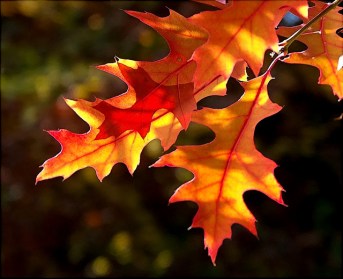
Autumn LeavesLooking across the mossy roof to the neighbors home, which has a cleverly-built deck railing constructed of former bicycle wheels, I can see leafy grape vines trailing along the railing and the awning of the first storey. All year I’ve watched these vines grow, mere sticks when we first arrived here in the heart of winter, growing pale green shoots and curling vines through the spring, and then a spreading glory of wide, rich verdant leaves covering every available surface. Autumn turned the leaves to flaming red, a deep crimson that draws the eye like the cloth of a royal garment. Just in the last few days these red leaves have begun to fall, some blowing even to the threshold of our doorstep. The magnolia in the next yard over is now withered yellow and brown. But in the spring I know it will once again burst to life with thick white and pale pink blossoms before the dense, green spring foliage replaces the flowers. I’ve watched nearly one full seasonal cycle from this seat, countless books open on my knees as I’ve done so.

Walking through my neighborhood late this afternoon the crisp fall air rattled the leaves overhead, a welcome alternative for the moment to the sound of the turning leaves of books. Fruit trees are heavy with figs, apples, and persimmons, while the branches of the plum and loquat—so abundant this spring and summer—await next year’s rejuvenation. This will always be my favorite time of year, when the world becomes misty and golden, and the overlapping worlds of inner and outer saturate my imagination with flowing images. A quietness is whispered in the autumn winds, a song not heard any other time of year.

The world is in chaos, but moments of peace can enter in. Perhaps they become more poignant to savor when held up against the dark mirror of the outer world. The Sun is setting now, and I light a candle to awaken the golden autumn light within the darkness.

Following the Day Star

“To philosophize is to learn how to die.”
– Cicero

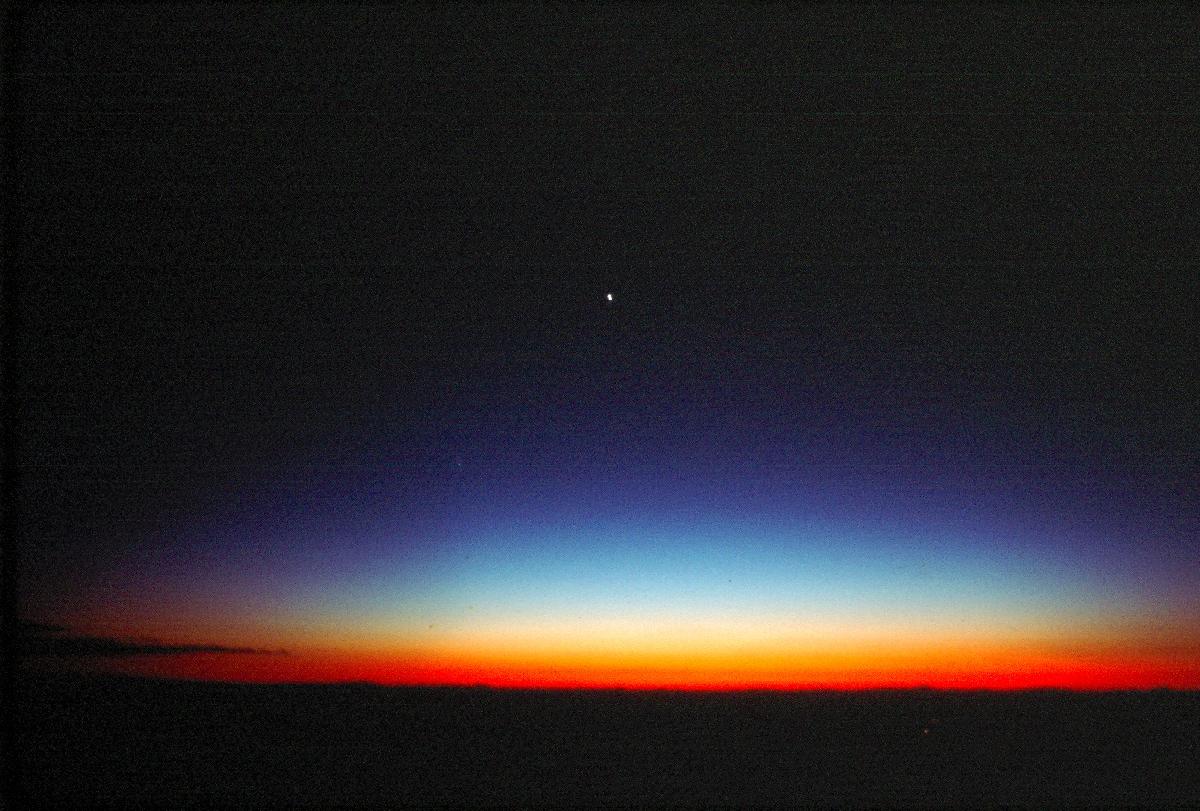
Night comes softly following the glory of sunset. The sun dies in a blaze of color, hues of gold and magenta, blood orange and dusty rose. When the sun sinks below the horizon it is as though it has taken hold of all the colors of the waking world and pulled them from out of the landscape, like dye extracted from cloth, and trailed them in streaming splendor toward the dying sun. The landscape bleeds out its colors, fading to a twilight gray, while the dying ember of the sun shines forth in one final burst of magnificence. At last, when the day star appears to sink beneath the wine-dark horizon, the colors depart with it, the inky black of night oozing out across the open canvas of the sky.

Moon and Venus SunsetWait patiently. The liminal space seems to be most still now, in this time that is neither day nor night. The world seems to hold its breath. Then, with a gasp of wonder, the dusk is pierced by the first white star of the evening. It is there, where it was not a moment before, yet the exact moment it appeared is unknown. In cooling quiet the sky bedecks herself in jewels, webs and nets of storied interconnection, shapes that have walked the sky since before ever human eyes beheld their patterns.

Socrates drank the hemlock at sunset.

No sunset is ever the same. If you are present to witness one, you cannot bring yourself to look away. The sunset is like a moment out of time; yet it is the moment that makes time be as well.

In the period of time right before to his execution, Socrates spoke to his students of the rhythms of life and death. “Well then,” he spoke, “is there an opposite to living, as sleeping is the opposite of being awake?” “Being dead,” one student answers.[1]

Sleep follows waking, waking follows sleep. Dawn comes after each long night. Does death too birth into new life? How can we know? How do we prepare ourselves for our own sunset, the inevitable ending of this life? Plato’s dialogue Apology tells of the trial and condemnation of Socrates, in which he says

To fear death, gentlemen, is no other than to think oneself wise when one is not, to think one knows what one does not know. No one knows whether death may not be the greatest of all blessings for a man, yet men fear it as if they knew that it is the greatest of evils.[2]

Here Socrates claims that no one knows if death is a great blessing, yet in the dialogues that lead up to his inevitable demise he seems to have an increasingly clearer understanding that death is indeed a gift.

Many of Plato’s dialogues carry implicitly the theme of death in their tone and setting. Plato was just crossing into his third decade of life when his teacher Socrates was condemned to death by the city of Athens. He did not begin writing the dialogues until some time after the execution of his mentor, but the impression of that pivotal moment underlies nearly every dialogue composed. Socrates’ death is imprinted upon each of Plato’s dialogues as words and images are upon the face of a wax tablet. Other philosophies may be engraved over the initial impression, but through the palimpsest can often be read the echo of this early, defining tragedy.

In the Republic, as Socrates and his students are choosing how best to educate the future guardians of their ideal city, they decide the young guardians should “be told stories that will make them least afraid of death.”[3] Socrates begins reciting lines that must be expunged from the poetry of Greek tradition, censoring and editing to find the tales that will shape the future guardians into the philosopher-kings they are meant to become. But in his dialogues Plato is not only editing the old myths; he is bringing forth new myths as well, illustrating them with images that have since been impressed up the philosophic imagination of the Western world for two and a half thousand years.

While some dialogues literally recount the story of Socrates’ trial, imprisonment, and execution, others carry the weight of his death more symbolically. The Republic opens with Socrates saying “I went down to the Piraeus yesterday. . .” in language echoing Odysseus’s “I went down to Hades” in Homer’s epic. One of the first characters we meet is the aging Cephalus, who seems rapidly to be approaching death. Yet the dramatic date of the dialogue is set some twenty to thirty years after the historical Cephalus passed away. Plato’s dialogue is evidently not taking place in the land of the living.

At Socrates’ request Cephalus begins speaking of what it is like to approach death:

When someone thinks his end is near, he becomes frightened and concerned about things he didn’t fear before. It’s then that the stories we’re told about Hades, about how people who’ve been unjust here must pay the penalty there—stories he used to make fun of—twist his soul this way and that for fear they’re true . . . . he is filled with foreboding and fear, and he examines himself to see whether he has been unjust to anyone.[4]

These are the stories that Socrates later refers to that he wishes to censor: stories that ignite a fear of death. Yet it is these very stories that inspire an examination of justice in one’s life. Does not this indicate that the stories do some good?

In the Phaedo, the dialogue that ends in Socrates’ execution, the philosopher says to his gathered students, “I am not so resentful, because I have good hope that some future awaits men after death, as we have been told for years, a much better future for the good than for the wicked.”[5] Here too, Socrates gives reference to myths of Hades for his understanding of the underworld. But Socrates also has his own assurance that death is the right course for him, that it is nothing to fear. During his trial, as laid out in the Apology, he refers to his “familiar sign,” the daemon that accompanies and guides his actions by negating what he ought not to do. Socrates comes to find that his daemon has not opposed anything that he said during his trial.

What do you think is the reason for this? I will tell you. What has happened to me may well be a good thing, and those of us who believe death to be an evil are certainly mistaken. I have convincing proof of this, for it is impossible that my familiar sign did not oppose me if I was not about to do what is right.[6]

His absolute trust in the guidance of his daemon is remarkable. This assuredness appears to come from an inherent trust Socrates has in the way he has spent his life; if the guidance of the daemon has led him to follow a just life, this guidance must be true. Furthermore, his daemon is one whom Socrates chose himself, if indeed the myth that ends the Republic is meant to be read in such a way. As depicted in the Myth of Er, reincarnating souls choosing their next lifetimes are told “Your daemon or guardian spirit will not be assigned to you by lot; you will choose him.”[7] The guidance one receives in life is freely chosen by each individual before birth.

In the Phaedo, Socrates refutes the idea that there might be but a single path to Hades. Rather, he says,

I think it is neither one nor simple, for then there would be no need of guides; one could not make any mistake if there were but one path. As it is, it is likely to have many forks and crossroads; and I base this judgment on the sacred rites and customs here.[8]

The many paths to Hades can also be read symbolically: there are many paths one can choose in life; if there were but one then leading a just life would not be a free decision made with the help of one’s chosen daemon, rather it would be predetermined and unchangeable. One’s lot would be cast and there would be naught to strive for.

Within the prison Socrates tells his gathered followers that “The one aim of those who practice philosophy in the proper manner is to practice for dying and death.”[9] Considering all that philosophy seems to cover in its practice, this statement carries significant weight. But Socrates goes on to explain exactly what he means by this statement. He defines death, saying that it is, “namely, that the body comes to be separated by itself apart from the soul.”[10] The action of the philosopher is to contemplate the divine Forms or Ideas, and to do this he must reach for the Ideas not with his bodily senses but through thought alone, with the soul. The philosopher is therefore in a state most closely related to death, a separating of the soul from the body.

If we are ever to have pure knowledge, we must escape from the body and observe things in themselves with the soul by itself. It seems likely that we shall, only then, when we are dead, attain that which we desire and of which we claim to be lovers, namely, wisdom.[11]

As a philosopher, Socrates does not claim to ever have attained wisdom, and here we see that he does not believe it to be possible while one is alive and incarnated in physical form. Yet not much earlier in this same dialogue he emphasizes to his disciples that one must not end one’s life to attain the wisdom that is accessible after death. “There is the explanation that is put in the language of the mysteries,” he says, “that we men are in a kind of prison, and that one must not free oneself or run away.”[12] A reason exists for incarnation, for this being one with a body.Venus Sunset

The Myth of Er in the Republic tells of how souls after death are led to heaven or hell and, after a specific amount of time in one or the other place, are brought forth again to choose new lives and to be born anew. Socrates notes that most of the souls who come from heaven choose less virtuous lives due to their ignorance, while those souls ascending from their time in hell are able to choose more wisely because of the suffering they have witnessed and experienced.[13] Only the philosopher is able to choose a virtuous life and also enjoy the rewards of heaven. By studying philosophy, Socrates says,

he will be able, by considering the nature of the soul, to reason out which life is better and which worse and to choose accordingly, calling a life worse if it leads the soul to become more unjust, better if it leads the soul to become more just, and ignoring everything else: We have seen that this is the best way to choose, whether in life or death.[14]

The philosopher’s ability to discern a good life is presumably because, as said in the Phaedo, it is only after death that one is able to directly perceive the Forms and to attain wisdom. Yet it seems that not any soul is able to attain wisdom after death, otherwise all of the other souls coming from heaven to choose their new lives would not be plagued by ignorance and choose difficult new lives. Plato seems to be indicating that it is only one who has been a philosopher in life that has the ability after death to reach wisdom.

Plato has often been accused of being a dualist who denies the value of the body, instead privileging the soul and the abstract realm of the Forms. While a soul-body dualism seems to be implicit in Plato’s dialogues, the utter denial of the body may not be a full reading of Plato’s project. The philosopher in life is not one who has attained wisdom; he is a lover of wisdom and not in possession of it. Only by being a philosopher, one who loves but does not possess wisdom, can one choose a just life when one reincarnates. And it is only by being in a body, and therefore at a certain distance from the Forms, that one can actually become a philosopher.

The doctrine of the Forms indicates that an archetype exists for each thing that we experience in the earthly realm, from the more concrete Ideas of Bed, Horse, and Tree, to the more abstract Ideas of Justice, Truth, and the Good. Would this not also indicate that there must be an Idea for Death? Is there an archetypal expression of the mysterious transition that ends all lives? In the ancient Greek world Cronus, later to be named Saturn by the Romans, was the god of Time who ruled endings, mortality, finitude, old age, and death. Saturn was the outermost planet known to the ancients, the furthest celestial body visible to the naked eye. Saturn was the guardian of the threshold, the last circle of the wandering planets inside the crystalline sphere of the fixed stars that encircled the cosmos.

The nature of the Forms is such they can be approached by the philosopher in thought, but never attained while he lives. So too it is with death, that direct knowledge of death is unattainable while alive; as one is dying one comes ever closer to death, yet does not ever fully know what it is until one has actually died. Just as Saturn represents the guardian of the threshold, death too may be such a guardian, standing at the gateway to the realm of Forms: the first Form to be attained by the soul may be Death itself.

How then does one spend one’s life preparing to cross this threshold, cultivating the philosophic way of life? If, as Socrates said in the Phaedo, there is a mirroring between sleeping and waking, death and life, what further insight can be drawn forth from these parallels? After death Socrates says we are released from our bodies and the soul is able, without hindrance, to contemplate the eternal Forms. In embodied life the philosopher strives for the Forms in thought, never fully attaining them but coming ever closer with practice. In the Apology Socrates describes what he sees as the two options for what comes after death: “either the dead are nothing and have no perception of anything, or it is, as we are told, a change and a relocating for the soul from here to another place.”[15] Death is either “like a dreamless sleep”[16] or a “change from here to another place”[17] where one would encounter the “true jurymen who are said to sit in judgment there” and the “other demi-gods who have been upright in their own life.” [18] If death is the former, Socrates says “it is an advantage, for all eternity would then seem to be no more than a single night”[19] and if it is the latter he says, “I am willing to die many times if that is true.”[20] In the parallel between sleep and death, if the former is like a dreamless sleep then the latter, in which one meets gods and heroes, and encounters the realm of eternal Ideas, may be likened to a night rich with dreaming in which one encounters images strange and familiar, beings of all kinds from humans and animals, to mythic creatures, the living Earth, and gods and deities. Dreaming too is like entering into a realm of archetypes.

If death can be likened to entering a realm of dreams, what is it that the philosopher does in life to bring himself closer to that realm? The philosopher contemplates the eternal Forms, but what does this in practice look like? In the Symposium, as Socrates and Aristodemus are walking to the home of Agathon for dinner, Socrates begins to get lost in thought. “As they were walking, Socrates began to think about something, lost himself in thought, and kept lagging behind. Whenever Aristodemus stopped to wait for him, Socrates would urge him to go on ahead.”[21] When Aristodemus arrives Agathon asks of him, “‘But where is Socrates? How come you didn’t bring him along?” So I turned around (Aristodemus said), and Socrates was nowhere to be seen.”[22] Once Socrates has been located, standing still in contemplation on a neighbor’s porch, Aristodemus says, “‘Leave him alone. It’s one of his habits: every now and then he just goes off like that and stands motionless, wherever he happens to be. I’m sure he’ll come in very soon, so don’t disturb him; let him be.”[23] What is it that Socrates is doing? He is clearly lost in thought, but to a degree beyond what most people do. He has the air of one lost in a dream but in waking life; perhaps in contemplating the realm of eternal Forms the philosopher becomes a daydreamer, meditating upon dreams more real than common life.

The Symposium takes place over the course of a single night, the story bookended by sunset and sunrise. Socrates is the only one to stay awake through the entire course of the night, departing quietly at dawn to go about his day. Within the narrative of the dialogue, another story is told of Socrates when he slips into one of his daydreaming states. The tale, spoken by Alcibiades, is worth quoting at length, as it gives a beautiful character picture of Socrates, this man who “as a whole . . . is unique; he is like no one else in the past and no one in the present—this is by far the most amazing thing about him.”[24] So Alcibiades describes:

One day, at dawn, he started thinking about some problem or other; he just stood outside, trying to figure it out. He couldn’t resolve it, but he wouldn’t give up. He simply stood there, glued to the same spot. By midday, many soldiers had seen him, and, quite mystified, they all told everyone that Socrates had been standing there all day, thinking about something. He was still there when evening came, and after dinner some Ionians moved their bedding outside, where it was cooler and more comfortable (all this took place in the summer), but mainly in order to watch if Socrates was going to stay out there all night. And so he did; he stood on the very same spot until dawn! He only left next morning, when the sun came out, and he made his prayers to the new day.[25]

The imagery of the sun in this story is prominent, with the period of thought or daydreaming beginning at dawn and not reaching completion until the following sunrise. In the Republic, Socrates gives the image of the sun as a metaphor for the Good. “This is what I called the offspring of the good,” he says, “which the good begot as its analogue. What the good itself is in the intelligible realm, in relation to understanding and intelligible things, the sun is in the visible realm, in relation to sight and visible things.”[26] But, from an earthly perspective, the sun dies every night, descending below the horizon in a flaring forth of color. The sun pulls the clear definition of all that has illuminated, the bright hues of the landscape, into the underworld with it. To follow the images of the sun we must dream, or learn to contemplate them in thought or dialogue through the night.

Socrates, the only member of the Symposium to stay awake through the entire night, was in the same way caught in thought all through the long night during the summer campaign of which Alcibiades speaks. The work of the philosopher takes place within the embodied realm, for once he has passed the threshold of death he is no longer a lover of wisdom; he has attained wisdom and is no longer a practitioner of philosophia. To be a philosopher is to prepare to cross the threshold of death by always striving to remain in a state closest to death. Thus Socrates, the true lover of wisdom, stays awake through the night to try to consciously understand the Forms in their completeness, so he might recognize them once he too crosses with the Sun below the horizon. “As long as I draw breath and am able,” he says in the Apology, “I shall not cease to practice philosophy.”[27]

The death of Socrates was a literal event in the life of Plato, but the dialogues that poured forth afterwards are a mythological eulogy that has elevated Socrates from human status to that of mythic daemon, a mentor and conscience to guide the dawning philosophical tradition as it walked across Greece’s borders and began its criss-crossing journey throughout the Eurasian continent, leading it eventually to cross the encircling seas and make its wanderings throughout other continents as well.

Socrates was executed at sunset. It is those who remain who are asked to contemplate the long night. It is those who remain who must await the dawn. But in that quiet twilight moment between the sun’s departure and the descent of dark night, we wait for the arrival of that first shining star, the wanderer who appears in the metaxic realm of dusk. As night deepens, the star known by the ancients to be the shining symbol of Love blazes forth ever brighter in the darkening western sky. Never far from the sun, this brightest of planets circles sometimes closer, sometimes further from the celestial image of the Good. It stands as a guide for those called to follow, to be lovers also of wisdom.

“Evening star, you bring all things
which the bright dawn has scattered . . .”
– Sappho

 Moon, Venus, Jupiter

Work Cited

Plato. Plato: Complete Works. Edited by John M. Cooper. Indianapolis, IN: Hackett, 1997.


[1] Plato, Phaedo, trans. G.M.A. Grube, in Plato: Complete Works, ed. John M. Cooper (Indianapolis, IN: Hackett, 1997), 62, 71c.

[2]Plato, Apology, trans. G.M.A. Grube, in Plato: Complete Works, ed. John M. Cooper (Indianapolis, IN: Hackett, 1997), 27, 29a-b.

[3] Plato, Republic, trans. G.M.A Grube, in Plato: Complete Works, ed. John M. Cooper (Indianapolis, IN: Hackett, 1997), 1022, 386a.

[4] Plato, Republic, 975, 330d-e.

[5] Plato, Phaedo, 55, 63c.

[6] Plato, Apology, 35, 40b-c.

[7] Plato, Republic, 1220, 617d.

[8] Plato, Phaedo, 92, 108a.

[9] Plato, Phaedo, 55, 64a.

[10] Ibid, 56, 64c.

[11] Ibid, 58, 66e.

[12] Ibid, 54, 62b.

[13] Plato, Republic, 1222, 619d.

[14] Ibid, 1221, 618d-e.

[15] Plato, Apology, 35, 40c-d.

[16] Ibid, 40d.

[17] Ibid, 40e.

[18] Ibid, 41a.

[19] Ibid, 40e.

[20] Ibid, 41a.

[21] Plato, Symposium, trans. A. Nehamas and P. Woodruff, in Plato: Complete Works, ed. John M. Cooper (Indianapolis, IN: Hackett, 1997), 460, 174d-e.

[22] Plato, Symposium, 460, 174e.

[23] Ibid, 461, 175b.

[24] Plato, Symposium, 503, 221c.

[25] Ibid, 502, 220c-d.

[26] Plato, Republic, 1129, 508b.

[27] Plato, Apology, 27, 29d.

Phenomenology of Astrology

This phenomenological exploration, originally written in December 2013, was published in the Fall 2016 issue of Immanence: The Journal of Applied Mythology, Legend, and Folktale.

Prologue: Cosmos in Ellipsis

As I climb higher up the gray switchback staircase of rickety wooden boards my body tenses with the increasing height, even as my mind knows I am safe, that the stairs beneath my feet will support me. Already present is that indescribable bodily sense, that physical intuition that seems only able to be captured wordlessly, by something as unarticulated as an ellipsis . . . I step out onto the gravel of the roof to be met by the sight of the flaming orb of the setting Sun. This closest of stars burns the clarity from the landscape, blurring the features of the horizon line being pulled toward it: hill, forest, and stretch of ocean I can only perceive in memory as the deepening gold of sunset shatters my sight into uncountable, undifferentiable monads of color.

Sitting on the wide ledge of the roof my body settles into an accustomed level of comfort at this new height. But if I lean closer to the edge, to glance below at the street, then this indescribable bodily sense flares up once again, a seeming leap of my heart into my throat that signifies danger or delight I cannot tell. Why is it that looking down four stories at unforgiving concrete gives the same bodily sensation as looking deeply into the eyes of one I love? Wherein lies the truth of this . . .

Looking away from the Sun I turn to my left to see the Moon seated aloft in a soft indigo sky. The reverberating green echo of the Sun’s shape slowly fades from my vision as the Moon’s gentler light fills my gaze instead. The relationship of these two celestial bodies feels familiar . . . and my body knows it before I do . . . Ah yes, I stood upon a mountain exactly a month ago today, positioned as a third body between these two heavenly beings, seeing them in this same triangular relationship once again. I feel this, sense this, intuit this, I . . . this, my body . . . this: this relationship, this interaction.

Whenever I behold a celestial body ablaze in the night sky it stops me in my tracks, without fail. My body is commanded to stop, to wonder, to worship these orbs. My breath catches. It feels not unlike falling in love . . . over and over and over, with each wandering star I witness. The same as looking down from some great height, but rather it is looking up . . . No it is looking out, a looking out into the depths of space. To behold the Sun, the Moon, a thousand stars is to look up, to look out, and to look down into the greatest depths all at once. No wonder we lose our balance, no wonder our bodies react, they catch us and remind us that gravity is real.

I have seen countless sunsets but no one is the same, no one is ever worth looking away from before it has made its perfected exit. I never say to myself, “Not this time, I have seen this before.” It now becomes impossible to look away as the ocean swallows the flaming disc of molten gold. In these final moments of a day I will never see again I feel my heart pulled, as though by an emotion-laden gravitational force, toward the Sun. My heart strains within my chest to follow the Sun beyond the crashing purple waves.

Wash over me, oh descending night . . . let me drown once more in your celestial waters.

Introduction: An Experiential Astrology

“The stars are like letters which inscribe themselves at every moment in the sky . . . . Everything in the world is full of signs. . . . All events are coordinated. . . . All things depend on each other; as has been said, ‘Everything breathes together.’” – Plotinus

Go outside on a clear night. Gaze up into the sky, let the points of light that have been traveling for minutes or millennia enter into you through your eyes. I ask not what do you see, but rather, what does it feel like? Your eyes are drawn to one particular body blazing like a white flame in the western sky. A wandering planet, visible at a different height above the horizon with each passing night—only to disappear into the overwhelming light of the Sun for an extended period of time, to once again be found shining in the indigo skies preceding dawn. Your body quivers in response to this gem-like orb, truly like a bright diamond set among a net of precious stones. Beauty. How can this not be an experience of Beauty, an archetypal vision burning forth in the physical realm? You watch Venus slowly sink beyond the blackened waves of the Earth’s greatest sea, a trail of Venus-shine tracing a path directly from the planet to where your feet stand on a grassy cliff’s edge. A geometrical relationship exists between your body and the body of Venus, but you also feel a psychic connection as well: beauty shines forth from this planet, a beauty which you cannot help but feel resonating internally as well. Distill all of this moment to its essence, to Beauty.

In the ancient world astronomy and astrology were a single science, to be practiced as a unified discipline of contemplating what Plato called the “moving image of eternity”[1] that is the night sky. With the rise of modernity, astronomy and astrology diverged, astronomy to become a science solely of mathematical physics and celestial mechanics, while astrology was relegated to the realm of superstition and pseudoscience. Contemporary research on astrology, however, has come to affirm “a highly significant––indeed a pervasive––correspondence between planetary movements and human affairs.”[2] This correspondence is perceptible in the position of the planets at the time of one’s birth, as well as in the transiting movement of the planets in relation to the birth chart throughout one’s life, and the continuously changing dynamics of the planets’ relational positions to each other. The correlated expression is of an archetypal nature: the character or energy of the planets is expressed in a multivalence of ways both by human individuals and in collective cultural and natural events.

An astrological chart is a two-dimensional representation of our three-dimensional solar system, shown from a geocentric perspective but using heliocentric calculations to predict the specific locations of the planets (Figure 1). Sometimes in the practice of astrology it can be easy to become absorbed in the planetary archetypes as symbols, as they are manifested in the human psyche. Just as astronomy has forgotten it was once completed by astrology, perhaps sometimes astrology too can forget to look back out into the starry sky to gain greater understanding, and not just to the multidimensional manifestations of the archetypes in human events. If phenomenology is meant to bring us, as Husserl said, “back to the things themselves,” perhaps a phenomenological approach to astrology may be in order, to experience at all levels the archetypal energies pulsating through all dimensions of the cosmos.

The Sun

Why is it we are so compelled to watch the sunset? On clear days the Sun is visible all through the daylight hours, yet it is usually only when the Sun is near the horizon at dusk and dawn that the desire to suspend whatever we might be doing simply to watch overcomes us. The Sun is most accessible to the naked eye at this time. The explosion of color—of rose, vermillion, gold, magenta, orange, crimson, indigo—as the sunlight passes through the greatest density of Earth’s atmosphere is like watching a cosmic painter improvise with an infinite watercolor set on living canvas. How could we look away?

The Sun in the birth chart represents the conscious self, what one identifies as, what we name ourselves, how we shine in the world, the will to be, to exist. The Sun illuminates, focuses, radiates, integrates. It is the autonomous self, the ego, the part of ourselves that says “I am.” When I gaze at the horizon illuminated by the setting Sun, the “I” that I call myself—the “I” whose personality is reflected in the position of the Sun in my birth chart, the location at which the actual Sun appeared to be from my situated position on a moving Earth—is gazing out at the Sun that contains all “I”s. Every birth chart contains a Sun, every person has a self whose personality is reflected in the planetary and zodiacal relationships to that Sun. Yet it is all the same Sun. Each one of us has a personal relationship to this celestial body that gives life to the Earth, gives movement to the solar system. When we look at the Sun, not only do we see our self reflected, we see all selves reflected back to us. No wonder it is so hard to look away.

Yet when the Sun sets the starry sky can begin to shine forth. When the self steps aside, all the other persons of our being are able to come forth and shine with their own archetypal colors.

The Moon

A few nights ago I was walking down a busy city street at night, cars passing back and forth, people hurrying in every direction, home from work, onto buses, into subway stations. Stepping around the corner of a tall building and looking up through the maze of power lines blocking a dark, almost star-less sky, I was struck by the sight of the Moon, barely a crescent of light showing on its face, yet in its darkness still visible all the way around. The dark orb appeared to be hanging so close to the Earth, a haunting reminder that not all the world is contained in the narrow field of our bustling urban lives. Yet I was amazed to see no one else stopped to stare at this fantastic apparition far more beautiful than any of the hurried activity occurring down at the street level.

The Moon astrologically represents our relational self, the emotions, feelings, the body. It is the mother-child relationship, that which cares and nurtures, and that which desires to be cared for and nurtured. The Moon is the matrix of being, the family, the home, the past, our most intimate selves. It is what our conscious self is unconscious of, sometimes invisible in its intimacy. We can become so accustomed to seeing the Moon night after night, or as a pale sphere in the daytime sky, that we forget its presence if we are too wrapped up in the overly focused narrowness of our ego-driven lives. It does not demand attention. Yet the Moon is always present, the closest celestial body to Earth, affecting the ebb and flow of the ocean tides, mirroring the ebb and flow of our changing emotions and bodily sensations.

From Earth we always see the same face of the Moon; the Moon’s rotation on its axis and its orbit about the Earth take the same amount of time. This physical characteristic gives the impression that the Moon does not rotate at all, which contributed to the long-held belief that the Earth was the stationary center of the cosmos. The maternal nature of the Lunar archetype seems to be symbolically expressed in this physical positioning; the Moon cradling the young human species in an Earth-centered universe for far longer than if the Moon had rotated on its axis.

Sun Trine Moon

I am standing on the precipice of a mountain gazing westward, into the molten fire of the setting Sun. One hundred and twenty degrees to my left, an angle my body can hold within itself as I gaze in both directions, the waxing Moon rises over the further arches of a vermillion and rose stained ridge. I can feel the relationship of Sun and Moon within my body, somehow feeling my heart as the third point in this harmonious triangle. “We grasp external space through our bodily situation,”[3] Maurice Merleau-Ponty writes. Standing between rising Moon and setting Sun I know their relationship because my body is in relationship to each of them. “We also find” Merleau-Ponty continues, “that spatial forms or distances are not so much relations between different points in objective space as they are relations between these points and a central perspective—our body.”[4]

I am a full participant in this moment. My body is in relationship with these two powerful celestial bodies that light up our world, that pull all of the existence I know forward along its spiraling path. “For us the body is much more than an instrument or a means; it is our expression in the world, the visible form of our intentions,” the phenomenologist says.[5] This seems to hold true not only for my own body, but each body I am able to witness: the flaming Sun, the pregnant Moon, blazing Venus as it becomes visible in the cooling hues of the sky, the point of light that is Saturn that appears not long after Venus makes her debut, and the solidity of the Earth beneath my feet. Each are bodies giving visible form to their intentions.

I turn to my companions standing next to me and say, “This is a transit. Can you feel it?

Jupiter

A couple years ago I was out walking through Golden Gate Park in the later evening. In the darkness of the park I saw through a gap in the trees the shining, soft orange light of Jupiter. It was the only light in the sky, dazzling between dappled purple clouds. I left the path to stand in the darkness of the trees, to focus all my attention upon this planetary body, this planetary being.

As I gazed with openness and curiosity upon Jupiter it appeared to grow brighter, and I almost felt as though a communion was arising between us. As dark clouds passed over the planet it still managed to shine through radiantly. I was suddenly reminded of the moment in J.R.R. Tolkien’s The Return of the King when Sam looks up at the smog covering the desolation of Mordor:

There, peeping among the cloud-wrack above a dark tor high up in the mountains, Sam saw a white star twinkle for a while. The beauty of it smote his heart, as he looked up out of the forsaken land, and hope returned to him. For like a shaft, clear and cold, the thought pierced him that in the end the Shadow was only a small and passing thing: there was light and high beauty for ever beyond its reach[6]

It suddenly dawned on me that part of the archetypal nature of Jupiter is Hope. I had the sense I was looking directly at the Divine and feeling Hope, an uplifting and elevation of spirit, a buoyancy and joy I could not explain. The Shadow of our times, the great devastation of our Earth, will also pass in the end. There is always Hope.

Encountering The Archetypes

Sometimes the planets want to speak to us. This is the only way I can describe what such a connection feels like. Once, in a meditative state, I closed my eyes and gazed upward towards the heavens and could feel that all the planets were so excited I finally was listening that they each were telling me who they are all at once. It was an overwhelming deluge of colors, emotions, images, sensations, processes; it was far too much to take in. I begged them, please come one at a time.

One by one, beginning with the Sun, each planet introduced itself, revealing how their multidimensional and multivalent appearances in the incarnated realm were really all unified into single archetypes in the transcendent realm. With each planet I encountered qualities I had learned of before, and yet other qualities which were new to me. The Sun, radiant presence, gold, singularity of vision, shone through me, through everything; nothing else existed in that light. The Moon, cradling and being cradled, softness, a silver sheen of lavender comfort, holding in warmth, fullness and settled contentment. Mercury, a quickening pace as my thoughts raced to catch up, a rapid quill spelling, articulating, word, glance, taste, touch, sound, senses singing. Venus, a verdant green of flowering beauty, vines growing in curls that turn into exquisite art, the silver sparkling of dew under leaves, mirroring a reciprocity of love and heart-warming presence, the shiver of pleasure and desire. Mars, a flaming red heat burning through me with energy, action, anger, force, violence, blood, rushing in a hiss of fiery passion. Jupiter, uplifting to a panoramic sweep of glory and triumph, images of great civilizations flourishing in their crowning moments, a spiraling climb to the grand arches of the Kingdom of Heaven, laughing, just laughing, releasing into giggles, soft joy, lips kissed by a smile.

The smile faded into a serious fixed gaze as Saturn entered my field, making me sit straighter, feeling the structural strength of my bones, my skeleton, holding me erect and steady, the stability of age-old institutions weathering through time, weathered away by time—Time who eats his children—feeling my body slowly decay in death, yet somehow feeling reassured by this, again and again in repetition, that all things must come to an end, and with that final acceptance at last can come wisdom.

Lightning quick Uranus burst through, not settling into a single color or image, always overturning, breaking out, breaking through, a pace impossible to follow as sparks of genius flew off of every new idea to explode in firecrackers opening up ever unexplored future horizons.

All dissolved, and no sense of myself remained as the oceanic azure oneness of Neptune washed over all that had come before, containing everything in its synchronous holism, a peaceful oblivion of floating in a flowing celestial realm of watery image, ethereal spirit, imaginal soul, transcending all boundaries.

And with a rendering tear the ocean ripped apart as a volcanic chasm, Pluto, gaped open swallowing all in titanic destruction, a violence so deep it was beyond fear, rather a pulsing of life impulse to survive or perish, pushed and pressured by the unbounded force of desire, teeth, torn flesh, corpses, pushing through the excrement, massive desolation laying waste, decomposing, turning over, evolving through pain, passing through the white hot burning fire and from the dead ashes reborn . . .

Then white light. All the colors melted together, every image unified. Only light.

Such an encounter with the archetypes I felt at every level of my being. It is like hearing the story of the entire world all at once. It is a distillation of everything into the passing of but a few breaths, a bracketing of everything, to be able to fully experience everything. An archetype is a phenomenological reduction of experience, a reduction that distills being down to its essence. Return to the things themselves. Look to the night sky, the planets want to tell you who they are—who you are.

When the starry night passes, so comes the dawn. The self is reborn from the multitudinous matrix of being. Yet as day shines forth, one can still feel the stars radiating behind the blue sky.

Works Cited

Merleau-Ponty, Maurice. The Primacy of Perception. Edited by James M. Edie. Evanston, IL: Northwestern University Press, 1964.

Plato. Plato: Complete Works. Edited by John M. Cooper. Indianapolis, IN: Hackett, 1997.

Tarnas, Richard. Cosmos and Psyche: Intimations of a New World View. New York, NY:             Viking Penguin, 2006.

Tolkien, J.R.R. The Lord of the Rings, New York, NY: Houghton Mifflin Company, 1954.

[1] Plato, Timaeus, trans. Donald J. Zeyl, in Plato: Complete Works, ed. John M. Cooper (Indianapolis, IN: Hackett, 1997), 1241, 37d.

[2] Richard Tarnas, Cosmos and Psyche: Intimations of a New World View, (New York, NY: Viking Penguin, 2006), 68-69.

[3] Maurice Merleau-Ponty, The Primacy of Perception, ed. James M. Edie (Evanston, IL: Northwestern University Press, 1964), 5.

[4] Merleau-Ponty, The Primacy of Perception, 5.

[5] Ibid.

[6] J.R.R. Tolkien, The Lord of the Rings: The Return of the King (New York, NY: Houghton Mifflin Company, 1954), 901.

Setting Sun