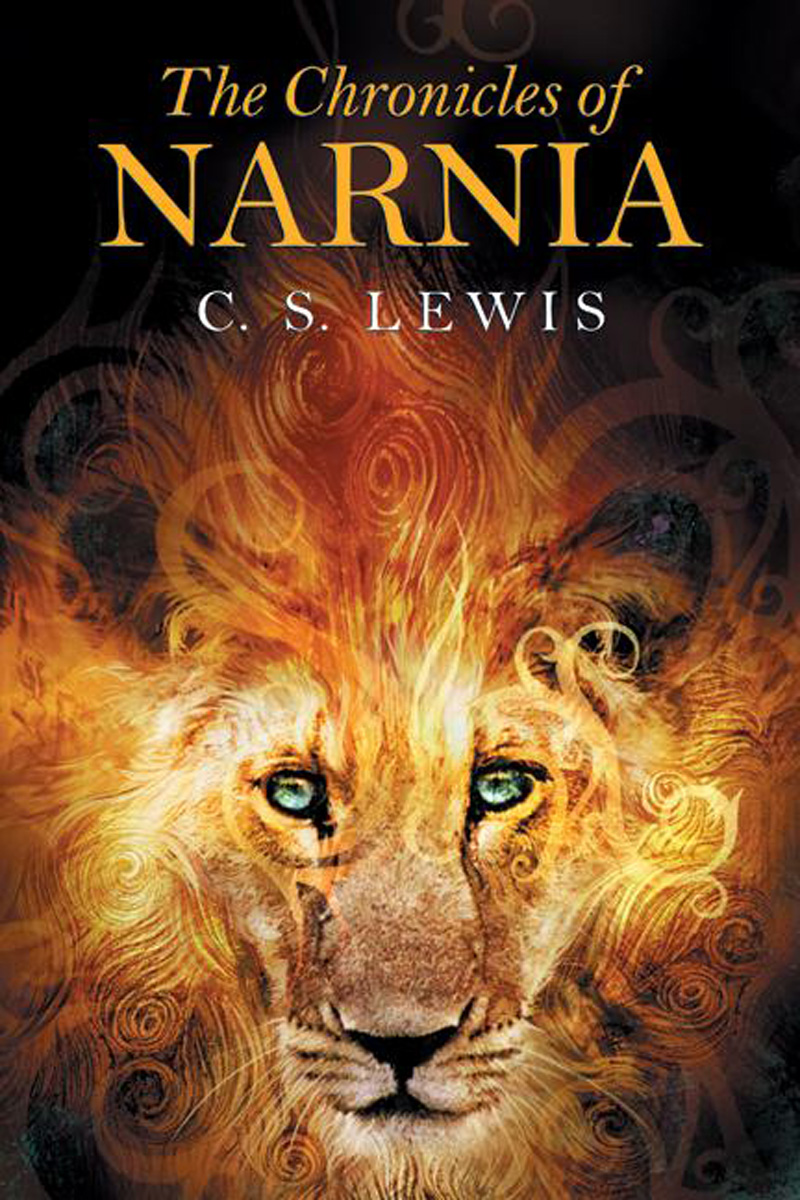
Back Through the Wardrobe: Returning to “The Chronicles of Narnia”

The world of Narnia has a distinct aura, a tangible presence that remains evasive, elusive yet alluring. The feeling of the Narnian world is somehow familiar, eliciting that nostalgic pull that calls from the heart of the Imaginal Realm. Many years had passed since I last read C.S. Lewis’s series of seven short novels for children, and I returned to them with fresh eyes and a much wider perspective than my childhood consciousness brought to the stories. While still enchanted by the places, the names, the people of Narnia, I was also aware of the underlying Christian themes woven into the stories in a way I was not as a child. Recognizing these themes elicited a mixed reaction from me, for on the one hand I could appreciate what Lewis was trying to communicate, but on the other I have been so deeply influenced by J.R.R. Tolkien and his profound distaste for allegory that occasionally I wished the stories could stand for themselves, apart from any parallel meaning intended by the author. At times I felt I was losing the real experience of Narnia to the allegory behind it.

Chronicles of NarniaThe Chronicles of Narnia tell the full arc of the history of that realm, from its creation in The Magician’s Nephew and its parallels with Genesis, to The Last Battle, with its coming of the Antichrist and the Last Judgment, ending in the extinguishing of the world of Narnia. Yet each one also feels somewhat disparate from the others, in tone, style, and feeling. They almost seem to not quite hang together, while at the same time being compelling and hugely popular. My two favorite stories were The Lion, the Witch, and the Wardrobe and the Dawn Treader, interestingly perhaps the most and the least allegorical of the tales respectively. Although The Lion, the Witch, and the Wardrobe tells of the Crucifixion and the Resurrection, with Aslan the Lion representing Christ, that story also feels like the one in which the pure realm of Narnia, apart from any allegorical meaning, shines through most brightly. The world of Narnia has a life of its own in that tale, more exuberant than in any of the other stories, perhaps in part stemming from the fact it was the first book Lewis wrote in the series. The four Pevensie children, the frozen Lantern Waste, Mr. Tumnus the Faun, Aslan himself, all have an imaginal reality to them which stands above and beyond the allegory that later came to be told through their actions. The Christian allegories Lewis is telling are taking place in a genuine part of Faërie, to draw on Tolkien’s term for the Imaginal Realm. Indeed, these aspects of Narnia came to Lewis before the Christian themes worked themselves into the tales, and Aslan himself seemed to be appearing in Lewis’s dreams for some time before he began writing, as the Imaginal Realm can so often do when the veils between worlds begin to thin.

The Voyage of the Dawn Treader, my second favorite of the novels, appears to be the least allegorical, intended to depict the spiritual life of those upon the journey to the World’s End. There is a numinosity to this story, and one feels saturated by the light of the East as the voyagers enter the sweet seas whose waters give strength and vitality. I felt a longing to enter into this depiction of Narnia more strongly than in all the other tales, as the Dawn Treader sails through the sea of white lilies toward Aslan’s country. Perhaps the magnetism of both The Lion and The Dawn Treader comes in particular from that tangible sense of Narnia as a real place, alluring one to enter into its landscapes.

Looking beyond the purely Narnian and Christian themes, there is also a Platonic element to Lewis’s stories. Particularly in The Silver Chair, which takes place in an underground realm, the allegory of the Cave from Plato’s Republic is echoed in the witch’s enchantment of the children who have entered her domain. She is attempting to convince them that no world exists beyond her underground realm, and the children appeal to her by describing their own world which is quickly fading from their memories. In their penultimate defense they attempt to describe the Sun, which the witch dismisses as an imaginary enhancement of a lamp. Finally, they appeal to Aslan and try to describe a lion, only to be told they are just embellishing upon a cat. But in the end the children and their companions overthrow the witch’s enchantments because the power of the world above, the world beyond the shadows of Plato’s cave, is stronger and more real than the lies she is weaving below in the darkness. Carrying the Platonic theme further, in the final chapters of The Last Battle, after the world of Narnia has ended and the many familiar characters drawn from all seven books are traversing a new landscape, they discover that the new land is the real Narnia and that the one with which they were familiar was merely a copy, a Shadowland. The Professor, or Lord Diggory, exclaims: “It’s all in Plato, all in Plato: bless me, what do they teach them at these schools?”[1]

The Last Battle was difficult for me to read for many reasons, not least of which because of the judgments passed upon so many of the characters. When Aslan stands at the door of Narnia as the world is ending, in one moment all the creatures of that world are judged and divided. Those who glance upon him for even a moment without love in their eyes are cast aside; Talking Beasts become dumb and descend out of Aslan’s realm forever, to a place unbeknownst even to the author. Furthermore, all of the characters from our world who have played roles in the various stories are drawn together into the real Narnia, a place that is an allegory for Heaven, because in their own world they have all died in a sudden train accident—all except Susan, who was once a Queen of Narnia and who played a major role in both The Lion, the Witch, and the Wardrobe and in Prince Caspian. She has apparently dismissed her memories of Narnia as merely fantasy, games she played with her siblings as children. Yet at the end of The Lion, the Witch, and the Wardrobe Aslan says, “Once a king or queen in Narnia, always a king or queen.”[2] Has he forgotten his own words? Is doubting one’s experiences so deep a sin that Susan is not only banned from ever entering the real Narnia, but also loses all of her siblings and parents to a single train accident and, one assumes, must now bear this grief alone in England? Where is Aslan’s compassion and forgiveness? Does he not recall that she wept alongside Lucy over his dead body upon the Stone Table before his resurrection? Or is there perhaps some other hidden answer, a consolation not directly written on the pages of the final book?

Perhaps the most difficult aspect for me about the closing of The Chronicles is that because the world has come to an end we as readers cannot hold on to the glimmer of hope that we may find a doorway to that world as well. Fairy-story gives us faith in the real existence of the Imaginal Realm, and a trust that we too may some day be given the grace to enter its domain. But what if “the gates should be shut and the keys be lost,”[3] as Tolkien writes, and we are locked upon the outside? Whence then do we turn to enter into Faërie? Perhaps it is in this sense of loss and nostalgia that one can truly reflect upon the potency of Lewis’s stories, for though they do at times bear the flaws of an all-too-human author, do we not still wish to return to the woods of Lantern Waste, the palace of Cair Paravel, and the sweet waters and white lilies of the eastern Silver Sea? Perhaps we may yet be granted that wish, for the time of the Narnian world does not align linearly with the time of this world—and some new doorway may someday open, allowing a different epoch of Narnia to be explored by some fortuitous wandering soul. With the ending comes both nostalgia and hope, a sense of loss mingled with the potential for remembrance and rebirth.

Works Cited

Lewis, C.S. The Chronicles of Narnia. New York, NY: Harper Trophy, 1994.

Tolkien, J.R.R. “On Fairy-Stories.” In The Monsters and the Critics. Edited by Christopher Tolkien. London, England: HarperCollins Publishers, 2006.

[1] C.S. Lewis, The Last Battle: The Chronicles of Narnia, (New York, NY: Harper Trophy, 1994), 212.

[2] C.S. Lewis, The Lion, the Witch, and the Wardrobe: The Chronicles of Narnia, (New York, NY: Harper Trophy, 1994), 199.

[3] J.R.R. Tolkien, “On Fairy-Stories” in The Monsters and the Critics, ed. Christopher Tolkien (London, England: HarperCollins Publishers, 2006), 109.

Continuing Thoughts on “Global Environmental Politics”

The fourth section of Simon Nicholson and Paul Wapner’s anthology deals with the international state system, and its ability, or lack thereof, to deal with global ecological issues, particularly climate change and mass species loss. The section opens with the Rio Declaration on Environment and Development, drafted in 1992. I was both struck that this document was drafted over twenty years ago, and found myself questioning the validity of many of the principles in face of the reality of the ecological problems before us. For example, the continued emphasis on sustainable development made me question whether sustainability is really the emphasis, or is it rather a mere “green-washing” of development as usual? What would happen if the term were reversed, and instead we created “developmental sustainability,” or some other means of prioritizing resilience over exponential growth? Overall, the declaration does not examine the underlying assumption that the economic growth model is the only way forward, or consider that it may inherently have a dire ecological cost.

Global Environmental PoliticsMoving forward to the next chapter by Jennifer Clapp and Peter Dauvergne, entitled “Brief History of International Environmental Cooperation,” I was repeatedly discouraged by the numerous ecologically-oriented political gatherings that have been held over the last fifty or so years that have had relatively minimal impact compared to the scale of the ecological issues we face globally. Why has so much effort been put into agreements if very few of them are legally binding? Why are there seemingly no immediate social consequences when agreed upon goals are not met by various countries? Is there a way to make international state agreements more effective and binding or, like the ecological crises themselves, must they be both borderless and bioregional in order make a real impact?

Archetypal Astrological Counseling

Archetypal Astrology Counseling Website

“The stars are like letters which inscribe themselves at every moment in the sky . . . . Everything in the world is full of signs. . . . All events are coordinated. . . . All things depend on each other; as has been said, ‘Everything breathes together.’”
– Plotinus

I am excited to announce my archetypal astrology counseling practice, and the launch of my website ArchetypalPrism.com. The archetypal perspective has been a continual presence throughout my life, and I have been working intensively with astrology since 2010. The form of astrology I practice is known as Archetypal Cosmology and focuses primarily on the geometrical relationships between the planetary bodies of our solar system. I offer astrological consultations that explore both the natal chart—the position of the planets at the moment of one’s birth—as well as personal transits—the relationships formed between the continuous movements of the planets and the natal chart. If you are interested in having an astrological consultation with me, please visit my new website and email me through my Contact Page.

It would be an honor to explore the cosmos with you,
Becca

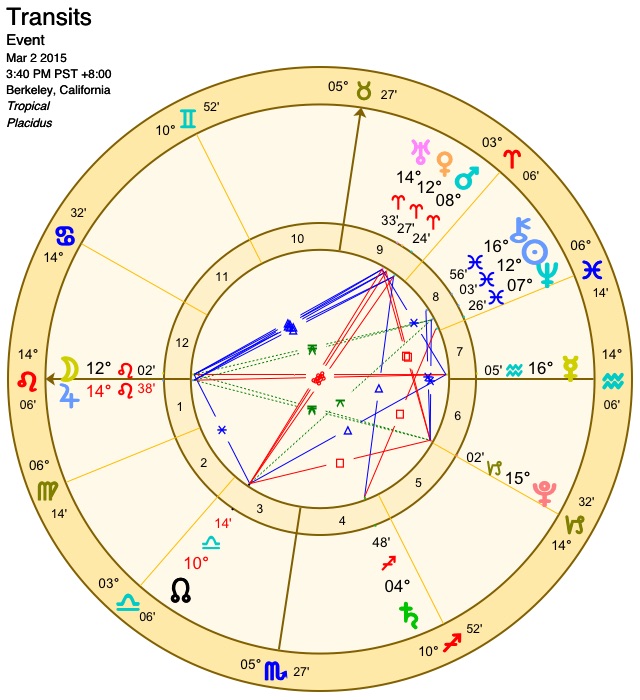
Current Transits

Having “Wild Hope”

Opening the first pages of Andrew Balmford’s book Wild Hope: On the Front Lines of Conservation Success, I found myself feeling immensely skeptical. I usually have held a somewhat wary view of conservation, tying it to the ideologies of Gifford Pinchot, a contemporary of Teddy Roosevelt and John Muir, who advocated for the conservation of wild places so that their resources might be available for future generations (as opposed to Muir’s preservationist view that desired to preserve wild places for their intrinsic value and sacred beauty). I have agreed with many of the critiques articulated by William Cronon, who sees preservation of wilderness—defined as wild landscapes untouched by human impacts—as a fantasy of civilization born of Romantic ideals. Yet I also know that it is absolutely vital that human beings begin to lessen our impact on wild landscapes and to make room for the countless multitude of other species with whom we should be sharing this planet.

Wild HopeDelving into Wild Hope and reading of the different conservation projects that are having positive impacts across the globe gave me just that: hope. It is such a nourishing experience to taste hope in the face of all the devastation we have caused. While the stories of conservation success clearly had shadow sides—deadly violence to protect endangered animals, economic incentives based on the same capitalist model that has created the destruction in the first place—what inspired me was that around the world people are taking action. Although the odds are clearly against those who wish to slow ecological decline, reverse climate change, and save thousands of species from extinction, I have always felt that we should still use all of the imagination, creativity, and will that we have to take action on behalf of the Earth. Sometimes when the air is particularly thick with despair I still know that at a karmic level this is what must be done, even when it seems hopeless on the surface.

Perhaps what I appreciated most in Wild Hope was the level of creativity and imagination expressed by those who want to make some difference in conserving the ecosystems of our world. I believe imagination is a great gift to ecology, one that gives those drawing on its power a sense of deep connection and aliveness. Drawing from the wellspring of imagination seems to inspire in others a desire to do the same. Perhaps the greatest value in reading Wild Hope for me was that as I saw how others were engaging creatively to find solutions and participate in holding actions, I felt more inspired to continue with the work as well.

Sitting with “The Sixth Extinction”

“If you want to think about why humans are so dangerous to other species, you can picture a poacher in Africa carrying an AK-47 or a logger in the Amazon gripping an ax, or, better still, you can picture yourself, holding a book in your lap.”[1] In this one sentence, in the final chapter of her book, Elizabeth Kolbert implicates you, the reader, as the cause of the sixth mass extinction of species on this planet. When reading of the human impact upon Earth, upon the other species with whom we share—or do not know how to share—this planet, it can become so easy to want to seek the source of blame outside oneself, to charge other humans with responsibility for the ecological crisis. But we have been “othering” for far too long, and it is time to take that responsibility within ourselves. So I am sitting here with this book on my lap, I am writing these words on my computer screen, and I know that this crisis is my fault. What, then, do I do with this deeply personal recognition, a recognition that must break afresh upon us again and again if we are to move forward honestly in this field?

The Sixth ExtinctionMy response to Kolbert’s book was wholly positive, a response I do not take lightly. I felt that she was undertaking a task similar to Bruno Latour’s Science in Action in which she opens the mysterious black boxes that create our scientific knowledge to reveal the specific and all-too-human processes of knowledge creation about our planet’s geological and biological history. Her research undertaking in itself was highly impressive; to make it so accessible to a wide audience in such an intelligible way I find even more so. Somehow this volume on mass extinction was not written in a depressing tone, as so much environmental literature is, but rather in an empathic human tone, taking in the emotional reality that we hold many responses to this material and cannot remain in one emotional state for long. The human response is ever changing, and the tone of this book reflected that. Yet I did grieve too: for the loss of the amphibians, the calcites, the rhinos, the coral reefs, the rainforests, as well as the ancient losses of mastodons and the other great megafauna, the ammonites, the auks, the Neanderthals. Of course, I cannot name them all here. No one has ever named all the species we have lost from Earth, nor will we ever be able to name all those who we are bringing to extinction now. But as we wake up to the reality we have created, cannot we remember Aldo Leopold’s words and recognize how far we have come as a species as well: “For one species to mourn the death of another is a new thing under the sun.”

Work Cited

Kolbert, Elizabeth. The Sixth Extinction: An Unnatural History. New York, NY: Picador, 2014.

[1] Elizabeth Kolbert, The Sixth Extinction: An Unnatural History (New York, NY: Picador, 2014), 266.

Thoughts on “Global Environmental Politics”

Upon reading the first three sections of Simon Nicholson and Paul Wapner’s new anthology on the current state of the planet, I was struck by how succinct and compelling each of the short articles were that comprise the book. The volume is clearly made for a classroom setting, and I felt the content was accessible to a wide range of readers. What was particularly striking though was the continual interweaving of both hope and despair carried by the various authors’ voices. For example, Alex Steffen’s chapter “Humanity’s Potential,” while not naïvely optimistic, still gave me the sense that if we lose ourselves to pessimism we will actually be in a worse situation than if we engaged the crisis with some sense of hope. Hope is not certainty of outcome; I feel hope is something deeper, perhaps more akin to faith.

Global Environmental PoliticsOn the other hand, Stephen Meyer’s essay “End of the Wild” carries within it a true and necessary sense of mourning of the inevitable extinction of species accelerating on the planet due to the activities of our own singularly prolific species. Meyer makes the distinction that while there is nothing we can do to save the loss of the wild this is no reason to not do anything. He concludes:

The end of the wild does not mean a barren world. There will be plenty of life. It will just be different: much less diverse, much less exotic, far more predictable, and—given the dominance of weedy species—probably far more annoying. We have lost the wild. Perhaps in 5 to 10 million years it will return.[1]

His final note is clearly one of despair and grief, deep emotions we must allow ourselves to feel if we are to engage with this crisis in any realistic way.

The book opens with two essays that both address the name of the new geologic epoch into which humanity has ushered the planet: the Anthropocene. Elizabeth Kolbert and Charles Mann both speak to the meaning and uses of this term: whether to use it ironically or seriously, what the impact of naming the epoch might be, when one might date the beginning of the Anthropocene—whether from the invention of agriculture, the Industrial Revolution, or even further into the future when the effects of climate change are absolutely undeniable. The question that continued to arise for me in relation to the term Anthropocene is, will it awaken humanity to the fact we have become a force of planet Earth as powerful as the geologic and hydrologic cycles and that we must take responsibility for this power, or will it reinforce the anthropocentric hubris that led us to this crisis in the first place?

Work Cited

Nicholson, Simon and Paul Wapner, ed. Global Environmental Politics. Boulder, CO: Paradigm Publishers, 2015.

[1] Stephen Meyer, “End of the Wild,” in Global Environmental Politics, ed. Simon Nicholson and Paul Wapner (Boulder, CO: Paradigm Publishers, 2015), 57.

The Synchronicity of the Two Red Books: Dissertation Methods & Methodology

“Perhaps the path or method of re-search done with soul in mind is simply a recognition that all our acts of knowing are attempts at remembering what we once knew but have forgotten. Perhaps all our attempts at re-search are sacred acts whose deep motive is salvation or redemption. Maybe all our re-search reenacts the Gnostic dream of the fall of soul into time and its desire to return home.”
– Robert Romanyshyn[1]
Red Book Dragon

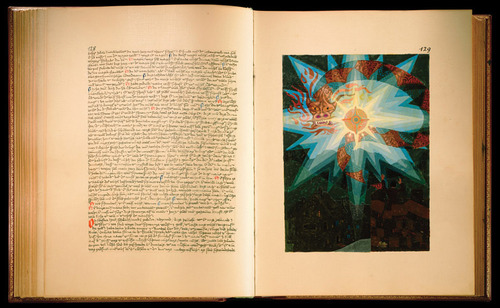
The journey of this dissertation began with the intuition of a synchronicity. The first time I beheld The Red Book of C.G. Jung I felt an echo in my memory: J.R.R. Tolkien also had a Red Book, The Red Book of Westmarch, that he claimed was the supposedly fictional source from which he had translated his stories The Hobbit and The Lord of the Rings. Yet, besides the titles, there was no reason to suppose any similarity existed between the two Red Books; no reason except that my intuition was telling me to look further, to find out if there might perhaps be more in common between these seemingly disparate works than would ordinarily be expected.

As I started preliminary research on this topic I began to find uncanny similarities between many of the images and experiences recorded in Jung’s Red Book and several of the stories and pieces of artwork from Tolkien’s oeuvre. Furthermore, I found that both men were having experiences of what Jung came to call “active imagination” beginning in the same year—1913—and continuing for several years thereafter. The images from this time period provided the seminal material that both men spent the next forty years developing in their work. The further I investigated, the more the similarities revealed themselves, until I began to question what the implications were of the synchronicity of the two Red Books. If Jung and Tolkien were simultaneously having experiences of active imagination that led them each to create art and writing with many similarities in style and content, what did this indicate about the sources of these experiences? If these findings were not to be dismissed as mere coincidence, then what did they imply about the nature of imagination? Such thoughts led me to the formulation of the primary research question of my dissertation: What implications might the imaginal experiences of Jung and Tolkien have for the modern disenchanted world view that has led to our current ecospiritual crisis, and how might a greater understanding of imagination lead to a shift in consciousness? My preliminary thesis statement is that the experiences of these two men point to the ontological reality of an imaginal realm, which holds significant implications for overturning the disenchanted world view that has contributed greatly to the ecological crisis.

Because of the nature of my inquiry, and the manner in which the research topic revealed itself, the methodological approach to this dissertation must be one that affirms the importance of imagination and intuition in the research process. Therefore I will be using an alchemical hermeneutics, as developed by Robert Romanyshyn, as my primary research methodology because it is an approach that aims to “keep soul in mind,”[2] and emphasizes the importance of imagination, intuition, feelings, dreams, synchronicity, and the myriad other expressions of the unconscious that emerge in the research process. Alchemical hermeneutics is what Romanyshyn calls an imaginal approach to research, an approach that complements other methods, rather than seeking to replace them.[3] Thus, I will be taking a mixed methods approach to this research topic, with each method filtered through the imaginal lens of alchemical hermeneutics.

“When one designs a method,” Romanyshyn writes, “one is mapping out the journey that one will take from that place of not knowing one’s topic to that place of coming to know it.”[4] For my dissertation research I will be employing an array of methods to address the multiple levels of the topic: literary, artistic, biographical, historical, and archetypal analysis, which will each be engaged from an imaginal research perspective. If alchemical hermeneutics is the path mapped out for my research journey, I see these different forms of comparative analysis as the supplies I have in my pack to aid me along the way. Each of these methods will come in handy at different points on the journey, depending on what the terrain of the research is at the current moment.

“Method is also who the researcher is in the work, who he or she is as he or she continuously opens a path into a work. Method is an attitude that pervades the whole process of research as a journey.”[5] My choice of an alchemical hermeneutics will not only shape the results of my research, it will shape me along the way. According to Romanyshyn, “dissertation writing can become an aspect of the individuation process.”[6] As I am transformed by the process of researching and writing, my methodological approach will be transformed as well. This is what Romanyshyn refers to as the hermeneutic circle:

Within the embrace of this circle of understanding, the knower approaches a text with some foreknowledge of it, which in turn is questioned and challenged and amplified by the text, thereby transforming the knower who returns to the text with a different understanding of it.[7]

For example, when I first approached Jung’s Red Book, I had already been steeped for a decade and a half in the stories, languages, and images of Tolkien’s world of Middle-Earth. This reserve of knowledge, which I was already shaped by, in turn shaped how I approached my initial reading of Jung’s Red Book. Yet, after delving more deeply into the content of Jung’s imaginal experiences, the way in which I viewed Tolkien’s stories, and his process of creating them, began to shift as well. As Romanyshyn points out, “the topic chooses the researcher as much as, and perhaps even more than, he or she chooses it.”[8] I had the sense that something in the material was asking me to explore it, although the calling seemed to be taking place below the conscious level. One way in which alchemical hermeneutics differentiates from traditional hermeneutics is that is seeks to bring the unconscious of the researcher into the process of research itself. Romanyshyn describes this recursive dialogue between the researcher and the material as the hermeneutic spiral:

One task of an alchemical hermeneutic method is to deepen the hermeneutic circle by twisting it into a spiral. The researcher, then, follows the arc of the hermeneutic circle, but in such a way that the engagement of the two takes into account the unconscious aspects of the researcher and the work.[9]

The imaginal approach to research is particularly well-suited to this topic because it seeks to recreate through methodology Jung’s and Tolkien’s own imaginal methods in producing their material. Romanyshyn writes, “In a sense, we might say that alchemical hermeneutics is the offspring of the encounter between the tradition of hermeneutics and depth psychology.”[10]

Before unpacking further the pertinent aspects of alchemical hermeneutics, I would like to look at the more specific methods I will be using throughout this research journey. As mentioned previously, I will be using literary, artistic, biographical, historical, and archetypal analysis, depending on which aspects of Jung and Tolkien I am studying. Both men expressed themselves primarily through writing, therefore I will be using literary analysis to compare the texts they each produced. To narrow the scope of which texts I will analyze, I am focusing on material directly related to or produced by imaginal means—in Tolkien’s case the stories, poems, and languages that he composed, and in Jung’s case the narrations of his experiences of active imagination, recorded primarily in The Red Book. I will be comparing the content of these texts, and at times the style, although the fact that they were originally written in different languages—English and German, respectively—will have to be taken into account.

Besides the common name of The Red Book, what originally drew my attention to the potential similarities between Jung’s and Tolkien’s work was a resonance in the style and content of their artwork. Not only were there common images of dragons, cosmic trees, eyes, and mandalas, but there were deeper similarities that I could feel intuitively but were not explicitly on the surface. These were images that seemed to be expressing the entrance into an internal world, an imaginal world, the realm of psyche. An analysis of these images has to take place on multiple levels. On the one hand, the images can be analyzed for specific content, compared to each other as well as to other artwork produced at the time. Is the resonance in style particular to Jung and Tolkien, or does it reflect a larger artistic style of that cultural period in history? On the other hand, the artwork can also be analyzed symbolically, not only when there are shared appearances between Tolkien’s and Jung’s art, but also when the images differ aesthetically yet might symbolically be pointing toward a congruent meaning.

Hermeneutics is the art of interpreting and coming to understand symbols as expressed in texts and images. An alchemical hermeneutics seeks to approach this act of interpretation by recognizing that a symbol can never be exhausted, for the very nature of a symbol is that it presences what is absent. Romanyshyn writes,

Interpretation is always a “failure” because what is present in the symbol remains haunted by what is absent. . . . Interpretation at the level of soul is not just about deciphering a hidden meaning, it is also about a hunger for the ordinary presence that still lingers as an absent presence.[11]

In my approach to the images created by Jung and Tolkien, both in text and in art, I am not only reading what the symbols contained therein are explicitly communicating, but also what is implicit in their very existence. I am asking of these symbols not only what they are expressing, but why. What meanings do these symbols point towards? The meaning of symbols can unfold eternally: “Alchemical hermeneutics,” Romanyshyn writes, “is not, therefore, only about arriving at meaning as a solution. It is also about the continuous dissolution of meaning over time in relation to the unfinished business in the soul of the work.”[12] As I walk the path of my research I have to come to recognize that the path does not end, I will only choose to stop treading it at a certain moment. As Romanyshyn goes on to say, “there is never simply an ‘after’ of the work, a time when, after the work is finished, it is done.”[13]

In addition to literary and artistic comparative analysis, I will also be doing biographical and historical analysis. I believe that life context is essential to understanding any person’s work, particularly when the material is as intimate as the Red Books are to their authors. Therefore, I will delving into all the available biographies of both Tolkien and Jung, looking for how the external experiences of their lives may have shaped their imaginal explorations. In order to put their life stories into context I will also be looking at the historical landscape in which Jung and Tolkien lived their lives. What cultural, political, ecological, and other pertinent factors were shaping their experiences? How did their imaginal experiences and expressions relate to or differ from their contemporaries? Looking at the larger context in which Jung and Tolkien were each having their imaginal experiences will shed light on the significance of the similarities in their work, whether the correlations are unique to them or are reflective of the culture and historical situation at large.

The final method I will be using to approach this research will be archetypal analysis. There are two ways in which I will be using the archetypal lens: one will be identifying the archetypes present in the stories and symbols expressed by Tolkien and Jung in their works, and the second will be using the empirical data of archetypal astrology to explore the birth charts, world transits, and personal transits relevant to the area of research. The latter archetypal method will illustrate the correlations between the movements of the planets and the manifestations of their archetypal energies in world events as well as in the personal lives of Tolkien and Jung. Thus, this aspect of archetypal analysis will be done alongside the biographical and historical readings of the material. The astrological perspective can shed light on the collective energies manifesting in world events during specific time periods, or on the energies being carried by individuals as reflected in their personal transits and natal charts. For example, the primary years of creative imagination for Jung and Tolkien, beginning in 1913, took place under the opposition of the planets Uranus and Neptune, which archetypally correlates with

widespread spiritual awakenings, the birth of new religious movements, cultural renaissances, the emergence of new philosophical perspectives, rebirths of idealism, sudden shifts in a culture’s cosmological and metaphysical vision, rapid collective changes in psychological understanding and interior sensibility . . . and epochal shifts in a culture’s artistic imagination.[14]

Recognizing that these transits were taking place can bring greater illumination to the imaginal experiences Jung and Tolkien were undergoing during this time.

The same archetypal eye that can recognize the astrological patterns manifesting in both personal and worldly events can also be turned inward to interpret the stories and images expressed in the Red Books. The second form of archetypal analysis will therefore be done in conjunction with the literary and artistic analysis discussed before. An archetypal lens will allow the symbols inherent in the material to speak a common language, allowing correlations to be more discernible.

One final methodological approach I am taking to my dissertation research is the analogical approach used by Daniel Polikoff in his book In the Image of Orpheus: Rilke: A Soul History. This method can be seen as a means of encompassing the five methods I just delineated and unifying them into a multivalent, symbolic lens. The analogical approach allows the researcher to recognize analogies between artistic expression and life event, or between life event and archetype, or between archetype and myth, and so forth. By reading through the many layers present, the meanings of the symbols in the work can continue to reveal themselves indefinitely.

While the empirical orientation of this dissertation is the identification of similarities between Jung’s and Tolkien’s Red Books, the deeper question at work in the research is what the implications are of these correlations. Therefore, not only are the similarities of import, but the differences are as well. If the similarities in their work point toward a common experience of the imaginal realm, what do the differences indicate? As I approach these questions in my research I have to be careful not to impose my own preconceived ideas onto the material, but rather remain open to what is being communicated directly to me by the work. As Romanyshyn writes,

Not so impatient to engage the work in any conscious way, not so quick to irritate the work into meaning, the researcher who uses the alchemical hermeneutic method is content to dream with the text, to linger in reverie in the moment of being questioned, as one might, for example, linger for a while in the mood of a dream.[15]

Here is both the gift and the challenge of an imaginal approach to research, because it can be such a trial to stay with the material when no clear answers seem to be arising, when the meaning or understanding one is searching for is not on the surface. Romanyshyn goes on:

Thus, the alchemical hermeneutic researcher begins with a kind of emptiness. It is an emptiness that has the qualities of patience and hospitality, which leave the researcher continuously open to surprise, an openness that, in having no plans, simply invites the text—the work—to tell its tale.[16]

When I first began my research on the Red Books there were times when I was sure that I would find nothing, no correlations to back up the intuition I had that some relation existed between these works. Yet, as Jung wrote, intuition “is not concerned with the present but is rather a sixth sense for hidden possibilities.”[17] I felt I had to surrender myself to whatever the text wanted to reveal. Romanyshyn speaks of how “The ego as author of the work has to ‘die’ to the work to become the agent in service to those for whom the work is being done.”[18] It may not even be clear for whom the work is being done, but that too is part of the surrender of ego to the soul of the work. “Within an imaginal approach,” Romanyshyn writes, “that larger tale to which one is in service is the unfinished business in the soul of the work, which makes its claims upon a researcher through his or her complexes for the sake of continuing that work.”[19] An essential part of the imaginal approach is recognizing that the work itself has soul, and has agency. The work guides the researcher as much as the researcher guides the work.

Soul means many things to many different people, and its elusive meanings have changed and evolved over millennia as well. From the depth psychological perspective soul, or Psyche, is primary. We exist in Psyche’s realm. “Soul is not inside us,” Romanyshyn writes. “It is on the contrary our circumstance and vocation. It surrounds us, and we are called into the world, as we are called into our work, through this kind of epiphany.”[20] Not only is the researcher ensouled, the researcher’s work is as well. An alchemical hermeneutics acknowledges that embeddedness in soul and seeks to articulate it, to give “voice to the soul of one’s work” by “allowing oneself to be addressed from that void, which depth psychology calls the unconscious.”[21]

How does one listen to the void? How does one open oneself to the unspoken wisdom of the unconscious? In an imaginal approach, this orientation is called a poetics of the research process. Not literally drawing on poetry, it is a means of entering into mythopoetic consciousness. In Romanyshyn’s words: “A poetics of the research process, then, is a way of welcoming and hosting within our work the images of the soul, a way of attending to more than just the ideas or facts, and it requires a different style, a different way of being present.”[22] More specifically, “A poetics of research invites the researcher to become the work through the powers of reverie and imagination and then let go of it.”[23] Traditional hermeneutics does not explicitly give a place to reverie and imagination in its methodological process, yet they are epistemological forces shaping the work nonetheless, although oftentimes unconsciously. A poetics of research allows the knowledge and understanding born from reverie the space to unfold. “In reverie,” says Romanyshyn, “we are in that middle place between waking and dreaming, and, in that landscape, the borders and edges of a work become less rigid and distinct. . . . In reverie, the work takes on a symbolic character and is freed of its literal and factual density.”[24]

Part of my research process has been learning to cultivate these moments of reverie while in direct relationship with Jung’s and Tolkien’s material, particularly while doing the literary and artistic analysis. When reading Jung’s Red Book for the first time, I created a ritual practice around the reading to honor the feeling I had that I was approaching a sacred text. The practice was in some ways communicated to me by the confluence of my embodied reaction to the material and the text itself. At first I would sit down to read with the intention of taking in as much material as possible, as I might with any other text I was researching. But I began to find after about eight pages I would emotionally shut down and disconnect from what was on the page; I was saturated, and literally could absorb no more. I would sit staring at the page wondering what had happened. Romanyshyn speaks of the role the body plays in our research, and that one should pay attention to those moments when we disconnect from the text, when we seem to drift off intellectually and depart from ourselves and what is present before us.[25] Something important is being communicated in that moment, and instead of reprimanding ourselves for “spacing out” we can instead learn to cultivate that place of reverie. One lesson I received from paying attention to this moment of splitting off from the text was that its richness could not be digested if I sought to take in too much at once. Therefore, I created a daily practice of reading eight pages—no more and no less—of The Red Book at a pace where I could absorb more of the material, and also be absorbed into the material. Such an approach, according to Romanyshyn, “deepens research and makes it richer by attending to the images in the ideas, the fantasies in the facts, the dreams in the reasons, the myths in the meanings, the archetypes in the arguments, and the complexes in the concepts.”[26]

Another aspect of my daily practice with Jung’s Red Book was that I only read from the original text. The Red Book has been published with the same size pages as Jung’s original manuscript, making it a weighty volume fifteen inches in height and eleven inches wide. Jung created The Red Book to look and feel like a medieval manuscript, and when one sits and reads it one cannot help but feel like a monk pouring over an ancient text. One must sit up at a table to read the book because it is too heavy to hold in one’s lap; the turning of each page feels like an accomplishment, giving the sense that the turning of a leaf has its consequences. Although a reader’s edition, as well as digital versions of the text, are available, I had an intuition I would learn more from the volume if I sat with its weight each day and learned from it at the emotional and physical levels, as well as at the intellectual level.

When approaching Tolkien’s work I developed a few different practices to bring the same care and reverence as I was bringing to Jung’s Red Book. I have read much of Tolkien’s oeuvre repeatedly over the course of my life, and to a high degree have internalized much of the content. When I came across a correlation in Jung’s work, it usually triggered my memories of some passage or aspect of Tolkien’s stories that I had read years before. The texts I was consulting of Tolkien’s, in the initial research, were a part of me, imprinted on my memory and soul. In some ways, my own memory could be seen as one of the texts being consulted in the research. Therefore, I decided to try to bring my memory even more consciously into the process. Certain passages I chose to memorize, to internalize the exact wording of Tolkien’s writing. For me this was another way of attending to the poetics of research, to become one with the poetics of the material. Another way in which I sought to bring ritual practice into my reading of Tolkien’s work was reading certain stories out loud with my partner. By presencing the language to each other, hearing the shape of the words—particularly the words of languages that Tolkien invented—gave greater life to the text and allowed the imaginal experience to lift off the page. Both sitting with Jung’s Red Book and reading Tolkien’s stories out loud became practices of trying to recreate their own imaginal experiences, of attempting to come to a greater understanding of their journeys into the realm of the imagination.

From these practices of physically sitting with the weight of the texts, as well as with the artwork created by both men, I realized that another part of the research I wish to undertake is to travel to the homelands of Tolkien and Jung to attempt to find any additional artwork in their archives that have not yet been published. In the Bodleian Library in Oxford, England is an archive of Tolkien’s work that I know contains several pieces of artwork not previously published. I am particularly interested in a series of drawings from his unpublished sketchbook The Book of Ishness, which is a series of imaginal drawings created at the exact same time as the early years of Jung’s Red Book period. While some of the images have been published in Hammond and Scull’s J.R.R. Tolkien: Artist & Illustrator, a footnote in that book lists the titles of the many drawings from the series that remain unpublished. I am curious to see if any of these bear a resemblance to more of Jung’s artwork. Thus I would also want to travel to archives in Zürich, Switzerland where the papers and artwork of Jung are held, to see what other images of his have not been published.

Approaching research from a place of reverie can open unexpected doorways into the research topic. For example, my research question regards the nature of imaginal experience, and one day when I was sitting with The Red Book I closed my eyes after reading a particularly beautiful passage about the sea. As I my eyelids descended, an inner world opened up before me: I had the sense of diving into a still pool in a forest glade and of swimming down, down, down. Long past the moment I felt I should have touched the bottom I was still descending. Then, instead of touching the base of the pool, I found myself surfacing from another body of water. The world had inverted, turned upside down. The waters in which I found myself swimming stretched as far as the eye could see under a grey sky, wan sunlight illuminating the backs of the clouds. As I began to swim forward I saw the white shores of what seemed to be an island. I swam up to the beach and pulled myself from the waters. A forest grew not far from the water’s edge, and I walked through the soft sands on a path under the trees. As I began to ascend the path, the vision started to fade and I reopened my physical eyes to The Red Book lying open before me.

This experience was not looked for in my analyses of Jung and Tolkien, but it gave me an experiential understanding of what active imagination felt like. Imaginal experiences born of reverie or dreams—of sleep or waking—can contribute to the methodological approach to the research. However, as Romanyshyn writes, “dreams as portals into research are not the data of research.”[27] While the content of this vision will not be a part of my dissertation, the experience of it has shaped me and therefore will implicitly shape the nature of the work.

The subject of my dissertation is the descent into soul, the threshold into the world of the imagination that both Jung and Tolkien seemed to have crossed on their life journeys. Part of what I am attempting to understand was their own methodological approach to those journeys. As Romanyshyn writes, “the descent into the depths of soul is easy. Finding our way back, however, is the art and is the work.”[28] The Red Books were Tolkien’s and Jung’s means of finding their way back from the world of soul. By treading the path again and again it becomes easier for others to follow in their footsteps. In creating a methodology I am attempting to find the maps they used on their imaginal journeys, and to survey the terrain in my own right.

Part of the intuition that drew me into this research was a sense of recognition of the experiences both Jung and Tolkien had undergone. At age nine when I first encountered the realm of Middle-Earth by having The Hobbit read aloud to me, I acknowledged that there was something deeply familiar about this territory. The sound of the names, the feeling of the places and the people all seemed to be echoing something I had somehow known before. When, over a decade and a half later, I encountered Jung’s Red Book I had that same sense of familiarity, and again could not place from whence it came. This very feeling Romanyshyn addresses as why we are drawn to do the research that we do, what in the work calls us forth to attend to it. He writes, “Research with soul in mind is re-search, a searching again, for something that has already made its claim upon us, something we have already known, however dimly, but have forgotten.”[29] The process of research is that of anamnesis, the un-forgetting that is the philosopher’s quest, as Plato articulates. The inexplicable affinity and familiarity the work holds for the researcher is the soul of the work calling to the soul of the researcher. It is a call to action within the realm of soul itself. That call ignites the desire to remember, to re-search, to find what we sense is there. As quoted in the epigraph opening this essay, “Maybe all our re-search reenacts the Gnostic dream of the fall of soul into time and its desire to return home.”[30]

Bibliography

Carpenter, Humphrey. J.R.R. Tolkien: A Biography. New York, NY: Houghton Mifflin Company, 2000.

Hammond, Wayne G. and Christina Scull. J.R.R. Tolkien: Artist & Illustrator. New York, NY: Houghton Mifflin Company, 2000.

Hillman, James. Re-Visioning Psychology. New York, NY: Harper Perennial, 1992.

Jung, C.G. Memories, Dreams, Reflections. Edited by Aniela Jaffé. Translated by Richard and Clara Winston. New York, NY: Vintage Books, 1989.

–––––. The Red Book: Liber Novus. Edited by Sonu Shamdasani. Translated by Mark Kyburz, John Peck, and Sonu Shamdasani. New York, NY: W.W. Norton & Company, 2009.

Polikoff, Daniel. In the Image of Orpheus: Rilke: A Soul History. Wilmette, IL: Chiron Publications, 2011.

Romanyshyn, Robert. The Wounded Researcher: Research with Soul in Mind. New Orleans, LA: Spring Journal Books, 2007.

Samuels, Andrew, Bani Shorter and Fred Plant. A Critical Dictionary of Jungian Analysis. New York, NY: Routledge & Kegan Paul, 1986.

Tarnas, Richard. Cosmos and Psyche: Intimations of a New World View. New York, NY: Viking Penguin, 2006.

Tolkien, J.R.R. The Letters of J.R.R. Tolkien. Edited by Humphrey Carpenter, with Christopher Tolkien. New York, NY: Houghton Mifflin Company, 2000.

–––––. The Lord of the Rings. New York, NY: Houghton Mifflin Company, 1994.

–––––. “On Fairy-Stories.” In The Monsters and the Critics. Edited by Christopher Tolkien. London, England: HarperCollins Publishers, 2006.

–––––. The Silmarillion. New York, NY: Houghton Mifflin Company, 2001.

–––––. “Smith of Wootton Major.” In Tales from the Perilous Realm. London, England: HarperCollinsPublishers, 2002.

[1] Robert Romanyshyn. The Wounded Researcher: Research with Soul in Mind (New Orleans, LA: Spring Journal Books, 2007), 268.

[2] Romanyshyn. The Wounded Researcher, 9.

[3] Ibid, 259.

[4] Romanyshyn. The Wounded Researcher, 215.

[5] Ibid, 273.

[6] Ibid, 270.

[7] Romanyshyn. The Wounded Researcher, 221.

[8] Ibid, 4.

[9] Ibid, 222.

[10] Romanyshyn. The Wounded Researcher, 235.

[11] Romanyshyn. The Wounded Researcher, 225.

[12] Romanyshyn. The Wounded Researcher, 233.

[13] Ibid, 262.

[14] Richard Tarnas, Cosmos and Psyche: Intimations of a New World View (New York, NY: Viking Penguin, 2006), 356.

[15] Romanyshyn. The Wounded Researcher, 223.

[16] Ibid, 224.

[17] C.G. Jung, qtd. in Romanyshyn. The Wounded Researcher, 291.

[18] Romanyshyn. The Wounded Researcher, 6.

[19] Romanyshyn. The Wounded Researcher, 83.

[20] Ibid, 9.

[21] Ibid, 15.

[22] Ibid, 12.

[23] Romanyshyn. The Wounded Researcher, 11-12.

[24] Ibid, 87.

[25] Ibid, 296-7.

[26] Romanyshyn. The Wounded Researcher, 12.

[27] Romanyshyn. The Wounded Researcher, 98.

[28] Ibid, 15.

[29] Romanyshyn. The Wounded Researcher, 4.

[30] Ibid, 268.

Bearing the Passionate Soul: An Astrological Analysis of Rainer Maria Rilke

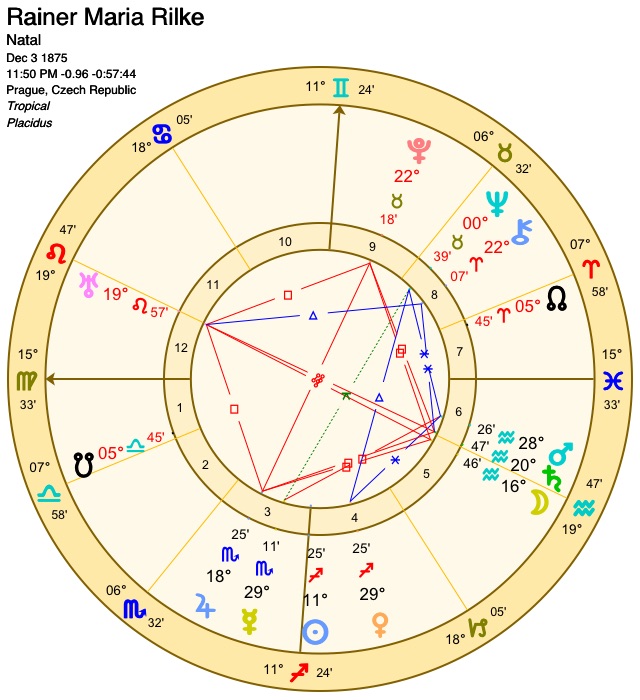
The window to the soul can have many frames. The soul of a poet already lends itself to rich symbolic interpretation, since it is in symbols and images that the poet expresses his imaginal world. One such symbolic frame to the soul is that of the astrological birth chart, which can provide an archetypal lens into the psyche of the individual. Born with six planets in a tight grand cross, the great poet Rainer Maria Rilke expressed the powerful dynamism of his birth chart through a lifetime of poetic works. A deep exploration of Rilke’s birth chart and transits would fill volumes, so I will just lightly touch the surface in this essay, focusing first on some of the major aspects in his natal chart, and then looking at two pivotal moments in his life which, although seemingly disparate from the outside, symbolically seem to bookend Rilke’s journey in relation to his search for the “unknown beloved,” for the encounter with the divine feminine, the union with the Anima. These two pivotal moments on which I shall focus are the day when Rilke met Lou Andreas Salomé, his first great love, and when he began to write the Duino Elegies, considered by many to be his masterwork.

The description Rilke’s mother gave of the day he was born is saturated with Christian symbolism, from his birth in the cold of winter at midnight, “the very hour at which our Saviour was born,” to his first gift of a tiny gold cross, bestowing upon him the gift of Jesus.[1] Rilke’s birthday is December 4, 1875, although as best we know the exact time was in the last minutes of December 3, at 11:50 pm, in Prague. He is born with a triple conjunction of the Moon, Saturn, and Mars in Aquarius; this stellium forms a grand cross with Uranus in opposition, Pluto in a square to the Moon stellium and Uranus on one side, and a Mercury-Jupiter conjunction in a square to the Moon stellium and Uranus on the other side. Before even delving into the particular archetypal qualities of the planets and their various relationships to each other, I would like to draw attention to the symbol of the grand cross itself.

Rilke's Birth ChartA grand cross is made up of two oppositions and four squares. The quality of an opposition is that of powerful polarity, a tension of opposites in which the archetypal energies of the planets involved come into potent dialectic with each other. The quality of a square is that of dynamic challenge, sometimes with an unexpectedness to it, in which the archetypal energies can be in conflict or tension with one another. As hard aspects, both the opposition and the square can lend themselves to the growth and transformation of the individual through facing the obstacles, challenges, and crises these aspects can bring up. When these aspects come together to form a grand cross those powerful tensions and energies are multiplied and intensified. A grand cross can at times have the feeling of soul crucifixion, of being stretched across the polarities of one’s life, a simultaneous forcing together and pulling apart of oneself. Rilke’s grand cross can symbolically be seen in his dynamic and fraught relationship to Christianity, from his severely religious upbringing, to his unorthodox Visions of Christ, to the Duino Elegies, in which, as Daniel Polikoff writes, “we experience the signal events of the Passion—carrying of the cross, the crucifixion, entombment, and resurrection,”[2] and to Rilke’s own sense of personal martyrdom.

The Moon in the grand cross can be seen as symbolizing Rilke’s soul journey in relation to the archetype of the Anima. The Moon relates to emotion, intuition, feeling, nurturance and care-taking, the psychosomatic aspects of oneself; it is the womb or matrix of one’s being, the mother-child relationship, emotional connection with others, one’s home and one’s past. While the lunar archetype is not solely equal to the “feminine” per se, women, and in particular the cycles of women’s bodies, have a correlative relationship to the Moon. To have this most intimate of personal planets in such dynamic relationship with many of the outer planets—a bridging of the personal to the great powers of the transpersonal archetypes—correlates with the many transformative relationships Rilke had over the course of his life. In Polikoff’s words:

Rilke’s most intimate relationships did not begin or end solely in the personal sphere but catalyzed (and were catalyzed by) his connection with archetypal, impersonal factors, spiritual and imaginal realities that underlie and overlay the human realm, exceeding the bounds of ego consciousness.[3]

Much of Rilke’s emotional character can be seen in his Moon-Saturn conjunction, as well as its opposition to Uranus. The archetype of Saturn restricts, constrains, distances, and severs, while Uranus is the archetype of freedom, spontaneity, youth, and rebellion. Rilke’s Moon-Saturn can be recognized in his need for emotional distance and his lifelong sense of homelessness, but with the restlessness of Uranus in the aspect he also had a strong need for emotional freedom, and lived a life of nomadic wandering. In a letter ending a relationship with one of his lovers Rilke wrote: “Never forget that solitude is my lot, that I must not have a need for anyone, that all my strength in fact comes from my detachment . . . I implore those who love me to love my solitude.”[4] With Pluto, which impels, drives, empowers, and deepens, squaring each of these planets as part of the grand cross, the need for emotional distance and freedom is intensified into a powerful force, in many ways driving the energies of Rilke’s life and relationships. His Moon square Pluto can also be seen in his many relationships with powerful women, women who not only had social power but great power of mind and personality as well.

To complete the grand cross, Mercury and Jupiter are in a broad conjunction squaring Uranus. Mercury relates to all forms of communication, from thinking and speaking, to writing and, of course, to the art of poetry. Jupiter elevates and grants success upon that which it touches, and archetypally relates to abundance and magnitude. The generosity of words which flowed through Rilke over the course of his poetic career clearly relate to this archetypal combination, and Uranus can be seen in the ingenuity and brilliance with which Rilke executed his writing, as well as in the breakthrough success his works have been granted. Yet in order to bring these works of poetic genius into being, Rilke entered into many dark periods of suffering and despair, which is carried by the square of Saturn to Pluto in his grand cross. He had a “lifelong preoccupation with death”[5] and was often held in the depths of depression, which relate to the tremendously powerful constraining force Saturn-Pluto can have upon one’s psyche. Yet instead of denying what these feelings were asking of him, Rilke was able to bring them forth and come into objective relationship with them, a desire particularly characteristic of the Moon-Saturn aspect. As Polikoff writes, “Rilke . . . craved, not to leave feelings behind, but to realize their mode of objective existence; to make, as the poet said, ‘things out of feelings,’ to lend ever more concrete existence to the soul’s innate longings.”[6] It was just this which he achieved in his poetry, particularly his Dingedichte, which not only made ‘things out of feelings,’ but gave soul feeling to things.

One final aspect I would like to touch on before moving into Rilke’s transits is his natal Venus trine Neptune. The archetype of Venus relates to love and romance, beauty, art, and aesthetics, while Neptune is the archetype of the transcendent, of both soul and spirit, of image and imagination, of the ideal as well as the illusory. The aspect of the trine is considered to be a harmonious or soft aspect, and the archetypal energies tend to flow in confluence and harmony with one another. Rilke’s Venus-Neptune can be seen in the exquisite beauty of his poetic art, and its expression of his “soul-based spirituality.”[7] Yet this aspect also manifested in Rilke’s search for an ideal love who could never be actualized, for the humanness of his many lovers would always shatter the ideal image which he had projected onto them:

“You, beloved, lost in advance, you
who never arrive . . .”[8]

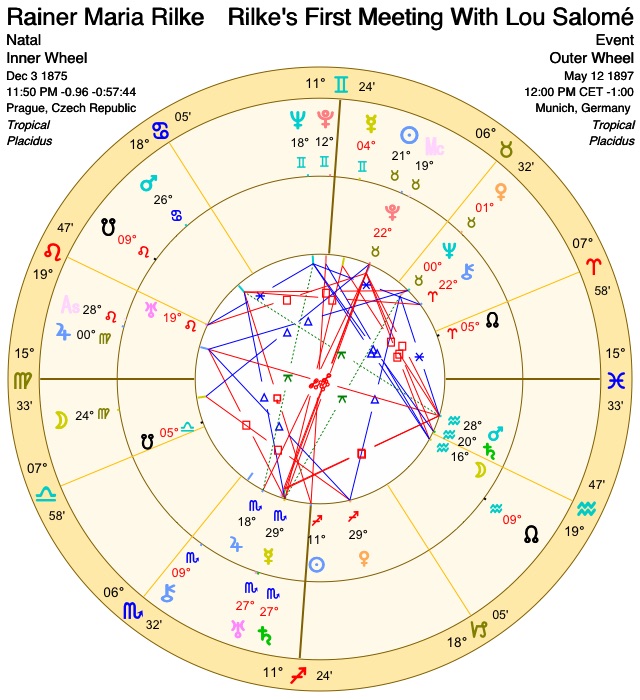
The day that Rilke met Lou Salomé, May 12, 1897, when he was only twenty-two years old, a powerful transformation was set into motion in Rilke’s soul. On that day there was a Venus-Mars square in the sky—the archetypal configuration related to romance in which Mars is the passion and fire that attract the Venusian lovers to one another—that was aligned right on Rilke’s natal Neptune. As his lover, Lou introduced Rilke to new ways of engaging with spirituality and religion as a means to attend to his own soul development, all of which are symbolized by the Neptune archetype.First Meeting with Lou Salome

Also on that day the Sun happened to be aligned with Rilke’s natal Pluto opposite Mercury. He also had a longer transit of Saturn-Uranus, which were exactly conjunct in the sky at the time, conjoining his Mercury. The Saturn-Uranus complex relates to the Puer-Senex dialectic—Lou was fourteen years his elder—as well as the revolutionizing of traditional structures, rebellion against authority, and that which is old or constraining. But Saturn-Uranus is also the maturation of youth, the careful revision of that which has come before and the refinement of that which is yet to come. Rilke had already been experiencing this transit on his Mercury-Pluto—the part of his chart which correlates to the tremendous depth and transformative power of his poetry—for some time before he met Lou, but with the Sun highlighting the transit on the day they met one can see that moment as a symbol of the impact their relationship would have upon him and his work, transforming and revolutionizing the vision that he would spend his life learning to articulate. Furthermore, Rilke was also in the heart of a long transit of Pluto opposite his Sun, which would have been a long period of powerful and intense transformation of his sense of self. Lou clearly played a strong role in that metamorphosis.

To finish this analysis I would like to leap from Rilke’s early years and relationships to his later life, to the time when he composed the Duino Elegies, his “greatest, life-defining task.”[9] As Polikoff writes, “The Elegies unfold a further stage of the intimate yet deeply fraught intercourse between the soul and the transcendent spirit of love that underlies the whole of the poet’s oeuvre.”[10] In this statement can be seen the dialectic between two of the major components in Rilke’s chart: the ‘transcendent spirit of love’ as embodied by his Venus-Neptune, and the ‘deeply fraught intercourse’ of soul as can be seen in his grand cross, particularly in relation to the Moon and its connection to the Anima. Polikoff goes on to say “The Elegies transparently carry forward the meditation on the mysteries of death, (impossible) love, and poetic vocation so central to Rilke’s previous work.”[11]

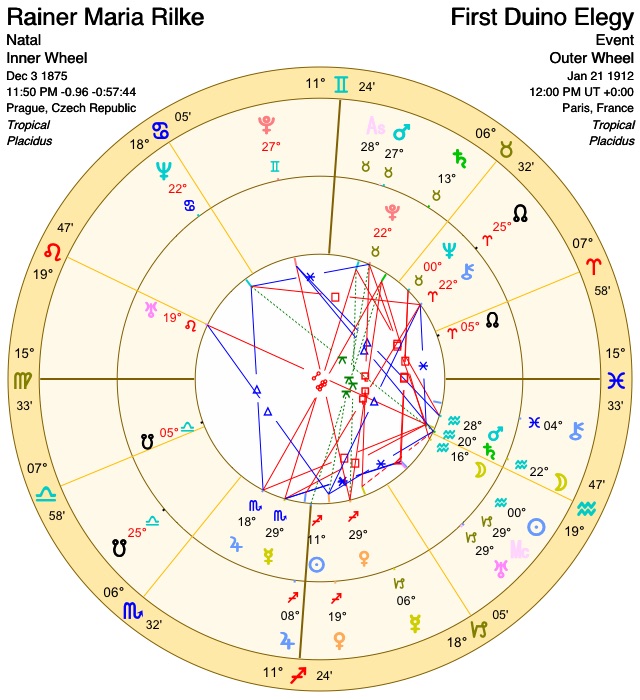
Rilke wrote the Elegies over a ten year period beginning in 1912, but left a long gap between late 1914 and 1922 when he finished the series. For this essay I will focus in particular on the transits to Rilke’s natal chart on the day he wrote The First Elegy, January 21, 1912, and glance briefly at some of the outer planet transits he experienced over the following three years as he wrote the next three Elegies.

First Duino ElegyLeading up to the time when Rilke wrote the first Elegies he was undergoing a rare transit of the planet Uranus squaring his natal Neptune, at the same time that Uranus was beginning to oppose Neptune in the sky as a world transit. One can see how Rilke, along with others of his generation who also experienced the world transit of Uranus opposite Neptune coming into a t-square alignment with their natal Neptune (such as C.G. Jung who was born the same year as Rilke) became a personal vessel of the archetypal energies that were affecting the whole world at that time. The Uranus-Neptune combination relates to a revitalization of the spiritual, as well as a rejuvenation and upwelling of the ingenuity of the creative imagination. Not long before he began writing the Duino Elegies, Rilke went on a journey to North Africa that “refreshed and invigorated his religious imagination” through his encounter with Islam, a religious tradition previously unknown to him.[12] The Uranus-Neptune motifs awakened during this journey were carried into the Elegies as a revisioning of the Christian mythos with which he had been engaging throughout his poetic career. Polikoff writes,

Rilke’s Duino Elegies effectively restyle Christ’s Passion as a work of human soul-consciousness. In reading the Duino Elegies, we experience the signal events of the Passion—carrying of the cross, the crucifixion, entombment, and resurrection—as they are reenacted in transformed form in the inner space of the speaker’s decidedly human subjectivity—a self-consciousness archetypally psychological and poetic at one and the same time.[13]

In this passage one can recognize the Promeathean-Uranean themes in restyling and revitalizing the Christian symbolism, but in such a way that draws on other Neptunian qualities such as soul-consciousness in relation to the archetypal, psychological, and the poetic.

Another powerful, long-term transit Rilke was experiencing when he wrote the first four Elegies was the planet Pluto opposing his natal Venus. Furthermore, on the very day when Rilke wrote The First Elegy, the planet Mercury was forming an opposition to Pluto in the sky, therefore also conjoining Rilke’s Venus. This transit can be seen in the force and power of the voice carried in the Elegies, right from the first line: “Who, if I cried out, would hear me among the angels’/ hierarchies?”[14] Over this time period as Pluto opposed Rilke’s Venus, it was also in a sextile to his natal Neptune, thus highlighting in different aspects his Venus-Neptune trine. The Elegies convey a powerful spiritual vision that plumbs the depths of the human soul, and burns with a passionate fire of love throughout. Pluto empowers and deepens the spiritual vision and soul expressive of Neptune, while Venus is reflected not only in the themes of love and the beloved throughout, but also the artistic medium of poetry itself.

Part of Rilke’s soul journey that led to the writing of the Elegies was a transformation in his relationship to love, and his eternal search for the unknown and unattainable beloved so expressive of his Venus-Neptune trine. With the transformative power of Pluto transiting this natal aspect, Rilke was finally able to own this desire in himself, turning the search for the beloved—which again and again ended in loss and isolation so characteristic of Moon-Saturn opposite Uranus—away from the outside world and into the heart of his soul instead. Polikoff writes that Rilke had the “sense that the way forward lay, not in abandoning the work of love, but, on the contrary, in withdrawing the centrifugal force of his outward projection of it, better interiorizing and so truly realizing it for the first time.”[15] One such example of this can be seen in a few lines from The First Elegy, in which Rilke declares:

Isn’t it time that we lovingly
freed ourselves from the beloved and, quivering, endured:
as the arrow endures the bowstring’s tension, so that
gathered in the snap of release it can be more than
itself.[16]

Over the course of this transit from Pluto, Rilke’s relationship to the beloved is being transformed, and the possibility of him encountering the beloved in his own soul, as the Anima, is now awakened.

Over the course of the years during which the first four Elegies were written, from 1912 until 1914, the planet Saturn moved from first squaring Rilke’s Moon, to next conjoining his Pluto, to opposing his Sun, and finally to exactly conjoining Pluto in the sky opposite his Venus in November 1914 when he wrote the Fourth Elegy. The archetype of Saturn constrains and pressurizes, like the repeated and seemingly unending contractions of the birth process, all in service of forging something with strength and maturity, of bringing to birth that which has been compressed and sculpted until it has the quality of a diamond. Each of these major transits of Saturn to four of Rilke’s natal planets can be seen symbolically as year-long contractions slowly bringing to birth Rilke’s masterwork, the Duino Elegies. The archetypal qualities of Saturn can be seen coming through the Elegies both at the intimate and personal level, as when Saturn transits Rilke’s Moon and later his Sun, and also at the transpersonal level when Saturn transits Rilke’s Pluto, and later Saturn-Pluto in the sky oppose his Venus. As Polikoff writes,

The great subject of the Elegies is nothing less than the nature and destiny of humanity, the contours of modern consciousness per se as these appear silhouetted against the abyss; the existential core of human being that begins to reveal hidden features even as its accustomed faces are torn away in the apocalyptic storm of the soul’s dark night.[17]

Much of the imagery in this quote is Saturnian, from the contours and silhouettes against the abyss, to the destiny and existential core of humanity; furthermore the transits with Pluto empower and deepen Saturn’s relentless challenge to truly bring about the ‘apocalyptic storm of the soul’s dark night.’

Much more could be said about Rilke’s process of writing the Duino Elegies and the corresponding transits that unfolded over the course of the decade in which he wrote them. The archetypal symbols carried by an individual person take a lifetime to unfold, and still they could not be exhausted. Rilke came into his life bearing an immensely complex chart, one that must have indeed been challenging to carry, the weight of the grand cross in particular not unlike a soul crucifix to be born through the dark valleys of depression. Yet it is the most challenging aspects that can forge us into who we are meant to be, and in this Rilke responded superbly—for not only did he continue on his dark journey, he returned to the world a gift of poetic beauty that could only have been newly forged in the burning fires of the underworld.

Works Cited

Polikoff, Daniel. In the Image of Orpheus: Rilke: A Soul History. Wilmette, IL: Chiron Publications, 2011.

Rilke, Rainer Maria. The Selected Poetry of Rainer Maria Rilke. Edited and translated by Stephen Mitchell. New York, NY: Vintage International, 1989.

[1] Sophia Rilke, qtd. in Daniel Polikoff, In the Image of Orpheus: Rilke: A Soul History (Wilmette, IL: Chiron Publications, 2011), 6.

[2] Polikoff, In the Image of Orpheus, 498.

[3] Polikoff, In the Image of Orpheus, 239.

[4] Rainer Maria Rilke, qtd. in Polikoff, In the Image of Orpheus, 447.

[5] Polikoff, In the Image of Orpheus, 16.

[6] Ibid, 337.

[7] Polikoff, In the Image of Orpheus, xvii.

[8] Rainer Maria Rilke, qtd. in Polikoff, In the Image of Orpheus, 479.

[9] Polikoff, In the Image of Orpheus, 446.

[10] Ibid, 447.

[11] Polikoff, In the Image of Orpheus, 477.

[12] Ibid, 449.

[13] Polikoff, In the Image of Orpheus, 489-90.

[14] Rainer Maria Rilke, The Selected Poetry of Rainer Maria Rilke, ed. and trans. Stephen Mitchell (New York, NY: Vintage International, 1989), 151.

[15] Polikoff, In the Image of Orpheus, 482.

[16] Rilke, The Selected Poetry of Rainer Maria Rilke, 153.

[17] Polikoff, In the Image of Orpheus, 486.

When Symbol Becomes Fact: Reflections on “Saving the Appearances”

“The world of final participation will one day sparkle in the light of the eye as it never yet sparkled early one morning in the original light of the sun.”
– Owen Barfield[1]

When sunlight refracts on the droplets of a raincloud, and an arc of colors bend across the sky, we must ask ourselves, “Is the rainbow really there?” With this image Owen Barfield opens his book Saving the Appearances: A Study in Idolatry, a short but profound tale of the evolution of consciousness from original participation, through the non-participatory (or rather, unconsciously participatory) scientific revolution, to final participation. But what does Barfield mean by participation? And how might one trace an evolution of consciousness?Saving the Appearances

Barfield begins with the image of the rainbow, demonstrating how it is a shared collective representation. A representation is something that I, and others, perceive to be there: whether it is a rainbow, a tree, a house, or any other phenomenon available to sensory experience. A representation is more than what any phenomenon can be reduced down to—such as subatomic particles; a representation is the phenomenon in its wholeness. The particles, which Barfield calls the unrepresented, are what science claims really exist in the world prior to human perception of them. “The world we all accept as real,” Barfield writes, “is in fact a system of collective representations.”[2] We do not perceive collective representations with our sense organs alone, but with “mental habits, memory, imagination, feeling.”[3] The generation of representations is what Barfield means by participation: “Participation is the extra-sensory relation between man and the phenomena.”[4] The world as we know it is created by participation in that world.

Through imagination Barfield enters into the participatory consciousness of previous world views, from the Medieval European, to the Graeco-Roman, to the Hebraic, each of which lived in original participation with the world to some degree. Original participation is “an awareness which we no longer have, of an extra-sensory link between percipient and the representations.”[5] Modern consciousness also participates in the phenomena, but does so unconsciously, believing instead that the perceived phenomena are independent of human perception. “Thus the phenomena themselves are idols, when they are imagined as enjoying that independence of human perception which can in fact only pertain to the unrepresented.”[6] This misperception of the phenomena as entirely independent of human perception Barfield terms idolatry, and it is to idolatry that he is attempting to bring awareness, to thus overcome and lead human consciousness into final participation—an awakened recognition that the phenomenal world is one of collective representations.

Simply put, it was through the development of the scientific revolution that original participation was expunged from the consciousness of the modern West and idolatry took hold in its place. “If therefore man succeeds in eliminating all original participation, without substituting any other, he will have done nothing less than eliminate all meaning and all coherence from the cosmos.”[7] Not only does idolatry empty spirit from the cosmos, it eventually eliminates spirit from the human as well. In order to move beyond idolatry into final participation, Barfield turns to religion, to the Incarnation of the Word in the Christian faith.

Idolatry suffers from literalness, thus to the idolatrous mind an event can be historical or it can be a symbol: it cannot be both. Barfield uses the Incarnation of the Word—the birth of Christ, the Second Person of the Trinity incarnating into a human body situated in historical time—to usher in final participation. Because the Incarnation is both historical and symbolic, it breaks down the schism between human consciousness and perceived phenomena. Yet by turning to religion, and particularly Christianity, in this way, it feels like Barfield narrows the field of those to whom final participation might apply. He defines religion as “essentially an ‘I-Thou’ relation between man on the one hand and the Creator of man and of his phenomena, on the other. A man who cannot think of his Creator as a Being other than himself cannot be said to have religion.”[8] This definition of religion is quite narrow, and excludes many of the world’s religious and spiritual traditions (and the masculine language unconsciously excludes women as well). Yet Barfield writes that the only possible answer to idolatry is acceptance of a “directionally creator relation to the phenomenal world.”[9] Is that really the case? Can there be a wider reading of final participation that can allow for the inclusion of those who have entered into that stage of consciousness by paths other than the Christian one?

To begin answering this question perhaps a wider reading of what Barfield means by the Incarnation of the Word is also necessary. Idolatry, or non-participatory consciousness, has brought with it gifts as well as shadow. Barfield writes, at first in seemingly negative terms, that “a non-participating consciousness cannot avoid distinguishing abruptly between the concept of ‘man,’ or ‘mankind,’ or ‘men in general’ on the one hand and that of ‘a man’—an individual human spirit—on the other.”[10] This is the literalness of idolatry. But this literalness allows something else to be born as well, of which Barfield speaks shortly thereafter:

The awakened clarity of retrospect . . . will . . . be obliged to recognize that the gradual emergence of man from original participation amounts also to the gradual emergence of ‘men’ from ‘man;’ that it is not just the cumulative history of the race, but the biography, also, of each individual spirit.[11]

What Barfield fails to mention explicitly here, yet can be implied by this statement when read half a century after it was first written, is that not only can individual men emerge from the all-encompassing term “Man,” but so can individual women, as well as others whose identities have been obscured by the Western male conception of Man. The symbolic becomes situated, and thus refracts into a myriad of individuals. This is the gift of the non-participatory stage of the evolution of consciousness as Barfield describes it.

Beginning in the chapter entitled “Israel” Barfield writes about the Divine Name, the “I Am.” The Divine Name, when spoken within the mind of an individual human—one who has only been able to individuate through the refraction of non-participatory consciousness—indicates the divinity not only of the Creator whose name is being spoken, but the divinity of each individual speaking it. This is the Incarnation of the Word, the Word become flesh, that Barfield sees as able to overcome idolatry and usher human beings into final participation. I find myself drawn to read Barfield’s use of the Christian mythos itself as both a symbol and a historically situated reality. If I were to reject Barfield’s concluding thesis on the premise that his turn to Christianity excludes those for whom this perspective does not, or perhaps even cannot, apply then I too would fall into the literalness of idolatry. From my situated perspective I can recognize the way in which the Incarnation of the Word—which allows for a new form of individual participation in the Divine and participation with one another as individuals—was for Barfield the real way in which idolatry could be overcome and final participation entered into. Yet I can also read the Incarnation as a symbol of something beyond the Christian faith alone, a symbol of the recognition of the Divine within, that can encompass a multiplicity of forms of spiritual connection and religious perspective.

Work Cited

Barfield, Owen. Saving the Appearances: A Study in Idolatry. Middletown, CT: Wesleyan University Press, 1988.

[1] Owen Barfield, Saving the Appearances: A Study in Idolatry (Middletown, CT: Wesleyan University Press, 1988), 161.

[2] Barfield, Saving the Appearances, 20.

[3] Barfield, Saving the Appearances, 20.

[4] Ibid, 40.

[5] Ibid, 34.

[6] Ibid, 62.

[7] Ibid, 144.

[8] Barfield, Saving the Appearances, 156.

[9] Ibid, 159.

[10] Barfield, Saving the Appearances, 183.

[11] Ibid, 184.