Thoughts on “Global Environmental Politics”

Upon reading the first three sections of Simon Nicholson and Paul Wapner’s new anthology on the current state of the planet, I was struck by how succinct and compelling each of the short articles were that comprise the book. The volume is clearly made for a classroom setting, and I felt the content was accessible to a wide range of readers. What was particularly striking though was the continual interweaving of both hope and despair carried by the various authors’ voices. For example, Alex Steffen’s chapter “Humanity’s Potential,” while not naïvely optimistic, still gave me the sense that if we lose ourselves to pessimism we will actually be in a worse situation than if we engaged the crisis with some sense of hope. Hope is not certainty of outcome; I feel hope is something deeper, perhaps more akin to faith.

Global Environmental PoliticsOn the other hand, Stephen Meyer’s essay “End of the Wild” carries within it a true and necessary sense of mourning of the inevitable extinction of species accelerating on the planet due to the activities of our own singularly prolific species. Meyer makes the distinction that while there is nothing we can do to save the loss of the wild this is no reason to not do anything. He concludes:

The end of the wild does not mean a barren world. There will be plenty of life. It will just be different: much less diverse, much less exotic, far more predictable, and—given the dominance of weedy species—probably far more annoying. We have lost the wild. Perhaps in 5 to 10 million years it will return.[1]

His final note is clearly one of despair and grief, deep emotions we must allow ourselves to feel if we are to engage with this crisis in any realistic way.

The book opens with two essays that both address the name of the new geologic epoch into which humanity has ushered the planet: the Anthropocene. Elizabeth Kolbert and Charles Mann both speak to the meaning and uses of this term: whether to use it ironically or seriously, what the impact of naming the epoch might be, when one might date the beginning of the Anthropocene—whether from the invention of agriculture, the Industrial Revolution, or even further into the future when the effects of climate change are absolutely undeniable. The question that continued to arise for me in relation to the term Anthropocene is, will it awaken humanity to the fact we have become a force of planet Earth as powerful as the geologic and hydrologic cycles and that we must take responsibility for this power, or will it reinforce the anthropocentric hubris that led us to this crisis in the first place?

Work Cited

Nicholson, Simon and Paul Wapner, ed. Global Environmental Politics. Boulder, CO: Paradigm Publishers, 2015.

[1] Stephen Meyer, “End of the Wild,” in Global Environmental Politics, ed. Simon Nicholson and Paul Wapner (Boulder, CO: Paradigm Publishers, 2015), 57.

The Synchronicity of the Two Red Books: Dissertation Methods & Methodology

“Perhaps the path or method of re-search done with soul in mind is simply a recognition that all our acts of knowing are attempts at remembering what we once knew but have forgotten. Perhaps all our attempts at re-search are sacred acts whose deep motive is salvation or redemption. Maybe all our re-search reenacts the Gnostic dream of the fall of soul into time and its desire to return home.”
– Robert Romanyshyn[1]
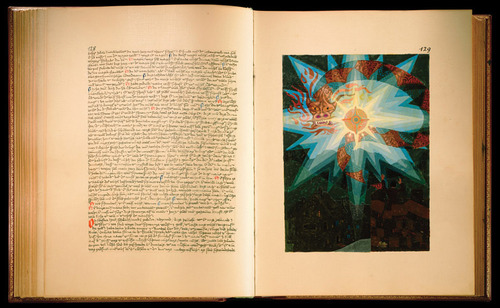
Red Book Dragon

The journey of this dissertation began with the intuition of a synchronicity. The first time I beheld The Red Book of C.G. Jung I felt an echo in my memory: J.R.R. Tolkien also had a Red Book, The Red Book of Westmarch, that he claimed was the supposedly fictional source from which he had translated his stories The Hobbit and The Lord of the Rings. Yet, besides the titles, there was no reason to suppose any similarity existed between the two Red Books; no reason except that my intuition was telling me to look further, to find out if there might perhaps be more in common between these seemingly disparate works than would ordinarily be expected.

As I started preliminary research on this topic I began to find uncanny similarities between many of the images and experiences recorded in Jung’s Red Book and several of the stories and pieces of artwork from Tolkien’s oeuvre. Furthermore, I found that both men were having experiences of what Jung came to call “active imagination” beginning in the same year—1913—and continuing for several years thereafter. The images from this time period provided the seminal material that both men spent the next forty years developing in their work. The further I investigated, the more the similarities revealed themselves, until I began to question what the implications were of the synchronicity of the two Red Books. If Jung and Tolkien were simultaneously having experiences of active imagination that led them each to create art and writing with many similarities in style and content, what did this indicate about the sources of these experiences? If these findings were not to be dismissed as mere coincidence, then what did they imply about the nature of imagination? Such thoughts led me to the formulation of the primary research question of my dissertation: What implications might the imaginal experiences of Jung and Tolkien have for the modern disenchanted world view that has led to our current ecospiritual crisis, and how might a greater understanding of imagination lead to a shift in consciousness? My preliminary thesis statement is that the experiences of these two men point to the ontological reality of an imaginal realm, which holds significant implications for overturning the disenchanted world view that has contributed greatly to the ecological crisis.

Because of the nature of my inquiry, and the manner in which the research topic revealed itself, the methodological approach to this dissertation must be one that affirms the importance of imagination and intuition in the research process. Therefore I will be using an alchemical hermeneutics, as developed by Robert Romanyshyn, as my primary research methodology because it is an approach that aims to “keep soul in mind,”[2] and emphasizes the importance of imagination, intuition, feelings, dreams, synchronicity, and the myriad other expressions of the unconscious that emerge in the research process. Alchemical hermeneutics is what Romanyshyn calls an imaginal approach to research, an approach that complements other methods, rather than seeking to replace them.[3] Thus, I will be taking a mixed methods approach to this research topic, with each method filtered through the imaginal lens of alchemical hermeneutics.

“When one designs a method,” Romanyshyn writes, “one is mapping out the journey that one will take from that place of not knowing one’s topic to that place of coming to know it.”[4] For my dissertation research I will be employing an array of methods to address the multiple levels of the topic: literary, artistic, biographical, historical, and archetypal analysis, which will each be engaged from an imaginal research perspective. If alchemical hermeneutics is the path mapped out for my research journey, I see these different forms of comparative analysis as the supplies I have in my pack to aid me along the way. Each of these methods will come in handy at different points on the journey, depending on what the terrain of the research is at the current moment.

“Method is also who the researcher is in the work, who he or she is as he or she continuously opens a path into a work. Method is an attitude that pervades the whole process of research as a journey.”[5] My choice of an alchemical hermeneutics will not only shape the results of my research, it will shape me along the way. According to Romanyshyn, “dissertation writing can become an aspect of the individuation process.”[6] As I am transformed by the process of researching and writing, my methodological approach will be transformed as well. This is what Romanyshyn refers to as the hermeneutic circle:

Within the embrace of this circle of understanding, the knower approaches a text with some foreknowledge of it, which in turn is questioned and challenged and amplified by the text, thereby transforming the knower who returns to the text with a different understanding of it.[7]

For example, when I first approached Jung’s Red Book, I had already been steeped for a decade and a half in the stories, languages, and images of Tolkien’s world of Middle-Earth. This reserve of knowledge, which I was already shaped by, in turn shaped how I approached my initial reading of Jung’s Red Book. Yet, after delving more deeply into the content of Jung’s imaginal experiences, the way in which I viewed Tolkien’s stories, and his process of creating them, began to shift as well. As Romanyshyn points out, “the topic chooses the researcher as much as, and perhaps even more than, he or she chooses it.”[8] I had the sense that something in the material was asking me to explore it, although the calling seemed to be taking place below the conscious level. One way in which alchemical hermeneutics differentiates from traditional hermeneutics is that is seeks to bring the unconscious of the researcher into the process of research itself. Romanyshyn describes this recursive dialogue between the researcher and the material as the hermeneutic spiral:

One task of an alchemical hermeneutic method is to deepen the hermeneutic circle by twisting it into a spiral. The researcher, then, follows the arc of the hermeneutic circle, but in such a way that the engagement of the two takes into account the unconscious aspects of the researcher and the work.[9]

The imaginal approach to research is particularly well-suited to this topic because it seeks to recreate through methodology Jung’s and Tolkien’s own imaginal methods in producing their material. Romanyshyn writes, “In a sense, we might say that alchemical hermeneutics is the offspring of the encounter between the tradition of hermeneutics and depth psychology.”[10]

Before unpacking further the pertinent aspects of alchemical hermeneutics, I would like to look at the more specific methods I will be using throughout this research journey. As mentioned previously, I will be using literary, artistic, biographical, historical, and archetypal analysis, depending on which aspects of Jung and Tolkien I am studying. Both men expressed themselves primarily through writing, therefore I will be using literary analysis to compare the texts they each produced. To narrow the scope of which texts I will analyze, I am focusing on material directly related to or produced by imaginal means—in Tolkien’s case the stories, poems, and languages that he composed, and in Jung’s case the narrations of his experiences of active imagination, recorded primarily in The Red Book. I will be comparing the content of these texts, and at times the style, although the fact that they were originally written in different languages—English and German, respectively—will have to be taken into account.

Besides the common name of The Red Book, what originally drew my attention to the potential similarities between Jung’s and Tolkien’s work was a resonance in the style and content of their artwork. Not only were there common images of dragons, cosmic trees, eyes, and mandalas, but there were deeper similarities that I could feel intuitively but were not explicitly on the surface. These were images that seemed to be expressing the entrance into an internal world, an imaginal world, the realm of psyche. An analysis of these images has to take place on multiple levels. On the one hand, the images can be analyzed for specific content, compared to each other as well as to other artwork produced at the time. Is the resonance in style particular to Jung and Tolkien, or does it reflect a larger artistic style of that cultural period in history? On the other hand, the artwork can also be analyzed symbolically, not only when there are shared appearances between Tolkien’s and Jung’s art, but also when the images differ aesthetically yet might symbolically be pointing toward a congruent meaning.

Hermeneutics is the art of interpreting and coming to understand symbols as expressed in texts and images. An alchemical hermeneutics seeks to approach this act of interpretation by recognizing that a symbol can never be exhausted, for the very nature of a symbol is that it presences what is absent. Romanyshyn writes,

Interpretation is always a “failure” because what is present in the symbol remains haunted by what is absent. . . . Interpretation at the level of soul is not just about deciphering a hidden meaning, it is also about a hunger for the ordinary presence that still lingers as an absent presence.[11]

In my approach to the images created by Jung and Tolkien, both in text and in art, I am not only reading what the symbols contained therein are explicitly communicating, but also what is implicit in their very existence. I am asking of these symbols not only what they are expressing, but why. What meanings do these symbols point towards? The meaning of symbols can unfold eternally: “Alchemical hermeneutics,” Romanyshyn writes, “is not, therefore, only about arriving at meaning as a solution. It is also about the continuous dissolution of meaning over time in relation to the unfinished business in the soul of the work.”[12] As I walk the path of my research I have to come to recognize that the path does not end, I will only choose to stop treading it at a certain moment. As Romanyshyn goes on to say, “there is never simply an ‘after’ of the work, a time when, after the work is finished, it is done.”[13]

In addition to literary and artistic comparative analysis, I will also be doing biographical and historical analysis. I believe that life context is essential to understanding any person’s work, particularly when the material is as intimate as the Red Books are to their authors. Therefore, I will delving into all the available biographies of both Tolkien and Jung, looking for how the external experiences of their lives may have shaped their imaginal explorations. In order to put their life stories into context I will also be looking at the historical landscape in which Jung and Tolkien lived their lives. What cultural, political, ecological, and other pertinent factors were shaping their experiences? How did their imaginal experiences and expressions relate to or differ from their contemporaries? Looking at the larger context in which Jung and Tolkien were each having their imaginal experiences will shed light on the significance of the similarities in their work, whether the correlations are unique to them or are reflective of the culture and historical situation at large.

The final method I will be using to approach this research will be archetypal analysis. There are two ways in which I will be using the archetypal lens: one will be identifying the archetypes present in the stories and symbols expressed by Tolkien and Jung in their works, and the second will be using the empirical data of archetypal astrology to explore the birth charts, world transits, and personal transits relevant to the area of research. The latter archetypal method will illustrate the correlations between the movements of the planets and the manifestations of their archetypal energies in world events as well as in the personal lives of Tolkien and Jung. Thus, this aspect of archetypal analysis will be done alongside the biographical and historical readings of the material. The astrological perspective can shed light on the collective energies manifesting in world events during specific time periods, or on the energies being carried by individuals as reflected in their personal transits and natal charts. For example, the primary years of creative imagination for Jung and Tolkien, beginning in 1913, took place under the opposition of the planets Uranus and Neptune, which archetypally correlates with

widespread spiritual awakenings, the birth of new religious movements, cultural renaissances, the emergence of new philosophical perspectives, rebirths of idealism, sudden shifts in a culture’s cosmological and metaphysical vision, rapid collective changes in psychological understanding and interior sensibility . . . and epochal shifts in a culture’s artistic imagination.[14]

Recognizing that these transits were taking place can bring greater illumination to the imaginal experiences Jung and Tolkien were undergoing during this time.

The same archetypal eye that can recognize the astrological patterns manifesting in both personal and worldly events can also be turned inward to interpret the stories and images expressed in the Red Books. The second form of archetypal analysis will therefore be done in conjunction with the literary and artistic analysis discussed before. An archetypal lens will allow the symbols inherent in the material to speak a common language, allowing correlations to be more discernible.

One final methodological approach I am taking to my dissertation research is the analogical approach used by Daniel Polikoff in his book In the Image of Orpheus: Rilke: A Soul History. This method can be seen as a means of encompassing the five methods I just delineated and unifying them into a multivalent, symbolic lens. The analogical approach allows the researcher to recognize analogies between artistic expression and life event, or between life event and archetype, or between archetype and myth, and so forth. By reading through the many layers present, the meanings of the symbols in the work can continue to reveal themselves indefinitely.

While the empirical orientation of this dissertation is the identification of similarities between Jung’s and Tolkien’s Red Books, the deeper question at work in the research is what the implications are of these correlations. Therefore, not only are the similarities of import, but the differences are as well. If the similarities in their work point toward a common experience of the imaginal realm, what do the differences indicate? As I approach these questions in my research I have to be careful not to impose my own preconceived ideas onto the material, but rather remain open to what is being communicated directly to me by the work. As Romanyshyn writes,

Not so impatient to engage the work in any conscious way, not so quick to irritate the work into meaning, the researcher who uses the alchemical hermeneutic method is content to dream with the text, to linger in reverie in the moment of being questioned, as one might, for example, linger for a while in the mood of a dream.[15]

Here is both the gift and the challenge of an imaginal approach to research, because it can be such a trial to stay with the material when no clear answers seem to be arising, when the meaning or understanding one is searching for is not on the surface. Romanyshyn goes on:

Thus, the alchemical hermeneutic researcher begins with a kind of emptiness. It is an emptiness that has the qualities of patience and hospitality, which leave the researcher continuously open to surprise, an openness that, in having no plans, simply invites the text—the work—to tell its tale.[16]

When I first began my research on the Red Books there were times when I was sure that I would find nothing, no correlations to back up the intuition I had that some relation existed between these works. Yet, as Jung wrote, intuition “is not concerned with the present but is rather a sixth sense for hidden possibilities.”[17] I felt I had to surrender myself to whatever the text wanted to reveal. Romanyshyn speaks of how “The ego as author of the work has to ‘die’ to the work to become the agent in service to those for whom the work is being done.”[18] It may not even be clear for whom the work is being done, but that too is part of the surrender of ego to the soul of the work. “Within an imaginal approach,” Romanyshyn writes, “that larger tale to which one is in service is the unfinished business in the soul of the work, which makes its claims upon a researcher through his or her complexes for the sake of continuing that work.”[19] An essential part of the imaginal approach is recognizing that the work itself has soul, and has agency. The work guides the researcher as much as the researcher guides the work.

Soul means many things to many different people, and its elusive meanings have changed and evolved over millennia as well. From the depth psychological perspective soul, or Psyche, is primary. We exist in Psyche’s realm. “Soul is not inside us,” Romanyshyn writes. “It is on the contrary our circumstance and vocation. It surrounds us, and we are called into the world, as we are called into our work, through this kind of epiphany.”[20] Not only is the researcher ensouled, the researcher’s work is as well. An alchemical hermeneutics acknowledges that embeddedness in soul and seeks to articulate it, to give “voice to the soul of one’s work” by “allowing oneself to be addressed from that void, which depth psychology calls the unconscious.”[21]

How does one listen to the void? How does one open oneself to the unspoken wisdom of the unconscious? In an imaginal approach, this orientation is called a poetics of the research process. Not literally drawing on poetry, it is a means of entering into mythopoetic consciousness. In Romanyshyn’s words: “A poetics of the research process, then, is a way of welcoming and hosting within our work the images of the soul, a way of attending to more than just the ideas or facts, and it requires a different style, a different way of being present.”[22] More specifically, “A poetics of research invites the researcher to become the work through the powers of reverie and imagination and then let go of it.”[23] Traditional hermeneutics does not explicitly give a place to reverie and imagination in its methodological process, yet they are epistemological forces shaping the work nonetheless, although oftentimes unconsciously. A poetics of research allows the knowledge and understanding born from reverie the space to unfold. “In reverie,” says Romanyshyn, “we are in that middle place between waking and dreaming, and, in that landscape, the borders and edges of a work become less rigid and distinct. . . . In reverie, the work takes on a symbolic character and is freed of its literal and factual density.”[24]

Part of my research process has been learning to cultivate these moments of reverie while in direct relationship with Jung’s and Tolkien’s material, particularly while doing the literary and artistic analysis. When reading Jung’s Red Book for the first time, I created a ritual practice around the reading to honor the feeling I had that I was approaching a sacred text. The practice was in some ways communicated to me by the confluence of my embodied reaction to the material and the text itself. At first I would sit down to read with the intention of taking in as much material as possible, as I might with any other text I was researching. But I began to find after about eight pages I would emotionally shut down and disconnect from what was on the page; I was saturated, and literally could absorb no more. I would sit staring at the page wondering what had happened. Romanyshyn speaks of the role the body plays in our research, and that one should pay attention to those moments when we disconnect from the text, when we seem to drift off intellectually and depart from ourselves and what is present before us.[25] Something important is being communicated in that moment, and instead of reprimanding ourselves for “spacing out” we can instead learn to cultivate that place of reverie. One lesson I received from paying attention to this moment of splitting off from the text was that its richness could not be digested if I sought to take in too much at once. Therefore, I created a daily practice of reading eight pages—no more and no less—of The Red Book at a pace where I could absorb more of the material, and also be absorbed into the material. Such an approach, according to Romanyshyn, “deepens research and makes it richer by attending to the images in the ideas, the fantasies in the facts, the dreams in the reasons, the myths in the meanings, the archetypes in the arguments, and the complexes in the concepts.”[26]

Another aspect of my daily practice with Jung’s Red Book was that I only read from the original text. The Red Book has been published with the same size pages as Jung’s original manuscript, making it a weighty volume fifteen inches in height and eleven inches wide. Jung created The Red Book to look and feel like a medieval manuscript, and when one sits and reads it one cannot help but feel like a monk pouring over an ancient text. One must sit up at a table to read the book because it is too heavy to hold in one’s lap; the turning of each page feels like an accomplishment, giving the sense that the turning of a leaf has its consequences. Although a reader’s edition, as well as digital versions of the text, are available, I had an intuition I would learn more from the volume if I sat with its weight each day and learned from it at the emotional and physical levels, as well as at the intellectual level.

When approaching Tolkien’s work I developed a few different practices to bring the same care and reverence as I was bringing to Jung’s Red Book. I have read much of Tolkien’s oeuvre repeatedly over the course of my life, and to a high degree have internalized much of the content. When I came across a correlation in Jung’s work, it usually triggered my memories of some passage or aspect of Tolkien’s stories that I had read years before. The texts I was consulting of Tolkien’s, in the initial research, were a part of me, imprinted on my memory and soul. In some ways, my own memory could be seen as one of the texts being consulted in the research. Therefore, I decided to try to bring my memory even more consciously into the process. Certain passages I chose to memorize, to internalize the exact wording of Tolkien’s writing. For me this was another way of attending to the poetics of research, to become one with the poetics of the material. Another way in which I sought to bring ritual practice into my reading of Tolkien’s work was reading certain stories out loud with my partner. By presencing the language to each other, hearing the shape of the words—particularly the words of languages that Tolkien invented—gave greater life to the text and allowed the imaginal experience to lift off the page. Both sitting with Jung’s Red Book and reading Tolkien’s stories out loud became practices of trying to recreate their own imaginal experiences, of attempting to come to a greater understanding of their journeys into the realm of the imagination.

From these practices of physically sitting with the weight of the texts, as well as with the artwork created by both men, I realized that another part of the research I wish to undertake is to travel to the homelands of Tolkien and Jung to attempt to find any additional artwork in their archives that have not yet been published. In the Bodleian Library in Oxford, England is an archive of Tolkien’s work that I know contains several pieces of artwork not previously published. I am particularly interested in a series of drawings from his unpublished sketchbook The Book of Ishness, which is a series of imaginal drawings created at the exact same time as the early years of Jung’s Red Book period. While some of the images have been published in Hammond and Scull’s J.R.R. Tolkien: Artist & Illustrator, a footnote in that book lists the titles of the many drawings from the series that remain unpublished. I am curious to see if any of these bear a resemblance to more of Jung’s artwork. Thus I would also want to travel to archives in Zürich, Switzerland where the papers and artwork of Jung are held, to see what other images of his have not been published.

Approaching research from a place of reverie can open unexpected doorways into the research topic. For example, my research question regards the nature of imaginal experience, and one day when I was sitting with The Red Book I closed my eyes after reading a particularly beautiful passage about the sea. As I my eyelids descended, an inner world opened up before me: I had the sense of diving into a still pool in a forest glade and of swimming down, down, down. Long past the moment I felt I should have touched the bottom I was still descending. Then, instead of touching the base of the pool, I found myself surfacing from another body of water. The world had inverted, turned upside down. The waters in which I found myself swimming stretched as far as the eye could see under a grey sky, wan sunlight illuminating the backs of the clouds. As I began to swim forward I saw the white shores of what seemed to be an island. I swam up to the beach and pulled myself from the waters. A forest grew not far from the water’s edge, and I walked through the soft sands on a path under the trees. As I began to ascend the path, the vision started to fade and I reopened my physical eyes to The Red Book lying open before me.

This experience was not looked for in my analyses of Jung and Tolkien, but it gave me an experiential understanding of what active imagination felt like. Imaginal experiences born of reverie or dreams—of sleep or waking—can contribute to the methodological approach to the research. However, as Romanyshyn writes, “dreams as portals into research are not the data of research.”[27] While the content of this vision will not be a part of my dissertation, the experience of it has shaped me and therefore will implicitly shape the nature of the work.

The subject of my dissertation is the descent into soul, the threshold into the world of the imagination that both Jung and Tolkien seemed to have crossed on their life journeys. Part of what I am attempting to understand was their own methodological approach to those journeys. As Romanyshyn writes, “the descent into the depths of soul is easy. Finding our way back, however, is the art and is the work.”[28] The Red Books were Tolkien’s and Jung’s means of finding their way back from the world of soul. By treading the path again and again it becomes easier for others to follow in their footsteps. In creating a methodology I am attempting to find the maps they used on their imaginal journeys, and to survey the terrain in my own right.

Part of the intuition that drew me into this research was a sense of recognition of the experiences both Jung and Tolkien had undergone. At age nine when I first encountered the realm of Middle-Earth by having The Hobbit read aloud to me, I acknowledged that there was something deeply familiar about this territory. The sound of the names, the feeling of the places and the people all seemed to be echoing something I had somehow known before. When, over a decade and a half later, I encountered Jung’s Red Book I had that same sense of familiarity, and again could not place from whence it came. This very feeling Romanyshyn addresses as why we are drawn to do the research that we do, what in the work calls us forth to attend to it. He writes, “Research with soul in mind is re-search, a searching again, for something that has already made its claim upon us, something we have already known, however dimly, but have forgotten.”[29] The process of research is that of anamnesis, the un-forgetting that is the philosopher’s quest, as Plato articulates. The inexplicable affinity and familiarity the work holds for the researcher is the soul of the work calling to the soul of the researcher. It is a call to action within the realm of soul itself. That call ignites the desire to remember, to re-search, to find what we sense is there. As quoted in the epigraph opening this essay, “Maybe all our re-search reenacts the Gnostic dream of the fall of soul into time and its desire to return home.”[30]

Bibliography

Carpenter, Humphrey. J.R.R. Tolkien: A Biography. New York, NY: Houghton Mifflin Company, 2000.

Hammond, Wayne G. and Christina Scull. J.R.R. Tolkien: Artist & Illustrator. New York, NY: Houghton Mifflin Company, 2000.

Hillman, James. Re-Visioning Psychology. New York, NY: Harper Perennial, 1992.

Jung, C.G. Memories, Dreams, Reflections. Edited by Aniela Jaffé. Translated by Richard and Clara Winston. New York, NY: Vintage Books, 1989.

–––––. The Red Book: Liber Novus. Edited by Sonu Shamdasani. Translated by Mark Kyburz, John Peck, and Sonu Shamdasani. New York, NY: W.W. Norton & Company, 2009.

Polikoff, Daniel. In the Image of Orpheus: Rilke: A Soul History. Wilmette, IL: Chiron Publications, 2011.

Romanyshyn, Robert. The Wounded Researcher: Research with Soul in Mind. New Orleans, LA: Spring Journal Books, 2007.

Samuels, Andrew, Bani Shorter and Fred Plant. A Critical Dictionary of Jungian Analysis. New York, NY: Routledge & Kegan Paul, 1986.

Tarnas, Richard. Cosmos and Psyche: Intimations of a New World View. New York, NY: Viking Penguin, 2006.

Tolkien, J.R.R. The Letters of J.R.R. Tolkien. Edited by Humphrey Carpenter, with Christopher Tolkien. New York, NY: Houghton Mifflin Company, 2000.

–––––. The Lord of the Rings. New York, NY: Houghton Mifflin Company, 1994.

–––––. “On Fairy-Stories.” In The Monsters and the Critics. Edited by Christopher Tolkien. London, England: HarperCollins Publishers, 2006.

–––––. The Silmarillion. New York, NY: Houghton Mifflin Company, 2001.

–––––. “Smith of Wootton Major.” In Tales from the Perilous Realm. London, England: HarperCollinsPublishers, 2002.

[1] Robert Romanyshyn. The Wounded Researcher: Research with Soul in Mind (New Orleans, LA: Spring Journal Books, 2007), 268.

[2] Romanyshyn. The Wounded Researcher, 9.

[3] Ibid, 259.

[4] Romanyshyn. The Wounded Researcher, 215.

[5] Ibid, 273.

[6] Ibid, 270.

[7] Romanyshyn. The Wounded Researcher, 221.

[8] Ibid, 4.

[9] Ibid, 222.

[10] Romanyshyn. The Wounded Researcher, 235.

[11] Romanyshyn. The Wounded Researcher, 225.

[12] Romanyshyn. The Wounded Researcher, 233.

[13] Ibid, 262.

[14] Richard Tarnas, Cosmos and Psyche: Intimations of a New World View (New York, NY: Viking Penguin, 2006), 356.

[15] Romanyshyn. The Wounded Researcher, 223.

[16] Ibid, 224.

[17] C.G. Jung, qtd. in Romanyshyn. The Wounded Researcher, 291.

[18] Romanyshyn. The Wounded Researcher, 6.

[19] Romanyshyn. The Wounded Researcher, 83.

[20] Ibid, 9.

[21] Ibid, 15.

[22] Ibid, 12.

[23] Romanyshyn. The Wounded Researcher, 11-12.

[24] Ibid, 87.

[25] Ibid, 296-7.

[26] Romanyshyn. The Wounded Researcher, 12.

[27] Romanyshyn. The Wounded Researcher, 98.

[28] Ibid, 15.

[29] Romanyshyn. The Wounded Researcher, 4.

[30] Ibid, 268.

Bearing the Passionate Soul: An Astrological Analysis of Rainer Maria Rilke

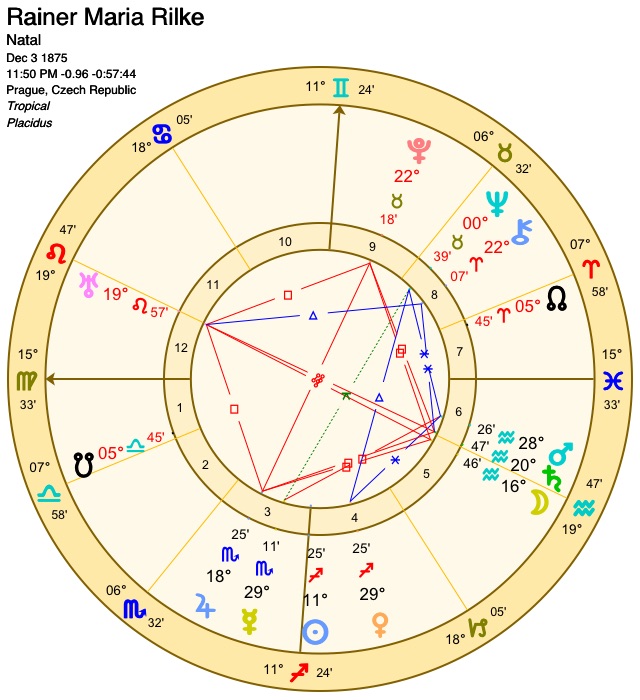
The window to the soul can have many frames. The soul of a poet already lends itself to rich symbolic interpretation, since it is in symbols and images that the poet expresses his imaginal world. One such symbolic frame to the soul is that of the astrological birth chart, which can provide an archetypal lens into the psyche of the individual. Born with six planets in a tight grand cross, the great poet Rainer Maria Rilke expressed the powerful dynamism of his birth chart through a lifetime of poetic works. A deep exploration of Rilke’s birth chart and transits would fill volumes, so I will just lightly touch the surface in this essay, focusing first on some of the major aspects in his natal chart, and then looking at two pivotal moments in his life which, although seemingly disparate from the outside, symbolically seem to bookend Rilke’s journey in relation to his search for the “unknown beloved,” for the encounter with the divine feminine, the union with the Anima. These two pivotal moments on which I shall focus are the day when Rilke met Lou Andreas Salomé, his first great love, and when he began to write the Duino Elegies, considered by many to be his masterwork.

The description Rilke’s mother gave of the day he was born is saturated with Christian symbolism, from his birth in the cold of winter at midnight, “the very hour at which our Saviour was born,” to his first gift of a tiny gold cross, bestowing upon him the gift of Jesus.[1] Rilke’s birthday is December 4, 1875, although as best we know the exact time was in the last minutes of December 3, at 11:50 pm, in Prague. He is born with a triple conjunction of the Moon, Saturn, and Mars in Aquarius; this stellium forms a grand cross with Uranus in opposition, Pluto in a square to the Moon stellium and Uranus on one side, and a Mercury-Jupiter conjunction in a square to the Moon stellium and Uranus on the other side. Before even delving into the particular archetypal qualities of the planets and their various relationships to each other, I would like to draw attention to the symbol of the grand cross itself.

Rilke's Birth ChartA grand cross is made up of two oppositions and four squares. The quality of an opposition is that of powerful polarity, a tension of opposites in which the archetypal energies of the planets involved come into potent dialectic with each other. The quality of a square is that of dynamic challenge, sometimes with an unexpectedness to it, in which the archetypal energies can be in conflict or tension with one another. As hard aspects, both the opposition and the square can lend themselves to the growth and transformation of the individual through facing the obstacles, challenges, and crises these aspects can bring up. When these aspects come together to form a grand cross those powerful tensions and energies are multiplied and intensified. A grand cross can at times have the feeling of soul crucifixion, of being stretched across the polarities of one’s life, a simultaneous forcing together and pulling apart of oneself. Rilke’s grand cross can symbolically be seen in his dynamic and fraught relationship to Christianity, from his severely religious upbringing, to his unorthodox Visions of Christ, to the Duino Elegies, in which, as Daniel Polikoff writes, “we experience the signal events of the Passion—carrying of the cross, the crucifixion, entombment, and resurrection,”[2] and to Rilke’s own sense of personal martyrdom.

The Moon in the grand cross can be seen as symbolizing Rilke’s soul journey in relation to the archetype of the Anima. The Moon relates to emotion, intuition, feeling, nurturance and care-taking, the psychosomatic aspects of oneself; it is the womb or matrix of one’s being, the mother-child relationship, emotional connection with others, one’s home and one’s past. While the lunar archetype is not solely equal to the “feminine” per se, women, and in particular the cycles of women’s bodies, have a correlative relationship to the Moon. To have this most intimate of personal planets in such dynamic relationship with many of the outer planets—a bridging of the personal to the great powers of the transpersonal archetypes—correlates with the many transformative relationships Rilke had over the course of his life. In Polikoff’s words:

Rilke’s most intimate relationships did not begin or end solely in the personal sphere but catalyzed (and were catalyzed by) his connection with archetypal, impersonal factors, spiritual and imaginal realities that underlie and overlay the human realm, exceeding the bounds of ego consciousness.[3]

Much of Rilke’s emotional character can be seen in his Moon-Saturn conjunction, as well as its opposition to Uranus. The archetype of Saturn restricts, constrains, distances, and severs, while Uranus is the archetype of freedom, spontaneity, youth, and rebellion. Rilke’s Moon-Saturn can be recognized in his need for emotional distance and his lifelong sense of homelessness, but with the restlessness of Uranus in the aspect he also had a strong need for emotional freedom, and lived a life of nomadic wandering. In a letter ending a relationship with one of his lovers Rilke wrote: “Never forget that solitude is my lot, that I must not have a need for anyone, that all my strength in fact comes from my detachment . . . I implore those who love me to love my solitude.”[4] With Pluto, which impels, drives, empowers, and deepens, squaring each of these planets as part of the grand cross, the need for emotional distance and freedom is intensified into a powerful force, in many ways driving the energies of Rilke’s life and relationships. His Moon square Pluto can also be seen in his many relationships with powerful women, women who not only had social power but great power of mind and personality as well.

To complete the grand cross, Mercury and Jupiter are in a broad conjunction squaring Uranus. Mercury relates to all forms of communication, from thinking and speaking, to writing and, of course, to the art of poetry. Jupiter elevates and grants success upon that which it touches, and archetypally relates to abundance and magnitude. The generosity of words which flowed through Rilke over the course of his poetic career clearly relate to this archetypal combination, and Uranus can be seen in the ingenuity and brilliance with which Rilke executed his writing, as well as in the breakthrough success his works have been granted. Yet in order to bring these works of poetic genius into being, Rilke entered into many dark periods of suffering and despair, which is carried by the square of Saturn to Pluto in his grand cross. He had a “lifelong preoccupation with death”[5] and was often held in the depths of depression, which relate to the tremendously powerful constraining force Saturn-Pluto can have upon one’s psyche. Yet instead of denying what these feelings were asking of him, Rilke was able to bring them forth and come into objective relationship with them, a desire particularly characteristic of the Moon-Saturn aspect. As Polikoff writes, “Rilke . . . craved, not to leave feelings behind, but to realize their mode of objective existence; to make, as the poet said, ‘things out of feelings,’ to lend ever more concrete existence to the soul’s innate longings.”[6] It was just this which he achieved in his poetry, particularly his Dingedichte, which not only made ‘things out of feelings,’ but gave soul feeling to things.

One final aspect I would like to touch on before moving into Rilke’s transits is his natal Venus trine Neptune. The archetype of Venus relates to love and romance, beauty, art, and aesthetics, while Neptune is the archetype of the transcendent, of both soul and spirit, of image and imagination, of the ideal as well as the illusory. The aspect of the trine is considered to be a harmonious or soft aspect, and the archetypal energies tend to flow in confluence and harmony with one another. Rilke’s Venus-Neptune can be seen in the exquisite beauty of his poetic art, and its expression of his “soul-based spirituality.”[7] Yet this aspect also manifested in Rilke’s search for an ideal love who could never be actualized, for the humanness of his many lovers would always shatter the ideal image which he had projected onto them:

“You, beloved, lost in advance, you
who never arrive . . .”[8]

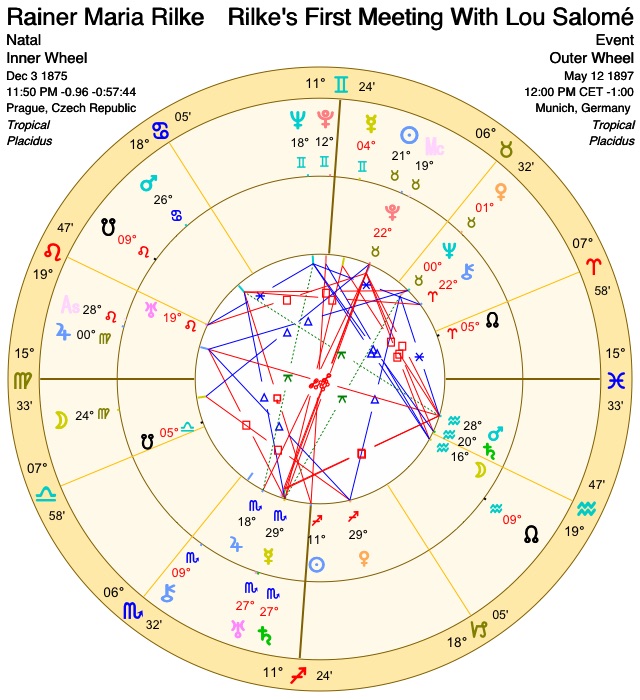
The day that Rilke met Lou Salomé, May 12, 1897, when he was only twenty-two years old, a powerful transformation was set into motion in Rilke’s soul. On that day there was a Venus-Mars square in the sky—the archetypal configuration related to romance in which Mars is the passion and fire that attract the Venusian lovers to one another—that was aligned right on Rilke’s natal Neptune. As his lover, Lou introduced Rilke to new ways of engaging with spirituality and religion as a means to attend to his own soul development, all of which are symbolized by the Neptune archetype.First Meeting with Lou Salome

Also on that day the Sun happened to be aligned with Rilke’s natal Pluto opposite Mercury. He also had a longer transit of Saturn-Uranus, which were exactly conjunct in the sky at the time, conjoining his Mercury. The Saturn-Uranus complex relates to the Puer-Senex dialectic—Lou was fourteen years his elder—as well as the revolutionizing of traditional structures, rebellion against authority, and that which is old or constraining. But Saturn-Uranus is also the maturation of youth, the careful revision of that which has come before and the refinement of that which is yet to come. Rilke had already been experiencing this transit on his Mercury-Pluto—the part of his chart which correlates to the tremendous depth and transformative power of his poetry—for some time before he met Lou, but with the Sun highlighting the transit on the day they met one can see that moment as a symbol of the impact their relationship would have upon him and his work, transforming and revolutionizing the vision that he would spend his life learning to articulate. Furthermore, Rilke was also in the heart of a long transit of Pluto opposite his Sun, which would have been a long period of powerful and intense transformation of his sense of self. Lou clearly played a strong role in that metamorphosis.

To finish this analysis I would like to leap from Rilke’s early years and relationships to his later life, to the time when he composed the Duino Elegies, his “greatest, life-defining task.”[9] As Polikoff writes, “The Elegies unfold a further stage of the intimate yet deeply fraught intercourse between the soul and the transcendent spirit of love that underlies the whole of the poet’s oeuvre.”[10] In this statement can be seen the dialectic between two of the major components in Rilke’s chart: the ‘transcendent spirit of love’ as embodied by his Venus-Neptune, and the ‘deeply fraught intercourse’ of soul as can be seen in his grand cross, particularly in relation to the Moon and its connection to the Anima. Polikoff goes on to say “The Elegies transparently carry forward the meditation on the mysteries of death, (impossible) love, and poetic vocation so central to Rilke’s previous work.”[11]

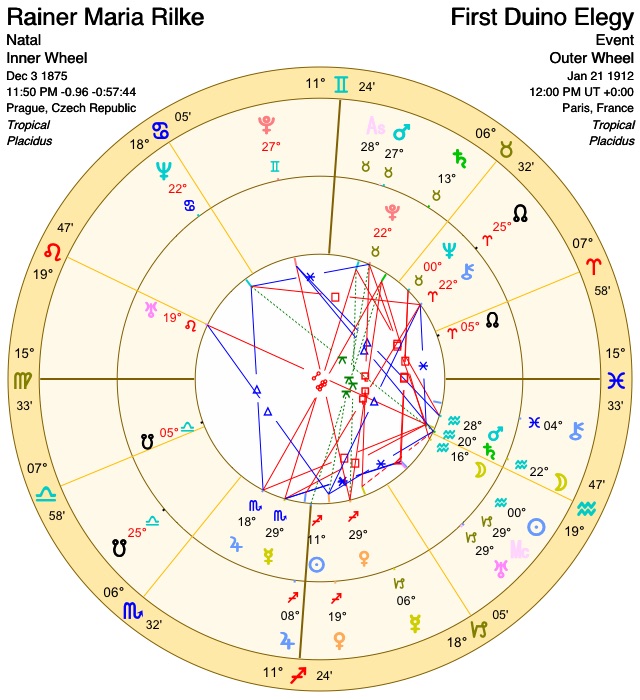
Rilke wrote the Elegies over a ten year period beginning in 1912, but left a long gap between late 1914 and 1922 when he finished the series. For this essay I will focus in particular on the transits to Rilke’s natal chart on the day he wrote The First Elegy, January 21, 1912, and glance briefly at some of the outer planet transits he experienced over the following three years as he wrote the next three Elegies.

First Duino ElegyLeading up to the time when Rilke wrote the first Elegies he was undergoing a rare transit of the planet Uranus squaring his natal Neptune, at the same time that Uranus was beginning to oppose Neptune in the sky as a world transit. One can see how Rilke, along with others of his generation who also experienced the world transit of Uranus opposite Neptune coming into a t-square alignment with their natal Neptune (such as C.G. Jung who was born the same year as Rilke) became a personal vessel of the archetypal energies that were affecting the whole world at that time. The Uranus-Neptune combination relates to a revitalization of the spiritual, as well as a rejuvenation and upwelling of the ingenuity of the creative imagination. Not long before he began writing the Duino Elegies, Rilke went on a journey to North Africa that “refreshed and invigorated his religious imagination” through his encounter with Islam, a religious tradition previously unknown to him.[12] The Uranus-Neptune motifs awakened during this journey were carried into the Elegies as a revisioning of the Christian mythos with which he had been engaging throughout his poetic career. Polikoff writes,

Rilke’s Duino Elegies effectively restyle Christ’s Passion as a work of human soul-consciousness. In reading the Duino Elegies, we experience the signal events of the Passion—carrying of the cross, the crucifixion, entombment, and resurrection—as they are reenacted in transformed form in the inner space of the speaker’s decidedly human subjectivity—a self-consciousness archetypally psychological and poetic at one and the same time.[13]

In this passage one can recognize the Promeathean-Uranean themes in restyling and revitalizing the Christian symbolism, but in such a way that draws on other Neptunian qualities such as soul-consciousness in relation to the archetypal, psychological, and the poetic.

Another powerful, long-term transit Rilke was experiencing when he wrote the first four Elegies was the planet Pluto opposing his natal Venus. Furthermore, on the very day when Rilke wrote The First Elegy, the planet Mercury was forming an opposition to Pluto in the sky, therefore also conjoining Rilke’s Venus. This transit can be seen in the force and power of the voice carried in the Elegies, right from the first line: “Who, if I cried out, would hear me among the angels’/ hierarchies?”[14] Over this time period as Pluto opposed Rilke’s Venus, it was also in a sextile to his natal Neptune, thus highlighting in different aspects his Venus-Neptune trine. The Elegies convey a powerful spiritual vision that plumbs the depths of the human soul, and burns with a passionate fire of love throughout. Pluto empowers and deepens the spiritual vision and soul expressive of Neptune, while Venus is reflected not only in the themes of love and the beloved throughout, but also the artistic medium of poetry itself.

Part of Rilke’s soul journey that led to the writing of the Elegies was a transformation in his relationship to love, and his eternal search for the unknown and unattainable beloved so expressive of his Venus-Neptune trine. With the transformative power of Pluto transiting this natal aspect, Rilke was finally able to own this desire in himself, turning the search for the beloved—which again and again ended in loss and isolation so characteristic of Moon-Saturn opposite Uranus—away from the outside world and into the heart of his soul instead. Polikoff writes that Rilke had the “sense that the way forward lay, not in abandoning the work of love, but, on the contrary, in withdrawing the centrifugal force of his outward projection of it, better interiorizing and so truly realizing it for the first time.”[15] One such example of this can be seen in a few lines from The First Elegy, in which Rilke declares:

Isn’t it time that we lovingly
freed ourselves from the beloved and, quivering, endured:
as the arrow endures the bowstring’s tension, so that
gathered in the snap of release it can be more than
itself.[16]

Over the course of this transit from Pluto, Rilke’s relationship to the beloved is being transformed, and the possibility of him encountering the beloved in his own soul, as the Anima, is now awakened.

Over the course of the years during which the first four Elegies were written, from 1912 until 1914, the planet Saturn moved from first squaring Rilke’s Moon, to next conjoining his Pluto, to opposing his Sun, and finally to exactly conjoining Pluto in the sky opposite his Venus in November 1914 when he wrote the Fourth Elegy. The archetype of Saturn constrains and pressurizes, like the repeated and seemingly unending contractions of the birth process, all in service of forging something with strength and maturity, of bringing to birth that which has been compressed and sculpted until it has the quality of a diamond. Each of these major transits of Saturn to four of Rilke’s natal planets can be seen symbolically as year-long contractions slowly bringing to birth Rilke’s masterwork, the Duino Elegies. The archetypal qualities of Saturn can be seen coming through the Elegies both at the intimate and personal level, as when Saturn transits Rilke’s Moon and later his Sun, and also at the transpersonal level when Saturn transits Rilke’s Pluto, and later Saturn-Pluto in the sky oppose his Venus. As Polikoff writes,

The great subject of the Elegies is nothing less than the nature and destiny of humanity, the contours of modern consciousness per se as these appear silhouetted against the abyss; the existential core of human being that begins to reveal hidden features even as its accustomed faces are torn away in the apocalyptic storm of the soul’s dark night.[17]

Much of the imagery in this quote is Saturnian, from the contours and silhouettes against the abyss, to the destiny and existential core of humanity; furthermore the transits with Pluto empower and deepen Saturn’s relentless challenge to truly bring about the ‘apocalyptic storm of the soul’s dark night.’

Much more could be said about Rilke’s process of writing the Duino Elegies and the corresponding transits that unfolded over the course of the decade in which he wrote them. The archetypal symbols carried by an individual person take a lifetime to unfold, and still they could not be exhausted. Rilke came into his life bearing an immensely complex chart, one that must have indeed been challenging to carry, the weight of the grand cross in particular not unlike a soul crucifix to be born through the dark valleys of depression. Yet it is the most challenging aspects that can forge us into who we are meant to be, and in this Rilke responded superbly—for not only did he continue on his dark journey, he returned to the world a gift of poetic beauty that could only have been newly forged in the burning fires of the underworld.

Works Cited

Polikoff, Daniel. In the Image of Orpheus: Rilke: A Soul History. Wilmette, IL: Chiron Publications, 2011.

Rilke, Rainer Maria. The Selected Poetry of Rainer Maria Rilke. Edited and translated by Stephen Mitchell. New York, NY: Vintage International, 1989.

[1] Sophia Rilke, qtd. in Daniel Polikoff, In the Image of Orpheus: Rilke: A Soul History (Wilmette, IL: Chiron Publications, 2011), 6.

[2] Polikoff, In the Image of Orpheus, 498.

[3] Polikoff, In the Image of Orpheus, 239.

[4] Rainer Maria Rilke, qtd. in Polikoff, In the Image of Orpheus, 447.

[5] Polikoff, In the Image of Orpheus, 16.

[6] Ibid, 337.

[7] Polikoff, In the Image of Orpheus, xvii.

[8] Rainer Maria Rilke, qtd. in Polikoff, In the Image of Orpheus, 479.

[9] Polikoff, In the Image of Orpheus, 446.

[10] Ibid, 447.

[11] Polikoff, In the Image of Orpheus, 477.

[12] Ibid, 449.

[13] Polikoff, In the Image of Orpheus, 489-90.

[14] Rainer Maria Rilke, The Selected Poetry of Rainer Maria Rilke, ed. and trans. Stephen Mitchell (New York, NY: Vintage International, 1989), 151.

[15] Polikoff, In the Image of Orpheus, 482.

[16] Rilke, The Selected Poetry of Rainer Maria Rilke, 153.

[17] Polikoff, In the Image of Orpheus, 486.

When Symbol Becomes Fact: Reflections on “Saving the Appearances”

“The world of final participation will one day sparkle in the light of the eye as it never yet sparkled early one morning in the original light of the sun.”
– Owen Barfield[1]

When sunlight refracts on the droplets of a raincloud, and an arc of colors bend across the sky, we must ask ourselves, “Is the rainbow really there?” With this image Owen Barfield opens his book Saving the Appearances: A Study in Idolatry, a short but profound tale of the evolution of consciousness from original participation, through the non-participatory (or rather, unconsciously participatory) scientific revolution, to final participation. But what does Barfield mean by participation? And how might one trace an evolution of consciousness?Saving the Appearances

Barfield begins with the image of the rainbow, demonstrating how it is a shared collective representation. A representation is something that I, and others, perceive to be there: whether it is a rainbow, a tree, a house, or any other phenomenon available to sensory experience. A representation is more than what any phenomenon can be reduced down to—such as subatomic particles; a representation is the phenomenon in its wholeness. The particles, which Barfield calls the unrepresented, are what science claims really exist in the world prior to human perception of them. “The world we all accept as real,” Barfield writes, “is in fact a system of collective representations.”[2] We do not perceive collective representations with our sense organs alone, but with “mental habits, memory, imagination, feeling.”[3] The generation of representations is what Barfield means by participation: “Participation is the extra-sensory relation between man and the phenomena.”[4] The world as we know it is created by participation in that world.

Through imagination Barfield enters into the participatory consciousness of previous world views, from the Medieval European, to the Graeco-Roman, to the Hebraic, each of which lived in original participation with the world to some degree. Original participation is “an awareness which we no longer have, of an extra-sensory link between percipient and the representations.”[5] Modern consciousness also participates in the phenomena, but does so unconsciously, believing instead that the perceived phenomena are independent of human perception. “Thus the phenomena themselves are idols, when they are imagined as enjoying that independence of human perception which can in fact only pertain to the unrepresented.”[6] This misperception of the phenomena as entirely independent of human perception Barfield terms idolatry, and it is to idolatry that he is attempting to bring awareness, to thus overcome and lead human consciousness into final participation—an awakened recognition that the phenomenal world is one of collective representations.

Simply put, it was through the development of the scientific revolution that original participation was expunged from the consciousness of the modern West and idolatry took hold in its place. “If therefore man succeeds in eliminating all original participation, without substituting any other, he will have done nothing less than eliminate all meaning and all coherence from the cosmos.”[7] Not only does idolatry empty spirit from the cosmos, it eventually eliminates spirit from the human as well. In order to move beyond idolatry into final participation, Barfield turns to religion, to the Incarnation of the Word in the Christian faith.

Idolatry suffers from literalness, thus to the idolatrous mind an event can be historical or it can be a symbol: it cannot be both. Barfield uses the Incarnation of the Word—the birth of Christ, the Second Person of the Trinity incarnating into a human body situated in historical time—to usher in final participation. Because the Incarnation is both historical and symbolic, it breaks down the schism between human consciousness and perceived phenomena. Yet by turning to religion, and particularly Christianity, in this way, it feels like Barfield narrows the field of those to whom final participation might apply. He defines religion as “essentially an ‘I-Thou’ relation between man on the one hand and the Creator of man and of his phenomena, on the other. A man who cannot think of his Creator as a Being other than himself cannot be said to have religion.”[8] This definition of religion is quite narrow, and excludes many of the world’s religious and spiritual traditions (and the masculine language unconsciously excludes women as well). Yet Barfield writes that the only possible answer to idolatry is acceptance of a “directionally creator relation to the phenomenal world.”[9] Is that really the case? Can there be a wider reading of final participation that can allow for the inclusion of those who have entered into that stage of consciousness by paths other than the Christian one?

To begin answering this question perhaps a wider reading of what Barfield means by the Incarnation of the Word is also necessary. Idolatry, or non-participatory consciousness, has brought with it gifts as well as shadow. Barfield writes, at first in seemingly negative terms, that “a non-participating consciousness cannot avoid distinguishing abruptly between the concept of ‘man,’ or ‘mankind,’ or ‘men in general’ on the one hand and that of ‘a man’—an individual human spirit—on the other.”[10] This is the literalness of idolatry. But this literalness allows something else to be born as well, of which Barfield speaks shortly thereafter:

The awakened clarity of retrospect . . . will . . . be obliged to recognize that the gradual emergence of man from original participation amounts also to the gradual emergence of ‘men’ from ‘man;’ that it is not just the cumulative history of the race, but the biography, also, of each individual spirit.[11]

What Barfield fails to mention explicitly here, yet can be implied by this statement when read half a century after it was first written, is that not only can individual men emerge from the all-encompassing term “Man,” but so can individual women, as well as others whose identities have been obscured by the Western male conception of Man. The symbolic becomes situated, and thus refracts into a myriad of individuals. This is the gift of the non-participatory stage of the evolution of consciousness as Barfield describes it.

Beginning in the chapter entitled “Israel” Barfield writes about the Divine Name, the “I Am.” The Divine Name, when spoken within the mind of an individual human—one who has only been able to individuate through the refraction of non-participatory consciousness—indicates the divinity not only of the Creator whose name is being spoken, but the divinity of each individual speaking it. This is the Incarnation of the Word, the Word become flesh, that Barfield sees as able to overcome idolatry and usher human beings into final participation. I find myself drawn to read Barfield’s use of the Christian mythos itself as both a symbol and a historically situated reality. If I were to reject Barfield’s concluding thesis on the premise that his turn to Christianity excludes those for whom this perspective does not, or perhaps even cannot, apply then I too would fall into the literalness of idolatry. From my situated perspective I can recognize the way in which the Incarnation of the Word—which allows for a new form of individual participation in the Divine and participation with one another as individuals—was for Barfield the real way in which idolatry could be overcome and final participation entered into. Yet I can also read the Incarnation as a symbol of something beyond the Christian faith alone, a symbol of the recognition of the Divine within, that can encompass a multiplicity of forms of spiritual connection and religious perspective.

Work Cited

Barfield, Owen. Saving the Appearances: A Study in Idolatry. Middletown, CT: Wesleyan University Press, 1988.

[1] Owen Barfield, Saving the Appearances: A Study in Idolatry (Middletown, CT: Wesleyan University Press, 1988), 161.

[2] Barfield, Saving the Appearances, 20.

[3] Barfield, Saving the Appearances, 20.

[4] Ibid, 40.

[5] Ibid, 34.

[6] Ibid, 62.

[7] Ibid, 144.

[8] Barfield, Saving the Appearances, 156.

[9] Ibid, 159.

[10] Barfield, Saving the Appearances, 183.

[11] Ibid, 184.

Perspectives on Fairy-Story: Tolkien, Lewis, MacDonald, Chesterton & Clark

“The realm of fairy-story is wide and deep and high and filled with many things: all manner of beasts and birds are found there; shoreless seas and stars uncounted; beauty that is an enchantment, and an ever-present peril; both joy and sorrow as sharp as swords.”
– J.R.R. Tolkien[1]

With these words J.R.R. Tolkien introduces his readers to Faërie, the domain of fairy-story, a realm encountered through Imagination. But what, one might ask, are fairy-stories? Often fairy-stories have been construed as short tales written for children, of little weight or importance in the world of adult matters. In five separate essays, this simplistic perspective is argued against by Tolkien, C.S. Lewis, George MacDonald, G.K. Chesterton, and Stephen Clark, who each wrote their own defense of the genre of fairy-story. From differing yet complementary perspectives, these five authors address what fairy-story is and why it is important, exploring the relationship between fantasy and reality, Truth and Imagination, and the laws of consistency and morality that allow an true imaginal world to come into being.

Lewis opens his short essay “On Stories” by pointing out that little attention has been paid by critics to Story, or at least to the particular qualities of Story that make it alluring. The particulars, the details of the experience, that which creates the tangible atmosphere and aura, are what draw the reader into the narrative—not some abstract plot concept but rather the unique qualities of the story lure us to return again and again to certain tales. Indeed, Lewis writes,

We do not enjoy a story fully at the first reading. Not till the curiosity, the sheer narrative lust, has been given its sop and laid asleep, are we at leisure to savour the real beauties. Till then, it is like wasting great wine on a ravenous natural thirst which merely wants cold wetness. The children understand this well when they ask for the same story over and over again, and in the same words.[2]

Although Lewis here refers to children’s appreciation of fairy-story, he and Tolkien—and I would argue the other three authors discussed here as well—agree that fairy-stories are by no means exclusively intended for children. Tolkien writes,

At least it will be plain that in my opinion fairy-stories should not be specially associated with children. They are associated with them: naturally, because children are human and fairy-stories are a natural human taste.[3]

Tolkien goes on to say, “If fairy-story as a kind is worth reading at all it is worthy to be written for and read by adults.”[4] The stories that affect us most as children are usually those we read again and again long into adulthood. Such stories shape who we are as individuals, allowing us as readers to fully inhabit the emotions, experiences, challenges, and breakthroughs of a multitude of people. Through story, and the inherent awakening of Imagination, we can bring more of ourselves forth into the world and develop more fully.

To create a fairy-story worth reading, a successful fantasy, the creator must imbue it with what Tolkien calls an “inner consistency of reality,” a quality that is bestowed only by the power of Imagination.[5] The successful storyteller “makes a Secondary World which your mind can enter. Inside it, what he relates is ‘true’: it accords with the laws of that world. You therefore believe it, while you are, as it were, inside.”[6] MacDonald, as written in his essay “The Fantastic Imagination,” shares with Tolkien this perspective on internal consistency: “To be able to live a moment in an imagined world, we must see the laws of its existence obeyed.”[7] Without such laws an imaginal world could not hold, it would fall apart into meaningless disconnection. For Tolkien and MacDonald, these internal laws, the ‘inner consistency of reality,’ are given by the power of Imagination. Imagination allows one to access to Truth, and Truth is what provides an imaginal world with its own reality.

Law is the soil in which alone beauty will grow; beauty is the only stuff in which Truth can be clothed; and you may, if you will, call Imagination the tailor that cuts her garment to fit her, and Fancy his journeyman that puts the pieces of them together, or at most embroiders their button-holes.[8]

Both MacDonald and Tolkien reference the theory of Imagination articulated by S.T. Coleridge in his Biographia Literaria, which delineates the difference between the creative powers of the Primary and Secondary Imagination from the function of Fancy. The role of Fancy is to reassemble aggregates of remembered experience. Imagination, on the other hand, gives birth to new life: the Primary Imagination births the Primary World of creation, the Secondary Imagination births Secondary Worlds of human Art and creativity. The Primary and Secondary Imagination differ only in degree, and the Secondary Imagination is simply the Primary Imagination creating through the vessel of the human being. For this reason Tolkien refers to one who creates a Secondary World as a “sub-creator” because she or he is creating under the Primary Creator. Tolkien writes, “Fantasy remains a human right: we make in our measure and in our derivative mode, because we are made: and not only made, but made in the image and likeness of a Maker.”[9] Human creativity is the gift of Divine creativity.

Within the heart of Faërie, as understood by these authors, is also a consistent moral law that is more pronounced than the moral law of the Primary World. Chesterton writes in his essay “Fairy Tales”: “I think poets have made a mistake: because the world of the fairy-tales is a brighter and more varied world than ours, they have fancied it less moral; really it is brighter and more varied because it is more moral.”[10] Indeed, the clear morality present in fairy-stories is a sign of their enchantment; when such connection is severed the world becomes disenchanted. Perhaps this is why, in a time when the dominant world view is largely disenchanted, fairy-stories are so alluring—even when the critics say that as adults we must put them aside. Fairy-stories allow access to Truth in a way that everyday lived experience may not. Tolkien points towards this when he writes, “The peculiar quality of the ‘joy’ in successful Fantasy can thus be explained as a sudden glimpse of the underlying reality or truth. It is not only a ‘consolation’ for the sorrow of this world; but a satisfaction, and an answer to that question, ‘Is it true?’”[11] Shining through the fantastical narrative is that glimpse of Truth, which can be perceived more clearly through the fresh lens of fairy-story, rather than the clouded window of our ordinary, everyday perception.

The Truth glimpsed in fairy-story is the Truth that broadens one’s perspective beyond the confines of a disenchanted, materialistic world view. Clark, in his essay “How To Believe In Fairies,” writes,

It is to take folk-stories seriously as accounts of the “dreamworld,” the realm of the conscious experience of which our “waking world” is only a province, to acknowledge and make real to ourselves the presence of spirits that enter our consciousness as moods of love or alienation, wild joy or anger. In W.B. Yeats’s philosophy fairies are the moods and characters of human life, conceived not as alterations in a material being, but as the spiritual rulers of an idealistically conceived world.[12]

Clark articulates the idea that to believe in fairies, or mermaids or dragons, or other inhabitants of Faërie, is not to reduce them to some facet of the known material world—such as insects, manatees, or other mistakenly glimpsed animals—but to accept as an essential part of these beings the very mystery of what they are. Tolkien writes that Elves, and other creatures of Faërie, are “true” “even if they are only creations of Man’s mind, ‘true’ only as reflecting in a particular way one of Man’s visions of Truth.”[13] The beings of Faërie are born of Truth and mystery, and if we do not reduce them to mistaken perceptions of the physical world, or mere flights of Fancy, Truth and mystery comingle and give birth to something real.

For Tolkien fairy-stories provide a “recovery” of the Primary World, “a regaining of a clear view.”[14] Fantasy gives us the opportunity “to clean our windows; so that the things seen clearly may be freed from the drab blur of triteness and familiarity.”[15] Returning from the pages of fantasy to one’s life, our mundane habits give way to the patterning of story. Imagination breathes new life into the simplest actions—once again we can recognize the miracle in good food, the laughter of a friend, the colors of the setting Sun. In Lewis’s words, “. . . the whole story, paradoxically enough, strengthens our relish for real life.” Yet Lewis seems to diverge from Tolkien when he says: “This excursion into the preposterous sends us back with renewed pleasure to the actual.”[16] I do not feel Tolkien draws such a distinct line between the ‘preposterous’ and the ‘actual.’ Fantasy and reality for Tolkien cannot ultimately be separated.

On this matter, Clark seems to be in greater agreement with Lewis than Tolkien. Lewis writes “that is one of the functions, of art: to present what the narrow desperately practical perspectives of real life exclude.”[17] I would argue that real life does not exclude the fantastical with which art reacquaints us; rather habit and routine allow us to forget the fantastical inherently present in real life. Clark argues that the ‘desperately practical perspectives of real life,’ as Lewis describes them, are what allow us to fully appreciate and understand the world of Faërie:

Only those who have lived out of water know what water is. Only those whose ordinary human life is structured by ceremonial and human meaning, who know of their duties and their perils, their friends and children, can clearly conceive that form of life which is fairy.[18]

I would say that the experience of disenchantment, of seeing the world from a desperately practical perspective, is simply a forgetting of the enchantment inherent in our lived reality, the magic of the waking world. Such forgetting is its own form of enchantment. We are compelled, as Lewis felt, to return again and again to the great stories that affected our lives so deeply because some part of us knows we want to remember. We forget so that we may remember. “The primal desire at the heart of Faërie,” Tolkien writes, is “the realisation, independent of the conceiving mind, of imagined wonder.”[19] We forget so that again and again we may return, through story and Imagination, to experience wonder once more.

Works Cited

Chesterton, G.K. “Fairy Tales.” In G.K. Chesterton. New York, NY: Catholic Way Publishing, 2014.

Clark, Stephen R.L. “How To Believe In Fairies,” Inquiry, 30:4: 337-355.

MacDonald, George. “The Fantastic Imagination.” In A Dish of Orts, 232-237. Hazleton, PA: The Electronic Classics Series, 2012.

Lewis, C.S. “On Stories.” In Of Other Worlds, 3-21. San Diego, CA: Harcourt, Inc, 1994.

Tolkien, J.R.R. “On Fairy-Stories.” In The Monsters and the Critics. Edited by

Christopher Tolkien. London, England: HarperCollins Publishers, 2006.

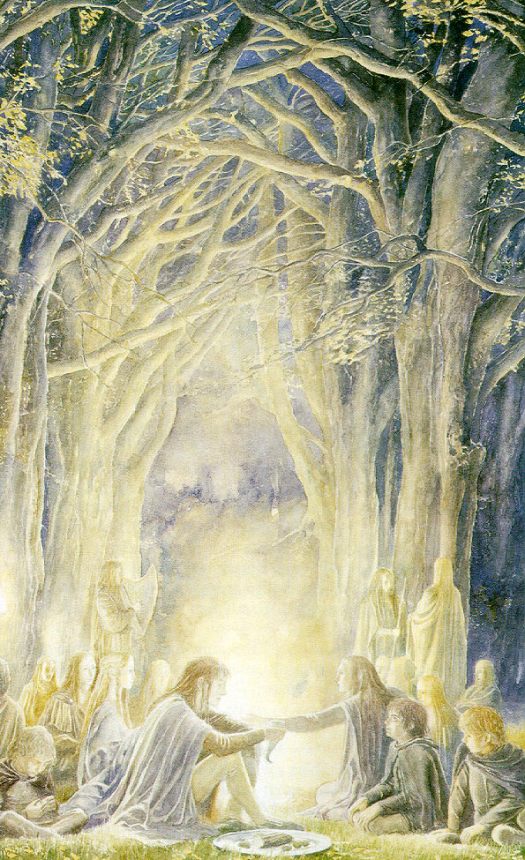
Elves at Woody End - Alan Lee

[1] J.R.R. Tolkien, “On Fairy-Stories” in The Monsters and the Critics, ed. Christopher Tolkien (London, England: HarperCollins Publishers, 2006), 109.

[2] C.S. Lewis, “On Stories,” in Of Other Worlds (San Diego, CA: Harcourt, Inc, 1994).

[3] Tolkien, “On Fairy-Stories,” 135-6.

[4] Ibid, 137.

[5] Tolkien, “On Fairy-Stories,” 138.

[6] Ibid, 132.

[7] George MacDonald, “The Fantastic Imagination,” in A Dish of Orts (Hazleton, PA: The Electronic Classics Series, 2012), 233.

[8] MacDonald, “The Fantastic Imagination,” 233.

[9] Tolkien, “On Fairy-Stories,” 145.

[10] G.K. Chesterton, “Fairy Tales,” in G.K. Chesterton (New York, NY: Catholic Way Publishing, 2014).

[11] Tolkien, “On Fairy-Stories,” 155.

[12] Stephen R.L. Clark, “How To Believe In Fairies,” Inquiry, 30:4: 337.

[13] Tolkien, “On Fairy-Stories,” 113, n. 2.

[14] Ibid, 146.

[15] Ibid.

[16] Lewis, “On Stories.”

[17] Ibid.

[18] Clark, “How To Believe In Fairies,” 349.

[19] Tolkien, “On Fairy-Stories,” 116.

Pathways to Truth: Article Review of “Unfinished Creation”

Imagination is the reconciliator of paradox. In the words of S.T. Coleridge, imagination “dissolves, diffuses, dissipates, in order to re-create; or where this process is rendered impossible, yet still at all events it struggles to idealize and to unify.”[1] Andrew Linzey draws on the importance of imagination for theological exegesis in his short article “Unfinished Creation: The Moral and Theological Significance of the Fall” published in Ecotheology: Journal of Religion, Nature & the Environment. By using a fantastical tale from The Acts of Philip about a leopard who chooses out of pity not to eat a lamb, Linzey begins by demonstrating the ways in which story, and particularly fantasy, make a strong claim on the imagination, and can thus communicate religious and spiritual truth in a way that didactic reduction cannot reveal. He quotes Rachel Trickett’s essay “Imagination and Belief” to hone in on the ways the unifying qualities of imagination can aid in the quest for theological truth:

To see truth as a process of stripping bare, paring away, is a common rational perception; to see truth as a gathering together, a process of accretion which may appear to lead to paradox and contradiction, but which, in the end, resolves them by asserting completeness, is a function of the imagination.[2]

Linzey’s desire to emphasize the need for imaginative narrative within a theological context is to demonstrate the importance of the story of the Fall, as told in Genesis, for an establishment of ethical truth in regards to creation. The focus of the article soon shifts away from imagination and fantastical narrative when Linzey begins to unpack what seems to be the primary aim of his article, which is a defense of the fallenness of creation and its implications for the development of an ecological ethic.

Linzey is specifically addressing theologians who have rejected the concept of the Fall “simply on the grounds that it is an imaginative story.”[3] The implications of such a rejection lead for Linzey to the following conclusions, which have an extensive ethical impact, particularly in regards to an ecological morality:

  1. There is no evil in the natural world.
  2. There is no possibility of redemption for nature, animals in particular.
  3. There is no human obligation to cooperate with God in the redemption of nature, animals in particular.
  4. There is no morally just God.[4]

Knowing that Linzey is a prominent figure in the Christian vegetarian movement lends a deeper context to this short article, and why he has chosen to argue for the fallenness of the created world. The fallenness of creation can alternatively be seen as an impetus toward world-rejection, which has also had significant impact on the Christian relationship to the Earth. Yet for Linzey it is the teleological striving toward redemption that is of primary importance, which can be seen as a call to engage actively with the ecological crisis particularly by attending to our relationships with non-human beings. Linzey concludes by addressing one form of this engagement that takes place at a practical, daily level: “It is therefore unsurprising that the frequent backcloth to this theological issue is the intensely practical question, namely: What, or whom, are we to eat?”[5] This short article seems to take three rapid turns, from the importance of imagination, to a defense of the story of the Fall, to a brief argument on behalf of vegetarianism as a concluding statement: “The truth is that human beings can now approximate the peaceable kingdom by living without killing sentients for food.”[6] Coming to the article’s end one can feel as though something has been left behind, that the conclusion does not align with the introduction, and that perhaps the argument for imagination has really been used to argue for vegetarianism, without actually going deeply into the full implications of either thesis and thus cutting each short at the undeserved expense of the other.

Noting the wider context of Linzey’s position as an animal ethicist explains the turn toward an advocation of vegetarianism, and perhaps the numerous articles and books he has written on theology and animal rights can stand in place of opening up the argument further in this brief essay. His method of research for the article draws on contemporary theological and ecological scholarship, as well as returning to the primary sources of Genesis and The Acts of Philip. The argument on behalf of imagination is primarily a tool to unlock the treasures held within the narratives of the primary literature, which in turn is used to address a very specific question: ‘What, or whom, are we to eat?’ Returning to the content of the opening fantastical narrative it becomes clear the direction in which Linzey was headed, that the story was a means to argue for a specific and valid viewpoint in regards to the human relationship with non-human beings and the Earth itself. Yet, by using the argument on behalf of the value of imagination in such a way, he actually seems to undercut the purpose of the article, for in the end Linzey has drawn on the power of imagination, and fantastical narrative, not for its inherent value as a revelation of truth, but rather to forward one specific perspective reduced out of that story. To return to Trickett’s statement on different ways to approach truth—’To see truth as a process of stripping bare, paring away, is a common rational perception’—Linzey appears to have inadvertently used an argument on behalf of the unifying nature of imagination to actually strip bare and pare away the fullness of story to put forward a rational argument aimed at revealing one particular truth.

Expulsion from the Garden of Eden

Works Cited

Coleridge, Samuel Taylor. Biographia Literaria. London, England: J.M. Dent & Co., 1906.

Linzey, Andrew. “Unfinished Creation: The Moral and Theological Significance of the Fall.” Ecotheology: Journal of Religion, Nature & the Environment 4 (1998): 20-26.

Trickett, Rachel. “Imagination and Belief.” In God Incarnate: Story and Belief, edited by A.E. Harvey. London, England: SPCK, 1981.

[1] S.T.Coleridge, Biographia Literaria (London, England: J.M. Dent & Co., 1906), 159.

[2] Rachel Trickett, “Imagination and Belief,” in God Incarnate: Story and Belief, ed. A.E. Harvey, (London, England: SPCK, 1981), 38-39.

[3] Andrew Linzey, “Unfinished Creation: The Moral and Theological Significance of the Fall,” Ecotheology: Journal of Religion, Nature & the Environment 4 (1998): 22.

[4] Linzey, “Unfinished Creation,” 23-25.

[5] Linzey, “Unfinished Creation,” 25.

[6] Ibid, 25-6.

Hawaii: Island Hopping and Switchback Trekking

Maui – Photo by Becca Tarnas

The forty-five minute flight from Waimea to Kahului was one of the most visually stunning experiences I have ever had. First to see the dry landscape and deep cracks in the Earth on the Big Island, then the turquoise coastal edge before a vast expanse of deep blue water flecked with whitecaps far below. Then, through the clouds, the peak of one of Maui’s mountains became visible, deep green slopes descending down into plains planted with pale sugar cane. We were coming to Maui for just four days to spend some time camping with a couple we know from our graduate school. Maui feels palpably different than the Big Island, its age as one of the older islands in the Hawaiian chain immediately apparent. The soil is of a rich red color, and the shape of the mountains are clearly eroded from eons of rain descending on their slopes.

After picking up supplies in Kahului we drove to Lahaina to meet our friends for lunch. Lahaina is definitely a tourist town, packed with overpriced shops, restaurants, and cafés—beautiful and inviting, yet somehow exhausting all the same. We were excited to leave and drive about half an hour up the coast to Windmills Beach, where we set up camp among the ironwood trees right by the water. It was a soft, white sand beach, with sheltered pools to dip into the ocean water. We sat around a fire late into the night, drinking beers and gazing at the stars, talking about all the experiences we each had already had.

The following morning, after a leisurely swim at the beach, we made our slow, scenic way up Haleakala, the East Maui Volcano. The four of us stopped in at the visitor’s center to get our camping permits, and then parked several miles further up the mountain at the Halemau’u Trail Head. As we made the finishing touches to organizing our gear we conversed with the other groups of people in the parking lot, some of whom had just returned from a full twelve-mile day hike across the crater and back. One of them opened the trunk of his car and brought out several green coconuts from his backyard, which he cut open with a machete and shared with all of us. I realized it was the first fresh coconut we had eaten since coming to the islands, and it was perfect to consume before setting off on our trek. We also shared a whole pineapple, and some papayas and lilikoi, before departing with bellies full of water, fruit, and optimism.

Halemau'u Switchback Trail – Photo by Matt Segall
Halemau’u Switchback Trail – Photo by Matt Segall

Although it was warm and sunny in the parking lot, about ten minutes down the switchback trail into the crater we encountered a wall of dense cloud, and soon our vision was limited to just a few feet on all sides. The path cut back and forth across the face of the ridge, but we had no perspective on where we were going, or even really a sense of what we left behind as we passed through the landscape. The hillside was covered in vegetation, red and green ferns dominating the slopes. Every so often a nene, the native Hawaiian goose, would startle from a bush up ahead and fly across our trail. The world was eerily silent, like the dense fog was pressed against our eardrums. Soon we were drenched, moisture dripping from our hair and rolling down our faces and limbs. It was hard to tell how far we had come, and we had no idea how much further there was left to go.

Suddenly, a bottom was in sight. It came completely unexpectedly. First the dim thread of a trail seemed visible, and soon a pale green field began materializing. The fog became less dense, the path ahead more clear. Before long the last switchback was in sight, and the mountain path ended in a gate that opened onto the flat bottom of the crater. We passed through the gate, closing it behind us, and began walking through a field of tall, wet grasses adorned with sprays of delicate yellow flowers. The mist was rapidly evaporating as we continued on our way. To the left was one of the many cinder cones inside the Haleakala Crater, and the Moon, nearly full, had risen like a pale pearl in the now darkening sky. The path before us began to ascend gently, winding through a’a lava rocks and rough vegetation.

Moon Over Haleakala Crater – Photo by Becca Tarnas

After about a mile, the four of us arrived at our campsite, which was just a little round clearing amongst the brush and lava. Another group of campers was set up nearby, and a pair of hikers came in not long after us and set up in the distance. The Sun had set some time before behind the ridge we had descended, but streaks of bright pink still adorned the sky to the north. The light of the Moon dominated the scene, becoming ever brighter as the rest of the landscape faded into darkness. As night descended the sounds of nene and other birds began to echo all around, a soft cooing emanating from the dry foliage surrounding us. Looking south we could see the two bright stars Alpha and Beta Centauri, which Matt and I had also viewed from the heights of Mauna Kea. Yet we could also observe the slight difference in latitude between the Big Island and Maui, because while we had seen Alpha and Beta Centauri from both islands, the Southern Cross was only visible from the Big Island, the one place in all the United States from which that constellation can be seen.

Dusk in Haleakala – Photo by Becca Tarnas

The heat of the early morning Sun awakened us and coaxed us forth from our little tents. Our plan was to hike for a couple miles further into the crater before packing up the tents and returning up the switchback trail. The path into the crater led over more rough a’a lava toward the part of Haleakala where the Sliding Sands trail leads. The pu’us in this part of the crater are an array of red, black, orange, and ochre sands, seemingly drizzled over each other to form a desert landscape reminiscent of the surface of Mars. The central field of the crater looked like a sea of blackened waves, frozen in time. Off of the main path to our left we came to the Silversword Loop, a section of trail that passes a cluster of silversword plants, a species endemic to the mountain heights of Maui. The silverswords have long pointed leaves that are a pale green silver hue. Many of the silverswords on the loop were in bloom, with countless bees humming around their dark magenta flowers. The smell of the blossoms is like honeybush tea, sweet yet subtle and inviting.

Blooming Silversword – Photo by Matt Segall

Eventually we turned back, packed up at the campsite, and headed up toward the switchback trail. The Sun had been blazing all morning but we could see a bank of clouds in the distance and felt sure that we would be mired in fog as we had the day before. Ascending the switchback at first was not nearly as challenging as I expected, and I even said so to Matt. We had already ascended hundreds of feet above the crater floor and were still in good energy and spirits. The bank of cloud kept approaching, yet also appeared to be maintaining a good distance. The view with each rise in elevation was spectacular: first we were overlooking the inside of the crater where we had spent the night and then, as we rounded the other side of the ridge, a new view leading all the way down to the ocean opened up. Even though we were walking the same trail as yesterday the experience of it with clear skies and sunlight was utterly new and exciting. It soon became clear that the fog was not going to encompass us, and that the rest of the hike would be under the penetrating heat of the Sun. Suddenly the switchback grew steeper, at times even becoming stone steps. One section of the path ran across the top of a ridge connecting two larger slopes, and there was nothing but open air on either side of us, a narrow bridge on top of the world. About a mile and a half from the parking lot we ran out of drinking water. The view was still beautiful, but the end of the trail felt like it would never come. Sure that we were nearing the end of the hike we passed a sign: Park Road – 0.7 miles. From our situated perspective that seemed an eternity away.

Sliding Sands – Photo by Becca Tarnas

Yet of course the trail did end, and we emerged hot and sweaty, coated in dust and exhaustion. We had no water in the car, but fortunately something even better—a cooler still filled with ice and cold beers. We lay on the ground for a long time just drinking beer, amazed at what we had accomplished.

After a good amount of time resting, the four of us left Haleakala behind and headed into Paia, a little hippie town to the east of Kahului. Completely exhausted, we chose not to camp, but rather find a room at the Rainbow Surf Hostel, whose manager is a recent transplant to Maui who spends his days interacting with, to use his words, all the “awesome” guests that pass through his domain while playing covers of ‘90s female musicians on his guitalele, a cross between a guitar and a ukulele. Still exhausted, we treated ourselves an epic meal at the Flatbread Company, which serves locally brewed beer and organic pizzas. The four of us stayed up late playing music and talking in the coconut-shaded courtyard of the hostel.

About mid-morning we left the hostel to spend our final moments on Maui at Paia Beach, and then Matt and I bid our friends adieu and set off for the airport. I can certainly say four days is not enough time to spend on Maui, and that I hope to return sooner rather than later to explore the road the Hana, the Seven Sacred Pools, and many other places that I have yet to hear of.

The flight back to Waimea was just as beautiful as the flight to Maui, and this time we were graced with a rainbow arcing through the clouds beneath the belly of the plane. One of my uncles met us at the airport and brought us back to rest at his house where we could just relax and unwind from all of our adventures.

With only three days left in Hawaii we decided to spend the remainder of our time moving at a slow pace and just returning to our favorite places in the area. In the morning we helped my beekeeper uncle sell honey at the Waimea Farmers Market, then spent the rest of the day at Mauna Lani Beach lying in the Sun and floating on the peaceful waves. The following day we learned how to harvest bananas from my uncle’s trees, then spent the late afternoon at Mauna Kea Beach, which I must say is my favorite beach we visited during the entire three weeks. The white sand beach is curved in a gentle crescent, and the surf is simultaneously perfect for body surfing and for just floating calmly. That night Matt and I cooked Thai green curry as part of a dinner to show our deep gratitude to my two uncles, who really made this trip possible for us by giving us a place to stay and a van to take around the Big Island.

For our final full day Matt and I returned briefly to Honaka’a, then went back to Mauna Kea Beach to body surf and eventually watch our last Hawaiian sunset. We went out for sushi near Mauna Lani, and then met up with my cousin and her boyfriend for a final dip in one of the resort pools and hot tubs.

Three weeks can seem like a long time, but when you are in a place as rich and diverse as Hawaii it seems to go by in half a heartbeat. Yet how much we had experienced; indeed how much we had been changed in so many deep and beautiful ways by this experience together. I want to learn how to hold these experiences within me in such a way that I can draw on them for strength and inspiration when I need them. And yet, as much as I hope to embody as fully as possible the transformative power for growth and healing that Hawaii can offer, I also cannot help but ask, when can I return?

View from Halemau'u – Photo by Becca Tarnas
View from Halemau’u – Photo by Becca Tarnas

Hawaii: Pahoehoe Desert and Forest Rains

Onomea Bay – Photo by Becca Tarnas

The journey of exploring Hawaii’s Big Island continued as Matt and I made our way in our traveling van home down the Hamakua Coast and eventually into Volcanoes National Park and Puna on the eastern side of the island. We had begun our morning on the heights of Mauna Kea, watching the Sun rise among an ocean of clouds, but we spent our first night of this leg of our adventure right by the water’s edge, back at Laupahoehoe Point where the grandmother banyan tree stands. I mentioned in my last post that my dreams seemed to be shifting depending on where I was sleeping each night, with an array of violent dreams taking place in Waimea, but dreams of majestic mountain-consciousness occurring on Mauna Kea. At Laupahoehoe, where the tsunami took the lives of nearly two dozen people, many of whom were schoolchildren, my dreams were saturated with watery depths, beginning first in a car that was being driven underwater, bloated bodies with white eyes floating past the windows, and then having the experience of floating far out at sea with two other people, debris littering the rough waves, an endless distance between myself and anything that felt safe. When I awoke I finally was beginning to recognize how much the history of each place we were staying was influencing the content of my nightly visions, and it led me to inquire later into the history of violence that took place in Waimea.

Akaka Falls – Photo by Matt Segall

Once again waking before the dawn, I leapt from inside the van to stand near the crashing waves and watch the Sun emerge in blazing gold from the sea. I have been coming to love these early mornings on the Big Island, the whole day stretching before us filled with the potential of new places to see and explore. We began driving south along Old Mamalahoa Highway (which seems to be the name of half of the roads on the Big Island, at least according to Google maps), going first to Akaka Falls, an exquisite plunging thread of water descending 442 feet into a narrow, circular pool. A trail loop circles through lush rainforest, across a passing stream, and over to first one look-out where Kahuna Falls can be seen in the distance, and then up to a closer look-out where one can see the full length of Akaka Falls. Throughout the rainforest were flowers of almost unimaginable complexity, intricacy, color, demonstrating the sheer creativity of tropical evolution.

We continued along the winding thread of coastal highway until we reached the Onohi Loop, a scenic route through rainforest trees, over streams and small waterfalls, and along the coastal cliffs. At Onomea Bay, which is at the base of Alakahi Stream, Matt and I walked out onto the stony beach, and then onto a jut of land that extended out into the crashing waves. In a playful mood, I walked as far out as I could and stood up on a promontory of rock above the waves crashing all around me. Like the Sorcerer’s Apprentice, I started to use my arms to conduct the waves, in synchronized movement pulling the swells up from the sea and raising them until they crashed against the sharp, black lava rocks, splashing me with salty, white foam. It was a dance with the waves, each seeming to respond to me as much as I to them, a dialogue of danger and play. It was like being a child and a god all in one moment. I felt so serious, yet couldn’t stop laughing, playing in shear delight with the rhythms of the world.

Conducting the Ocean Waves – Photo by Matt Segall

After Onomea Bay we drove into Hilo, making many short stops in and around the small city. First we went to Rainbow Falls, a much smaller yet still immensely gorgeous waterfall. Unlike Akaka, it’s possible to climb up above the waterfall and watch it flow past below you, catching the light in arc after arc of misty rainbows. We sat with our feet in the cool pools of rushing water, soaking in the warm sun of the still early morning. After Rainbow Falls we made another quick visit to Boiling Pots, a series of pools that looks like pots of boiling water as they bubble and splash on their way downstream. From there we continued into Hilo itself, walking along Kiawe Street, stopping in shops, picking up some lychee from the farmers market, and eating papayas while looking upstream from the Wailuku Bridge. We ate a picnic lunch in a park full of dozens of enormous banyan trees, and then walked through the Japanese Botanical Gardens over to Coconut Island, a tiny plot of land out in Kuhio Bay.

With several hours still left in the afternoon, Matt and I went over to Richardson Ocean Park to see how snorkeling on the east coast of the Big Island compared to what we had seen on the western side. I pushed myself to face my fears of the water and set off from the black sand beach closely tailing Matt. The corals and fish at this particular location were gorgeous; purples, yellows, brain corals, rainbow-colored fish. No eels. We went out for a ways until the water got deeper, and then turned back in to where the water was shallower and rougher, which seemed to house an even greater diversity of fish and corals. Just as we decided to head back to shore, we had a deeply profound encounter. At the base of one of the larger rocks was a dark cave; gazing out from that cave was the head of a turtle. The turtle watched us swim nearby, and then slowly swam up to meet us. Not wanting to disturb this majestic creature we backed away, but the turtle followed. Each time we retreated, she came closer, floating gently in the water, gazing at the two of us. How old must this being be? What is her consciousness like? What does she think of the world around her, what changes has she noticed in the decades she has spent beneath the waves? After some time the moment of connection came to an end, and the turtle swam back into her cave. Matt and I both felt blessed to have had such an encounter.

We ended our day in Hilo by going to a tiny sushi restaurant, Hime Bar Sushi, that had only three tables and was run by an elderly Japanese couple: he made all the sushi behind the counter while she served at the tables, a quiet dance between two people who seemed to have been practicing the steps for many years. It was some of the best sushi I have ever had, somehow at half the price of most other sushi restaurants I have been to.

As night descended we left Hilo, and drove in the dark to Volcanoes National Park, where we awoke to the sound of two little birds tapping on the windows of the van. What did they want? Perhaps tapping at their own reflections, or perhaps offering a needed reflection for us at that moment, I do not know. This was our fullest day yet, beginning with a short walk through the Thurston Lava Tubes. The lava tube we walked inside was enormous, lit up with warm yellow torches that gave the sense of entering an underground dwarvish kingdom. Mosses and other plants grew around the entrances, and in places throughout the tube a tree root broke through the outer layer of rock.

Not far from the lava tubes was a path along the top edge of the Kilauea Iki crater, which is close to the main summit caldera of Kilauea. A trail runs across the crater and we could see tiny figures far below walking it. I recalled making the same trek a decade ago with my cousins. But today we had a different adventure in mind, so after a brief look out over the edge we returned to the van and drove to the parking lot where our real hike would begin.

Matt had chosen the Napau Trail for us to hike that day, a trail which crosses a vast field of forty-year-old pahoehoe flows from the Mauna Ulu eruption that eventually leads to the Makaopuhi Crater, the largest crater on the Big Island. We decided to walk about eight miles of the trail, four miles in to the crater’s edge and then the return journey. This trail leads all the way to the Pu’u O’o vent, but the end of the trail has been closed due to volcanic activity at Pu’u O’o. At the start of the trail we had to self-register at the hiker’s check-in station so that we would be accounted for if anything were to go wrong. I felt very tentative about this hike, seeing the immense stretch of lava desert before me. It was not a hospitable environment, and at times I couldn’t help but see our two little figures crossing this bleak landscape as something akin to crossing the plain of Gorgoroth in Mordor. It was absolutely fitting for the Sun-opposite-Pluto transit in the sky.

Rainbow Sun – Photo by Matt Segall

About a mile into the hike we reached Pu’u Huluhulu, a rainforest-covered cinder cone which provided an amazing view in all directions from its top. A circular rainbow happened to be surrounding the Sun at the time we reached the summit of the cinder cone, casting enchanted colors across the stark landscape. Leaving the minimal shade of the rainforest, which felt stuffy and close compared to the open air over the lava flows, the landscape of the hike unfolded like waves that had been frozen into crystalline structures. Each step was precarious, the path uncertain, yet all the better for it. Nothing could be taken for granted. An orchid in the middle of this desert appeared a small miracle. Golden ferns adorned the landscape here and there. Eventually we began to approach a crater, which at first we thought was the Makaopuhi, but soon realized that it was but a small chasm in the Earth compared to what we were about to encounter. The colors of the lava all around this smaller crater were amazing to behold though, rusted reds and yellows that seemed to be a product of the intense heat arising from this part of the ground.

Finally in the distance we could see the green of trees growing along the edge of the Makaopuhi Crater. At first it was difficult to even begin to take in just how enormous this crater was. We weren’t able to see it fully before the path plunged into the trees, which provided a welcome relief from the hot sun. The path wove between soft green grasses under a canopy of tall trees. Suddenly there was an opening in the trees to my left, and I dared to walk off the path for the first time since starting this hike. Just a few yards from the path was an open ledge, and beyond that—nothing. The cliff before our feet went down and down, hundreds of feet. The bottom of the crater was a lifetime away, and nothing was between us and that precarious edge. It was almost too much to behold. One side of the crater was covered in the multiple shades of the green rainforest, the other side the deep purple-browns of lava flows that spilled over its edge and obliterated the living forest. Life and new land were intermingled in a flow of colors, the life of the rainforest an older presence on this land than the seemingly dead flow of lava. Standing on that cliff edge, and the conversation that took place there between me and Matt, will remain one of the most precious moments of my life.

At magic hour we turned back toward home, walking with the Sun before us, casting ever-longer shadows behind. The return journey felt shorter than setting out, with familiar features of the landscape making themselves apparent. At long last we returned to the van, and then to the campsite where we had spent the previous night. Although we never saw the sunset, the sky was a myriad display of fuchsia and tangerine, tangled in a spiderweb of clouds.

Makaopuhi Crater – Photo by Matt Segall

The following two days were a series of adventures all around Puna. We went first to the town of Pahoa and breakfasted at Pele’s Kitchen, before going to Lava Trees National Park to see the eerie towering remains of a forest covered over by lava flows. Our next stop was to Hedonesia, a little hostel and intentional community located in a lush pocket of forest overflowing with coconut trees and raspberries. The funky rooms are all open to the landscape, with screens as walls and tall grasses already seeming to swallow the structures back into the Earth. After being given a tour of the work they are doing on the land there, Matt and I headed out again, this time to Kehena Beach. It happened to be a Sunday, the day when many of the local Punatics descend on this rocky black sand beach after Ecstatic Dance at Kalani Retreat Center to bodysurf nude, play drums, dance, smoke, converse, laugh. It made both of us want to join the community here, to have the rhythm of Sundays at Kehena be a part of the rhythm of our own lives.

We returned to Pahoa for dinner at Kaleo’s Bar and Grill, and then had a slightly trying night attempting to find somewhere to park our van to sleep. First we had to leave from Isaac Hale Beach Park, only to later be kicked out by police from Alahanui. At last we found a place where we would not be troubling anyone, and got a few hours of sleep before waking to a lush, rainy morning. For lunch Matt and I decided to go to Kalani, the local retreat center where my Dad has come to give workshops at times. Kalani reminded me of a tropical version of Hollyhock in British Columbia, with flowering trees and gardens, open lawns, small rustic yet beautiful buildings set up for guests and workers. We enjoyed the abundance of the kitchen while seated on the Lanai, and imagined what it might be like to be able to teach workshops there one day.

After a return visit to Kehena Beach and a quick dip in the waves, Matt and I returned to Hilo to meet a fellow scholar of Alfred North Whitehead at a local burger joint. Over a series of pints we dove into process philosophy and archetypal reality, exchanging ideas that may come up next year in the International Whitehead Conference being held at Claremont for which Matt is the organizer of the track “Late Modernity and Its Reductive Monism.” To my surprise much of what we were discussing was extremely pertinent to the paper I was working on at the time on the nature of archetypes and if it is possible to have an experience beyond the patterning of one’s birth chart and transits. That paper was deeply influenced and shaped by the different places I wrote it in, with each new landscape and experience offering different perspectives on the material.

Much later that night we made it back to Waimea, and spent a few hours doing laundry and repacking all of our gear in preparation for our early flight to Maui the next morning. Sleep was such a relief after all our adventures, and yet we still had so many more awaiting us.

Hawaii: Coastal Roads and Mountain-Consciousness

Our first week on the Big Island of Hawai’i was based around Waimea, with daily excursions to the beach or on a day hike. The second week I have come to think of as the week of the van: my uncle was kind of enough to lend Matt and I his van to travel in around the island, so we took out the back two rows of seats, put in a futon and created a little traveling home for the next week. We had a handful of my uncle’s family’s CDs for entertainment—the I Am Sam soundtrack with its Beatles covers became our theme music for the trip—as well as the exquisite changing scenery all around us and rich conversation throughout.

Photo by Becca Tarnas
Kealakekua Bay – Photo by Matt Segall

Our first day with our travel van was a day trip, heading down the west coast toward Kona. After checking out the small city briefly, and stopping at a painting exhibition detailing the life and conquerings of King Kamehameha, we drove further down the coast to Kealakekua Bay, a dark blue bay with deep waters where spinner dolphins often come to rest during the day. We first walked along the rough lava rocks on the shore before finding a grassy beach area where we could lie in the sun. Although we did not encounter any dolphins we did go for a short snorkel in part of the bay, seeing a whole school of bright yellow fish among the coral. We also hiked a little ways along the shore, exploring tide pools filled with little fish, crabs, and sea anemones. On our drive back up toward Waimea we stopped off at Da Poke Shack, a tiny little storefront south of Kailua-Kona, where we got the last of the day’s catch of fresh poke served with steamed rice and seaweed salad—hands down one of the most delicious meals I’ve had on the island.

Photo by Becca Tarnas
Laupahoehoe Point – Photo by Becca Tarnas

The following day Matt and I decided to head out from Waimea in the opposite direction, going east toward the Hamakua Coast. Our first stop was about 45 minutes away at Laupahoehoe Point, a leaf of lava jutting out into the more turbulent ocean crashing along the east coast. A school had been operating on this point during the first half of the 20th century, and it had been tragically impacted by the 1946 tsunami which killed 23 people, mostly young students, on this one part of the island. Further destruction hit both Hilo in the south and Waipio Valley up north. One of the most beautiful aspects of Laupahoehoe is the enormous banyan tree growing there, that was planted by the third grade class in 1916. The tree survived the incoming waters of the tsunami and still thrives today. We spent a good amount of time with this majestic goddess of a tree, climbing barefoot into her branches where whole rooms were created by the braided ropes of ascending branches and descending roots.

As we made our way back up the coast we drove into the hills above the ocean towards Kalopa Native Forest State Park, a tropical forest mired in mist where red birds flitted around us and mongooses scurried mischievously through the grass. We ate our lunch among the trees before going back toward the coast and driving up into the little town of Honaka’a, which is essentially one road with an array of little shops and cafés. The crystal store boasts the largest crystal on Hawai’i (although it actually originated in Brazil), and the woman running the shop offers free mini massages with a rounded crystal as you sit on a geode-encrusted stool named the “chair of adventure.” From Honaka’a we went several miles further down the road to the Waipio Valley lookout. Much like Pololu, which is two valleys further north, Waipio is a deep rift between steep forested ridges with a black sand beach stretching between the enclosing cliffs. Waipio is privately owned, although it is possible to hike or ride horses down into the valley itself. From the lookout we could see forest and grassland, and a few small cultivated plots with an occasional building here or there. A heavy mist hung over the valley, and rain was pouring in distant sheets over the ocean, catching the wan sunlight between watery veils.

Photo by Becca Tarnas
Waipio Valley – Photo by Becca Tarnas

On the road back to Honaka’a the roadside was littered with bright yellow fallen guava fruits. I was determined to stop and pick some, but by the time I convinced Matt to stop by a guava tree we had passed all the ones whose branches were within reach. Alas, all the fruit available to me was past its prime rotting on the ground. Next time, I suppose. Very much craving dinner as we rolled back into Waimea, we chose to stop at the Red Water Café, recommended to us by several different family members. We arrived under an epic rainbow, the second we had seen so far on the trip. Red Water was delicious but a little expensive—arriving just in time for happy hour we shared Negihama sushi and a lilikoi yellow curry. The décor seemed to be a cross between Western saloon and sushi bar: truly a fusion, and fitting of the culture in Waimea.

Matt, my cousin, and I spent the next day completely melting into the sand at Mauna Lani Beach, known for its excellent snorkeling in its small protected bay. It’s a short walk in to the beach through a field of rough a’a lava with the openings to some lava tubes here and there. The path then winds around some brackish ponds with trees growing right out of the water and with moray eels peering eerily out from their rock homes. I recalled a startling encounter I had with a moray eleven years ago while snorkeling at this same beach and felt a little reluctant to enter the water again. The inverted teeth are less than friendly looking.

Photo by Matt Segall
Mauna Kea – Photo by Matt Segall

That evening Matt and I set off for an adventure we had both particularly been looking forward to: a night spent up on Mauna Kea at the Visitor Information Center, located at 9,200 feet elevation above the cloud line. The observatories at the summit are at 14,000 feet but it requires a four-wheel drive vehicle to manage the road so we settled for the lower station. We soon learned that 9,000 feet is actually the best elevation for humans to view stars because while the atmosphere is thinner at that height than lower elevations, any higher there is not enough oxygen for the human eye to function optimally.

Our plan was to arrive in time for sunset, but by the time we climbed the nearest hill with a view of the western horizon the Sun had just passed below the ocean rim. The colors were still spectacular, vermillion and rose bleeding into a darkening indigo sky. The crescent Moon hung high in the western sky, a clear white arc lit up on the edge of a darkened orb. As night descended stars emerged everywhere one turned, more clear and bright than I have seen anywhere else. Down by the visitor’s center a young student from the University of Hawaii guided us through a tour of the constellations, beginning with the Southern Cross, which cannot be viewed anywhere else in the United States except on the Big Island of Hawai’i. She then pointed out the constellation of Leo, descending toward the horizon. Near where the Sun had set a glow was still in the sky, although it was now long past sunset. We were told this was indeed the Sun’s light as it reflected on the accretion disc of our solar system, the remaining particles of dust that lie on the plane of the ecliptic.

We were led through all the constellations of the zodiac visible above the horizon in the summer sky, as well as several particularly prominent stars. Polaris, the north star, is visible at 19.5° above the horizon, indicating the latitude of the Big Island. We could see the bright blue-silver star Vega, and were told that due to the procession of the equinoxes Vega will be Earth’s north star in about 12,000 years. I recognized then that knowing the constellations of the night sky at a glance is something I would like to master. While it is not as easy to see the constellations while living in San Francisco, there are still places I can go that are not too far away where the stars are clearly visible. But it is difficult to find a stargazing platform that can rival the heights of Mauna Kea.

Photo by Matt Segall
Mauna Kea – Photo by Matt Segall

Because we just missed the sunset I had the thought we could sleep in our van right at the visitor’s center, and wake up in time to see the sunrise. So we spent the night at 9,000 feet, our first evening where the temperature was actually cool, awaiting the dawn. I’ve had an interesting experience with my dreams since coming to Hawai’i: each night we stayed in Waimea my dreams were incredibly violent in content, but when we slept on Mauna Kea my dreams changed completely. There was a majestic stillness; I dreamt mountain-consciousness and starlight. The experience was far beyond human. It was grandness, height, vastness. Stillness. Without an alarm I awoke as the sky was getting light, and woke Matt up so we could climb back up the nearby hill to see the Sun complete its night journey as it passed back above the horizon. The sky lightened slowly, reds and salmon-orange clouds streaking the yellowing sky. Behind us the shadow of Mauna Kea stretched over the plane below. The wind picked up in the moment before the Sun seemed to melt as fiery gold over the horizon. Awe. No wonder we are drawn to worship this life-giving orb of fire. The landscape all around awakened, golden light hitting the edges of the pu’us, the cinder cones, down the slopes of the mountain. At long last we left, having seen the Sun at last from the heights of Mauna Kea.

Photo by Becca Tarnas
Mauna Kea – Photo by Becca Tarnas

Hawaii: A Waterfall of Stars

Photo by Becca Tarnas
Pololu Valley – Photo by Becca Tarnas

When you arrive on Hawaii by night your first impression is the stars. The land is dark and only instinct and memory remind you that the ocean is to your left as you travel north along the coast. Diamond stars bejewel the sky, the Milky Way a blazing band through the darkness. Our first night we were ushered into the welcoming arms of family, met at the airport with orchid leis, and brought to stay up in Waimea. It has been seven long years since I was last here, and for my partner Matt it is his first time on the island. We awoke the following morning to the sound of banana leaves rustling in the wind right outside our bedroom window, and our first meal was fresh papayas and apple-bananas from the grove my uncle has planted all around his house. I want our time here to be a drinking in of experience: of sights and sounds, tropical tastes and cultural variety, rich emotions and the beckoning call of the unexpected. I am open and ready for what this volcanic land has to teach us.

First thing in the morning one of my cousins came to meet us and take us to the Waimea Coffee Co. where we got to try White Mountain Kona Coffee—perhaps the most perfect coffee I have ever tasted, without a hint of acidity and thus requiring nothing to supplement its superbly smooth taste. No wonder it costs $58 a pound! Happily caffeinated, my cousin took us to our first beach visit of the trip, a secret little beach we had all to ourselves (except for the appearance of a spear-fishing octopus hunter who emerged in camouflaged gear from under the turquoise waters) a little ways off of Mau’u Mae Beach. Lying on that first beach I kept having to remind myself that there was nothing more that I had to do than just lie in the Sun, swim in the waters, and let go of all the planning and scheduling and millions of other thoughts that are always flying around my mind. Hawaii reminds you to release all agendas. And since it was our first day we figured we ought to go to a second beach, so we spent the later part of the afternoon at Anaeho’omalu Bay, watching the Sun and horizon slowly begin to approach one another as the wind picked up and whipped across the surface of the waves.

For our second full day another one of my cousins, who grew up here on Hawaii, brought us up over the hills behind Waimea over to Pololu Valley, one of the three valleys that extends like fingers from the north of the island toward the ocean. The beginning of our drive was through the dryer landscape of grasslands and sparse trees that extend north of Waimea, but as we descended down the further side of the hills the vegetation became richer and more lush, the grasses tall and the trees filled with colorful flowers and enormous tropical leaves. Streams ran through the small valleys at the turns in the road and banyan trees hung their curious roots in search of new fertile places to take hold. We drove through the small town of Kapa’au before arriving at the top of Pololu Valley. Gazing out over the ocean from the lip of the valley, seeing where the waves meet the base of plunging green cliffs and the mouths of black sand beaches, I felt like the beauty of it actually hurt when I tried to fully take it in. Wonder is too small a word to describe what I felt at this piercing intersection of beauties.

Photo by Matt Segall
Pololu Valley – Photo by Matt Segall

The three of us hiked down the steep, turning path into Pololu, past guava trees, flowering vegetation, and several towering trees bedecked with large yellow blossoms. At the floor of the valley the black sand beach gave way to stands of ironwood trees hung with rope swings, that felt like a tropical enchanted forest. The ground was covered in needles and soft green plants, and small crevasses at the base of some of the trees could easily pass for fairy doors. A stream ran out from the heart of the valley, and many different species of bird careened over the brackish waters and the marshy vegetation. After wandering on the beach and through the trees, swinging on the ropes and photographing the rock cairns piled precariously by the crashing waves, we re-ascended to the valley’s edge and bid farewell for now to Pololu. Hopefully we will be able to return to this area soon, to explore one of the other two valleys, Waimanu or Waipio, when the time is right.

69s Beach
Beach 69s – Photo by Matt Segall

On our way home we made a brief stop in the town of Hawi, to get ice cream cones at the local coffee shop. Not only am I trying to eat every tropical fruit I can get my hands on while here, but also macadamia nuts in as many culinary forms as possible—so while I tried the macadamia ice cream, Matt got the white chocolate ginger and my cousin got lemon cream. Why is eating one’s way through one’s travels so much fun? Each morning since coming here we have started our days with homegrown bananas and papayas, accompanied by mango and lychee, and toast with white kiawe honey from my uncle’s bees. And from there our days have unfolded with avocado salads and carrot-ginger juice at Lilikoi Café in Waimea, bi bim bop and Thai ice tea with coconut milk at the local farmers market, fresh poke (raw fish salad), fish tacos and margaritas at the Plantation Grill in Kawaihae, local ginger and coconut brews from the Big Island Brewhaus, and still I know each day will open up more culinary adventures.

Photo by Becca Tarnas
Kawaihae Harbor Photo by Becca Tarnas

On our third day we spent the afternoon at a favorite beach for locals, known as 69s, that is shaded all along the shore by small groves of trees the grow right up to the water’s edge. Like in Pololu, rope swings hang from the branches, these swings right over the incoming surf. Before we knew it the day had passed us by, and we met up with my cousin and her boyfriend for dinner and sunset out at Kawaihae Harbor. The sunsets here have been beyond words, more colors than a painter could dream to mix in her pallet. One might say you could taste the sunset, it is so rich and complex.

I always say it is better to travel with locals because you get taken to the places a tourist would never imagine to go, or you can have free access to places a tourist would pay a fortune to visit. So we spent the rest of our night enjoying an epically beautiful swimming pool at one of the coastal hotel resorts, and soaking in a hot tub beneath a swath of stars that peaked through the shifting night fogs.

Photo by Matt Segall
The Waterfall – Photo by Matt Segall

We seem to be alternating each day between hiking and beach lounging, so yesterday one of my cousins, my cousin’s boyfriend, Matt and I hiked up above Waimea to a series of pools and waterfalls. After climbing through thick, spongy kikuyu grass we first went to one of the smaller swimming holes above the larger waterfall and swam through the cool red waters. Waimea means “red water” and we could clearly see why the town had been named for the waters that flow through this land. After a couple hours we went to the larger pond at the base of the tallest waterfall we encountered that day, a circular pool surrounded by grey lava rocks and an abundance of ginger plants. We watched as my cousin’s boyfriend climbed up the side of the waterfall and made the thirty foot jump into the waiting waters below. I didn’t feel I had it in me that day to try a similar jump, but perhaps I will work up the courage the next time we go here, or perhaps when we go to the cliffs down at South Point.

We have been here less than a week, and yet have already had the good fortune to have seen so much. And yet there is always so much more to see, so many places we still plan to go: Mauna Kea, Hilo, Volcano National Park, Puako, Hi’ilawe, Maui. . . So there will be more writings and photos to share, I promise.

Photo by Becca Tarnas