The Beating Heart of Poetry: The Elegant Simplicity of “Poetic Diction”

Owen Barfield’s Poetic Diction—first published during his Saturn return—lays forth, in simple yet elegant terms, an argument for the evolution of consciousness. By tracing the differentiating meaning of words through the history of poetry, he reveals the participatory relationship of humanity with the cosmos. Barfield argues against the mainstream perspective held by philologists of his time that the origins of the words for abstract concepts find their roots in metaphors for concrete objects. Most philologists assumed words gained meaning by the use of intentional metaphors: for example, the contemporary word spirit has its roots in the ancient word for wind, therefore the assumption was that an ancient poet once decided to draw a metaphor between the blowing gusts of wind and the principle for life animating living beings.

Poetic DictionBarfield posits an alternative theory. From his understanding, these primal words are not metaphorical but rather contain within them the full meaning—the spectrum of spirit and wind and all between—in a single utterance. He writes that “these poetic, and apparently ‘metaphorical’ values were latent in meaning from the beginning.”[1] Only over time, and through a changing of consciousness in human beings, is the “undivided meaning”[2] of words split apart, so that now wind refers to a material reality and spirit to an abstract thought. Barfield argues that it is not the case that “the earliest words in use were ‘the names of sensible, material objects’ and nothing more.”[3] Rather, one “must suppose the ‘sensible objects’ themselves to have been something more; you must suppose they were not, as they appear to be at present, isolated, or detached, from thinking and feeling.”[4] Language, in Barfield’s view, reveals the ensoulment of the cosmos once perceptible to ancient human consciousness, a quality revealed through true metaphor. A true metaphor was once a single ancient word, a unified meaning expressed not only in human language but in the language of the world.

Barfield’s thesis holds profound implications for a question often asked of astrologers: how was it that the ancients knew what names to give the planets so that their corresponding mythic figures expressed the same archetypal characteristics that are still carried in the astrological manifestations apparent today? How was the planet Venus aptly named after the Goddess of Beauty, or Mercury after the Messenger of the Gods, when Venus in the birth chart relates to love, beauty, romance, and artistic expression, and Mercury relates to communication, thought, speech, intellect, writing, and learning? The question is being asked with the same modern mindset as the philologists who assumed that consciousness has remained the same throughout time, and that humanity has only come to understand the world better through the acquisition of knowledge. Rather, as Barfield articulates, to ancient consciousness a physical object was inherently imbued with resonant, ensouled presence. This is the ‘undivided meaning’ of which Barfield speaks, the metaphor that exists latently in the word before a later consciousness has split it asunder. Our contemporary language cannot fully capture this ‘undivided meaning’ even as I try to describe it, because in the language I am using psyche and physis long ago diverged from one another.

The consciousness that in modernity wiped away the horizon of meaning, to paraphrase Nietzsche, cannot perceive in the world the unity of archetype and object, universal and particular. They are fundamentally split, finally to the point of unrelatedness. Yet, reawakening within an archetypal cosmos, the unity of archetype and manifestation is once again apparent, but from the other side of a long history of differentiation. The undivided meaning of words has splintered again and again—the white light has passed through the prism to be refracted into a myriad of colors—and the consciousness living in a reenchanted, archetypally patterned world view can witness both the differentiation and unity at once. The language of the archetypes hearkens back to a time when the world reverberated with unified, ensouled, embodied meaning. Yet now it is possible, through conscious participation, to once again hear the song of the spheres. But instead of the cosmos simply singing to us as our ancestors once experienced it, we are able to read the score and, along with the cosmos, play its song back in harmony. Through his passion Barfield lets his readers feel the “beating heart of poetry”[5] as it once lived, and to recognize that its poetic rhythm is the beating heart of the cosmos itself.

Work Cited

Barfield, Owen. Poetic Diction: A Study in Meaning. Oxford, England: Barfield Press, 2010.

[1] Owen Barfield, Poetic Diction: A Study in Meaning (Oxford, England: Barfield Press, 2010), 77.

[2] Barfield, Poetic Diction, 71.

[3] Barfield, Poetic Diction, 77.

[4] Ibid, 78.

[5] Barfield, Poetic Diction, 123.
Engaging with “Reason in a Dark Time”

In the first few pages of his book, Dale Jamieson situates his perspective as coming from a generally Western point of view, saying that although he lived through many of the events he details in the book he was not at the center of the action. I appreciated this nod to recognizing his position in relation to the material he was addressing, although I wished he had continued to do so more throughout the book—and had addressed other influences on perspective such as gender, race, class, and so forth. Jamieson acknowledges at the outset that he is coming from the perspective of an analytical philosopher, but that very position seems to blind him to the multiplicity of perspectives that can be taken in relation to the issue of climate change.

Reason in a Dark TimeReason in a Dark Time, simply put, is a pessimistic book. Jamieson shows his readers how globally we have failed to address climate change. The outlook feels bleak, and his concluding seven priorities for action do not seem to carry much hope considering he has spent the previous 200 hundred pages demonstrating how dysfunctionally the international negotiation system operates. The core of the book focuses on what Jamieson identifies as the most powerful motivators for addressing climate change: economics and ethics—before showing the limits and barriers in each of these arenas. The most telling sentence in the whole book, for me, that reveals Jamieson’s perspective and its influence on his pessimistic view, is when he writes: “We live in a post-Nietschean world in which the gods are not available to give meaning to our lives, nor can nature provide transcendental grounding in a human-dominated world.”[1] For a book that is addressing global climate change and the effects it will have on the world population now and into the future, the unsituated “we” that opens this sentence is particularly revealing. Rather, Jamieson and his colleagues live in this post-Nietschean world and it is from this place that this book on economics and ethics is written. Part of the opportunity with which the global ecological crisis provides us is the potential to forge a way through the dark postmodern underworld where the gods are dead and nature is a backgrounded resource to a new world view that has room for intelligence and meaning to exist beyond the locus of the human being.

Where is the room in Jamieson’s approach to climate change for emotion, feeling, a sense of interconnection and, perhaps most importantly, grief at the loss and destruction? Ethics cannot be broken down into a series of equations like economics can—something deeper must be appealed to. At times this depth is almost reached by Jamieson, momentarily making appeals to “love, sympathy, and empathy”[2] and to an understanding of humanity as being a part of the natural world. Indeed, he writes that “we find meaning in our lives in the context of our relationship to humans, other animals, the rest of nature, and the world generally.”[3] However, just a few pages later he once again reduces the value of this relationship into economic terms, writing “The idea of nature as a partner in a valuable relationship makes itself felt in economic language when people talk about ‘natural capital’ or ‘ecosystem services.’ On this view protecting nature returns monetized benefits. Damaging nature damages ourselves.”[4] The appeals to meaning found in relationship feel hollow if they can simply be reduced into monetary terms.

Jamieson concludes his book by saying, “Despite the unprecedented nature of the challenge, human life will have meaning as long as there are people to take up the burden.”[5] Yes, I agree that great meaning can be found in taking on the work of defending the Earth and its countless species, as well as the multitude of human beings whose lives and livelihoods are threatened by the rapacious capitalist economy. But the meaning is not made simply by the work of human actions—the work is what reconnects our sense of value to that ground of meaning inherent in every creature, in every corner of the vast cosmos within which we are awakening to our integral part.

Work Cited

Jamieson, Dale. Reason in a Dark Time: Why the Struggle Against Climate Change Failed—And What It Means for Our Future. New York, NY: Oxford University Press, 2014.

[1] Dale Jamieson, Reason in a Dark Time: Why the Struggle Against Climate Change Failed—And What It Means for Our Future (New York, NY: Oxford University Press, 2014), 200.

[2] Jamieson, Reason in a Dark Time, 100.

[3] Ibid, 184.

[4] Jamieson, Reason in a Dark Time, 190.

[5] Ibid, 238.

Further Musings on “Global Environmental Politics”

The discussion in the fifth section of Simon Nicholson and Paul Wapner’s book is entirely on the economic system and its impact and influence on the global environment. The section is titled simply “Economy,” but really it should be titled “Capitalism” for that is the only economic system that is actually addressed. The three chapters of the section present gradations from greening the industrial growth economy to addressing the hard truth that capitalism and human greed are the heart of the problem. While reading Peter Dauvergne and Jane Lister’s chapter on “The Promise of Corporate Environmentalism” I found myself feeling the hollowness of those promises. Big brand corporations making non-binding commitments of vague outcomes such as “delivering sustainable growth” and “performance without compromising sustainability”[1] in order to preserve their image, while still increasing the total destructive impact upon the planet, actually seems like a greater hindrance to the cause because it obscures where the real problems lie: in a model of trade that depends on exponential growth, exploitation, and limitless greed.

Global Environmental PoliticsPaul Krugman’s chapter, “Environmental Economics 101: Overcoming Market Failures” addresses more realistically the ways in which the free market cannot address global ecological issues such as climate change. Yet ultimately his solutions also return to the altar of capitalism, simply relying on regulations and taxes to mitigate the crisis. An economic solution inherently calculates all loss in terms of monetary value alone, something that cannot account for the great suffering climate change will unleash—indeed, it has already begun—upon humans, animal and plant species, and entire ecosystems.

Finally, Naomi Klein’s piece, “Capitalism vs. Climate” dared to question the ideology of capitalism itself. In reading her portrayal of the climate change deniers of the conservative right in the US—who go to great lengths to prove global warming is a hoax, at times even sending death threats to climate scientists—I could not help but be curious at the psychology behind such actions. Clearly fear is a powerful motivator, but fear of what? Is it really fear of dismantling the capitalist system? Fear of freedoms being taken away? Or is there also a deep-seated existential fear of climate change itself? Allowing oneself to feel the true losses climate change will wreak across the globe—to a greater or lesser extent no matter what action is taken—is not central to the ideologies of right or left. What does fear of these losses blind us to? And what, on the opposite end of the spectrum, do they awaken in us?

Work Cited

Nicholson, Simon and Paul Wapner, ed. Global Environmental Politics. Boulder, CO: Paradigm Publishers, 2015.

[1] Peter Dauverge & Jane Lister, “The Promise of Corporate Environmentalism,” in Global Environmental Politics, ed. Simon Nicholson and Paul Wapner (Boulder, CO: Paradigm Publishers, 2015), 157.

Is “Just Water” Just About Water?

“There are many types of wilderness, literal and figurative; there are many types of thirst, material and spiritual. But there is only one water molecule that sustains life in conditions of aridity; its presence or absence shapes human lives.”
– Christiana Peppard[1]

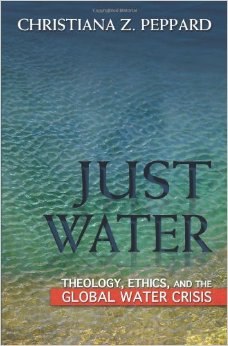
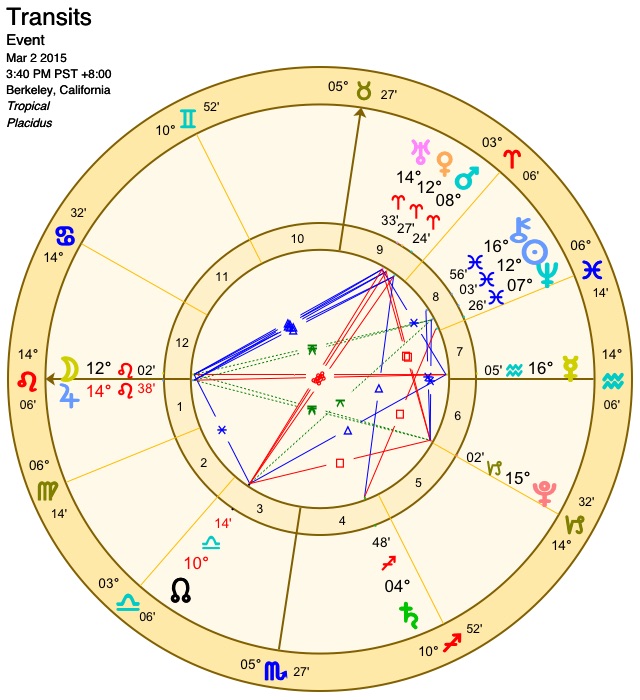
Not until my final day of reading this book did a friend point out to me the dual meaning of the title of Christiana Peppard’s short book Just Water. While it sounds as though Peppard may be indicating that the book is explicitly focused on water, the subtitle, Theology, Ethics, and the Global Water Crisis, indicate that the book is about much more, and that the “just” in the title is additionally pointing towards the justice issues bound up within the fresh water crises plaguing the planet. Just Water is about the justice of water, and Peppard is addressing the water crisis from the angle that access to fresh water is a right-to-life issue, particularly as defined by the Catholic Church. Just WaterFirst of all, I was struck by the astrological correlation in the world transits that took place over the roughly two week period when I was reading this book along with my classmates in the course Ecology in a Time of Planetary Crisis. Over this period of time the Sun has been in a conjunction with the planet Neptune, and the archetype of the Sun in world transits sheds light, and brings focus and clarity upon whatever it touches, which in this case is the Neptunian realm of water, spirituality, religion, and ethics. Furthermore, the Sun-Neptune conjunction is square to Saturn, which archetypally relates to crisis, conflict, shortage, pollution, and justice. Saturn-Neptune, which first came into orb about a year ago and will be in the sky for nearly three more years, can manifest in world events as drought, water shortage, contamination and toxicity, and conflicts over water rights, among many other multivalent expressions. To be reading Just Water when the Sun was aligned with this transit felt particularly significant. As for the content of the book itself, I found myself having mixed feelings about how the material was presented. The chapters relating directly to the global water crisis—or crises as Peppard points out, since the issues with water are diverse and differentiated based on local context—were extremely engaging, important to take in, and indeed quite frightening. The second chapter especially, titled “A Primer on the Global Fresh Water Crisis” laid out many of the hard facts of how human beings are using and wasting water, mining “fossil water” from aquifers that will never be replenished on a human timescale, and capitalizing on water packaged in disposable plastic bottles sold to those in first world countries who have easy access to clean tap water, while millions around the world do not have a guaranteed source of clean, fresh water. The global water crisis is afflicting those who are not causing it to a highly disproportionate degree, while those who are responsible are largely sheltered from the effects. The parts of the book with which I struggled most were when Peppard drew on the teaching of the Catholic Church, particularly Catholic Social Teaching (CST), as an ethical resource for how to address the water crises. While I felt she had a legitimate argument for drawing on CST, at the same time the chapters relating to the Church felt disjointed and at odds with the rest of the book, as though they were not fully integrated. If the title of the book had been Just Water: Catholic Theology, Ethics, and the Global Water Crisis I could have understood better where she was coming from, but in reading the book it felt like she was trying to use the Catholic voice as the sole ethical voice addressing the water crises. While this is not necessarily true, I still wish Peppard had defined her position more clearly from the beginning, even in the title, or that she had drawn on other religious and spiritual traditions to provide additional ethical perspectives on the issue of water rights. I came away from reading this book recognizing that the global water crisis is as dire as climate change, and yet does not receive nearly the level of press as global warming does. While I can go online and roughly calculate my carbon footprint, I do not know how to calculate my water footprint: the amount of water that goes into everything I use, from the water I drink and bathe in, to the water used to grow everything I eat, to the water used to make all of the products that see me through my day-to-day existence. I cannot even begin to fathom the scale of that water usage, and yet it feels so essential that I be able to access this information and somehow change my behavior based upon it.

Work Cited

Peppard, Christiana Z. Just Water: Theology, Ethics, and the Global Water Crisis. Maryknoll, NY: Orbis Books, 2014.

[1] Christiana Z. Peppard, Just Water: Theology, Ethics, and the Global Water Crisis (Maryknoll, NY: Orbis Books, 2014), 182.

Back Through the Wardrobe: Returning to “The Chronicles of Narnia”

The world of Narnia has a distinct aura, a tangible presence that remains evasive, elusive yet alluring. The feeling of the Narnian world is somehow familiar, eliciting that nostalgic pull that calls from the heart of the Imaginal Realm. Many years had passed since I last read C.S. Lewis’s series of seven short novels for children, and I returned to them with fresh eyes and a much wider perspective than my childhood consciousness brought to the stories. While still enchanted by the places, the names, the people of Narnia, I was also aware of the underlying Christian themes woven into the stories in a way I was not as a child. Recognizing these themes elicited a mixed reaction from me, for on the one hand I could appreciate what Lewis was trying to communicate, but on the other I have been so deeply influenced by J.R.R. Tolkien and his profound distaste for allegory that occasionally I wished the stories could stand for themselves, apart from any parallel meaning intended by the author. At times I felt I was losing the real experience of Narnia to the allegory behind it.

Chronicles of NarniaThe Chronicles of Narnia tell the full arc of the history of that realm, from its creation in The Magician’s Nephew and its parallels with Genesis, to The Last Battle, with its coming of the Antichrist and the Last Judgment, ending in the extinguishing of the world of Narnia. Yet each one also feels somewhat disparate from the others, in tone, style, and feeling. They almost seem to not quite hang together, while at the same time being compelling and hugely popular. My two favorite stories were The Lion, the Witch, and the Wardrobe and the Dawn Treader, interestingly perhaps the most and the least allegorical of the tales respectively. Although The Lion, the Witch, and the Wardrobe tells of the Crucifixion and the Resurrection, with Aslan the Lion representing Christ, that story also feels like the one in which the pure realm of Narnia, apart from any allegorical meaning, shines through most brightly. The world of Narnia has a life of its own in that tale, more exuberant than in any of the other stories, perhaps in part stemming from the fact it was the first book Lewis wrote in the series. The four Pevensie children, the frozen Lantern Waste, Mr. Tumnus the Faun, Aslan himself, all have an imaginal reality to them which stands above and beyond the allegory that later came to be told through their actions. The Christian allegories Lewis is telling are taking place in a genuine part of Faërie, to draw on Tolkien’s term for the Imaginal Realm. Indeed, these aspects of Narnia came to Lewis before the Christian themes worked themselves into the tales, and Aslan himself seemed to be appearing in Lewis’s dreams for some time before he began writing, as the Imaginal Realm can so often do when the veils between worlds begin to thin.

The Voyage of the Dawn Treader, my second favorite of the novels, appears to be the least allegorical, intended to depict the spiritual life of those upon the journey to the World’s End. There is a numinosity to this story, and one feels saturated by the light of the East as the voyagers enter the sweet seas whose waters give strength and vitality. I felt a longing to enter into this depiction of Narnia more strongly than in all the other tales, as the Dawn Treader sails through the sea of white lilies toward Aslan’s country. Perhaps the magnetism of both The Lion and The Dawn Treader comes in particular from that tangible sense of Narnia as a real place, alluring one to enter into its landscapes.

Looking beyond the purely Narnian and Christian themes, there is also a Platonic element to Lewis’s stories. Particularly in The Silver Chair, which takes place in an underground realm, the allegory of the Cave from Plato’s Republic is echoed in the witch’s enchantment of the children who have entered her domain. She is attempting to convince them that no world exists beyond her underground realm, and the children appeal to her by describing their own world which is quickly fading from their memories. In their penultimate defense they attempt to describe the Sun, which the witch dismisses as an imaginary enhancement of a lamp. Finally, they appeal to Aslan and try to describe a lion, only to be told they are just embellishing upon a cat. But in the end the children and their companions overthrow the witch’s enchantments because the power of the world above, the world beyond the shadows of Plato’s cave, is stronger and more real than the lies she is weaving below in the darkness. Carrying the Platonic theme further, in the final chapters of The Last Battle, after the world of Narnia has ended and the many familiar characters drawn from all seven books are traversing a new landscape, they discover that the new land is the real Narnia and that the one with which they were familiar was merely a copy, a Shadowland. The Professor, or Lord Diggory, exclaims: “It’s all in Plato, all in Plato: bless me, what do they teach them at these schools?”[1]

The Last Battle was difficult for me to read for many reasons, not least of which because of the judgments passed upon so many of the characters. When Aslan stands at the door of Narnia as the world is ending, in one moment all the creatures of that world are judged and divided. Those who glance upon him for even a moment without love in their eyes are cast aside; Talking Beasts become dumb and descend out of Aslan’s realm forever, to a place unbeknownst even to the author. Furthermore, all of the characters from our world who have played roles in the various stories are drawn together into the real Narnia, a place that is an allegory for Heaven, because in their own world they have all died in a sudden train accident—all except Susan, who was once a Queen of Narnia and who played a major role in both The Lion, the Witch, and the Wardrobe and in Prince Caspian. She has apparently dismissed her memories of Narnia as merely fantasy, games she played with her siblings as children. Yet at the end of The Lion, the Witch, and the Wardrobe Aslan says, “Once a king or queen in Narnia, always a king or queen.”[2] Has he forgotten his own words? Is doubting one’s experiences so deep a sin that Susan is not only banned from ever entering the real Narnia, but also loses all of her siblings and parents to a single train accident and, one assumes, must now bear this grief alone in England? Where is Aslan’s compassion and forgiveness? Does he not recall that she wept alongside Lucy over his dead body upon the Stone Table before his resurrection? Or is there perhaps some other hidden answer, a consolation not directly written on the pages of the final book?

Perhaps the most difficult aspect for me about the closing of The Chronicles is that because the world has come to an end we as readers cannot hold on to the glimmer of hope that we may find a doorway to that world as well. Fairy-story gives us faith in the real existence of the Imaginal Realm, and a trust that we too may some day be given the grace to enter its domain. But what if “the gates should be shut and the keys be lost,”[3] as Tolkien writes, and we are locked upon the outside? Whence then do we turn to enter into Faërie? Perhaps it is in this sense of loss and nostalgia that one can truly reflect upon the potency of Lewis’s stories, for though they do at times bear the flaws of an all-too-human author, do we not still wish to return to the woods of Lantern Waste, the palace of Cair Paravel, and the sweet waters and white lilies of the eastern Silver Sea? Perhaps we may yet be granted that wish, for the time of the Narnian world does not align linearly with the time of this world—and some new doorway may someday open, allowing a different epoch of Narnia to be explored by some fortuitous wandering soul. With the ending comes both nostalgia and hope, a sense of loss mingled with the potential for remembrance and rebirth.

Works Cited

Lewis, C.S. The Chronicles of Narnia. New York, NY: Harper Trophy, 1994.

Tolkien, J.R.R. “On Fairy-Stories.” In The Monsters and the Critics. Edited by Christopher Tolkien. London, England: HarperCollins Publishers, 2006.

[1] C.S. Lewis, The Last Battle: The Chronicles of Narnia, (New York, NY: Harper Trophy, 1994), 212.

[2] C.S. Lewis, The Lion, the Witch, and the Wardrobe: The Chronicles of Narnia, (New York, NY: Harper Trophy, 1994), 199.

[3] J.R.R. Tolkien, “On Fairy-Stories” in The Monsters and the Critics, ed. Christopher Tolkien (London, England: HarperCollins Publishers, 2006), 109.

Continuing Thoughts on “Global Environmental Politics”

The fourth section of Simon Nicholson and Paul Wapner’s anthology deals with the international state system, and its ability, or lack thereof, to deal with global ecological issues, particularly climate change and mass species loss. The section opens with the Rio Declaration on Environment and Development, drafted in 1992. I was both struck that this document was drafted over twenty years ago, and found myself questioning the validity of many of the principles in face of the reality of the ecological problems before us. For example, the continued emphasis on sustainable development made me question whether sustainability is really the emphasis, or is it rather a mere “green-washing” of development as usual? What would happen if the term were reversed, and instead we created “developmental sustainability,” or some other means of prioritizing resilience over exponential growth? Overall, the declaration does not examine the underlying assumption that the economic growth model is the only way forward, or consider that it may inherently have a dire ecological cost.

Global Environmental PoliticsMoving forward to the next chapter by Jennifer Clapp and Peter Dauvergne, entitled “Brief History of International Environmental Cooperation,” I was repeatedly discouraged by the numerous ecologically-oriented political gatherings that have been held over the last fifty or so years that have had relatively minimal impact compared to the scale of the ecological issues we face globally. Why has so much effort been put into agreements if very few of them are legally binding? Why are there seemingly no immediate social consequences when agreed upon goals are not met by various countries? Is there a way to make international state agreements more effective and binding or, like the ecological crises themselves, must they be both borderless and bioregional in order make a real impact?

Archetypal Astrological Counseling

Archetypal Astrology Counseling Website

“The stars are like letters which inscribe themselves at every moment in the sky . . . . Everything in the world is full of signs. . . . All events are coordinated. . . . All things depend on each other; as has been said, ‘Everything breathes together.’”
– Plotinus

I am excited to announce my archetypal astrology counseling practice, and the launch of my website ArchetypalPrism.com. The archetypal perspective has been a continual presence throughout my life, and I have been working intensively with astrology since 2010. The form of astrology I practice is known as Archetypal Cosmology and focuses primarily on the geometrical relationships between the planetary bodies of our solar system. I offer astrological consultations that explore both the natal chart—the position of the planets at the moment of one’s birth—as well as personal transits—the relationships formed between the continuous movements of the planets and the natal chart. If you are interested in having an astrological consultation with me, please visit my new website and email me through my Contact Page.

It would be an honor to explore the cosmos with you,
Becca

Current Transits

Having “Wild Hope”

Opening the first pages of Andrew Balmford’s book Wild Hope: On the Front Lines of Conservation Success, I found myself feeling immensely skeptical. I usually have held a somewhat wary view of conservation, tying it to the ideologies of Gifford Pinchot, a contemporary of Teddy Roosevelt and John Muir, who advocated for the conservation of wild places so that their resources might be available for future generations (as opposed to Muir’s preservationist view that desired to preserve wild places for their intrinsic value and sacred beauty). I have agreed with many of the critiques articulated by William Cronon, who sees preservation of wilderness—defined as wild landscapes untouched by human impacts—as a fantasy of civilization born of Romantic ideals. Yet I also know that it is absolutely vital that human beings begin to lessen our impact on wild landscapes and to make room for the countless multitude of other species with whom we should be sharing this planet.

Wild HopeDelving into Wild Hope and reading of the different conservation projects that are having positive impacts across the globe gave me just that: hope. It is such a nourishing experience to taste hope in the face of all the devastation we have caused. While the stories of conservation success clearly had shadow sides—deadly violence to protect endangered animals, economic incentives based on the same capitalist model that has created the destruction in the first place—what inspired me was that around the world people are taking action. Although the odds are clearly against those who wish to slow ecological decline, reverse climate change, and save thousands of species from extinction, I have always felt that we should still use all of the imagination, creativity, and will that we have to take action on behalf of the Earth. Sometimes when the air is particularly thick with despair I still know that at a karmic level this is what must be done, even when it seems hopeless on the surface.

Perhaps what I appreciated most in Wild Hope was the level of creativity and imagination expressed by those who want to make some difference in conserving the ecosystems of our world. I believe imagination is a great gift to ecology, one that gives those drawing on its power a sense of deep connection and aliveness. Drawing from the wellspring of imagination seems to inspire in others a desire to do the same. Perhaps the greatest value in reading Wild Hope for me was that as I saw how others were engaging creatively to find solutions and participate in holding actions, I felt more inspired to continue with the work as well.

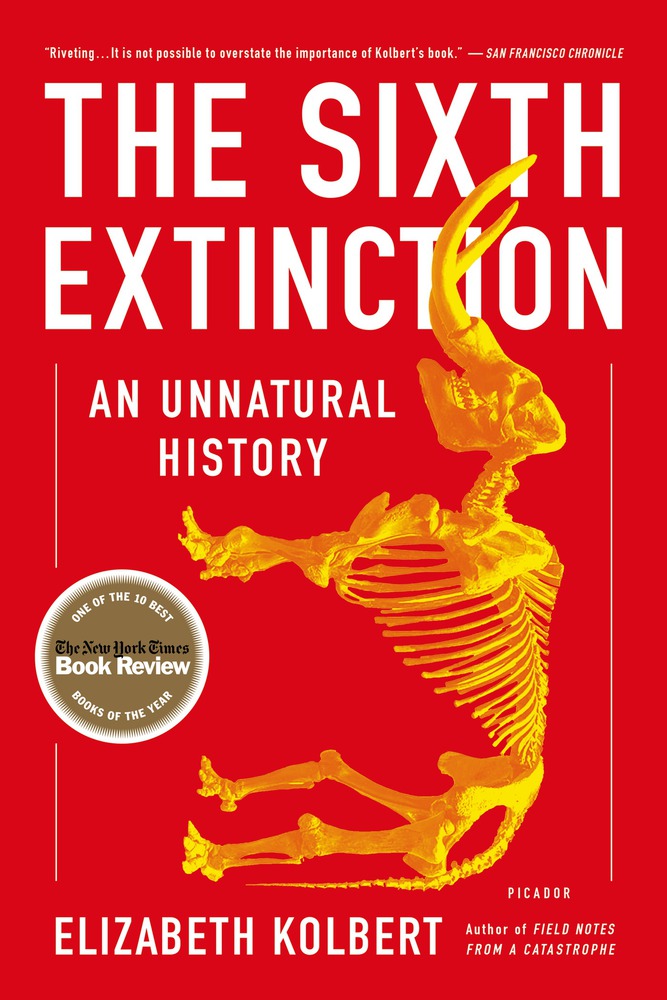
Sitting with “The Sixth Extinction”

“If you want to think about why humans are so dangerous to other species, you can picture a poacher in Africa carrying an AK-47 or a logger in the Amazon gripping an ax, or, better still, you can picture yourself, holding a book in your lap.”[1] In this one sentence, in the final chapter of her book, Elizabeth Kolbert implicates you, the reader, as the cause of the sixth mass extinction of species on this planet. When reading of the human impact upon Earth, upon the other species with whom we share—or do not know how to share—this planet, it can become so easy to want to seek the source of blame outside oneself, to charge other humans with responsibility for the ecological crisis. But we have been “othering” for far too long, and it is time to take that responsibility within ourselves. So I am sitting here with this book on my lap, I am writing these words on my computer screen, and I know that this crisis is my fault. What, then, do I do with this deeply personal recognition, a recognition that must break afresh upon us again and again if we are to move forward honestly in this field?

The Sixth ExtinctionMy response to Kolbert’s book was wholly positive, a response I do not take lightly. I felt that she was undertaking a task similar to Bruno Latour’s Science in Action in which she opens the mysterious black boxes that create our scientific knowledge to reveal the specific and all-too-human processes of knowledge creation about our planet’s geological and biological history. Her research undertaking in itself was highly impressive; to make it so accessible to a wide audience in such an intelligible way I find even more so. Somehow this volume on mass extinction was not written in a depressing tone, as so much environmental literature is, but rather in an empathic human tone, taking in the emotional reality that we hold many responses to this material and cannot remain in one emotional state for long. The human response is ever changing, and the tone of this book reflected that. Yet I did grieve too: for the loss of the amphibians, the calcites, the rhinos, the coral reefs, the rainforests, as well as the ancient losses of mastodons and the other great megafauna, the ammonites, the auks, the Neanderthals. Of course, I cannot name them all here. No one has ever named all the species we have lost from Earth, nor will we ever be able to name all those who we are bringing to extinction now. But as we wake up to the reality we have created, cannot we remember Aldo Leopold’s words and recognize how far we have come as a species as well: “For one species to mourn the death of another is a new thing under the sun.”

Work Cited

Kolbert, Elizabeth. The Sixth Extinction: An Unnatural History. New York, NY: Picador, 2014.

[1] Elizabeth Kolbert, The Sixth Extinction: An Unnatural History (New York, NY: Picador, 2014), 266.