
The essay “The Fantastic Imagination: Sub-Creating Tolkien’s Middle-Earth,” which is the foundation of this presentation, is available here.
The essay “The Fantastic Imagination: Sub-Creating Tolkien’s Middle-Earth,” which is the foundation of this presentation, is available here.
“You cannot think without abstractions; accordingly, it is of the utmost importance to be vigilant in critically revising your modes of abstraction.”[1] The entire purpose and means of this essay is to use a variety of provisional abstractions to attempt to avoid mistaking the abstraction of reality for reality itself, or what Alfred North Whitehead refers to as the “Fallacy of Misplaced Concreteness.”[2] As stated in the quotation from Whitehead that opens this essay, one cannot think, describe, or write about anything without employing some kind of abstraction of that thing. It is essential to know how one has come to an abstraction so that when the time comes to understand it in its full context the abstraction can be dismantled in exact reversal of how it was built. The proper method of abstraction is like holding the waters of the ocean at bay to better study the shore, while remembering that one’s retaining wall is not actually a part of either the ocean or the shore, and that the ocean and shore create and define each other reciprocally.
This essay will explore Whitehead’s concepts of the separative, prehensive, and modal characters of space and time as put forward in Chapter IV “The Eighteenth Century” in his Science and the Modern World. The study I am undertaking is a nest of abstractions focusing on two pages within a chapter, set within a book, which is itself a written abstraction of the reality first spoken in lectures delivered by Whitehead in 1925, and now explored in an entirely different context eighty-seven years later. To grasp a concept is to feel it as an intuition, in Henri Bergson’s use of the term.[3] To bring it forth into thought or writing is like a layering of multiple images that provide refractions of the full picture but can never entirely represent the initial intuition. We shall proceed with this limitation in mind.
The foundational assumption of eighteenth century science, from Whitehead’s perspective, is the concept of “simple location” used when studying any kind of phenomenon. Whitehead defines simple location as follows:
To say that a bit of matter has simple location means that, in expressing its spatio-temporal relations, it is adequate to state that it is where it is, in a definite finite region of space, and throughout a definite duration of time, apart from any essential reference of the relations of that bit of matter to other regions of space and to other durations of time.[4]
To reconnect simple location with the reality surrounding and composing it, Whitehead draws forth three characters of space-time: the separative character, the prehensive character, and the modal character. These can also be conceived as six characters, three in reference to space and three in reference to time. The more the concepts are divided the easier it is to grasp their definitions but the further we retreat from their actual meaning.
The separative character of space and time is the simplest of the three to comprehend: things can be separated from each other in space, and they can also be separated from each other in time. In space I am physically separate from the person sitting next to me, and all others surrounding me. In time I am also separate from other persons; billions have been born and died before me, and billions more shall live after I have died.
The prehensive character of space and time is the necessary opposite of the separative character; they allow each other to exist. Within space things are not only separated but also together, and the same holds true for time. This togetherness is what creates compounds and allows new things to exist. Hydrogen is together with oxygen and thus water is formed. I am together in time with a glass of water I drink, or with the person next to me with whom I am conversing. Yet this idea of togetherness, the prehensive quality, becomes more complicated yet is also clarified when understood in conjunction with Whitehead’s third quality of space and time: the modal character.
The modal character, as Whitehead initially defines it, is what gives rise to simple location if not understood in relation to the separative and prehensive characters. But as he goes on to explain the modal character further it is also what allows for the overcoming of that particular form of abstraction, simple location. Whitehead’s first definition of the modal relates to the limit of something both in space and in time. All things have a limit in space, limits that define their shape and location. For example a ball is limited by its shape as a sphere, which is also the spherical limit of its location. In time such limitation can be understood as the duration of something; for example I am limited in time by the length of my life as bookmarked by my birth and eventually my death. But again, to describe the modal character in isolation from separative and prehensive characters is to give rise to a false understanding of each of these things. Hence, they must all be conceived in relationship.
Whitehead first uses the example of volume to illustrate how the abstraction of simple location cannot give a full representation of reality. A volume, when measured, is divided into sub-volumes; to visualize such division one must picture not the space itself but rather the lines dividing it. As a result, what is being conceived is not the space at all but rather the divisions. Thus it appears that the volume is only a collection of lines and points. The problem that arises is that in order to add up these divisions to measure a volume either the lines must be added up, or the space between them, but not both. If only the volume is added without the divisions we arrive where we began, with an unmeasured volume. If only the divisions are added we have a collection of lines all put together producing nothing but a single line. We have a number representing the divisions but no longer a space. It is as though the volume has been turned inside out.
An example of how such ways of measuring cannot present reality can be seen in the relation of matter to space in the atom. An atom is composed of ninety-nine percent empty space. Only one percent of an atom is actual matter. This can be visualized by imagining a human being, and then subtracting the empty space from each atom in the human body. The remaining matter would be no bigger than a grain of sand. While the pure matter of a human body has now been measured, what remains is not a representation of what we understand a human being to be.[5]
What is needed is an intuition of space as inclusive of both its separative and prehensive characters. Yet these cannot be understood together without the participation of the third character, the mode. Each part of space, defined by the separative character and unified by the prehensive, is in relation to every other part of space, for it only exists by relation to each of those parts. Whitehead describes it as follows: “The parts form an ordered aggregate, in the sense that each part is something from the standpoint of every other part, and also from the same standpoint every other part is something in relation to it.”[6] An example that can help illustrate this is a technique used in watercolor painting, called negative painting. The technique is used to bring an object, say a leaf, to the foreground (see Figure 1). The leaf, which presumably has been sketched in with pencil, is then painted around. In this way the background is defined by a distinct color whereas the leaf, which is actually the focal subject, is the plain, undefined white of blank paper. The background is defining the subject, while the subject defines the background. They create each other.

Figure 1 – Negative Watercolor Painting
Whitehead chooses to illustrate the way in which the modal character works with the abstract example of spaces A, B, and C. He writes, “Thus if A and B and C are volumes of space, B has an aspect from the standpoint of A, and so has C, and so has the relationship of B and C. This aspect of B from A is the essence of A.”[7] But B is not the only essence of A. For the aspects from A to C, to D, to E, and so forth are also the essence of A. “The volumes of space have no independent existence. They are only entities as within the totality; you cannot extract them from their environment without destruction of their very essence.”[8] One way to visualize this is with the image of a honeycomb, an example of organic geometry (see Figure 2). The honeycomb is made up of many hexagons, each one creating the others around it. Each of the six walls of one hexagon are simultaneously one of the six walls of each hexagon next to it, and so forth. No single hexagon can be isolated, otherwise all semblance of structure is lost and one is left only with a small globule of wax and honey.

Figure 2 – Honeycomb hexagons
It is the aspect of B from A, or of the one wall shared between two honeycomb hexagons, that Whitehead calls “the mode in which B enters into the composition of A.” Thus the mode in which hexagon A enters into hexagon B next to it is the wall they share between them. Furthermore, if hexagon C shared a wall with hexagon B, but not hexagon A, then the modal character between A and C would be different than between A and B but they would be in relationship nonetheless. Thus the modal character can best be understood as the relational character. One hexagon cannot exist, it will have no essence, without the presence of all the other hexagons. Unlike the previous example of negative painting, no space is in the background while another in the foreground. All spaces are in the foreground and simultaneously dependent on each other. A better of example of how to visualize this would be the trick image of two facial silhouettes in profile looking at each other (see Figure 3). Viewed one way the faces are apparent. Viewed in another the space between the faces becomes visible, revealing the silhouette of a vase. Both the faces and the vase are present simultaneously and they each define each other, however, they cannot be described except by abstracting one from the other alternatively.

Figure 3 – Vase and two faces
It almost seems odd that what Whitehead has termed the modal character, what I am calling the relational character, in his initial definition is that which, when isolated from the separative and prehensive characters, is the abstraction known as simple location. Simple location, according to Whitehead’s second definition of the modal, is the concept of relationship without factoring in actual beings or objects into that relationship. It is merely the concept of relationality with no participants. This is not likely how scientists of the 18th century might have defined simple location, which would be more along the lines of the participant without the relationship. It is this paradox that Whitehead’s somewhat contradictory definitions of the modal character appear to reveal.
Applying these three characters of separation, prehension, and mode to time is both simpler and more complex than applying them to space. Simpler because it is easy to understand that a moment in time cannot be separated from the moments on either side of it. Time continues to flow whether someone pauses to think about it or not. Time can never be stopped. (Unless one has entered another realm such as Faërie; but in such a place the laws of physics may not apply in the same way, so the characters of separation, prehension, and mode may not be relevant.) On the other hand, it is more complicated to understand the character of time (back in our realm) because time cannot be visualized; our usual way of imagining something requires the introduction of space. The need for space within time is entirely Whitehead’s point, because ultimately space cannot be understood without the flow of time either. So even the separation of space and time from each other are false abstractions, or misplaced concreteness. “For each volume of space, or each lapse of time, includes in its essence aspects of all volumes of space, or of all lapses of time.”[9]
This tri-part relationality of all things can also be applied to how the thinking mind relates to anything that it contemplates. To study any one object, time, place, being, or anything else is to have the mind in relationship to that thing. The object and the mind are each defining the essence of each other. Whitehead quotes Bishop Berkeley on this point:
When we do our utmost to conceive the existence of external bodies, we are all the while only contemplating our own ideas. But the mind taking no notice of itself, is deluded to think it can and does conceive bodies existing unthought of or without the mind, though at the same time they are apprehended by or exist in itself.[10]
The object and the mind are each defining the essence of each other.
As Whitehead writes more on this concept of interrelationality he begins to use the term prehension, which was initially introduced as one of three characters of space-time, to refer to the entire concept of essence defining essence. He writes, “This unity of a prehension defines itself as a here and a now, and the things so gathered into the grasped unity have essential reference to other places and other times.”[11] The modal becomes the prehensive, the prehensive becomes the separative, the separative becomes the modal. What keeps the leaf separate from its background, or environment, is what brings the leaf together with its environment. The leaf cannot exist as a leaf without its branch, its tree, its forest, its soil and so forth, and they each would not be branch, tree, forest, or soil without the existence of that and all other leaves. As we pull away from viewing reality as an abstraction all abstractive descriptors blend one into the others. Reality, the entire universe, begins to pour in to our experience.
The concept of prehension expands when considering a perceiver in relationship to the universe. The prehensive character is no longer merely a volume defined by all other volumes, it is all the senses in relationship to every stimulus. Yet it is also more than this, for sense is too specific a word for prehension. Prehension occurs without either sense or cognition. Stimulus is too simple a term as well, because what are referred to as stimuli are also each in their own acts of prehension of the universe.
When prehension is brought into the context of human relationships—whether between two or more human beings, between humans and other species, the Earth, or any other part of the cosmos—Whitehead’s concept can provide a grounding for an ethics of relationship and responsibility. If every part of the cosmos is prehending every other part, and they each create the essence of the other, no fundamental separation exists that can justify causing harm to another being without it also affecting oneself in an essential way. As previously quoted, Whitehead writes that all things “are only entities as within a totality; you cannot extract them from their environment without destruction of their very essence.”[12] Such a concept, if brought into other realms of thought, can provide a powerful ethical argument on behalf of human and ecological justice.
This exploration of Whitehead’s philosophy of prehension and separation has moved back and forth between the abstract and the concrete in an attempt to bring clarity to abstract concepts that can ultimately reveal a more concrete form of reality. I believe the best test for the validity of a philosophical concept is an exploration of how that concept can serve the ways we behave in everyday life. Do they make a difference in our habits, thoughts, and personal relationships? Whitehead is providing not only a way to overcome the fallacy of misplaced concreteness but also the fallacy of misplaced separation and independence. I say “misplaced separation” instead of merely “fallacy of separation” because holding a balance between separation and unity is what allows relationship to exist. A relationship cannot be formed within a unity alone, but requires some sense of separation as well. Carrying an understanding of the interdependence and relationality of our own essence to every other aspect of reality, I believe, could make such a difference in how one’s life is lived, not only in relation to our fellow human beings, but in relationship to other species, ecosystems, the planet Earth, and perhaps even the extent and interior of the cosmos.
Bibliography
Whitehead, Alfred North. Science and the Modern World. New York, NY: The Free Press. 1967.
Bergson, Henri. “Philosophical Intuition.” In Henri Bergson: Key Writings, edited by Keith Ansell Pearson and John Mullarkey, translated by Melissa McMahon, 233-247. New York, NY: Continuum. 2002.
[1] Alfred North Whitehead, Science and the Modern World, (New York, NY: The Free Press, 1967), 59.
[2] Whitehead, Science and the Modern World, 58.
[3] Henri Bergson, “Philosophical Intuition,” in Henri Bergson: Key Writings, ed. Keith Ansell Pearson and John Mullarkey, trans. Melissa McMahon (New York, NY: Continuum, 2002),240.
[4] Whitehead, Science and the Modern World, 58.
[5] Brian Swimme, personal communication, 2011.
[6] Whitehead, Science and the Modern World, 65.
[7] Ibid, 65.
[8] Ibid.
[9] Whitehead, Science and the Modern World, 71.
[10] Berkeley, qtd. in Whitehead, Science and the Modern World, 67.
[11] Whitehead, Science and the Modern World, 69.
[12] Whitehead, Science and the Modern World, 65.
September 22, Early morning
I am awake before dawn on the Equinox. The sky is lightening all around me. The clouds are so soft it is hard to see where each one ends and the robin’s egg sky flows in. To my right is a small herb garden planted in dry, mounded beds delineated by white stones. A gateway, made of three simple, straight boughs barely differentiated from the trees they once were, stand beyond the herbs. Past the gate unfolds an intricately woven permaculture garden: fruit trees ranging from a few years old to the grandmother plum in her sixties.
A white horse whinnies restlessly on the golden hill; a stand of redwoods frame her from behind. Interspersed in the orchard are beds of annual crops: beets, carrots, tomatoes, strawberries, kale, chard. Concord grapes grow from vines draping every available trellis, their scent saturating the air. Although I cannot see them where I sit, I hear the chickens, ducks, and geese calling to the arriving dawn. Somewhere, hidden behind apples and sunflowers, are the family of five goats. The two young males, Peaches and Sweetie, we will be harvesting and processing today, and making into our evening meal.
Goat milk clouds my warm cup of black breakfast tea, adding an unfamiliar sweetness. The goats are an integral part of the life here; they provide milk, cheese, yogurt, even caramel, as well as meat and companionship.
The sun has now risen.
The three days spent on the Hill of the Hawk farm was a lesson in ethics, an ethic related to one of the most intimate aspects of survival: eating. Whether or not to eat animal products, especially meat, is an issue to which every culture seems to have a different answer. An example of the views on these issues are presented by Peter Singer and Jim Mason in their book The Ethics of What We Eat, which stands in contrast to the perspective of Sally Fallon in her cookbook Nourishing Traditions. While Singer and Mason agree with Fallon on many aspects of food choice, such as eating organic produce and purchasing from fair trade and sustainable sources, their primary disagreement is about the consumption of animal products.
Singer and Mason write primarily on animal rights and well-being, looking into the methods of factory farming, as well as large- and small-scale organic production. Fallon, on the other hand, is writing from the perspective of human dietary health, drawing on research about the major benefits of a diet rich in animal products raised in a humane way. She gives examples of the longevity of peoples eating diets high in animal fats and proteins—namely the Japanese, Swiss, Austrian, Greek, and, of course, French[1]—as well as archeological research on the decline in stature of Mayan peoples correlated to periods of meat scarcity.[2] Fallon also draws on numerous studies relating to the importance of animal products, both meat and dairy, for the healthy development of children, and for the prevention of numerous degenerative diseases and maladies.
Singer and Mason focus more on how animals for consumption are produced rather than the dietary effects of eating them. They draw on several differing viewpoints regarding the ethics of taking animals’ lives, looking at the quality of life as well as methods of slaughter. They are clearly in favor of a vegan or vegetarian diet, but also present arguments from those who feel that it is better that animals raised well have the lives they do, rather than not existing at all.[3] While these issues have no clear answers even when one chooses to take a particular position, one aspect of my own understanding of eating meat is that one must experience participating in killing an animal before a decision can be made in favor of meat-eating. And this is just the experience which we encountered at Hill of the Hawk.

September 22, Late afternoon
The goats were brought up in the back of a pick-up truck cradled in the arms of several students. They ate grass near us while we sat and spoke with Tamara, the woman who would guide us with the killing. She said that if she ever were to take an animal’s life and feel no emotion in that act she would know she had done it too much and would have to stop. She wanted to cause the least suffering possible, in part by keeping herself and the other participants calm, and therefore giving no reason for the animals to feel anxiety. Everything is about the animal in his last moments, not about the humans involved. Our well-being in that time comes second. Tamara uses the term “processing” to refer to the entire procedure of harvesting the animal, because we humans can process our emotions as we process the animal.
We brought the goats under a great spreading oak and laid a cloth beneath them. The first goat Tamara gently straddled while her assistant held his head. She put her sharp blade into the back of his neck, severing the spinal cord so he would feel less pain. He only made one small sound, one that seemed to convey surprise more than pain or even fear. Swiftly she brought the knife forward and sliced into the jugular vein. Crimson blood welled from the opening, pouring and pouring forth. I came forward to catch it in a clean, glass bowl. Whispered thanks came from Tamara and her assistant, and many of those standing further back. The animal’s fading pulse seemed to pass from him to the very air itself, beating through everything. I was grateful to stand so close, to look into this little animal’s beautiful deep brown eyes, to thank him, and to recognize the moment when life left him. The eye transformed. No longer a window to the soul it became a glass bead. The blood still poured forth.
The deaths of Peaches and Sweetie were not the routine slaughters of factory farmed chickens, cattle, and pigs as depicted in Singer and Mason’s book. Clearly present in the processing of these two little goats was an aspect not mentioned by Singer, Mason, or Fallon; it was a spiritual presence. The focus for Singer and Mason is on the pain of farmed life and the trauma of the slaughtering process. What became apparent for me beneath that oak tree was that death itself was not an issue that could be assessed with statistics, written description, photography, or even filming. When the issue of pain and fear were handled in apparently the most ethical ways possible, death seemed to become a spiritual exchange, a gifting of one species to another, something that could not be captured in any other way than by standing witness.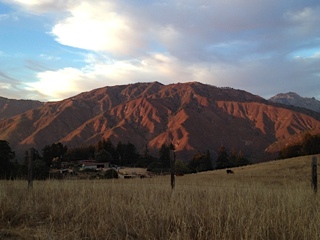
September 22, Late afternoon
The rest of the day was given to skinning and gutting the goats, and making recipes of each of the organ meats. Nothing was wasted. Liver and onions, kidneys and red wine, spleen pâté, breaded heart and testicles, lung soup, sausages stuffed into the intestines, fried blood, chocolate blood ice cream. The heads were skinned and sawn in half, the brains dried to be used later to tan the hides. The hides were salted and set aside to be cured. The hooves and bones will be cleaned and buried until they are white, then made into jewelry and musical instruments. Nothing was wasted.
Using every part of the animals felt like the most practical way of honoring their gift and sacrifice. Unlike large-scale farming operations which only use the choicest parts of animals, and often feed the remainder back to a different species,[4] our use and consumption of the animal in his entirety seemed an act of thanks. Additionally, it is the diverse organ meats that provide the greatest nutritional value, as Fallon writes about frequently. Fat-soluble vitamins, such as vitamins A, B, D, and E, are especially abundant in organ meats[5], and also allow for the absorption of minerals[6] and the assimilation of protein.[7] While Singer and Mason argue that any vitamins unavailable in one’s diet can be taken supplementally,[8] Fallon provides arguments of how isolated vitamins can, in some forms, be toxic to the system.[9] Organ meats are especially nourishing for pregnant women, and aid in the development and maintenance of healthy sexual organs.[10] Yet Singer and Mason also give the example of a healthy family of four living exclusively on a well-planned vegan diet, without any seeming detriment to their health.
Reflection on September 21, Evening
Sunset. A road climbs to the west over the hill and opens out to a full view of the Pacific Ocean, a vista broad and high enough to indicate Earth’s great curve. In silence we sat and watched the molten gold of the sun sink in blazing glory as Earth rolled away from its heat. The clouds were set alight, shifting from gold to vermillion, to crimson and magenta. Not until the sun had made his departure did the clouds shift to reveal the ivory crescent of the moon, one day from the quarter. She glowed ever brighter in the fading sky, her face ever turned in adoration to the departed sun.
Watching the cycles of the sun and moon, the passage of the planets, and the great wheeling of the stars across the sky each night led me to thinking about the passage and cycles of life upon Earth as well. The processing of the goats somehow to fit into these cycles, a mysterious give and take, an exchange of life and death, sorrow and gratitude. I was all too aware of that sunset as the final sunset in the lives of those goats, and the following dawn as a dawn onto perhaps a new life for them. Whether we eat other beings or not, death is something we all must contemplate and someday face. In reflection, I learned more from those goats about my own death than I could have imagined.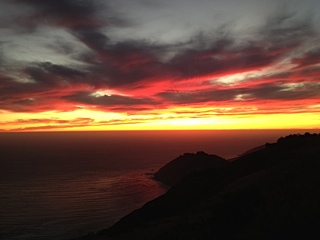
September 23, Early morning
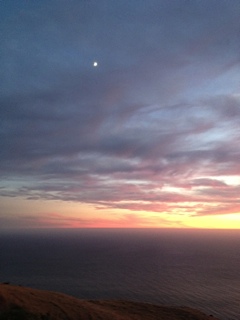
Venus and Jupiter, two fading diamonds in the warming dawn sky. The few clouds are saturated in rosy sunlight, but the fiery orb has not yet peaked over the Coastal Ridge. The flock of wild turkeys that haunt the farm walk past on my left, and quietly filter into the neat rows of the young Pinot Noir vineyard. One of the farm’s many cats, a large gray and white tabby, cuddles close providing welcome warmth, dividing my attention between petting and the pen. He finally leaves to find a more steady source of love.
Venus, last of the night stars, has now vanished from my sight, lost behind an atmosphere flooding with dawn light. The wind stirs, the cold air pushed forward by the approaching sun. Sunrise here for us is sunset for someone else, someone on the far side of that distant horizon.
When I awoke this morning it was still dark, the sky bejeweled in her net of stars. The moment I stepped through the canvas flaps of my tent I beheld Venus, a gem so bright she shone out unmistakably, shimmering princess of the twilight. From her it was easy to trace along the ecliptic to Jupiter, an orange-shaded beam of light, seated right at the mid-heaven.
Dawn is close. I can see pure sunlight on the south-western slopes of the Ventana Double Cone Mountain. Ventana. A window to the east. The Esalen Indians believe the souls of the dead pass between those two white, granite peaks into another realm. Perhaps the souls of our two little goats passed that way as well.
The birds are all awakening; a hummingbird thrums among the branches directly over my head, jays cry, a kite hawk circles in search of prey. When the kite pauses in mid-air, wings poised, he looks like a white angel in the distance, an angel framed against the Ventana Mountain. Many songbirds call to each other. I can feel their anticipation, their celebration, their worship of the sun. The air stirs restlessly and the temperature continues dropping.
The sun is emerging. A liquid platinum fire is melting up over the hill, spreading across the ridge like gold spilled from an alchemist’s forge. At the heart of that fire pure light spreads in all directions, filling the sky, obscuring the mountain. It melts all things surrounding it into undifferentiated lightness. The first warmth of the day is playing over my skin.
I have found myself wondering often if the experience with Sweetie and Peaches has changed the way I eat. Many questions have come up for me regarding veganism and vegetarianism. As we saw at Hill of the Hawk, the consumed dairy from the female goats requires the occasional slaughter of male goats so that the herd does not become too large. And even an organic vegan diet requires the presence of animals on the farm to provide manure to fertilize the soil in a healthy way to grow crops. To farm sustainably seems to involve animals in some way or another, whether we are vegan, vegetarian, or omnivorous. As before this experience, I personally still eat meat and dairy yet also, as before, I eat them in fairly small quantities. But there is something else that has become a greater part of my diet since leaving Hill of the Hawk: intention and gratitude. Whether we are eating animals—or grains, vegetables, and fruits—what seems to matter most is recognizing the gift of that food. All food is a life sacrificed, a life gifted. How do we in turn repay that life?
Bibliography
Fallon, Sally. Nourishing Traditions: The Cookbook That Challenges Politically Correct Nutrition and the Diet Dictocrats. Washington, DC: New Trends Publishing. 2001.
Singer, Peter and Jim Mason. The Ethics of What We Eat: Why Our Food Choices Matter. United States: Rodale, Inc. 2006.
[1] Sally Fallon, Nourishing Traditions: The Cookbook That Challenges Politically Correct Nutrition and the Diet Dictocrats (Washington, DC: New Trends Publishing, 2001), 7.
[2] Fallon, 27.
[3] Singer and Mason, The Ethics of What We Eat (United States: Rodale, Inc., 2006), 251.
[4] Singer and Mason, 62.
[5] Fallon, 39.
[6] Ibid, 16.
[7] Ibid, 29.
[8] Singer and Mason, 228-229.
[9] Fallon, 37.
[10] Ibid, 29.
This series of four paintings is a visual response to the content of Chris Bache’s course The Birth of the Diamond Soul, offering different images of the reincarnating soul both inside and outside the influence of time and space, as well as an homage to the devastation of the ecological crisis and how it may be the catalyst for the forging of the Diamond Soul.
THE OVERSOUL

The Oversoul is a term used by Bache in his book Lifecycles to describe the larger soul overseeing, but also incorporating, each incarnating human life. It is simultaneously a single entity, but also a family of entities nested within each other, and ultimately nested within the larger and larger spheres of existence. This painting is one representation of the Oversoul, pictured as a nautilus, an image Bache provided in class. The chambers of the nautilus each represent a human incarnation, yet the whole shell is the full soul. I have depicted a waiting fetus gestating within each chamber as a symbol of these lives. The life about to be born resides in the outermost chamber, with a diamond in potentia within his heart. The diamond represents the Diamond Soul being forged slowly over the course of each lifetime. A second diamond resides in the center of the nautilus representing the ultimate birth of the Diamond Soul at the end of the incarnational process.
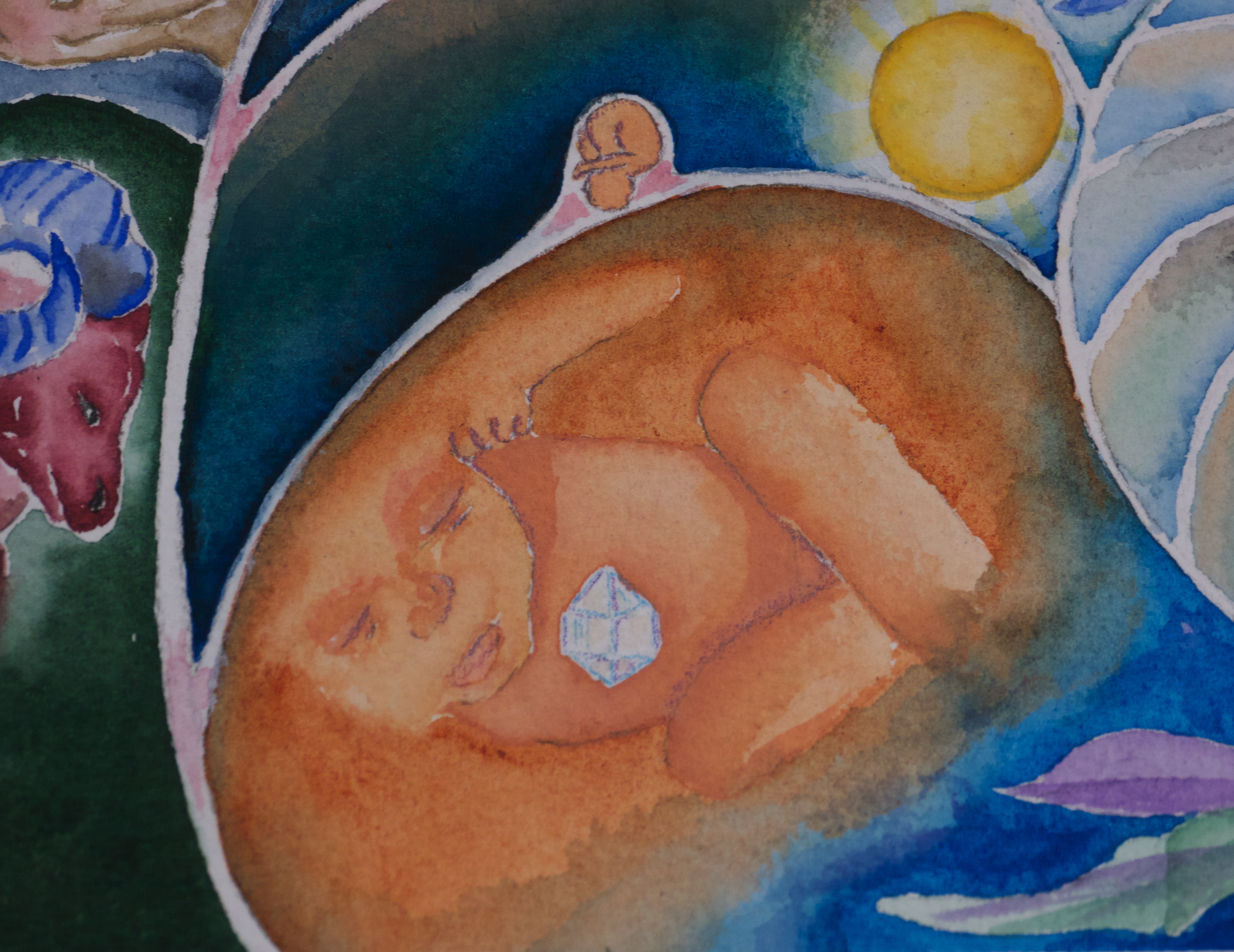 The pantheon of planets within the nautilus and the zodiacal signs surrounding it indicate the archetypal influences on each life and upon the soul as a whole, each chamber of the nautilus having a different perspective and relationship to the signs and planets that characterize that particular life. The baby about to be born residing in the outermost chamber is within the realm of Pisces, both as a fetus in the aquatic realm of the womb, but also as a symbol of our current times since we are in the Age of Pisces.
The vision of this painting came to me nearly in complete form when I began contemplating the nautilus as a metaphor for the Oversoul. To my delight, each of the zodiacal signs took on a life of their own as I painted them, as I had not pictured their exact form before drawing them in. I was particularly surprised by the form Sagittarius took, as a horseshoe doubling as a bow with an arrow. The animals also each took on their own personality seemingly independent of my intentions for them. The real surprise came as the baby being born into the Age of Pisces, for it was pure synchronous chance that the nautilus opened into the sign of Pisces, yet it seemed to fit perfectly with the concept behind the painting.
THE DIAMOND SOUL NEBULA

In an effort to visualize the concept of the Diamond Soul, Bache introduced us to several images from the natural world that might represent parts of the Diamond Soul, ranging from blossoming flowers to nebulae. This particular nebula, the Cat’s Eye Nebula, is one that conveys the idea in an especially evocative way, with its ethereal explosion and heavenly sacrificial blooming. The core of the nebula, as can be seen in all the images captured of it, is a pure white space resembling a diamond.
I found in my attempts to paint this nebula with watercolor that portraying the light and darkness, the veiled colors of the celestial event, was much more difficult than I had previously expected and took more than one try. When one looks at a photograph of a nebula it is the qualities of the whole that are so compelling, but in painting it I had the experience of becoming intimately familiar with each part, trying to understand where the colors blend and where they do not, yet also attempting to capture the whole as well. The only adjustment I made from the image as I painted it was emphasizing the diamond at the heart, forged in the layers upon layers of light and color.
DROUGHT AND HOPE

This painting of a drought-ridden desert with a single sapling growing in it is less an image of the Diamond Soul, but rather of the birth canal humanity seems to be entering before such soul transformation is possible. The painting is a representation of the changes rapidly being wrought upon the globe by human-induced climate change, and was particularly inspired by Bill McKibben’s book Eaarth: Making a Life on a Tough New Planet. McKibben provides the data that clearly demonstrates that global warming is no longer a future threat, it is a current reality. On a personal level this understanding was reinforced by a road trip I took across the American Continent this July while creating the concepts for this gallery. From Nevada to Michigan temperatures soared above 100° F, usually averaging at 104° but sometimes even reaching 108°. Fields were dry and often barren, and many cornfields showed yellowing leaves coated in a layer of dust. Yet oil wells continued to pump in these same fields by the roadside, and every building we entered was blasting arctic temperatures of air conditioning, all fueled by coal and oil burning power plants.
In the painting a young woman is bending over an olive sapling, seemingly watering it with her tears. It is ambiguous if this is the last plant left growing in this barren desert, or if it is the first that has managed to survive. I chose the olive as this single plant because of the great lineage of symbolism connected to the olive, particularly in the Western tradition. The olive is the tree of Athens, mythically a gift from the Grecian goddess Athena who gave it to provide wood, oil, and fruit to the people of Athens. In return they named their city-state after her. Athens is the birthplace of democracy and as such the olive may also symbolize the democratic process. The olive is part of the painting to pose the question of the role of democracy, or perhaps its absence, in the onset and unfolding of the ecological crisis.
The olive is also a symbol from the Hebrew tradition, a sign of hope in the Old Testament. When Noah sends a dove from the Ark to search for signs of land, the dove returns upon the second journey with an olive branch. The olive thus is the first growing plant after a devastating environmental catastrophe, the Great Flood, and also able to emerge out of a desert, but in the biblical case it is a desert of sea water.
The woman’s body is painted in a multitude of colors to represent all races that will be affected by the ravages of climate change, yet it also has an ethereal quality to it, almost resembling the sparkling surface of a diamond, as perhaps she is approaching the stage of a Diamond Soul.
Finally, the labyrinth in the background represents the circuitous route of the human journey, of the soul’s journey, and of our pathway to learning and wisdom.
BREATHING TIME
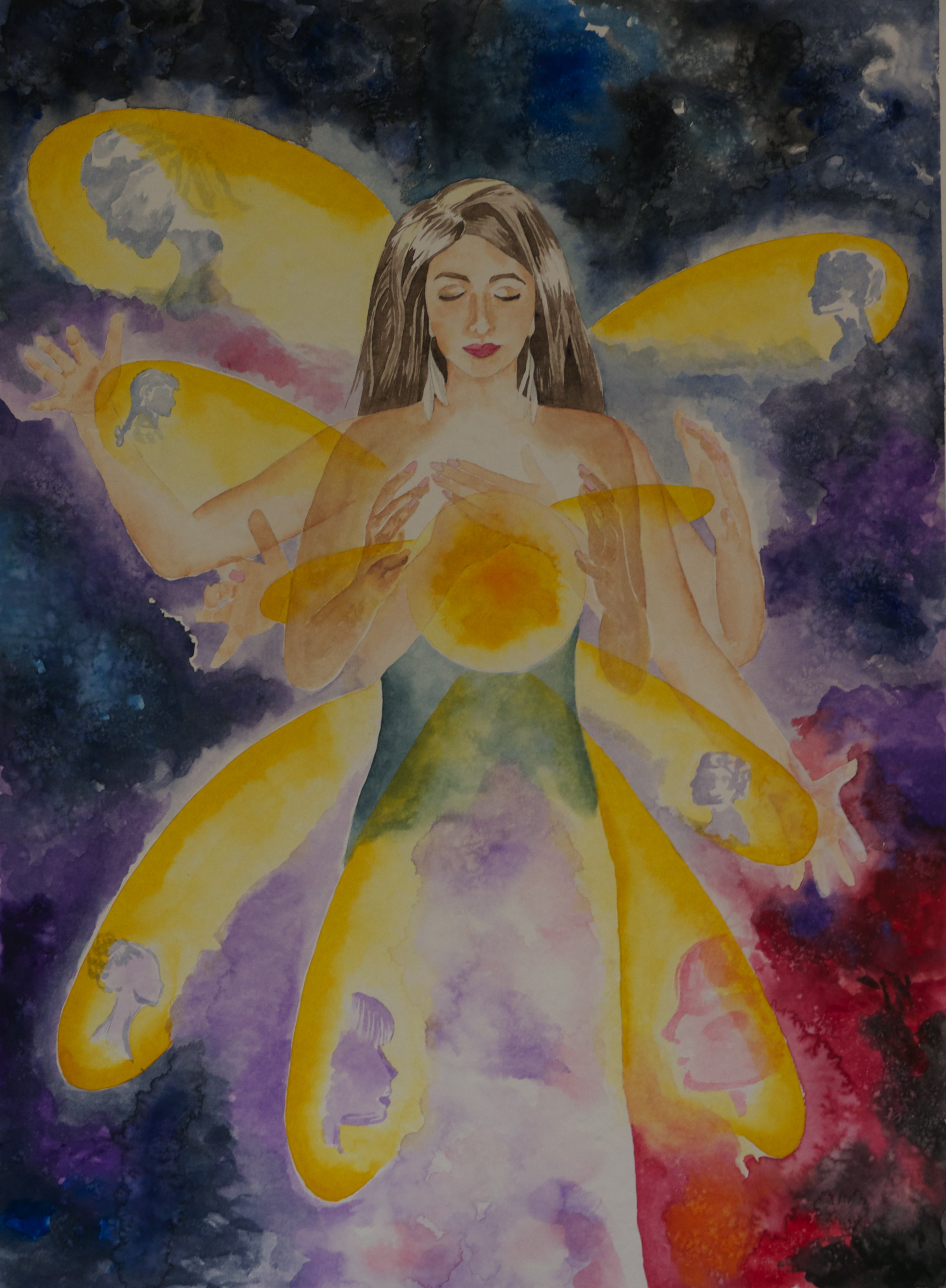
Breathing Time was inspired by a meditative exercise presented by Bache during the Diamond Soul course in which each breath we took represented one hundred years, or approximately one human life. Eventually we brought the movement of our hands into this meditation, each expansion and contraction of the hands 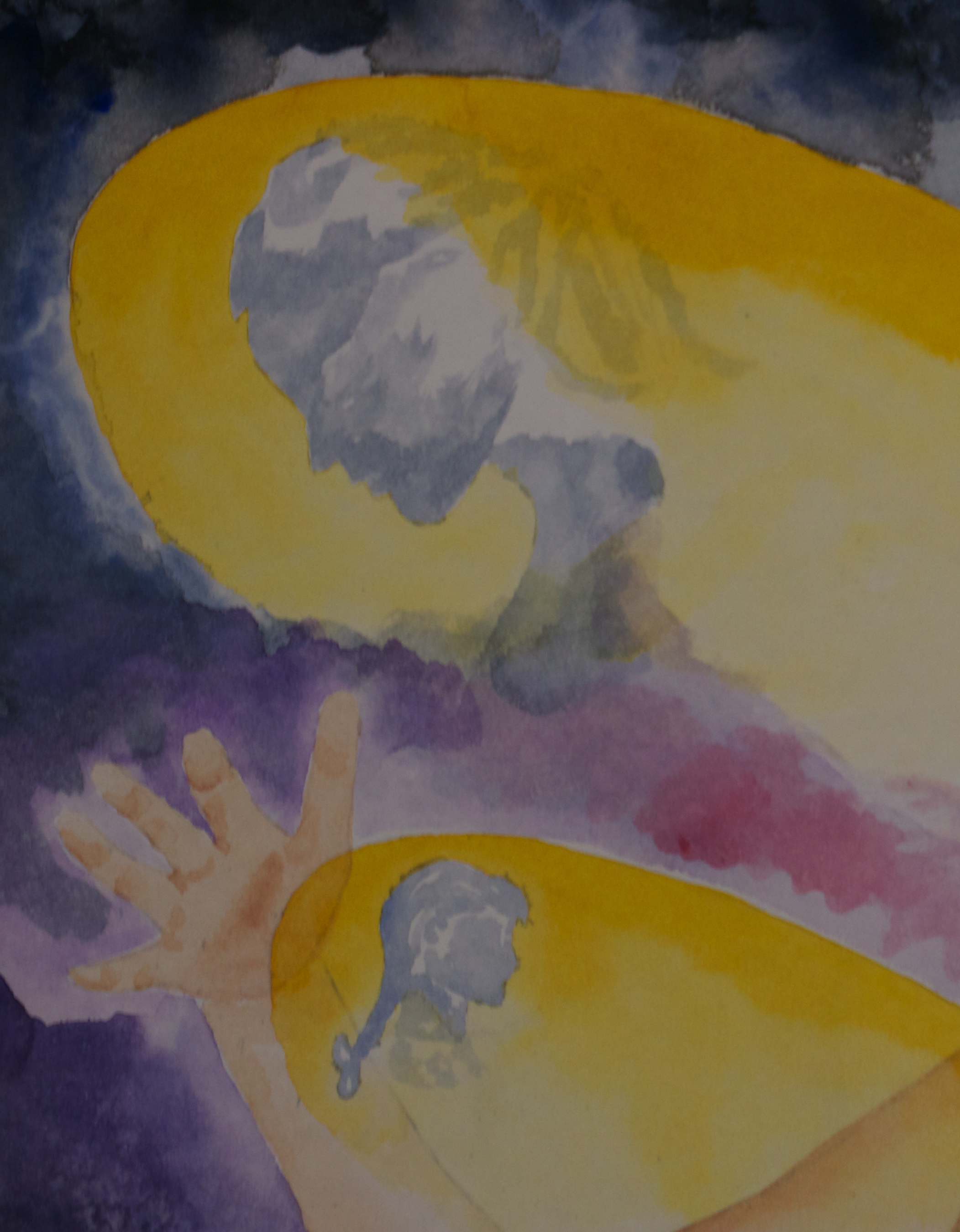 representing a lifetime. The energy created by this movement we slowly gathered into a sphere at our centers, then held it like a ball of light, before pressing the energy into our hearts and letting it fill our bodies. This painting is a visual representation of that
 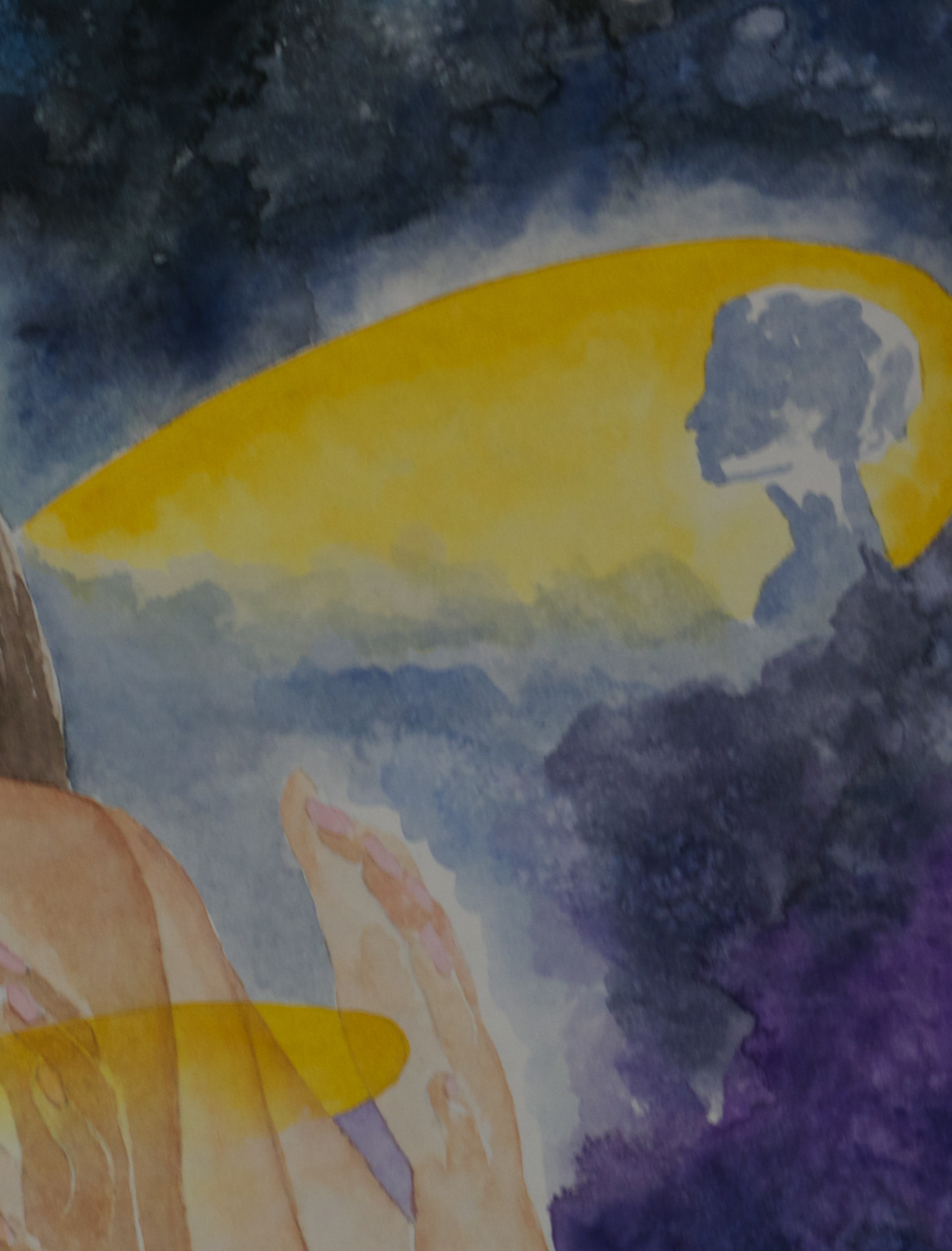 meditation as I saw it during the exercise itself.
In the painting, within the arcs of energy created by the breath and the moving hands are revealed faces, each one the face of a previous life. The faces are the color of the murky, nebulaic background indicating that the air may be packed full of these faces, full of lifetimes, but only the ones that are swept over with the meditative energy are revealed in that moment. There may be an infinity of faces present, just as we likely have an infinity of lifetimes to our souls.

BIBLIOGRAPHY
Bache, Christopher M. Lifecycles: Reincarnation and the Web of Life. New York, NY: Paragon House, 1994.
Bache, Christopher M. Dark Night, Early Dawn: Steps to a Deep Ecology of Mind. Albany, NY: State University of New York Press, 2000.
Grof, Stanislav. Psychology of the Future: Lessons from Modern Consciousness Research. Albany, NY: State University of New York Press, 2000.
Grof, Stanislav. The Cosmic Game: Explorations of the Frontiers of Human Consciousness. Albany, NY: State University of New York Press, 1998.
McKibben, Bill. Eaarth: Making a Life on a Tough New Planet. New York, NY: St. Martin’s Griffin, 2011.
Thus it ends…

I never imagined that I would know what it was like to be in a car for 1,095 miles straight, but now that I do I hope not to have to experience it again. Perhaps it was the two full days rest in Aspen, or just a strong desire to be back in our own home by the Bay nestled beneath our blanket of fog, but come Wednesday morning Matt and I decided to drive all the way home in one long shift. Or rather, we decided to keep the option open, in case we arrived at the campground in Austin, Nevada with enough energy and daylight hours to keep going to the coast. 
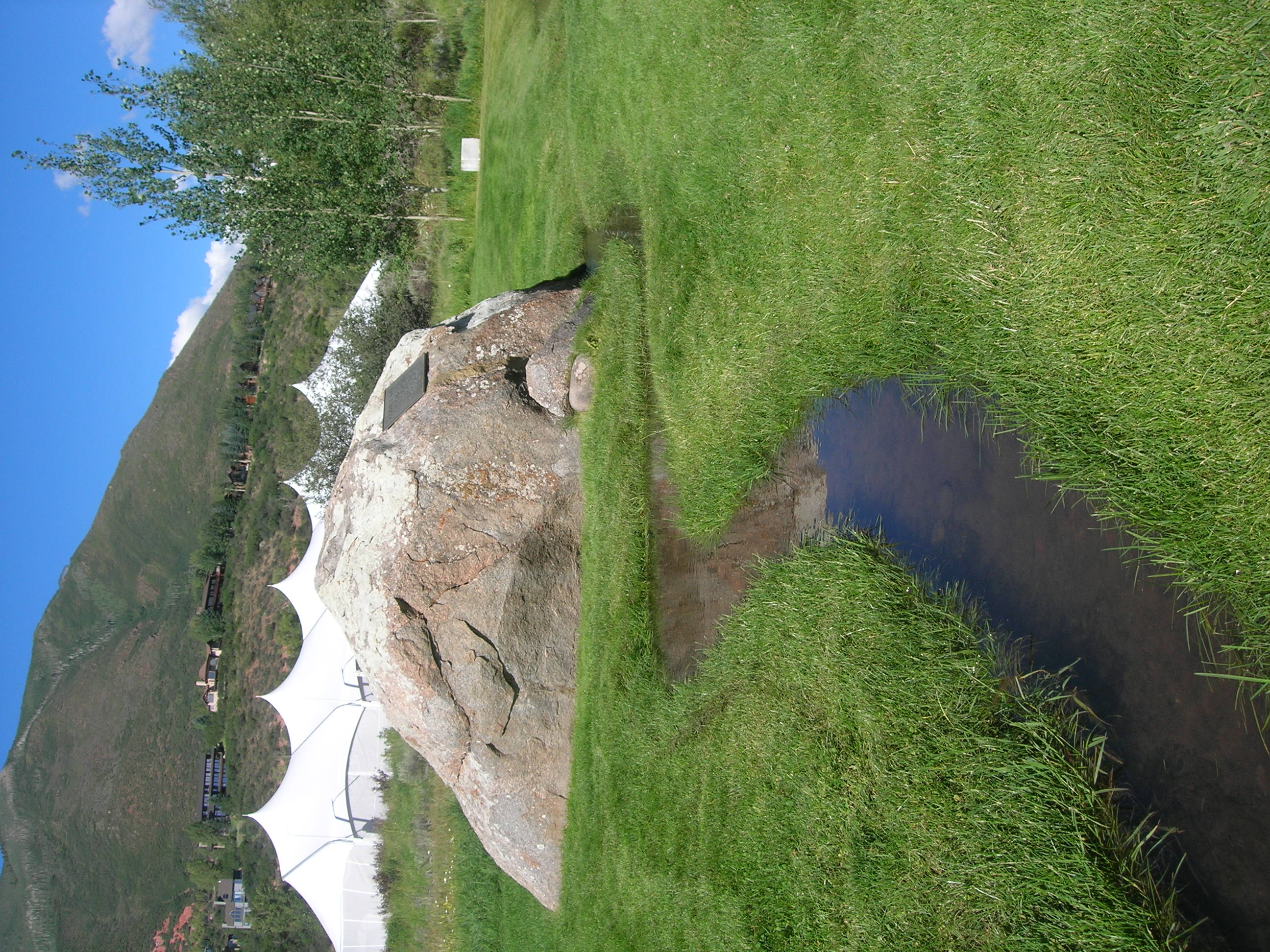
The two whole days in Aspen were worth the trip itself, even if we hadn’t had all the other adventures and wonderful encounters along the way. There is something about Aspen that makes one feel as though one has stepped into a painting, like the moment Robin Williams arrives in heaven in the film What Dreams May Come. Everything is too perfect, each blade of grass arranged in just such a way as to set off the seemingly carefully placed rocks beneath the snowy white trunks of the aspen trees. The towering mountains with their rouge and evergreen flanks are dwarfed only by the vast sky, with its many hued cloud formations sculpted by a divine breath. We went on a brief hike the first day there, noticing the lupines and wild geraniums peering out among the grasses. Like the rest of the country, Aspen has also suffered drought this summer, which could be seen in the reddish dust that is usually moist soil. The wildflowers too were sparse this year; normally the mountains are garlanded in purple and yellow blossoms all throughout June and July.
The town of Aspen is as picturesque as the wild scenery, with quaint little houses surrounded by blossoming flower gardens, and old brick buildings with former store names carved into the very stonework overhanging the doors. The streets are all named after the miners who first settled the area. The design of the town reflects the natural surroundings, bringing aspen trees onto many of the sidewalks, even allowing them to grow through the center of the architecture in some cases. Strips of grass and fountains border the cobblestone streets, and narrow streams meander between the grassy banks and laugh their way over smooth river stones arranged beneath the clear ripples.

On our second day in Aspen we attended a concert put on by the American Academy of Conducting at Aspen. The orchestra, which gives young conductors the opportunity to learn their craft with the help of a full orchestra at their disposal, played three symphonies over the course of the afternoon, beginning with Haydn’s Symphony No. 85 in D major, written in 1786. This was followed by Mozart’s Violin Concerto No. 4 in D major, written in 1775 when Mozart was only nineteen years old. The solo violinist for this piece, Hannah Tarley, has been playing since she was two years old, and was the youngest violinist to lead the San Francisco Youth Symphony on tour. She played, to say the least, exquisitely. After an intermission, the final symphony of the day was Shostakovich’s Symphony No. 9 in E-flat major, written in 1945; however, we only heard the ending of this piece because we chose to take a stroll through the gardens of the Aspen Institute while the afternoon sun was still warm.
It was with some reluctance that we packed up the car for the last time and bid adieu to Aspen and its fluttering silver-green leaves and crystal streams. We headed west toward Glendale where we went back onto I-70. The mountainsides turned a sunburnt red, and each peak looked like a scalp with thinning tree hair that had spent too much time exposed to the sunlight. As we passed Mount Sopris I was already beginning to observe the much drier climate. A magpie, with its black and white wings, soared over the road. As we passed through Glendale I noticed a crew of carrion birds circling ominously over the town.
As the mountains around us became more angular and treeless, we listened to a debate between Richard Dawkins and the Archbishop of Canterbury. I was amazed to hear the sense of wonder in Dawkins’ voice as he described the unfolding of the universe and how it could give rise to “apparently purposeful” beings such as ourselves, that give the cosmos the “illusion of design.” This dialogue accompanied us for more than half of the day’s journey because occasionally it would cut out and we would switch to music, then try again an hour or two later. Because of this, the debate seemed to set the tone for much of the ride, giving rise to many exciting discussions between Matt and myself, including one regarding the language and cultures of animals, and whether or not they can be understood from a human perspective; if they cannot, as far as I see it, that is not proof that animals or even plants, cells, or minerals, do not have the same capacity for language, culture or spirituality that we do. It may, at this point, just not be able to be translated into something humanity can comprehend.

Our road followed the Colorado River for some time, and I marveled how this one river had been able to overcome these mountains surrounding us, carving such wonders as the Grand Canyon, and yet it could not—as of yet—overcome humanity, who has dammed it and siphoned off its waters until barely a trickle remains to empty into the Sea of Cortez. Eventually we left the Colorado River behind, and passed through Rabbit Valley and a park offering a Trail Through Time walk. As we crossed the border into Utah a signpost stood by the road warning of eagles on the highway, definitely the strangest of the many animal warning signs we saw over the rest of the day: moose, deer, cows, and hikers all had their own specific warning signs in different mountain areas.
The buttes and plateaus shifted into greener mountains and short trees as we entered Fishlake National Forest. To the side of the road I saw several cows and calves among the greenery, and past them a wood and metal fence climbing at nearly a 90° angle up a mountainside. Imagine the determination of the rancher who had put up that fencing, not wanting to lose a single acre of his property no matter how steep the terrain.
Mysterious train tunnels once again bored through the mountainsides as we neared Salina, Utah. Past the town flat green fields unfolded for several miles, dotted with horses along a placid blue lakeshore. Eventually we left I-70 and began the long journey upon the loneliest road in the West, US 50. Barely a car passed us. The fences by the roadside were constructed with rough-hewn branches, making the era we traveled through ambiguous. A neat little farm stood by the road named Duckworth Dairy. Eventually we entered the town of Delta, Utah, where a tiny wooden shack was featured in the central square: the very first house ever built in Delta. The house was smaller than a modest bedroom.
Outside Delta we passed a tree completely ornamented with dozens upon dozens of pairs of shoes. I once heard that a pair of shoes tossed over a power line means “I love you.” If that is the case this is the most loved tree I had ever seen, even if not a single leaf graced its branches.

Highway 50 went on straight for seemingly endless hours, with only an occasional crossroad going just as eternally straight in the opposite direction. We saw hardly anyone. We crossed over a snow white salt plain, passed Death Canyon, and entered into a new set of mountains. At some point we crossed into Nevada but it was hard to tell where. Our road less traveled was not busy enough to bother marking the state border. The landscape of Nevada seemed to be a repeating pattern of flat plain followed by a mountain ridge, then flat plain, mountain ridge, flat plain, mountain ridge. It was difficult to keep track, except by the changing names of the different national parks: Great Basin National Park, Humboldt State Park. A ranch in one of the mountain ranges had an entrance gate made entirely of bleached white antlers. Not long after we glimpsed a fence decorated in deer antlers. The deer population in that area must be abundant indeed.
 The largest town we saw on 50 was Ely, which boasted six churches on a sign at its entrance. From the size of the town there must be one church for every family. Some time after we had left Ely we came to the next largest town along the highway, Austin, where we had intended to camp. At this point it was only 5:30 pm, and with barely a consultation Matt and I decided we wanted to continue all the way home to San Francisco. So with 702 miles already under our belts we left Austen behind to complete the next 391 miles to the end of the continent.
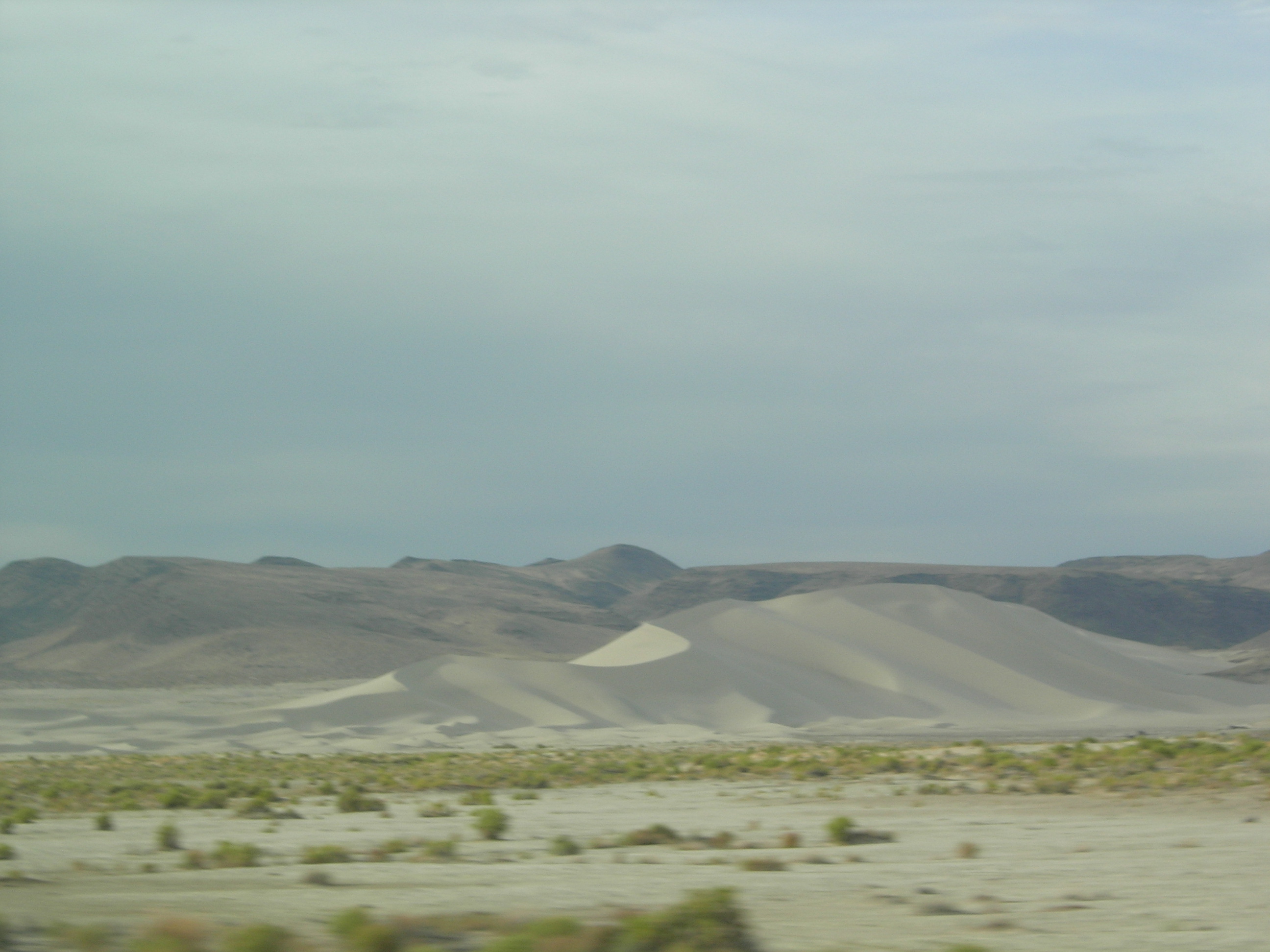
The light slowly grew dimmer and fantastic sunset colors streaked the sky. Since we were driving westward the twilight seemed prolonged for many hours. We passed Sand Mountain, a large sand dune set back from the road, glowing white against the dark backdrop of the distant mountains. The last of the light began to fade as we left Carson City, and the last sight I saw before nightfall was a sign for the Old Pony Express trail. Then, in the still darkness, we entered California and began to climb into the Sierra Nevada Mountains. Immediately I wished we were passing through here in daylight, and I longed to see the trees, lakes, and mountains that were now shrouded in darkness.
The backroad route we had inadvertently chosen to take provided a stressful 70 miles of watching for deer potentially leaping into the road. In total we saw five deer, two coyotes, and a bobcat. The bobcat, standing directly in the center of the road, seemed not in the least disturbed by our car, and gently pawed its way off the road at its own sweet pace. When we passed where it had exited moments later, it was already swallowed up in the camouflaged gloom of the forest.
The last couple hours of the ride were the most difficult of the entire trip. Both Matt and I were questioning our decision to go 1,100 miles in one day. But somehow, close to 1:00 am, we arrived on our own familiar street, where parking is still familiarly difficult, and at last were able to be home.
So in total, after 110 hours of driving, 6,700 miles, 20 states, one province, dozens of family members and friends, and not a single argument, Matt and I ended our rather epic journey. As for the next one, who can say?
Roads go ever ever on,
Over rock and under tree,
By caves where never sun has shone,
By streams that never find the sea;
Over snow by winter sown,
And through the merry flowers of June,
Over grass and over stone,
And under mountains in the moon.

One thousand, four hundred miles in two days, from the rolling wooded hills of Ohio, through the dry tabletop flatland of Kansas, deep into the rapid ascent of the Colorado Rocky Mountains. Matt has been a heroic driver. And because of the exhaustion of such an expedition, we have decided to spend an extra day in the idyllic beauty of Aspen, enjoying the sight of high green and red mountaintops, fluttering aspen leaves, and glittering hummingbirds feeding outside the window.
 The much-needed rain began to descend as we departed Cincinnati Saturday morning, and we were met with a sudden downpour and pools of water on the poorly constructed Ohio highways. Traffic slowed immediately to a crawl as we appeared to be going through a car wash machine without soap. Soon, however, we left the shadow of the rain clouds and entered drier land. Meanwhile a debate between Christopher Hitchens and Reverend Al Sharpton, over the existence of God and the need or lack for religion, played out on the speakers. At many times they seemed to be having parallel but separate arguments, Hitchens focusing on the evils of religious interpretations, and Sharpton pushing the issue of the existence of God without religious trappings, a point which Hitchens seemed to generally avoid. From there we turned our attention to a lecture given by Chris Hedges, not to be in any way confused with Hitchens, who spoke of religious fundamentalism, the Christian Right in America, the economic despair that drives people to such extremist faith, and the “epistemology of television” which suppresses critical thinking. With his words reverberating in the car we passed large crucifixes in the cornfields, anti-abortion posters, and billboards with images of a pale white, effeminate Jesus blessing the drivers of I-70.
While passing through Indiana we listened to a rousing talk by Helen Caldecott given in 1982 on the threats of nuclear war; she drew an analogy between the state of our planet and the plight of a terminally ill cancer patient. The horrific images she painted of nuclear war, and the insanity that the governments who build these weapons have not thought of the ultimate consequences of their use, reminds me of the same delusional denial the world’s leaders take in regard to climate change and the ecological crisis. We stopped briefly at a gas station where I saw a woman dressed as a clown filling up her car—a perfect image to capture the direction in which this country is going. Not long after, we passed for the second time on this trip a concrete cross at least ten stories high, towering over the yellow straw of drought-ridden, eroded agricultural fields on the edge of desertification.
Matt and I returned to Lake Quivira near Kansas City for the night, the place we stayed ten days before on our outward journey. Early the next morning, we left the comforts of a familiar place to embark on the longest stretch of the entire trip: 782 miles from the eastern edge of Kansas up into the Rockies to Aspen, Colorado. Although we crossed just two states, unlike the day before when we had traversed five, the day totaled thirteen hours of driving.

The long expanse of Kansas proved to be flatter than a pancake, with the largest fields of wheat and corn I have ever seen. It felt like an alien landscape, with a mile of corn suddenly giving way to gray dirt and clumps of yellow grass as suddenly as if a wall had been built to separate the two. The highest objects in sight for hours were the plastic signs advertising fast food joints and gas stations. Occasionally a stream would meander over the land, and an oasis of green followed the track of the water. When there was variation in the topography the road would occasionally dip into a cut in the soil, revealing red and white striations of earth layered like a cake beneath dry grass icing. Our own oasis was provided by a set of tapes recorded in 1992 of Robert McDermott, who gave a lecture series on spiritual masters while he was president of the California Institute of Integral Studies. We heard the first three of those lectures, on Martin Buber, C.G. Jung, and Simone Weil.
After leaving behind us the Oz Winery, a massive wind farm of white turbines, and the Quivira National Wildlife Refuge, we entered the tiny town of Hays and knew we needed to stop for lunch. It was 106°. As Matt put it, it felt like a breeze blowing straight out of Hell. It was not hard to believe the large billboard we had seen earlier that stated “Hell Is Real.” Hell is the havoc we have wrecked on the climate that is producing this massive drought and soaring temperatures. The small oil wells we had seen along the roadside, pumping oil up out of the barren fields, seemed like some kind of a mockery of the weather.
As we entered Hays I could not help but wonder what life was like in this small town. What is the primary form of income? What makes people happy? What do they dream about? To our delight we found a local brewery called Gella’s Liquid Bread, and were able to sample their award-winning oatmeal stout and American wheat ale with our afternoon meal. Here certainly was one expression of creativity in the town of Hays.

Hours after lunch was digested we crossed the chalky Colorado border. Feral sunflowers grew by the sides of the highway. Black calves followed their mothers through fields. Train tracks led to nowhere. Small houses from a bygone era stood alone, each with their own forgotten history. Who had once settled this piece of land in the name of freedom, so many decades ago? Still the land was flat.
Then, in the far western distance, clouds began to gather. A deep azure shadow blurred the once clear edge of the horizon. Rays of sunlight cut through the clouds to illuminate the land. Planes trafficked the air, criss-crossing the skies. Denver. A city, trees, hills, mountains, then thunderheads, each layered against the next. In a matter of minutes the plains were a mere memory.
I can barely begin to describe the feeling of ascending into the Rocky Mountains after hours upon hours and miles upon miles of flat grassland. It is like drinking in the sweetest draughts of color and texture, light and shadow, like paintings unfolding beneath the artist’s wrist of the Divine. The rapid incline was accompanied by flourishing conifers and carved red boulders. The foothills grow into mountains like seedlings into trees, children into adults. These ancient mountains are decaying; after millennia of shooting skyward with the pressure of tectonic upheaval, they now are slowly crumbling, their peaks rounding and smoothing under the centuries of rain and snowfall. Yet still they are great majesties.
It began to rain. Sunlight seared through the falling water creating a world of white and platinum, the road and trees cast silver in the shifting light. A tumbling river tore through the rock on the left of the road, sparkling in the sun’s rays. Then, without warning, we left the shadow of the rainstorm and entered a dry realm higher still. Red barns and soft meadows, indigo lakes and laughing streams. We crested over a pass between the mountains, then descended into a wide grassy plain, the High Plains filled with horses and foals, likely an ancient lakebed drained long ago. I saw a highland cow, a red, long haired, horned creature I had only ever seen in the Scottish Highlands. Yet here one was in the Rockies. We were taking an alternate route, along highway 285, because there was a sink hole in the usual road to Aspen on 24. Though it was 25 miles longer, we would never have encountered the High Plains if we had gone the normal route.
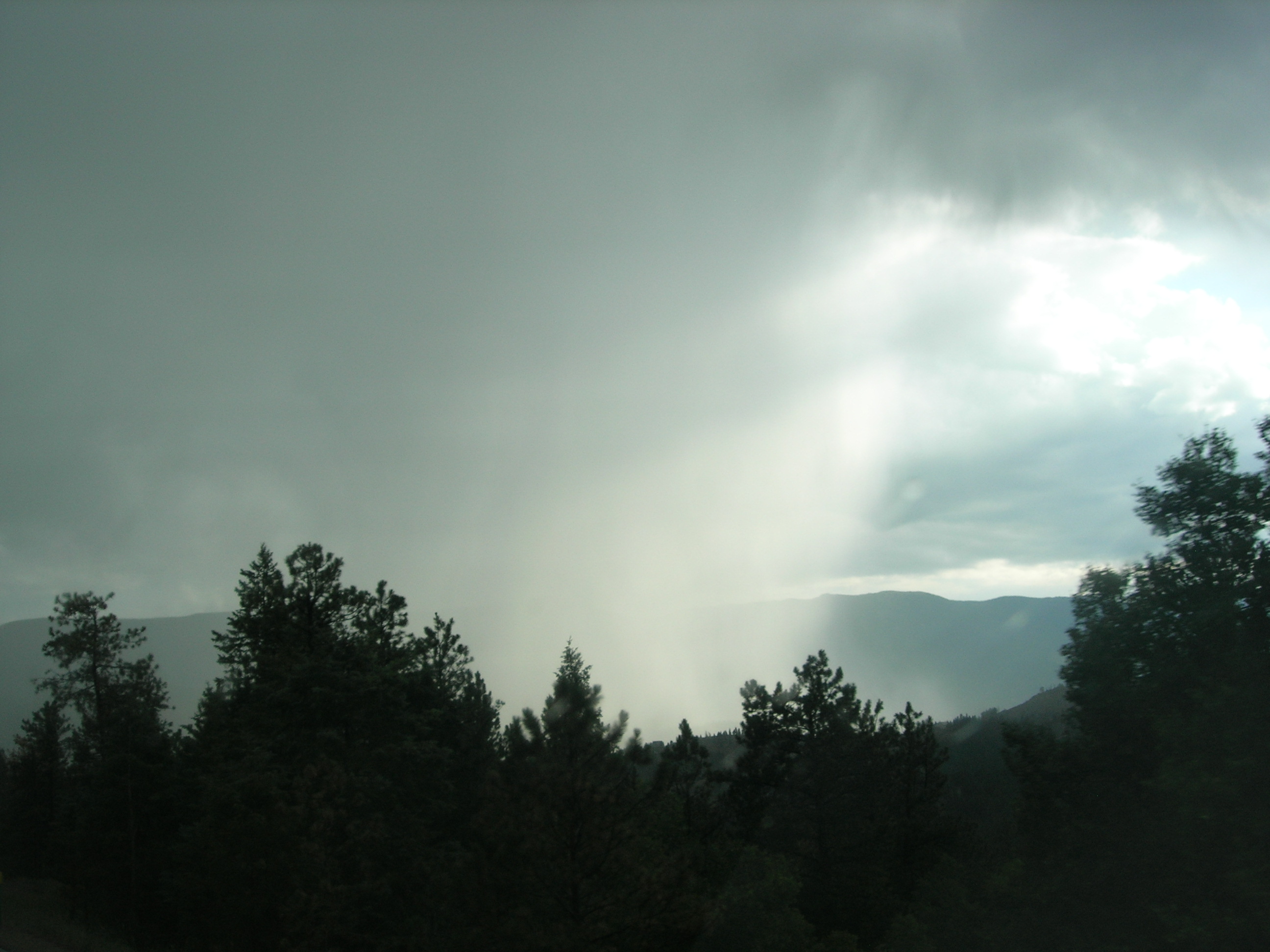
After the plains we passed the town of Buena Vista, and saw several signs protesting a Colorado Springs plan to dam this valley for a reservoir. It was hard to imagine these canyons and valleys sunk below placid waves, a lake that would most likely surrender to silt build-up in less than a century. Our route turned on to 82, and we circled a still, blue lake, reflecting the high peaks in exact mirror image. The road climbed ever higher, making sharp turns on the mountain’s face, leaving the bottoms of my feet with that hollow tickle that accompanies a slight fear of heights. The evening sun rises and sets constantly in the mountains as new views open beyond each passing peak. Yet at last it set for good, and our road became ever dimmer.
Finally, no more mountains obstructed our view and we rose above the world at Independence Pass. We stepped into the crystal air at 12,095 feet. Immediately we were short of breath as we walked about a glass pool reflecting the dusk sky, the tundra foliage bedecked in miniscule wildflowers. The descent into Aspen grew ever darker, and the road twisted and turned beneath overhanging rocks and aspen branches. Moths flew continuously into our headlights. Then, out of nowhere, a pale brown bunny leapt into our path, so close to the car there was literally no way to avoid it. We hit it instantly and I prayed it had died quickly. I cried all the way into Aspen. There was literally nothing we could have done, yet I could find no way to justify it. I have seen many things on this trip that humanity cannot justify, and this one act I felt so personally.

Rarely have I felt the kind of exhaustion we both felt upon arrival in Matt’s aunt’s beautiful home, decorated with exquisite relics from her world travels. We ate peaches and cherries, a sweet relief from American road trip food. I long to go on the kinds of adventures that I see captured as memories in every part of this house. But for now, my only adventure will be into the dreamworld of sleep.

My friends who Matt and I stayed with in Whately, Massachusetts are wildlife rehabilitators, which means that whenever someone in their area finds a wounded creature or abandoned baby animal it is brought to them for care and feeding until the animal is able to be released into the wild to survive on its own. While our friends care for hundreds of baby rabbits, squirrels, mice, and songbirds over the course of the season, we were able to distantly interact with just a few, but it was a special experience indeed. Matt and I were each able to feed a cherry to two orphaned baby squirrels, who are at this age about the size of chipmunks and only have skinny tufts on their tails, unlike the full-grown fluffy adornment that they will some day grow into. We would not be able to handle any animals that had been in rehabilitative care, but since the squirrels were just arriving we could have some contact with these delightful little beings, and they were comforted in their transition by our care.

From a distance we were also able to see a wounded kingfisher, likely hit by a car, who adored eating minnows caught for her from the stream; one of two fledgling starlings in their care; a baby meadow jumping mouse; and a beautiful baby hawk whose soft down was being exchanged for adult feathers. Although we had the shortest glimpse of the hawk, who was not to become accustomed to human contact, it was like looking at a miniature version of majesty, a young prince who, if he survives, will one day hunt the skies.
My dear friends who do this work, a mother and her daughter, are like real life Snow Whites who truly work magic to heal these creatures. When we arrived the day before, the mother, who I have known since I was four years old, was wearing a full length white summer dress and crooning to one of the birds in her care. A perfect Snow White indeed.
After fresh corn fritters and fruit smoothies, coconut balls and a swift chiropractic treatment, Matt and I knew we would have to depart this haven of nurturance and love to continue our journey, despite having to pass up a dip in the nearby Fairy Pond. Every visit leaves more to be desired, and a laying out of new plans for future visits we hope some day to make. Our route to Matt’s older brother’s home in New Jersey led us through Connecticut and New York State, passing within sight of Manhattan before turning into Livingston, New Jersey. For the entirety of the 193 mile trip I felt myself caught up in a daze, unable to focus too much on the road, but rather looking more at the mottled clouds of the sky and the thick green foliage of a New England summer. The dynamic clouds suddenly broke open and a downpour of rain splashed over the road in pink and blue reflections. Then, just as suddenly as it began, the rain dried up and retreated, leaving no trace of the brief deluge.
Traffic condensed more and more thickly as we neared New York City and the leafy branches overhanging the road gave way to the urban tangle of steel, wires, crumbling brick stamped with curling painted letters from 1930s advertisements for Coca Cola and soda crackers. Perhaps because it is so hideous, it is easy to romanticize the graffiti, the stains, the gray rivers choked with steel bridges, giving rise to a vision like Rent, with youth and creativity bursting forth from the pressure cooker of poverty, hunger, disease, crowds, and pure strains of human emotion and love. Above it all, the pastel clouds were rent with blades of sunlight piercing to earth, looking like prayer posters of God speaking to the decrepit masses below. As Matt said, maybe it’s the Divine apologizing for the Industrial Revolution.
Matt and I spent the night with Matt’s brother, his wife, and two young children in a nearby New Jersey suburb, the kind of suburb with rolling lawns, a pool in every backyard, and belts of trees between the streets to help dampen the sound of city traffic from the surrounding highways. We were a fifteen minute drive from the heart of Manhattan. Our overnight stay was brief though, because we had to make the 635 mile journey back to Cincinnati, and we were on the road by 9:00 am. While there has still been warm summer weather, the unbearable temperatures we experienced last week seem to be receding, and we have been enjoying days in the low 80° range.
Our route from New Jersey to Cincinnati crossed the great width of Pennsylvania, which had similar topography to upstate New York: wooded mountains spaced widely apart which afforded expansive views before descending into new farmland valleys. This terrain and that of the prior day reminded me of a trip I took four years ago, when I biked with a friend from Mount Holyoke College to Philadelphia over eight days. On that journey we biked from Massachusetts through Connecticut, crossed the Hudson River at Poughkeepsie, ran along the edge of the Delaware Water Gap, and finally arrived in Philadelphia, where my second-hand bike, incidentally, was stolen. Meanwhile, back on this road trip, I recognized signs for different landmarks that I had seen at a much slower pace four years ago.

Matt’s and my discussion came to the difference between environment and ecology, and our need to understand our embeddedness in the environment, as a part of an ecosystem, to be able to make the psychological leap required to address the current ecological crisis. I began reading Bill McKibben’s book Eaarth the other night, which presents the statistics of the effects of global warming currently taking place. This is no longer a discussion of what might happen, but what is happening. The new question is, how will we cope with the changes? How can we prevent them from being even worse than they are? These are the questions that are essential, that I feel the need to devote my life to understanding.
We listened to several lectures by Timothy Morton on just this topic, in which he addresses the question of what nature is. It is not something that is “out there” but rather something we are, and something of which we are a part. Where do we see nature? If nature is not the forests, streams, and mountains that we pass by the roadside, is it also the road itself, and us and the cars upon it? Morton addresses the issue that global warming is so difficult to face because it is so huge, yet still able to be quantified. It is a problem the size of the Earth, but not bigger. We are trapped inside it. We are inside a womb that we have poisoned, and we cannot blame anyone besides ourselves for its toxicity. It is humiliating. And as Morton points out, the word “humiliating” comes from the word “humus,” meaning soil. To be humiliated is to come closer to the Earth. In our humiliation we must come closer to the Earth to learn how to be born out of our womb and into a cleaner world of our own making. But we must go through the birth canal first.
As we were hearing Morton’s words and I was having these thoughts, a bird passed overhead that I have never seen in this country: a bald eagle. While I have seen dozens of eagles in British Columbia I had never before seen one in the country that claims it as its national bird, as its symbol. What does it mean that we can barely keep our own symbol alive in supposedly the most powerful country in the world? What does it mean that I just saw one overhead? Perhaps, both literally and figuratively, to survive the constriction of the ecological crisis we have to become wildlife rehabilitators, just like my friends in New England.

In the late afternoon we passed into the stethoscope of West Virginia, a narrow section wedged between Pennsylvania and Ohio. The valleys and rivers became steeper and more plunging, and traffic slowed as we crossed a green metal bridge over the Ohio River. Not long after this crossing we saw smoke rising out of the woods to the left of the road, possibly a forest fire due to the nationwide droughts this summer. A couple hours later, as we were honing in on Cincinnati, the fiery orb of the sun could be seen setting, a vermillion star blazing through a rose and tangerine sky.
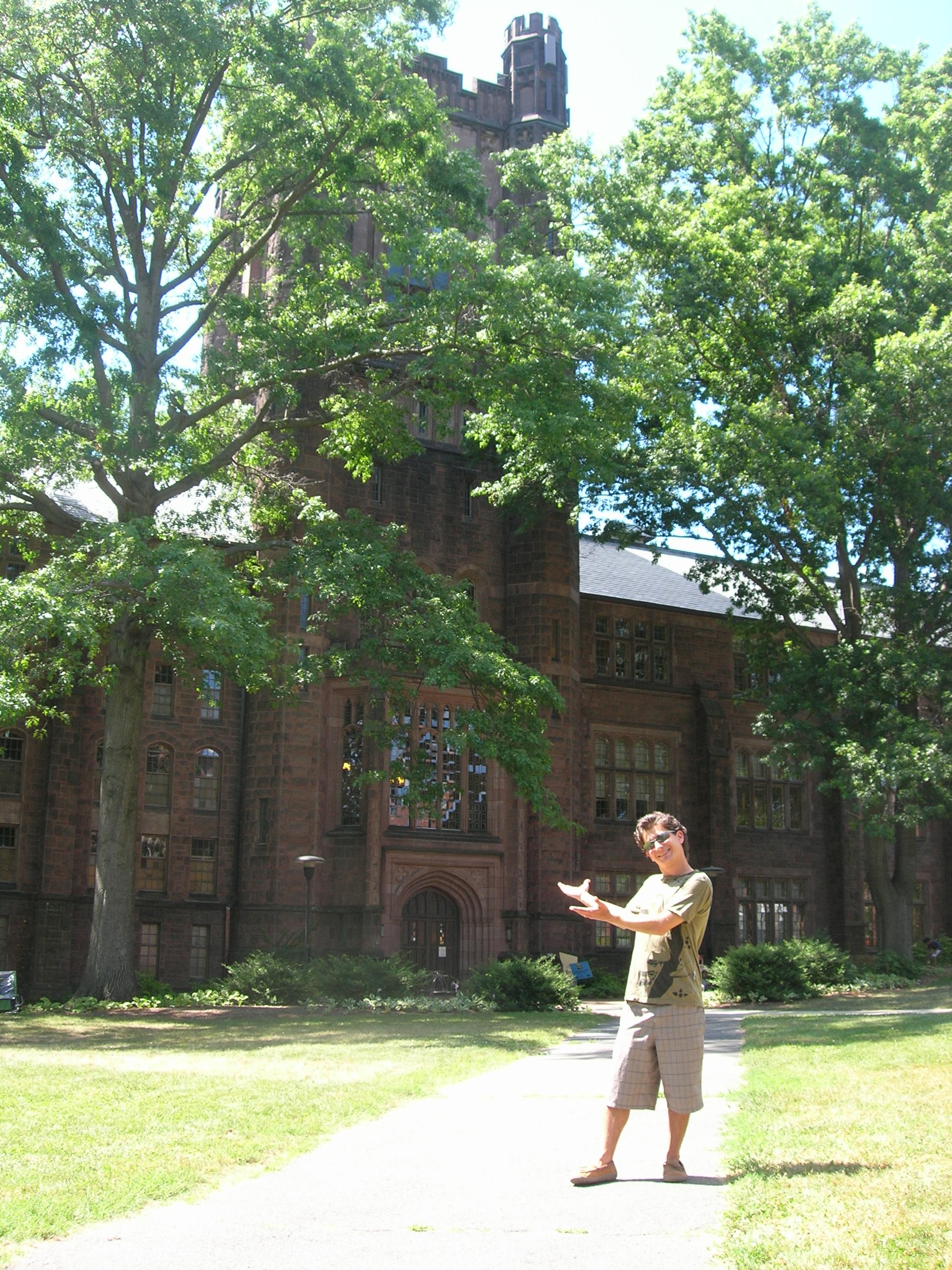
It is hard to capture fully in words the sense of elation at returning to one’s alma mater and recognizing how much the place shaped the way you think about the world. Stepping onto the Mount Holyoke campus was like going back in time to a place with roots deeply grounded in almost two centuries of empowering learning, welcoming tradition, and liberating fun. I was amazed by how excited I was to be back here, squirming in my car seat like a little child with the promise of ice cream and swimming in her future.

Matt and I left Bennington in the late morning and took a lovely winding route through the Green Mountain State, definitely feeling the new weight in the car of all my possessions. The trees were so numerous there seemed to be more green to the state than mountains, although plenty of plunging cliffs and rocky streams paralleled our road offering the most varied topography of the trip so far. The road wove between little coffee roasteries, garden shops, and other businesses with such quaint names as Amaranth Gardens, Bodhi Books, Strawberry Fields, and we even saw a Vipassana Meditation Center. Between the apple orchards and horse farms the occasional ancient graveyard stood with faded, moss-enshrouded stones, a clear indication that this is the longest settled portion of the country by European settlers.
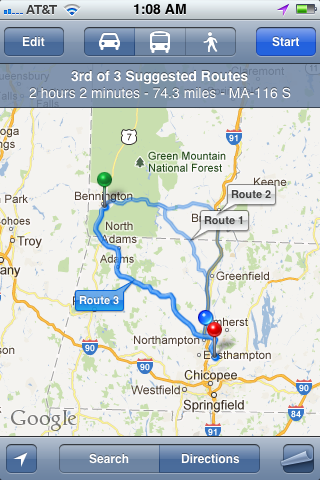 The roads began to look more and more familiar until I was able to take over from the map directions and point out the way to Matt myself. Near Northampton we crossed the Connecticut River, and cut diagonally toward South Hadley while passing old haunts I once knew: Food Bank Farm, the road to Hampshire College, Mount Holyoke itself––the mountain for which the school is named, that we would climb once a year on Mountain Day. At last we turned left onto College Street and drove under the black iron and brick gates, that were bad luck to pass under until one had graduated, and onto the college campus.
I showed Matt all my favorite buildings, inside the chapel and magnificent library (which was the primary reason I came to the school really, since it had immediately made me think of Hogwarts Castle). Even the four class symbols of a red Pegasus (my own class symbol), a yellow Sphinx, a blue Lyon (spelled like the founder Mary Lyon’s name), and a green Griffin, resonated with the well-known wizarding novels. We toured Clapp, the science building that housed the Environmental Studies Department that I majored in, and I left a little note for Lauret Savoy, the chair of the department and my mentor in my last semester as I wrote my children’s book Autumn, and my two-act play Live Power.
From there Matt and I continued our tour, passing through the greenhouse, to Upper Lake, into the Art Museum, past the amphitheater, Lower Lake, and Pratt Music Hall, to Rooke Theatre, where I once spent so much time I joked that they should set up a cot for me in one of the back rooms to rest between activities. We glimpsed the white house across the street that was my apartment senior year, and Mead and Buckland Halls in which I lived in the first and second semesters of my first year. From there we circled Skinner Green and stopped briefly in Blanchard Campus Center, before passing by Safford Hall, in which I lived the second semester of my junior year once I had returned from my study abroad semester in New Zealand. The only residence hall we didn’t visit was Dickinson, set further off the campus, where I lived for my sophomore year.
Whether in the MHC library, the Odyssey Bookstore across the street, or the Amherst Bookstore near where we had lunch, it was difficult to pull Matt away from the poetry and philosophy books. We did depart with a few new titles in hand, including Eaarth by Bill McKibbon, The Cosmic Blueprint by Paul Davies, and Not For Profit: Why Democracy Needs the Humanitiesby Martha Nussbaum. We’ll likely read the latter out loud during parts of our return journey.

As we drove away from Mount Holyoke I didn’t feel too much sadness because I felt for certain I would return here for other visits, and definitely for reunions once more time has passed since my graduation date. What I did feel though was intense gratitude. Two years after graduation, and now currently in a graduate program which I truly love, I can see more clearly what it is this particular school gave to me. This institution is in the business of empowering women, something few women even now in 2012 are given. In a setting where every student position––from teacher’s assistants, to theater directors, radio hosts, technical directors, and class presidents––is held by a woman, students can graduate with an accurate sense of a woman’s true potential. Like men, we are qualified to hold any position of power in the world, including United States president some day, but it sometimes requires a place such as this to open our eyes to that fact.
In such a state of thought I departed Mount Holyoke, and Matt and I drove to Amherst to have some lunch at one of my former favorite eateries, Fresh Side. The warm day called for an outdoor lunch on the sidewalk in the shade of some ginkgo trees, a lunch of ginger honey ice tea, an assortment of Thai and Vietnamese tea rolls, and a little bean paste mochi for dessert. After a quick stop in another bookstore we recrossed the Connecticut River and entered my favorite town in the Pioneer Valley, Northampton. We settled in to the downstairs of one of the best study cafés in the area, The Haymarket, to do a little reading and writing before meeting up with our hosts for dinner. I relaxed into the chair that I had most likely written at least a couple papers in over the years, and once again gazed around the olive oil colored room with its assortment of tables and tiny votive candle holders. I could almost convince myself I was still in college, on one of those school days in early fall when everything feels fresh and exciting and the desire to learn whispers in one’s ear on the crisp autumn winds.
Come early evening we drove a few miles north to Whately to meet my dear family friends who had gathered together to see us for this one night we could spend in the area. Over stories of how Matt and I met we enjoyed a delicious roast chicken dinner with an abundant salad, Massachusetts’ best sweet corn (we heard that assessment from a well-travelled, corn-tasting expert), and summer fruit salad. The accompanying beverage was kombucha brewed by a man I once knew when I spent a summer at the nearby Sirius ecovillage in Shutesbury.

We chattered away the evening looking at birth charts and transits, photos from our trip, and sharing stories about our families. I wish we could have one more day here at least, but our travel schedule keeps us moving. Tomorrow we drive to our last stop on the East Coast, a visit to New Jersey to see Matt’s brother, and then we point our noses westward once more, and begin the long journey home.
I am sitting by the deck in early evening, as the shadows grow long upon the sun-dappled grass, listening to the call of a mourning dove. As I watch a diversity of finches and other song birds eat at the bird feeder and play in the stone bird bath, chipmunks, squirrels, and butterflies all dance about each other in the peaceful quiet of a Vermont backyard. There are no sounds of traffic or other human voices, only the whistling of the gentle wind through acres upon acres of trees. And the mourning dove continues to cry.
 A short burst of rain on Saturday night at Green Lake broke through the heat wave, and as we awoke Sunday morning to drive to Vermont we knew we would be traversing through more pleasant temperatures. We planned to set off by 8:00 am, but were delightfully delayed by the unexpected arrival of another dear aunt, who had come down several hours the day before from northern Michigan. We only had a half hour with her, but it was enough to double our smiles at leaving, while also strengthening the desire to stay a little longer. Reluctantly we were able to break away from the family embrace and set out through Detroit toward the Canadian border.
I realized as we passed easily through customs––I am after all a dual citizen and have a right to be in both countries––that on this trip we would not only pass through nineteen different states, but one province as well, technically making this not a cross country trip, but a transnational trip! Although I had noticed little change in climate or landscape for the last few days of driving, once in Canada I could begin to discern the more northerly qualities of the land around us. The air smells different up there, more thin yet pure as though it were made from fewer ingredients. The trees became taller and deeper green, with thick foliage in the undergrowth, and swampy ponds choked with bulrushes and reeds. The land appeared less disturbed by human hands, and several stretches of forest would pass before we would see a farm nestled between the trees. Heavy wooden barns and red houses gave the impression of older family farms, although I imagine many of them practice conventional agriculture the same way as their neighboring American farmers do.
We passed over the Grand River and in a fleeting glimpse I saw steep cliff sides topped with entangled trees, the gray rocks plunging into the rushing river. We entered a stretch called the Green Belt where wind rippled silver through long grasses, and meanwhile we settled in to listening to half a dozen or so episodes of This American Life. David Sedaris with his slightly sighing gay whine and perfectly placed adjectival jibes, an episode on bridging the gap between secularists and Christians, gun lovers and gun haters, and even a piece on fiascos including a hilarious description of a Peter Pan production in which absolutely everything went wrong. One of the most interesting episodes was on Harold Washington, the first black mayor of Chicago who was a key player in the slowly shifting racial attitudes in the Windy City. By the end of the day’s driving Ira Glass seemed to have become a third traveler in our car.
Our road navigated along the narrow strip of land between Lakes Erie and Ontario, and our short view of the latter gave the impression of a sea rather than a lake. It is not hard to understand why they are called the Great Lakes. When I was a little girl my mother read me a wonderful story called Paddle to the Sea, about a young Native Canadian boy who carved a tiny boat with a wooden Indian seated in it. He set the boat out in a frozen streambed where it sat until the spring thaw melted its waters and sent the boat sailing downstream. The story follows the little boat and Indian as he descends through each of the Great Lakes and eventually leaves the fresh water for the salt of the ocean. As he floats by an ocean dock he is picked up by a young man working quietly, a man who recognizes every feature of this beautiful carving. Against all odds Paddle to the Sea fulfilled his name and in the same moment found his maker years after he began his journey.

Matt had never seen Niagara falls so we committed to the traffic and tourist attractions to get a view from the Canadian side. On the slow moving road mist from the falls speckled our windshield. People were everywhere. At the end of a half hour wait we were directed into a parking lot, even though we didn’t want to stay long, where $20 was removed from us for a few minutes of parking. Rather disgruntled, we walked along the sidewalk weaving among visitors from all over the world to see the epic falls. An old rusted boat appeared to be disintegrating up river of the plunge. I wondered what horrific accident may have occurred here in the past. At last we were able to see the falls themselves, visible through a haze of mist and rainbows, unimaginable quantities of water gushing over the edge every second. The Maid of the Mist boats approached the crashing waters far below where we stood. I’ll now admit, it was worth the stop.
To return to the US we crossed the Rainbow Bridge and entered New York state. We were on the East Coast. We had driven to New England, a place I have been to many times before but always by plane. It was somewhat surreal. The woods had a different feeling here, that older world change from the forests in the rest of America. Here there were cabbage fields and rivers, rolling hills providing brief open vistas of the state. Gray cliffs towered over the road, and on one a narrow white crucifix had been erected. Little towns poked out among the trees, visible by the height of their church steeples. Unlike the freeways of the West Coast the highways here were guarded by steep tolls. We had definitely come very far.
The sun sank below the horizon and we saw the last of its vermillion light on a wide reservoir over which a duck flew at the same pace as our car. We crossed the border to Vermont and entered Bennington minutes later, to be welcomed by my uncle, aunt, and cousin at their beautiful home. A delicious dinner of grilled salmon, green beans, and fried sweet potatoes awaited us. A truly cozy welcome.
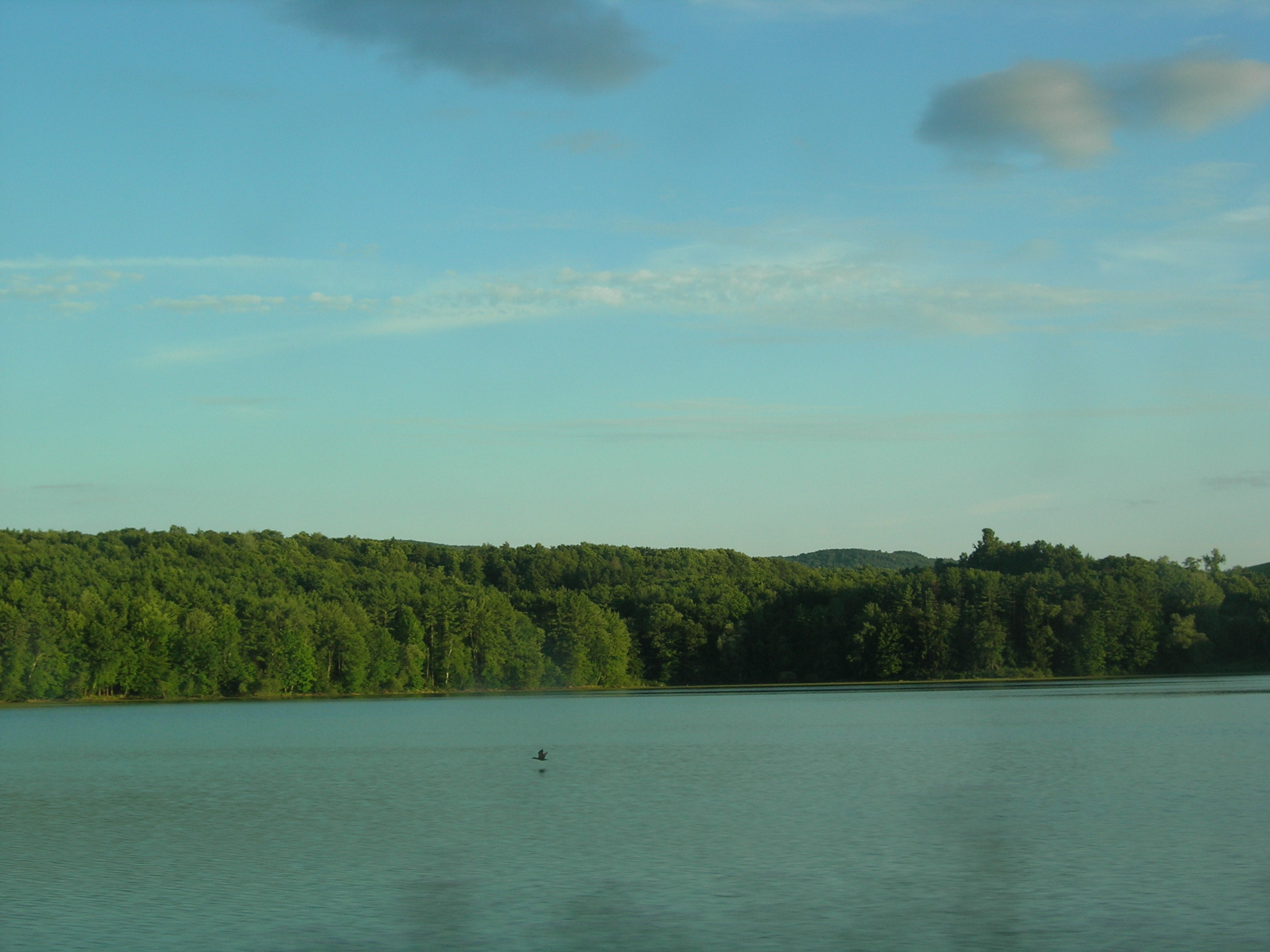
Today was dedicated to sorting through all my belongings that I left here, bringing some items to Goodwill and packing the rest into the Ford Focus. It was like greeting old friends as I opened each box and looked at journals, college notebooks, letters, and art supplies, as well as clothes, cushions, necklaces, and so many other lovely things. After easily parting with three heavy boxes for donation, we managed to pack everything else into the car, even leaving enough space for all three mirrors to be safely used for the drive home. I feel a certain sense of freedom now that I have collected these belongings once again. I now feel as though I have completed a necessary trip that I had the responsibility to take, and now that it is done I have the freedom to travel anywhere new that I want. Not that these current travels are close to over, but rather that I have seen this key piece through.
My cousin, Matt, and I went into town for a few errands, including dropping off the boxes at Goodwill. We stopped at the library and spent a few minutes adding pieces to a 1000 piece puzzle someone had been working on. Next we got ice cream cones and strolled in the sun while licking their dripping sides. Once back at the house I took a brief wander around the property, tasting peas and raspberries in the garden, and lying under the low-branched apple tree to watch the clouds drift past. The temperature was idyllic. Within the hour the three of us were merrily at work in the kitchen, preparing whole wheat pizzas piled high with fresh mozzarella, mushrooms, artichokes, tomatoes, broccoli and, for those who enjoy them, red bell peppers. The whole meal was completed with a plate of ripe cantalope, blueberries, strawberries, and raspberries.
In the morning Matt and I will take our shortest drive of the trip, to the Pioneer Valley of Massachusetts to stay with dear friends and visit the place that, in many ways made me who I am today: Mount Holyoke College.
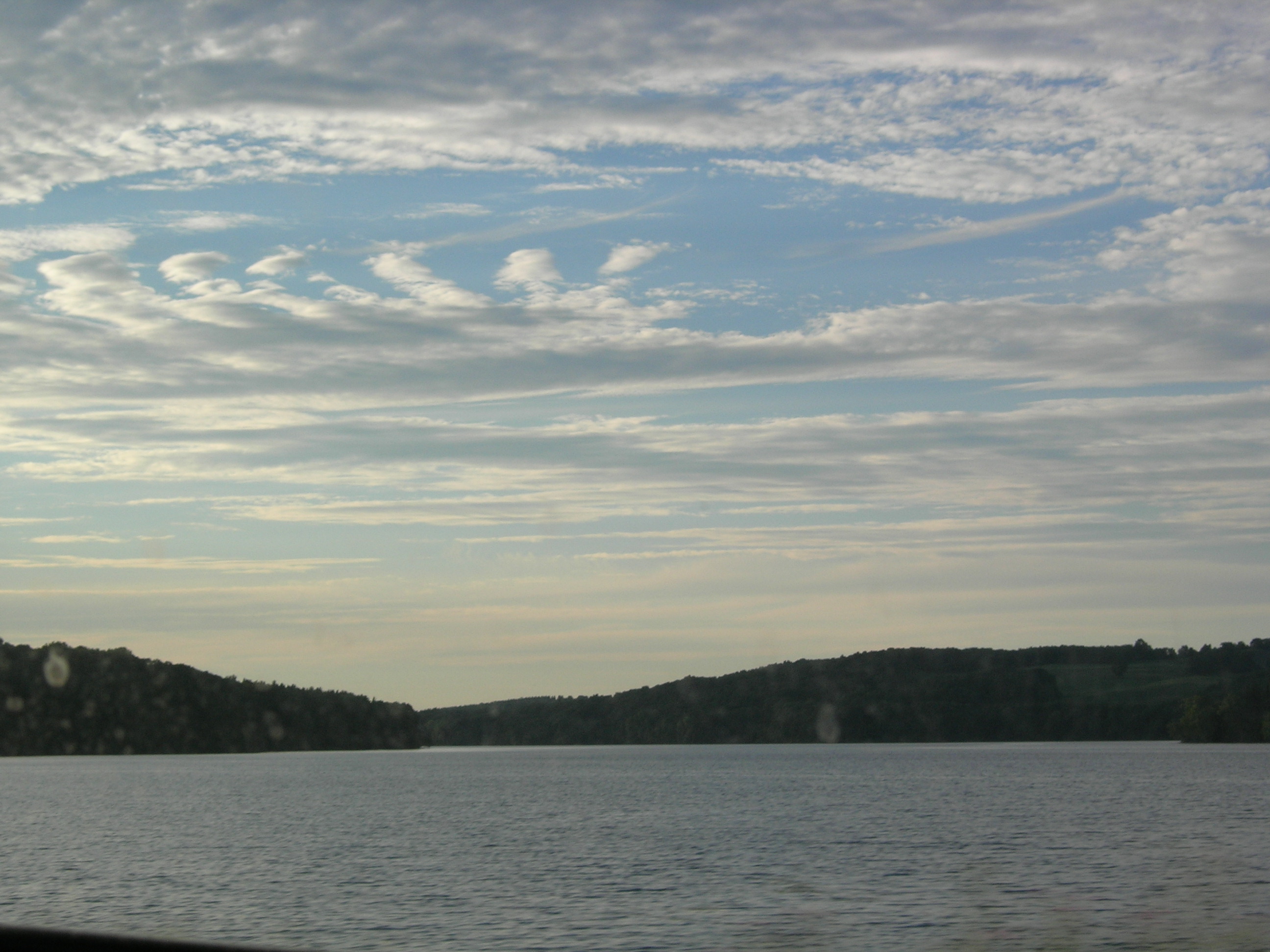
Our minds felt as thick and hazy as the air of Ohio as we departed Cincinnati in the mid-day 104° heat. Our musical accompaniment thrummed out the rhythms of the road, syncopating to the rhythms of our thoughts and musings: Sweet Honey in the Rock, Jimmy Cliff, Rockapella, Benny Goodman, Johnny A. The journey from Cincinnati to West Bloomfield, Michigan, though by far the shortest of our adventure so far––totaling 282 miles––never really picked up the speedy ease of our previous drives. The roads had more lanes, more congestion, and weaving trucks. The landscape never opened out into expanses of nature as it had on other days, but stayed more stubbornly embroiled in suburb, city, and monocrop farm.
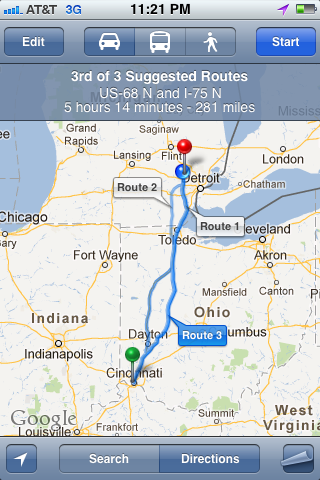 About halfway there, while massive military planes flew overhead to their local air force bases, we suddenly realized the gas tank was nearly spent! It was the first time we had not filled up before departing our starting location. As we awaited a gas station to announce itself on the roadside signs, I fell back to thinking about the greatest difficulty I have with undertaking this particular road trip: burning the gallons upon gallons of gas it takes to drive over 6,000 miles across the country and back. Yes it is expensive, but in the long run such a trip is far more expensive when counted not solely in monetary terms. The cost to the environment, from extraction and refinement, to the releasing of CO2 from our exhaust pipe, to the cost in human lives from war and corrupt politics, spreads a dark stain across our more simple desire to view the country from the ground level while visiting friends and family. How do I justify being able to take this road trip? The costs are no better had I flown; the use of petroleum is just more hidden when one is not filling up the tank oneself at least once a day. The correlation between the burning oil and the burning weather we drove through could not seem more apparent.
I love to travel. It is a major part of who I am, no matter where it is I am exploring. Meeting new people, having deep conversations in different accents, sampling new food, smelling new lands, hearing new cities, delving further into familiar haunts of years past. A different side of myself is able to come out in such situations. But it seems that traveling as it has been thus far in my lifetime may be rapidly becoming an activity of a bygone era. Flights and long car trips will become less feasible, or at least less justifiable to people like myself who are beginning to consider the greater costs of such privilege. Will it ever be possible to reconcile my passionate love of travel with my deep love for the Earth? It is an issue with which I struggle greatly. Yet I think with such joy on my own past adventures, and long for so many more as I hear the stories of those who have gone further than I.
After what felt like a longer drive than usual (although much shorter in reality), we pulled into the familiar driveway of my aunt and uncle’s home on Green Lake in Michigan, just outside Detroit. The shape of the house, the lawn, the trees, the dock, all had a familiar resonance that pulled forward archives of summers spent here. My cousin, who is becoming increasingly similar to my uncle in looks and mannerisms as he gets older, greeted us with a smile at the door. It was like coming back to a distant home away from home.
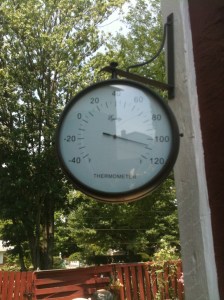
The weather, still oppressively hot despite the descending sun, sent us into the teal waters of Green Lake. My childhood fear of the lake weeds growing in the deepening waters off the shore led us to take the paddle boat––the same one I had played on as a little girl––out onto the deeper waters surrounding the diving board raft. Cannonballs off the raft into the sixty-foot deep waters quickly erased the weary of the road and the heat of the day. We paddled around for about an hour, resting on the step that protrudes off the raft just below the water’s surface, the three of us discussing the last few years of our lives, biodynamic farming, California vineyards, Rudolf Steiner, hitchhiking, crossing international borders, and many other topics. I enjoy seeing how similar threads of interest run between all my cousins, but also how we each weave those threads into our own tapestry.
The following day, the seventh of the trip, we spent relaxing at Green Lake, my cousin and I going for a wind-deprived sail in the neighbor’s little Sunfish boat, while Matt kept pace with us in a bright red kayak. Upon our return I convinced myself that if I could not get over my fear of lake weeds and swim to the raft at this point in my life I would never be able to and would wallow in shame until the next opportunity. So while no one watched I took a deep breath and left the safe sandy shallows and began to swim out over the dark green weeds. I jumped more than once as one or two tickled my stomach, and my imagination exploded with images of snapping turtles, eels, giant catfish, and demonic leeches all with a particular hunger to eat free-range Becca. But before long I reached the deep open water where I was safe (theoretically), and I floated along peacefully on my back until I persuaded myself to make the return journey. Eventually, of course, I did and arrived thoroughly out of breath (from outpacing the monsters) but also proud of myself for taking on my childhood fear.

As dusk came on more Tarnases came over to visit and Matt was able to meet another uncle and aunt, plus my grandfather. We all talked until the sun sank below the horizon and the candles, mosquitoes, and fireflies came out. Green Lake puts on their Independence Day firework show the weekend after July 4th, so we were treated to a second showing this year. As the colored rockets exploded in the night sky, I sat with my grandfather who was thrilled with the spectacle. I appreciated having the time to speak with him; he is almost 89, and is a gem mine of stories, of which I was able to hear several, sometimes interwoven with each other in a creative narrative. It was wonderful to hear him say he is happy.
Today we leave early for Bennington, Vermont to see more of the Tarnas family, and also to achieve the main objective of this road trip: to retrieve my belongings that I have not seen since my college graduation.
 Becca Tarnas