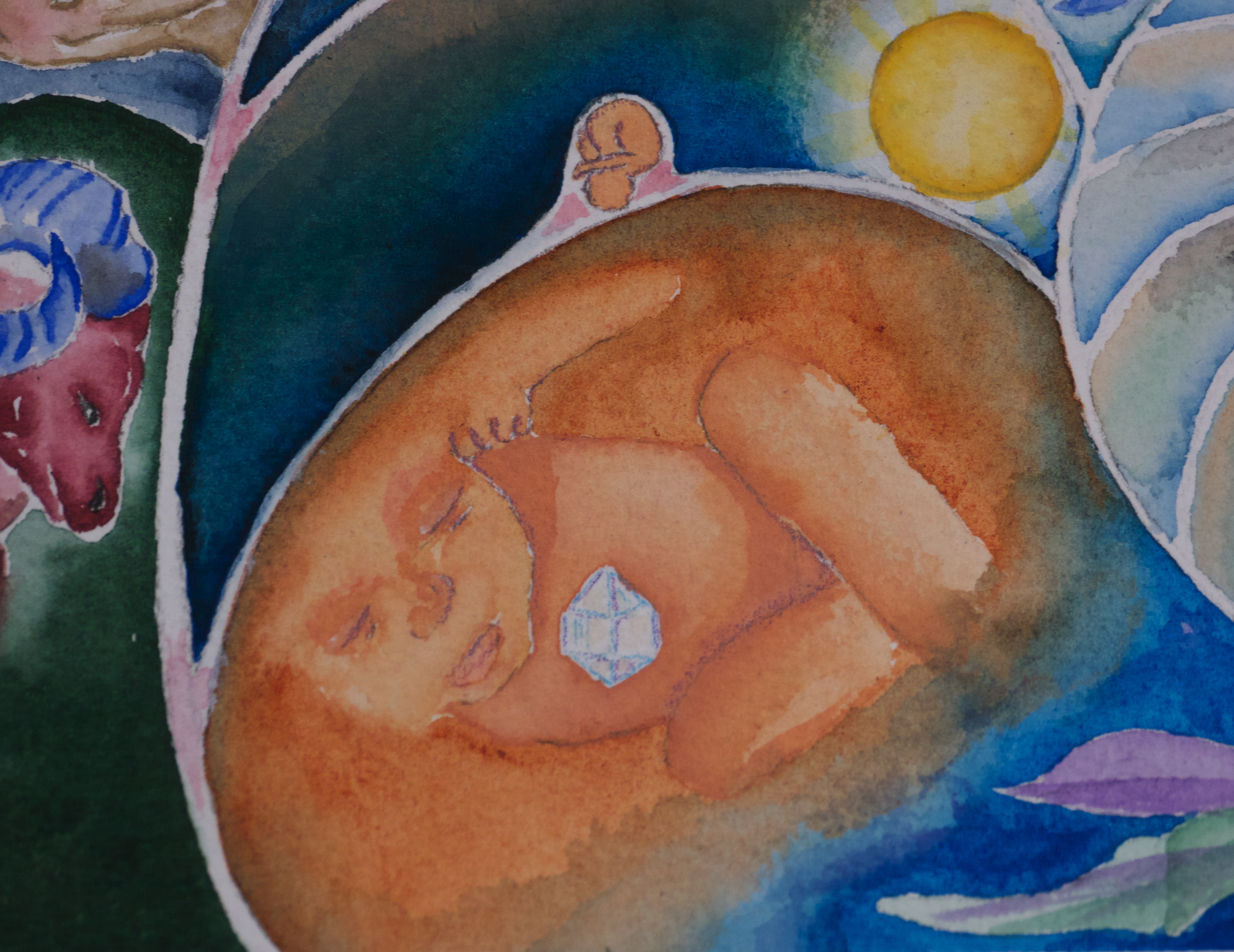
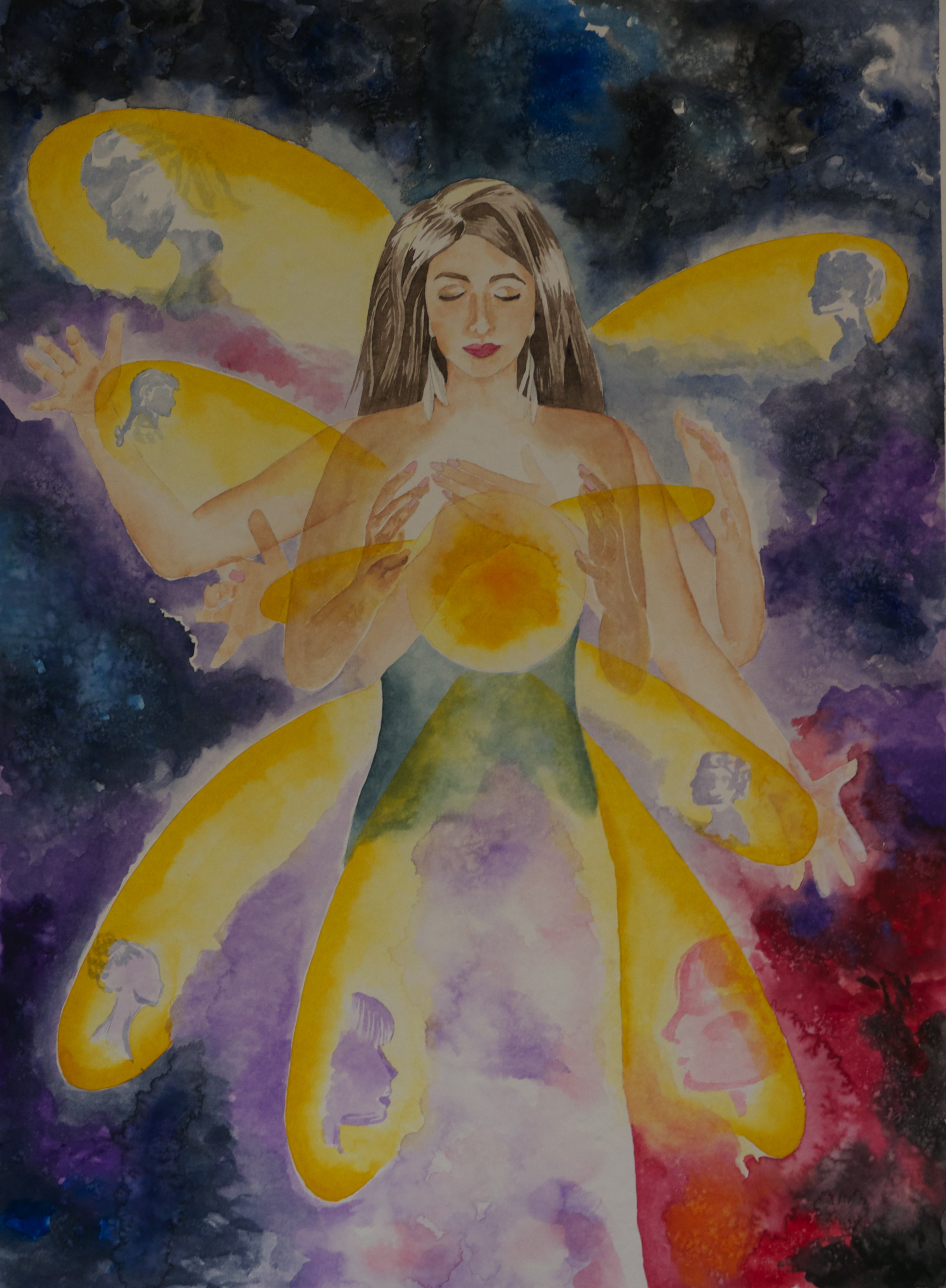
Incarnation

Bury me in my immanence,
These bones who hold me in,
Under flesh, underground,
Beneath gravity of skin.

What does it mean
To walk this Earth?
What does it mean
When these bodies come to birth?

Immersed in this flesh,
A mirror from below.
Songs echo from the deep
As the child learns to grow.

Each unfolding limb
A living fossil entwined:
The eye of the storm
In the whirlpools of the mind.

Stretch for the stars,
Bury your toes in the sand.
If I look in your eyes
Will you hold my hand?

What does it mean
To walk this Earth?
What does it mean
When these bodies come to birth?

Limber laughter enmeshed
In each step we take,
From these early paces
To final footpad ache.

Walk with me sister,
Walk with me son,
Tread this careful curve
Where multitude is One.

Sing with the clouds
As they cross the sky,
Breathe out all staleness
With a synchronized sigh.

I want to tread this path,
With you always by,
When we play, flow, and dance,
Hold council and cry.

What does it mean
To walk this Earth?
What does it mean
When these bodies come to birth?

Dance this Earth prayer
As long as we breathe,
Bury me in my immanence,
To find joy with all who grieve.

Earth and Sunrise

Co-Created Movement

The soles of my leather shoes are thin, allowing me to feel the contours of the path with each step. The thick layer of redwood leaves that slowly disintegrates into the rich canyon soil, soften the sounds of all the footsteps being taken around me. A meandering line of people are wending their quiet way along this forest path, each connected to one another, yet simultaneously enclosed in their own imagination-suffused worlds. The path bends to the right, taking a steep dive toward the clear, spring-fed creek. This is the place we cross, leaving the soft path momentarily, to leap from rock to rock, staying precariously above the chill waters below.

Photo by Matthew David Segall

I watch as the first person in this line of individuals begins to descend. Her arms flail slightly, not reaching for an object to steady her, yet monitoring her balance nonetheless. It seems she is about to fall and a ripple of concern echoes back through the group of waiting walkers, some expressed verbally, others merely in a position of body or facial expression. No, she assures us. She often can look as though she is about to topple off her feet, but this is just how she finds her balance. She apologizes for worrying anyone, and continues to make her wavering descent.

The next person, who is walking directly before me, begins to take careful steps down the winding way, with a greater steadiness in his footfall, but still with arms out to balance his movement. No one is concerned for his safety, however. His is not a gait that inspires uncertainty.

Without thinking I begin to move next along the trail. In a state of reflective curiosity I observe my own movement, fascinated by how the way I move might differ from those ahead of me now stepping or leaping from boulder to boulder over the cold stream. My arms are relaxed by my side, and I feel my footsteps fall evenly forward, one after the other. I find my balance like a line within myself. Why do I not use my arms? What is giving me this sense of stability? I recognize that I know this path, having walked it countless times from childhood into adulthood, and wonder if that history is built into my sense of balance now. My feet, my legs, the whole length of my body knows the placement of this path before my mind has a chance to reflect on it.

What, I ask myself, is movement? One usually thinks of movement as arising from the body of a person or other being who is moving with agency through the world. The uniqueness of movement seems to arise from the body and personality of the individual. Yet in this moment, as I watch myself and others navigate the winding, steep path by the stream, I realize how all movement is really a co-creation. Movement arises not from the individual’s agency but rather in the intermediate place between the individual—with all her history, personality, unconscious material, physical qualities, and so forth—and the dynamic contours of the surrounding world. The movement itself, although I might call it mine, is rather both mine and the world’s as we press into each other with each passing moment.

Bridging Our Attitudes Toward Nature

“Phusis kruptesthai philei”

For twenty-five hundred years the concept of Nature has evolved through the writings of Western History. The myriad meanings of the Greek word phusis have unfolded through history as Nature personified, Nature divine, Nature hidden, Nature secretive, nature separate from humanity, nature inclusive of humanity, nature as dead matter, Nature as art, Nature as All. Pierre Hadot traces this winding history in his book-length essay The Veil of Isis by examining the famous aphorism attributed to the philosopher Heraclitus, “phusis kruptesthai philei,” usually translated as “Nature loves to hide.”[1] Using these three cryptic words, whose meaning it seems also loves to hide, Hadot explores the many different ways this aphorism could be—and has been—translated, and the various effects such interpretations have had upon the continuing relationship humanity has with the world into which we each are born. Hadot perceives how traditional metaphors such as Heraclitus’ phrase will

hold sway for centuries over successive generations like a kind of program to be realized, a task to be accomplished, or an attitude to be assumed, even if, throughout the ages, the meaning given to these sentences, images, and metaphors can be profoundly modified.[2]

He goes on to note that “To write the history of a thought is sometimes to write the history of a series of misinterpretations.”[3]

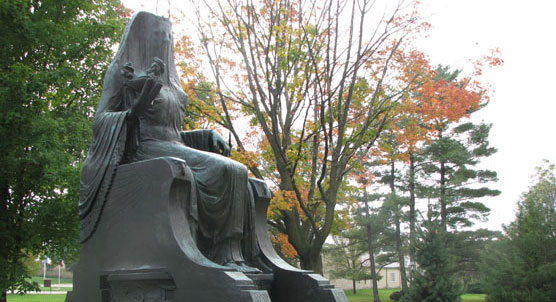
Isis Veiled

Why is it that Nature loves to hide? What is it she—for in Hadot’s traced lineage Nature is always unquestioningly personified as female—is hiding, and from whom is she hiding it? History has offered many answers, from Nature as divine mystery, to Nature as weak and inferior and thus wrapped up in shame, Nature as clothed in imagination, Nature as malicious toward humanity, Nature protective of humanity: all of these and more have been reasons given for why Nature’s veils have been deemed so difficult to peel away.

At the beginning of the nineteenth century, the metaphor of the veils and the secrets of Nature never ceases to fade, until it gives way to amazement before an unveiled Nature, which, in Goethe’s expression, henceforth became “mysterious in full daylight,” in the nudity of her presence.[4]

The image of veiled Nature has tempted the curiosity of humanity from deep into our ancestral memory until the present day, although the understanding of who and what Nature is has shifted dramatically over that time.

Hadot posits two archetypal narratives to illustrate what he sees as the primary approaches humanity has taken in the quest to unveil Nature: the Promethean and the Orphic. In Hadot’s own words, these approaches or perspectives can be understood as follows:

Orpheus thus penetrates the secrets of nature not through violence but through melody, rhythm, and harmony. Whereas the Promethean attitude is inspired by audacity, boundless curiosity, the will to power, and the search for utility, the Orphic attitude, by contrast, is inspired by respect in the face of mystery and disinterestedness.[5]

The Promethean attitude is based upon a notion of progress in which humanity will some day attain all of nature’s veiled secrets so that they might be put to use for the betterment of the human species. The three main methods of the Promethean attitude, as Hadot delineates them, are that of experimentation, mechanics, and magic, all of which manipulate nature in some way for a specific end. In this perspective Nature is seen as hiding her secrets out of hostility for humanity, keeping her knowledge hidden due to a kind of spite.

The Orphic attitude takes the approach that “if nature has hidden certain things, then it had good reasons to hide them.”[6] In many ways the Orphic is an antidote to the Promethean, although it extends far beyond that as well. The Orphic approach is that of approaching nature through the contemplation of art, poetry, music, classical physics, and myth. Hadot’s archetypal analysis of nature is itself an Orphic approach, in that he draws on myth and art to unfold the meanings of humanity’s changing relationship to the natural world.

In our current era of ecological destruction and crisis, understanding what is at stake and how we came to this precipice is key to moving in a new direction. If we do not have an understanding of what humanity has perceived nature to be throughout history then we have little chance of knowing how to heal our relationship to that which we call nature. Although in The Veil of Isis Hadot seems to favor more of an Orphic approach, in that it is more holistic, contemplative, non-violent, and non-exploitative, it could be that finding a bridge between the two perspectives is a better way forward. Although a deep chasm has often separated the two, Hadot offers examples of individual thinkers who embody both perspectives within themselves. For example, to dive back toward Western philosophy’s beginnings, Hadot demonstrates how Plato carries both a Promethean and Orphic attitude within his works. In the Timaeus, “Plato represents the world fashioned in an artisanal way,” but that world can also be understood through mechanical, mathematical models.[7] Plato saw phusis as divine art.[8] For Hadot, the view of nature as art is in itself part of a solution for overcoming the division of human and nature that has contributed to create the ecological crisis.

If. . . people consider themselves a part of nature because art is already present in it, there will no longer be opposition between nature and art; instead, human art, especially in its aesthetic aspect, will be in a sense the prolongation of nature, and then there will no longer be any relation of dominance between nature and mankind.[9]

Hadot’s work is not prescriptive, yet he indicates that finding bridges may be what is needed: a bridge between Promethean and Orphic, a bridge between humanity and nature—and in many ways art is able to fill this bridging role.


Work Cited

Hadot, Pierre. The Veil of Isis: An Essay on the History of the Idea of Nature. Translated by Michael Chase. Cambridge, MA: The Belknap Press of Harvard University Press, 2006.


[1] Pierre Hadot, The Veil of Isis: An Essay on the History of the Idea of Nature, trans. Michael Chase (Cambridge, MA: The Belknap Press of Harvard University Press, 2006), 1.

[2] Hadot, The Veil of Isis, xiii.

[3] Hadot, The Veil of Isis, 14.

[4] Ibid, 87.

[5] Hadot, The Veil of Isis, 96.

[6] Ibid, 91.

[7] Hadot, The Veil of Isis, 97.

[8] Ibid, 22.

[9] Ibid, 92.

Saturating Words with Image

A text means nothing to me until it is suffused with image. As I sit with book in hand, the slightly rough texture of the pages meeting the pads of my fingers with a soft sound, I am somehow more aware of the breathing presence of the room around me, of the book’s scent, rather than the black ink words upon the page. Reading a line takes me out of the space in which I sit. Reading another takes me further out, yet also pulls me further into the text. Yet not until the first sentence of the third paragraph does the text ground itself in an image, something I can grasp beyond, or perhaps before, my intellect can take hold of it. The sentence is “The perceiving mind is an incarnated mind.”[1] Reading that line, I cannot doubt my own incarnation. As is written just three pages later, “Before our undivided existence the world is true; it exists. The unity, the articulations of both are intermingled.”[2] I can feel that I myself exist, not because I think, but because I can perceive myself: perceiving my breathing, perceiving touch, feeling, sensuality, this textured book in my grasp.

Sunset Moonrise
Photo by Matthew Segall

I am standing on the precipice of a mountain gazing westward, into the molten fire of the setting Sun. One hundred and twenty degrees to my left, an angle my body can hold within itself as I gaze in both directions, the waxing Moon rises over the further arches of a vermillion and rose stained ridge. I can feel the relationship of Sun and Moon within my body, somehow feeling my heart as the third point in this harmonious triangle. “We grasp external space through our bodily situation.”[3] Standing between rising Moon and setting Sun I know their relationship because my body is in relationship to each of them. “We also find that spatial forms or distances are not so much relations between different points in objective space as they are relations between these points and a central perspective—our body.”[4] As I read each page of Merleau-Ponty’s words they gain meaning only as much as the image of these cosmic luminaries are able to saturate the words.

I am a full participant in this moment. My body is in relationship with these two powerful celestial bodies that light up our world, that pull all of the existence I know forward along its spiraling path. “For us the body is much more than an instrument or a means; it is our expression in the world, the visible form of our intentions.”[5] This seems to hold true not only for my own body, but each body I am able to witness: the flaming Sun, the pregnant Moon, blazing Venus as it becomes visible in the cooling hues of the sky, the point of light that is Saturn that appears not long after Venus makes her debut, and the solidity of the Earth beneath my feet. Each are bodies giving visible form to their intentions.


[1] Maurice Merleau-Ponty, The Primacy of Perception, ed. James M. Edie (Evanston, IL: Northwestern University Press, 1964), 3.

[2] Merleau-Ponty, The Primacy of Perception, 6.

[3] Merleau-Ponty, The Primacy of Perception, 5.

[4] Ibid.

[5] Ibid.

Reinhabiting Death

“Death is certain; the time of death is uncertain.”
– Second reflection of Buddhist practice[1] 

“When did we become human? One second to midnight.”
– Joanna Macy[2]

I am walking through a world of accelerating decay. I am walking through a world of exquisite beauty. I am living a life of sorrow and suffering. I am living a life of boundless joy. Somewhere, and at some time, I know my death is out there. We wander along life’s twisting roads, our paths occasionally coming breathlessly close. We almost know that we have met, but not quite. Sometimes I feel as though I am stalking my death, sometimes my death seems to almost deliberately be avoiding me. But then, one day, after walking around an inevitable bend, we encounter one another. Time halts.

I look deeply into my death’s eyes, seeing the beauty present in this moment, embodied in her. My death. And for her too I am death, the bringer of this life’s closing. We lock eyes. A smile plays across my lips, and a light giggle escapes on my breath. What is this? A sense of utmost relief. A release from the hold of incarnation. We reach up to touch each other’s hands and then, as if this was always meant to happen, we fall into a deep embrace, sinking into the comfort and warmth of each other’s presence.

Quietly we take each other’s hands and walk slowly together to a place where we can gaze out over the world, to take in all that we are leaving behind. I feel calm, at peace. Then, just as quietly, we sit down together, still hand in hand, our knees touching. She puts my hand on her heart and as we breathe together it feels as if every good deed, every kind gesture, each moment of grace in her life passes out through me and into the cosmos. As her life continues to flow through me our positions change, and her hand is upon my heart: now I too feel the release of letting all that I did and all that I was pour forth into the universe. And then there we sit, just two beings, outside of time.

As a culture, the West seems to have a disengaged relationship with death. We are often raised with little confrontation of the knowledge that this life someday will end. Somehow we see death as a possibility, rather than a certainty. Death is the greatest certainty we have in life, and yet it remains the greatest of mysteries as well. It is an ever-present reality to us, whether we acknowledge it or not. As Sean Kelly writes,

The natural and cultural dimensions of the human experience, however, cannot of themselves circumvent the fact that this Earth and all of its life forms, as indeed our sun and the entire physical cosmos within which they are embedded, are finite beings, with beginnings in time, and bound to inevitable death.[3]

For much of human history, when we contemplated the inevitability of our individual deaths, we had the comfort of a sense of continuity, remembering our ancestors behind us and our descendents whose lives await in the future. Continuity, perhaps, was as much an inevitability as our own death. Yet now humanity has entered a new period in which that continuity is no longer certain. The devastation of the ecological crises endangering every region of our home planet has made that continuity questionable. As Joanna Macy writes, the deleterious effects of the industrial growth society—from species extinction, to mass deforestation, to ocean acidification and climate change—“are warning signals that we live in a world that can end, at least as a home for conscious life. This is not to say that it will end, but it can end. That very possibility changes everything for us.”[4] As Kelly remarked, all finite entities of our physical reality will have an eventual, inevitable end, but the time scale on which Macy is speaking is one that could be experienced in a single lifetime: a reality so terrifying it has the ability to either stop us in our tracks in fear and apathy—or to give rise to the greatest creativity humanity has ever expended in service not of preserving our own personal lives, but of offering some hope to the very existence of future generations.

When we allow the realization of our potential collective death—as individuals, as a species, and as a planet—“to become conscious,” as Macy explains, “it is painful, but it also jolts us awake to life’s vividness, its miraculous quality, heightening our awareness of the beauty and uniqueness of each object and each being.”[5] Awareness of death not only awakens the possibility for our highest creative potential within life, but also brings up questions of what exists after the threshold of death: questions of personal and collective continuity not only on Earth but beyond this lifetime as well. It is in this context that Macy’s exercise, the Meditation on Death with which I opened this essay, was conducted.

The sense of peace, release, and well-being I experienced during the meditation with my death echoes many of the stories told by religions and spiritual traditions, and by individuals who have survived near death experiences. Contemplating one’s own personal death can lead to a beautiful acceptance of the inevitable, a realization that it may not be a doom but rather a gift. But shifting the contemplation of death to a collective level presents us with a great paradox: for while one’s own death may come to seem acceptable, or eventually even welcome, the idea of our entire human species, or the entirety of life on Earth, coming to an end is beyond the scope of tragedy. It feels impossible to transfer the sense of post-mortem peace to the loss of billions of individuals or whole species.

The severance of our continuity as a species, the “future canceled” as Macy writes, has only been realized as a global possibility since the atomic bomb was first exploded 1945.[6] As Robert J. Lifton explains, the possibility of species annihilation seems to have sliced the currently living generations off from any sense of connection to future descendents, but also from our ancestors who likely lived with a collective sense of species survival. Lifton argues, “We are thus among the first to live with a recurrent sense of biological severance.”[7] Interestingly, the remembrance of individual death under natural circumstances provides the opposite sense: not a severance, but a thread tying the generations together, as the elderly pass away and leave the world to their grandchildren, who will one day do the same for their own grandchildren.

Besides the biological continuity of familial generations, many cultural and religious traditions contain an understanding of spiritual continuity as well, in the form of the ideas of reincarnation and karma. From the perspective of reincarnation, as Christopher Bache puts it, “Death is but a pause that punctuates the seasons of our life, nothing more.”[8] Being able to see that some part of us carries on through multiple lifetimes releases us from the constraint imposed by the limited time of a single life. It makes death less of something to fear and more of a milestone upon a long, evolutionary journey. Yet death is much more than mere punctuation because, from Bache’s perspective, “the concept of reincarnation actually challenges the notion of personal survival because it ruptures the category of personal identity itself.[9] Bache and Kelly both write of the need to understand reincarnation without retaining the image of an individual, atomistic soul being reborn in life after life.[10] Bache continues, “We must eventually move beyond the atomistic vision of separate souls reincarnating for their individual evolution and begin to grasp the larger intentional fabric that our lives collectively express.”[11] Such a perspective shifts the focus away from the individual human being and broadens the horizon to include the collective: at the community, species, and possibly even planetary levels.

A major component of Macy’s “Work That Reconnects” is engagement through practices and exercises with the future generations whose potential existence we strive to bring to reality. Including the concept of rebirth in the practice of visualizing our future descendents can draw us even more personally into working for their well-being; not only might we be paving a smoother way for our great great grandchildren to walk, we ourselves in some form may be walking that path. Drawing from his research on reincarnation and the bardo, Bache suggests that rebirth may not be affected by linear time in the way we perceive it while incarnated. The possibility may exist for one to be born into any historical period, or even perhaps to be living multiple lives simultaneously.[12] “Each life,” as Kelly writes, “. . . however seemingly distant in our past or future—is always and already ensouled, is inalienably associated with its own soul, whose personal and singular drama is ever unfolding in the Eternal Now.”[13] The future is already present within us: biologically—in our ovaries, gonads, and dna, as Macy points out,—but also possibly spiritually—in our souls. Our present personality, along with our past and future personalities may coexist or participate in soul, an entity greater than anything with which our present personality can identify.

The other side to the equation of rebirth, the yin to reincarnation’s yang, is the concept of karma. Kelly writes,

The series of lives is said to be bound together by the law of Karma or its analogue, which, whether or not one believes in a transmigrating soul, provides continuity both before and beyond an individual life, and therefore also gives a ground for its value and meaning.[14]

The karma of our actions ripples forward into the future, affecting not only ourselves but all those who may come after. Nuclear waste and ecological devastation, Macy argues, may be the clearest physical example of how karma, in this case negative karma, ties together thousands of generations. Yet karma is not a fate engraved in stone, and how we choose to meet our karma will positively emanate into the future as well: as the Buddha said, if we cannot alter our karma, “all effort is fruitless.”[15] The fruit born by our effort is a selfless gift given to those who will inhabit our future world; yet it is also a gift to ourselves for the future we will inhabit. Bache describes a vision he had of that future with the following words: “I could see that the future we were creating was a future that we ourselves would participate in through future incarnations. We were doing this for God, for others, and also for ourselves.”[16]

The others:

Gray Wolf

Swallowtail Butterfly

Polar Bear

African Elephant

Blue Whale

“The Bestiary:” Macy’s poetic eulogy of those species leaving, or on the brink of departing, our planet forever—each name spoken, punctuated by the harsh beat of the drum.[17] Boom. A species erased. Boom. Yet another lost. The punctuating drum marks their permanent death. The accelerating drumbeat of extinction does not feel like a simple pause punctuating the seasons of life. Extinction is an irreversible loss, a diminishment of the wholeness and the creativity of our living planet.

The only sane response seems to be despair. Yet somehow despair is not the collective human response, at least at a conscious level. Macy observes, “Of all the dangers we face, from climate chaos to nuclear warfare, none is so great as the deadening of our response.”[18] Our cultural inability to confront death has extended to the numbness we feel in place of mourning, as the presence of thousands of our ecological companions is erased forever. Macy continues, “The energy expended in pushing down despair is diverted from more creative uses, depleting the resilience and imagination needed for fresh visions and strategies.”[19] By turning our empathy into apathy we seal ourselves off from the collective suffering of our planet: we either become numb or experience the world’s pain as solely our own, expressed in our personal pathologies, depressions, and diseases. Releasing the experience of one’s isolated suffering, while simultaneously living into and owning the despair that is such a real presence upon the Earth, unleashes the energy suppressing one’s grief and also may help release some of the suffering of the collective. Bache writes on this latter point saying, “Instead of seeing ‘my’ pain as existing separately from the suffering of ‘others,’ it becomes more natural to see it as a distinct nodal point within a collective field of suffering that runs throughout the species”—and, I would argue, throughout planet Earth as a whole.[20]

We are learning to confront grief and despair and to make it part of who we are. We are facing our mortality, learning to reinhabit death as a part of life and maturation. Macy writes, “We are confronting and integrating into our awareness our mortality as a species. We must do that so that we can wake up and assume the rights and responsibilities of planetary adulthood.”[21] Much of Western civilization has lost the ritualized initiation rites that serve to guide young people into the responsibilities of adulthood. Such rites of passage usually involve immense pain, a real confrontation with one’s mortality that helps forge the adolescent into the adult they will become. As Macy, Bache, and many others have suggested, the human species as a whole may be confronting such an initiatory rite in the imminent potential of our collective demise. “The specter of global death,” Bache writes, “that hangs over the postmodern era may be fueling a profound psychic transformation of our species.”[22] Bache goes on to describe what the container for that profound transformation seems to be:

The crisis of ecological sustainability is even more lethal than the nuclear crisis because it is not being generated by an overzealous military minority but by the very fabric of modern civilization. . . If there is a species ego-death in our immediate future, I think it will be triggered by the impending ecological crisis of sustainability.[23]

The ecological crisis forces us to face not only the mortality of our species and our planet, but also the deep shame that comes with the realization that we have done this to ourselves, shame that is more difficult to accept and perhaps even more repressed than our grief and despair.

I would argue that the rite of passage presented by the ecological crisis is not only an initiation for the human species, but for every species on this planet and perhaps even for the Earth itself. There may be an ego death of industrial civilization, but much of the suffering and confrontation with mortality of this rite of passage is being borne by the thousands of species going extinct at far too rapid a pace. They have borne the pain of this initiation far longer than we humans. To fully understand the depth of this rite of passage I believe humanity has to recognize that it is an initiation for the planet as a whole.

In a meditation to “re-story our identity as Gaia”[24] Macy offers the experience of imagining the entire existence of the Earth taking place within twenty-four hours, beginning at midnight. For much of the day the Earth is undergoing large-scale geologic processes, and not until five o’clock does organic life emerge. The evening is dedicated to the evolution of all living beings, and not until the last half hour of the day do mammals even evolve. “When did we become human?” Macy asks. “One second to midnight.”[25] In that one second before the clock strikes midnight all that we know of human existence takes place: every tribe is formed and reformed, every civilization rises and falls, every religion flourishes, every human to ever be born lives and eventually dies. The expansion of time felt by embracing a belief in reincarnation is suddenly compressed into that one second before midnight. Could that really be the time human souls have reincarnated within? If a spiritual continuity does exist between human lives, would not this continuity carry back throughout more of the twenty-four hours of our earthly evolution? Were we present with the beginning of life? The beginning of Earth? Might we have some spiritual continuity beyond even that beginning? And if so, what happens moving into the future, when the clock does eventually toll midnight?

A rite of passage is often related to the notion of the dark night of the soul. Perhaps it is only fitting that humanity would emerge during that dark night, in that one second before the midnight hour. Bache writes of his own personal understanding of our significance as a species, in connection with the greater whole of the cosmos:

How blind a species we are. How noble. How deep and profound the evolutionary currents that carry us. Sometimes the darkness stands out for me, sometimes the dawn. Increasingly it is the dawn.[26]

The midnight hour is the hour of mortality, death, the crossing of a threshold. It is the hour of transformation. Humanity may be undergoing a rite of passage but I believe it is an initiation in which we are one of many participating members. If we learn to support our fellow initiates, our fellow species, ecosystems, and biomes, then some of us may pass midnight. Eventually we, in an expanded sense of the term, may see the dawn.

Works Cited

Bache, Christopher M. Dark Night, Early Dawn: Steps to a Deep Ecology of Mind. Albany, NY: State University of New York Press, 2000.

Kelly, Sean “Integral Time and the Varieties of Post-Mortem Survival.” Integral Review. 4. No. 2 (2008): 5-30.

Lifton, Robert J. The Broken Connection. New York, NY: Simon and Schuster, 1979.

Macy, Joanna. World As Lover, World As Self: Courage for Global Justice and Ecological Renewal. Berkeley, CA: Parallax Press, 2007.


[1] Joanna Macy, World As Lover, World As Self: Courage for Global Justice and Ecological Renewal (Berkeley, CA: Parallax Press, 2007), 76.

[2] Macy, World As Lover, 183.

[3] Sean Kelly, “Integral Time and the Varieties of Post-Mortem Survival,” Integral Review, 4, No. 2 (2008): 6.

[4] Macy, World As Lover, 17.

[5] Ibid, 124.

[6] Macy, World As Lover, 174-5.

[7] Robert J. Lifton, The Broken Connection (New York, NY: Simon and Schuster, 1979), 338.

[8] Christopher M. Bache, Dark Night, Early Dawn: Steps to a Deep Ecology of Mind (Albany, NY: State University of New York Press, 2000), 41.

[9] Bache, Dark Night, Early Dawn, 42.

[10] Kelly, “Integral Time,” 24.

[11] Bache, Dark Night, Early Dawn, 34.

[12] Bache, Dark Night, Early Dawn, 133.

[13] Kelly, “Integral Time,” 23.

[14] Ibid, 6.

[15] Macy, World As Lover, 57.

[16] Bache, Dark Night, Early Dawn, 223.

[17] Macy, World As Lover, 87-90.

[18] Macy, World As Lover, 92.

[19] Ibid, 93.

[20] Bache, Dark Night, Early Dawn, 169.

[21] Macy, World As Lover, 184.

[22] Bache, Dark Night, Early Dawn, 215.

[23] Ibid, 232-3.

[24] Macy, World As Lover, 181.

[25] Ibid, 183.

[26] Bache, Dark Night, Early Dawn, 249.

Towards an Imaginal Ecology: A First Glance

“The imagination is a tree. It has the integrative virtues of a tree. It is root and boughs. It lives between earth and sky. It lives in the earth and in the wind. The imagined tree becomes imperceptibly the cosmological tree, the tree which epitomizes the universe, which makes a universe…”
– Gaston Bachelard[1] 

California Sunset

Imagine a stream, choked, murky gray, oiled surface, sunken deep below the watermark-stained banks. Feel deep within your soul the hopelessness of this place, the deadening of your senses to the despair of the river. Allow your imagination to fill with the river’s pain. Now, slowly, begin to imagine those waters rising, gradually at first, then more and more quickly, flowing first as a muddy trickle, widening into an onrushing stream. Bulbous plants begin to flourish along the banks, setting roots into the silted bottom. Filth becomes food, the waters begin to run clear. Light, once again, sparkles on the rippling surface. Fish return. What has allowed such a transition to occur? A re-imagining of purpose.

The imagination plays many roles in our practice of ecology upon this exquisite, blue and green celestial gem we have named Earth. As our planet suffers the ravaging destruction of industrialization and the consumptive growth of human greed, humanity is beginning to re-imagine its purpose in relationship to the Earth. The imagination is a multifaceted gift to ecology, one that can connect us to both our past and future, that can connect us with spiritual strength and moral empathy, that allows us to see our human role in an enchanted cosmos. The imagination is the eye of the soul, a bridge between the rational mind and the physical world, the opening of a realm in which the true beauty of the anima mundi can be revealed. Aspects of what could be called “imaginal ecology” can be glimpsed throughout the work of Joanna Macy, Thomas Berry, Brian Swimme, Mary Evelyn Tucker, Christopher Bache, James Hillman, Theodore Roszak, David Abram, and many other thinkers; it resounds in the poetry and philosophy of the Romantics, Transcendentalists and German Idealists. Imaginal ecology flourishes in the articulations of the enchanted realm of Faërie penned by J.R.R. Tolkien, and other fiction writers whose work reveals the enchantment of the realm in which we live.

The moral imagination of which Macy speaks can allow us to situate ourselves in the experience of other beings, whether ancestors of our past, or plants and animals, ecosystems of our current Earth, even beings of the future. Through imaginal practice we can hear the needs of others and recognize them as our own. Macy writes, “The imagination needs to be schooled in order to experience our inter-existence with all beings in the web of life.”[2] We can gain spiritual and psychic courage by seeing with the imagination’s eye into our potentially dire future. The work of Bache allows one to envision such a future while learning to cultivate the spiritual center needed to stay grounded in such an unstable time. The grief and despair work of both Macy and Bache lay a solid foundation in reality that can act as the fertile ground from which creative solutions can sprout and flourish.

Imagination can carry us back through time to the flaring forth of our cosmos, and as we experience the unfolding of our universe our own role as human beings becomes clearer. As Swimme and Tucker write, “Every time we are drawn to look up into the night sky and reflect on the awesome beauty of the universe, we are actually the universe reflecting upon itself.”[3] Such a realization can reorient our actions into a more harmonious relationship to the Earth as we recognize that we also are the Earth in relationship to ourselves.

Because we are the cosmos in human form, the pain of the world is expressing itself through our human pains, through our pathologies and diseases. The work of ecopsychology practiced by Hillman, Roszak and others, which itself could be seen as a form of imaginal ecology, seeks to engage in the healing of the soul of the world, the anima mundi.

Abram suggests that the imagination exists not only in the human but in the Earth and the cosmos itself. The imagination of the Earth is diverse, and varies from region to region like the landscape, affording various insights and ideas that differ by location. Abram writes,

There are insights we come upon only at the edge of the sea, and others we glimpse only in the craggy heights. Some prickly notions are endemic to deserts, while other thoughts, too slippery to grasp, are met mostly in swamps. Many nomad thoughts migrate between different realms, shifting their habits to fit the terrain, orienting themselves by the wind and the stars.[4]

Our ability to create and sustain our existence, to imagine the future, is wholly dependent on this creativity gifted by the Earth.

The creative works of many authors and artists can serve ecology by offering a “recovery,” as Tolkien writes, giving us the opportunity of “regaining a clear view”[5] of the enchantment inherent to the world in which we live. They offer a view of a fantasy realm, which Tolkien calls Faërie, crafted out of the materials of our everyday world, just as the painter’s or sculptor’s materials are drawn also from nature.[6] Yet fantasy allows us to see these primary ingredients in a new way, once again marveling at the wonders of our own world.[7] Tolkien shows the overlap between our world and Faërie when he writes,

Faërie contains many things besides elves and fays, and besides dwarfs, witches, trolls, giants, or dragons: it holds the seas, the sun, the moon, the sky; and the earth, and all things that are in it: tree and bird, water and stone, wine and bread, and ourselves, mortal men, when we are enchanted.[8] (Emphasis added.)

Faërie could then be seen as the real cosmos but without the human, or rather, without the disenchanted human. Fantasy—expressed through any art form, from literature, to painting, to sculpture—allows us to look again at our own world with new eyes, for as Hillman writes, “We pay respect to it simply by looking again, re-specting, that second look with the eye of the heart.”[9] The role the imagination can play in ecology is to unlock the doorway to this realm, our own cosmos, and re-enter as re-enchanted human beings, reflecting on themselves in the form of the universe.

Bibliography

Abram, David. Becoming Animal: An Earthly Cosmology. New York, NY: Pantheon Books. 2010.

Bache, Christopher M. Dark Night, Early Dawn: Steps to a Deep Ecology of Mind. Albany, NY: State University of New York Press. 2000.

Bachelard, Gaston. On Poetic Imagination and Reverie. Putnam, CT: Spring Publications, Inc. 2005.

Berry, Thomas. Evening Thoughts: Reflecting on Earth as Sacred Community. San Francisco, CA: Sierra Club Books. 2006.

–––––. The Dream of the Earth. San Francisco, CA: Sierra Club Books. 1988.

–––––. The Great Work: Our Way Into the Future. New York, NY: Three Rivers Press. 1999.

–––––. The Sacred Universe: Earth, Spirituality, and Religion in the Twenty-First Century. New York, NY: Columbia University Press. 2009.

Hillman, James. The Thought of the Heart and the Soul of the World. Putnam, CT: Spring Publications, Inc. 2007.

Macy, Joanna. World As Lover, World As Self: Courage for Global Justice and Ecological Renewal. Berkeley, CA: Parallax Press, 2007.

Roszak, Theodore, Mary E. Gomes, and Allen D. Kanner, ed. Ecopsychology: Restoring the Earth, Healing the Mind. San Francisco, CA: Sierra Club Books. 1995.

Swimme, Brian and Mary Evelyn Tucker. Journey of the Universe. New Haven, CT: Yale University Press, 2011.

Swimme, Brian and Thomas Berry. The Universe Story. New York, NY: HarperCollins Publishers. 1994.

Tolkien, J.R.R. The Tolkien Reader. New York, NY: Ballantine Publishing Group. 1966.


[1] Gaston Bachelard, On Poetic Imagination and Reverie (Putnam, CT: Spring Publications, Inc, 2005), 85.

[2] Joanna Macy, World As Lover, World As Self: Courage for Global Justice and Ecological Renewal (Berkeley, CA: Parallax Press, 2007), 112.

[3] Brian Swimme and Mary Evelyn Tucker, Journey of the Universe (New Haven, CT: Yale University Press, 2011), 2.

[4] David Abram, Becoming Animal: An Earthly Cosmology (New York, NY: Pantheon Books, 2010), 118.

[5] J.R.R. Tolkien, “On Fairy Stories,” in The Tolkien Reader (New York, NY: Ballantine Publishing Group, 1966), 77.

[6] Tolkien, “On Fairy Stories,” 78.

[7] Ibid, 77.

[8] Ibid, 38.

[9] Hillman, The Thought of the Heart, 129.

The Great Mosaic: California’s Wilderness Garden

NATURE WRITING: A NATIVE PARK

This is not the wilderness. The crisp leaves rattle overhead as squirrels jump from branch to branch. The wind and sun alike are filtered through the dry, prickly foliage causing the reflective leaves to sparkle like the ruffled surface of a lake. Spiderwebs catch the westering light, near invisible threads stretching seemingly to nowhere. It is here that I encounter my subject, the tree who will be my emissary of Nature, a representative on behalf of landscape, ecosystem, Earth: Quercus chrysolepus, the canyon live oak, one of many oak species native to the California climate. I cannot presume to know this tree, but I will attempt to inquire, to observe, to learn, perhaps to better understand the land that generated us both.
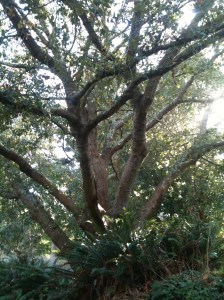
Canyon Live OakThis oak is not in the wilderness. We have both grown up in the city of San Francisco. This particular Quercus lives within the Botanical Gardens of Golden Gate Park, in the California Native Plant section. It lives in an enclosed space surrounded by a human constructed city, a place that is artificial yet natural at the same time. This park is tended and cared for by human hands, not for food, clothing, or shelter, but as a place of beauty. This tree is not growing in the wilderness, but it is still a tree, it is still nature. Perhaps it is better to conduct this inquiry within the bounds of a city park, a place where human and non-human ecosystems coincide, where boundaries are less clear and the symbiotic role of the human in these micro-ecosystems is more apparent than in the places that have been designated pristine wilderness.

The live oak I sit beneath is several feet wide at the base of its trunk with seven thick boughs extending radially outward, branching again and again until they end in thin twigs clothed in the distinctively pointed, dull green leaves that characterize California’s oaks. Many brown leaves litter the wide, mossy paving stones and the small, fern-covered slope beneath its spreading branches. It is a chilly November day, and both the fallen leaves and the temperature bring to mind that autumn is well underway. The rough, cracked bark of the ochre branches are spotted with sea-foam green lichen. Toward the base of the trunk, nailed into the wood, hangs a small, black, metal sign printed with the words: Fagaceae, Quercus chrysolepus, Canyon Live Oak, Western North America.

Spreading out around the oak is a gardened landscape containing many of California’s native plant species. Within the enclosure of this park is likely a better representation of the plant species growing on the West Coast of North America before European settlement than anywhere else in California. It is a reproduction and preservation of the past, guarded and tended to remain in such a state. Paths wind between dense clusters of chaparral—which means “short, woody vegetation” in Spanish—that are comprised of manzanita, buck brush, chamise, nude buckwheat, scrub oak, mountain mahogany, toyon, California coffeeberry, and silk tassel bush. Around and beneath the denser patches of chaparral are herbs and flowers: matilija poppies, red maids, farewell-to-spring, melic grass, gilia, chia, and clover.[1] Although the composition of the plants reflects an ecosystem prior to European contact, the contemporary common names clearly do not.

Timothy Morton writes in his book Ecology Without Nature that “We discover how nature always slips out of reach in the very act of grasping it.”[2] As I sit beneath this live oak tree writing of the play of golden light across the waxy leaves of the chaparral, I am actually distancing myself from nature. The more I describe the landscape, the deeper I go into the writing and the further I depart from where I am situated in this moment.[3] Nature slips away as it is turned into written words, making what is tangible and alive transform into a piece of art, something that is no longer nature. This paradox may be worth keeping in mind as I enquire further into the nature of nature, the nature of the human being, and the boundaries that may or may not exist between us.Native California Garden

I have titled this essay “The Great Mosaic” for several reasons: the name refers to the diverse ecological microclimates of the landmass named California, as well as to the mosaics created by symbiotic human interaction with that landscape; but it also refers to the method of writing I am exploring in this piece. I will attempt to create a mosaic of language, forming puzzle pieces of nature writing, scientific and ecological study, and philosophical and historical inquiry that will fit together with the same diversity, incongruity, and complexity as the landscapes that inspired these words.

A DUALISTIC WORLD VIEW

It is becoming increasingly evident that human beings are rampantly destroying the ecosystems of the Earth. A primary reason for such destruction seems to be part of the Western world view as developed and inherited from the European tradition: a perceived dualism between the human and all other non-human entities, the latter often termed nature. If one is to address this dualism one needs to understand not only how it came to be, but also why it is a problem. Many, although certainly not all, environmentalists work on behalf of nature without actually addressing the underlying foundations of why they do their work, acting from a sense of reverence and love for an intrinsically valuable and good environment that must be saved from the marring touch of human hands. For this kind of environmentalist, the environment is defined as “that form of nature that is vulnerable to human-made devastation and disaster.”[4] The work such environmentalists do should not in any way be disregarded or dismissed. It is important work not to be taken lightly or for granted. What I hope to address is the world view behind their actions. Their work may ultimately be futile unless we can have a clearer understanding of the role of the human being, not as an alien destroyer of the natural world, but as a fundamental part of Earth’s ecosystems, a species that shapes and inhabits its ecological niche like all other species.

WITHOUT WILDERNESS, WITHOUT NATURE

“Scientific findings indicate that virtually every part of the globe, from the boreal forests to the humid tropics, has been inhabited, modified, or managed throughout our human past.”[5] As is clear in this quote from Arturo Gomez-Pompa and Andrea Kaus’s article “Taming the Wilderness Myth,” the idea of wilderness as a pristine, untouched landscape is increasingly being exposed—through the writings of William Cronon, M. Kat Anderson, Anna Lowenhaupt Tsing, James Fairhead, Melissa Leach, and many others—as an idealized myth of the Western psyche. Timothy Morton takes this perspective a step further by calling for not only a human practice of ecology without the idea of wilderness, but without even the concept of nature. The idea of nature will have to “wither away” for an “ecological” human state to be able to exist.[6] He writes that “in all its confusing, ideological intensity, nature ironically impedes a proper relationship with the earth and its life-forms, which would, of course, include ethics and science.”[7]

Cronon writes in his essay “The Trouble With Wilderness” that wilderness does not exist apart from the human, it is rather an entirely human construction.

Far from being the one place on earth that stands apart from humanity, it is quite profoundly a human creation—indeed, the creation of very particular human cultures at very particular moments in human history. It is not a pristine sanctuary where the last remnant of an untouched, endangered, but still transcendent nature can for at least a little while longer be encountered without the contaminating taint of civilization. Instead, it’s a product of that civilization, and could hardly be contaminated by the very stuff of which it is made.[8]

This is not to say that the land itself is shaped exclusively by human hands—indeed, quite the contrary—but rather that the human is a species interacting with the natural environment in ways that shape it like every other species that participates with that land.

CALIFORNIA AND ITS OAKS

The landscapes of California provide a clear example of ecosystems that have been preserved under the guise of untouched wilderness in some of the world’s most famous and majestic national parks. Far from being untouched, however, these ecosystems were formed in relationship to human inhabitants over thousands of years, and some species may even have become dependent on a symbiotic relationship with humans. Therefore, I will be concentrating specifically on the various oak species indigenous to California, to understand the role they play in their ecosystems, their relationships to humans, as well as to ecosystem disturbance, to fire, and to the virulent pathogen that causes sudden oak death which is now devastating oak populations across the state.

California is a richly diverse landscape supporting between 5,800 and 6,300 plant species that grow in a wide variety of ecosystem communities, making it one of the world’s greatest biodiversity hotspots.[9] California’s microclimates range from deserts to salt and freshwater marshes, coastal prairie, valley grasslands, shrublands, riparian and foothill woodlands, and coastal redwood, lower montane, and evergreen forests.[10] The state has been called by some “the great mosaic.”[11] The wealth of species diversity can be seen in the example of the coastal prairie grassland, in which the average of 22.6 plant species per square meter is higher than in any other grassland in the North America.[12]

There are nine major kinds of chaparral ecosystem in California, each defined by the dominant species in its community. The variety I was observing in San Francisco’s Botanical Gardens was the ceanothus chaparral, characterized by its abundance of buck brush (Ceanothus cuneatus).[13] Different oak species grow among this kind of chaparral, predominantly scrub oak (Quercus dumosa), a shorter, more shrub-like oak than the Quercus chrysolepus under which I was sitting.[14] Unlike the scrub oaks, canyon live oaks grow primarily in California’s moist ravines and canyons and can live to be three hundred years old. Foothill woodland ecosystems, which cover some three million acres of California land, are dominated by oak species. In the drier inland regions the endemic blue oak (Quercus douglasii) grows in stands from the Sacramento Valley to Los Angeles County. Often the blue oak grows in mixed stands along with valley oak (Quercus lobata), interior live oak (Quercus wislizenii), coastal live oak (Quercus agrifolia), and gray and foothill pine (Pinus sabiniana); blue oak also grows among chaparral species and even in pure stands solely comprised of Quercus douglasii.[15]

The largest species of California oak are the valley oaks, christened “monarchs of the soil” because of their enormous size. Their shade provides a nourishing microclimate rich with a diversity of understory species.[16] In the northern coastal regions of California the dominant oak species are California black oak and Oregon oak; further south coastal live oaks are the dominant species. Unlike the valley oak, live oaks have little to no undergrowth, giving their stands the look of well-tended parks.[17] Indeed, California has been compared not only to a park but also to a flower garden, or as John Muir named it “the Pacific land of flowers.”[18] While this concept of California as a park or garden may have seemed unusual to arriving Europeans who believed they were entering a pristine wilderness area, it actually was the case that they were entering a garden of sorts, a landscape that had been developing in symbiosis with the hundreds of indigenous tribes living in the area over the previous 12,000 to 13,500 years.[19]

THE WILD GARDEN

No country in the world was as well supplied by Nature, with food for man, as California, when first discovered by the Spaniards. Every one of its early visitors have left records to this effect—they all found its hills, valleys and plains filled with elk, deer, hares, rabbits, quail, and other animals fit for food; its rivers and lakes swarming with salmon, trout, and other fish, their beds and banks covered with mussels, clams, and other edible mollusca; the rocks on its sea shores crowded with seal and otter; and its forests full of trees and plants, bearing acorns, nuts, seeds and berries.[20]

This evocative excerpt from Titus Fey Cronise’s book The Natural Wealth of California, published in 1868, provides a delectable image of a veritable Garden of Eden ripe for the taking. Yet Cronise makes no mention of the thousands of people whose lifestyles were thoroughly integrated into this wealthy landscape, who had coaxed forth such abundance through cultural practices that cultivated the land not as an intensive farm but as an extended wild garden.

California’s high species diversity was matched by its diversity of indigenous peoples. Indeed, Fikret Berkes has written of correlations worldwide between cultural diversity and biodiversity, likely caused by human “disturbance” and rotational use of the land.[21] Some 500 to 600 tribes lived in California, with each tribe spread over multiple villages.[22] Estimates of California’s indigenous human population at the time of European contact ranges from 133,000 to 705,000 people, with the most widely accepted estimate at around 310,000.[23] The tribes that lived in what is now the San Francisco Bay Area, where I was sitting beneath the canyon live oak, were the Ohlone, Coast Miwok, and Pomo, among others.

Juan José Warner, a European traveler in the San Joaquin Valley in the 1830s, noted with some wonder that such large indigenous populations could thrive on land that was apparently not cultivated.[24] Yet what he did not see were the subsistence activities carried out by these different tribes that were a form of cultivation and conservation, a coaxing of abundance from the natural processes of the land. Native Californians gathered, hunted, fished, and quarried stone for tools.[25] The acorns of the canyon live oak were used by the Pomo to relieve coughs and sore throats. The oak stands and prairies provided ingredients for acorn bread, wild grass seed cakes, and a variety of edible bulbs. Indigenous peoples lit fires on the land that could burn through chaparral and other woody vegetation to open up pathways and restart the cycle of regenerative plant growth that provides new vegetable matter and attracts grazing herds.[26] Fire is critical to the California landscape and many plant species have developed both a resistance and dependence on it for their lifecycles to continue. The same acre of land burned about once every ten to fifteen years before European contact, and fire has been crucial in shaping at least three quarters of California’s flora.[27]

CREATIVE DESTRUCTION: FIRE AND DISEASE

Ecosystem resilience is defined as how much disturbance a system can take before it is fundamentally altered and becomes a new kind of ecosystem.[28] The four stages of ecosystem recovery after disturbance begin with the reorganization phase, in which the ecosystem is renewed, seeds open and begin to germinate; followed by the exploitative phase, in which pioneer species compete and colonize the landscape with rapid plant growth; the next is the conservation phase, during which growth slows and larger, perennial species dominate; the fourth phase is ecological disturbance, or the creative destruction phase, which begins the cycle anew. It is the phase of creative destruction that is activated by such activities as routine burning of the land. Such a disturbance releases what Lance Gunderson calls “accumulated ecological capital,” such as nutrients and dormant seeds, that can now germinate and grow into new plants.[29]

Another type of ecosystem disturbance can come in the form of insect or pathogen invasion.[30] Like fire, insects and pathogens can lead to a creative destruction phase but, also like a fire that burns too hot or for too long, such invasions can cause irreparable damage, pushing an ecosystem to the brink of collapse. An example of such an invasive pathogen is Phytophthora ramorum, which has been the cause of sudden oak death for thousands of oaks across California and Oregon. Thus far it is unknown which stands of oak trees will be infected or exactly how the disease is spread, but research has been conducted to locate the most susceptible parts of oak forests. The species of oak that have been most devastated are coastal live oaks (Quercus agrifoli), black oaks (Quercus kelloggi), and tanoaks (Lithocarpus densifloru).[31] It appears that the trees at highest risk for infection are those at the edge of forest clusters, those growing near stands of bay laurels, and also those in close proximity to hiking and biking trails.[32]

The pathogen can colonize several other species of plant without actually killing them, such as the California rhododendron, huckleberry, madrone, California buckeye, big leaf maple, and manzanita.[33] Many of these species grow in the understory of oak stands and only carry the pathogen on their leaves while the main stem of the plants remain uninfected. The disease can pass easily from this understory foliage to their terminal hosts, the oaks, during rain and wind storms.[34] Mortality of oaks is highest at the edge of forest stands where the presence of pathogen-colonized undergrowth is most prevalent.[35]

Lee Klinger, a scientist who has closely studied sudden oak death, has found a correlation between abundance of moss and lichens on oaks and diseased and weakened trees. The mosses and lichens contribute to acidification of the soil, which is detrimental to the health of the trees and often kills their fine root systems.[36] Klinger suggests that the compromised health of the oaks, due to acidification and lichen growth, are making the trees more susceptible to Phytophthora ramorum, aiding the spread of sudden oak death.

Studies conducted on sudden oak death throughout Northern California have indicated that Phytophthora ramorum infecting oaks is far less prevalent in areas that have been recently burned.[37] Interestingly, the presence of lichens and mosses are also greatly reduced in frequently burned forest stands.[38] Although three quarters of California’s vegetation, including oaks, are fire-adapted species, the frequency of fire is dramatically different than during the time before European settlement. The U.S. Forest Service suppresses most forest fires, and as a result large quantities of undergrowth and lichens can build up that once were regularly burned away. It is quite likely that fire suppression has played a major role in the spread of sudden oak death.

Many of the indigenous tribes of California had symbiotic relationships with the oak trees growing near them. They often tended to the trees by burning brush and undergrowth from beneath the oak, thus improving the fertility of the soil and suppressing pests or diseases that might be detrimental. The soil fertility was also enhanced through working seashell and bone fragments into the soil, and mulching with seaweed.[39] Klinger writes,

In my holistic view, the problem of sudden oak death is ultimately related to the profound ecological shift of the oak forests in California brought about by a fundamental change in management practices associated with white settlement of the lands. The oak forests that, for centuries, were tended by native people were suddenly abandoned.[40]

Klinger treats oak trees today with a holistic medicinal approach which aims not to treat sudden oak death, or eradicate Phytophthora ramorum, but to support the trees’ health so they are more resistant to pathogens.[41] He scrubs the moss and lichens from the trees to reduce acidification, then fertilizes the soil surrounding the oaks, essentially mimicking the effects of fire.[42] He is stepping in to fulfill an ecological niche critical to California’s oak-dominant landscapes that was once filled by a species often not considered to be an integral part of nature: the human being.

THE SUBLIME AND THE FRONTIER

Over a relatively brief period of time touching three centuries from the 18th to the 20th, the concept of wilderness shifted from a place of evil and desolation to the sublime cathedral of pristine perfection wrought by the hand of God. Romanticism and the Enlightenment were the two primary catalysts of this profound shift. Before this transformative period, as Cronon writes, “To be a wilderness then was to be ‘deserted,’ ‘savage,’ ‘desolate,’ ‘barren’—in short, a ‘waste,’ the word’s nearest synonym.”[43] Yet by the year 1862 Henry David Thoreau would be declaring “In Wildness is the preservation of the World,”[44] and just seven years later John Muir, upon his arrival in the Sierra Nevada Mountains, said “No description of Heaven that I have ever heard or read of seems half so fine.”[45]

The two sources that led to such a reverence for the concept of pristine, wild nature, according to Cronon, were the ideas of the Sublime, and of the Frontier. The Sublime comes to us through European Romanticism, whereas the Frontier is truly a concept of Americanism.[46] Cronon writes,

Indeed, it is not too much to say that the modern environmental movement is itself a grandchild of Romanticism and post-frontier ideology, which is why it is no accident that so much environmentalist discourse takes its bearings from the wilderness these intellectual movements helped create.[47]

Romantic thought is what birthed the concept of Nature that Morton finds so problematic. “The ‘thing’ we call nature becomes, in the Romantic period and afterward, a way of healing what modern society has damaged.”[48]

In both contrast and complement to Morton, Berkes traces the origins of the concept of nature, as an external environment, to post-Enlightenment thought and the Cartesian dualism of mind and body, spirit and matter, man and nature (I use the term “man” instead of the gender-inclusive “human” here purposefully).[49] Thoreau wrote a beautiful passage in The Maine Woods which captures both this Romantic notion of sublime awe and the Enlightenment dualism of man and nature:

It is difficult to conceive of a region uninhabited by man. We habitually presume his presence and influence everywhere. And yet we have not seen pure Nature, unless we have seen her thus vast and drear and inhuman, though in the midst of cities. Nature was here something savage and awful, though beautiful. I looked with awe at the ground I trod on, to see what the Powers had made there… It was the fresh and natural surface of the planet Earth, as it was made forever and ever,—to be a dwelling of man, we say,—so Nature made it, and man may use it if he can. Man was not to be associated with it. (My italics.) [50]

Nature, for Thoreau, is a place of sublime, terrifying beauty. It is a place where spirit and matter are able to be conjoined, an overcoming of the Cartesian dualism, but it can only be so if nature does not include the human. Nature is, as Morton writes, “a transcendental term in a material mask.”[51] The grand cathedrals of the natural world, for the Romantics and American conservationists, were places where the lone individual might have the chance to encounter the might of God.[52] This is, of course, not an experience unique to Euro-Americans; for example, the indigenous tribes living near the Arctic glaciers understood that the glaciers had a powerful sentience and would respond to human behavior.[53] The sacred in nature is certainly not isolated to the European tradition. However, it seems the idea of an untouched sacred wilderness, with a complete lack of human presence, is less common worldwide.

Morton makes a strong case against revering such a conception of Nature: “Putting something called Nature on a pedestal and admiring it from afar does for the environment what patriarchy does for the figure of Woman.”[54] He is clear though that he is not advocating for no environmentalism—or what he prefers to call “ecology” as this term encompasses so much more—but rather he is suggesting an “ecology to come,” an ecology of the future.[55] Many environmentalists are trying to preserve what they see as pristine wilderness, particularly places of supreme natural beauty or biodiversity.[56] But the problem with privileging such sublime locations of grandeur is that we choose to value some parts of the Earth over other, perhaps more humble, places, or endangered species over more “common” plants and animals.[57] New dualisms are created between wilderness and the garden, the park, or even our human dwellings.

The other source of the American notion of wilderness, besides the Romantic Sublime, is the American Frontier. As Euro-American settlers moved ever westward across the North American continent the idea of the frontier became a way to reconnect with one’s primitive origins, to experience what it meant to be a true American. As settlers reached the West Coast they shared a sense of loss, a lament for the “free land” that had been available to them.[58] But this is the heart of the problem of wilderness, or nature, and of the frontier: there never was free land. This land had been occupied and shaped by and with the thousands of tribes that had been living here for millennia.

AN EMPTIED WILDERNESS

Both the movement of the frontier and the movement to preserve national parks were, and still are, acts of violence against the indigenous people who belonged to this land. As national parks were emptied of their inhabitants it created the illusion for tourists that they were visiting, “raw nature,”[59] land as fresh and pristine as God first created it.[60] Activities that helped shape the land and ecosystems, such as hunting, gathering, and burning, have been made illegal in many, although not all, parks, and are now labeled arson and poaching.[61] The 1964 U.S. Wilderness Act defines wilderness as a place “where man himself is a visitor who does not remain.”[62] Cronon points out that the ideal of a natural landscape unworked by human hands can only be the fantasy of those who have never had to make their living from the land.

Only people whose relation to the land was already alienated could hold up wilderness as a model for human life in nature, for the Romantic ideology of wilderness leaves precisely nowhere for human beings actually to make their living from the land… If we allow ourselves to believe that nature, to be true, must also be wild, then our very presence in nature represents its fall. The place where we are is the place where nature is not.[63]

Wilderness, from such a perspective, is imagined to be an escape from history, from our human past.[64] We can enter the wilderness and leave behind our personal and collective histories, forgetting the violences committed so no trace might be left of the human being on these isolated preservations of nature. Yet any study of environmental history, which is an emerging branch of ecology, will show how human interaction has shaped nearly every landscape on Earth.[65]

Forests worldwide that were once thought to be pristine, for example, are actually the result of ecosystem resilience developed directly through human disturbance over thousands of years.[66] Forest islands amid the African savanna, once thought be the remains of an original primal forest, are now understood to have been brought forth from the grasslands and maintained through human care and nourishment.[67] By studying the environmental history of the landscape, Fairhead and Leach were able to see how the distribution of these forest islands follow the distribution of past and present village settlements.[68] Human interaction and engagement with the landscape in ways that are integrative and not domineering, have been shown in numerous cases to increase biodiversity and maintain resilient ecosystems.[69] A different example of this comes from India, where grazing water buffalo in Keoladeo maintained the biodiverse wetlands that otherwise would secede to less abundant grasslands.[70] Ecosystem resilience is defined by a system’s keystone species; perhaps the human is also a keystone species in many landscapes, able to build resilience and diversity if we can keep our own activities in check, within a threshold of sustainability.[71]

KEEPING THE LAND

The indigenous cultures that were able to cultivate such abundance in relationship to the California landscape over 13,000 years developed many social and cultural narratives, guidelines, and taboos for engaging with the land. Common terms used for this engagement have been “keeping the land,” “caring for the country,” or “taking care of the land.”[72] As Berkes defines it, tradition ecological knowledge is about moral and ethical human-ecological relations.[73] Cruikshank writes, “Narratives underscore the social content of the world and the importance of taking personal responsibility for changes in that world.”[74] This is a great contrast to the notion of pristine wilderness erased of any signs of our human past. In indigenous California nearly every place was named, even seemingly unimportant locations, usually for the subsistence activity carried out there.[75] The landscape was more than just a container for human knowledge though; it carries the memories of all past events, it is a mnemonic of social relations and responsibility.[76] The poet Gary Snyder writes, “In the old ways, flora and fauna and landforms are part of the culture.”[77]

Of course, being part of an indigenous culture, or possessing the knowledge of such a culture, is no guarantee that one will have a sustainable relationship with the Earth.[78] Not all indigenous cultures have consistently treated the land they live on well, and many examples exist of those who failed or did not survive.[79] But this does not mean there are not powerful lessons to learn from many of these cultural groups. It is true that the Earth must be conserved from the ravages of industrialism and greed, but not by the violent methods used to preserve the national parks of the United States. Such preservation is a form of embalming, a moment frozen in time, an erasure of the dynamic life forces that allow the Earth to be resilient and regenerative. It is a slow but eventual death knell, a false tilling of the soil to preserve a moment long gone, that does not allow new birth to take place. If the planet is divided solely into wild places and places domesticated for development neither will truly flourish to their full potential. Engagement of all species is required. If land is to be conserved, the human beings who shaped that ecosystem should be treated as a continual, integral part of that landscape as well.[80]

In her book Friction, Anna Lowenhaupt Tsing writes of “anthropogenic” landscapes, landscapes that are co-created with their human inhabitants, forming places that are neither domesticated nor wild.[81] For true conservation of the Earth, a form of conservation that includes human beings, to flourish it must rise up in the gaps, between the dualism of nature and human, like an acorn buried beneath a concrete sidewalk that eventually pushes up between the seemingly impenetrable slabs on either side. But the tender shoot will grow strong in its liminal space, forging a new path where none seemed to exist before, eventually emerging as a sturdy, powerful oak tree.

SOLSTICE OAK

The leaves whisper, drier even than when I first sat beneath this tree in mid-autumn. Winter has nearly set in; the branches are cold to the touch. The tree has changed little itself during this shift of the seasons, only its leaves have faded from dusty green to a crunchy brown. Yet I see this canyon live oak with new eyes now. Are the mosses and lichens growing up its branches weakening its health? Ferns grow right up to the base of the tree, and I know no fire will sweep through this park to clear the underbrush.

As I gaze west through the branches the sunlight streams through with the rich, deep golden glow so characteristic of the days around the winter solstice. In between the branches pale, white-winged insects flutter, their wings like an ethereal gauze in the sunset. There is no denying that the scene is magical. This sense of ecological wonder is a form of magic created between the human being and all other species we humble ourselves to approach in communion. The magic of this moment is one ignited specifically between myself, the dancing insects, and this truly majestic oak tree.

As I walk away from the oak, meandering through the winding paths in between the chaparral, I realize that this particular canyon live oak has something that many oaks in California once had, but no longer do. It has human caretakers, caretakers who will clear the underbrush and mosses away by hand, and who will nourish the soil so that the oak remains healthy. This oak is neither domesticated nor wild, but growing in the gap, the liminal space of a human-shaped park, thriving between the streets of San Francisco.

BIBLIOGRAPHY

Anderson, M. Kat. Tending the Wild: Native American Knowledge and the Management of California’s Natural Resources. Berkeley, CA: University of California Press, 2005.

Berkes, Fikret. Sacred Ecology. New York, NY: Routledge. 2012.

Cronon, William. “The Trouble with Wilderness; or, Getting Back to the Wrong Nature.” In Uncommon Ground: Rethinking the Human Place in Nature, edited by William Cronon, 69-90. New York, NY: W.W. Norton & Co, 1995. Accessed November 12, 2012. http://www.williamcronon.net/writing/Cronon_Trouble_with_Wilderness_1995.pdf

Cruikshank, Julie. “Glaciers and Climate Change: Perspectives from Oral Tradition.” Arctic 54 No. 4 (2001): 377-393.

Fairhead, James and Melissa Leach. Misreading the African Landscape: Society and Ecology in a Forest-Savanna Mosaic. Cambridge, England: Cambridge University Press, 1996.

Gomez-Pompa, Arturo and Andrea Kaus. “Taming the Wilderness Myth.” BioScience. 42 No. 4 (1992): 271-279. Accessed November 13, 2012.             http://campus.greenmtn.edu/faculty/gregbrown/NRM3061/biosciencearticle.pdf

Gunderson, Lance H. “Ecological Resilience—In Theory and Application.” Annual Review of Ecology, Evolution and Systematics 31 (2000): 425-439.

Kelly, Maggi and Ross K. Meentemeyer. “Landscape Dynamics of the Spread of Sudden Oak Death.” Photogrammetric Engineering & Remote Sensing. 68 No. 10 (2002): 1001-1009. Accessed October 16,             2012.http://www.asprs.org/a/publications/pers/2002journal/october/2002_oct_1001-1009.pdf

Klinger, Lee F. “A Holistic Approach to Mitigating Pathogenic Effects on Trees.” Paper presented at the Treework Environmental Practice Seminar XII, Trees, Roots, Fungi, Soil: Below-ground Ecosystem & Implications for Tree Health, at the Natural Museum Cardiff, Cardiff, UK, November, 13, 2008. Accessed December 18, 2012. http://suddenoaklifeorg.files.wordpress.com/2009/07/tep-paper-final.pdf

Moritz, Max A. and Dennis C. Odion. “Examining the Relationship Between Fire History and Sudden Oak Death Patterns: A Case Study in Sonoma County.” Paper presented at the Sudden Oak Death Second Science Symposium: The State of Our Knowledge, Monterey, California, January 18-21, 2005. Accessed December 18, 2012.             http://suddenoaklifeorg.files.wordpress.com/2009/04/psw_gtr196_004_037moritz.pdf

Morton, Timothy. Ecology Without Nature: Rethinking Environmental Aesthetics. Cambridge, MA: Harvard University Press, 2009.

Thoreau, Henry David. The Maine Woods. Harmondsworth, England: Penguin, 1988.

Tsing, Anna Lowenhaupt. Friction. Princeton, NJ: Princeton University Press, 2005.


[1] M. Kat Anderson, Tending the Wild: Native American Knowledge and the Management of California’s Natural Resources (Berkeley, CA: University of California Press, 2005), 30.

[2] Timothy Morton, Ecology Without Nature: Rethinking Environmental Aesthetics (Cambridge, MA: Harvard University Press, 2009), 19.

[3] Morton, Ecology Without Nature, 30.

[4] Anna Lowenhaupt Tsing, Friction (Princeton, NJ: Princeton University Press, 2005), 123.

[5]Arturo Gomez-Pompa and Andrea Kaus, “Taming the Wilderness Myth,” BioScience 42, no. 4 (1992): 273, accessed November 13, 2012, http://campus.greenmtn.edu/faculty/gregbrown/NRM3061/biosciencearticle.pdf.

[6] Morton, Ecology Without Nature, 1.

[7] Ibid, 2.

[8] William Cronon, “The Trouble with Wilderness; or, Getting Back to the Wrong Nature,” in Uncommon Ground: Rethinking the Human Place in Nature, ed. William Cronon (New York, NY: W.W. Norton & Co, 1995), 1, accessed November 12, 2012, http://www.williamcronon.net/writing/Cronon_Trouble_with_Wilderness_1995.pdf.

[9] Anderson, Tending the Wild, 25.

[10] Ibid, 26-34.

[11] Ibid, 26.

[12] Ibid, 28.

[13] Anderson, Tending the Wild, 30.

[14] Ibid.

[15] Ibid, 32.

[16] Ibid, 31.

[17] Ibid, 32.

[18] Anderson, Tending the Wild, 15.

[19] Ibid, 37.

[20] Titus Fey Cronise, qtd. in Anderson, Tending the Wild, 13.

[21] Fikret Berkes, Sacred Ecology (New York, NY: Routledge, 2012), 44.

[22] Anderson, Tending the Wild, 35.

[23] Ibid, 34.

[24] Ibid, 37-38.

[25] Ibid, 38.

[26] Fikret Berkes, Sacred Ecology, 89.

[27] Anderson, Tending the Wild, 17.

[28] Lance H. Gunderson, “Ecological Resilience—In Theory and Application,” Annual Review of Ecology, Evolution and Systematics 31 (2000): 426.

[29] Gunderson, “Ecological Resilience,” 430.

[30] Gunderson, “Ecological Resilience,” 430.

[31] Maggi Kelly and Ross K. Meentemeyer, “Landscape Dynamics of the Spread of Sudden Oak Death,” Photogrammetric Engineering & Remote Sensing 68 no. 10 (2002): 1001, accessed October 16, 2012, http://www.asprs.org/a/publications/pers/2002journal/october/2002_oct_1001-1009.pdf.

[32] Kelly and Meentemeyer, “Landscape Dynamics of the Spread of Sudden Oak Death,” 1005.

[33] Ibid, 1001.

[34] Ibid, 1002.

[35] Kelly and Meentemeyer, “Landscape Dynamics of the Spread of Sudden Oak Death,” 1006.

[36] Lee F. Klinger, “A Holistic Approach to Mitigating Pathogenic Effects on Trees” (paper presented at the Treework Environmental Practice Seminar XII, Trees, Roots, Fungi, Soil: Below-ground Ecosystem & Implications for Tree Health, at the Natural Museum Cardiff, Cardiff, UK, November, 13, 2008), 3, accessed December 18, 2012. http://suddenoaklifeorg.files.wordpress.com/2009/07/tep-paper-final.pdf

[37] Max A. Moritz and Dennis C. Odion, “Examining the Relationship Between Fire History and Sudden Oak Death Patterns: A Case Study in Sonoma County” (paper presented at the Sudden Oak Death Second Science Symposium: The State of Our Knowledge, Monterey, California, January 18-21, 2005), 173, accessed December 18, 2012. http://suddenoaklifeorg.files.wordpress.com/2009/04/psw_gtr196_004_037moritz.pdf.

[38] Klinger, “A Holistic Approach,” 4.

[39] Klinger, “A Holistic Approach,” 5.

[40] Ibid, 6.

[41] Ibid, 2.

[42] Ibid, 1.

[43] Cronon, “The Trouble with Wilderness,” 2.

[44] Henry David Thoreau, qtd in Cronon, “The Trouble with Wilderness,” 2, 19.

[45] John Muir, qtd in Cronon, “The Trouble with Wilderness,” 3.

[46] Cronon, “The Trouble with Wilderness,” 3.

[47] Cronon, “The Trouble with Wilderness,” 3-4.

[48] Morton, Ecology Without Nature, 22.

[49] Berkes, Sacred Ecology, 51.

[50] Henry David Thoreau, The Maine Woods (Harmondsworth, England: Penguin, 1988), 93.

[51] Morton, Ecology Without Nature, 14.

[52] Cronon, “The Trouble with Wilderness,” 4.

[53] Julie Cruikshank, “Glaciers and Climate Change: Perspectives from Oral Tradition,” Arctic 54 no. 4 (2001): 387-388.

[54] Morton, Ecology Without Nature, 5.

[55] Ibid, 6.

[56] Ibid, 9.

[57] Cronon, “The Trouble With Wilderness,” 16.

[58] Cronon, “The Trouble With Wilderness,” 7.

[59] Cruikshank, “Glaciers and Climate Change,” 390.

[60] Cronon, “The Trouble With Wilderness,” 9.

[61] Ibid, 10.

[62] Berkes, Sacred Ecology, 249.

[63] Cronon, “The Trouble With Wilderness,” 11,

[64] Cronon, “The Trouble With Wilderness,” 10.

[65] Berkes, Sacred Ecology, 30.

[66] Ibid, 79-80.

[67] James Fairhead and Melissa Leach, Misreading the African Landscape: Society and Ecology in a Forest-Savanna Mosaic (Cambridge, England: Cambridge University Press, 1996) 78-83.

[68] Fairhead and Leach, Misreading the African Landscape, 90.

[69] Berkes, Sacred Ecology, 44.

[70] Berkes, Sacred Ecology, 43.

[71] Gunderson, “Ecological Resilience,” 431.

[72] Berkes, Sacred Ecology, 40.

[73] Ibid, 11, 19.

[74] Cruikshank, “Glaciers and Climate Change,” 391.

[75] Anderson, Tending the Wild, 38.

[76] Berkes, Sacred Ecology, 6.

[77] Gary Snyder, qtd. in Anderson, Tending the Wild, 39.

[78] Berkes, Sacred Ecology, 78.

[79] Ibid, 241.

[80] Ibid, 252.

[81] Tsing, Friction, 174.
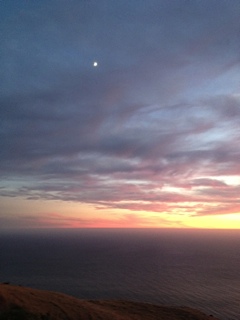
Of Blood and Stars

September 22, Early morning

I am awake before dawn on the Equinox. The sky is lightening all around me. The clouds are so soft it is hard to see where each one ends and the robin’s egg sky flows in. To my right is a small herb garden planted in dry, mounded beds delineated by white stones. A gateway, made of three simple, straight boughs barely differentiated from the trees they once were, stand beyond the herbs. Past the gate unfolds an intricately woven permaculture garden: fruit trees ranging from a few years old to the grandmother plum in her sixties.

A white horse whinnies restlessly on the golden hill; a stand of redwoods frame her from behind. Interspersed in the orchard are beds of annual crops: beets, carrots, tomatoes, strawberries, kale, chard. Concord grapes grow from vines draping every available trellis, their scent saturating the air. Although I cannot see them where I sit, I hear the chickens, ducks, and geese calling to the arriving dawn. Somewhere, hidden behind apples and sunflowers, are the family of five goats. The two young males, Peaches and Sweetie, we will be harvesting and processing today, and making into our evening meal.

Goat milk clouds my warm cup of black breakfast tea, adding an unfamiliar sweetness. The goats are an integral part of the life here; they provide milk, cheese, yogurt, even caramel, as well as meat and companionship.

The sun has now risen.

The three days spent on the Hill of the Hawk farm was a lesson in ethics, an ethic related to one of the most intimate aspects of survival: eating. Whether or not to eat animal products, especially meat, is an issue to which every culture seems to have a different answer. An example of the views on these issues are presented by Peter Singer and Jim Mason in their book The Ethics of What We Eat, which stands in contrast to the perspective of Sally Fallon in her cookbook Nourishing Traditions. While Singer and Mason agree with Fallon on many aspects of food choice, such as eating organic produce and purchasing from fair trade and sustainable sources, their primary disagreement is about the consumption of animal products.

Singer and Mason write primarily on animal rights and well-being, looking into the methods of factory farming, as well as large- and small-scale organic production. Fallon, on the other hand, is writing from the perspective of human dietary health, drawing on research about the major benefits of a diet rich in animal products raised in a humane way. She gives examples of the longevity of peoples eating diets high in animal fats and proteins—namely the Japanese, Swiss, Austrian, Greek, and, of course, French[1]—as well as archeological research on the decline in stature of Mayan peoples correlated to periods of meat scarcity.[2] Fallon also draws on numerous studies relating to the importance of animal products, both meat and dairy, for the healthy development of children, and for the prevention of numerous degenerative diseases and maladies.

Singer and Mason focus more on how animals for consumption are produced rather than the dietary effects of eating them. They draw on several differing viewpoints regarding the ethics of taking animals’ lives, looking at the quality of life as well as methods of slaughter. They are clearly in favor of a vegan or vegetarian diet, but also present arguments from those who feel that it is better that animals raised well have the lives they do, rather than not existing at all.[3] While these issues have no clear answers even when one chooses to take a particular position, one aspect of my own understanding of eating meat is that one must experience participating in killing an animal before a decision can be made in favor of meat-eating. And this is just the experience which we encountered at Hill of the Hawk.

September 22, Late afternoon

The goats were brought up in the back of a pick-up truck cradled in the arms of several students. They ate grass near us while we sat and spoke with Tamara, the woman who would guide us with the killing. She said that if she ever were to take an animal’s life and feel no emotion in that act she would know she had done it too much and would have to stop. She wanted to cause the least suffering possible, in part by keeping herself and the other participants calm, and therefore giving no reason for the animals to feel anxiety. Everything is about the animal in his last moments, not about the humans involved. Our well-being in that time comes second. Tamara uses the term “processing” to refer to the entire procedure of harvesting the animal, because we humans can process our emotions as we process the animal.

We brought the goats under a great spreading oak and laid a cloth beneath them. The first goat Tamara gently straddled while her assistant held his head. She put her sharp blade into the back of his neck, severing the spinal cord so he would feel less pain. He only made one small sound, one that seemed to convey surprise more than pain or even fear. Swiftly she brought the knife forward and sliced into the jugular vein. Crimson blood welled from the opening, pouring and pouring forth. I came forward to catch it in a clean, glass bowl. Whispered thanks came from Tamara and her assistant, and many of those standing further back. The animal’s fading pulse seemed to pass from him to the very air itself, beating through everything. I was grateful to stand so close, to look into this little animal’s beautiful deep brown eyes, to thank him, and to recognize the moment when life left him. The eye transformed. No longer a window to the soul it became a glass bead. The blood still poured forth.

The deaths of Peaches and Sweetie were not the routine slaughters of factory farmed chickens, cattle, and pigs as depicted in Singer and Mason’s book. Clearly present in the processing of these two little goats was an aspect not mentioned by Singer, Mason, or Fallon; it was a spiritual presence. The focus for Singer and Mason is on the pain of farmed life and the trauma of the slaughtering process. What became apparent for me beneath that oak tree was that death itself was not an issue that could be assessed with statistics, written description, photography, or even filming. When the issue of pain and fear were handled in apparently the most ethical ways possible, death seemed to become a spiritual exchange, a gifting of one species to another, something that could not be captured in any other way than by standing witness.

September 22, Late afternoon

The rest of the day was given to skinning and gutting the goats, and making recipes of each of the organ meats. Nothing was wasted. Liver and onions, kidneys and red wine, spleen pâté, breaded heart and testicles, lung soup, sausages stuffed into the intestines, fried blood, chocolate blood ice cream. The heads were skinned and sawn in half, the brains dried to be used later to tan the hides. The hides were salted and set aside to be cured. The hooves and bones will be cleaned and buried until they are white, then made into jewelry and musical instruments. Nothing was wasted.

Using every part of the animals felt like the most practical way of honoring their gift and sacrifice. Unlike large-scale farming operations which only use the choicest parts of animals, and often feed the remainder back to a different species,[4] our use and consumption of the animal in his entirety seemed an act of thanks. Additionally, it is the diverse organ meats that provide the greatest nutritional value, as Fallon writes about frequently. Fat-soluble vitamins, such as vitamins A, B, D, and E, are especially abundant in organ meats[5], and also allow for the absorption of minerals[6] and the assimilation of protein.[7] While Singer and Mason argue that any vitamins unavailable in one’s diet can be taken supplementally,[8] Fallon provides arguments of how isolated vitamins can, in some forms, be toxic to the system.[9] Organ meats are especially nourishing for pregnant women, and aid in the development and maintenance of healthy sexual organs.[10] Yet Singer and Mason also give the example of a healthy family of four living exclusively on a well-planned vegan diet, without any seeming detriment to their health.

Reflection on September 21, Evening

Sunset. A road climbs to the west over the hill and opens out to a full view of the Pacific Ocean, a vista broad and high enough to indicate Earth’s great curve. In silence we sat and watched the molten gold of the sun sink in blazing glory as Earth rolled away from its heat. The clouds were set alight, shifting from gold to vermillion, to crimson and magenta. Not until the sun had made his departure did the clouds shift to reveal the ivory crescent of the moon, one day from the quarter. She glowed ever brighter in the fading sky, her face ever turned in adoration to the departed sun.

Watching the cycles of the sun and moon, the passage of the planets, and the great wheeling of the stars across the sky each night led me to thinking about the passage and cycles of life upon Earth as well. The processing of the goats somehow to fit into these cycles, a mysterious give and take, an exchange of life and death, sorrow and gratitude. I was all too aware of that sunset as the final sunset in the lives of those goats, and the following dawn as a dawn onto perhaps a new life for them. Whether we eat other beings or not, death is something we all must contemplate and someday face. In reflection, I learned more from those goats about my own death than I could have imagined.

September 23, Early morning

Venus and Jupiter, two fading diamonds in the warming dawn sky. The few clouds are saturated in rosy sunlight, but the fiery orb has not yet peaked over the Coastal Ridge. The flock of wild turkeys that haunt the farm walk past on my left, and quietly filter into the neat rows of the young Pinot Noir vineyard. One of the farm’s many cats, a large gray and white tabby, cuddles close providing welcome warmth, dividing my attention between petting and the pen. He finally leaves to find a more steady source of love.

Venus, last of the night stars, has now vanished from my sight, lost behind an atmosphere flooding with dawn light. The wind stirs, the cold air pushed forward by the approaching sun. Sunrise here for us is sunset for someone else, someone on the far side of that distant horizon.

When I awoke this morning it was still dark, the sky bejeweled in her net of stars. The moment I stepped through the canvas flaps of my tent I beheld Venus, a gem so bright she shone out unmistakably, shimmering princess of the twilight. From her it was easy to trace along the ecliptic to Jupiter, an orange-shaded beam of light, seated right at the mid-heaven.

Dawn is close. I can see pure sunlight on the south-western slopes of the Ventana Double Cone Mountain. Ventana. A window to the east. The Esalen Indians believe the souls of the dead pass between those two white, granite peaks into another realm. Perhaps the souls of our two little goats passed that way as well.

The birds are all awakening; a hummingbird thrums among the branches directly over my head, jays cry, a kite hawk circles in search of prey. When the kite pauses in mid-air, wings poised, he looks like a white angel in the distance, an angel framed against the Ventana Mountain. Many songbirds call to each other. I can feel their anticipation, their celebration, their worship of the sun. The air stirs restlessly and the temperature continues dropping.

The sun is emerging. A liquid platinum fire is melting up over the hill, spreading across the ridge like gold spilled from an alchemist’s forge. At the heart of that fire pure light spreads in all directions, filling the sky, obscuring the mountain. It melts all things surrounding it into undifferentiated lightness. The first warmth of the day is playing over my skin.

I have found myself wondering often if the experience with Sweetie and Peaches has changed the way I eat. Many questions have come up for me regarding veganism and vegetarianism. As we saw at Hill of the Hawk, the consumed dairy from the female goats requires the occasional slaughter of male goats so that the herd does not become too large. And even an organic vegan diet requires the presence of animals on the farm to provide manure to fertilize the soil in a healthy way to grow crops. To farm sustainably seems to involve animals in some way or another, whether we are vegan, vegetarian, or omnivorous. As before this experience, I personally still eat meat and dairy yet also, as before, I eat them in fairly small quantities. But there is something else that has become a greater part of my diet since leaving Hill of the Hawk: intention and gratitude. Whether we are eating animals—or grains, vegetables, and fruits—what seems to matter most is recognizing the gift of that food. All food is a life sacrificed, a life gifted. How do we in turn repay that life?

Bibliography

Fallon, Sally. Nourishing Traditions: The Cookbook That Challenges Politically Correct Nutrition and the Diet Dictocrats. Washington, DC: New Trends Publishing. 2001.

Singer, Peter and Jim Mason. The Ethics of What We Eat: Why Our Food Choices Matter. United States: Rodale, Inc. 2006.


[1] Sally Fallon, Nourishing Traditions: The Cookbook That Challenges Politically Correct Nutrition and the Diet Dictocrats (Washington, DC: New Trends Publishing, 2001), 7.

[2] Fallon, 27.

[3] Singer and Mason, The Ethics of What We Eat (United States: Rodale, Inc., 2006), 251.

[4] Singer and Mason, 62.

[5] Fallon, 39.

[6] Ibid, 16.

[7] Ibid, 29.

[8] Singer and Mason, 228-229.

[9] Fallon, 37.

[10] Ibid, 29.

The Diamond Vision Gallery

This series of four paintings is a visual response to the content of Chris Bache’s course The Birth of the Diamond Soul, offering different images of the reincarnating soul both inside and outside the influence of time and space, as well as an homage to the devastation of the ecological crisis and how it may be the catalyst for the forging of the Diamond Soul.

THE OVERSOUL

The Oversoul is a term used by Bache in his book Lifecycles to describe the larger soul overseeing, but also incorporating, each incarnating human life. It is simultaneously a single entity, but also a family of entities nested within each other, and ultimately nested within the larger and larger spheres of existence. This painting is one representation of the Oversoul, pictured as a nautilus, an image Bache provided in class. The chambers of the nautilus each represent a human incarnation, yet the whole shell is the full soul. I have depicted a waiting fetus gestating within each chamber as a symbol of these lives. The life about to be born resides in the outermost chamber, with a diamond in potentia within his heart. The diamond represents the Diamond Soul being forged slowly over the course of each lifetime. A second diamond resides in the center of the nautilus representing the ultimate birth of the Diamond Soul at the end of the incarnational process.

The pantheon of planets within the nautilus and the zodiacal signs surrounding it indicate the archetypal influences on each life and upon the soul as a whole, each chamber of the nautilus having a different perspective and relationship to the signs and planets that characterize that particular life. The baby about to be born residing in the outermost chamber is within the realm of Pisces, both as a fetus in the aquatic realm of the womb, but also as a symbol of our current times since we are in the Age of Pisces.

The vision of this painting came to me nearly in complete form when I began contemplating the nautilus as a metaphor for the Oversoul. To my delight, each of the zodiacal signs took on a life of their own as I painted them, as I had not pictured their exact form before drawing them in. I was particularly surprised by the form Sagittarius took, as a horseshoe doubling as a bow with an arrow. The animals also each took on their own personality seemingly independent of my intentions for them. The real surprise came as the baby being born into the Age of Pisces, for it was pure synchronous chance that the nautilus opened into the sign of Pisces, yet it seemed to fit perfectly with the concept behind the painting.

THE DIAMOND SOUL NEBULA

In an effort to visualize the concept of the Diamond Soul, Bache introduced us to several images from the natural world that might represent parts of the Diamond Soul, ranging from blossoming flowers to nebulae. This particular nebula, the Cat’s Eye Nebula, is one that conveys the idea in an especially evocative way, with its ethereal explosion and heavenly sacrificial blooming. The core of the nebula, as can be seen in all the images captured of it, is a pure white space resembling a diamond.

I found in my attempts to paint this nebula with watercolor that portraying the light and darkness, the veiled colors of the celestial event, was much more difficult than I had previously expected and took more than one try. When one looks at a photograph of a nebula it is the qualities of the whole that are so compelling, but in painting it I had the experience of becoming intimately familiar with each part, trying to understand where the colors blend and where they do not, yet also attempting to capture the whole as well. The only adjustment I made from the image as I painted it was emphasizing the diamond at the heart, forged in the layers upon layers of light and color.

DROUGHT AND HOPE

This painting of a drought-ridden desert with a single sapling growing in it is less an image of the Diamond Soul, but rather of the birth canal humanity seems to be entering before such soul transformation is possible. The painting is a representation of the changes rapidly being wrought upon the globe by human-induced climate change, and was particularly inspired by Bill McKibben’s book Eaarth: Making a Life on a Tough New Planet. McKibben provides the data that clearly demonstrates that global warming is no longer a future threat, it is a current reality. On a personal level this understanding was reinforced by a road trip I took across the American Continent this July while creating the concepts for this gallery. From Nevada to Michigan temperatures soared above 100° F, usually averaging at 104° but sometimes even reaching 108°. Fields were dry and often barren, and many cornfields showed yellowing leaves coated in a layer of dust. Yet oil wells continued to pump in these same fields by the roadside, and every building we entered was blasting arctic temperatures of air conditioning, all fueled by coal and oil burning power plants.

In the painting a young woman is bending over an olive sapling, seemingly watering it with her tears. It is ambiguous if this is the last plant left growing in this barren desert, or if it is the first that has managed to survive. I chose the olive as this single plant because of the great lineage of symbolism connected to the olive, particularly in the Western tradition. The olive is the tree of Athens, mythically a gift from the Grecian goddess Athena who gave it to provide wood, oil, and fruit to the people of Athens. In return they named their city-state after her. Athens is the birthplace of democracy and as such the olive may also symbolize the democratic process. The olive is part of the painting to pose the question of the role of democracy, or perhaps its absence, in the onset and unfolding of the ecological crisis.

The olive is also a symbol from the Hebrew tradition, a sign of hope in the Old Testament. When Noah sends a dove from the Ark to search for signs of land, the dove returns upon the second journey with an olive branch. The olive thus is the first growing plant after a devastating environmental catastrophe, the Great Flood, and also able to emerge out of a desert, but in the biblical case it is a desert of sea water.

The woman’s body is painted in a multitude of colors to represent all races that will be affected by the ravages of climate change, yet it also has an ethereal quality to it, almost resembling the sparkling surface of a diamond, as perhaps she is approaching the stage of a Diamond Soul.

Finally, the labyrinth in the background represents the circuitous route of the human journey, of the soul’s journey, and of our pathway to learning and wisdom.

BREATHING TIME

Breathing Time was inspired by a meditative exercise presented by Bache during the Diamond Soul course in which each breath we took represented one hundred years, or approximately one human life. Eventually we brought the movement of our hands into this meditation, each expansion and contraction of the hands representing a lifetime. The energy created by this movement we slowly gathered into a sphere at our centers, then held it like a ball of light, before pressing the energy into our hearts and letting it fill our bodies. This painting is a visual representation of that meditation as I saw it during the exercise itself.

In the painting, within the arcs of energy created by the breath and the moving hands are revealed faces, each one the face of a previous life. The faces are the color of the murky, nebulaic background indicating that the air may be packed full of these faces, full of lifetimes, but only the ones that are swept over with the meditative energy are revealed in that moment. There may be an infinity of faces present, just as we likely have an infinity of lifetimes to our souls.

BIBLIOGRAPHY

Bache, Christopher M. Lifecycles: Reincarnation and the Web of Life. New York, NY: Paragon House, 1994.

Bache, Christopher M. Dark Night, Early Dawn: Steps to a Deep Ecology of Mind. Albany, NY: State University of New York Press, 2000.

Grof, Stanislav. Psychology of the Future: Lessons from Modern Consciousness Research. Albany, NY: State University of New York Press, 2000.

Grof, Stanislav. The Cosmic Game: Explorations of the Frontiers of Human Consciousness. Albany, NY: State University of New York Press, 1998.

McKibben, Bill. Eaarth: Making a Life on a Tough New Planet. New York, NY: St. Martin’s Griffin, 2011.