I am writing to you as a concerned Berkeley citizen and a life-long resident of the San Francisco Bay Area. There is much that I love about living in the East Bay, but one that I appreciate most is the easy accessibility of the beautiful forested hills rising above Oakland and Berkeley. To have such a thriving ecosystem right on the doorstep of one’s urban home is truly a gift to the residents of the East Bay, allowing one to easily leave the confines of the city to explore the paths through the woods and have a taste of nature without needing to drive long distances.
Thus I was devastated when the Oakland Wildfire Plan recently came to my attention, with the proposal to clear-cut the forest and spray toxic herbicides on the 150-year-old ecosystem. I recognize that because many of the trees in the forest are eucalyptus—a non-native species—they pose a greater threat of wildfire, however, clear-cutting would not provide a healthy solution because not only would it destroy the ecosystem, making it uninhabitable to the countless animal species that thrive there, but the debris left over from clear-cutting would dry out and pose a greater fire risk than if the trees were left standing. Furthermore, the spraying of herbicides to eradicate the remaining vegetation would not only poison the soil, but also pose risk to the fresh water in the area and make the hills prone to erosion and landslide since no vegetation would be holding the soil in place. Overall the plan to prevent wildfire would be far more destructive in the long-run than an actual wildfire might be.
The Hills Conservation Network has a well-researched plan that would provide alternatives to the Oakland Wildfire Plan, including methods to thin the forest without clear-cutting, and removing much of the debris that has accumulated below the trees, which is what actually poses a greater fire risk than the living trees themselves. This would not only be a less expensive project but would leave a beloved ecosystem intact that has been a part of the Oakland and Berkeley hills for a century and a half.
I urge you strongly to please meet with the Hills Conservation Network so that an alternative wildfire plan based on environmental science and restoration ecology may be formulated to save our urban forest.
“Ralph Waldo Emerson once asked what we would do if the stars only came out once every thousand years. No one would sleep that night, of course. The world would create new religions overnight. We would be ecstatic, delirious, made rapturous by the glory of God. Instead, the stars come out every night and we watch television.” – Paul Hawken[1]
While the overarching theme of Paul Wapner and Simon Nicholson’s anthology has been the question of how to address the global ecological crisis, the last two sections that I read consecutively—Section 6: “Civil Society” and Section 9: “Political Imagination”—related particularly to the question of how to move forward from here. Now that we have the facts and the stories, what science and local knowledge can each tell us to the best of their abilities, how do we take what we know and truly begin to act upon it?
The relatively short section on Civil Society addresses the roles of non-government organizations (NGOs) and environmental groups, some of which are taking meaningful action and making positive impacts. But too many, as Johann Hari writes in his chapter, “The Wrong Kind of Green,” and as Naomi Klein unpacks in This Changes Everything, have succumbed to the temptation of corporate money and compromise their actions to please their polluting donors. If this is the direction many of the environmental organizations have taken, what hope is there really for making the changes that are required before ecological tipping points are crossed and the damage is essentially irreparable? It is this theme of hope that Paul Hawken addresses in his contribution, originally the commencement address given at University of Portland in 2009. “The most unrealistic person in the world,” Hawken says, “is the cynic, not the dreamer.”[2] The entire book also concludes with a commencement address given at Duke University by the great novelist Barbara Kingsolver. No matter how dire the world situation, a commencement address is always oriented toward hope for the future. For what else can one say to a group of young, newly empowered individuals, ready to contribute their gifts to the world? I sometimes wonder what the impact would be if all ecological literature were written in such a way, addressing it to those who not only have hope for a new future but ultimately whose lives depend on imagining a new course for history.
The power of imagination is the theme that concludes this anthology, with visions of a localized, bioregional economy that respects the unique gifts of each individual landscape as presented by Wendell Berry, to a civilization a millennium in the future constituted by small technological human “islands” surrounded with untouched wilderness described by Roderick Frazier Nash, to a hyper-controlled dystopia told in the fictional, narrative voice of Joanne Harris. Michael Shellenberger and Ted Nordhaus put forward some well-argued critiques of the “ecotheological elite” and I could certainly recognize myself in some of their criticisms. But their ultimate conclusion that continuing modernized development with more nuclear power, desalinization plants, and genetically modified organisms will provide our “technological salvation” I felt utterly lacked the imaginal leap required. Yes, technology has a role to play in our future—how can it not at this point?—but falling back on those technologies that continue to poison the Earth and exhibit ever more control over other species and ecosystems will not be the ones that will bring about a future in which humans are in a reciprocal, mutually enhancing relationship to the planet. And yes, I recognize my own hypocrisy in writing these words on a computer powered by electricity and made from rare-earth metals, but I also recognize that we are in a time caught between worlds and turning futures, and that every day is a new opportunity to figure out what of the old world we are leaving behind and what of the new world we are creating from what we have been given so far.
Some of the visions presented in this concluding section I felt were hopeful and worth striving for, while some were utterly terrifying, and others a combination of both. What I appreciated was that the authors allowed themselves to dream a radically different world, no matter what it looks liked. As I have said elsewhere, imagination is a great gift to ecology, one whose eternal wellspring we can all draw upon. No single vision will shape the future. Thus we each have the responsibility to drink deeply from the imaginal stream, and live forward those dreams of a thriving future that are bestowed upon us.
Work Cited
Nicholson, Simon and Paul Wapner, ed. Global Environmental Politics. Boulder, CO: Paradigm Publishers, 2015.
[1] Paul Hawken, “The Power of Environmental Activism” in Global Environmental Politics, ed. Simon Nicholson and Paul Wapner (Boulder, CO: Paradigm Publishers, 2015), 191.
[2] Hawken, “The Power of Environmental Activism,” 191.
Many critics have said that C.S. Lewis’s Chronicles of Narnia seem to possess “little apparent coherence in design,” no clear continuity of tone or characters, or even consistent level of Christian allegory. Yet somehow these seven stories, penned “by an unlikely novice,” have gone on to “become some of the best-selling and most influential fables in the world.”[1] In a book that started out as his doctoral dissertation, Michael Ward lays out what he believes is the underlying scheme present in The Chronicles: each of the seven short novels is an homage to one of the seven planets of the ancient cosmos, expressed through the atmosphere and tone of each book. Not only does this provide an account for the great variations between each of the stories, it also offers a much greater depth of insight to The Chronicles as a whole, and also to the author who dreamt them into being.
Upon completing this book, I was entirely convinced by Ward’s argument, and as someone who seeks to keep my own archetypal eye open to the astrological manifestations in our world, I could clearly see how each of Lewis’s books expressed the planetary aura in a subtle and implicit way. As Ward writes, this aura or atmosphere must “remain hidden, woven into the warp and woof of the story so that it comprises not an object for Contemplation but the whole field of vision within which the story is experienced.”[2] Ward’s methods for understanding the characteristics of each planet, as far as I could tell, were based entirely upon Lewis’s own expression of the planetary qualities in his other works, from his literary scholarship, to his Ransom Trilogy comprised of Out of the Silent Planet, Perelandra, and That Hideous Strength, to his poetry—particularly the poem entitled “The Planets,” which Ward was reading when the insight came to him about the underlying theme of The Chronicles. Ward did not draw on medieval sources of astrology, nor any contemporary works. Thus Ward’s depiction of the planetary archetypes was entirely through Lewis’s own perspective on them, which led to some interesting archetypal combinations that I will explore forthwith. Not only do each of The Chronicles of Narnia appear to subtly correlate to each of the ancient planets, as Lewis understood them from his breadth of knowledge about Medieval and Renaissance literature, but the expression of those planets is characterized by how they are each aspected in Lewis’s birth chart, which includes the archetypes of the three outer planets, Uranus, Neptune, and Pluto.
C.S. Lewis’s Birth Chart
The planetary correspondence to each novel (in the order Lewis wrote them) Ward has identified as follows:
The Lion, the Witch, and the Wardrobe – Jupiter Prince Caspian – Mars The Voyage of the Dawn Treader – Sun The Silver Chair – Moon The Horse and His Boy – Mercury The Magician’s Nephew – Venus The Last Battle – Saturn
Painting by Jeremiah Briggs
The first book, The Lion, the Witch, and the Wardrobe, expresses the Jupiterian archetype through its Jovial turn from winter to summer, the kingliness of the divine lion Aslan, the crowning of the four children and their peaceful rulership of Narnia, and many other subtle expressions that Ward points out. Lewis particularly favored the planet Jupiter, and it is interesting to note that while he is not born with Sun-Jupiter, as one might expect from his feeling of its centrality to his personality, he does have five planets in Sagittarius (six if including Chiron) which is the zodiac sign ruled by Jupiter. But another aspect that is interesting to note is that Lewis is born with Jupiter square Mars, and the theme of triumphant and victorious battle plays a major role in The Lion, the Witch, and the Wardrobe. Furthermore, Lewis is also born with Jupiter trine Neptune, which can be seen not only in the explicit religious and spiritual themes expressed in the novel, particularly in the self-sacrifice and resurrection of Aslan, but also in his choice of re-telling the Gospel story in the form of a fantasy novel. The story concludes by the shores of Narnia, by the great ocean ruled by Neptune, a symbol of the eternal realm. As Ward writes,
[Lewis] tells us that the waves break “for ever and ever,” as if they belong to an eternal realm; and this is indeed what he is wanting to evoke, what the whole book has been intended to evoke: a glimpse of supernatural reality, a window onto an aspect of the divine nature.[3]
We see Lewis’s Jupiter-Neptune expressed here in the depiction of an eternal realm, the supernatural reality, and the divine nature, all within the Jupiterian context of the novel that Ward has already laid forth.
Interestingly, in the summer of 1948 when Lewis began to write The Lion, the Witch, and the Wardrobe, he happened to be undergoing a long transit of Jupiter conjoining his natal Mercury—perfect for writing a novel with a strong Jupiterian theme.
Painting by Ludek Pesek
The second book written in the series, Prince Caspian, is an expression of the planet Mars, run through with martial themes of war and violence. The entire story centers on the War of Deliverance that liberates Narnia from the tyrannical rule of the usurper King Miraz, with the Old Narnians and Prince Caspian aided by the four Pevensie children who first appeared in The Lion, the Witch, and the Wardrobe. Yet many of the themes Ward draws forward that illustrate the Martian atmosphere of the story actually have a more complex Mars-Saturn quality: discipline and obedience in the chain of military command, the necessity of war, steadfast strength in battle, the integrity of the true warrior. And it naturally follows to mention that C.S. Lewis is born with Mars trine Saturn in his natal chart. As Ward concludes the chapter on Mars he writes the primary themes present in Prince Caspian: “Discipline—obedience—faithfulness—strength—growth.”[4] All of these qualities are manifestations of the planetary archetype of Saturn, but they are expressed through the Martian realm of the warrior in battle as portrayed in Prince Caspian. Thus, while the book is indeed an homage to Mars, it is Mars as seen through Lewis’s own Mars-Saturn complex.
The Voyage of the Dawn Treader is clearly an expression of the Solar journey, as the heroes embark upon a sea voyage into the utter East, the land of the rising Sun. However, while much of the imagery in the tale is actually Neptunian—the atmosphere of the eternal ocean, the spiritual quest—many of the episodes within the story are Plutonic, which resonates with Lewis’s natal Sun-Pluto opposition (he does also have a very wide Sun-Neptune opposition). Much of the Solar imagery is alchemical, focusing on the transmutational and transformative power of the Solar gold. Ward writes about the “connection in [Lewis’s] imagination between Solar influence (improperly received) and the will to power;”[5] the will to power is a clear manifestation of Pluto. Much of the story is about the transformation of one’s personal greed, ambition, and desire for power, all qualities associated with Pluto, into service for a higher good. Furthermore, a central piece of the story is Eustace’s journey of being turned into a dragon—an expression of the Plutonic underworld demon—and being transformed into a better person for the experience. The Solar ego with which Eustace enters the story constellates the Plutonic dragon energy within himself, transforming his very being into a monster, and when he is reborn from the discarded scales of the dragon, like a snake shedding its skin, he is reborn as a new Solar hero, humble and able to be in service to the whole.
Painting by Oscar Nilsson
The Moon is the underlying theme of The Silver Chair, yet much of the imagery present in the story has little in common with an archetypal understanding of the Moon as an expression of emotion, feeling, caretaking, relationality, family, and nourishment. Indeed, the story is far more expressive of the two planets Lewis has in conjunction with the Moon: Neptune and Pluto. The story is darker than the previous three, and much of it is set in a dangerous land inhabited by vicious giants, and in Underland, the underworld realm of the witch reborn. The Neptunian theme is also carried throughout in the form of water and wetness, from rain and fog, to marshes, tears, and an underground lake. Prince Rilian, who the heroes are attempting to rescue, is under an evil (Pluto) enchantment (Neptune) cast by the vile (Pluto) sorcery (Neptune) of the witch-queen, who transforms (Pluto) into a giant, terrifying serpent (Pluto) through her magical (Neptune) powers (Pluto). Most of the Lunar imagery is distorted through the Plutonic lens with which Lewis perceived it, and Ward spends much of the chapter on The Silver Chair defining the Moon by its relational submission to the Sun—a repression of the Lunar that is not only evident in Lewis’s chart but in the patriarchal culture that shaped his views, a culture that has elevated the Solar at the expense of the denied and relegated Lunar. Interestingly, one way in which the Lunar is able to shine through in this story is when the young girl Jill asks if she may return home at the end of the narrative, the only character to make such a request in the entirety of the Narniad. Lewis’s own struggle integrating the Lunar archetype in his life is clearly present in its expression in The Silver Chair.
Mercury, particularly in the form of Gemini (which is ruled by Mercury), is the god present in The Horse and His Boy. Ward shows this clearly in the multiplicity of twin imagery, and that the whole story orients around the delivering of a vital message. Yet Ward also points out that the ongoing patterning of the story is about two merging into one, whether it is the separated twins reconnecting, or the mistaken belief that the main characters were being chased by two lions when really it was but one. This theme of merging within the Mercurial context can be seen in Lewis’s natal Mercury-Neptune opposition, as Neptune has the capacity to dissolve boundaries and to unite all things into oneness. Furthermore, the Mercury-Neptune theme can be seen in Shasta’s encounter with Aslan, who is named simply “the Voice” in the text—a clear expression of Mercury within the divine Neptunian context.
The Magician’s Nephew, now placed as first in the series but published sixth, is an expression of Venus, but in a way complexified by the many aspects Lewis has to Venus in his natal chart, and the ways those aspects manifested in his life. Two of the major themes in the story are the near-fatal illness of the main character’s mother, and the birth of a new world, Narnia itself, sung into being by Aslan. Lewis is born with a Venus-Saturn conjunction and lost the first primary love relationship of his life at a young age, for his mother died when he was but nine years old. The shadow of this lost love is present throughout the story, as the character Diggory hopes to find some way of curing his mother’s illness. On the other hand, the creation of an entirely new world, sung into existence by the musical artistry of Aslan, is a reflection of Lewis’s natal Venus-Uranus conjunction, with the generative creativity of Uranus birthing through song (Venus) a verdant and vibrant world ringing with “newness” and “vitality.”[6] Sweetness also plays a role, whether in the sweet taste of the healing apple Diggory brings to his mother, or the “sweet natural sleep”[7] she enters into after eating it—a reflection of Lewis’s Venus-Moon opposition. This aspect is also present in Lewis’s seeming conflation of the Venusian and Lunar archetypes, describing Venus as motherly, fecund, fertile, and nourishing—qualities usually attributable to the Moon. (Because we do not know Lewis’s exact birth time, his Moon may be in tighter opposition to both Venus and Saturn if he was born earlier in the day—this would correlate to the death of his mother at an early age, a clear expression of the Moon-Saturn combination.)
Yet the Venusian imagery is complexified further in the character of Jadis, the beautiful yet terrible queen of the dying world of Charn, a world destroyed by her own hand, who becomes the first evil present in Narnia. Jadis is the witch we meet later in The Lion, the Witch, and the Wardrobe. Here one can witness Lewis’s Venus-Pluto opposition in the evil and destructive power (Pluto) of this beautiful queen (Venus).
Ward brings up an issue in this chapter that shows the clear influence of patriarchy on Lewis’s creative imagination. Each story expresses the planetary archetype most clearly through the character of Aslan, so Ward asks why in The Magician’s Nephew, as an homage to Venus, Aslan is not portrayed as female. He is taking the gendered imagery of the planets as gods and goddesses in the Hellenic pantheon quite literally in this question, ignoring the fact that the archetypes all express themselves in male and female form through each one of us. Ward writes, “Lewis was of the belief that major imaginative difficulties arose when one attempted to depict God in feminine terms.”[8] Besides the inherent sexism in this statement, an interesting point is being addressed: when the Divine is depicted as feminine, or as both masculine and feminine, the imaginative implications ripple through all levels of reality. Ward quotes Lewis as saying, “a child who had been taught to pray to a Mother in Heaven would have a religious life radically different from that of a Christian child.”[9] I actually agree with this statement, but not in the way that Lewis meant it. What a different world we might live in if the feminine aspect of the Divine had been given equal devotion as the male, or if the female, male, and non-gendered aspects of each planetary archetype were given equal recognition. Ward concludes by saying that the feminine aspect of Venus is still expressed through Aslan, but not by changing the lion’s gender.
. . . Aslan is feminized, but not to the complete expulsion of the masculine. And this is a fair representation of Venus, for Venus may be properly understood as containing a masculine element alongside her feminine ones.[10]
If only Lewis, and Ward, could have seen the way each archetype contains feminine and masculine elements, as they both recognized in relation to Venus.
The Narniad concludes with The Last Battle, a tragic homage to the final planet of the ancient cosmos, Saturn. Lewis’s natal Saturn-Pluto opposition is deeply apparent in his depiction of Saturn’s domain. Ward writes that for Lewis “evil was perceived as a merciless power in his younger days; as weakness, sorrow, and death in his later years.”[11]The Last Battle is indeed tragic and filled with death (Saturn) and the destructive (Pluto) ending (Saturn) of the Narnian world. “Under the planet who is responsible for ‘fatal accidents,’” Ward writes, “everyone who is alive at the beginning of this story is dead by the end of it.”[12] Yet Lewis, and also Ward, seem unable to recognize the gifts and nobility of the Saturnian archetype, desiring rather to return to the Jupiterian themes that began The Chronicles of Narnia. This depiction of only the negative side of Saturn is also a reflection of how Saturn was understood by Medieval and Renaissance sources, which naturally shaped Lewis’s understanding of the archetype. The ending of The Last Battle begins to shift toward images of spring and rebirth, an awakening into a radically different world—the true Narnia where all the characters from previous ages are reborn and living in peace. Ward sees this as Saturn deferring to Jupiter, writing “the spirit of the sixth sphere [Jupiter] is also the spirit which dominates the universe beyond the seventh [Saturn].”[13] He goes on to say later in the chapter, “Indeed, it is only by virtue of his deferral to Jove that Saturn can exert his true influence, making his patients into contemplatives who see beyond sorrow.”[14] I would argue rather that this is not Saturn deferring to Jupiter, but rather Saturn being seen all the way through in the entirety of its archetypal spectrum, moving from sorrow and death to the contemplative wisdom granted by sitting with the inherent grief of such challenges and obstacles. Saturn’s medicine can be found still within the seventh sphere, without having to turn elsewhere for its gifts.
Although The Chronicles of Narnia, from Ward’s perspective, are an expression of the ancient Ptolemaic cosmos, the archetypes of the three outer planets are still present implicitly throughout the series. This is most apparent at the end of The Last Battle when there are clear intimations that there is a world beyond the threshold of Saturn. Ward writes, “Sorrow comes, but it is not total, not ‘full,’ there is something ‘beyond;’ Saturn does not have the last word.”[15] Indeed, Saturn does not have the last word, but not because there is a deferral to Jupiter; rather the threshold is at last crossed and we are able to enter the transpersonal realm of Uranus, Neptune, and Pluto. These three archetypes are all present and interwoven in the final pages of The Last Battle, as all of the characters enter into a radically new world, a true paradigm shift (Uranus) in a transcendent, heavenly, ideal realm (Neptune), because each character, indeed all of Narnia, has gone through a powerful cycle of death and rebirth (Pluto).
To conclude, I would want to both critique and compliment Ward for the insight of the project he undertook, searching for a hidden underlying theme that unifies the entirety of Lewis’s Chronicles of Narnia. As I have hopefully made clear here, I feel he has really hit the mark with his analysis, perceiving the archetypal qualities of the ancient planets as expressed by each of the seven tales—although those archetypal qualities are complexified by their expression through the lens of Lewis’s own natal chart aspects. Yet my critique of Ward’s book is of the way in which he expressed his profound insight. For he opens the book by stating his assurance that the planetary theme was one clearly devised by Lewis but intentionally kept secret for the rest of his life. Before laying out any of his evidence Ward writes, “I believe that I also have discovered a genuine literary secret, one that has lain open to view since the Chronicles were first published, but that, remarkably, no-one has previously perceived.”[16] His self-assurance, which echoes throughout the book, actually has the opposite effect upon the reader, casting into doubt his argument before the evidence has even been presented. Ward asserts again and again that the theme was intentionally created by Lewis and then kept as a guarded secret for decades. While it is clear from the evidence that The Chronicles do indeed express the planetary archetypes, I feel that the evidence would have stood more confidently on its own, without the investigations into Lewis’s reasons for keeping the theme a deeply hidden secret. The secrecy may indeed be so, but the pure literary evidence Ward puts forth actually speaks louder than his arguments—and there is a humility in the simple expression of the evidence when not overlaid by assertions of correct discovery. But perhaps that is my own stylistic preference.
As can be seen in the above analysis, even if Lewis consciously chose to offer each one of The Chronicles to the altar of its own planetary god, the other gods are still intermingled throughout the novels. For even when we try to contain the gods in their archetypal purity, our own biased lenses, influenced by our particular birth charts, will naturally shape how the gods choose to express themselves. As was carved above the doorway of C.G. Jung’s home: “Vocatus atque non vocatus deus aderit.” Called or not called, the god is present.
Work Cited
Ward, Michael. Planet Narnia: The Seven Heavens in the Imagination of C.S. Lewis. New York, NY: Oxford University Press, 2008.
[1] Michael Ward, Planet Narnia: The Seven Heavens in the Imagination of C.S. Lewis (New York, NY: Oxford University Press, 2008), 4.
How does one begin to take action on behalf of the ecological crisis once one has awakened to its existence? This is the question addressed in the eighth section of Global Environmental Politics, titled “Thinking Strategically.” The editors selected essays to illustrate two different approaches, one at the level of individual lifestyle change, the other at the level of large-scale systemic change. The essays argue from different perspectives, some saying that the individual actions of planting a tree or riding a bicycle will not effect the level of change needed to address the problem, while others argue that by relying on the larger political, economic, and social systems to shift without making individual changes is what “helped get us into this mess in the first place,”[1] as Michael Pollan puts it. Yet by putting together both sets of essays and perspectives, this section of the book points to what I also feel is also an optimal approach: individual and systemic changes must be enacted simultaneously.
Michael Pollan concludes his short essay entitled “Why Bother?” by encouraging each person reading this to start their own garden or to participate in a community agricultural plot. Knowing how to grow one’s own food is a skill that may indeed prove essential in the future, and the immediate benefits are innumerable, from being able to connect with soil and plants, to using one’s body for meaningful work, to sharing produce and tools with neighbors and friends, thus potentially inspiring others to do the same.
A few months ago I moved to Berkeley where I now live in a little cottage. I have been dreaming of ways to lighten my personal footprint, while at the same time educating myself on how to help instigate systemic change as well. This weekend we will finally be putting in garden beds out behind our cottage, getting fresh compost from the city of Berkeley, and starting our own little garden. Even if individual changes do not have as far-reaching an impact as we might wish, they at least empower individuals to know that there is something we each can do, while at the same time nourishing the community ties needed to make real changes at a higher level.
Work Cited
Nicholson, Simon and Paul Wapner, ed. Global Environmental Politics. Boulder, CO: Paradigm Publishers, 2015.
[1] Michael Pollan, “Why Bother?” in Global Environmental Politics, ed. Simon Nicholson and Paul Wapner (Boulder, CO: Paradigm Publishers, 2015), 291.
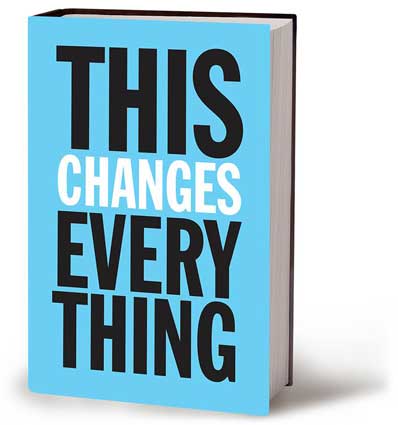
This book made me cry, multiple times. I cried, I was shocked, I was angered and horrified. And I also felt the first real sense of ambitious hope ignited in me since I started reading climate change literature when I was a senior in high school. Naomi Klein’s This Changes Everything really does change everything: she has shifted the winds on the climate change debate, addressing head on that the ideology of unregulated free market capitalism is standing directly in the way of any meaningful action that could be taken to keep human beings—and particularly the fossil fuel industry—from making Earth uninhabitable for the human species and most complex forms of life.
The nearly five hundred page book lays out the parallel histories of the climate movement and the globalization of free market capitalism, showing how in the last two decades—in which we knew that the build-up of greenhouse gases in the atmosphere was anthropogenic—we not only failed to address the issue but accelerated the rates of our emissions in the name of profit for multinational corporations. Indeed, I find it particularly significant that the Rio Earth Summit was held in 1992, the same year the North American Free Trade Agreement (NAFTA) was signed into law. Again and again, efforts to reduce emissions and mitigate the impacts of climate change have been directly challenged, and defeated by, the unregulated capitalist model whose agenda is being pushed by the minority corporate-political elites who are concentrating the world’s wealth into their own pockets.
The clarity, precision, and nuance of Klein’s book is staggering, and I feel gives it tremendous credibility. She seems to have left no stone unturned, and addresses the light and shadow of every situation, presenting the moral issues at stake without moralizing. I devoured this book, taking it in over the course of about four days, so the energy and tone completely shaped my waking and breathing mind and body as I read it. Klein brings together a huge range of interconnected issues—from the conservative denialist reaction, to the extractivist mentality that treats Earth as resource without the need to reciprocate, the unholy alliance of Big Green environmental groups and corporate powers, the terrifying hubristic possibility of geoengineering, and the micro-movements she refers to as Blockadia that are fighting extractivism, exploitation, and toxicity in local communities worldwide. I came to understand that the work Indigenous communities are doing to save their lands and ways of life, because they have the rights but not the power to enforce them, are perhaps our last best chance to overthrow the corporate stranglehold on our planet. As Klein writes,
Their heroic battles are not just their people’s best chance of a healthy future . . . they could very well be the best chance for the rest of us to continue enjoying a climate that is hospitable to human life. That is a huge burden to bear and that these communities are bearing it with shockingly little support from the rest of us is an unspeakable social injustice.[1]
Again and again, I felt affirmed that there was something I could do, something we each could do, that would make a tangible difference in whether humanity—and many of our fellow species—will have a future on this beautiful planet. It is simply, or not so simply, a matter of daring to challenge the status quo that has left us a world of inequality, exploitation, and injustice. As Klein writes, “It is slowly dawning on a great many of us that no one is going to step in and fix this crisis; that if change is to take place it will only be because leadership bubbled up from below.”[2]
The next time a major disaster hits, such as Hurricane Katrina, or Superstorm Sandy—as is becoming all the more frequent with climate change—will be the moment to seize when we can indeed change everything:
Because these moments when the impossible seems suddenly possible are excruciatingly rare and precious. That means more must be made of them. The next time one arises, it must be harnessed not only to denounce the world as it is, and build fleeting pockets of liberated space. It must be the catalyst to actually build the world that will keep us all safe.[3]
One criticism I have heard of Klein’s book is that it is too idealistic. In a way, this could be true. But I have come to realize that we do not have the time not to be idealistic. In Klein’s words, “The stakes are simply too high, and time too short, to settle for anything less.”[4]
Work Cited
Klein, Naomi. This Changes Everything. New York, NY: Simon & Schuster, 2014.
[1] Naomi Klein, This Changes Everything (New York, NY: Simon & Schuster, 2014), 379.
The seventh section of Global Environmental Politics felt to me to be the most important part of this book: “Race, Class, and Geopolitical Difference.” In five concise chapters the oxymoronic ideal of “sustainable growth” and the insanity of basing the well-being of a nation on the numbers of Gross Domestic Product (GDP) were debunked, and environmental colonialism and racism were brought forward as the darkest shadows of the global economic and social systems. Without addressing ecological justice issues humanity cannot change our destructive impact on Earth’s systems—ecology and justice are inseparably intertwined.
Herman Daly lays out in plain terms how the delusional myth of economic growth is simply not possible on a finite planet, whether we label it sustainable or not. This perspective ties in with Jonathan Rowe’s explanation of GDP, and how this worshipped number counts as positive the most destructive aspects of society. He writes,
Cooking at home, talking with kids, walking instead of driving, involve less expenditure of money than do their commercial counterparts. Solid marriages involve less expenditure for counseling and divorce. Thus they are threats to the economy as portrayed in the GDP. By that standard, the best kids are the ones that eat the most junk food and exercise the least, because they will run up the biggest medical bills for obesity and diabetes.[1]
Is it any wonder that the human relationship with the Earth’s ecosystems is broken when our own society is so fractured by a misplacement of values? How can we continue to appeal to the economy as the highest good when it is destroying the very fabric of relationship between humans and within ecosystems?
The latter half of the book’s seventh section portrays the blatant injustice done upon the populations of the global South in the distribution of the costs and accountability for climate change and pollution. Colonialism is as much alive today as it was under the British Empire, but it is disguised by other names and economic ideologies that allow egregious injustices to be perpetrated upon the world’s poor. The final chapter by Robert Bullard, “Environmental Racism and the Environmental Justice Movement,” shows not only how internationally toxic waste is foisted upon those with no political power to protect themselves, but even how the U.S. is a microcosm of this international situation as pollutants are outsourced to minority communities that lack the political voice to speak in their own defense. What shocked me most was how consciously this location of toxic materials is chosen by those in power, whether the majority white zoning boards and planning commissions or top officials in the World Bank. Bullard concludes by saying,
The crux of the problem is that the mainstream environmental movement has not sufficiently addressed the fact that social inequality and imbalances of social power are at the heart of environmental degradation, resource depletion, pollution, and even overpopulation. The environmental crisis can simply not be solved effectively without social justice.[2]
As a white person living in the San Francisco Bay Area of California, one of the wealthiest locations on the planet, I can feel my tremendous privilege and social position as I read these words. I have to ask myself—stripped of naive idealism—what real power do I have to make changes on behalf of social justice that are in responsible allyship, that do not perpetuate the systemic injustice that stratifies this world? Simply put, as one individual, how can I help?
Work Cited
Nicholson, Simon and Paul Wapner, ed. Global Environmental Politics. Boulder, CO: Paradigm Publishers, 2015.
[1] Jonathan Rowe, “Who is an Economy For?: Rethinking gdp,” in Global Environmental Politics, ed. Simon Nicholson and Paul Wapner (Boulder, CO: Paradigm Publishers, 2015), 222.
[2] Robert Bullard, “Environmental Racism and the Environmental Justice Movement,” in Global Environmental Politics, ed. Simon Nicholson and Paul Wapner (Boulder, CO: Paradigm Publishers, 2015), 245.
Owen Barfield’s Poetic Diction—first published during his Saturn return—lays forth, in simple yet elegant terms, an argument for the evolution of consciousness. By tracing the differentiating meaning of words through the history of poetry, he reveals the participatory relationship of humanity with the cosmos. Barfield argues against the mainstream perspective held by philologists of his time that the origins of the words for abstract concepts find their roots in metaphors for concrete objects. Most philologists assumed words gained meaning by the use of intentional metaphors: for example, the contemporary word spirit has its roots in the ancient word for wind, therefore the assumption was that an ancient poet once decided to draw a metaphor between the blowing gusts of wind and the principle for life animating living beings.
Barfield posits an alternative theory. From his understanding, these primal words are not metaphorical but rather contain within them the full meaning—the spectrum of spirit and wind and all between—in a single utterance. He writes that “these poetic, and apparently ‘metaphorical’ values were latent in meaning from the beginning.”[1] Only over time, and through a changing of consciousness in human beings, is the “undivided meaning”[2] of words split apart, so that now wind refers to a material reality and spirit to an abstract thought. Barfield argues that it is not the case that “the earliest words in use were ‘the names of sensible, material objects’ and nothing more.”[3] Rather, one “must suppose the ‘sensible objects’ themselves to have been something more; you must suppose they were not, as they appear to be at present, isolated, or detached, from thinking and feeling.”[4] Language, in Barfield’s view, reveals the ensoulment of the cosmos once perceptible to ancient human consciousness, a quality revealed through true metaphor. A true metaphor was once a single ancient word, a unified meaning expressed not only in human language but in the language of the world.
Barfield’s thesis holds profound implications for a question often asked of astrologers: how was it that the ancients knew what names to give the planets so that their corresponding mythic figures expressed the same archetypal characteristics that are still carried in the astrological manifestations apparent today? How was the planet Venus aptly named after the Goddess of Beauty, or Mercury after the Messenger of the Gods, when Venus in the birth chart relates to love, beauty, romance, and artistic expression, and Mercury relates to communication, thought, speech, intellect, writing, and learning? The question is being asked with the same modern mindset as the philologists who assumed that consciousness has remained the same throughout time, and that humanity has only come to understand the world better through the acquisition of knowledge. Rather, as Barfield articulates, to ancient consciousness a physical object was inherently imbued with resonant, ensouled presence. This is the ‘undivided meaning’ of which Barfield speaks, the metaphor that exists latently in the word before a later consciousness has split it asunder. Our contemporary language cannot fully capture this ‘undivided meaning’ even as I try to describe it, because in the language I am using psyche and physis long ago diverged from one another.
The consciousness that in modernity wiped away the horizon of meaning, to paraphrase Nietzsche, cannot perceive in the world the unity of archetype and object, universal and particular. They are fundamentally split, finally to the point of unrelatedness. Yet, reawakening within an archetypal cosmos, the unity of archetype and manifestation is once again apparent, but from the other side of a long history of differentiation. The undivided meaning of words has splintered again and again—the white light has passed through the prism to be refracted into a myriad of colors—and the consciousness living in a reenchanted, archetypally patterned world view can witness both the differentiation and unity at once. The language of the archetypes hearkens back to a time when the world reverberated with unified, ensouled, embodied meaning. Yet now it is possible, through conscious participation, to once again hear the song of the spheres. But instead of the cosmos simply singing to us as our ancestors once experienced it, we are able to read the score and, along with the cosmos, play its song back in harmony. Through his passion Barfield lets his readers feel the “beating heart of poetry”[5] as it once lived, and to recognize that its poetic rhythm is the beating heart of the cosmos itself.
Work Cited
Barfield, Owen. Poetic Diction: A Study in Meaning. Oxford, England: Barfield Press, 2010.
[1] Owen Barfield, Poetic Diction: A Study in Meaning (Oxford, England: Barfield Press, 2010), 77.
In the first few pages of his book, Dale Jamieson situates his perspective as coming from a generally Western point of view, saying that although he lived through many of the events he details in the book he was not at the center of the action. I appreciated this nod to recognizing his position in relation to the material he was addressing, although I wished he had continued to do so more throughout the book—and had addressed other influences on perspective such as gender, race, class, and so forth. Jamieson acknowledges at the outset that he is coming from the perspective of an analytical philosopher, but that very position seems to blind him to the multiplicity of perspectives that can be taken in relation to the issue of climate change.
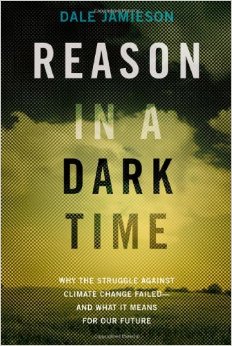
Reason in a Dark Time, simply put, is a pessimistic book. Jamieson shows his readers how globally we have failed to address climate change. The outlook feels bleak, and his concluding seven priorities for action do not seem to carry much hope considering he has spent the previous 200 hundred pages demonstrating how dysfunctionally the international negotiation system operates. The core of the book focuses on what Jamieson identifies as the most powerful motivators for addressing climate change: economics and ethics—before showing the limits and barriers in each of these arenas. The most telling sentence in the whole book, for me, that reveals Jamieson’s perspective and its influence on his pessimistic view, is when he writes: “We live in a post-Nietschean world in which the gods are not available to give meaning to our lives, nor can nature provide transcendental grounding in a human-dominated world.”[1] For a book that is addressing global climate change and the effects it will have on the world population now and into the future, the unsituated “we” that opens this sentence is particularly revealing. Rather, Jamieson and his colleagues live in this post-Nietschean world and it is from this place that this book on economics and ethics is written. Part of the opportunity with which the global ecological crisis provides us is the potential to forge a way through the dark postmodern underworld where the gods are dead and nature is a backgrounded resource to a new world view that has room for intelligence and meaning to exist beyond the locus of the human being.
Where is the room in Jamieson’s approach to climate change for emotion, feeling, a sense of interconnection and, perhaps most importantly, grief at the loss and destruction? Ethics cannot be broken down into a series of equations like economics can—something deeper must be appealed to. At times this depth is almost reached by Jamieson, momentarily making appeals to “love, sympathy, and empathy”[2] and to an understanding of humanity as being a part of the natural world. Indeed, he writes that “we find meaning in our lives in the context of our relationship to humans, other animals, the rest of nature, and the world generally.”[3] However, just a few pages later he once again reduces the value of this relationship into economic terms, writing “The idea of nature as a partner in a valuable relationship makes itself felt in economic language when people talk about ‘natural capital’ or ‘ecosystem services.’ On this view protecting nature returns monetized benefits. Damaging nature damages ourselves.”[4] The appeals to meaning found in relationship feel hollow if they can simply be reduced into monetary terms.
Jamieson concludes his book by saying, “Despite the unprecedented nature of the challenge, human life will have meaning as long as there are people to take up the burden.”[5] Yes, I agree that great meaning can be found in taking on the work of defending the Earth and its countless species, as well as the multitude of human beings whose lives and livelihoods are threatened by the rapacious capitalist economy. But the meaning is not made simply by the work of human actions—the work is what reconnects our sense of value to that ground of meaning inherent in every creature, in every corner of the vast cosmos within which we are awakening to our integral part.
Work Cited
Jamieson, Dale. Reason in a Dark Time: Why the Struggle Against Climate Change Failed—And What It Means for Our Future. New York, NY: Oxford University Press, 2014.
[1] Dale Jamieson, Reason in a Dark Time: Why the Struggle Against Climate Change Failed—And What It Means for Our Future (New York, NY: Oxford University Press, 2014), 200.
The discussion in the fifth section of Simon Nicholson and Paul Wapner’s book is entirely on the economic system and its impact and influence on the global environment. The section is titled simply “Economy,” but really it should be titled “Capitalism” for that is the only economic system that is actually addressed. The three chapters of the section present gradations from greening the industrial growth economy to addressing the hard truth that capitalism and human greed are the heart of the problem. While reading Peter Dauvergne and Jane Lister’s chapter on “The Promise of Corporate Environmentalism” I found myself feeling the hollowness of those promises. Big brand corporations making non-binding commitments of vague outcomes such as “delivering sustainable growth” and “performance without compromising sustainability”[1] in order to preserve their image, while still increasing the total destructive impact upon the planet, actually seems like a greater hindrance to the cause because it obscures where the real problems lie: in a model of trade that depends on exponential growth, exploitation, and limitless greed.
Paul Krugman’s chapter, “Environmental Economics 101: Overcoming Market Failures” addresses more realistically the ways in which the free market cannot address global ecological issues such as climate change. Yet ultimately his solutions also return to the altar of capitalism, simply relying on regulations and taxes to mitigate the crisis. An economic solution inherently calculates all loss in terms of monetary value alone, something that cannot account for the great suffering climate change will unleash—indeed, it has already begun—upon humans, animal and plant species, and entire ecosystems.
Finally, Naomi Klein’s piece, “Capitalism vs. Climate” dared to question the ideology of capitalism itself. In reading her portrayal of the climate change deniers of the conservative right in the US—who go to great lengths to prove global warming is a hoax, at times even sending death threats to climate scientists—I could not help but be curious at the psychology behind such actions. Clearly fear is a powerful motivator, but fear of what? Is it really fear of dismantling the capitalist system? Fear of freedoms being taken away? Or is there also a deep-seated existential fear of climate change itself? Allowing oneself to feel the true losses climate change will wreak across the globe—to a greater or lesser extent no matter what action is taken—is not central to the ideologies of right or left. What does fear of these losses blind us to? And what, on the opposite end of the spectrum, do they awaken in us?
Work Cited
Nicholson, Simon and Paul Wapner, ed. Global Environmental Politics. Boulder, CO: Paradigm Publishers, 2015.
[1] Peter Dauverge & Jane Lister, “The Promise of Corporate Environmentalism,” in Global Environmental Politics, ed. Simon Nicholson and Paul Wapner (Boulder, CO: Paradigm Publishers, 2015), 157.
“There are many types of wilderness, literal and figurative; there are many types of thirst, material and spiritual. But there is only one water molecule that sustains life in conditions of aridity; its presence or absence shapes human lives.” – Christiana Peppard[1]
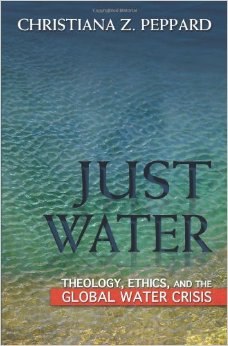
Not until my final day of reading this book did a friend point out to me the dual meaning of the title of Christiana Peppard’s short book Just Water. While it sounds as though Peppard may be indicating that the book is explicitly focused on water, the subtitle, Theology, Ethics, and the Global Water Crisis, indicate that the book is about much more, and that the “just” in the title is additionally pointing towards the justice issues bound up within the fresh water crises plaguing the planet. Just Water is about the justice of water, and Peppard is addressing the water crisis from the angle that access to fresh water is a right-to-life issue, particularly as defined by the Catholic Church. First of all, I was struck by the astrological correlation in the world transits that took place over the roughly two week period when I was reading this book along with my classmates in the course Ecology in a Time of Planetary Crisis. Over this period of time the Sun has been in a conjunction with the planet Neptune, and the archetype of the Sun in world transits sheds light, and brings focus and clarity upon whatever it touches, which in this case is the Neptunian realm of water, spirituality, religion, and ethics. Furthermore, the Sun-Neptune conjunction is square to Saturn, which archetypally relates to crisis, conflict, shortage, pollution, and justice. Saturn-Neptune, which first came into orb about a year ago and will be in the sky for nearly three more years, can manifest in world events as drought, water shortage, contamination and toxicity, and conflicts over water rights, among many other multivalent expressions. To be reading Just Water when the Sun was aligned with this transit felt particularly significant. As for the content of the book itself, I found myself having mixed feelings about how the material was presented. The chapters relating directly to the global water crisis—or crises as Peppard points out, since the issues with water are diverse and differentiated based on local context—were extremely engaging, important to take in, and indeed quite frightening. The second chapter especially, titled “A Primer on the Global Fresh Water Crisis” laid out many of the hard facts of how human beings are using and wasting water, mining “fossil water” from aquifers that will never be replenished on a human timescale, and capitalizing on water packaged in disposable plastic bottles sold to those in first world countries who have easy access to clean tap water, while millions around the world do not have a guaranteed source of clean, fresh water. The global water crisis is afflicting those who are not causing it to a highly disproportionate degree, while those who are responsible are largely sheltered from the effects. The parts of the book with which I struggled most were when Peppard drew on the teaching of the Catholic Church, particularly Catholic Social Teaching (CST), as an ethical resource for how to address the water crises. While I felt she had a legitimate argument for drawing on CST, at the same time the chapters relating to the Church felt disjointed and at odds with the rest of the book, as though they were not fully integrated. If the title of the book had been Just Water: Catholic Theology, Ethics, and the Global Water Crisis I could have understood better where she was coming from, but in reading the book it felt like she was trying to use the Catholic voice as the sole ethical voice addressing the water crises. While this is not necessarily true, I still wish Peppard had defined her position more clearly from the beginning, even in the title, or that she had drawn on other religious and spiritual traditions to provide additional ethical perspectives on the issue of water rights. I came away from reading this book recognizing that the global water crisis is as dire as climate change, and yet does not receive nearly the level of press as global warming does. While I can go online and roughly calculate my carbon footprint, I do not know how to calculate my water footprint: the amount of water that goes into everything I use, from the water I drink and bathe in, to the water used to grow everything I eat, to the water used to make all of the products that see me through my day-to-day existence. I cannot even begin to fathom the scale of that water usage, and yet it feels so essential that I be able to access this information and somehow change my behavior based upon it.
Work Cited
Peppard, Christiana Z. Just Water: Theology, Ethics, and the Global Water Crisis. Maryknoll, NY: Orbis Books, 2014.
[1] Christiana Z. Peppard, Just Water: Theology, Ethics, and the Global Water Crisis (Maryknoll, NY: Orbis Books, 2014), 182.




 Becca Tarnas