Metamorphosis of the Unwilling

My body felt heavy, awkward. I did not actually want to dance. Staying safely curled up in the soft cushions of the chair, cocooned in a warm blanket, seemed far more appealing. So I did something I do not usually allow myself to do. When called forward to dance I asked if I could wait. To see when, or even if, my body had any desire to come out of its instinct to remain hidden and safely nestled in obscurity.

I waited. Beautiful bodies danced before me. I waited longer. I witnessed. Now? Almost. . .

Stop planning, I told myself. Stop trying to control this moment, or know what moves you think you know how to make.

I waited. The waiting turned into something else. Waiting. Ah. . .  that’s when you know you’ve somehow moved to the edge of your seat.

My feeling of inward hesitation led me to surrender all mental control of what I was supposed to do next. If I didn’t want to dance I didn’t want to plan it either. I stepped forward, not knowing what song momentarily would come to fill the swollen silence that now held me in subdued anticipation. In those brief, still moments I moved about, first contemplating a chair in the corner, then leaning against the wall, and finally just sitting with my knees tucked up on the floor. I wrapped myself in a long piece of fur. I could bring my inwardness and hesitation into the heart of this unstarted dance, holding myself in warmth and comfort even here.

Then the music began. Then the music began to move me. I had nothing to do. My body somehow knew how to follow.

With each beat one shoulder, then the other, moved a little. The fur slipped down, inch by inch. As my movement unfolded I felt I was being led, led by sound and the intelligence of my body riding those musical waves. The fur stayed with me, followed me, like it too had its own dance it wished to play out upon my body. Few thoughts arose, only points of memory-formation, tagging this moment or that for posterity. Not all stayed with me. Much of this dance is a blur that whirled away into the moments that drew the dance forth from me. Somehow I moved from the floor to the wall. My body, the fur, the music, all knew what to do. I did not. Nor did I need to.

Sensation led me forward, leaving the support of the wall. The metal pole stretching from ceiling to floor, an arboreal axis, called me forward. Giving myself the mental option never to dance with this powerful object during the course of this song allowed the desire instead to co-arise between my body and the music. As I walked toward the pole the fur dragged behind me; it left my grasp without thought the moment I no longer needed its comfort and support.

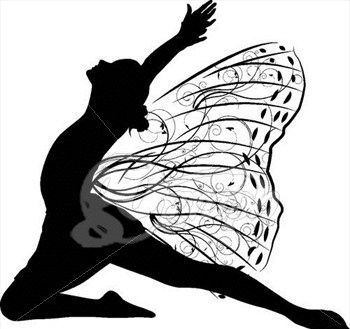
The pole calls forth spirals and swirls, a spinning energy that can only exist between flexibility and stability. I do not know how I danced, but only that my body was sending ripples of exuberance through my consciousness, a recognition that I was doing what I could not plan. I ascended the stretch of metal a foot, two, three, with a feeling like the internal inch of a caterpillar along a vertical branch. Seated above the ground I let my hands go, trusting the security of my legs, spreading my wings behind me. A caterpillar no more, I opened myself into metamorphosis, descending to the rhythm of a musical heartbeat.

Butterfly Dancer


Incarnation

Bury me in my immanence,
These bones who hold me in,
Under flesh, underground,
Beneath gravity of skin.

What does it mean
To walk this Earth?
What does it mean
When these bodies come to birth?

Immersed in this flesh,
A mirror from below.
Songs echo from the deep
As the child learns to grow.

Each unfolding limb
A living fossil entwined:
The eye of the storm
In the whirlpools of the mind.

Stretch for the stars,
Bury your toes in the sand.
If I look in your eyes
Will you hold my hand?

What does it mean
To walk this Earth?
What does it mean
When these bodies come to birth?

Limber laughter enmeshed
In each step we take,
From these early paces
To final footpad ache.

Walk with me sister,
Walk with me son,
Tread this careful curve
Where multitude is One.

Sing with the clouds
As they cross the sky,
Breathe out all staleness
With a synchronized sigh.

I want to tread this path,
With you always by,
When we play, flow, and dance,
Hold council and cry.

What does it mean
To walk this Earth?
What does it mean
When these bodies come to birth?

Dance this Earth prayer
As long as we breathe,
Bury me in my immanence,
To find joy with all who grieve.

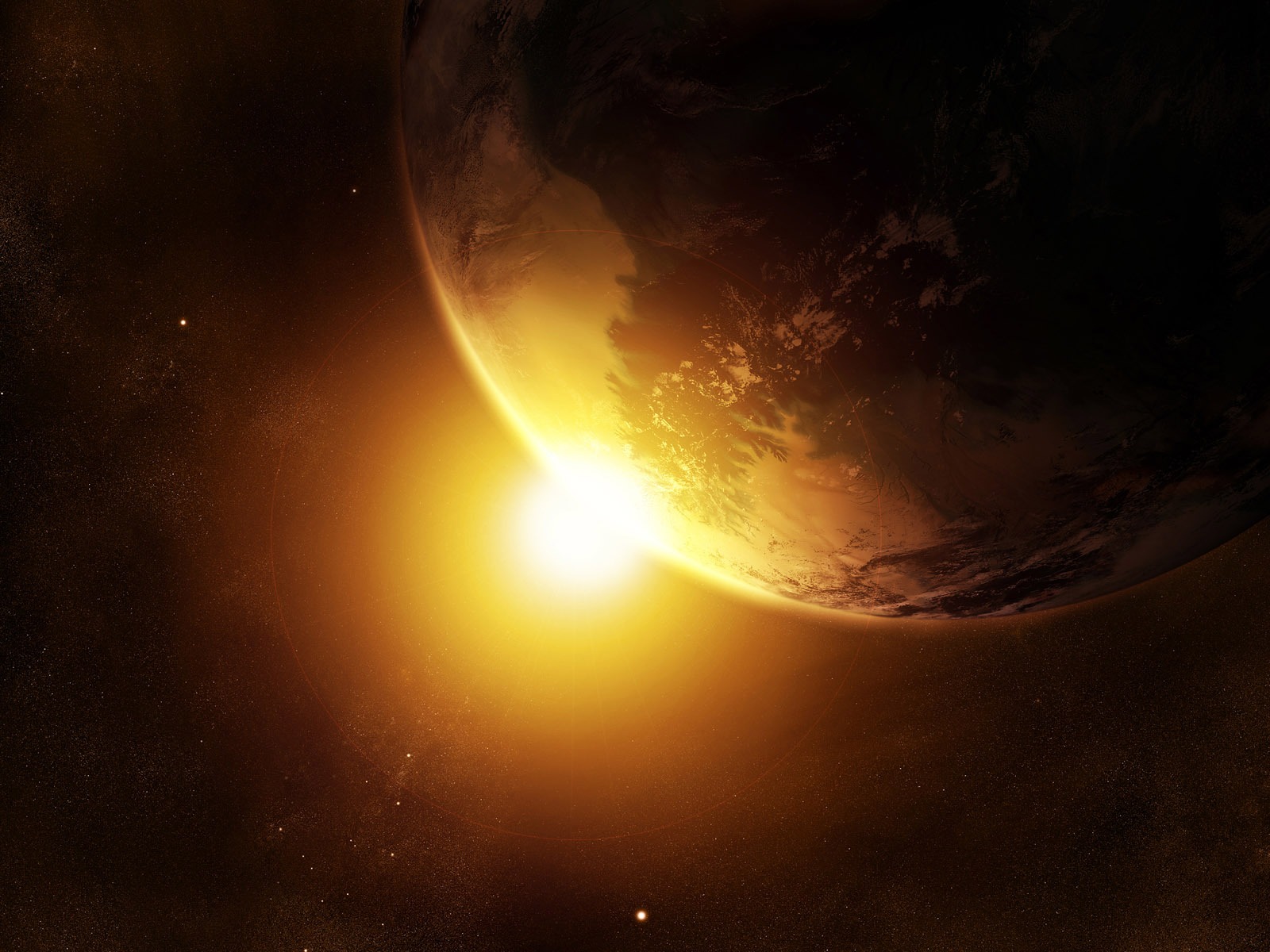
Earth and Sunrise

Co-Created Movement

The soles of my leather shoes are thin, allowing me to feel the contours of the path with each step. The thick layer of redwood leaves that slowly disintegrates into the rich canyon soil, soften the sounds of all the footsteps being taken around me. A meandering line of people are wending their quiet way along this forest path, each connected to one another, yet simultaneously enclosed in their own imagination-suffused worlds. The path bends to the right, taking a steep dive toward the clear, spring-fed creek. This is the place we cross, leaving the soft path momentarily, to leap from rock to rock, staying precariously above the chill waters below.

Photo by Matthew David Segall

I watch as the first person in this line of individuals begins to descend. Her arms flail slightly, not reaching for an object to steady her, yet monitoring her balance nonetheless. It seems she is about to fall and a ripple of concern echoes back through the group of waiting walkers, some expressed verbally, others merely in a position of body or facial expression. No, she assures us. She often can look as though she is about to topple off her feet, but this is just how she finds her balance. She apologizes for worrying anyone, and continues to make her wavering descent.

The next person, who is walking directly before me, begins to take careful steps down the winding way, with a greater steadiness in his footfall, but still with arms out to balance his movement. No one is concerned for his safety, however. His is not a gait that inspires uncertainty.

Without thinking I begin to move next along the trail. In a state of reflective curiosity I observe my own movement, fascinated by how the way I move might differ from those ahead of me now stepping or leaping from boulder to boulder over the cold stream. My arms are relaxed by my side, and I feel my footsteps fall evenly forward, one after the other. I find my balance like a line within myself. Why do I not use my arms? What is giving me this sense of stability? I recognize that I know this path, having walked it countless times from childhood into adulthood, and wonder if that history is built into my sense of balance now. My feet, my legs, the whole length of my body knows the placement of this path before my mind has a chance to reflect on it.

What, I ask myself, is movement? One usually thinks of movement as arising from the body of a person or other being who is moving with agency through the world. The uniqueness of movement seems to arise from the body and personality of the individual. Yet in this moment, as I watch myself and others navigate the winding, steep path by the stream, I realize how all movement is really a co-creation. Movement arises not from the individual’s agency but rather in the intermediate place between the individual—with all her history, personality, unconscious material, physical qualities, and so forth—and the dynamic contours of the surrounding world. The movement itself, although I might call it mine, is rather both mine and the world’s as we press into each other with each passing moment.

Psyche in Breath

“Breathing is our very first teaching—a silent teaching—in the way of interdependency, continuity, relationship, giving and receiving. Our first teaching is one of perfect integration, harmony, non-duality. Breathing comes naturally; it is so rudimentary that it requires no action of volition, no attention or thought. But, for that very reason, the wisdom of breathing is the most difficult, and the very last to be learned.”
– David Michael Levin[1]

Do not put a butterfly in a bell jar,
She is no rose.
No still whorl of petals,
No silent standing stem
To be gazed at from without,
To be denied an inner landscape
From within.

What is this translucent glass,
This invisible barring shield?
Does it keep her safe,
Preserve her from decay?
While a rose’s petals will fall,
A butterfly’s soul
Will not stay.

A life’s breath is finite
When thus closed in.
A life’s breath is finite
When one is shut in.
When all the air’s depleted
What new may
Begin?

Each wing beat a breath,
Each breath a wing beat
In her fluttering breast.
Count each beat,
Count each rest,
Count each moment,
For Self begins in breath.

Breathe deep, wingéd soul,
Sing your heartfelt song.
Expand this element
That you are,
Expand your heart
Beyond the confines
Of this bell jar.

Two images I see
When I say “glass blown”:
A shattering crash
Of splintered glass,
As air forces through
And you fly to the
Unknown.

Or softer yet, though dangerous
Nonetheless:
A warmth, a temperance
Melts the glass from within,
Melting out, melting forth,
Melting away
Oh, begin.

Each wing beat a breath,
Each breath a wing beat
In her fluttering breast.
Count each beat,
Count each rest,
Count each moment,
Now Self begins in breath.

Butterfly in Bell Jar

Work Cited

Levin, David Michael. “Logos and Psyche: A Hermeneutics of Breathing.” Research in Phenomenology 14 (1984): 121-147.


[1] David Michael Levin, “Logos and Psyche: A Hermeneutics of Breathing,” Research in Phenomenology 14 (1984): 129.

Bridging Our Attitudes Toward Nature

“Phusis kruptesthai philei”

For twenty-five hundred years the concept of Nature has evolved through the writings of Western History. The myriad meanings of the Greek word phusis have unfolded through history as Nature personified, Nature divine, Nature hidden, Nature secretive, nature separate from humanity, nature inclusive of humanity, nature as dead matter, Nature as art, Nature as All. Pierre Hadot traces this winding history in his book-length essay The Veil of Isis by examining the famous aphorism attributed to the philosopher Heraclitus, “phusis kruptesthai philei,” usually translated as “Nature loves to hide.”[1] Using these three cryptic words, whose meaning it seems also loves to hide, Hadot explores the many different ways this aphorism could be—and has been—translated, and the various effects such interpretations have had upon the continuing relationship humanity has with the world into which we each are born. Hadot perceives how traditional metaphors such as Heraclitus’ phrase will

hold sway for centuries over successive generations like a kind of program to be realized, a task to be accomplished, or an attitude to be assumed, even if, throughout the ages, the meaning given to these sentences, images, and metaphors can be profoundly modified.[2]

He goes on to note that “To write the history of a thought is sometimes to write the history of a series of misinterpretations.”[3]

Isis Veiled

Why is it that Nature loves to hide? What is it she—for in Hadot’s traced lineage Nature is always unquestioningly personified as female—is hiding, and from whom is she hiding it? History has offered many answers, from Nature as divine mystery, to Nature as weak and inferior and thus wrapped up in shame, Nature as clothed in imagination, Nature as malicious toward humanity, Nature protective of humanity: all of these and more have been reasons given for why Nature’s veils have been deemed so difficult to peel away.

At the beginning of the nineteenth century, the metaphor of the veils and the secrets of Nature never ceases to fade, until it gives way to amazement before an unveiled Nature, which, in Goethe’s expression, henceforth became “mysterious in full daylight,” in the nudity of her presence.[4]

The image of veiled Nature has tempted the curiosity of humanity from deep into our ancestral memory until the present day, although the understanding of who and what Nature is has shifted dramatically over that time.

Hadot posits two archetypal narratives to illustrate what he sees as the primary approaches humanity has taken in the quest to unveil Nature: the Promethean and the Orphic. In Hadot’s own words, these approaches or perspectives can be understood as follows:

Orpheus thus penetrates the secrets of nature not through violence but through melody, rhythm, and harmony. Whereas the Promethean attitude is inspired by audacity, boundless curiosity, the will to power, and the search for utility, the Orphic attitude, by contrast, is inspired by respect in the face of mystery and disinterestedness.[5]

The Promethean attitude is based upon a notion of progress in which humanity will some day attain all of nature’s veiled secrets so that they might be put to use for the betterment of the human species. The three main methods of the Promethean attitude, as Hadot delineates them, are that of experimentation, mechanics, and magic, all of which manipulate nature in some way for a specific end. In this perspective Nature is seen as hiding her secrets out of hostility for humanity, keeping her knowledge hidden due to a kind of spite.

The Orphic attitude takes the approach that “if nature has hidden certain things, then it had good reasons to hide them.”[6] In many ways the Orphic is an antidote to the Promethean, although it extends far beyond that as well. The Orphic approach is that of approaching nature through the contemplation of art, poetry, music, classical physics, and myth. Hadot’s archetypal analysis of nature is itself an Orphic approach, in that he draws on myth and art to unfold the meanings of humanity’s changing relationship to the natural world.

In our current era of ecological destruction and crisis, understanding what is at stake and how we came to this precipice is key to moving in a new direction. If we do not have an understanding of what humanity has perceived nature to be throughout history then we have little chance of knowing how to heal our relationship to that which we call nature. Although in The Veil of Isis Hadot seems to favor more of an Orphic approach, in that it is more holistic, contemplative, non-violent, and non-exploitative, it could be that finding a bridge between the two perspectives is a better way forward. Although a deep chasm has often separated the two, Hadot offers examples of individual thinkers who embody both perspectives within themselves. For example, to dive back toward Western philosophy’s beginnings, Hadot demonstrates how Plato carries both a Promethean and Orphic attitude within his works. In the Timaeus, “Plato represents the world fashioned in an artisanal way,” but that world can also be understood through mechanical, mathematical models.[7] Plato saw phusis as divine art.[8] For Hadot, the view of nature as art is in itself part of a solution for overcoming the division of human and nature that has contributed to create the ecological crisis.

If. . . people consider themselves a part of nature because art is already present in it, there will no longer be opposition between nature and art; instead, human art, especially in its aesthetic aspect, will be in a sense the prolongation of nature, and then there will no longer be any relation of dominance between nature and mankind.[9]

Hadot’s work is not prescriptive, yet he indicates that finding bridges may be what is needed: a bridge between Promethean and Orphic, a bridge between humanity and nature—and in many ways art is able to fill this bridging role.


Work Cited

Hadot, Pierre. The Veil of Isis: An Essay on the History of the Idea of Nature. Translated by Michael Chase. Cambridge, MA: The Belknap Press of Harvard University Press, 2006.


[1] Pierre Hadot, The Veil of Isis: An Essay on the History of the Idea of Nature, trans. Michael Chase (Cambridge, MA: The Belknap Press of Harvard University Press, 2006), 1.

[2] Hadot, The Veil of Isis, xiii.

[3] Hadot, The Veil of Isis, 14.

[4] Ibid, 87.

[5] Hadot, The Veil of Isis, 96.

[6] Ibid, 91.

[7] Hadot, The Veil of Isis, 97.

[8] Ibid, 22.

[9] Ibid, 92.

The Myth of Er

Can argument be presented in the form of myth? What more does myth offer that simple argument is unable to provide? What lies between the simple spoken words of myth that is conveyed as a whole through its telling? And what might be lost in using such a form of argument? Plato ends the ten books of the Republic with what has been referred to as the Myth of Er. After much dialogue in Book X around the ills of poetic imitation, Socrates nonetheless concludes the long dialogue with a narrative of such poetic grace that it seems almost to upset the very balance of the entire dialogue. Only six pages in length, the Myth of Er somehow tips the scales of the Republic, as much of the dialogue must now be reinterpreted through the multifaceted lens of Er’s tale.

Socrates implies that he knew this myth even before the dialogue began. Yet it is only through the unfolding of the dialogue that the myth becomes an appropriate ending. How differently the Republic would read if it were to begin, rather than end, with the Myth of Er. Socrates also does not present this myth as a likely story, begun with such a disclaimer as “This is what I’ve heard” as he does in the Phaedrus, or other dialogues.[1] Throughout the myth Socrates emphasizes that Er was chosen to be the messenger to humanity about what he sees take place between death and new birth. This intentionality gives the impression that this knowledge is not given by accident, or abducted by the cleverness of humanity, but rather is a gift from the gods, an account meant to be shared and known.[2] Is Er’s tale really then a myth, or is it being presented as an empirical report? Or is Socrates creating this story in the moment, a narrative weaving of all the threads of argument that have come forward in some way or other in the previous ten books?

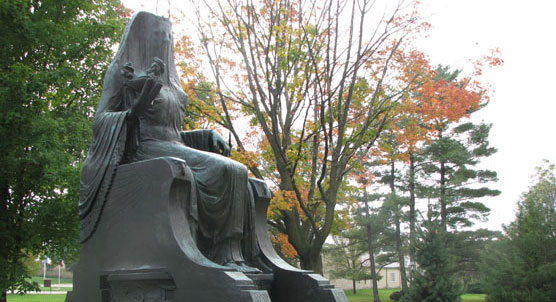
Spindle of Necessity

The theme of the Republic is justice, and until this final book the focus has been on how to know justice in the world of the living. The Myth of Er shows the other side of that coin, which perhaps explains why it carries so much weight in the balance of the dialogue. What roles do justice and injustice play once a life has ended? Socrates presents an account of this in which fate is intermingled with free choice, and seems to conclude that it is only the philosopher who truly remains free.

On his journey beyond the bounds of death, Er first encounters the judges seated at the entrances and exits of heaven and hell. Once a life has ended these judges determine whether a soul has led a just or unjust life, and send the soul accordingly towards its punishments or rewards. Socrates says that

For each in turn of the unjust things they had done and for each in turn of the people they had wronged, they paid the penalty ten times over, once in every century of their journey. . . But if they had done good deeds and had become just and pious, they were rewarded according to the same scale.[3]

In this judgment of the just from the unjust, it is interesting to note that there is no intermediate place for a soul to go; one’s life is either deemed to fall under one or another category, even though most lives would all seem to contain a mixture of just and unjust actions. The quality of life determines the nature of the rewards or punishments, but the location in which these are bestowed is limited.

Most unjust souls it seems are cleansed by their punishments and sufferings below the Earth, but when Socrates comes to speak of the tyrant Ardiaeus, it is said, “He hasn’t arrived here yet and never will.”[4] Is it possible, within this mythology, that there are “incurably wicked people,”[5] those who will never be given the opportunity to redeem themselves or to end their suffering? When we arrive at the part of the narrative in which their next lives are chosen by souls, I cannot help but wonder what the choosing may have been like for those who never again resurface from the tortures of hell.

The theme of fate and free will is carried strongly by the images of the spindle of Necessity that holds together the whorls of the planetary spheres. Sirens sing the harmony of the spheres, while the three Fates interweave their own melodies with those of the Sirens.[6] As the Fates help spin the planets along their various orbits we are shown how Past, Present, and Future guide the motions of the planets. That the choice of lives takes place within this setting gives a strong indication of the role astrology played in the ancient Greek world view although, as can be seen by the manner in which the lives are chosen, free choice is still an integral part of how one’s fate is woven. The order in which the souls choose a new life is cast by lot—randomly assigned—but the lives chosen are picked by the souls’ own discernment, using the wisdom they gained not only from their previous lives but from their time spent in heaven or hell as well.[7] Lachesis, the Fate of the Past, gives this message to the souls, “Your daemon or guardian spirit will not be assigned to you by lot; you will choose him.”[8] Justice then is not something dispensed by the gods, but rather something cultivated within the individual.

Celestial Spheres

Lachesis’ message continues, “Virtue knows no master; each will possess it to a greater or less degree, depending on whether he values or disdains it. The responsibility lies with the one who makes the choice; the god has none.”[9] Virtue both has no master and yet is also in service to each person should she or he choose to take on that role of master. If this is the case—that the quality of one’s virtue is determined by each individual person—then it seems no matter how carefully constructed a city might be, how could it be guaranteed that justice will reign within the city? Is this the reason Plato ends his dialogue with this myth? To show the role free choice plays in the possession of virtue by souls?

By giving an image of the soul’s journey after death, a certain level of clarity is brought to the difficulty of trying to control reproduction within the ideal city. Even if the parents are all chosen according to standards of high virtue, the souls incarnating ultimately determine the kinds of people they will become. It is interesting to note that Socrates chooses not to recount in the Myth of Er what happens to those souls who are stillborn or short-lived—those who, in the ideal city, might be taken from their mothers and left to die if they seemed unfit to live.[10] If they are deemed in life not to be virtuous and not to deserve life, was that fate also determined before they were born? Why has Plato chosen not to elaborate on this key point? What kind of soul might choose a life which would end so quickly based on their seeming lack of merit in life?

The Myth of Er concludes with Socrates declaring that the most important task one can undertake in life is studying how to determine a virtuous life when the time comes to choose a new one. This is the task of the philosopher, and it here seems as though he deems a life of philosophy to be best for all souls. By studying philosophy, Socrates says,

he will be able, by considering the nature of the soul, to reason out which life is better and which worse and to choose accordingly, calling a life worse if it leads the soul to become more unjust, better if it leads the soul to become more just, and ignoring everything else: We have seen that this is the best way to choose, whether in life or death.[11]

Socrates notes that most of the souls who came from heaven chose less virtuous lives due to their ignorance, while those souls ascending from their time below the Earth were able to choose more wisely because of the suffering they had witnessed and experienced.[12] Only the philosopher was able to choose a virtuous life and also enjoy the rewards of heaven. Socrates is indicating that cultivating the knowledge of justice and injustice, as was demonstrated in practice throughout the ten books of the Republic, will lead to a better soul life than merely being virtuous by habit or constraint. If this is the case then not only must the ruler of the ideal city be a philosopher but each individual citizen must also be, otherwise the city will not be just. Perhaps the ideal city is not one in which control is imposed from without, as has been postulated in many forms throughout the Republic, but rather one in which that compass toward virtue and justice is cultivated within each individual.

The cultivation of inner justice is also perhaps the reason the finale of the Republic is given in the form of a narrative myth: one must cultivate one’s own wisdom in discerning the meaning of the myth. Understanding must come from within. It cannot, as in more direct arguments, be imposed from without. Only then is the soul able to learn the kind of life it wishes to lead.

Works Cited

Plato. Plato: Complete Works. Edited by John M. Cooper. Indianapolis, IN: Hackett, 1997.


[1]Plato, Phaedrus, trans. A. Nehamas and P. Woodruff, in Plato: Complete Works, ed. John M. Cooper (Indianapolis, IN: Hackett, 1997), 551, 274c.

[2] Plato, Republic, trans. G.M.A Grube, in Plato: Complete Works, ed. John M. Cooper (Indianapolis, IN: Hackett, 1997), 1218, 614d.

[3] Plato, Republic, 1218, 615a-b.

[4] Plato, Republic, 1219, 615d.

[5] Plato, Republic, 1219, 615e.

[6] Plato, Republic, 1220, 617c.

[7] Plato, Republic, 1222, 620a.

[8] Plato, Republic, 1220, 617d.

[9] Plato, Republic, 1220, 617e.

[10] Plato, Republic, 1218, 615c.

[11] Plato, Republic, 1221, 618d-e.

[12] Plato, Republic, 1222, 619d.

Ellipsis . . .

. . .

            I begin letters with . . . when I want you to feel what I am feeling, when I want you to suspend for a moment who you are and make space for who I might be instead.

As I climb higher up the gray switchback staircase of rickety wooden boards my body tenses with the increasing height, even as my mind knows I am safe, that the stairs beneath my feet will support me. Already present is that indescribable bodily sense, that physical intuition that seems only able to be captured wordlessly, by something as unarticulated as an ellipsis . . . I step out onto the gravel of the roof to be met by the sight of the flaming orb of the setting Sun. This closest of stars burns the clarity from the landscape, blurring the features of the horizon line being pulled toward it: hill, forest, and stretch of ocean I can only perceive in memory as the deepening gold of sunset shatters my sight into uncountable, undifferentiable monads of color.

Sunset

Sitting on the wide ledge of the roof my body settles into an accustomed level of comfort at this new height. But if I lean closer to the edge, to glance below at the street, then this indescribable bodily sense flares up once again, a seeming leap of my heart into my throat that signifies danger or delight I cannot tell. Why is it that looking down four stories at unforgiving concrete gives the same bodily sensation as looking deeply into the eyes of one I love? Wherein lies the truth of this . . .

Looking away from the Sun I turn to my left to see the Moon seated aloft in a soft indigo sky. The reverberating green echo of the Sun’s shape slowly fades from my vision as the Moon’s gentler light fills my gaze instead. The relationship of these two celestial bodies feels familiar . . . and my body knows it before I do . . . Ah yes, I stood upon a mountain exactly a month ago today, positioned as a third body between these two heavenly beings, seeing them in this same triangular relationship once again. I feel this, sense this, intuit this, I . . . this, my body . . . this: this relationship, this interaction.

Whenever I behold a celestial body ablaze in the night sky it stops me in my tracks, without fail. My body is commanded to stop, to wonder, to worship these orbs. My breath catches. It feels not unlike falling in love . . . over and over and over, with each wandering star I witness. The same as looking down from some great height, but rather it is looking up . . . No it is looking out, a looking out into the depths of space. To behold the Sun, the Moon, a thousand stars is to look up, to look out, and to look down into the greatest depths all at once. No wonder we lose our balance, no wonder our bodies react, they catch us and remind us that gravity is real.

I have seen countless sunsets but no one is the same, no one is ever worth looking away from before it has made its perfected exit. I never say to myself, “Not this time, I have seen this before.” It now becomes impossible to look away as the ocean swallows the flaming disc of molten gold. In these final moments of a day I will never see again I feel my heart pulled, as though by an emotion-laden gravitational force, toward the Sun. My heart strains within my chest to follow the Sun beyond the crashing purple waves.

Wash over me, oh descending night . . . let me drown once more in your celestial waters.

Great Hawk: Presence, Presence This

Hawk

Emotion held, a breath caught, dark feathered wing-tips,
All rush, all bustle, all anxiety—all suspended.
There is but you and me caught in the inhale of this moment.
Or are you me? Is this suspension nothing more than a pause
A breakdown of the barrier that lies between what I understand,
Between what I understand makes you be you
And makes me
Be?

Dark wings soar, cutting hawk shape from textured sky,
Yet when you appear that sky is no more: merely backdrop.
Gripped between razor claws, your prey—my attention—is caught,
Passing mere feet from this barrier I call skin
You land, you presence, you settle, you ignore, you own,
You own my focus, draw me in, alluring
Me to drop all my life in this moment
Simply
To watch.

Heart beat, heart beat, wing beat, breath,
Heart beat, wing beat, heart beat, breath.
The branch moves, the outside world closing out—
Am I within your envelope of tearing want
Or has that gateway closed?
You shred, you rip, what lies within your grasp,
Talons, razor beak, dark feathers etched with
Beauty, etched with
Death.

Two cries rupture this world into which I gaze alone,
Yet not alone, no more:
Ravens twain disrupt your reign
A pair, a couple, a bonded force, cry out
No!—Do not enter our sacred nest, for which we give our lives
Do not, be not, crisis cries—away, please God
What have you
Done?

Who do you hold between your claws?
How did it come to this? My heart
It beats with desperate want,
Presence, presence this—this moment, this hour,
These days are lost, all brought to focus now
Great hawk, whose heart do you devour
Please tell me, how did it come to
This?

The Phenomenon of Painting

“In a forest, I have felt so many times over that it was not I who looked at the forest. Some days I felt that the trees were looking at me, were speaking to me. . . . I was there, listening. . . . I think that the painter must be penetrated by the universe and not want to penetrate it. . . . I expect to be inwardly submerged, buried. Perhaps I paint to break out.”     – André Marchand[1]

When does a painter cease her painting? Who determines when a painting is complete? The very word painting, as both a noun and a verb, implies action. A painting never ceases creating and being created by the very nature of the word humanity has assigned to describe it. Or perhaps that word was never assigned, it simply emerged from  the phenomenon of painting, just as the imagery of a painting seems to emerge not solely from the artist or the canvas, but rather from a mysterious intermediate ground between the two. Yet what is that ground? How can we contemplate that which emerges from ambiguity?

Light Iris

Merleau-Ponty writes, “From the writer and philosopher. . . we want opinions and advice. We will not allow them to hold the world suspended. . . . Only the painter is entitled to look at everything without being obliged to appraise what he sees.”[2] Even to sit here and write of painting, as I am doing in this moment, brings a literal concreteness to the ambiguity I am attempting to describe, that which can only emerge between world, artist, and art. When one looks at a painting, or even more so when one looks at a painting that is in the process of being created—perhaps even by the artistry of one’s own hand—there is a presence that exists within it that is beyond the intention of the artist, no matter how controlled the artist may try to be in her execution of the artwork. A painting has a life of its own, perhaps even before the artist ever conceived of it. Merleau-Ponty continues,

I would be at great pains to say where is the painting I am looking at. For I do not look at it as I do at a thing; I do not fix it in its place. My gaze wanders in it as in the halos of Being. It is more accurate to say that I see according to it, or with it, than that I see it.[3]

One sees according to the painting, almost as if the painting had its own will, a will separate from the will of the artist. This returns our thought to the question of how a painter knows when a painting is complete, especially if there is an internally active quality to the very existence of a painting even, or perhaps especially, in its completeness. It is as though the painting already existed before ever a brush was set to paper, and the painting is only complete when the already existent painting and the actions of the painter meet in the middle.

“I think that the painter must be penetrated by the universe,” Marchand writes, “and not want to penetrate it.”[4] A painter, it seems, is a vessel of the world, a receptacle that births the form with which matter is pregnant.[5] “So many painters have said that things look at them,”[6] Merleau-Ponty writes, almost as though those things wish to be born through new media.

The eye sees the world, sees what keeps a painting from being itself, sees—on the palette—the colors awaited by the painting, and sees, once it is done, the painting that answers to all these inadequacies just as it sees the paintings of others as other answers to other inadequacies.[7]

The painting itself, in this quote, seems to call forth the very existence of the painting. The colors are ‘awaited’ by the painting, the painting itself ‘answers.’ When is a painting complete? Perhaps when it wills it to be so.


Work Cited

Merleau-Ponty, Maurice. The Primacy of Perception. Edited by James M. Edie.
Evanston, IL: Northwestern University Press, 1964.


[1] André Marchand, qtd. in Maurice Merleau-Ponty, The Primacy of Perception, ed. James M. Edie (Evanston, IL: Northwestern University Press, 1964), 167.

[2] Merleau-Ponty, The Primacy of Perception, 161.

[3] Merleau-Ponty, The Primacy of Perception, 164.

[4] Marchand, qtd. in Merleau-Ponty, The Primacy of Perception, 167.

[5] Merleau-Ponty, The Primacy of Perception, 12.

[6] Ibid, 167.

[7] Merleau-Ponty, The Primacy of Perception, 165.